Mamatha Pasnoor, MD
Jianghua He, PhD
Laura Herbelin, BSc
Ted M. Burns, MD
Sharon Nations, MD
Vera Bril, MD
Annabel K. Wang, MD
Bakri H. Elsheikh, MD
John T. Kissel, MD
David Saperstein, MD
J. Aziz Shaibani, MD
Carlayne Jackson, MD
Andrea Swenson, MD
James F. Howard, Jr.,
MD
Namita Goyal, MD
William David, MD
Matthew Wicklund, MD
Michael Pulley, MD
Mara Becker, MD
Tahseen Mozaffar, MD
Michael Benatar, MD
Robert Pazcuzzi, MD
Ericka Simpson, MD
Jeffrey Rosenfeld, MD
Mazen M. Dimachkie,
MD
Jeffrey M. Statland, MD
Richard J. Barohn, MD
The Methotrexate in MG
Investigators of the
Muscle Study Group
Correspondence to Dr. Pasnoor: [email protected]
Supplemental data at Neurology.org
A randomized controlled trial of
methotrexate for patients with generalized
myasthenia gravis
ABSTRACT
Objective:
To determine the steroid-sparing effect of methotrexate (MTX) in patients with
symp-tomatic generalized myasthenia gravis (MG).
Methods:
We performed a 12-month multicenter, randomized, double-blind, placebo-controlled
trial of MTX 20 mg orally every week vs placebo in 50 acetylcholine receptor antibody
–
positive
patients with MG between April 2009 and August 2014. The primary outcome measure was the
prednisone area under the dose-time curve (AUDTC) from months 4 to 12. Secondary outcome
measures included 12-month changes of the Quantitative Myasthenia Gravis Score, the
Myas-thenia Gravis Composite Score, Manual Muscle Testing, the MyasMyas-thenia Gravis Quality of Life,
and the Myasthenia Gravis Activities of Daily Living.
Results:
Fifty-eight patients were screened and 50 enrolled. MTX did not reduce the month 4
–
12
prednisone AUDTC when compared to placebo (difference MTX
2
placebo:
2
488.0 mg, 95%
confidence interval
2
2,443.4 to 1,467.3,
p
5
0.26); however, the average daily prednisone dose
decreased in both groups. MTX did not improve secondary measures of MG compared to placebo
over 12 months. Eight participants withdrew during the course of the study (1 MTX, 7 placebo).
There were no serious MTX-related adverse events. The most common adverse event was
non-specific pain (19%).
Conclusions:
We found no steroid-sparing benefit of MTX in MG over 12 months of treatment,
despite being well-tolerated. This study demonstrates the challenges of conducting clinical trials
in MG, including difficulties with recruitment, participants improving on prednisone alone, and the
need for a better understanding of outcome measure variability for future clinical trials.
Classification of evidence:
This study provides Class I evidence that for patients with generalized
MG MTX does not significantly reduce the prednisone AUDTC over 12 months of therapy.
Neurology®2016;87:57–64
GLOSSARY
AUC5area under the curve;AUDTC5area under the dose-time curve;CI5confidence interval;LOCF5last observation carried forward;MG5myasthenia gravis;MG-ADL5Myasthenia Gravis Activities of Daily Living scale;MGC5Myasthenia Gravis Composite Score;MGFA5Myasthenia Gravis Foundation of America;MMT5manual muscle testing;MTX5 methotrexate;QMG5Quantitative Myasthenia Gravis Score.
Myasthenia gravis (MG) is the most prevalent (7.8/100,000) acquired disorder of the
neuro-muscular junction, causing significant morbidity.
1Symptoms include difficulties with vision,
speech, swallowing, breathing, and strength. The mainstays of treatment are disease-modifying
agents: corticosteroids alone or in combination with immunosuppressive drugs. The only
immunosuppressive drugs shown to be effective for MG in randomized placebo-controlled
studies are azathioprine and cyclosporine.
2,3Azathioprine
’
s steroid-sparing benefit was
From the Department of Biostatistics (J.H.), University of Kansas Medical Center (M.P., J.H., L.H., M.M.D., J.M.S., R.J.B.), Kansas City; University of Virginia (T.M.B.), Charlottesville; University of Texas Southwestern (S.N.), Dallas; University of Toronto (V.B.), Canada; University of California-Irvine (A.K.W., T.M.), Orange; Ohio State University (B.H.E., J.T.K.), Columbus; Phoenix Neurological Associates (D.S.), AZ; Nerve and Muscle Center of Texas (J.A.S.), Houston; University of Texas Health Science Center (C.J.), San Antonio; University of Iowa (A.S.), Iowa City; University of North Carolina (J.F.H.), Chapel Hill; Massachusetts General Hospital (N.G., W.D.), Boston; Penn State Hershey Medical Center (M.W.), Hershey, PA; University of Florida-Jacksonville (M.P.); Children’s Mercy Hospital and Clinics (M. Becker), Kansas City, MO; University of Miami (M. Benatar), FL; Indiana University (R.P.), Indianapolis; Methodist Hospital System (E.S.), Houston, TX; and University of San Francisco (J.R.), CA.
Coinvestigators are listed on theNeurology®Web site at Neurology.org.
discernable after 15 months of treatment. Use
of cyclosporine is limited by hypertension and
renal toxicity. Two mycophenolate mofetil
studies did not show benefit; however, the
results were hampered by concerns about
study design (short duration between 3 and
6 months and choice of primary outcome).
4,5There is still a need for alternative
immuno-suppressive drugs in MG.
Methotrexate (MTX), a selective inhibitor
of dihydrofolate reductase, is an
immunosup-pressant used in many autoimmune
dis-eases.
6–9The potential advantages of MTX
include oral weekly dosing, a moderate side
effect profile, and inexpensive generic
prepara-tions. Prior uncontrolled studies of MTX in
MG suggested that MTX reduced symptoms
or decreased corticosteroid dose in 38%
–
87%
of patients.
10–12One single-blind uncontrolled
study showed similar efficacy to azathioprine
at 10 months.
13We performed a randomized,
placebo-controlled trial of MTX in MG using
stan-dardized outcomes agreed upon in a consensus
MG statement.
14We chose the prednisone
area under the dose-time curve (AUDTC) as
our primary outcome as we believed this most
closely mimics the clinician
’
s experience of
treating MG, where prednisone dosing varies
by visit based on symptoms.
METHODS Trial design and classification of evidence.
We performed a 12-month randomized, double-blind, placebo-controlled study at 19 sites in the United States and Canada. This interventional study provides Class I evidence that MTX does not reduce the prednisone AUDTC compared to placebo over 12 months of treatment in participants with antibody-positive generalized MG.
Standard protocol approvals, registrations, and patient consents.The trial was approved by institutional review boards at each site. Written informed consent was obtained by all partic-ipants, in accordance with the Declaration of Helsinki and the principles of Good Clinical Practice. This study was registered at clinicaltrials.gov (NCT00814138).
Participants.Eligible participants were aged at least 18 years; had a diagnosis of generalized MG (Myasthenia Gravis Founda-tion of America [MGFA] Class II, II, or IV)15 with positive
acetylcholine receptor antibodies; and were treated with a stable dose of$10 mg/d of prednisone (or equivalent alternate day dosing) for at least 30 days prior to enrolling. Participants were ineligible if they had taken MTX for MG within the last 2 years; if they had a thymoma, tumor, active infection, or interstitial lung disease; if they had thymectomy in the previous 3 months; if they had taken steroid-sparing immunosuppressive drugs within the last 60 days prior to screening; or if they had contraindication to
taking MTX (e.g., use of daily nonsteroidal anti-inflammatory drugs, renal or hepatic disease).
The trial was conducted by The Methotrexate in MG Inves-tigators of the Muscle Study Group between April 2009 and Sep-tember 2014 at 19 sites in the United States and Canada. The study started with 6 sites, but 13 additional sites (including 2 Canadian sites) were added in 2010 because of difficulties with recruitment.
Interventions.MTX was purchased at the University of Iowa Research Pharmacy. Drug and placebo were overencapsulated. Participants were randomized to either oral MTX (2.5 mg tablets) or matching placebo tablets for 12 months. Participants titrated dosing starting with 4 tablets per week, then increasing by 2 tab-lets every 2 weeks until they reached 8 tabtab-lets weekly (20 mg of MTX or equivalent placebo).
Investigators used a standardized protocol to taper prednisone if participants improved or increase prednisone if participants worsened. Starting at the month 3 visit, if the participant demon-strated clinical improvement according to MGFA postinterven-tion status guidelines prednisone dose was tapered monthly (Supplemental tables e-1 and e-2 on theNeurology®Web site
at Neurology.org).15
The prednisone was increased at any time during the study if the patient worsened and the principal investigator believed it was in the best interest of the patient. For patients on$15 mg prednisone daily, prednisone daily dose was increased by 20 mg, and for patients on,15 mg daily, prednisone was increased by 10 or 20 mg at the physician’s discretion (or equiv-alent for every other day dosing).
Outcomes and measures.Baseline characteristics included sex, age, and self-reported race/ethnicity. Quantitative Myasthenia Gravis Score (QMG), Myasthenia Gravis Composite Score (MGC), manual muscle testing (MMT), and the Myasthenia Gravis Activities of Daily Living scale (MG-ADL) were performed at baseline and monthly for 12 months.
The primary outcome measure was the 9-month prednisone AUDTC (months 4–12).14We chose the prednisone AUDTC
because we believed this more closely mimicked prednisone dos-ing in the clinic where dosage often varies by visit based on MG symptoms. A reduction of prednisone AUDTC demonstrates that patients improved on clinical grounds, and a difference between MTX and placebo could prove a steroid-sparing effect of MTX. Month 4–12 was chosen because it was likely that a steroid-sparing effect of MTX would not occur immediately.
The QMG is a 39-point ordinal scale (05normal, 395 severely affected) that measures ocular, bulbar, and extremity fatigue and strength, along with respiratory function.16A change
of 4 is associated with a sustained clinical improvement.3,17
MG-ADL is an 8-item patient-reported scale developed to assess MG symptoms and their effects on daily activities.18A 2-point
change is considered clinically meaningful.19MG MMT measures
the strength of muscle groups in the face, neck, and extremities and determines the extent of weakness using an ordinal scale.20The
Myasthenia Gravis Quality of Life scale is a 15-item patient-reported scale indicating how MG affects quality of life.21The
MGC is made up of components of QMG, MG-ADL, and MMT, which were found to be the most responsive in prior MG trials.22MGC ranges from 0 (not affected) to 50 (severely
affected), and a change of 3 is believed to be clinically meaningful. Safety was assessed by standard adverse event reporting.
or placebo) was stratified by baseline prednisone doses:$30 mg day or,30 mg day, or the equivalent for every other day dosing. Investigators, evaluators, and participants were blinded to treat-ment allocation.
Sample size. Lacking prior information about prednisone AUDTC with MTX, we used the prednisone AUDTC from a prior study of azathioprine in MG for sample size calculations.2
Data (obtained from a protocol) showed a mean approximately 3 times its SD in the prednisone plus placebo group, and the mean prednisone area under the curve (AUC)/SD value based on the pooled data from both groups is about 2. We assume a mean AUC/SD ratio of 2.5 for the placebo group and equal variances between treatment groups. Twenty patients in each study arm provides 0.8 power of detecting an effect size of 0.784 (Cohend), which is equivalent to a 31.4% reduction in the mean AUC/SD in the methotrexate group over 9 months of treatment, using a one-sided 2-samplet test. To allow for 20% dropouts, we recruited a total of 50 participants. For reporting purposes, all analyses were done using 2-sided tests.
Statistical analysis. Descriptive statistics (mean and SD, or median, minimum, and maximum) were used to describe the study population. Balanced randomization was tested using a 2-sample t test if normality assumption was satisfied by the Shapiro-Wilk normality test; otherwise, a Wilcoxon rank sum test was used.
Outcome variables were analyzed in an intent-to-treat fash-ion. In the original protocol, no specific missing data imputation method was specified, as required for the intent-to-treat analysis. Prior to data analysis, multiple imputation method assuming missing at random was chosen as the primary imputation approach.23For 2 participants with one missing monthly
predni-sone dose, single imputation was used. The other missing monthly doses were imputed using multiple imputations based on a multiple linear regression model with independent variables such as prednisone dose at month 3, treatment, stratum (baseline prednisone$30 mg day or,30 mg day), and time trend. Five replicates of imputations were used. For each imputed dataset, prednisone AUDTC was calculated first and Wilcoxon rank sum test was used for between-group comparisons.
For secondary outcomes, a similar multiple imputation approach was used. The 12-month change scores were calcu-lated as the difference between month 12 (or 11, if month 12 was missing) and baseline. When the final measure was missing, the 12-month change scores were imputed based on a multivariate linear model with control for baseline score, stratum, and treatment, and between-group tests of secondary outcomes were done using 2-samplettest or Wilcoxon rank sum test if normality assumption was violated. Due to the skewed distributions for some outcomes, median values were used. The standard errors of each group median and the dif-ference between group medians were estimated by using 1,000 random bootstrapping samples.
As a primary method for imputing missing data was not pre-specified, a post hoc sensitivity analysis using different imputation approaches was conducted. This included the last observation car-ried forward (LOCF) and highest dose (or worst measurement) carried forward for confirmed worsening cases combined with LOCF (for other dropouts).23The first approach captures each
patient’s last known status in the study, and the second approach makes the assumption that worsening patients would get worse after dropping out of the study.
For the primary outcome, a significance level of 0.05 was considered significant. For the 5 secondary outcomes, a signif-icance level of 0.01 was used based on a Bonferroni correction
for multiplicity. All statistical tests were 2-sided. Analysis was performed using STATA 13.1 (StataCorp LP, College Station, TX).
RESULTS
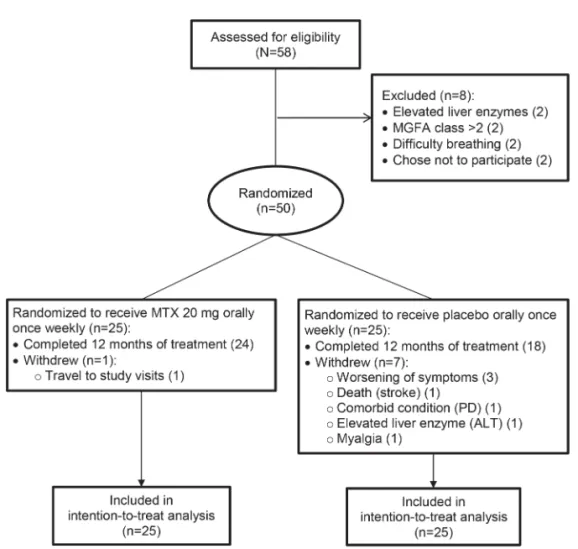
Eligible participants were screened between
April 2009 and December 2013. Of the 58 participants
who were screened, 8 were ineligible (2 due to difficulty
breathing, 2 due to elevated liver function tests, 2 due
to lack of weakness, and 2 chose not to participate
after screening; figure). Fifty participants were
ran-domized to treatment, 25 to MTX and 25 to
pla-cebo. Eight participants withdrew (7 on placebo) due
to the following reasons: 3 due to worsening of
symptoms, 1 due to myalgias, 1 due to comorbid
illness, 1 due to elevated liver transaminases, 1 due
to death (stroke), and 1 due to travel problems
(MTX group). Forty-two participants completed
12 months of follow-up. All participants were
included in analysis per the intent-to-treat analysis
plan. Missing data represented no more than 12.5%
of 600 possible observations of any outcome
(12 months
3
50 participants).
Baseline characteristics.
The groups were comparable
in regards to age, sex, and clinical MG parameters
(table 1). Both median prednisone dose and
predni-sone
,
30 mg stratification was balanced between
groups.
Outcomes and measures.
We saw no difference in
4–12 months prednisone AUDTC between MTX
and placebo participants (MTX 2,996.6 mg, 95%
confidence interval [CI] 1,495.9–4,497.3 vs
placebo
3,484.7, 95% CI
2,151.8–4,817.5;
p
5
0.26; table 2, figure e-1A). The estimated
between-group difference (methotrexate/placebo)
for the prednisone AUDTC is
2
488.0 (95% CI
2
2,443.4 to 1,467.3), which corresponds to
a difference in the mean daily prednisone dose of
2
1.9 mg/d (95% CI
2
9.7 to 5.8).
Secondary outcomes also did not show differences
in 12-month change from baseline between MTX
and placebo, although the estimated between-group
differences (methotrexate/placebo) were mostly in
favor of methotrexate (table 2, Supplemental figure
e-1B). The estimated mean MGC difference of
2
3.3
(95% CI
2
7.1 to 0.5,
p
5
0.09) would be considered
clinically meaningful.
Ancillary analysis.
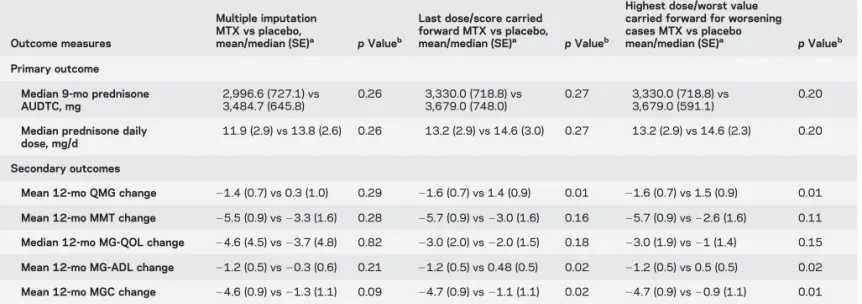
Post hoc sensitivity analysis was
per-formed using different imputation techniques as
described in Methods (table 3, figure e-1, C and
D). For prednisone AUDTC, LOCF (
p
5
0.27) or
the highest prednisone dose carried forward (
p
5
using both approaches (
p
,
0.01), and for MGC
using worst scores carried forward (
p
,
0.01).
Exploratory analyses showed that 7/8 dropouts in
the study had relatively low baseline prednisone doses
(
,
30 mg per day), which might explain why the
different imputation approaches did not affect the
results for the prednisone AUDTC.
Analysis looking at treatment failures, defined as
participants whose prednisone dose was increased
during the study, showed 11 treatment failures in
the MTX group vs 15 treatment failures in the
pla-cebo group (
p
5
0.26).
Adverse events.
There were 337 total adverse events
re-ported (MTX group 176 events, placebo 161 events;
table 4). Most of these were determined to be
unre-lated to treatment (66%). Seven patients had elevated
liver function tests (3 in MTX, 4 in placebo). Two
patients from the placebo group and 2 patients from
the MTX group did not report any adverse events.
There were no MTX-related serious adverse events.
There were more gastrointestinal side effects and
increased infections in the MTX group, but this did
not result in any participant stopping the study. The
most common adverse event was nonspecific pain
(20.6% MTX vs 18.0% placebo).
DISCUSSION
The primary endpoint of our study,
month 4–12 prednisone AUDTC, was not
signifi-cantly different between the MTX and placebo
groups, so we conclude no steroid-sparing benefit
for MTX in MG. Although it is tempting to
conclude, due to the direction of change in the
MTX/placebo differences for most outcomes, that
MTX may have provided some benefit and this
study was simply underpowered, it is also possible
MTX does not work for MG. Although frustrating
when studies produce indeterminate results, which
was also the case with the mycophenolate studies,
we have learned a number of important lessons that
will help instruct future MG clinical trials.
4,5The variability of the prednisone AUDTC was
greater than anticipated. We based our sample size
estimates on the prednisolone AUDTC variability
seen in a prior randomized control trial of
azathio-prine, which had a number of key differences from
our study.
2(1) The azathioprine study included
Figure 1 Study flow diagram
Fifty participants were randomized, 25 to each treatment group. Eight participants withdrew during the course of the study (1 methotrexate, 7 placebo). Fifty participants were included in analysis per the intention-to-treat analysis plan. ALT5
participants without prior immunosuppressant
exposure; (2) all participants were started on high
doses of prednisolone (1.5 mg/kg on alternate days,
to a maximum of 100 mg); and (3) the primary
outcome was the average prednisolone dosage
eval-uated at 12 and 36 months. Limiting cases to
pa-tients without prior immunosuppressant exposure
is not feasible today, as most patients are started
Table 2 Outcome measures
Outcome measure
Methotrexate (95% CI)a(n525)
Placebo (95% CI)a (n525)
(MTX2placebo)
(95% CI) pValueb
Primary outcome
Median prednisone 9-mo AUDTC, mg
2,996.6 (1,495.9 to 4,497.3)
3,484.7 (2,151.8 to 817.5)
2488.0 (22,443.4 to
1,467.3)
0.26
Median prednisone daily dose, mg/dc
12.8 (9.1 to 16.5) 14.6 (11.5 to 17.8) 21.9 (29.7 to 5.8) 0.26
Secondary outcomes
Mean 12-mo QMG change 21.4 (22.9 to 0.1) 0.3 (21.8 to 2.4) 21.7 (24.9 to 1.5) 0.29
Mean 12-mo MMT change 25.5 (27.4 to23.8) 23.3 (26.6 to 0.1) 22.2 (26.3 to 1.8) 0.28
Median 12-mo MG-QOL change
24.6 (29.1 to20.1) 23.7 (28.4 to 1.0) 20.9 (27.2 to 5.4) 0.82
Mean 12-mo MG-ADL
change 2
1.2 (22.3 to20.5) 0.26 (20.9 to 1.5) 21.5 (23.7 to 0.8) 0.21
Mean 12-mo MGC change 24.6 (26.4 to22.7) 21.3 (23.7 to 1.1) 23.3 (27.1 to 0.5) 0.09
Abbreviations: AUDTC5area under the dose-time curve; CI5confidence interval; MG-ADL5Myasthenia Gravis Activities of Daily Living scale; MG-QOL5Myasthenia Gravis Quality of Life scale; MGC5Myasthenia Gravis Composite Score; MMT5manual muscle testing; MTX5methotrexate; QMG5Quantitative Myasthenia Gravis Score.
aMean (95% CI) were used if the normality assumption was satisfied; otherwise, median (95% CI) was used (prednisone
AUDTC, prednisone daily dose, and MG-QOL) with the standard errors estimated by bootstrapping. The standard errors of the estimated means or medians are about half of the width of the 95% CIs.
bTwo-samplettest was used if the normality assumption was satisfied; otherwise, the Wilcoxon rank sum test was used.
For the primary outcome, a significance level of 0.05 was used, and for the secondary outcomes, 0.01 was used to adjust for multiple comparisons.
cPrednisone daily doses were calculated directly from prednisone AUDTCs.
Table 1 Baseline characteristics
Measurementa Methotrexate (n525) Placebo (n525) pValueb
Median age, y (min, max) 66.5 (28.5, 83.9) 68.6 (26.6, 87.2) 0.46
Men, n (%) 19 (76) 16 (64) 0.35
MGFA, n (%) 0.42
Class 2 23 (92) 20 (80)
Class 3 2 (8) 5 (20)
Median prednisone daily dose, mg (min, max) 20 (10, 40) 20 (10, 60) 0.51
Prednisone dose<30 mg/d, n (%) 16 (64) 17 (68) 0.80
Mean QMG (SD) 10.5 (4.1) 10.4 (4.2) 0.94
Mean MGC (SD) 10.0 (4.7) 8.2 (4.1) 0.16
Median MMT (min, max) 8 (0, 24) 10 (0, 30) 0.51
Mean MG-ADL (SD) 4.8 (2.7) 4.1 (3.0) 0.58
Median MG-QOL (min, max) 15 (2, 38) 17 (3, 59) 0.47
Abbreviations: MG-ADL5Myasthenia Gravis Activities of Daily Living scale; MG-QOL5Myasthenia Gravis Quality of Life scale; MGC5Myasthenia Gravis Composite Score; MGFA5Myasthenia Gravis Foundation of America; MMT5manual muscle testing; QMG5Quantitative Myasthenia Gravis Score.
aFor continuous variables, mean (SD) were used as summary statistics if the normality assumption was satisfied;
otherwise, median (minimum, maximum) were used as summary statistics (age, prednisone daily dose, MMT, and MG-QOL). For categorical variables, n (%) were used as summary statistics.
bTwo-samplettest was used for group comparison if the normality assumption is satisfied; otherwise, the Wilcoxon rank
immediately on prednisone. Even at the time of the
azathioprine study this prevented meeting the
tar-get enrollment of 100 participants (the authors
were only able to recruit 34). Our participants were
on lower initial doses of prednisone (median of 20
mg/d), which may have made it harder to detect
a reduction in prednisone in our study. When
plan-ning our study, we chose 12 months based on our
prior experience with the mycophenolate studies
being too short, but the azathioprine study required
.
15 months before a reduction in prednisolone
was detected, so our study may still have been too
short.
Although broad inclusion criteria might seem
intuitively appealing for MG trial generalizability, this
may actually favor older participants with milder
dis-ease. Our study had an older average participant age,
which may have enriched our population with
Table 3 Sensitivity analysis
Outcome measures
Multiple imputation MTX vs placebo,
mean/median (SE)a pValueb
Last dose/score carried forward MTX vs placebo,
mean/median (SE)a pValueb
Highest dose/worst value carried forward for worsening cases MTX vs placebo
mean/median (SE)a pValueb
Primary outcome
Median 9-mo prednisone AUDTC, mg
2,996.6 (727.1) vs 3,484.7 (645.8)
0.26 3,330.0 (718.8) vs
3,679.0 (748.0)
0.27 3,330.0 (718.8) vs
3,679.0 (591.1)
0.20
Median prednisone daily dose, mg/d
11.9 (2.9) vs 13.8 (2.6) 0.26 13.2 (2.9) vs 14.6 (3.0) 0.27 13.2 (2.9) vs 14.6 (2.3) 0.20
Secondary outcomes
Mean 12-mo QMG change 21.4 (0.7) vs 0.3 (1.0) 0.29 21.6 (0.7) vs 1.4 (0.9) 0.01 21.6 (0.7) vs 1.5 (0.9) 0.01
Mean 12-mo MMT change 25.5 (0.9) vs23.3 (1.6) 0.28 25.7 (0.9) vs23.0 (1.6) 0.16 25.7 (0.9) vs22.6 (1.6) 0.11
Median 12-mo MG-QOL change 24.6 (4.5) vs23.7 (4.8) 0.82 23.0 (2.0) vs22.0 (1.5) 0.18 23.0 (1.9) vs21 (1.4) 0.15
Mean 12-mo MG-ADL change 21.2 (0.5) vs20.3 (0.6) 0.21 21.2 (0.5) vs 0.48 (0.5) 0.02 21.2 (0.5) vs 0.5 (0.5) 0.02
Mean 12-mo MGC change 24.6 (0.9) vs21.3 (1.1) 0.09 24.7 (0.9) vs21.1 (1.1) 0.02 24.7 (0.9) vs20.9 (1.1) 0.01
Abbreviations: AUDTC5area under the dose-time curve; MG-ADL5Myasthenia Gravis Activities of Daily Living scale; MG-QOL5Myasthenia Gravis Quality of Life scale; MGC5Myasthenia Gravis Composite Score; MMT5manual muscle testing; MTX5methotrexate; SE5standard error; QMG5
Quantitative Myasthenia Gravis Score.
aMean (SE) were used as summary statistics if normality assumption was satisfied; otherwise, median (SE) were used as summary statistics (prednisone
9-month AUDTC, prednisone daily dose, and MG-QOL). The SEs for medians were estimated by bootstrapping.
bTwo-samplettest was used if normality assumption was satisfied; otherwise, Wilcoxon rank sum test was used. For the primary outcome, a significance
level of 0.05 was used, and for the secondary outcomes, 0.01 was used to adjust for multiple comparisons.
Table 4 Adverse events
Adverse event
No. (%) of adverse events
Participants reporting adverse event, n (%)
MTX (total events n5175)
Placebo (total
events n5161) MTX (n525) Placebo (n525)
Pain 36 (20.6) 29 (18.0) 13 (52) 14 (56)
Elevation of LFT 8 (4.6) 12 (7.5) 3 (12) 4 (16)
Infection 28 (16.0) 17 (10.6) 13 (52) 7 (28)
Allergic 1 (0.6) 0 (0) 1 (4) 0 (0)
Gastrointestinal 28 (16.0) 16 (9.9) 15 (60) 11 (44)
Pulmonary 13 (7.4) 12 (7.5) 9 (36) 7 (28)
Edema/bruising 9 (5.1) 11 (6.8) 6 (24) 7 (28)
Ophthalmologic 5 (2.9) 7 (4.3) 5 (20) 4 (16)
Dermatologic 7 (4.0) 10 (6.2) 3 (12) 5 (20)
Constitutional/other 24 (13.7) 34 (21.1) 10 (40) 8 (32)
Muscle weakness/fatigue 13 (7.4) 8 (5.0) 6 (24) 5 (20)
Hematologic 3 (1.7) 5 (3.1) 4 (16) 1 (4)
late-onset MG cases. The older mean age may reflect
a bias for older patients with MG to participate in
clinical trials, or regional variation in the
neuromus-cular clinics included in the study. Our study had
a male predominance in both treatment groups,
which may reflect the older average age of participants
(mid 60s), or regional variation in the ratio of sexes
affected by MG. In the future, stratification strategies
based on age at diagnosis may ensure an equal mix of
patients with early- and late-diagnosed MG.
Participants on prednisone plus placebo may
improve. Multiple recent studies have documented
a better than expected clinical course for patients on
prednisone plus placebo.
4,5We also saw patients on
prednisone alone improve over the course of the
study. However, prednisone itself has no randomized
placebo-controlled studies supporting its use in
iso-lation in MG, and long-term prednisone use is
associated with many complications including
osteoporosis, steroid-induced diabetes, poor wound
healing, and infections.
24Even long-term low-dose
glucocorticoid use is associated with typical
steroid-related adverse events.
25Thus there has been interest
in finding a steroid-sparing therapy for MG, but less
success in demonstrating effectiveness of one.
Care must be taken when interpreting clinically
meaningful changes. Although no change was
statisti-cally significant, the change in the MGC would be
considered clinically meaningful.
22This clinically
meaningful cutoff was determined in a
cross-sectional correlation and reliability study, so does
not account for the actual 12-month variability in
the MGC. The variability estimates from our current
study will help with future power and sample size
calculations. The MGC and MG-ADL were the most
sensitive measures seen here, and might improve our
statistical power to see change in future studies.
MTX was well-tolerated in this study; however,
a limitation would be whether the chosen dose of
20 mg weekly produced effective
immunosuppres-sion in all participants. One dropout occurred in
the MTX group, and this was due to an inability to
travel for study visits. Although the frequencies of
gas-trointestinal side effects or infections were higher in
the MTX group, this did not result in any participant
withdrawing from the study. There were no study
drug
–
related serious adverse events.
Although this study did not show a steroid-sparing
benefit for MG, we did learn important lessons that
will instruct planning future studies, including: (1)
a better handle on variability of a core set of outcome
measures; (2) a better understanding of the expected
change for participants on prednisone alone; (3)
strat-ification strategies for participants with a prior history
of immunosuppressant exposure; and (4) a better
understanding of responsiveness across our outcome
measures. As a field, the decision whether to test
another off-label use of existing steroid-sparing
immu-nosuppressant drugs needs to be weighed carefully, as
such studies will likely require large numbers of
partic-ipants with long follow-up periods. The MG
commu-nity should consolidate future efforts towards studies of
new investigational agents that have promise to do
more than reduce the required dose of prednisone,
but rather significantly alter the MG disease course.
AUTHOR CONTRIBUTIONS
Drs. Pasnoor, Statland, Dimachkie, Burns, and Barohn and L. Herbelin contributed to drafting/revising the manuscript for content, study con-cept or design, analysis or interpretation of data, acquisition of data, and statistical analysis. Dr. He contributed to drafting/revising the man-uscript for content, study concept or design, analysis or interpretation of data, and statistical analysis. Drs. Nations, Bril, Wang, Kissel, Saperstein, Rosenfeld, Shaibani, Jackson, Swenson, Howard, Goyal, Wicklund, Pul-ley, Mozaffar, David, Benatar, Pazcuzzi, and Simpson and Ms. Miller contributed to drafting/revising the manuscript for content, and acquisi-tion of data.
Comment:
Methotrexate for patients with generalized myasthenia gravis
Methotrexate (MTX) has long been a favorite drug of rheumatologists for treating rheumatoid arthritis, inflammatory myositis, and other autoimmune dis-eases. Why not myasthenia gravis (MG) as well? Reports of positive results of MTX treatment of MG led to this gold standard double-blind randomized con-trolled trial of MTX in patients with MG. The article by Pasnoor et al.1describesthe disappointing negative results of the trial, and raises important questions about the difficulties inherent in conducting such trials in MG, and the reliability of the conclusions.
MG is perhaps the most treatable autoimmune disease, with remarkable improvement if AChR autoantibodies or their effects2are controlled.
Paradoxi-cally, a meaningful gold standard trial is nearly impossible, because virtually all patients are already being treated, recruitment is an issue, and outcome measures are controversial. In this trial, the outcome was evaluated by the ability to reduce the cumulative dose of prednisone required.
What can we conclude from the negative results? Did the drug fail or did the trial fail?1It is unlikely that MTX will ever be retested and commonly used in MG.2
Perhaps that is appropriate. The benefit of MTX in RA is due both to its immu-nosuppressive action as a folic acid antagonist and to its anti-inflammatory effect,3
which would benefit RA but not MG.3This trial, like 2 negative trials of
myco-phenolate, was brief.4 Most patients with MG were on low-dose prednisone
(median 20 mg/d), and the outcome measure of further reduction, especially using the cumulative dose under an 8 months curve, is too difficult, variable, or unreal-istic.5It is not easy to evaluate therapy in MG. Clinical experience—not gold
standard trials—indicates that several of the available immunosuppressive agents (cyclosporine, tacrolimus, mycophenolate) actually work in MG, and should be used clinically.2
1. Pasnoor M, He J, Herbelin L, et al. A randomized controlled trial of methotrexate for patients with generalized myasthenia gravis. Neurology 2016;87:57–64.
2. Drachman DB. Therapy of myasthenia gravis. In: Engel A, ed. Myasthenia Gravis and Myasthenic Disorders, 2nd ed. New York: Oxford Press; 2012:130–155.
3. Tian H, Cronstein BN. Understanding the mechanisms of action of methotrexate. Bull NYU Hosp Jt Dis 2007;65:168–173.
4. The Muscle Study Group. A trial of mycophenolate mofetil with prednisone as initial immunotherapy in myasthenia gravis. Neurology 2008;71:394–399.
5. Sanders DB, Hart IK, Mantegazza R, et al. An international, phase III, randomized trial of mycophenolate mofetil in myasthenia gravis. Neurology 2008;71:400–406.
Daniel B. Drachman, MD
From the Department of Neurology, Johns Hopkins School of Medicine, Baltimore, MD. Study funding: No targeted funding reported.
STUDY FUNDING
This study was funded by Food and Drug Administration Orphan Prod-ucts Division RO1 FD 003538 (M.P.). Additional funding was provided in part by grants UL1 RR 033179 (which is now UL1 TR 000001) from the University of Kansas Medical Center Clinical and Translational Sci-ence Awards (CTSA). Dr. Statland’s work on this project was supported by a NCATS grant awarded to the University of Kansas Medical Center for Frontiers: The Heartland Institute for Clinical and Translational Research #KL2TR000119.
DISCLOSURE
M. Pasnoor, L. Herbelin, T. Burns, S. Nations, V. Bril, A. Wang, B. Elsheikh, J. Kissel, D. Saperstein, A. Shaibani, C. Jackson, A. Swen-son, J. Howard, N. Goyal, W. David, M. Wicklund, M. Pulley, M. Becker, T. Mozaffar, M. Benatar, R. Pascuzzi, E. Simpson, J. Rosenfeld, and M. Dimachkie report no disclosures relevant to the manuscript. J. Statland’s work on this project was supported by an NCATS grant awarded to the University of Kansas Medical Center for Frontiers: The Heartland Institute for Clinical and Translational Research #KL2TR000119. R. Barohn’s work on the project was sup-ported by Food and Drug Administration Orphan Products Division RO1 FD 003538. Go to Neurology.org for full disclosures.
Received August 28, 2015. Accepted in final form March 17, 2016.
REFERENCES
1. Carr AS, Cardwell CR, McCarron PO, McConville J. A systematic review of population based epidemiological studies in Myasthenia Gravis. BMC Neurol 2010;10:46. 2. Palace J, Newsom-Davis J, Lecky B. A randomized
double-blind trial of prednisolone alone or with azathio-prine in myasthenia gravis: Myasthenia Gravis Study Group. Neurology 1998;50:1778–1783.
3. Tindall RS, Rollins JA, Phillips JT, Greenlee RG, Wells L, Belendiuk G. Preliminary results of a double-blind, ran-domized, placebo-controlled trial of cyclosporine in myas-thenia gravis. N Engl J Med 1987;316:719–724. 4. Muscle Study Group. A trial of mycophenolate mofetil
with prednisone as initial immunotherapy in myasthenia gravis. Neurology 2008;71:394–399.
5. Sanders DB, Hart IK, Mantegazza R, et al. An interna-tional, phase III, randomized trial of mycophenolate mo-fetil in myasthenia gravis. Neurology 2008;71:400–406. 6. Gaujoux-Viala C, Nam J, Ramiro S, et al. Efficacy of
conventional synthetic disease-modifying antirheumatic drugs, glucocorticoids and tofacitinib: a systematic litera-ture review informing the 2013 update of the EULAR recommendations for management of rheumatoid arthri-tis. Ann Rheum Dis 2014;73:510–515.
7. Winzer M, Aringer M. Use of methotrexate in patients with systemic lupus erythematosus and primary Sjogren’s syndrome. Clin Exp Rheumatol 2010;28:S156–S159. 8. Aggarwal R, Oddis CV. Therapeutic approaches in
myo-sitis. Curr Rheumatol Rep 2011;13:182–191.
9. Hashkes PJ, Becker ML, Cabral DA, et al. Methotrexate: new uses for an old drug. J Pediatr 2014;164:231–236. 10. Abdou AM. Methotrexate for treatment of myasthenia
gravis. Neurology 2007;62:300–301.
11. Hartmann J, Rivner MH. Methotrexate in myasthenia gravis. Clin Neurophysiol 2009;120:e123–e124. 12. Raja FM, Dimachkie MM, McVey AL, et al.
Metho-trexate in the treatment of myasthenia gravis. Neurology 2009;72:A54.
13. Heckmann JM, Rawoot A, Bateman K, Renison R, Badri M. A single-blinded trial of methotrexate versus azathioprine as steroid-sparing agents in generalized myas-thenia gravis. BMC Neurol 2011;11:97.
14. Benatar M, Sanders DB, Burns TM, et al. Recommenda-tions for myasthenia gravis clinical trials. Muscle Nerve 2012;45:909–917.
15. Jaretzki A III, Barohn RJ, Ernstoff RM, et al. Myasthenia gravis: recommendations for clinical research standards: Task Force of the Medical Scientific Advisory board of the Myasthenia Gravis Foundation of America. Neurology 2000;55:16–23.
16. Barohn RJ, McIntire D, Herbelin L, Wolfe GI, Nations S, Bryan WW. Reliability testing of the quantitative myas-thenia gravis score. Ann NY Acad Sci 1998;841:769–772. 17. Tindall RS. Immunointervention with cyclosporin A in autoimmune neurological disorders. J Autoimmun 1992; 5(suppl A):301–313.
18. Wolfe GI, Herbelin L, Nations SP, Foster B, Bryan WW, Barohn RJ. Myasthenia gravis activities of daily living pro-file. Neurology 1999;52:1487–1489.
19. Muppidi S. The myasthenia gravis–specific activities of daily living profile. Ann NY Acad Sci 2012;1274:114–119. 20. Sanders DB, Tucker-Lipscomb B, Massey JM. A simple manual muscle test for myasthenia gravis: validation and comparison with the QMG score. Ann NY Acad Sci 2003; 998:440–444.
21. Burns TM, Grouse CK, Wolfe GI, et al. The MG-QOL15 for following the health-related quality of life of patients with myasthenia gravis. Muscle Nerve 2011;43: 14–18.
22. Burns TM, Conaway M, Sanders DB, Composite MG, Group MQS. The MG Composite: a valid and reliable outcome measure for myasthenia gravis. Neurology 2010; 74:1434–1440.
23. Molenberghs G, Thijs H, Jansen I, et al. Analyzing incom-plete longitudinal clinical trial data. Biostatistics 2004;5: 445–464.
24. Spies CM, Cutolo M, Straub RH, Burmester GR, Buttgereit F. Prednisone chronotherapy. Clin Exp Rheu-matol 2011;29:S42–S45.