Aldebaran
Volume 11 | Issue 1
Article 1
7-6-2009
Aldebaran Vol. 11, Issue 1
Follow this and additional works at:
http://docs.rwu.edu/aldebaran
This Article is brought to you for free and open access by the Journals at DOCS@RWU. It has been accepted for inclusion in Aldebaran by an authorized administrator of DOCS@RWU. For more information, please [email protected].
Recommended Citation
J
~ ,"Jf~
'0,0 -
~-1
CO-EVITORS
Jack J. Chielli Darlene Mikula
STAFF
Deborah Allen Mary-Lou Brockett
David E. Scott
FACULTY AVVISOR
Geoffrey Clark
ARTWORK
Joyce Davis
ALDEBARAN is a red star of the first magnitude, in the eye of Taurus. It is the brightest star in the Hyades.
Copyright 1981 by ALDEBARAN Volume 11 published July 1981
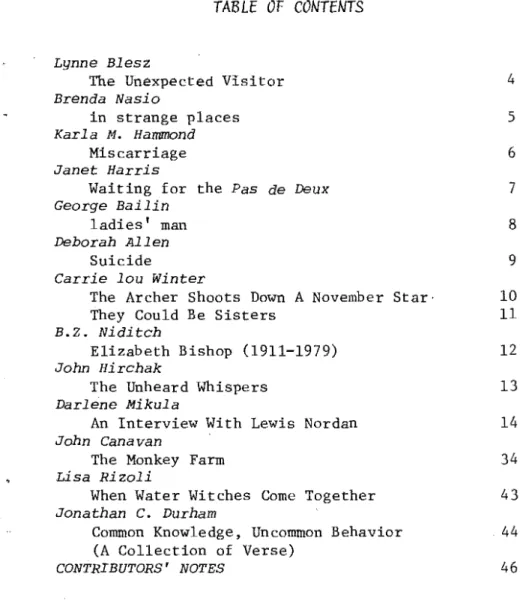
TABLE OF CONTENTS
Lynne Blesz
The Unexpected Visitor 4
Brenda Nasio
in strange places 5
Karla M. Hammond
Miscarriage 6
Janet Harris
Waiting for the Pas de Deux 7
George Bailin
ladies' man 8
Deborah Allen
Suicide 9
Carrie lou Winter
The Archer Shoots Down A November Star· 10
They Could Be Sisters 11
B.Z. Niditch
Elizabeth Bishop (1911-1979) 12
John Hirchak
The Unheard Whispers 13
Darlene Mikula
An Interview With Lewis Nordan 14
John Canavan
The Monkey Farm 34
Lisa Rizoli
When Water Witches Come Together 43
Jonathan C. Durham
(A Collection of Verse)
Common Knowledge, Uncommon Behavior 44
Lynne Blesz
THE UNEXPECTED VISITOR
At the convent
I sat on my cloistered stoop as I did so often,
dressed in monotonous black and bowed my head to pray again.
I looked down upon my hands, drawn to my heart,
and saw they were bleeding.
Limestone pillars surrounding the secluded walls began to crack
and the willow trees in the garden began their tarentella.
Out of the heavens
an angel should have appeared but did not.
Instead she walked up to the gate and unlatched it, weary.
She stumbled over her soiled pink robes that were too long and tattered.
Kneeling at my feet
the immortal begged me to help her. Her wings
had crumbled.
The angel of Death
fell to the marble floor, sobbing, and I, in my ignorance,
reached out my hand to comfort her.
Brenda Nasio
in strange places
here in san francisco i tan in strange places at the neck where my shirt is casually left unbuttoned
and on my wrists except for the place shaded by a watchband
one evening undressing i was startled to find patches of brown on my legs
between where the hemline of skirt ends and the tops of my boots begin
i think it has to do with only having time to sun at noon
when i grab my blazer and a container of yogurt
and walk to walden park nearby
since i'm not native to california
i dress according to the weather at eight and am usually taken by surprise
wearing clothing heavier than the day demands at twelve
heading home at five
the summer fog has begun to roll in and crossing van ness avenue
the sacramento street bus starts up the hill to a neighborhood called
pacific heights (which is where i live)
several blocks later when i leave at my stop i can see (before crossing at the corner) that cathedral hill is completely fogged in
but in the mission district below
Karla M. Hammond
MISCARRIAGE
Morning. is an Old Lady who bakes bread. who kneads dough into loaves.
& shucks the pods from ripened peas.
She's a mad mid-wife with a sharpened blade of light. who whets her hunger
on my dreams, who pares her long nails on that raw memory of sleep
as the sky
breaks its bloody-yolk out of night's
dark envelope.
Janet Harris
WAITING FOR THE PAS DE DEUX
Bloodied toes, wrapped in lambs' wool Drumming Debussy into the hardwood floor, Body in tune, rediscovered each day,
A straining swan, sweating in the cardboard twilight, Dancing for the audience of self.
Oh, sweet agony,
That all-consuming love affair I thought would never end.
Today I found
One dust-covered toe shoe, Pink now faded mauve, Ribbons turned to thread; Lonely souvenir
Of a lost passion.
It seems so long ago, Yet even now,
Halted at some city curb While cars and buses pass, I look down
George Bailin
ladies' man
go ahead,
and have them all, you fool as though the crystal bridge you cry
is hammered clear by joy,
as though your flesh is diamonded by pressure of your weighty lust,
as though all this will stand
beneath the single gnat, remorse.
Deborah Allen
SUICIDE
You see him huddled fetal
on a crumbled stoop Saturday afternoons stained
with odor. You avoid his watercolor stare for you prefer oils and smile at
no one. He twitches
from sleeping thoughts and you blink
in awareness sheltering the knowledge. Today
as another you passed at 2 but halted haughty steps turning your stiff neck
lowering mechanical eyes
at gray cement so gray
guil ty gray.
You avoided its message and shakily sat
touching the stone with nervous fingers
as i f afraid
of damaging
Carrie lou Winter
THE ARCHER SHOOTS DOWN A NOVEMBER STAR
Born into the world without touch-
too many blankets warming the cold, bitter cold
whose icy fangs
left a battlefield of death. Pretty white snow
covering the ugliness, hiding the frozen corpses- too late, I saw them all, black stumps, broken limbs, the scar of a bud
whose birth was late, and mother earth too cold and frigid to bury her children.
Carrie lou Winter
THEY COULD BE SISTERS
Jade was mind's creation- a name for the unexpected,
if and when.
A ring of precious stone waiting to be filled. Jade was a green Buddha- a religion not yet a belief,
a new moon
for the horn of fortune. Jade was four pasted letters on a scrap book's empty page.
Corie was life's creation- a name on the hospital bracelet
here and now. tiny reaching fingers filling Jade's ring. The Buddha swells with belief
Corie's umbilical of life. The horn of good fortune
B.Z. Niditch
ELIZABETH BISHOP (1911-1979)
There are no sounds now
only grey birds in the fields by Cambridge Common
morning rests on unfreed hills you do not walk between whispers only the wind's ear departs to a poet's humming voice
to capture the sunflame breath. You shudder in winter's seclusion where everything has wind
with the bird-boned city landscape I see your large shadows
among apple and grasses.
You read on an oak marble bench in the wind's ear I discern the shining wide-eyed sun forming poems itself
reawakening the blind dazzle the secrets of your time.
John Hi.rcbak
THE UNHEARD WHISPERS
Like a weakened gull
the waves rise, and too tired to go on, they fall.
The waves feed off the sand. Curling its self and
tossing it towards the untouched dunes. The waves secretly speak
A native Mississippian, Lewis Nordan has pub lished fiction, poetry, and essays in many national magazines including Harper's and Redbook, and has been represented twice in Best American Short Stories.
He holds the Ph.D. in Shakespeare and has taught at the University of Georgia and at Auburn University. Winner of the John Gould Fletcher Award for Fiction
and recipient of a grant from the Arkansas Arts Council, Mr. Nordan now works full-time as a free -lance writer in Arkansas.
Darlene Mikula
AN INTERVIEW WITH LEWIS NORDAN
Q. How long have you been writing? How long have you been writing seriously?
A. I started writing just seven years ago, when I was thirty-four years old. When you start as late as that, it is already a serious business, an obsession whose expression has been rather long delayed. It was difficult at first not to suspect that I had waited too long, that all my years of greatest energy and freshest insights had been wasted. There were advantages, of course. My writer friends who were much younger reminded me that I had been around long enough to have done and seen a few things to write about other than the death of my grandfather and the tyranny of my parents. That was true in part, but not entirely. As a thirty-four
year old beginner, I wrote not much different from an eighteen year old beginner. I wrote about sex mainly, in the beginning--terrible stories, none of them really concerned with anything I really knew about sex, but always fantasies of heroic sexual exploits in which the central figure was both myself and, at the same time, a person I would not have liked at all had I met him in real life. I am grateful none of those stories ever saw print. So I think of myself as having started and dropped a career in college teaching in order to pursue a career in writing. And yet a perfectly honest answer to the question of when I started writing would be a much earlier date, a time when I was very young and started imagining that I might some day be a writer. lYhen I was in grade school I wrote a story in a Blue Horse tablet, about
Mikula/NORDAN
whether it was a good story. She said yes, it was fine for somebody my age. I said, "But what about somebody not my age, somebody much older, a grownup?" She said that she was sorry but no, it was not possible to compare with a professional writer, only with others of approx imately my own age. I remember that I cried bitterly and wondered whether the truth was all it was cracked up to be if it had to hurt as much as that. I don't remember writing another story after that until I was on an aircraft carrier in the Mediterranean; this second effort was two typed pages, a Christmas story that end ed with the reader discovering that the narrator was Santa Claus--a much watered-down and warmed over version of the movie "Miracle on 42nd Street," which I had seen as a child in the Strand Theater
in Itta Bena, Mississippi. That story was, among my friends, universally despised; all agreed that a fifth grader could write a better story. I don't remember crying at that time, but I was hurt. And yet, for some reason, I continued to think of myself as a writer--I never wrote a word, but to myself I was always a writer. I joined the Creative Writing Club in college, and even had that listed among my associations in the yearbook when I graduated, and yet it is no exaggeration to say that I never wrote one word during the entire term of my membership, and never once opened my mouth to help analyze any of the pieces turned in by the other members of the club. I was the most passive dues-paying member ever to enroll in any club in America, I feel sure. It's funny that though I thought of myself as a writer over those many years in which I wrote nothing at all, it is not always possible now to think of myself as a "real" writer, des pite the fact that writing is all I do. The
Mikula/NORDAN
difficulty of writing a good story is no less great than ever, and the pain of admitting I've written a bad one is more damaging than ever, and yet I'm sometimes almost afraid to say, out right, that I am a writer, since there is a persistent. superstitious fear that I will "hex" myself, that I will wake up from this perfect
state. as if it were a dream, since a writer is all I've ever wanted to be in all my life, since my earliest memories.
Q. Your writing has been considered a part of the "Southern Gothic Tradition." Are you inspired
or influenced by this Tradition? Do you consider yourself a part of it?
A. The Southern Gothic Tradition in literature, as I understand it, is a body of writing headed by William Faulkner and Flannery O'Connor, and imi tated by many; its chief characteristic is exag geration to the point of grotesquery, in both characters and events. along with a style that is, at times, dense and obscure. For anyone in the present age to try to imitate that tradition seems to me a folly of profound proportions, and yet for any Southerner to avoid its influence, whether or not he has even read Faulkner or O'Connor, would seem impossible. The task for the Southern writer today is to deal honestly with his material--the inhabitants of the little
Mikula/NORDAN
rather than conforming neatly into its mold. In my own work. I have sometimes failed, some times succeeded; the degree to which I have
succeeded--and this is where imitators of the 'I form go wrong--is not the degree to which I
can dream up ever more bizarre grotesques, since they are a dime a dozen, but the degree to which I am able to love deeply whomever I write about and transmit that love, in the clearest language available to me, to my reader. The writers I most despise are those who make fun of their characters for their deformities; those are also usually the ones who can't write a clear declarative sentence. I would love to have been the writer who invented the Bible salesman who steals a young girl's wooden leg; I would love to have written of a Baptism in which somebody drowns; I wish I could claim as my own the character who goes to sleep smoking in his waterbed and drowns. But because they are not my inventions, I lose no sleep try ing to think up characters equally as odd. The only thing that troubles my sleep is whether I have done right by the characters that I have been given, and whether my sentences are the best that could have been written to convey the information. In the first story I ever published, a tale called liThe Farmer's Daughter," I came to grips with the problem of the Southern writer in the Gothic tradition in the only way I knew how. I wrote in a parody of William Faulkner's most obscure style; I used a bear (Faulkner's most readily identifiable metaphor) as a central
character--it lives in the drawing room of a decaying house with Doric columns; and it was
the story of the sexual initiation of a young girl who lives upstairs in the same house reading voraciously the complete works of William
Faulkner. In other words, I admitted, up front,
M}.kula/NORDAN
to the strong influence of the Gothic tradition and, at the same time, I made fun of the tradi tion. It was a crude way of going about an exorcism of the demon that plagues Southern wri ters, but it was at the time the only way I had. I had to laugh it out of existence, if I could. Since that time, I have not lost the strong influence of the tradition, but I hope I have learned subtler ways of distancing myself from it.
As an added note, I might say that the rea son Southerners are bound by the material and the rhythyms of Gothic-type writing is not that there are Significantly more dwarfs and eccentrics in the South than elsewhere, and not even because Southern writers are influenced to an unusual degree by their Southern predecessors. It is, I think, because the practice of oral storytell ing in the South is a major form of entertainment, and anywhere the telling of tales for fun is a significant part of the culture, there develops among the people a collective eye for the absurd, an eye that finds, even when it doesn't mean to or want to, the flaw that can be made to repre~ sent the whole. Though I would resist being called a "Southern Gothic" writer, or even a Southern writer--because of the limitations such a label connotes--I can think of no other cultural background in America that can employ with such precision the term "vision" to apply to a whole people, of many races and backgrounds and econo mic circumstances and political affiliations, as the South. A Southern "visionlt
Mikula/NORDAN
what is known loosely as Southern Gothic seems to derive. Storytellers and their audiences are interested in the tale, the whole tale and
each of its parts. It doesn't matter how many
..
times the tale is told, as long as it is a goodone. I have heard adults beg to have the same tale told over and over--I have done the same myself: tlTel1 about when Hambone, the narcoleptic peeping Tom, got shot in his sleep outside Raymond Barlow's window." At family reunions we tell the same stories over and over, and sometimes there is not one person in the room who was alive at the time the tale is supposed to have happened. We laugh or weep, usually laugh, as though the tale were brand new. I have an uncle who says, "Don't stop me if you've heard this one," just in case somebody doesn't know the rules. To tell a story, in the culture I'm talking about, is to give a gift. Some of these gifts are
elaborate beyond imagining, and these, I'm saying, are the inspiration for Southern Gothic writing, of which I both am and am not a part.
Q. How long before you can retell an oral story as
a written story?
A. I have written stories that were first told to me as long ago as twenty years. You just have
to wait for a story's proper form to come along.
Q. Where do you get your material for a story?
A. I write by intuition usually, and I'm never really sure where a story comes from, though when it is done I can recognize its parts. "Rat Song"
came from a story a friend told about his daughter
Mikula/NORDAN
bringing home a rat from school on the same day that his goldfish died. The characters in the story rose up around that central information. I had no idea Miss Cheshire, the child's drunk en teacher, was going to appear at all until her voice came out of the telephone. I was as surprised as the character in the story. In her telephone conversation Miss Cheshire described a great many persons I knew as a child--the tall, fat, ironic man who drank heavily, talked through his nose, and carried a loaded gun in his pants was the town marshall in Itta Bena, Mississippi, for example--and the central male character of the story is a good deal like my own father. The places that are described in the story are all places I have seen--the roadhouse with the rat's tail hanging through the ceiling, the tom R.to vine that grew taller than the man who har vested the fruit, etc. Likewise, I didn't make up any of the absurdities in "Storyteller"--the hanging elephant, the woman who shot her face off--but I arranged them in entirely different contexts from those in which they actually hap pened.
Q. So you use "real life" experience rather than imagined experience or the "freeing-up" of the
imagination?
Mikula/NORDAN
phies that have shaped it during my life. In my case, then, it is the imaginative elabora tions that are autobiographical. "The Lie" provides a framework on which I may hang as many memories as it will hold, and when a writer
is the head of his characters, the framework
-,
will hold a great deal. My "freed-up" imagi nation roots in the fields of my real life memories and finds a shape for them; to begin with a real life experience and try faithfully
to record it without first subjecting it to the discipline of a central lie, rarely yields good fiction for me.
Q. What do you think is the most important element in a story?
A. Character is the most important element in al most all stories, but there is always a shift ing tide of elements present. I think a char acter in relation to his 'geography is very important. One should give the reader a sense of where the story is taking place so that the reader can see, hear, taste, smell, and feel the setting around that character. Geographies are special and should afford the reader a feeling that the setting in which a character appears is the only one he could have grown out of.
Q. Does the main character have to be changed or
"moved" in a story?
A. Stories can be written in which nothing happens at the end except for intense implication of what was already there. Mainly though, a char
Rcter must change in order to work out for a
Mikula/NORDAN
reader. Sometimes all that needs to be changed is the reader, by understanding what the charac ters already know. It'd be a hell of a hard story to write though.
Q. What is the greatest challenge for a contemporary writer?
A. A writer is trying to invent new language and new forms while at the same time trying to pre serve the best of the old ways. You've got to deal with traditional story lines, but you've got to retell the stories with fresh language and in new form, being conscious of the tradition. As writers, we have to find the proper "voice" with which to speak the stories. We have to put into the writing what usually comes through in other ways, such as facial expressions, in the orally-told story. We've got to find a form that will provide. In "The Storyteller," I'm very conscious of telling the reader what he's supposed to do or feel and when to laugh. Talking and writing are two different things and you have to find a way to translate one into the other.
Q. You have been a "full-time" writer for the past seven years. Can you explain what "full-time" entails?
Mikula/NORDAN
I've had to take non-literary jobs to help sup port myself. I worked for one year for example as a nightwatchman in a factory, another year as a private attendant and orderly to a quadra plegic. Before I started writing full-time I taught english at a couple different universities.
Q. Do you ever find yourself in a lull?
A. Sure I do. Every writer gets writer's block.
Q. What do you do to get out of it?
A. A person with writer's block wouldn't have wri ter's block if he'd start writing. You can force yourself out of it and the easiest way is to have a body of material that you can go back to.
Q. As a writer, are you on a daily schedule?
A. William Faulkner was once asked if he wrote every day or by inspiration. He answered, "I write by inspiration and I am inspired every day." I wish I was inspired every day, but usually I try to write two hours a day, five days a week, and take the weekends off. You have to have a certain amount of discipline but some times it's very hard. Some jobs take all the creative energy out of you that you would have used for writing. Some non-academic jobs may leave you physically tired but you still may have a couple of hours of creative energy left which you can utilize to write.
Mikula/NORDAN
Q. What contemporary writers do you admire?
A. The writers I most admire are usually essayists. I'm thinking of Malcom Cowley, Joan Didion,
Mikula/NORDAN
art themselves, but they do find their own struc ture and shape themselves into fiction with greater ease than blank pages do, and with greater ease than "ideas" for stories. Essay-writing, even when the essays are only for personal use, allow us to use the first person pronoun unabashedly and without having to try to build the "I" into a character; we can allow ourselves the luxury of being a disembodied voice for a while, with opinions and doubts and inconsistencies. Later, when time for shaping the raw material into fic tion comes, the point of view will have to change usually, but until then to write vividly about what you remember and not have to worry about who the narrator is and where he's standing when he's talking is like breathing pure oxygen in compari son.
Q. Who were your greatest influences?
A. My earliest literary influence was James Thurber, later Woody Allen (his films, not his stories) and Mel Brooks. They taught me that the way I see life is in focus rather than out of focus. John Clellon Holmes later told me that directly. Eudora Welty was also a strong influence, be cause the "voice" I hear in her work is the same voice that my mother speaks in; it is therefore both easily imitated and easily made to seem
original with me, since I grew up on its rhythyms.
Q. Do you think one has to be a "reader" in order
to be a writer?
A. It's usually, I think, just at the moment you finally learn to read well that
you begin
tobe
Mikula/NORDAN
Mikula/NORDAN
up favorite stories, word for word, by Cheever and Welty and others, to force myself to deal with the words that they dealt with, to handle
their words mechanically and get a feel for what they were doing. I have written lengthy, chapter -by-chapter outlines of novels, trying to find out what it is that makes a reader keep reading, what is the reason we like this and do not stop
reading it. We begin reading like a writer when we become desparate enough, I suppose, when we want badly enough to be a writer that we are scouring every conceivable source for help. Careful read ing can be the best help of all to one who is really serious about the way words work.
Q. Why haven't you written any novels, just short stories?
A. I have not written a novel before for a couple of reasons. One is that story writing is a talent very different from novel writing, and I have been determined to explore that talent at the expense of others because it made its appearance before the others. Some persons who are good novelists will never write a good short story, certainly not a great one and the short story writers who have looked foolish by trying to write novels are legion. Sometimes the two talents simply don't manifest themselves in the same person. The head of the creative wri ting program at Syracuse University recently made the same point about his own work; he was a
short story writer, he said, and wanted to be the best short story writer he could be, but he was not interested in being anything other than that. It is a position, I would suggest, that requires no small measure of courage and self
Mikula/NORDAN
-awareness to assume. Likewise, Katherine Anne Porter, perhaps the modern master of the short story and the novella, or long story, wrote only one novel, Ship of Fools, a remarkable book cer tainly but not a great novel--not from some points of view, even a very good novel. One reason I've been resisting the novel form, then, is simply that I had a lot of stories that needed to be written first, both to get rid of them and to teach myself as much as possible about story writing, which is more akin, I think, to the wri ting of poetry than of novels, since even the slightest mistakes of language or tone can cause the whole structure to collapse. I was encouraged to keep on with this plan by the example, both negative and positive, of story writers before me. Another reason is that I simply had not
found material that lent itself to lengthy treat ment. Every piece of material that has come my way in the last several years has had attached
to it a question:
Am
I a novel? And the answer has always been, No, I'm afraid not, little fel ler, but don't feel bad, you'll be a fine story. Now, however, I do have the material for a novel- two novels, in fact--which I am currently working on.Q. What are the problems a writer encounters in getting a collection of stories published?
A. The major obstacle to getting a book of stories published is writing the stories, of course. I mean, given the tight money in the publishing
Mikula/NORDAN
a good novel first ("good" might mean any number of things here, from "high literary quality" to "sex, drugs, and violence which lead to big sales. ") When a writer has established a market for him self with a novel, a book of stories can often follow. Another way is to publish most of the stories in some well-respected magazine, such as New Yorker or Harper's or Atlantic Monthly. This is, of course, only another way of saying that the writer must first create a market for himself. This second means is less effective than the first, but it is not unheard of. A third way is to find a publisher at a university press who likes your work--Illinois, Louisianna State, Missouri, and Iowa are the only presses in the country right now that publish short fiction, and all are excellent in their way. The difficulty of publishing a book of stories is very real, and it is based on the oldest of realities: they simply don't sell, and there is no good reason for a commercial publisher to spend his money trying to make his reputation as a publisher
(and our reputation as writers) on books that will collect dust and finally be shredded. This may be hard to swallow but it's no less real for that. The fourth way is to find an editor of a small press who likes your work. These will be fewer and fewer in these hard economic times, especially since most of them have relied on grants from the National Endowment for the Arts, which is soon to lose one-half of its money on account of budget cuts. As writers we must
spend as little time weeping over these sad facts as we can, since nothing we can do will change them, and because feeling sorry for ourselves can keep us from our real purpose, which is to write what we must write, no matter the economic realities. My own difficulty with finding a
Mikula/NORDAN
publisher fora book of short steries is merely typical, and I certainly don't feel
singled out. Patience is important to a writer. particularly a writer who is not in the business for the money but in the hope of writing something really good before I am through. Ten years is a minimum length of time. I should think. to allot oneself to learn the craft of fiction; at the end of the ten years you may have a book. you may not- that will not be as important as the ability to say at the end. Yes. now I am a writer, now I know a few things about writing.
Q. Now that you've published, is the "foot in the door" myth true for you?
Mikula/NORDAN
to have a cover letter with unsolicited fiction- just a line or two to let the editors know what you have published in the past, or that you are a student, or whatever. They still won't publish the story if it isn't good, or at least if it's not in line with what their magazine customarily publishes, but they will be more likely to give it a careful look if your foot is already in the door at some other magazine, and will be more likely to offer a line or two of criticism if they reject the story, and the right word of criticism can be very helpful.
Q. What is your opinion of writing programs?
A. There is a saying that if a man flips a coin and the coin lands on heads ten times in a row, that man is asked not about his opinions on coin-flipping but on events in Washington. That is, his expertise in one area gives him license to speak authoritatively in areas about which he knows nothing. That's the way I feel when I'm asked about writing programs. I know nothing about writing programs, and yet I offer this observation: Anything that causes a person with aspirations to write to make his decisions with finality, yea or nay, is a great service. This, I think, is a primary effect of good writing programs. Your work is criticized, and you learn pain, frustration, and stoicism. You criticise others' work and learn to speak truth without cruelty. In time you learn to read like a writer, looking for what will help you along with what pleases you. You hang out with people who think of themselves as writers, and you start thinking of yourself as a writer. You meet writers and editors you would never have met on your own;
Mikula/NORDAN
maybe you pick up an agent. Nothing, I suppose, can really teach a person to write, or to be a writer, since one is a gift of God and the other is a rage and a terrible need and then a commit ment for a lifetime. But writing programs carr
teach you to read, and they can give you some notion whether the talent is there and whether the commitment you have to make is really worth all the trouble. The judgment of a program- the best programs admit this--is not always final. There are good writers who flunk out of programs, and bad writers who get their de grees. But yes, I think writing programs can be of great value, first as an initial means of beginning to make a full commitment, then in helping find ways of extending the commitment.
Q. Is there a "universal theme" in your works that you recognize as the writer?
A. I'm afraid I'm much better at analyzing other writers' stories than my own, at least in terms of theme, but there are a few things I recognize in my work. One is that storytelling is a gift- to a listener, an act of generosity. There are many storytellers in my short stories, some of
them obsessed like the Ancient Mariner, but they are all offering a gift, whether or not there is anyone capable of receiving it.
John Canavan
THE MONKEY FARM
It was never too hard to tell when it was feedin' time out there. They always let out this screechin' that sounds like a bunch of cats getting their hair pulled out by the roots. Me an a couple of other guys used to go out there an watch the Professor feed'em. This Professor guy used to live on a farm outside of town and get this. He didn't raise horses or pigs or corn or any of that other farmer junk. This guy here raised monkeys! Can you believe it? That big farm of his was lousy with all these crazy -ass monkeys hoppin' and runnin' allover the place. The Professor used to let us guys feed these monkeys but he got pist off at us cause Murf throwd a box of cigarets to 'em and one ate the whole thing, wrapper an all. He was puking allover the place and the Professor found out and says for us to get the hell out. Then Eddie flung a stone and conked one on the head. So the professor calls the cops on us but jeez, the cops don't care what goes on out there so nothin' ever came of it.
I can remember the first summer after me an my family moved to Melrose from the city. When I got my first good look up close of one of those things. Me an Eddie an Murf got Murf's brother's car runnin'. Murf's brother was away with the Army or Navy or
something. We took this crapped out old VW to the Monkey Farm which was nothin' more than an open
field and some woods with a chain1ink fence and a stream for boundaries. We brought Mary Gomes and Eddie's sister with us and we was drivin' allover the fields drinkin' beer and wrestling with the girls. Anyway, we was zoomin' that little shitbox allover the place until Murf tried to shoot through a stand of trees and we ended up window deep in a puddle and when we reached the other side it up an d~ed.
We
all left Murf with the car so's he could dry offJohn Canavan
the plugs or some other damn thing like that. So me an Eddie take the two girls into the field and start kissin' angrabbin' an whatnot. Just as I'm gettin' my hand up Eddie's sister's shirt she lets go with
this scream that almost makes me blind. I jump up an right behind me is this damn monkey that's almost as big as me an he's just sittin' there on his ass with his arms folded in front of him. Eddie didn't
look over when his sister screamed, probably 'cause he figured I just bit her tit or somethin', so I had to call over for him to take a look. When I looked back at the monkey I'll be damned if that sonovabitch wasn't grinnin' at me but by the size of those teeth I wasn't about to hang around. So's me an Eddie an this Mary Gomes, (who was killed a short while after this when the dentist gave her the gas and she swal lowed her own tongue), we start backin' away real slow an then we start runnin'. We finally get to a tree an climb up it, but Eddie's sister hasn't moved an the monkey is standin' right over her. We could hear her talking to him real soft-like an then she gives him an empty beer can. He smells an pokes at it while she walks over to us an says, "How the hell are you going to hide from a monkey up there in a tree?" She was right so we all start laughin' an climb down.
When we got back to the car we were all laughin' pretty good and when we told Murf what happened he laughed too an called Eddie's sister a monkey tease which she didn't like and whacked him good across the face. The VW died about a half mile down the road an we had to push that shitbox the rest of the way home.
This was the first time I ever seen one of them monkeys up close like that without a fence between us an it scared the shit out of me.
John Canavan
Haulin' logs an all that. The smell's enough to kill a person. If I had my way I'd do what the Professor does, or I guess I should say did. He got about four hundred bucks for each of those hairy-assed rascals he sold to the University. That ain't bad money. No sir, not for just watchin' a bunch of damn monkeys make another littler batch of monkeys and believe me, they take their love-makin' serious. Eddie says when his father comes home drunk he listens to his parents foolin' around and they sound just like those monkeys; all wheezin' an groanin'. Seems to me all you got to do with these monkeys is just feed'em and that's not too bad. Just some celery stalks and some carrots and a few nuts. It's not that hard at all. I mean what's a few cents a day? All you got to do is
feed'em, hose'em off once in a while an sell'em. Those doctors and scientists do the cuttin', not you. It ain't like cows where you have to milk'em or chickens where have to collect their eggs an ring their necks. No sir. Easy money.
The Professor must have been rich. Had to be. My father says he was nuts. But Christ, if you're rich, who gives a shit? I'll be a nutcase any day if I've got plenty of dough. Must be tough though if you're nuts and poor like Murf's father. He's got this hobby where he collects insects an on Saint Patrick's Day when he's really juiced he kisses all the women full on the lips. Then he reaches into his mouth an pulls out a big, dried out ole grasshopper. I was there when he did it an everyone laughed but jeez, that's as crazy as you get. Murf hates his father and I can't says that I blame'im.
One time last summer everyone was real excited 'cause some people from the city wanted to put up a drive-in picture show but the only place they wanted it was a strip of land out near the Professor's place. Everyone was all for it. Mrs. Cryder stood up an said, "If only my Tony had a place like that
John Canavan
to go to at night he wouldn't have gotten hooked on drugs an been crippled by that dairy truck."
Stich Newall jumped up an said, "Everybody knowed it weren't my fault. You just don't stop two tons of cottage cheese on a dime!"
The Council was gonna give these people their zoning okay but the Professor showed up dressed to the nines in a suit an carrying a briefcase. He got up an told the Council: "I'm emphatically reposed to the construction," or somethin' like that. "I can't raise my animals in surroundings that are anything other than total peace and quiet. So I'm against it."
Because his land was right next to the land in question he had the final say and when he said no, that was that. Those people from the city tried givin' him money and even offered to let him and his monkeys in for free for the rest of his life but it was no good.
I'll tell you, he didn't make no friends that night. Couple of days later he went out of his way to build swingsets down at the school and even bought a movie projector for the church hall.
But it just wasn't the same.
John Canavan
at Sheriff Downs to get out there an help'im find his damn daughter. After a little while there was a bunch of folks around the station an everyone had a pickup and Bill Noe had his dogs and brother. it was just one big madhouse of people. Us guys were just standin' around in front of the station 'cause we didn't have a truck or car back then 'cept Eddie who had a dirt bike but his front rim was warped an he
said there's just no way he's taking that thing out in the woods unless he had a straight rim. So we all just shuffled around for an hour or so smokin' an wonderin' where that little girl got to.
It was a little bit after dark when Leo Mullins pulls up an shows Mr. Kinter a pair of panties or somethin' an he starts hollering and everyone came runnin' over to ask where Leo found them panties an Sheriff Downs begins hollering at Leo for him to hand them panties over but Leo wants to give'em to Bill Noe so's his dogs can get a scent. I'll tell you. it sure was a strange sight with all them screamin' people totin' shotguns an rifles and some guy stuffin' girls panties up a dog's nose.
The Sheriff finally figured out from Leo that them panties he found were lying inside the fence runnin' around the Professor's farm. Sheriff Downs was trying to take away all those people's guns but no one was listening to'im an instead began piling
into pickups and on top of car hoods and such and it seemed like the whole damn town was ridin' out to the Monkey Farm.
Us guys didn't want to miss nothin' so we
piled on a flatbed an kicked out a few little nigger girls so's we could stand up front over the cab an off we went dotn' what had to be 70 through the middle of town.
By the time we got out there everyone was fan nin' out from the road. some carrying gas lanterns
and
others strappin' flashlights to their gun barrels,
John Canavan
then they'd go chargin' off into the woods toward the Professor's place.
Eddie said it'd be crazy to go out there with all them guys totin' guns and that he was going to stay on the truck. Murf took off down the road to borrow a gun from someone but I wanted to see what was going on so's I tagged along with Stu Michaels and the rest of those guys from the dealership.
A couple of guys banged on the Professor's door and when he opened it Stu Michaels and the rest of'em wanted to know if'n he had seen that little girl.
"No sir, I haven't," is what the Professor said. Some guys who I didn't know busted down part of the fence around the farm in a Jeep and the Pro
fessor started yellin' at them to get the hell out of there, but they just tore right on through and bounced out into the middle of the Monkey Farm, spray in' a big searchlight over the place. I was standing right next to the Professor out on the front porch and he looked over to me an said, "Please tell me. What's wrong?" I didn't feel none too good about
it an told'im so but he looked right over me an asked someone else the same question. His voice was real high, like a woman's, and right then I felt sorry for him. "I'm notifying the authorities," he said, and turned to walk back into the house but a bunch of guys barged in after him and began searchin' around.
We could hear Bill Noe's dogs workin' out along the fence and they must have snuffed something up
John Canavan
The Professor started cussin' us out pretty good by then but when Bob Beck told him to shut up and he didn't Bob socked him a good shot right in the eye and he didn't say nothin' else after that. I brought
'im over to the couch an set him down on it, then got him some ice and a towel from the kitchen. He didn't take'em but instead told me to call the police and I to1d'im not to worry, the cops are comin' right out.
We began hearing this pop ••• pop ••• pop .•• from out front so we all went out there and saw a bunch of shotgun flashes in the woods. A couple of guys dragged in a big monkey and laid it out on the lawn than they went back out and started shoot in , some more. Before you knew it just about everyone is saootin' and them monkeys are goin' nuts. How some one didn't get a slug in the head I have never figured out.
Two monkeys, a mother and her pup, came tearin' out of the bush and dove under the front porch but Murf and Mr. Kinter was right behind'em and they plugged both of'em and dragged their bodies out on the lawn with the rest. I ran over and screamed at Murf to put that fuckin' gun away and I grabbed it but Murf wheeled around and punched me hard in the chest and I fell backwards. He looked down at me with his eyes poppin' out of his head and for a moment I thought he was gonna shoot me! I said some thing like, "Go ahead an shoot," or, "That's it, go ahead," or some other stupid thing like that but he turned and ran back into the woods.
Bill Noe an another fella came in right after that carrying one of Bill's dogs that had collected a buttful of shot and laid him in the back of his truck.
"Jeeziz damn! You shot my best damn dog! You always wanted my Cody, Frank Dunn."
"It were an accident, Bill."
"Jeeziz damn! I wouldn't sell'im to you so now
you shoot'im.
My
best danm
dog!1IJohn Canavan
"It were an accident, Bill. I thought it were
a monkey."
"Jeeziz! You look more like a monkey than my Cody but you don't see me chasin' you around shoot in , holes in yer ass!"
"It were an accident, Bill."
It was 'bout this time that I seen the red lights from the cop cars come snakin' up the road from town. Sheriff Downs and two State Troopers wheeled through the Professor's gate and pulled up in front of the house.
Bill Noe came up leading a crew of other guys. I was standing right next to the Sheriff.
"What do you got goin' here, Billy?" is what the Sherif f said.
"That little girl is out there, Sheriff, with them things. Lord knows what that sonovabitch done to her before he throwed her to them." He pointed to the pile of monkeys stretched on the lawn. "We found this out there." He handed over the lunch pail.
The two State Troopers looked it over than threw it into the Sheriff's car.
"We found that girl, boys. Seems that slow -minded cook over at the Howard Johnson's picked her up and was givin' her candy to take her clothes off."
Mr. Kinter burst through the crowd and jumped at the Sheriff who caught him around the waist.
"She's fine, John. Seems she walked home a cou ple hours ago but no one was home so she went next door to your neighbor and that's where she is right now. No violation of her femaleness as far as we can make out."
John Canavan
alarm but all the volunteer fire department was already there so's they all had to hop into their cars and trucks and go get the fire truck.
The two Troopers inspected the dead monkeys by pokin' sticks through the bullet holes. I don't know why they did this. The Sheriff was talking to the Professor in a real soft voice but the Professor didn't answer and instead walked over and looked at the monkeys.
"Look here at this one," one of the Troopers said,"Half his head gone an he's still kickin'." The Professor reached out and grabbed onto one of the Trooper's guns an yanked it from the holster. The other one whipped out his gun an I thought for sure the Professor was going to plug all three, but instead he lowered the gun an' put a bullet through the monkey that was squirmin'. Then he gave the gun back.
"I'm sorry 'bout all this. I'll be out first thing in the morning and then we'll straighten this whole thing out." Then the Sheriff walked back to his car and as he was gettin' in, he said, "I think we can still save that barn." And then they were gone.
The Professor walked back into his hQuse and shut the door.
I walked home alone.
Well, I better get movin'. I hate missin' the first parts of movies. Got to get gas and beer too. Seems like every time I go out to the Drive-In I think of that night. I remember that look in Murf's eyes and it gives me the creeps.
*
*
*
Lisa Rizoli
WHEN WATER WITCHES COME TOGETHER
Around mid June
they emerge from the warmth of their caves and indoor enchantment
to the land of sand dunes and sea. These are the summer children who dwell among the cliffs overhanging the ocean.
Who safari hunt under seaweed for water animals and lost toys; who rake their toes into the wet mud, sending messages to secret mysteries and transform dull ocean tides
Jonathan C. Durham
COMMON KNOWLEDGE, UNCOMMON BEHAVIOR A collection of verse.
A
Queen'
J.:. pla.y .:to
.:teaJL6.
Pause. Moment. Rush.
Time. Space. Pace, race. \vaste. Care. Determination. Plausible ways,
wasting the days. Away.
Casting, catching, and throwing it back. Sincerely searching.
PhLioJ.:.ophiea.i. nambiingJ.:..
How come? Plants die. Dark Reaper.
Sick.
Like a leaf that gently floats from Autumn's limb,
Only to be swept up by the wind of disappointment
Love is sweaty palms, self conscious gestures, and inconsequential conversation.
Eat .:that QueJ.:.;tion.
How many decibels is that lamp? How big is that smell?
What color is that sound? How fast is that taste?
Know way of noing.
Jonathan C. Durham
SUe.nt wi.n.d.
The whisper of a soft summer breeze, A raging, spitting tornado,
A powerful gust, A lilac filled puff,
Like a crook with many faces,
the wind can be serene or ruthless, or not at all.
Incessant, disconnected ramblings.
The. Ki.n.g flhowfl
me.
ai.Jt.His ignorance protrudes sharply from his closed mind,
The stench of his ignorance fills the air around me,
Robbing the delicate scents of eternal spring.
Shallow King whips his wife, steals her life,
And calls it entertainment, feigning to be real.
And yours is the cloth, mine is the hand that sews time.
The. 6oo.t.
He stands alone with his ideals, His skills and loves that he steals, When confrontation hits, he squeals,
And he is crushed by his own hate's wheels.
CONTRIBlffORS
Vebonah Allen
has published a short story in TheLeaflet and an article on fashion in Kid's Fashions
Magazine. She has been a member of the Staff of
Aldebaran for the past two issues.
Geonge
BaiLLn'.6
poetry has appeared in many literarymagazines and scholarly journals including Beloit
Poetry Journal, Colorado Quarterly, and Dark Horse. He is currently teaching English at Evander Childs High School and is an ~~A graduate from Sarah Lawrence College.
Lynne
BI~z is a junior at the University of Iowa,studying towards a double major in Psychology and English, and is also in Secondary Education. She has worked under the Iowa Arts Council which spon sored the Writers-in-the-School Program and has published her poetry in other small press magazines.
John Canavan
is a recent graduate from the CreativeWriting Program at Roger Williams College. He lives in Newport, Rhode Island.
Jonathan
C.
Vunham
is a theatre major at RogerWilliams College. He lives in West Simsbury, Connec ticut.
Katl.la M.
Hammond'.6
poetry is forthcoming in TheSouthern Review, Nimrod, and The American Poetry
Review, among other literary magazines. She was recently listed in The World Who's Who Of Women (Fifth edition/Cambridge, England).
Janet
H~ has had her work published in severalmagazines and has been active in workshops. Her first collection of poems, In Vivo, will be published this summer.
John
H~ehak is a creative writing major at Roger Williams College. He lives in Tarrytown, New York.Vanlene Mikula
has worked on Aldebaran for the pastthree issues and plans to continue until she graduates next May. A recent recipient of the Journalism Award at RWC, she enjoys free-lance writing and is currently at work on her fiction thesis.
BlLe.ncia. Na.6,io
has published her work in several magazines, and has been assistant fiction and poetry editor for Mademoisalle and editorial assistant for the Paris Review. She has recently completed work on two collections of poetry.
B.Z.
N,iditeh
has poems appearing in several magazines.She has published two collections of poetry: Freedom
Trail--Poems on Boston (Wings Press) and Elements (M.O.P. Press).
L0W~
Noncia.n--see
page 14~a
Rizoti
is a career writing major at Roger WilliamsCollege. She lives in Hopedale, Massachusetts.