221
RESEARCH IN MATCHING LABOUR WITH LABOUR MARKET NEEDS IN
THE REGION OF SOUTH-WEST OLTENIA
TITA VICTOR, BOZGA ION, NIJLOVEANU DANIEL, VÂNĂTORU (RĂDULESCU) DIANA
Keywords: unemployed, employers, labour market, region of South-West Oltenia.
ABSTRACT
This paper emphasizes the importance of several items in linking labour with labour market needs in the region of South-West Oltenia.
By reference to the proposed research objectives, research instrument was a sociological survey, representing two sets of questions for two distinct target groups: unemployed and representatives of companies in the region.
These instruments allowed an assessment of labour market in South-West Oltenia region, the present study highlighting some aspects of skills that alleged employee should had, from two perspectives: the representatives of companies in the region and the perspective offered by unemployed from the same region.
Because prospective for the next 3 years of positive growth estimates began industrial production which will depend on regional socio-economic circumstances and especially the ability of firms to absorb some of the labor force will be found the financial resources to reduce the number unemployed in SW Oltenia.
INTRODUCTION
South-West Oltenia represented 10.5% of the total population of Romania, about 2.258 million inhabitants in 2009. In South-West Oltenia reduction registered from one year to another is greater, accounting for around 0.5% -0.7%, between 2009 and 2011 the population decreased by 3.9% - about 91,000 people less. Male population is in steep decline. In the South-West Oltenia unemployment rate raised in 2009, 76,000 people being unemployed, their number increased in 2011, too. Unemployment in the region is around the national average and is equivalent to 6.8%, the male population suffered, with an increase of 5.9%, more closely than the female.
In 2011, the South-West Oltenia vacancy rate in economic sectors is 0.8%, agriculture sector, narrow industry and constructions have lower rates (0.2 to 0.3%) but conversely, public and social services, have relatively high percentages: activities department with residential care specific reached 4.9%, and social activities to 1.8%. The highest percentage of vacancies presents the medium-superior professions.
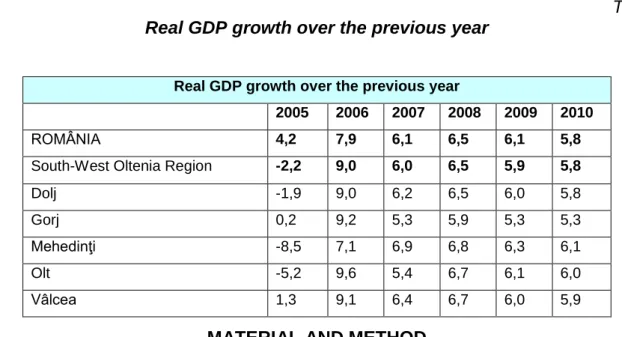
South-West Oltenia has a share of GDP of the country of almost 8%. Agriculture is the most important contribution to GDP by about 18%.
222
Table 1. Real GDP growth over the previous year
MATERIAL AND METHOD
Sociological research conducted by two separate questionnaires aimed primarily to obtain information about complex psychosocial phenomena generated by national labour market dynamics and in relation to specific elements belonging to South-West Oltenia region.
The research instrument used was questionnaire sociological.
Two questionnaires were formed, distinct, for the two target groups: unemployed and company representatives. Omnibus type surveys are conducted.
The questionnaire for the unemployed is structured into the following chapters:
demographic variables and micro (12 questions).
Information and advice (7 questions).
Attitudes and behaviours (1 question).
Unemployed and specific activities (19 questions)
Skills Assessment unemployed (46 variations on a scale from 1 to 4).
Other variables (6 questions).
Questionnaire for companies structure has the following coordinates:
General information identifying the company (9 questions).
Business Environment (3 questions).
Companies and human resource issues (17 questions).
Continuous training (6 questions).
Assessment of skills potential employees (46 variations on a scale from 1 to 4).
The two completed questionnaires allowed an evaluation of skills of unemployed in their own perspective and potential employer, and obtain comprehensive information about specific individual variables and their networking with micro elements (manifested by attitudes, perceptions, behaviours, etc.)
In the South-West Oltenia were interviewed representatives of 139 companies in our area of responsibility.
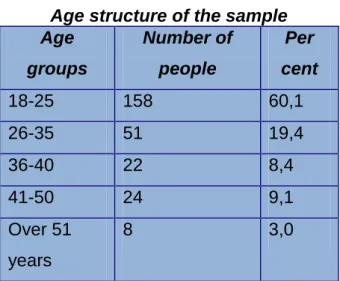
Also, in the same region South-West Oltenia a number of 263 unemployed people have replied to the questioners. Of these, 87 were women (33.1%) and 176 were men (66.9%). Age structure of the sample is presented as the table below: (Table 2).
Young people (people under 35 years) represent almost 80% of subjects with unemployed status that have been investigated. Also, 76.0% of participants were from urban areas, the difference of 24.0% belonging to rural areas.
Real GDP growth over the previous year
2005 2006 2007 2008 2009 2010
ROMÂNIA 4,2 7,9 6,1 6,5 6,1 5,8
South-West Oltenia Region -2,2 9,0 6,0 6,5 5,9 5,8
Dolj -1,9 9,0 6,2 6,5 6,0 5,8
Gorj 0,2 9,2 5,3 5,9 5,3 5,3
Mehedinţi -8,5 7,1 6,9 6,8 6,3 6,1
Olt -5,2 9,6 5,4 6,7 6,1 6,0
223
Table 2. Age structure of the sample
Age
groups
Number of
people
Per
cent
18-25 158 60,1
26-35 51 19,4
36-40 22 8,4
41-50 24 9,1
Over 51
years
8 3,0
RESULTS AND DISCUTIONS
Developing research tools allowed an assessment of labour market size in South-West Oltenia by starting with two perspectives: the perspective offered by representatives of companies in the region and the perspective offered by subjects belonging to the target, having the status of unemployed.
Evaluation of transversal competences. Point of view of the unemployed Below are the results obtained in our research on transversal key skills or competences of unemployed in South-West Oltenia.
The analysis of descriptive data can be observed that submits the lowest average communication skills in a foreign language, followed by business skills. (Table 3)
The skills developed in the minds of the trial, are the mother tongue followed by social and civic. What is important to note that none of the media skills assessed does not exceed 3 (well developed) scale with four steps used in the study.
Table 3. Descriptive statistics transversal competences
Descriptive statistics transversal competences
Evaluated competences N Minimum Maximum Average AS
Communication in mother tongue 140 1,00 4,00 2,33 1,00
Communication in foreign languages 140 1,00 4,00 1,62 0,76
Basic numeracy and technical
competences
139 1,00 3,45 2,04 0,72
ICT Competences 140 1,00 4,00 2,00 0,99
Self-development competences 140 1,00 4,00 2,02 0,89
Searching a job competences 140 1,00 4,00 2,06 0,80
Social and civic competences 140 1,00 4,00 2,16 0,82
224
Moreover, even the largest environments are located around 2 which means a low scale of development.
Overall, we can say that the perception of the sample of participants on their own skills is not very positive, placing their own level of development at a low level.
More detailed analyses (analyses aimed the investigation of flattening and skew index and also data distributions on the eight dimensions.) conducted showed that over half of those surveyed have communication skills in foreign language at a very low level of development.
A similar situation is observed for ICT skills where also there are many people with low levels of this skill, but also the frequency of people with an average level of development of this competence is high.
Also personal self-development skills and finding a job manifest a tendency toward negative inclination distribution, towards the bottom of the scale, congruent and with lower average of these skills, indicating that there are in our sample more people with low levels of development of these skills.
Overall, we can say that, based on self-assessments made by research participants in South-West Oltenia, the development of the eight key competences assessed cross is slow, the problem is communication skills in a foreign language and entrepreneurship.
These results indicate that these skills are not independent, but tend to evolve in the same direction, which means that a low level of a competence will tend to be associated with a low cross and the other competences.
This is even more important as the skills level of our sample tends to be a reduced one.
Point of view of the companies
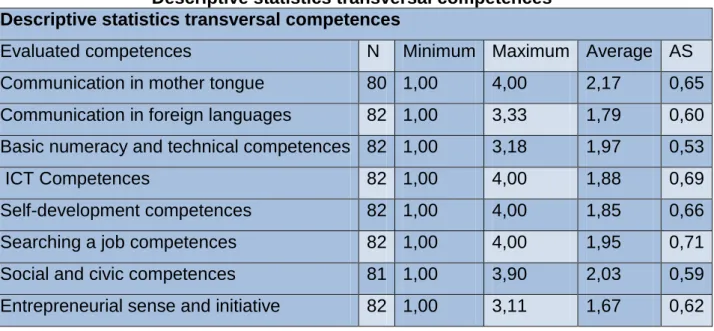
The analysis of descriptive data can be seen that, overall, the companies evaluated the competences of persons seeking jobs as being below theoretical average scale.
This may indeed indicate a low level of development of these skills from the perspective of corporate representatives.
Investigating the table below (Table 4), we see that the least developed in terms of employers, are entrepreneurial skills (M = 1.67) and the communication in foreign languages (M = 1.79), two central transversal competences in the European perspective on the development of a knowledge society.
The differences between these environments and the other are not very large in the environment under theoretical average scale being and competences to search for a job (M = 1.95) and the personal self-development (M = 1, 85) which could indicate difficulties in shifting people on employment and maintain employment.
Also, mother tongue communication skills along with social and civic skills are evaluated most positively by representatives of employers.
These data coincide with those from the evaluations unemployed stands who situate the same two competences at the highest level of development.
Overall, we see also that none of the media do not approach the value 3 of the scale, a value which indicates that a competence is considered to be developed, most ranging between stage 1 - very weak, and 2 - weak developed.
Based on assessments made by representatives of companies participating in research in South-West Oltenia, the development of the eight transversal key competences assessed is weak, the most problematic being entrepreneurial skills, communication in foreign languages, and to search for a job.
225
Table 4. Descriptive statistics transversal competences
Descriptive statistics transversal competences
Evaluated competences N Minimum Maximum Average AS
Communication in mother tongue 80 1,00 4,00 2,17 0,65
Communication in foreign languages 82 1,00 3,33 1,79 0,60
Basic numeracy and technical competences 82 1,00 3,18 1,97 0,53
ICT Competences 82 1,00 4,00 1,88 0,69
Self-development competences 82 1,00 4,00 1,85 0,66
Searching a job competences 82 1,00 4,00 1,95 0,71
Social and civic competences 81 1,00 3,90 2,03 0,59
Entrepreneurial sense and initiative 82 1,00 3,11 1,67 0,62
CONCLUSIONS
We present several conclusions written in the research report from the following perspectives:
A. From the perspective of employers:
• For the next three years companies have not imposed the need for clear policy towards its own labour, preferring a kind of status quo (keeping the number of employees). • From the perspective of employers the most important qualities of their employees are: experience, education, professional knowledge and held specialized skills.
B. From the perspective of unemployed:
• In terms of unemployed, the most relevant information in the counseling process should refer to the training and retraining opportunities existing in the area.
• The main reasons for which they accept a job are economic: appropriate wages salary increases.
• There is a relatively wide dispersion of responses for questions that focused on the causes and reasons for rising unemployment, after completing a vocational training process, they could not integrate vocational and occupational.
This prevents a large part of the unemployed to integrate occupational on medium and long term. We could discuss about some "passivity" of the unemployed.
REFERENCES
[1] Raport de cercetare - Corelarea forţei de muncă cu cerinţele pieţei în regiunile sud-vest
Oltenia şi Nord-Vest, 2011
[2]www.oirsvfse.ro/.../PRAI%202008%20text%20principal.doc, pp 10-33 [3] http://www.banknews.ro/stire/36877/
[4]http://ro.wikipedia.org/wiki/Regiunea_de_dezvoltare_Sud-Vest#Ecomomia [5]http://www.mdlpl.ro/_documente/regiuni/4.SW_ro.pdf
[6]http://www.oirsvfse.ro/site_utile/PRAO_draft_final.pdf [7]http://www.mie.ro/_documente/regiuni/4.SW_ro.pdf [8]http://stpsv.eubiz.ro/ro/downloads/prao-2010-fin.pdf
[9]Comisia Naţională de Prognoză (CNP), “Proiecţia principalilor indicatori economico-sociali în profil teritorial până în 2010” (februarie 2008)