9
Understanding the Function
of Coral Tools from
Anse
a
la Gourde
An Experimental Approach
Harold]. Kelly and Annelou L. van Gijn
Introduc
t
ion
Coral objects are found throughout the Caribbean in archaeological excavations. A magnificent example is the mask from Anse a la Gow·de (Hofman et al. 2001). Other examples are the zemis made of Acropora palmata and Porites sp. found at Golden Rock on St. Eustatius and several Sa ban sites (Hoogland 1996; Steenvoor-den 1992). However, coral fragments also were collected as raw material for the manufacture of tools. Sometimes these pieces of coral were not further modified; sometimes they were shaped into standardized artifacts. These tools have been recognized for some time and reported by various researchers (e.g., Rostain 1997; Steenvoorden1992). Coral tools that were reported included grinders, metates, and rasps, functions that were basically inferred from morphological characteristics of the artifacts and by means of analogy to tools whose function was known. So far, however, use-wear studies of tl1ese tools by means of microscopic analysis are lacking.
In order to better understand the role of tl1e coral tools in the technological system of ilie native peoples of the Caribbean islands, it was decided to examine a selection of tools for traces of wear (Kelly 2003). The tools derived from the site of Anse a la Gourde, a Saladoid-Troumassoid (A.D. 400-1400) site on Grande-Terre, Guadeloupe (Hofman et al. 1999; Hofman et al. 2001) (Figure 9.1). Tools of shell, flint, and hard stone from this site had already been microscopically studied, the results of which could be integrated with the study of the coral tools (Van Gijn et al. this volume).
11 6
I
Kelly and van GijnAnguilla
Saint Matti~ -:- Saint Barts ....
Saba. Saint Eustatius • ~
Saint Kitts 0
Nevi~ <>
OAntigua
'Is-U
C>~
Anse
aoourde
(" --=~loupe 1'~
.-A•
\1'4 0 Marie-Galante·
'\) Dominica
~
~
Martinique~
~
(J
Saintlu<;ia ~Saint Vincent,
0
.
.
b
;;; Barbados
.0
GrenadaFigure 9.1. Location of the site Anse
a
la Gourde on Guadeloupe.was therefore to establish an experimental reference collection and to determine whether interpretable wear traces developed on the coral tools. The approach was subsequently applied to a selection of the coral tools from Anse
a
la Gom·de. The second objective was to understand the role of coral in the technological system ofthe Amerindian inhabitants of Anse
a
la Gourde.Me
t
hodology and
Samp
l
ing
-Function of Coral Tools from Anse
a
la GourdeI
11 7fications of 100-56ox:. As it turned out from the experiments, the corallite ridges
within the honeycomb structure of the coral behaved very much like other fine-grained surfaces such as flint or shell, displaying clearly developed polishes with topographical features similar to the ones observed on flint tools (Van Gijn 1990). The topography and relative smoothness of the polish cao be assessed within the spatial confines of these ridges. The only difficulty is that, in order to evaluate the extent, distribution type, and limit of the polished zones, one has to "jump" as it were from one ridge to the next to obtain an idea of the extent of the wear. Pol -ish does not develop on the coarse-grained interstices between the corallite ridges. Contrary to our expectations, therefore, the macroscopic wear such as edge remov-als and rounding was sometimes difficult to distinguish. It was decided to concen -trate on High Power analysis, using the stereomicroscope only to obtain an overall view of the macroscopic wear and to detect residue.
The polish was described the same way as on flint tools, making use of the same
attributes such as polish brightness, topography, directionality, and so forth. Prob -lematic was the limit of the polish, in other words, whether it gradually fades out or whether the polish stops abruptly. This is because of the fragmented polish dis -tribution: only on the corallite ridges. A few extra attributes were added to accow1t for the specific physical properties of coral, the most important one being the de
-gree of beveling visible on the ridges (a hard contact material will "bevel" the top of the corallite ridge, whereas a soft material will round the ridge).
The use-wear analysis was performed using a Nikon Optlphot incident light microscope with magnifications in the range of 10-560x (equipped with diff er-ential interference contrast [DIC] and polarizing filter) and a Wild stereoscopic
microscope (10-16ox). Photographs were taken with a Nikon DXM1200 digital camera. Some of the tools were cleaned in distilled water in an ultrasonic clean-ing tank in order to remove adhering dirt, but the majority of the tools were just wiped clean with alcohol to remove finger grease. Chemical cleaning was not done in order not to damage the artifacts.
A large•number of coral artifacts were found in Anse
a
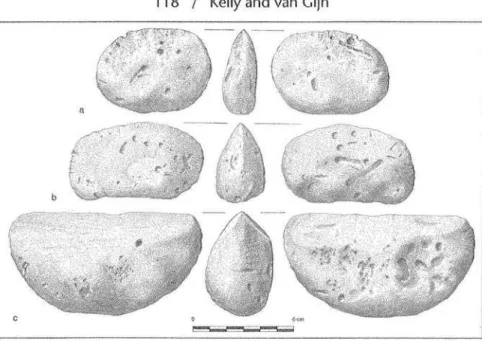
la Gow·de, not all of which could be subjected to a time-consuming microscopic analysis. It was there-fore decided to focus on one type of tool: the tools with abraded angles made on Porites sp. The 52 Porites sp. artifacts selected displayed varied shapes and types of abraded angles (Figure 9.2). A categorization into different groups was made according to morphological similarities between the artifacts in terms of tool shape, degree of angle, occmrence of one or multiple abraded angles, and one-or two-sided abraded angles. The objective was to assess whether this morphological variation reflected differences in function. In addition, a few abraded implements118
I
Kelly and van GijnFigure 9.2. Angled abraded Porites sp. artifacts.
The Experiments
At Anse
a
la Gourde three types of coral predominated in the assemblages: Poritessp., Acropora palmata, and Acropora cervicomis. They each have different
prop-erties, making them appropriate for different kinds of tools. The Acropora pal-mala has thick flat branches that form excellent blanks for grinders and metates.
It is also very hard and resistant. Acropora cervicornis grows in branches that have
a rough smface, comparable to Acropora palmata. Fragments of these branches
are very suitable as rasps to polish wood, shell, and bone, as well as for scaling fish
(Steenvoorden 1992). Porites sp. is softer tl1an the previously described species and
can therefore more easily be modified into tools and objects than Acropora pal
-mata. We concentrated on Porites sp. and Acropora cervicornis because they were
the species the most common coral tools at Anse
a
la Gourde were made of: that is,scrapers (or angle abraded tools) and rods, respectively.
Coral has abrasive properties tl1at most stones, shell, and wood lack. Because
of the corallite ridges, surrounded by softer interstices, it resharpens itself
dur-ing use, a bit like vesicular basalt. However, it does not provide a very sharp cutting
edge. For cutting purposes flint, and to a lesser extent shell or hard wood, is a very
wanted raw material.
The Porites sp. artifacts from Anse
a
]a Gourde showed a wide range of shapesFunction of Coral Tools from Anse
a
la GourdeI
119striations, and hammer traces. Our assumption was that they were probably used for a wide variety of tasks. The experimental program therefore focused on a broad range of activities in order to obtain a wide variety of use-wear traces for the ref
-erence collection.
The experimental tools were made on coral gathered far from the site to exclude the possibility of usi11g probable archaeological coral pieces. Since the Porites sp. artifacts from An se
a
la Gourde appeared to have been used both unmodified and modified, the experin1ents were divided into two sets. Tbe first set consisted of ex-periments based on the natural shape of the coral; the second consisted of experi-ments with modified Parites sp. (angled abrasions). These angled abrasions were made either one or two sided, depending on the aim of the experiment. Both sets of tools were used on tl1e same type of contact materials. Additionally, the modi-fied Porites tools were also used in experiments for which an unmodified piece would not be suitable, that is, cutting and :incising calabashes and de-barking of branches, tasks for which a ground cutting edgeis
needed.Contact materials included various types of (tropical) hardwood, shell, seeds, stone, ochre, clay, various plant species like calabashes, charcoal, and bone. The motions included cutting/sawing, scraping, sanding, rasping, polishing, incising, crushing, and pounding. Each tool was used an average of 30 minutes. If no traces were visible after the first 30 minutes of use, the tools were used another 30 min-utes and observed again. The maximum time the tools were used was 1.5 hours.
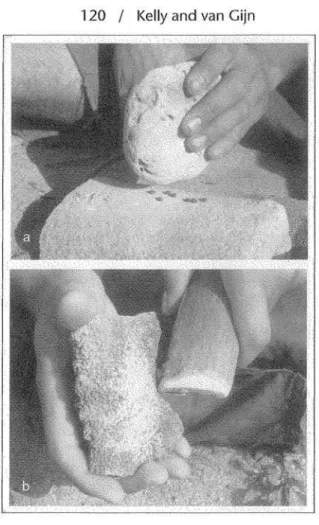
A total of 37 experiments were carried out on the Porites sp. coral (Figure 9.3). The experiments not only served as a means to build up a reference but, more im -portantly, also provided insight into the way in which coral handles and behaves on different types of materials.
M
i
crowe
ar An
alys
i
s of
t
h
e Ex
p
er
i
me
n
tal
T
ools
Contact with hard materials as shell, coral, and stone all caused a flattening of the corallite ridges (referred to as beveling) and a sinlilar polish distribution (Figure 9.4b). Other attributes of wear, however, such as polish brightness and amount of striations, varied between the three materials. Contact with shell caused a bright polish, whereas rubbing coral wiili coral resulted in a dull, rather rough polish.
Moreover, the corallite ridges of the tools used on shell developed deep gorges with a rounded bottom. Both materials produced a polish distribution that could be characterized as "streaks" (Figure 9.4b). So even though the wear traces from contact with these three hard materials overlapped to some extent, other charac-teristics were associated with specific contact materials. However, it may not al
-ways be possible to differentiate between these contact materials in archaeological context.
1 20
I
Kelly and van GijnFigure 9-3· Experiments with coral tools. a: pounding
seeds; b: rasping hard wood.
wear traces obtained from experiments on clay were characterized by the devel
-opment of rounded (rather than a beveled) corallite ridges in combination with a
bright polish with flat topography, a lot of randomJy oriented striations can be
dis-cerned in the polished zones.
Contact with materials such as wood, plant material, and bone showed some
overlapping similarities in terms of resulting use-wear traces. However, each of
these materials also provided specific features of wear. Working bone resulted in a
dull to bright polish and a cratered and pitted polish topography (Figure 9-4c). A variable number of randomly oriented striations are also visible. The wear traces
that resulted from the experiments with wood were characterized by the occur
-rence of rounded to very rounded corallite ridges (Figw-e 9-4a). Furthermore, a
Figure 9-4-Matching experimental and archaeological use-wear traces. a: polishing tropi
-cal hardwood for 45111inutes (original magnification 2oox); b: sanding Strornbus gigas
122
I
Kelly and van Gijna clear directionality, as well as a limited number of striations. Experiments with plant materials resulted in a rather variable corallite ridge shape, ranging from rounded to slightly flattened. The polish was bright to very bright and striations
were generally absent. Topographical features in the polish .included the presence of small craters.
To conclude, use-wear traces that resulted from experiments carried out on
hard materials such as shell, stone, and coral were clearly different from the wear
traces that resulted from experiments on softer material types such as wood, plant, bone, and clay. Characteristics specifically related to the hard materia]s are a flat to very flat or beve)ed coraUite ridge, streaked polish distribution, a rough texhue,
and the occunence of a lot of striations. The softer contact materials resulted in more rotU1ded corallile ridges and a smooth, bright polish with a dear direction
-ality. Striations do occur but in lesser quantities.
The
Ar
c
h
aeo
l
og
i
ca
l
Too
l
s
from
Anse
a
l
a Gourde:
Matching
T
r
aces
The Porites sp. angle-abraded artifacts were classified into nine different groups. This classification was based on the basis of general shape, the shape of the edge (straight, concave, or convex), and the occurrence of single-or double-angle
abra-sion on the artifact.
In order to test the hypothesis that the angle-abraded tools made of P01·ites sp.
were indeed used for a variety of activities, 52 artifacts were selected. Each typo-logical group was treated separately to examine its functioual homogeneity. Traces on the archaeological tools were compared to the experimental ones in order to in
-fer the probable contact material and the movement applied (e.g., longitudinal or transverse).
Unfortunately, 18 archaeological implements displayed postdepositional surface
modifications that made a functional analysis impossible. It is not entirely clear
how these secondary modifications developed. More research into the taphonomic conditions under which use-wear traces on coral tools are affected is first needed. On three other tools the traces could not be matched to experimental equivalents and were classified as unknown. It may actually involve multiple usages, causing the superimposition of different types of traces making identification impossible. The traces on one tool were insufficiently developed to allow a functional infe
le-Function of Coral Tools from Anse
a
la GourdeI
123ments (Figure 9-4e), six as bone-working implements (Figure 9.4f), and three as
plant-working implements.
It turned out that there is little relation between tool form and function.
Char-acteristics such as similarity between tool and edge shape, amount of abraded
angles, and degrees of abraded angles of tools are not specifically related to one
contact material or motion. This may relate to our own classification system, based
on etic criteria that probably did not correspond to the emic approach of tools of
the inhabitants.
Conclusion
The experimental use of coral tools and subsequent analysis of the resulting wear
traces indicates that use-wear analysis of coral artifacts can be carried out
suc-cessfully. Coral has a totally different contact sllt'face-corallite ridges in a hon
ey-comb structltl'e on which the traces develop-as compared to materials such as
flint that display a flat smooth surface. Nonetheless, wear traces that resulted from
use of coral on a specific type of material were clearly visible and comparable to
traces that occur on materials such as flint. The High Power approach proved to be
more efficient compared to the Low Power approach during the analysis of the ex
-perimental tools and artifacts. Low Power analysis did prove to be very useful as
a means to get acquainted with the surface of the coral (e.g., characteristics and
distribution of the corallite ridges), possible wear traces, and residues. However, it
was through High Power analysis of tl1e experimental tools that the potential of
microwear analysis on coral became clear. Not only was it possible to obtain insight
into the general hardness of the contact materials (e.g., soft, medium, or hard),
but it was also frequently possible to reach a more detailed inference regarding the
contact material (e.g., clay, bone, and shell). The experimental program was not
only important to build up a reference collection, it also gave insight in the
man-ner in which the coral handled and the types of probable tasks for which it was
suitable. Fw-thermore, the experiments also provided an insight about the tool life
(i.e., length of use vs. degree).
Taphonomic processes such as dissolution or abrasion of the corallite ridges complicate t11e analysis and interpretations of the a1·tifacts. Even so,
postdeposi-tional surface modificatio~s can frequently be distinguished from wear traces. On
the one hand, postdepositional traces usually are located across the entire tool,
whereas the use-wear traces are limited to the functional edge. On the other band,
traces seen outside the abraded angle should not immediately be categorized as
postdepositional traces. They could also be handling traces (recognized on some of the experiments).
dem-124
I
l<elly and van Gijnonstrated the possibilities of use-wear analysis on coral tools. It also provides a
more in-depth view of the manner in which the Amerindians interacted with their
surroul1Clings in the sense of resource exploitation. Last, the use-wear study gave coral a place in the technological system of the native peoples of the Caribbean is-lands. It turns out that they used coral tools for various activities. They carefully selected their tools for specific purposes and obviously had a thorough knowledge of the physical properties of the various raw materials from which their tools were made. Coral tools therefore played a vital role in carrying out various activities and formed an integral part of the technological system. Their rough surfaces, ideal
for rasping, scraping, or polishing, make them very suitable for such tasks as the
grinding or sharpening of shell tools or objects of very hard wood types. It makes