A Geometric Distribution for Backoff Time in IEEE
802.11 DCF: An Analytical Study
Youssef Dehbi
1, Hafssa Benaboud
1and Noufissa Mikou
21 LRI, Performance Evaluation Team, Faculty of Sciences, University of Mohammed V – Agdal, Rabat, Morocco, 2
LE2I, University de Burgundy, France,
[email protected], [email protected], [email protected]
Abstract: Today’s networks, including WLANs, transport
different classes of services. A service differentiation is then essential to provide QoS. However, IEEE 802.11 for WLANs was primarily designed for best effort traffic and did not provide QoS specifications. IEEE 802.11e MAC has been then described to support QoS in WLAN. In this paper, we propose a new scheme for service differentiation which is based on the 802.11 standard and requires minor modifications. In fact, we act on DCF which uses the backoff procedure to solve contention in WLANs. For this scheme, we use, instead of the uniform distribution, a geometric distribution for random backoff time selection. Using a multi-class system, we propose three parameterizations of the geometric distribution which imply different dynamic differentiation modes and we provide an analytical study, using a Markov chain model, to compare our differentiation modes. We discuss our numerical results which give the performances evaluation of the proposed mechanism in term of throughput and delay.
Keywords: WLAN, 802.11 DCF, Markov chain, service
differentiation, QoS.
1.
Introduction
Today, network traffic has become more and more diversified, and each type of traffic has its own Quality of Service (QoS) requirements. Service differentiation is so essential for systems of different traffic classes in order to provide QoS. However, the IEEE 802.11 was primarily designed for best effort traffic and did not provide QoS specifications. IEEE 802.11e [2] has been then described to support QoS in WLANs (Wireless Local Area Networks) in introducing priority mechanism. IEEE 802.11e supports service differentiation by assigning data traffic with different priorities based on their QoS requirements.
IEEE 802.11 MAC [1] defines two different access mechanisms, the mandatory Distributed Coordination Function (DCF) which provides distributed channel access based on CSMA/CA (Carrier Sense Multiple Access with Collision Avoidance), and the optional Point Coordination Function (PCF) which provides centrally controlled channel access through polling.
A backoff procedure is necessary in DCF to avoid collision because of the CSMA/CA. Stations sharing the same medium have to wait, in addition to the DIFS (DCF Inter-Frame Space) time period, a random backoff time prior to the transmission if the medium is sensed busy, or was busy just before the station started waiting the DIFS period.
The random backoff value is uniformly chosen from the interval [0,CW], called the Contention Window. CW is
initialized to the minimum size CWmin and doubled after each
unsuccessful transmission, until it reaches the maximum Contention Window size, CWmax. CWis reset to CWmin after
every successful transmission. The selection of the random backoff time doesn’t take into consideration the type of traffic circulating in the medium, and thus, the service differentiation is not addressed.
In order to differentiate services, we propose in this paper, a novel scheme which requires minor change from DCF. Instead of the uniform distribution of the random backoff time selection, we use a geometric distribution which takes into account various classes of services.
This paper is organized as follows. Section 2 gives a description of the IEEE 802.11 DCF and discusses related research. Section 3 gives the problem formulation and describes our proposition. We present in the same section three interesting modes of the new scheme operation. In section 4, we give the analytical study using a Markov model and in Section 5 we show our performance evaluation results. Section 6 concludes the paper.
2.
Background and Related Research
Before describing our new scheme and proceeding with the problem formulation, it is appropriate to recall the DCF principle on which our new scheme is based. This section gives thus a description of DCF and outlines some proposed schemes to introduce QoS on MAC Level.
2.1. 802.11 Distributed Coordination Function
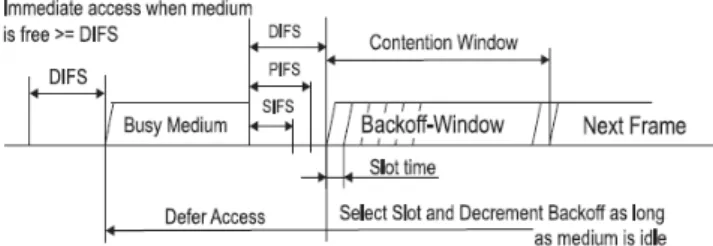
IEEE 802.11 MAC [1] uses two schemes for channel access: DCF and PCF. DCF is a contention based function that uses CSMA/CA to transmit frames. It can use either the basic access mode in which DATA frames are acknowledged by ACK control frames, or a channel reservation mechanism in which RTS (Request To Send)/CTS (Clear To Send) frames are exchanged before DATA/ACK exchange in order to reduce frame collisions introduced by the hidden terminal problem. In this paper we only consider the basic access mode.
an error. At the end of this waiting period, the station adds another waiting period by invoking the BEB (Binary Exponential Backoff) procedure if it is not already invoked.
Figure 1. DCF: Basic Access Method
At the beginning of that backoff procedure, a station sets its backoff stage to 0, and arms a backoff timer by drawing a uniformly distributed random backoff time (expressed in slots) from an initial contention window of size CWmin. The
backoff timer is decremented when there is no medium activity, otherwise it is frozen. The backoff timer decrement is resumed if the channel is sensed idle again for a DIFS/EIFS time. The station transmits its frame when the backoff timer reaches zero. If an ACK frame is not received for the transmitted frame, a collision is detected and the station retries to transmit the frame by moving to the next backoff stage where the contention window size is doubled. After the
m
'
th backoff stage, the transmission attempts donot affect the contention window. this latter remains constant with size equal to CWmax. The frame is dropped if its
transmission is incorrect after the maximum retry limit m. During the backoff procedure, when an ACK frame is received, the station resets its backoff stage and its contention window to their initial values in order to invoke the backoff procedure for the next frame to be transmitted. This is done also at the backoff stage m whether the transmission is successful or not.
A SIFS (Short InterFrame Space) time is used for ACK frames. If a DATA frame is correctly received, the receiver station waits for a SIFS time before sending the ACK frame. If the ACK frame is not received during an ACK Timeout interval, a collision is assumed to have occurred.
2.2. MAC Level QoS: Related Work
There were many research papers that focused on service differentiation for 802.11 DCF. Some works, as in [3], [4], used a DIFS based differentiation. By giving a smaller DIFS period to the high priority class, stations of that class can access quickly to the medium compared to the low priority class stations.
Service differentiation has been also addressed at backoff procedure level. This is made by differentiating one or more parameters of that procedure as the minimal contention window and the maximal contention window [8], the backoff increase factor [3], the maximum backoff stage [9], [10]. There were also works that have proposed service differentiation at the backoff time selection level. This is done, as in [6], by dividing the backoff interval into sub-intervals where the classes select their backoff time. In [4] classes select the backoff time according to different probability distributions.
The backoff interval in [6] is divided into disjoint subintervals. Each of them corresponds to a class of the network. Each class selects its backoff time only in its own backoff sub-interval. Therefore, as obviously the smallest backoff subinterval corresponds to the highest priority class, then if that class is inactive, it implies that the smallest backoff subinterval will never be chosen due to that strict differentiation. In this paper, our proposition is more flexible, in such a way that all slots are accessible for stations, but with different probabilities depending of the stations classes. If there are no active stations of high priority classes, low priority classes stations are still likely to select earlier slots. In [4], the authors propose a service differentiation scheme for two classes, using an exponential backoff time selection distribution for the high priority class and a uniform backoff time selection distribution for the low priority class. But using a continuous distribution is not well suited because the backoff time is expressed in term of discrete slots.
Moreover, for the priority implementation in [4], authors change distribution parameter for the high priority class at each backoff stage. That is superfluous because it affects very slightly the backoff time selection for that class in comparison to the evolution of the backoff time selection of the low priority class over the backoff stages. In addition, both [6] and [4] use only simulations to analyze performances of their propositions.
In [9] and [10] authors propose similar multi-class analytical models based on the Markov chains in [5]. Those models provide an analytical framework for service differentiation and include almost all the previous schemes.
In this paper, in order to provide service differentiation, we use a discrete distribution for random backoff time selection that covers all the values of the backoff interval, and that can, at each backoff stage, accelerate or decelerate the access to the medium depending to the priority. Also, we propose an accurate Markov model to evaluate the performances of our proposition in term of throughput and delay.
3.
Proposed Scheme Description
Let consider a system of C classes. The idea is that each station of a class
c c
;
∈
[0
,
C
−
1]
, will draw a backoff time from a truncated geometric distribution of a parameter in the current backoff interval. We will choose this parameter in such a way that a high priority class will have more chance to select a small backoff time and less chance to select a large backoff time in comparison with a low priority class.In the following, we define our priority based backoff selection model and propose three modes for priority adaptation to the backoff stage.
3.1. Geometric Backoff Time Distribution
Let Wi denote the backoff interval size at the ith backoff stage.
We have:
'
' 0
' 0
2
[0,
1]
2
[
, ]
i
i m
W
i
m
W
W
i
m m
∈
−
=
∈
(1)size of the initial backoff interval.
Instead of uniform random backoff time selection in the backoff interval [0, Wi -1], we propose a non-uniform
random backoff time selection which we model by using a truncated geometric distribution defined in [0, Wi -1]where i
is the actual backoff stage.
Let
ω
denote the pdf (probability density function) of this distribution., ,
1
;
1
[0, ],
[0,
1],
[0,
1]
i
k c c i k c W c
i
i
m k
W
c
C
α
ω
α
α
−
=
−
∈
∈
−
∈
−
(2)
The parameter
α
c∈
defines the shape and the increase/decrease of the distribution pdf of a given class c. Table 1 presents the variation ofω
c i k, , forα
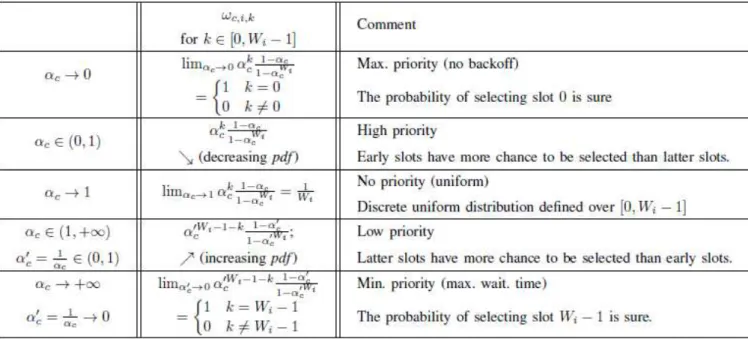
cbelonging to different intervals.From Table 1, we notice that the proposed backoff time selection using a truncated geometric distribution can be taught as a generalization of which the uniform backoff time selection, the no-backoff mode and the maximum backoff time selection are particular cases.
The parameter
α
c defines the priority of class c.α α
c<
c' means that class c has more priority than class c’, for, ' [0,
1]
c c
∈
C
−
. We can see that:, , ', , '
, , ', ,
[0,
)
(
,
1]
c i k c i k T c c
c i k c i k T i
k
k
k
k W
ω
ω
α α
<
⇒
ω
>
<
ω
∈
∈
−
where
k
Tis the point in which the two pdfs intersect.This means that the class c has more (resp. less) chance to select the earlier (resp. latter) slots in the range
[0,
k
T)
(resp.(
k W
T,
i−
1]
) than the class c’.Let
E
[
ω
c i,]
denote the average backoff time for a class c at backoff stage i:1
, , ,
0
[ ]
1 1
i i
i
W W
c c
c i c i k i W
k c c
E
ω
kω
α
Wα
α
α
−
=
= = −
− −
∑
(3)It can be easily proven that:
' [ ,] [ ',]
c c E c i E c i
α
<α
⇔ω
<ω
and' ', ,
1
[ ] 1 [ ]
c c i i c i
c
E W E
α
ω
ω
α
= ⇔ = − −
for
i
∈
[0, ]
m
andc c
, ' [0,
∈
C
−
1]
.Let the priority of a class c be defined as the fraction of the class c average backoff time over the maximum backoff time value at backoff stage i:
, ,
[ ]
1
c i c i
i E prio
W
ω
=− (4)
Figure 2 plots the class priority as defined in (4) for two classes and their opposites.
Figure 2. Class priority as a function of the backoff stage
(m’=6 and m=7)
3.2. Distribution Parameterization
For sake of symmetric study, we introduce a second parameter βc
∈
[-1,1]. Let the class “basic priority shape”(bps) be defined as the shape of the pdf of a class c with
parameter
1
1
c c
c
β
α
β
−
=
+
at backoff stage 0.In the following, we propose three priority differentiation modes in order to provide QoS guarantees.
3.2.1 Soft Differentiation Mode
' '
2
2
m c c m
c
β
α
β
−
=
+
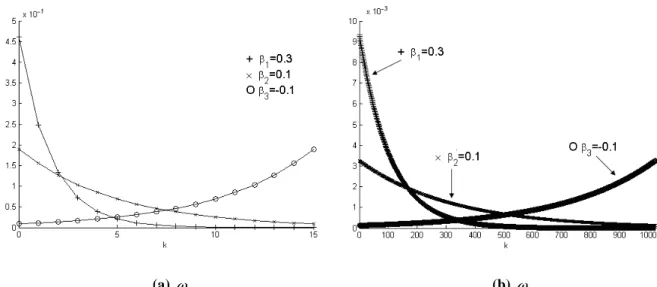
(5)At the first backoff stage, the classes’ distributions are uniform. When the backoff stage increases, they become more differentiated until reaching their bps at backoff stage m’ as in figure 3(b).
3.2.2 Constant Differentiation Mode
'
, '
' '
2
[0,
1]
2
2
[
, ]
2
i c i
c c i m
c m
c
i
m
i
m m
β
β
α
β
β
−
∈
−
+
=
−
∈
+
(6)
At the first backoff stage, the classes are differentiated according to their bps as in figure 3(a). The distribution shapes are scaled in function of the backoff stage i in such a way that, at the m’th backoff stage (Figure 3(b)), they remain similar to the bps.
3.2.3 Hard Differentiation Mode
1
1
c c
c
β
α
β
−
=
+
(7)The classes are differentiated at the first backoff stage according to their bps as in Figure 3(a) When the backoff stage increases, a class distribution shape tends to no backoff mode (resp. maximum waiting time) if its parameter βc is
positive (resp. negative).
(a)
,0, c k
ω
(b),6, c k
ω
By using the soft differentiation mode, a class will start its backoff procedure using the uniform distribution, and will gain or lose priority depending on the sign of its parameter βc
as the contention in the network increases. Thus low priority classes will not suffer from differentiation when the contention is low since differentiation is applied after contention.
Constant differentiation mode can be applied when the QoS requirements are met and have to be preserved.
Hard differentiation mode can be applied in order to accelerate the access to the medium for high priority classes (i.e. classes with positive βc parameter) as the contention
increases. Those classes will have their backoff times selected in earlier backoff slots, tending to no backoff mode. When this mode is used for low priority classes (i.e. classes with negative βc parameter), their waiting time increases by
forcing them to select high backoff time values, tending to maximum waiting time.
For classes with βc parameter of the same sign, only one class
should use the hard differentiation mode because there is no more differentiation between those classes as the contention increases.
All these differentiation modes are dynamic in such a way that the priority depends on the backoff stage.
4.
Analytical Model
We consider a network of n contending stations in ideal channel conditions. The network is divided into classes of nc
nodes,
c
∈
[0,
C
−
1]
where C is the number of classes. In our analysis, we follow the methodology in [5]. Let b(t) (resp. s(t)) be the stochastic process representing the backoff counter (resp. stage) for a station of class c at a time t. The time scale is discrete such that t and t + 1 correspond to the beginning of two consecutive slot times.Let pc denote the probability that a station of class c senses
the channel busy due to a collision or due to a transmission. pc is considered to be constant and independent of the past
retransmissions.
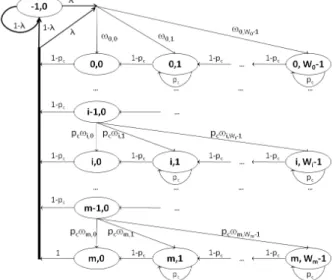
Figure 4 shows a discrete-time Markov chain which we use to model the bidimensional process {s(t) , b(t)} for a class c. For readability in figure 4, the probability
, ,
;
[0, ],
[0,
1]
c i k
i
m k
W
iω
∈
∈
−
is denoted byω
i k, .In order to deal with non-saturated traffic, an artificial state {-1 , 0} is introduced to model the probability λ of having a frame ready for transmission at the head of the transmission queue of the station at the beginning of a slot.
Figure 4. Markov chain model for class c
The non-null transitions probabilities for class c are1:
{
} {
}
{
}
{
}
{
}
{
}
{
} {
}
,0, 0
,0, 0
1, 0 1, 0 1, 0 , 0 1
1, 0 , 0 (1 )(1 ), [0, 1]
, , , [1, 1], [0, ]
, , 1 1 , [0, 2], [0, ]
0, , 0 (1 ) , [0, 1], [0, 1]
0, , 0 0, 1, 0 , [0, 1]
c c
c c
c c i
c c i
c c c k
c c c k
P P m
P i p i m
P i k i k p k W i m
P i k i k p k W i m
P k i p k W i m
P k m P k k W
P
λ
λ
λ
ω
λω
− − = − = −
− = − − ∈ −
= ∈ − ∈
+ = − ∈ − ∈
= − ∈ − ∈ −
= − = ∈ −
{
, 1, 0}
, , , [0, 1], [1, ]c i k i− =pc
ω
c i k k∈ Wi− i∈ mLet c i k, ,
lim
c{ ( )
, ( )
}
t
b
P s t
i b t
k
→∞
=
=
=
be the stationarydistribution of the chain. First, note that, for
[0,
1]
c
∈
C
−
we have:, ,0 , 1,0 , ,0 ,0,0 1
,0,0 , ,0 , ,0 0
;
[1, ]
;
[0, ]
(1
)
i c i c c i c i c c
m
c c c i c m i
b
p b
i
m
b
p b
i
m
b
p
b
b
− −
=
=
∈
⇒
=
∈
= −
∑
+
Owing to the chain regularities, for each
i
∈
[0, ]
m
, we have:
=
−
∈
−
−
−
=
0
]
1
,
1
[
1
1
0 , 0 ,
0 , 0 , ,
, ,
, ,
k
b
p
W
k
b
p
p
b
c i c
i c
W i c
W i c k
i c
c i c
k i c
i i
α
α
α
(8)
,0,0
c
b
is determined by imposing normalization condition as follows:1
We adopt the short notation:
1 1 0 0
1 1 0 0
{ ,
| ,
}
{ (
1)
, (
1)
| ( )
, ( )
}
c
c
P i k i k
P s t
i b t
k s t
i b t
k
=
1
, , , 1,0
0 0
1
, ,
,0,0
0 0 ,
1
1
1
1
1
i i i i W mc i k c i k
W k W m
c i c i i
c c c W
i k
c c i
b
b
b
p
p
p
α α
λ
α
λ
− − = = − = ==
+
−
−
=
− +
+
−
−
∑∑
∑
∑
After some algebraic manipulations we obtain:
∑
= − − + − − − + − − = m i c W i c W i c i i c c i c c c p W p p p b i i 0 , , , 0 , 0 , ) 1 )( 1 ( 1 1 1 ) 1 (λ
α
α
α
λ
λ
(9)Transmissions occur when the backoff counter is equal to 0, then we can express the probability
τ
c that a station of class c transmits in a randomly chosen slot time:]
,
0
[
;
1
1
1 0 , 0 , 0 0 ,,
i
m
p
p
b
b
c m c c m i i c c∈
−
−
=
=
+ =∑
τ
(10)4.1. Throughput Analysis
A transmitted frame of class c collides if at least one node also transmits during the same slot time. The probability pc
that a node of class c senses the channel busy is:
∏
− ≠ = −−
−
−
=
1 , 0 1)
1
(
)
1
(
1
C c i i n i n c c i cp
τ
τ
(11)Equations (10) and (11) form a nonlinear system of 2C unknowns. This nonlinear system can be solved using numerical methods.
Let pB denotes the probability that the channel is busy (i.e. at
least one transmission is occurring in the channel):
∏
− =−
−
=
1 0)
1
(
1
C i n i B ip
τ
(12)Let pS,c denote the transmission probability for class c and let
pS denote the transmission probability for the system.
1 1 ,
0,
(1
)
c(1
)
iC
n n
S c c c c i
i i c
p
n
τ
τ
τ
− −
= ≠
=
−
C
−
; (13)1 , 0
C S S c
c
p
p
− ==
∑
(14) The throughput is the fraction of time the channel is used to successfully transmit payload bits. Then, the throughput Scfor class c equal to the following ratio:
(payload transmission time in a slot for class c)
(length of a slot time)
c
E
S
E
=
)
15
(
)
(
)
1
(
)
(
, C S B S S B c S cT
p
p
T
p
p
P
E
p
S
−
+
+
−
=
σ
where E(P) is the average frame payload size. The denominator is the average duration of a slot, which can be idle, due to a successful transmission, or busy, due to a collision. TS is the duration of a successful transmission, TC is
the duration of a collision and
σ
is the average duration of a slot. Thus the system throughput is:)
16
(
)
(
)
1
(
)
(
10 B S S B S C
S C c c
T
p
p
T
p
p
P
E
p
S
S
−
+
+
−
=
=
∑
− =σ
For the basic access mechanism, TS and TC are written as
follow:
*
S DATA ACK
C DATA
T
T
SIFS
T
DIFS
T
T
EIFS
δ
δ
δ
=
+
+ +
+ +
=
+ +
(17)where TDATA is the transmission duration of a frame of size
E(P), TACK is the transmission duration of an ACK frame.
T*DATA is the average time to send E(P*) bytes, which is the average length of the longest frame payload involved in a collision. When all the frames have the same size, E(P) =E(P*) = P.
δ
is the propagation delay.4.2. Delay Analysis
We follow [9] to calculate the average delay for each class. Let
X c
c;
∈
[0,
C
−
1]
denote the random variable representing the total number of backoff slots which a frame of class c encounters without considering the case when the counter freezes. , 1 0 0(1
)
(
)
[
]
1
i m i c cc m c j
i c j
p
p
E X
E
p
+ω
= =
−
=
−
∑
∑
(18)where
E
[
ω
c j,]
is the average backoff time of class c at the jth backoff stage as calculated in [2].Let
B c
c;
∈
[0,
C
−
1]
denote the random variable representing the total number of slots which a frame encounters for the class c when the counter freezes.c c c c
p
p
X
E
B
E
−
=
1
)
(
)
(
(19)Let
N
c m,;
c
∈
[0,
C
−
1]
denote the average number of retries for the class c.∑
=−
+−
=
m i m c c i c m cp
p
ip
N
E
0 1 ,1
)
1
(
)
(
(20)Let
D c
c;
∈
[0,
C
−
1]
denote the frame delay for the class c. We have:)
21
(
)
)(
(
)
(
)
(
)
(
,m C O S c C B S B S B S c c c
T
T
T
N
E
T
p
p
p
T
p
p
B
E
X
E
D
E
+
+
+
−
+
+
=
σ
where TO denote the time that a station has to wait when its
frame transmission collides before it senses the channel again, and TACKtimeout denote the duration of the ACK timeout.
TO=SIFS+TACKtimeout
Thus, the system average delay is equal to:
∑
− ==
1 0)
(
1
)
(
C c cD
E
C
D
5.
Performance Results
5.1. Parameters
We implemented our service differentiation model in Matlab in order to obtain the throughput and delay for an IEEE 802.11a network.
Table 2. System Parameters
Here, we consider two classes of opposite parameters, a high priority class c with parameter βc and a low priority class c’
of parameter βc’. At each time, both classes use the same
differentiation mode. There are n stations in the system divided in n/2 stations for each class (Table 2 for parameters values used for calculations).
TDATA and TACK in (17) are calculated according to 802.11a
PHY layer, as in [7].
5.2. Throughput and Delay Analysis
We calculate classes throughput gain GainTh,c and delay gain
GainDel,c expressed as follows:
)
(
)
(
)
(
;
2
2
, ,
D
E
D
E
D
E
Gain
S
S
S
Gain
cc Del c
c Th
−
=
−
=
where S and E(D) (resp. Sc and E(Dc)) are obtained from
equations (16) and (22) (resp. (15) and (21)).
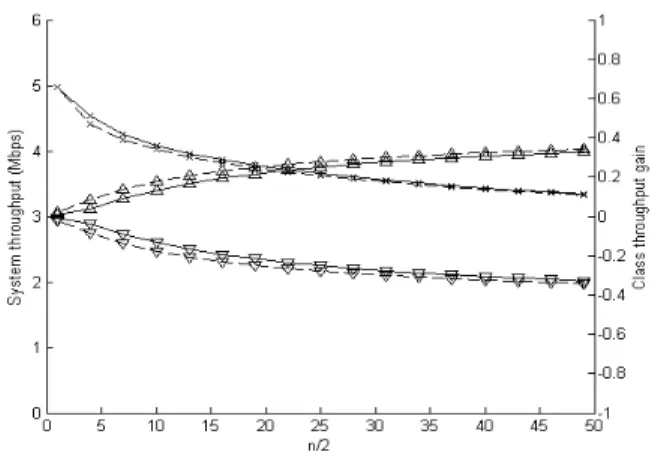
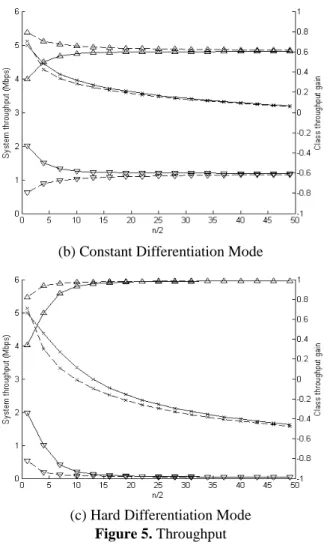
Figure 5 (resp. Figure 6) plots S and GainTh,c (resp. E(D) and
GainDel,c). Solid (resp. dashed) lines represent a traffic load
of
λ
=
0.1
(resp. saturated trafficλ
=
1
). The symbols “ ”, “ ”, “×” represent class c, class c’, the system respectively.Since βc = -βc’ =0.15, we notice that class c throughput (resp.
delay) gain is equal to class c’ throughput (resp. delay) loss. Table 3 provides some numerical values that allow the comparison of class c throughput gain (class c’ throughput loss) using our differentiation modes for different values of the network size and traffic loads.
Table 3. Throughput gain for class c
In Figure 5(a) for λ=0.1, GainTh,c and GainTh,c’ evolve following the soft differentiation mode. For a network of small size, GainTh,c and GainTh,c’ are almost null because both
class c and class c’ select their backoff times following the uniform distribution. When the size of the network increases, GainTh,c increases and GainTh,c’ decreases. This is because,
the contention increases with the network size. Thus, the stations of class c and class c’ reach higher backoff stages where they become more differentiated.
For λ=1, Gain
Th,c and GainTh,c’ evolve in a same manner as
with λ=0.1. Moreover, as the traffic load is saturated, the stations are more likely to reach higher backoff stages for smaller network size compared to a traffic load of λ=0.1. Thus, GainTh,c (resp. GainTh,c’) is larger (resp. smaller) than
with a traffic load of λ=0.1. Moreover, at larger network size, GainTh,c and GainTh,c’ for both traffic loads tend to be
similar since the system saturation point is nearly reached. In Figure 5(b) for λ=0.1, GainTh,c and GainTh,c’ evolve following the constant differentiation mode. For a network of small size, GainTh,c (resp. GainTh,c’) is positive (resp.
negative) because, according to that differentiation mode, class c and class c’ are differentiated even at the first backoff stage. When the size of the network increases, GainTh,c and
GainTh,c’ tend to be constant. This is because, even if the
contention increases with the network size, class c priority prioc,i and class c’ priority prioc’,i stay constant relatively to
the backoff stage i. Thus, GainTh,c and GainTh,c’ do not change
when the network size increases.
For λ=1, GainTh,c and GainTh,c’ evolve in a same manner as with λ=0.1. Moreover, as in Figure 5(a), for small network size, the stations of class c and class c’ are more likely to reach higher backoff stages even at smaller network size, that is due to traffic saturation. Thus, GainTh,c (resp. GainTh,c’) is
larger (resp. smaller) than with a traffic load of λ=0.1. Moreover, as in Figure 5(a), at larger network size, GainTh,c
and GainTh,c’ for both traffic loads tend to be similar since the
system saturation point is nearly reached.
In Figure 5(c) for λ=0.1, GainTh,c and GainTh,c’ evolve following the hard differentiation mode. For a network of small size, GainTh,c (resp. GainTh,c’) is positive (resp.
negative) as in Figure 5(b), because according to that differentiation mode, class c and class c’ are differentiated even at the first backoff stage.
When the size of the network increases, GainTh,c tends to be
100% and GainTh,c’ tends to be -100%. This is because, the
contention increases with the network size. Thus, the stations of class c tend to no backoff mode and class c’ tends to maximum waiting time when selecting the backoff time.
(b) Constant Differentiation Mode
(c) Hard Differentiation Mode
Figure 5. Throughput
For λ=1, GainTh,c and GainTh,c’ evolve in a same manner as with λ=0.1. Moreover, for small network size, as in Figures 5(a) and 5(b) the stations of class c and class c’ are more likely to reach higher backoff stages at smaller network size compared to a traffic load of λ=0.1. Thus, GainTh,c (resp. GainTh,c’) is larger (resp. smaller) than with a traffic load of
λ=0.1.
Moreover, using the hard differentiation mode in Figure 5(c), the whole system throughput S degrades more in comparison to the differentiation modes used in Figures 5(a) and 5(b). This is because, class c backoff time selection tends to no backoff mode and class c’ backoff time selection tends to maximum waiting time. Thus, the contention is not resolved even at small network size.
(a) Soft Differentiation Mode
(b) Constant Differentiation Mode
(c) Hard Differentiation Mode
Figure 6. Average Delay
For both traffic loads λ=0.1 and λ=1, using the three differentiation modes, the system throughput S starts from a value equal to 5Mbps (see Figure 5(a), 5(b) and 5(c)) when the size of the network is minimal and equal to n = 2. And, when the soft or the constant differentiation modes are used, the system throughput becomes equal to 3.4Mbps (see Figures 5(a) and 5(b)) for n =100. But using the hard differentiation mode, the system throughput degrades more to reach a value of 1.6Mbps (see Figure 5(c)) when n = 100. In Figure 6, we see that the impact of applying the different differentiation modes on class delay gain is similar to the impact of applying those modes on class throughput gain shown in Figure 5.
Table 4 shows the average delay for both class c and c’ using the differentiation modes at different traffic loads when the network size is 20. Class c’, of parameter βc’ = - 0.15, suffers
from delay degradation when it uses the hard differentiation mode along with class c of opposite parameter βc = 0.15.
The delay of class c’ becomes of the order of seconds from a network size of n = 24 stations when λ=0.1 and a network size of n = 16 stations when λ=1.
6.
Conclusions
In this paper, we proposed a new scheme for service differentiation in WLANs. This new scheme is based on the 802.11 DCF which uses the backoff procedure to solve contention in WLANs. Our new scheme uses a geometric distribution for random backoff time selection instead of the uniform distribution used by DCF standard. The introduction of a new parameter allows managing the access to the shared media of different types of traffic and gives a level of priority of each type of traffic. High priority traffic have more chance to select a small backoff time and less chance to select a large backoff time in comparison with a low priority traffic. To study our proposal, we used three interesting parameterizations of the backoff time distribution applied on a multi-class system. We gave an analytical study based on Markov model to evaluate performances of the proposed scheme in term of throughput and delay. Our numerical results showed the impact of applying the different differentiation modes on class delay gain and on class throughput gain.
References
[1] IEEE standard for Wireless LAN Medium Access Control (MAC) and Physical Layer (PHY) specifications, IEEE Std: 802.11b-1999/Cor 1-2001, 2001.
[2] IEEE 802.11e/D13.0, Draft Supplement to Part 11: Wireless LAN Medium Access Control (MAC) and Physical Layer (PHY) Specifications: Medium Access Control (MAC) Quality of Service (QoS) Enhancements, 2005.
[3] I. Aad and C. Castelluccia, “Differentiation mechanisms for IEEE 802.11,” INFOCOM 2001, Alaska, USA, pp. 209-218. 2001.
[4] X. Pallot, L. Miller, “Implementing message priority policies over an 802.11 based mobile ad hoc network,” IEEE Military Communications Conference, Virginia, USA, volume 2, pp. 861-865, 2001.
[5] G. Bianchi, “Performance analysis of the IEEE 802.11 distributed coordination function,” IEEE Journal on Selected Areas in Communications, Vol. 18, pp. 535-547, 2000.
[6] D.-J. Deng and R.-S. Chang, “A Priority Scheme for IEEE 802.11 DCF Access Method,” IEICE Transactions on Communication, Vol. E82-B, N°1, pp.96-102. 1999.
[7] M. Ergen and P. Varaiya, “Throughput Analysis and Admission Control for IEEE 802.11a,” Mobile Networks and Applications, Vol. 10, pp. 705-716, 2005.
[8] A. Veres, A-T. Campbell, Michael Barry and Li-hsiang Sun, “Supporting Service Differentiation in Wireless Packet Networks Using Distributed Control,” IEEE Journal on Selected Areas in Communications, Vol. 19, pp. 2094–2104, 2002.
[9] Yang Xiao, “Performance analysis of priority schemes for IEEE 802.11 and IEEE 802.11e wireless LANs,” IEEE transactions on wireless communications, Vol. 4, pp. 1506-1515, 2005.
[10] L. Zhao and C. Fan, “Enhancement of QoS Differentiation Over IEEE 802.11 WLAN,” IEEE COMMUNICATIONS LETTERS, Vol. 8, pp. 494-496, 2004.
[11]M. Ghazvini, N. Movahedinia, K. Jamshidi, “A Game Theory based Contention Window Adjustment for IEEE 802.11 under Heavy Load,” International Journal of Communication Networks and Information Security (IJCNIS), Vol. 5, No. 2, pp. 93-103, 2013.
[12]Tian Guosong and Tian, Yu-Chu, “Modelling and performance evaluation of the IEEE 802.11 DCF for real-time control,” Computer Networks, 56(1), pp. 435-447, 2012.