Early Recurrent Otitis Media, Language and
Central Auditory Processing in Children
Nicci Campbell, Rene Hugo and Isabel Uys
Department of Communication Pathology
University of Pretoria
Johan Hanekom
Department of Electrical and Electronic Engineering
University of Pretoria
Solly Millard
Department of Statistics
University of Pretoria
ABSTRACT
The study examines the relationships that exist between early recurrent otitis media, language and central auditory processing in children. A retrospective case-control experimental design was employed and ten subjects were allocated to each of the two research groups, namely children with a history of early recurrent otitis media (research group 1) and children without a history of early recurrent otitis media (research group 2). The children in both research groups were in grade one and turning 7 years old. The language and central auditory processing of the subjects were assessed using the Clinical Evaluation of Language Function (Wiig & Semel, 1980) and the Willeford Battery of Central Auditory Function (WMeford, 1974). The results showed that the language and central auditory processing of the children with a history of early recurrent otitis media were significantly poorer than that of their disease-free peers. The results stress the importance of vigorous identification and management programmes for children with a history of early recurrent otitis media.
OPSOMMING j
Hierdie studie bestudeer die verhoudings wat bestaan tussen vroee herhaalde otitis media, taal en sentrale ouditiewe prosessering in kinders. 'n Terugkykende geval-beheer eksperimentele navorsingsontwerp is gebruik en tien proefpersone is toegese aan elkeen van die twee navorsingsgroepe, naamlik kinders met 'n geskiedenis van vroee herhaalde otitis media (navorsingsgroep 1) en kinders sender 'n geskiedenis van vroee herhaalde otitis media (navorsings-groep 2). Die kinders in beide navorsingsgroepe was \in graad een en sou sewejaar oud word. Die taal en sentrale ouditiewe prosessering van die proefpersone is geevalueer met behulp van die "Clinical Evaluation of Language Function" (Wiig & Semel, 1980) en die
'Willeford Battery of Centrdl Auditory Function" (WMeford, 1974). Die resultate toon dat die taal en sentrale ouditiewe prosessering van die kinders met 'n geskiedenis van vroee herhaalde otitis media betekenisvol swakker was as vir die kinders sender 'n geskiedenis van vroee herhaalde otitis media. Die resultate beklemtoon die belangnkheid van kragtige identifiserings- en behandelingsprogramme vir kinders met 'n geskiedenis van vroee herhaalde otitis media.
KEY WORDS: early recurrent otitis media, language and central auditory processing. Otitis media, an inflammation of the middle-ear which
may or may not be infectious in origin, is one of the most prevalent diseases in childhood (Friel-Patti, il990). The degree of the conductive hearing loss associated with oti-tis media is variable, ranging from less than lOdBHL to as much as 50dBHL (Friel-Patti, 1990; Gravel & Ellis, 1995). Otitis media usually affects both ears and may be continuous, causing a constant reduced level of hearing or it may be recurrent, causing a fluctuating hearing loss (Northern & Downs, 1984; Gravel & Ellis, 1995). The
child with a history of early recurrent otitis media or the otitis prone child was first described by Howie, Ploussard and Sloyer (1975) as having six or more episodes of otitis media before six years of age.
Although otitis media has been a recognised concern for health-care professionals, the short- and long-term con-sequences of early recurrent otitis media and the accom-panying, usually temporary, hearing loss for child devel-opment are less well understood (Friel-Patti, 1990; Roush & Henderson, 1995). Children with a history of early re-Die
Suid-Afrikaanse
Tydskrifvir Kommunikasieafwykings, Vol. 42, 1995
by
S
ab
in
et
G
at
ew
ay
u
nd
er
li
ce
nc
e
gr
an
te
d
by
th
e
Pu
bl
is
he
r (
da
te
d
20
12
current otitis media are reportedly seen more often than their peers by the speech-language pathologist and audi-ologist for language and central auditory processing dis-orders (Collazo & Kricos, 1986; Paden, 1994). Shriberg & Kwiatowski (1982, cited in Friel-Patti, 1990) have esti-mated that one-third of children seen by the speech-lan-guage pathologist and audiologist have a history of early recurrent otitis media. A review of the literature does however, yield mixed support for associations between early recurrent otitis media and language disorders in children. Although there is strong support in the litera-ture for associations between early recurrent otitis media and central auditory processing disorders, this evidence is largely based on the results of animal studies (Tees, 1967; Clopton & Silverman, 1978; Webster, 1983) and a limited number of human studies (Folsom, Weber & Thompson, 1983; Finitzo, Gunnarson & Clark, 1990; Hurley & Hur-ley, 1995).
Central to the relationships that exist between early recurrent otitis media and language disorders, and early recurrent otitis media and central auditory processing dis-orders, is the hypothesis of a critical period for language acquisition and the development of the central auditory nervous system. The essential prediction from the criti-cal period hypothesis is that the timing of any adverse experience (such as the fluctuating hearing loss associ-ated with early recurrent otitis media) will be crucial and that after a certain age, the ability to acquire language and central auditory processing skills diminishes so that any deficits remaining at the end of this period are un-likely to be overcome (Mogford & Bishop, 1988; Gravel & Ellis, 1995). The notion of a critical period for language acquisition was first proposed by Penfield (1965). Although there is consensus in the literature that the critical pe-riod for language acquisition starts at birth, the upper limit of this period remains controversial (Mogford & Bishop, 1988). Lenneberg (1967) estimates the upper limit at pu-berty while Krashen (1973, cited in Mogford & Bishop, 1988) estimates the upper limit at five years of age. The upper limit of the critical period for the development of central auditory nervous system is also controversial and estimates vary from two years of age (Northern & Downs, 1984) to approximately twelve years of age (Welsh, Welsh &Healy, 1983; Keith, 1988). The upper limits of the criti-cal period for language acquisition and the development of the central auditory nervous system are thus poorly understood at this time (Mogford & Bishop, 1988).
Firstly, with regard to the influence of early re-current otitis media on language development, there are a large number of studies describing the influence of early recurrent otitis media on language acquisition. One of the earliest and most publicized studies describing the negative impact which early recurrent otitis media has on language development in children was documented by Holm and Kunze (1969). Since this study, research find-ings have reported general delays in speech and language development (Zinkus, Gottlieb & Schapiro, 1978; Jerger, Jerger, Alford & Abrams, 1983); lower performance on auditory perceptual and language processing tests (Zinkus etal., 1978; Brandes & Ehinger, 1981; Eimas & Clarkson, 1986); a higher incidence of academic problems, especially reading and spelling disorders; lower scores on tests of phoneme production in connected speech as well as the use of combinations of phonemes in word endings (Needleman, 1977); and a higher frequency of enrolment
in special support classes in schools (Brandes & Ehinger, 1981) as well as in speech and language therapy pro-grammes (Collazo & Kricos, 1986).
There are, however, studies that have yielded mixed support for associations between early recurrent otitis media and language disorders in children. Owrid (1970) found that children with a history of otitis media (but whose hearing was normal at the time of testing) suffer minor, if any, deficit in terms of vocabulary, language com-prehension, syntax and reading level. Roberts, Sanyal, Burchinal, Collier, Ramey and Henderson (1986) found no significant correlations between early recurrent otitis media and outcome measures of standardized test scores for both verbal and non-verbal intelligence and academic functioning. In 1988, in a second study with the same group of children (as used in the study of Roberts et al., 1986) which included speech measures of phonological process analysis and articulation testing, no significant relationship was found between early recurrent otitis media and the number of consonants in error or the number of phonological processes used (Roberts, Burchinal, Koch, Footo & Henderson, 1988). However, Feagans, Sanyal, Henderson, Collier and Applebaum (1987) again using the same sample as Roberts et al. (1986), found a correlation between early recurrent otitis media and narrative ability, but no relationship for early recurrent otitis media and mean length of utterance.
The extent to which early recurrent otitis media can be held responsible for impaired language development in children thus remains an unresolved issue. The above opposing positions to the relationship between early re-current otitis media and language development can possi-bly be attributed to the differences and limitations in the research methodologies employed in the above studies (Paden, 1994). Firstly, the subject sample is often too small to permit generalizations. Secondly, definitions of the oti-tis prone condition vary. Thirdly, the age at which the subjects were assessed vary and the subject sample is of-ten too small to permit generalizations. Fourthly, most of the studies concentrated on one area of speech or language but left others unexplored and finally, other variables such as mental retardation, hearing acuity, exposure to more than one language, history of neurological dysfunction and social-domestic problems which may influence measures of language are not always accounted for (Mogford & Bishop, 1988; Paden, 1994). Further research, which con-siders the above criticisms, is thus necessary to determine the impact, if any, which early recurrent otitis media has
on language acquisition in children. ! Secondly, with regard to the influence of early
recurrent otitis media on central auditory process-ing, evidence from animal studies (Tees, 1967; Clopton & Silverman, 1978; Webster, 1983) has been used to show that periods of auditory deprivation, occurring during a time when the maturational processes of the central audi-tory pathways are not complete, may result in abnormal development of these pathways. This evidence has taken the form of small but demonstrable neuro-anatomic dif-ferences in the brainstem, abnormalities iiythe higher brainstem electrophysiologic responses (Clopton & Silverman, 1978), differences in auditory electrophysiologic studies on binaural interaction tasks, and differences in the behavioural responses to complex sound (Tees, 1967). By way of analogy with animal studies, it has been sug-gested that auditory deprivation (including the
fluctuat-The South African Journal of Communication Disorders, Vol. 42, 1995
by
S
ab
in
et
G
at
ew
ay
u
nd
er
li
ce
nc
e
gr
an
te
d
by
th
e
Pu
bl
is
he
r (
da
te
d
20
12
Early Recurrent Otitis Media, Language and Central Auditory Processing in Children
ing hearing loss associated with early recurrent otitis media) may have a negative influence on the central audi-tory nervous system in humans (Downs, 1988). There are, however, disadvantages in the application of the results of animal studies to the developing human auditory sys-tem: Firstly, the description of a critical period during which the neural system demonstrates plasticity cannot be directly transferred to human development and sec-ondly, the animals used in the above experiments were opera'tively given constant conductive hearing impair-ments during specified periods of time and inferences made with respect to the effects of the fluctuating hearing loss
associated with early recurrent otitis media are thus
specu-lative.
The limited number of human studies available pro-vide strong epro-vidence to support a correlation between early recurrent otitis media and central auditory processing dis-orders in children. Folsom et al. (1983) found significantly greater absolute wave III and V latencies, and I to III and III to V interpeak latencies for children with a history of early recurrent otitis media which suggest subtle differ-ences in brainstem transmission. These findings are con-sistent with those of Finitzo et al. (1990) who also found differences in the middle latency response of children with a history of early recurrent otitis media. The results of the above studies thus provide evidence for associations between early recurrent otitis media and central auditory processing disorders at brainstem and cortical level.
In an interesting and relevant study reported by Welsh et al. (1983), a group of 35 children with a history of otitis media were assessed using the Willeford Battery of Cen-tral Auditory Function (Willeford, 1974). This battery of tests consists of two cortical procedures (the Competing sentence test and the Filtered speech test) and two brainstem procedures (the Binaural fusion test and the Rapidly alternating speech perception test). The results showed that 75 percent of the subjects failed one or more of the four tests. The performance of the subjects was also found to be significantly lower for the Competing sen-tence test, the Filtered speech test and the Binaural fu-sion test than for the Rapidlyj alternating speech percep-tion test. The results of Welsh et al.'s (1983) study thus provide evidence for associations between early recurrent otitis media and central auditory processing disorders at brainstem and cortical level and are consistent with the findings of Folsom et al. (1983) and Finitzo et al. (1990). Acritisism that can be directed at the study of Welsh et al. (1983) is that "the child with a history of otitis media" is not clearly defined. I
More recently, Hurley and Hurley (1995) have investi-gated the effect of otitis media on brainstem electrophysiology using matched experimental and con-trol groups. At the time of the testing all the subjects were free of otitis media and had a discernible auditory brainstem response to clicks at 25dBHL. The results showed that the absolute wave III and V latencies of the experimental group were significantly longer than those of the control group. In addition, the I to V interpeak la-tency of the experimental group was significantly delayed in comparison to the control group.
Despite strong evidence in the literature for associa-tions between early recurrent otitis media and central auditory processing disorders at brainstem and cortical level, further research is necessary to substantiate the results of the limited number of human studies available.
The rationale underlying the study is to examine the relationships that exist between early recurrent otitis media and language and early recurrent otitis media and central auditory processing in children. The results of the study will help the speech-language pathologist and audi-ologist to determine whether children with a history of early recurrent otitis media are a greater risk for develop-ing language and central auditory processdevelop-ing disorders than their peers.
METHODOLOGY
AIMS OF THE STUDY
The main aim of the study is to investigate the influ-ence of early recurrent otitis media on language develop-ment and central auditory processing in children. This aim is realized in the following sub-aims:
1. l b assess the language and compare the intergroup ten-dencies of the language of each research group of sub-jects, namely children with a history of early recurrent otitis media (research group 1) and children without a history of otitis media (research group 2).
2. To assess the central auditory processing and compare the intergroup tendencies of the central auditory processing of each research group of subjects.
RESEARCH DESIGN
A retrospective case-control experimental design (Roberts & Schuele, 1990) was employed to observe whether patterns and relationships exist between early recurrent otitis media and language impairment, and early recurrent otitis media and central auditory processing dis-orders in children.
SUBJECTS
Seventy-two questionnaires were distributed to five English medium primary schools in Pretoria. The five primary schools that participated in the study, were se-lected as there was already an established relationship between the staff at these schools and the staff at the De-partment of Communication Pathology at the University of Pretoria. This Department provides a community serv-ice programme that entails screening the hearing and middle-ear functioning of children at these schools on an annual basis. The advantage of using these schools was that greater cooperation could be expected from the staff and thus the parents (all the questionnaires distributed were completed and returned).
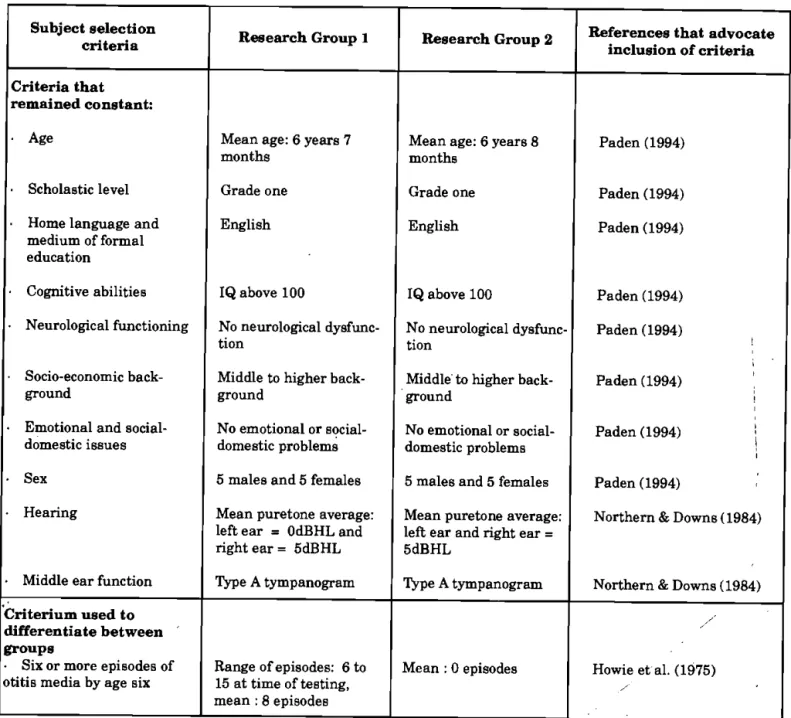
The information used to identify possible candidates was obtained from the questionnaires completed by the parents of the children, the school records and personnel declaration. The subject selection criteria included in the study are in accordance with Paden's (1944) recommen-dation that variables such as age, scholastic level, sex, socio-economic status, intelligence and hearing be control-led when researching the influence of early recurrent oti-tis media on child development. Possible candidates were required to be in grade one (and turning 7 years old). Children in grade one (and turning 7 years old) were se-lected to fascilitate the identification of children with and without a history of early recurrent otitis media in
accord-Die Suid-Afrikaanse
Tydskrifvir Kommunikasieafwykings, Vol. 42, 1995
by
S
ab
in
et
G
at
ew
ay
u
nd
er
li
ce
nc
e
gr
an
te
d
by
th
e
Pu
bl
is
he
r (
da
te
d
20
12
76
ance with Howie et al.'s (1975) definition of the "otitis prone" child namely as having six or more episodes of oti-tis media by 6 years of age. Furthermore, possible candi-dates were required to use English as their home language and medium of formal education, to have average to above-average cognitive abilities, to have no history of neuro-logical dysfunction or symptoms, to have a middle to higher socio-economic background, to have no emotional or so-cial-domestic problems, and finally to have normal hear-ing (air-conduction thresholds between 0 and 15 dBHL for the frequency range 125-8000 Hz) and normal middle-ear functioning (type Atympanograms with a middle-ear pres-sure of between -100 and +50 daPa, and a static compli-ance of between 0,3 and 1,75 cm3). The normative data
used to interpret the above audiometric test results is based on the norms recommended by Northern & Downs (1984) and Keith (1988). The subject selection criteria and parameters are presented in Table 1.
Sixteen possible candidates were identified for research group 1 (children with a history of early recurrent otitis
media) and twenty-nine possible candidates were identi-fied for research group 2 (children without a history of early recurrent otitis media). Possible candidates for re-search group 1 were also required to satisfy Howie et al.'g (1975) definition of the "otitis prone" child. Twenty sub-jects were then selected using the table of random num-bers method (Roberts & Schuele, 1990), and ten
subjects
were allocated to each research group with an even distri-bution of five males and five females per group.APPARATUS AND MATERIAL
- Apparatus and material used to identify possible subjects
- Questionnaire
A questionnaire was developed to identify children who met the subject selection criteria and thus possible candi-dates for the study. The areas covered in the question-naire included the child's name and age, home language, history of otitis media and medical history.
Table 1: Subject selection criteria and parameters Subject selection
criteria Research Group 1 Research Group 2 References that advocate inclusion of criteria Criteria that
remained constant:
• Age Mean age: 6 years 7
months Mean age: 6 years 8 months Paden (1994)
Scholastic level Grade one Grade one Paden (1994)
• Home language and medium of formal education
English English Paden (1994)
Cognitive abilities IQ above 100 IQ above 100 Paden (1994) • Neurological functioning No neurological
dysfunc-tion No neurological dysfunc-tion Paden (1994) 1 1 • Socio-economic
back-ground Middle to higher back-ground Middle to higher back-ground Paden (1994) 1 • Emotional and
social-domestic issues No emotional or social-domestic problems No emotional or social-domestic problems Paden (1994) j 1 • Sex 5 males and 5 females 5 males and 5 females Paden (1994)
• Hearing Mean puretone average: left ear = OdBHLand right ear = 5dBHL
Mean puretone average: left ear and right ear = 5dBHL
Northern & Downs (1984)
• Middle ear function Type A tympanogram Type A tympanogram Northern & Downs (1984) Criterium used to
differentiate between groups
Six or more episodes of
otitis media by age six Range of episodes: 6 to 15 at time of testing, mean : 8 episodes
Mean: 0 episodes Howie et al. (1975)
The South African Journal of Communication Disorders, Vol. 42, 1995
by
S
ab
in
et
G
at
ew
ay
u
nd
er
li
ce
nc
e
gr
an
te
d
by
th
e
Pu
bl
is
he
r (
da
te
d
20
12
77
Audiometric equipmentA GSI-10 Audiometer and GSI-33 Middle Ear Analyzer were used to assess hearing acuity and middle-ear func-tioning prior to the assessments of language and central auditory processing. A sound-proof testing booth and Tel-ephonic TDH-50 earphones with MX 41/AR cushions were
u s e d . The audiometer and middle-ear analyser were
cali-brated according to the SAB 0154 - 1979 requirements. Apparatus and material used in the evaluation of study groups 1 and 2
. The Clinical Evaluation of Language Function (Wiig & Semel, 1980)
The CELF was selected as this language assessment pro-cedure provides differential measures of selected language functions in the area of phonology, syntax, semantics, memory, word-finding and retrieval. These measures have thus been designed to probe specific areas of language processing and production abilities as well as the ability to process and produce speech sounds in school-age chil-dren. A summary of the CELF subtests is provided in Appendix A. All the subtests of the CELF were adminis-tered with the exception of the Word series subtest. The Word series subtest was not administered as Wiig and Semel (1980) stipulate (in their test manual) that this subtest should not be administered to children younger than 8 years of age.
A drawback to the choice of the CELF for assessing the language of the subjects in the study is the fact that the CELF has been compiled and standardized for children living in the United States of America (USA) and not chil-dren living in the Republic of South Africa (RSA). There is, however, no equivalent measure of language ability with norms available for the RSA population. It is of concern to note that most of the diagnostic measures used in the RSA for research and clinical diagnosis have been obtained from other countries, and the norms are thus not neces-sarily representative of the RSA population. Furthermore, certain words and language structures are specific to dif-ferent countries and may thus not be familiar to other groups. Although the language {structures included in the CELF should be familiar to the RSA population, there are a few words such as "sneakersJ, "candy" and "drugstore" that do not form part of South-African English. As the aim of the study was to assess the language and compare the intergroup tendencies of each experimental group (and not the applicability of the CELF norms to the RSA popu-lation) it was decided to use the CELF without any adap-tations or changes to the test items but to familiarize the subjects with the unfamiliar words prior to the testing (by explaining the meanings of the words and asking the sub-jects to repeat the words). A list of the words with which
the subjects were familiarized is presented in Appendix B. - The Willeford Battery of Central Auditory
Func-tion (Willeford, 1974)
The Willeford Battery of Central Auditory Function was selected as this battery of tests provides normative data for children from the age of five years and consists of four separate procedures for assessing central auditory process-ing. Two of the procedures have been designed to assess cortical function and two to assess the integrity of the brainstem. The cortical procedures are the Competing sentence test and the Filtered speech test. The brainstem
measures are the Binaural fusion test and the Rapidly alternating speech perception test. The Willeford Battery of Central Auditory Function (Willeford, 1974) was pur-chased from Professor J A Willeford and consists of an audio-cassette with the test stimuli, a test manual and normative data. A summary of the tests of the Willeford Battery of Central Auditory Function is provided in Ap-pendix C.
The drawbacks to the choice of the Willeford Battery of Central Auditory Function for assessing the central audi-tory processing of the subjects in the study are firstly, that this battery of tests has been compiled and standardized for the USA and not the RSA population, and secondly, the audio-casette with the test stimuli has been recorded using the voice of an adult male speaker with a USA ac-cent.
Although the language structures used in the Willeford Battery of Central Auditory Function should be familiar to the RSA population, there are a few words and phrases such as "gas", "dime" and "Fourth of July" that do not form part of South-African English. As the aim of the study was to assess the central auditory processing and com-pare the intergroup tendencies of each experimental group (and not the applicability of the norms of the Willeford Battery of Central Auditory Function to the RSA popula-tion) it was decided to use this battery of tests without any adaptations or changes to the test items but to famil-iarize the subjects with the unfamiliar words and phrases prior to the testing (by explaining the meaning of the words and phrases, and asking the subjects to repeat the words). A list of the words with which the subjects were familiar-ized is presented in Appendix D.
The test stimuli of the Willeford Battery of Central Au-ditory Function were retaped, using the voice of a speaker with a South African accent as the impact of the unfamil-iar accent would have influenced not only a few but all the test items. Permission to retape the test stimuli was ob-tained from Professor J A Willeford (personal telephone conversation, 1989). An electrical engineer at the Depart-ment of Electrical and Electronical Engineering at the University of Pretoria built the filters and equipment re-quired to retape the test stimuli (as stipulated in the test manual) and the test stimuli were recorded using the voice of an adult male speaker with a South-African accent simi-lar to that of the subjects.
- Audiometric equipment
A GSI-10 Audiometer and Philips N2520 audio-cassette recorder were used for administering the Willeford Bat-tery of Central Auditory Function to the subjects. The testing took place in a sound-proof booth and Telephonic TDH-50 earphones with MX41/AR cushions were used.
DATA COLLECTION PROCEDURES
The twenty subjects were individually assessed at the Department of Communication Pathology at the Univer-sity of Pretoria. Each subject was exposed to a 2 hour 20 minute test procedure and the testing was completed in a single session. Subjects were, however, permitted to rest if they became fatigued, and all the subjects were given a break of 15 minutes and refreshments midway through the testing.
Puretone testing and immittance were administered using the instructions and procedures stipulated by ANSI
Die Suid-Afrikaanse
Tydskrifvir Kommunikasieafwykings, Vol. 42, 1995
by
S
ab
in
et
G
at
ew
ay
u
nd
er
li
ce
nc
e
gr
an
te
d
by
th
e
Pu
bl
is
he
r (
da
te
d
20
12
53.21 - 1978 (in Silman & Silverman, 1991) and the GSI-33 Middle Ear Analyzer test manual. Subjects were re-quired to have normal hearing acuity and middle-ear func-tioning as a prerequisite to the administration of the CELF and the Willeford Battery of Central Auditory Function. The average time required to complete the puretone test-ing and immittance was 10 minutes per subject.
The subjects were then familiarized with the words listed in Appendixes Β and D prior to the administration of the CELF and Willeford Battery of Central Auditory Function. The meaning of the words in these appendixes were explained and the subjects were asked to repeat the words. This process took approximately 10 minutes per subject.
The CELF was then administered in a quiet hon-distractable room following the standardized instruction and administration procedures stipulated in the CELF Di-agnostic Examiners manual. The average time required for the administration of the CELF was 1 hour 10 min-utes per subject.
Finally, the Willeford Battery of Central Auditory Func-tion was administered following the standardized instruc-tions and procedures stipulated in the test manual. The average time that was required for the administration of this battery of tests was 50 minutes.
DATA ANALYSIS AND PROCESSING
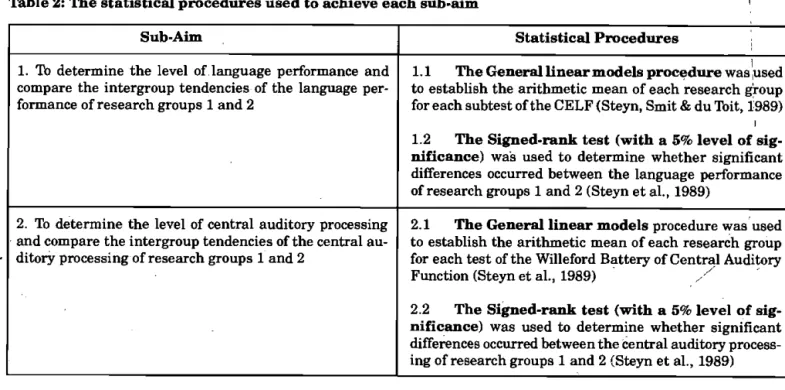
The subtests and tests of the CELF and Willeford Bat-tery of Central Auditory Function were totalled for each subject by adding the scores obtained for each item. This information was then analyzed by a statistician using an IBM 370 Computer and the Biomedical Computer Pro-gramme. The statistical procedures employed to achieve each sub-aim are presented in Table 2.
RESULTS AND DISCUSSION
This section is presented according to the formulated sub-aims and entails a description and comparison of the
language and central auditory processing of research groups 1 and 2.
DESCRIPTION AND COMPARISON OF THE LANGUAGE PERFORMANCE OF RESEARCH GROUPS 1 AND 2
The first sub-aim (namely, to determine and compare the intergroup tendencies of the language of research groups 1 and 2) was realized by administering the CELF (Wiig & Semel, 1980) to the subjects in the two research groups. The General linear models procedure (Steyn, Smit & du Ibit, 1989) was used to establish the arithmetic mean of each research group for each subtest of the CELF, and the Signed-rank test (with a 5% level of significance) was used to determine whether significant differences occurred between the language performance of research groups 1 and 2 (Steyn et al., 1989). These results are presented in Table 3.
The language processing subtests on which research group 1 exhibited significantly lower scores than that of research group 2 (at the 5% level of significance) were the Word and sentence structure subtest (which assesses the ability to process and interpret word and sentence struc-tures), the Linguistic concepts subtest (which evaluates the ability to process and interpret oral directions which con-tain linguistic concepts requiring logical operations), the Relationships and ambiguities subtest (which assesses the ability to process and interpret logico-grammatical and am-biguous sentences) and the Oral directions subtest (which evaluates the ability to interpret, recall and execute oral commands of increasing length and complexity). These results thus support the research findings of Zinkus et al. (1978), Brandes and Ehinger (1981), and Eimas and Clarkson (1986) who reported that children with a his-tory of otitis media have significantly poorer receptive lan-guage abilities and have difficulty understanding complex and/or lengthy language structures.
The language processing subtests on which no sig-nificant differences occurred (at the 5% level of signifi-Table 2: The statistical procedures used to achieve each sub-aim
Sub-Aim Statistical Procedures
1. To determine the level of language performance and compare the intergroup tendencies of the language per-formance of research groups 1 and 2
1.1 The General linear models procedure was 'used to establish the arithmetic mean of each research group for each subtest of the CELF (Steyn, Smit & du Toit, l'989)
I 1.2 The Signed-rank test (with a 5% level of sig-nificance) was used to determine whether significant differences occurred between the language performance of research groups 1 and 2 (Steyn et al., 1989)
2. To determine the level of central auditory processing and compare the intergroup tendencies of the central au-ditory processing of research groups 1 and 2
2.1 The General linear models procedure was used to establish the arithmetic mean of each research group for each test of the Willeford Battery of Central Auditory Function (Steyn et al., 1989) / 2.2 The Signed-rank test (with a 5% level of sig-nificance) was used to determine whether significant differences occurred between the central auditory process-ing of research groups 1 and 2 (Steyn et al., 1989)
The South African Journal of Communication Disorders, Vol. 42, 1995
by
S
ab
in
et
G
at
ew
ay
u
nd
er
li
ce
nc
e
gr
an
te
d
by
th
e
Pu
bl
is
he
r (
da
te
d
20
12
Early Recurrent Otitis Media, Language and Central Auditory Processing in Children cance) in the performance of research groups 1 and 2 were
the Word classes subtest (which evaluates the ability to perceive relationships between verbal concepts and iden-tify word pairs) and the Spoken paragraphs subtest (which evaluates the ability to process and interpret salient in-formation presented). The Word classes subtest consists of items featuring three or four verbal concepts of which two are associated. The child is required to identify the two concepts which are related. The subjects in both re-search groups 1 and 2 found this subtest less taxing than the other language processing subtests, and it is thus pos-sible that the Word classes subtest is less sensitive than the other language processing subtests in identifying the language impair-ment associated with early recurrent oti-tis media in children. The Spoken paragraphs subtest con-sists of four paragraphs of increasing length and com-plexity and the child is required to recall details such as proper names, numerical and geographical data. The sub-jects in both research groups 1 and 2 performed poorly on this subtest and can possibly be attributed to the high in-cidence of unfamiliar words (that do not form part of
South-African English, for example: candy, drugstore and dol-lar) which occur in this subtest. The subjects in both re-search groups had difficulty in recalling these words de-spite having been familiarized with these words prior to the testing. This finding highlights the need for language assessment procedures that have been compiled and stand-ardized for the RSA population.
The language production subtests on which research group 1 exhibited significantly lower scores than that of research group 2 (at the 5% level of significance) were the Confrontation naming subtest (which evaluates the child's accurancy, fluency and speed in naming colours, forms, and colour-form combinations), the Model sentences subtest (which assesses productive control of sentence structures in a sentence repetition task) and the Formulated sentence subtest (which evaluates the ability to formulate and pro-duce sentences). These results support the research find-ings of Jerger et al. (1983) and Menyuk (1986) who found that children with a history of otitis media produce fewer sentences with prepositional phrases, use a higher inci-dence of simple sentences and experience difficulties with
Tfeble 3: A comparison of the language performance of research groups 1 and 2 on the Celf subtests (at the level of significance)
The Celf Subtest
Average achievements or arithmetic means of research
groups 1 and 2
Comparison of the language performance
of research groups 1 Research
group 1
Research group 2
Comparison of the language performance
of research groups 1
1 Word and sentence structure 20 25
2 Word classes 10,7 11,3
I 3 Linguistic concepts 26 28,7
4 Relationships and ambiguities 9,9 19,7
5 Oral directions j 1 11 15,6
/ 6 Spoken paragraphs 1 1,1
7 Confrontation naming: accuracy 29,1 32,7 II Confrontation naming: time 161,8 130
8 Word associations 11 11
9 Model sentences 19 23
10 Formulated sentences 14 16
11 Processing speech sounds 119,8 120 12 Producing speech sounds - blends 52 52 III Producing speech sounds - final position 18 18 Producing speech sounds - initial position 20 20 KEY:
I Language processing subtests II Language production subtests III Supplementary subtests
[~| No significant difference between research groups 1 and 2. [~| Performance of research group 1 lower than experimental group 2.
Die Suid-Afrikaanse
Tydskrifvir Kommunikasieafwykings, Vol. 42, 1995
by
S
ab
in
et
G
at
ew
ay
u
nd
er
li
ce
nc
e
gr
an
te
d
by
th
e
Pu
bl
is
he
r (
da
te
d
20
12
syntax and morphological markers.
There was, however, no difference in the performance of research groups 1 and 2 for one of the language pro-duction subtests, namely the Word associations subtest (which evaluates the quantity and quality of the retrieval of semantically related word series from long term memory). This subtest requires the child to name as many members as possible from two semantic classes, foods and animals, in sixty seconds. The subjects in both research groups 1 and 2 found this subtest less taxing than the other language production subtests, and it is thus possi-ble that the Word associations subtest is less sensitive than the other language production subtests in identifying the language impairment associated with early recurrent oti-tis media in children.
There were also no significant differences between the two research groups (at the 5% level of significance) for the supplementary subtests of the CELF, namely the Processing of speech sounds subtest (which evaluates the ability to discriminate between speech sounds in minimally different word pairs) and the Producing speech sounds subtest (which evaluates the child's accuracy in articulat-ing blends, final position phonemes and initial position phonemes). These results support the research finds of Roberts et al. (1988) who found no significant correlations between early recurrent otitis media, auditory discrimina-tion and articuladiscrimina-tion disorders in children.
DESCRIPTION AND COMPARISON OF THE CEN-TRAL AUDITORY PROCESSING OF RESEARCH GROUPS 1 AND 2
The second sub-aim (namely, to determine and compare the intergroup tendencies of the central auditory process-ing of research groups 1 and 2) was realized by
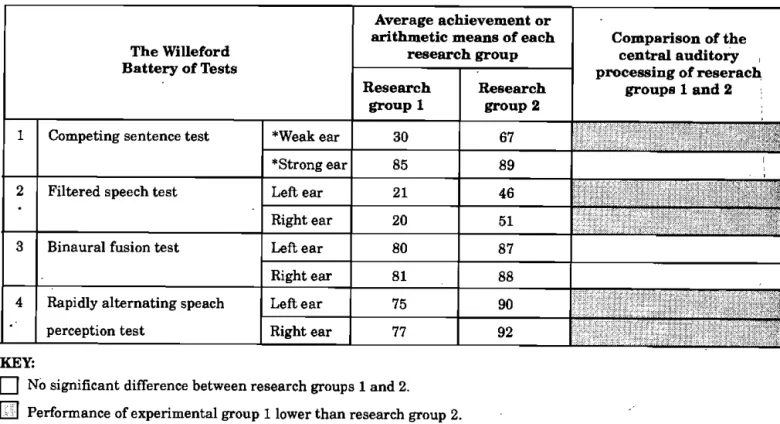
adminis-tering the Willeford Battery of Central Auditory Function (Willeford, 1974) to the subjects in the two research groups. The General linear models procedure (Steyn et al., 1989) was used to establish the arithmetic mean of each research group for each test of the Willeford Battery of Central Auditory Function, and the Signed-rank test (with a 5% level of significance) was used to determine whether sig-nificant differences occurred in the central auditory processing of research groups 1 and 2 (Steyn et al., 1989), These results are presented in Table 4.
The results of the Willeford Battery of Central Audi-tory Function showed that the central audiAudi-tory process-ing of subjects in research group 1 was significantly lower than that of research group 2 for both of the cortical pro-cedures, namely the Filtered speech test (test conditions: left and right ear) and the Competing sentence test for the weak ear condition. These results support the research findings of Welsh et al. (1983) who reported that children with a history of otitis media exhibit lower scores than their disease-free peers on the cortical procedures of the Willeford Battery of Central Auditory Function.
There was, however, no significant difference between the two research groups for the strong ear condition of the Competing sentence test. This finding suggests that the maturation of the strong ear condition may be less sus-ceptible to the negative influence of early recurrent otitis media. Further research is, however, necessary to sub-stantiate this hypothesis as there is no evidence in the literature to support this finding. It is interesting to note that the strong ear was the right ear for all the subjects in research groups 1 and 2. As documented in Kaplan, Gladstone & Katz (1984), the strong ear is usually the right ear and scores in the weak ear continue to improve until the age often years when ear performance becomes equal for the competing sentence test.
Table 4: A comparison of the central auditory processing of research groups 1 and 2 (at the 5% level of signifi-cance)
The Willeford Battery of Tests
Average achievement or arithmetic means of each
research group Comparison of the central auditory processing of reserach
groups 1 and 2 The Willeford
Battery of Tests
Research
group 1 Research group 2
Comparison of the central auditory processing of reserach
groups 1 and 2 1 Competing sentence test *Weak ear 30 67
1 Competing sentence test
*Strong ear 85 89
2 Filtered speech test Left ear 21 46 2 Filtered speech test
Right ear 20 51
3 Binaural fusion test Left ear 80 87 3 Binaural fusion test
Right ear 81 88
4 Rapidly alternating speach perception test
Left ear 75 90
4 Rapidly alternating speach
perception test Right ear 77 92
s a B H H B H I M N i
KEY:
I | No significant difference between research groups 1 and 2.
ED Performance of experimental group 1 lower than research group 2.
* The weak ear was the left ear and the strong ear the right ear for all the subjects in research groups 1 and 2
The South African Journal of Communication Disorders, Vol. 42, 1995
by
S
ab
in
et
G
at
ew
ay
u
nd
er
li
ce
nc
e
gr
an
te
d
by
th
e
Pu
bl
is
he
r (
da
te
d
20
12
The performance of research group 1 was also signifi-cantly lower than that of research group 2 for the first brainstem procedure, namely the Rapidly alternating speech perception test (test conditions : left and right ear performance) but no significant difference occurred for the second brainstem procedure, namely the Binaural fusion test (test conditions: left and right ear performance). These results contradict the research findings of Welsh et al. (1983) who reported that children with a history of otitis media exhibit lower scores than their disease-free peers on the Binaural fusion test but similar scores for the Rap-idly alternating speech perception test. These contradic-tions can possibly be attributed to the fact that the sub-jects included in the study were familiarized with the
words listed in Appendix D. prior to the testing (as dis-cussed in the Methodology). This procedure may have influenced the internal validity of the Binaural fusion test (where the child is asked to repeat words filtered in such a way that a low pass segment is presented to one ear and a high pass segment is simultaneously presented to the other ear) as it is easier to remember and repeat words with which one is familiar. The Rapidly alternating speech perception test consists of sentences which are presented in alternating bursts of 300 m. sec. duration to first the one ear and then the other. Although the subjects were familiarized with the unfamiliar words included in these sentences, they were not familiarized with the actual sen-tences which are more difficult to repeat than words (as required for the Binaural fusion test).
The above results thus provide evidence for associations between early recurrent otitis media and delayed central auditory processing abilities and support the research finds of the limited number of human studies (Folsom et al., 1983; Welsh et al., 1983; Finitzo et al., 1990; Hurley & Hurley, 1995) available.
To summarize, the results of the study found the lan-guage and central auditory processing abilities of children with early recurrent otitis media to be significantly poorer than that of their disease-free peers. This finding is con-cerning as the children included in the study were in grade one (and turning seven yearsjold). Children with a his-tory of early recurrent otitis media thus enter school at a disadvantage as impaired and/or delayed language and central auditory processing abilities place children at greater risk for developing scholastic difficulties (Friel-Patti, 1990). The language arid central auditory process-ing impairments and/or delays associated with early re-current otitis media should thus ideally be resolved be-fore children enter school (Paden, 1994). Although the results do not shed much light on the hypothesis of a criti-cal period, it would appear that early recurrent otitis me-dia has a negative influence on the development of lan-guage and central auditory processing during the first six years of life. Further research is necessary to determine the barriers of the critical period and to determine whether children are able to overcome language and central audi-tory processing disorders once the upper limit of this pe-riod has been reached.
A criticism that can be directed at the study and other retrospective studies (Holm & Kunze, 1969; Zinkus et al., 1978; Collazo & Kricos, 1986) is the fact that parental recall and physician's records of children's histories of early recurrent otitis media are not always accurate (Paden, 1994). Based on the results of the study, it is felt that a prospective longitudinal study where the history of otitis
media is carefully monitored and documented, and lan-guage and central auditory processing are assessed from birth to puberty would help to improve the speech-lan-guage pathologist and audiologist's understanding of the associations that exist between early recurrent otitis me-dia, language and central auditory processing in children. Prospective research is, however, expensive and is thus not always practical or viable, particularly in a country such as the Republic of South Africa where the poor eco-nomic situation has resulted in drastic financial cutbacks in research programmes. It is hoped that the results of the study will help to stress the importance of further re-search in this area, and that a prospective study will be possible in the near future. In the interim, the results of the study stress the importance of vigorous prevention, identification and intervention programmes for children with a history of early recurrent otitis media.
CONCLUSION
The results of the study have shown that the language and central auditory processing of the children with a his-tory of early recurrent otitis media (research group 1) were significantly poorer than for their disease-free peers (re-search group 2). Children with a history of early recur-rent otitis media were thus found to enter school at a dis-advantage as impaired and/or delayed language and cen-tral auditory processing abilities place children at greater risk for developing scholastic difficulties. The results of the study stress the importance of vigorous prevention, identification and intervention programmes for children with a history of early recurrent otitis media and the need for further research to improve the speech-language pa-thologist and audiologist's understanding of the relation-ships that exist between early recurrent otitis media, lan-guage and central auditory processing in children. REFERENCES
Brandes, P.J. & Ehinger, D.M. (1981). The effects of early middle ear pathology on auditory perception and academic achievement. Journal of Speech and Hearing Disorders, 46, 301-307.
Clopton, B.M. & Silverman, M.S. (1978). Changes in latency and duration of neural responses following developmental auditory deprivation. Experimental Brain Research, 32, 39-47.
Collazo, M. & Kricos, P. (1986). Otitis prone children and the need for speech/language services. Hearing instruments, 37, 14-19.
Downs, M.P. (1988). Contribution of Mild Hearing Loss to Auditory Language
Learning Problems. In Roeser, R.J. & Downs, M.P. (Eds.): Auditory Disorders in School Children. New York: Thieme
Medical Publishers, Inc.
Eimas, P.D. & Clarkson, R.L. (1986). Speech perception in children: are there effects of otitis media? In Kanagh, J.F. (Ed.): Otitis media and child development. Parkton: York Press.
Feagans, L., Sanyal, M., Henderson, F., Collier, A. & Applebaum, M. (1987).
Relationship of middle ear disease in early childhood to later narrative and attention skills. Journal of Paediatric Psychology, 12, 581-594.
Finitzo, T., Gunnarson, A.D. & Clark, J.L. (1990). Auditory deprivation and early conductive hearing loss from otitis media. Ibpics in Language Disorders, 11 (1), 29-42.
Folsom, R.C., Weber, B.A. & Thompson, G. (1983). Auditory brainstem response measures in children with early recurrent middle-ear disease. Annals of Otolaryngology, Rhinology and Laryngology, 92, 249-253.
Die Suid-Afrikaanse
Tydskrifvir Kommunikasieafwykings, Vol. 42, 1995
by
S
ab
in
et
G
at
ew
ay
u
nd
er
li
ce
nc
e
gr
an
te
d
by
th
e
Pu
bl
is
he
r (
da
te
d
20
12
Friel-Patti, S. (1990). Otitis media with effusion and the development of language: A review of evidence. Topics in
Language Disorders, 11 (11), 11-22.
Gravel, J.S. & Ellis, M.A. (1995). The auditory consequences of otitis media with effusion: the audiogram and beyond.
Seminars in Hearing, 16(1), 44-59.
Holm, V.A. & Kunze, R.H. (1969). The effects of chronic otitis media on language and speech development. Paediatrics, 43, 833-841.
Howie, V.M., Ploussard, J.H. & Sloyer, J. (1975). The'otitis prone' condition. American Journal of Diseases in Children, 129, 676-678.
Hurley, R.M. & Hurley, A. (1995). The auditory brainstem response in children with histories of otitis media. Seminars in Hearing, 16(1), 37-43.
Jerger, S.J., Jerger, J., Alford, B.R. & Abrams, S. (1983). Development of speech intelligibility in children with recurrent otitis media. Ear and hearing, 4, 138-145.
Kaplan, H., Gladstone, V.S. & Katz, J. (1984). Site of Lesion
Testing - Audiometric Interpretation, Volume II. Baltimore:
University Park Press.
Keith, R.W. (1988). Central Auditory Tests. In Lass, N.J., Reynolds, L.V.,
Northern, T.L. & Yoder, D.E. (Eds,): Handbook of Speech-Language Pathology and Audiology. Toronto: B.C. Decker, Inc.
Lenneberg, E.H. (1967). The Biological Foundations of Language. New York: Wiley.
Menyuk, R. (1986). Predicting speech and language problems with persistent otitis media. In Kawanagh, J.F. (Ed.): Otitis media and child develop-ment. Parkton: York Press. Mogford, K. & Bishop, D. (1988). Five questions about language
acquisition considered in the light of exceptional circumstances. In Bishop, D. & Mogford, K. (Eds): Language development in exceptional circumstances. Edinburgh: Churchill Livingstone.
Needleman, H. (1977). Effects of hearing loss from early recurrent otitis media on speech and language development. In Jaffe, B.F. (Ed.): Hearing Loss in Children. Baltimore: University Park Press.
Northern, J.L. & Downs, M.P. (1984). Hearing in Children. Baltimore: The Williams and Co.
Owrid, H.L. (1970). Hearing impairment and verbal attainment in primary school children. Educational Research, 12, 209-214.
Paden, E.P. (1994). Otitis media and disordered phonologies-some concerns and cautions. Topics in Language Disorders 14(2), 72-83.
Penfield, W. (1965). Conditioning the uncommitted cortex f0 r
language learning. Brain, 88, 787-798.
Roberts, J.E., Burchinal, M., Koch, M., Footo, M. & Henderson F. (1988). Otitis media in early childhood and its relationship to later phonological development. Journal of Speech and. Hearing Disorders, 53, 416-424.
Roberts, J.E., Sanyal, M.A., Burchinal, M.R., Collier, A.M., Ramey C.T.& Henderson, F.W. (1986). Otitis media in early childhood and its relationship to later verbal and academic performance
Paediatrics, 78, 428-430.
Roberts, J.E. & Schuele, C.M. (1990). Otitis media and later academic performance. The linkage and implications for intervention. Topics in Language Disorders, 11(1), 43-62. Roush, J. & Henderson, F. (1995). Medical and audiological
management of otitis media: consensus and controversy.
Seminars in Hearing, 16(1), 105-112.
Silman, S. & Silverman, C.A. (1991). Auditory diagnosis: Principles and Applications. San Diego: Academic Press, Inc Steyn, A.G.W., Smit, C.F. & du Toit. (1989). Moderne Statistiek
vir die Praktyk. Pretoria: J.L. van Schaik, Ltd.
Tees, R.C. (1967). The effects of early auditory restrictions in the rat on adult auditory discrimination. Journal of Auditory
Research, 7, 195-207.
Webster, D.B. (1983). A critical period during post-natal auditory development of mice. International Journal of Paediatric Otorhinolaryngology, 6, 107-118.
Welsh, L.W., Welsh, J.J. & Healy, M.P. (1983). Effects of sound deprivation on central hearing. Laryngoscope, 93 (12), 1569-1576.
Wig, E.H. & Semel, E.M. (1980). Clinical Evaluation of Language
Function. Columbus, Ohio: Charles, E. Merrill Publishing
Company.
Willeford, J.A. (1974). Willeford Battery of Central Auditory
Function. Colorado: Department of Audiology, Colorado State
University.
Willeford, J.A. (1989). Personal Telephone Conversation. Department of Audiology, Colorado State University.
Zinkus, P.W., Gottlieb, M.I. &Schapiro,M. (1978). Developmental and psycho-educational sequelae of chronic otitis media. American Journal of Disabilities in Children, 132, 1100-1104.
χ
The South African Journal of Communication Disorders, Vol. 42, 1995
by
S
ab
in
et
G
at
ew
ay
u
nd
er
li
ce
nc
e
gr
an
te
d
by
th
e
Pu
bl
is
he
r (
da
te
d
20
12
Appendix A: Summarized overview of the subtest of the celf (Wiig & Semel, 1980) Subtest Description of each subtest
1 Word and sentence structure Assesses the child's ability to process and interpret selected word and sen-tence structures.
2 Word classes Evaluates the child's ability to perceive relationships between verbal con-cepts and identify word pairs.
I 3 Linguistic concepts Evaluates the ability to process and interpret oral directions which contain linguistic concepts requiring logical operations.
4 Relationships and ambiguities Evaluates the ability to process and interpret logico-grammatical and am-biguous sentences.
5 Oral directions Evaluates the ability to interpret, recall and execute oral commands of in-creasing length and complexity.
6 Spoken paragraphs Evaluates the ability to process and interpret spoken paragraphs and recall salient information presented.
7 Word series Assesses the accuracy, fluency and speed in recalling and producing selected automatic-sequential word series.
8 Confrontation naming Evaluates the accuracy, fluency, and speed in naming colours, forms, and colour-form combinations in a sustained confrontation-naming task. II 9 Word associations Evaluates the quantity and quality of the retrieval of semantically related
word series from long term memory.
10 Model sentences Assesses productive control of sentence structure in a sentence repetition task.
11 Formulated sentences Evaluates the ability to formulate and produce sentences when word and sentence form choices are limited and when semantic and syntactic con-straints are introduced by a word which has to be included.
12 Processing speech sounds Evaluates the ability to discriminate between speech sounds (phonemes) in minimally different word pairs.
III 13 Producing speech sounds Evaluates the accuracy in articulating selected elicited speech sounds (pho-nemes).
KEY:
I Language processing subtests II Language production subtests III Supplementary subtests x
Appendix B: The list of unfamiliar words with which subjects were familiarized prior to the administration of the Celf
sneakers football player candy
yards mailman dollar
drugstore
Die Suid-Afrikaanse Tydskrif vir Kommunikasieafwykings, Vol. 42, 1995
by
S
ab
in
et
G
at
ew
ay
u
nd
er
li
ce
nc
e
gr
an
te
d
by
th
e
Pu
bl
is
he
r (
da
te
d
20
12
Appendix C: Summarized overview of the tests of the Willeford Battery of Central Auditory Function (Willeford, 1974)
TEST DESCRIPTION OF EACH TEST
I Competing sentence test The test stimuli consist of simultaneously presented competing sentences presented to opposite ears. Ten of the competing sentence pairs are presented with the primary sentence in the left ear and the other 10 competing sentence pairs are then pre-sented with the primary sentence in the right ear. The child is asked to repeat the primary sentence in the test ear. Two percentage scores are then obtained, namely the weak ear score (test condition: weak ear) and the strong ear score (test condition ; strong ear). The strong ear is usuallv (but not always") the right par for yming children. Scores in the weak ear improve until the age of 10 years when ear perform-ance becomes equal.
Filtered speech test The test stimuli consist of low-pass filtered consonant-vowel-consonant words pre-sented first to the left ear (test condition : left ear) and then to the right ear ftflfit condition : right ear). The child is asked to repeat the words heard first in tVio loft ear and then in the right ear. The difference between the left and right ear response is minimal, i.e. a balanced response is obtained.
II Binaural fusion test The test stimuli consist of spondee words filtered in such a way that a low pass segment is presented to one ear and a high pass segment is presented simultane-ously to the other ear. The child is asked to repeat the words. The test ear is re-ported with reference to the ear receiving the low pass segment. The low pass seg-ment is first presented in the left ear with the high pass segseg-ment to the right ear (test condition : left ear) for the first list of words. The low pass segment, is thpn presented to the right ear with the high pass segment to the right ear (test condition : right ear) for the second list of words. The difference between the lpft and right snr response is minimal, i.e. a balanced response is obtained.
Rapidly alternating
speech perception test The test stimuli consist of sentences which are presented in alternating bursts of 300m. sec. duration, first to one ear and then the other. The child is asked to repeat the sentences. The test ear is the ear in which the first burst starts, for example: starts in the left ear (test condition : left ear) or starts in right ear (test condition : right ear). The difference between the left and right ear response is minimal, i.e. a balanced response is obtained.
KEY:
I Cortical procedures II Brainstem procedures
Appendix D: The list of unfamiliar words and phrases with which the subjects were familiarized prior to the administration of the Willeford Battery of Central Auditory Function
gas bluejay 1
sweater |
Fourth of July bobwhite fall 1
band-aid bonbon garbage man
. baseball buckwheat hash
football drugstore whizzbang
rush hour traffic soybean watchword
dime