Impact of Faith-Based Interventions to Reduce Risk Factors that Lead to Increased Risk for Cardiovascular Disease among African Americans in the
American South
By
Rebecca Spitzer
A Master’s Paper submitted to the faculty of the University of North Carolina at Chapel Hill
in partial fulfillment of the requirements for the degree of Master of Public Health in
the Public Health Leadership Program
Chapel Hill
Spring 2015
!
! Abstract
Background: Cardiovascular disease (CVD) has been the leading cause of death in
the United States for more than 50 years, currently responsible for 48% of all deaths,
and as a chronic disease, is among the most prevalent and preventable health
problems facing our nation today. CVD can be effectively prevented through addressing
behavioral risk factors like poor diet, physical inactivity, or obesity. The American South
has been plagued with higher rates of CVD than other regions, and African Americans
have the highest rates of CVD compared to other racial/ethnic groups. This paper
describes the ability of faith-based interventions to impact and reduce CVD risk factors
among African Americans living in the South.
Methods: Electronic databases (PubMed and the Cochrane Library) were searched for
evaluation studies of faith-based interventions designed to address and reduce CVD
risk factors among African Americans living in the American South. Within PubMed, the
search algorithm was created to include the following elements: southern geographic
location, CVD and its risk factors, religious/church affiliation, and the African American
population. Within the Cochrane Library, the search term “church” was used to obtain
relevant studies. Additional studies were located through reference from articles
obtained through the primary database search. The following information was extracted
from each article included in the review: the type of intervention, the geographic
location(s) where it took place, the study design, the study population size and
composition, the intervention components, the outcome(s) of interest, the quantifiable
Results: The initial search yielded 142 articles from PubMed and 152 articles from the
Cochrane Library. After all articles were reviewed and any duplicates were ruled out, a
total of 11 articles were selected for inclusion in the review. The studies included in this
review proved to be very effective in that 3 of the 4 studies targeting weight loss, 7 of
the 8 studies targeting increased physical activity, and 6 of the 7 studies targeting
increased fruit and vegetable consumption were able to produce statistically significant
results.
Conclusions: The African American church is shown to be rich in social capital and
acts as a great support system for its members of all ages. It serves as a potentially
effective and instrumental setting to provide health programming to parishioners
because of the shared culture and religious beliefs along with the infrastructure to help
allow for sustainability. With cardiovascular disease as the leading cause of death in the
United States and a particularly high prevalence in the South, and African Americans as
the racial population with the highest prevalence, the implementation of faith-based
interventions to target cardiovascular disease in African Americans in the South is both
I. Introduction:
Cardiovascular Diseases are a comprised of a group of disorders of the heart and blood
vessels, and include coronary heart disease (CHD), cerebrovascular disease, peripheral
artery disease, rheumatic heart disease, congenital heart disease, and deep vein
thrombosis and pulmonary embolism (World Health Organization, n.d.).
Table 1. List and Definitions of Cardiovascular Diseases, as defined by the World Health Organization (WHO)
Coronary Heart Disease Disease of the blood vessels supplying the heart muscle Cerebrovascular Disease Disease of the blood vessels supplying the brain
Peripheral Artery Disease Disease of blood vessels supplying the arms and legs Rheumatic Heart Disease Damage to the heart muscle and heart valves from
rheumatic fever, caused by streptococcal bacteria Congenital Heart Disease Malformations of heart structure existing at birth Deep Vein Thrombosis and
Pulmonary Embolism
Blood clots in the leg veins, which can dislodge and move to the heart and lungs
(World Health Organization, n.d.)
CVD has been recognized as the leading cause of death in the United States for more
than 50 years (Cooper et al., 2000). The WHO notes, however, that the majority of
CVDs are preventable through targeting behavioral risk factors like tobacco use, poor
diet, physical inactivity, obesity, and excessive alcohol consumption, through
High rates of risk factors like smoking, diabetes, and obesity associated with increased
rates of stroke, coronary heart disease (CHD), and other cardiovascular complications,
as seen in Table 3, along with physical inactivity rates among southern adults ranging
from 23.0-35.2%, has, in part, led to the South being coined as the “Stroke Belt” due to
(Liao, Greenlund, Croft, Keenan, & Giles, 2009; America’s Health Rankings, 2014).The
“Stroke Belt”, as a region of the southeastern United States, was coined in 1965, having
stroke mortality rates approximately 50% higher than that of other regions (G. Howard
et al., 2007). The burden of chronic disease is felt most strongly by African-Americans,
as they have the highest age-adjusted death rates of any race for heart disease, cancer,
and diabetes, and higher incidence of both hypertension and obesity (Scott & Wilson,
2011). According to 2010 US Census data, the Black population has its highest
concentration in the South. Fourteen percent of all people in the US identified as being
black, and 55% of this population lives in the South (United States Census Bureau,
2011).
Ongoing research continues to suggest that social determinants of health play a key
role in predicting health outcomes and are leading contributors to health disparities
(Scott & Wilson, 2011). The World Health Organization (WHO) defines social
determinants of health as being ‘the conditions in which people are born, grow, live,
work and age’ (World Health Organization, 2013, p. 1), and can include factors like
relationships or social networks, and the respective reciprocity they are built upon.
African American churches are seen to be noticeably rich in social capital, created by
their system of strong support groups (Scott & Wilson, 2011).
In most African American communities, the church is considered the most important
social institution; it is considered to be and instrumental organization in providing health
programming to parishioners because members have a shared culture and shared
religious values, along with infrastructures that help allow for sustainability (Barnes,
2009). This abundance of positive social capital and its link to health outcomes has led
the majority of faith-based interventions for health purposes to be directed at the African
American population (DeHaven, Hunter, Wilder, Walton, & Berry, 2004). The use of community-based approaches like faith-based interventions to address chronic disease risk factors is one of the key recommendations within Healthy People 2020 (Healthy People, 2011). The goal of this paper will be to evaluate the effectiveness of faith-based interventions to reduce some of the risk factors that lead to an increased risk for
cardiovascular disease among African Americans in the South. The integration of social
determinants of health is used to help evaluate the efficacy of interventions included in
the review.
According to the CDC, African Americans (blacks) have the highest rates of death from
major CVDs compared to other racial groups (Table 2). CVD mortality rates are
especially high among black men compared to other race/sex groups, and CVD death
female counterparts. Diabetes, another common CVD risk factor, disproportionately
affects black populations, with a prevalence that is 1.8 times higher than that of
non-Hispanic whites. Furthermore, blacks are more likely to also experience
diabetes-related complications (Samuel-Hodge et al., 2009). Black adult males have higher
smoking rates compared to white adult males (22.0% vs. 20.7%), and both black adult
males and females have higher rates of obesity than white adults males and females
(38.8% vs. 34.8% and 58.0% vs. 32.7%, respectively) (CDC, 2015).
Table 2. Age-adjusted death rates for major CVDs by race and sex in the United States, 2013
Both Sexes Male Female
White 218.0 264.4 179.7
Black 284.1 345.3 238.6
American Indian / Alaska Native 157.5 187.4 131.3
Asian / Pacific Islander 133.5 162.2 111.4
Data are expressed as age-adjusted rates per 100,000 population; populations used for calculating death rates are estimates based on the 2010 census and estimated as of July 1, 2013 (CDC, 2015)
The foundational importance of the southern region in our nation’s history has led to a
regional distinctiveness that has remained a prolific and integral part of our culture and
society as a whole. Sociologist John Shelton Reed, who has extensively studied the
persistence of Southern subculture in American society, adds, “Southerners is not merely a descriptive label for a category which includes them, but the name of a group
to which they feel they belong” (Savitt & Young, 1991, p. 2). While there exist many
South Carolina, Georgia, Florida, Tennessee, Mississippi, Alabama, Louisiana, and
Arkansas (G. Howard, Labarthe, Hu, Yoon & V. Howard, 2007).
In the year 2010, of the top ten causes of death in the US, seven of them were chronic
diseases; of the top two chronic conditions, cardiovascular disease and cancer, 48% of
all deaths are attributable (CDC, 2014). Research has shown that today, many chronic
diseases disproportionately affect individuals living in the American South compared to
other regions of the country. The South contains four of the five states in categories with
the highest number of cardiovascular deaths, and highest smoking, obesity, and
diabetes rates (Table 3) (America’s Health Rankings, 2014). Smoking, obesity, and
diabetes are all among the top cardiovascular risk factors (World Heart Federation, n.d.).
Table 3. Lowest Ranked 5 States in the US for Cardiovascular Deaths, Smoking, Obesity, and Diabetes in 2013
*Number of deaths per due to all cardiovascular diseases including heart disease and strokes per 100,000 population
**Percentage of adults who are current smokers
***Percentage of adults who are obese, with a body mass index (BMI) of 30.0 or higher
†Percentage of adults who responded yes to the question: “Have you ever been told by a doctor that you have diabetes?”
(America’s Health Rankings, 2014)
Cardiovascular Deaths* Smoking** Obesity*** Diabetes† Mississippi (346.0) West Virginia (27.3) West Virginia (35.1) Alabama (13.8)
Alabama (329.2) Kentucky (26.5) Mississippi (35.1) West Virginia (13.0) Oklahoma (322.0) Arkansas (25.9) Arkansas (34.6) Mississippi (12.9)
According to the Centers for Disease Control and Prevention (CDC), “chronic diseases
and conditions are among the most common, costly, and preventable of all health
problems” (CDC, 2014, p. 1).Population-wide approaches that seek to address the
causes rather than the complications of chronic disease are key to reducing risks
throughout the entire population. The WHO notes that “fundamentally, interventions are
required to address the underlying determinants of chronic disease.” These
interventions must be designed to focus on both individuals who are at high risk and
individuals who have established chronic disease. The outcomes of such interventions
would reduce the risk for developing chronic disease in the future, reduce complications
from existing chronic disease, and improve overall quality of life (World Health
Organization, 2005, p. 90).
II. Methods
Focused Question
This systematic review seeks to answer the question, “What is the evidence that
faith-based interventions can be effective in incorporating social determinants of health to
reduce risk factors for cardiovascular disease in African Americans in the American
South?” More specifically, the interest lies in determining what types of intervention
strategies are most effective within the population of interest, and which risk factors can
Several studies in the past have focused on the reduction of cardiovascular disease risk
factors in African American populations, but fewer have focused on the regional
differences or the targeted focus on the American South (Barnes, 2009). Research has
shown that African American churches can be key organizations in providing health
programs because of their trusted and steadfast infrastructure and shared culture and
beliefs among members; most churches are believed to encourage and promote
excitement about the future among their members (Barnes, 2009). There is evidence
that faith-based health promotion programs have been able to produce significant
changes among a variety of health behaviors. For the African American population in
particular, health interventions that are able to incorporate both cultural and spiritual
aspects have been the most effective (Campbell, Hudson, Reniscow, Blakeney, Paxton,
et al., 2007).
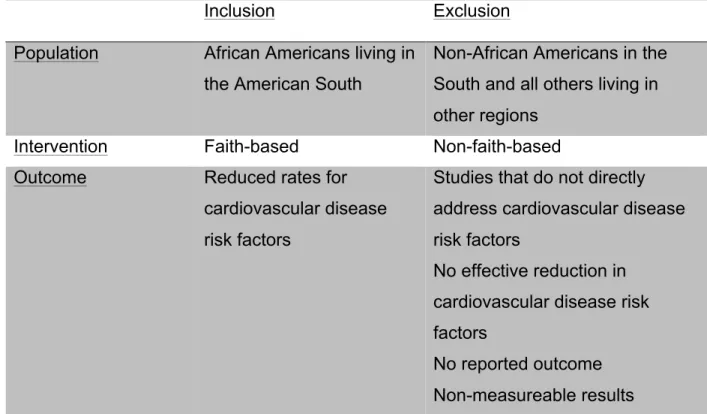
Eligibility Criteria (Table 4)
For the purposes of this review, the included articles had to describe an intervention
aimed at addressing and reducing cardiovascular risk factors among African Americans
living in the American South. The locations covered by the American South for the
purposes of this paper include Virginia, North Carolina, South Carolina, Georgia,
Florida, Tennessee, Mississippi, Alabama, Louisiana, and Arkansas. The goal of this
review is to determine the outcome of faith-based interventions on African Americans
living in the South in order to determine the effectiveness of the intervention in reducing
risk factors for cardiovascular disease. Through addressing risk factors for
mass index (BMI), increases in physical activity, increases in the consumption of fruits
and vegetables, or increases in diabetes-related quality of life. The interventions had to
have taken place in a church setting or within faith groups among church members.
Interventions that did not report outcomes and/or quantifiable results were excluded
from this review. Furthermore, interventions that had only reported baseline results or
pre-intervention status were also excluded. Articles were selected if the interventions
reduced the rates for risk factors for cardiovascular disease and/or reduced
cardiovascular disease rates.
Table 4. Eligibility Criteria
Inclusion Exclusion
Population African Americans living in the American South
Non-African Americans in the South and all others living in other regions
Intervention Faith-based Non-faith-based
Outcome Reduced rates for
cardiovascular disease risk factors
Studies that do not directly address cardiovascular disease risk factors
No effective reduction in cardiovascular disease risk factors
Data Sources and Search Strategy
PubMed and the Cochrane Library were used to search for relevant studies and articles.
Additional articles were retrieved through searching the references of articles obtained
through the previous searches. Within the Cochrane Library, the search term “church”
was used to obtain relevant studies; within PubMed, the following search algorithm was
used:
(South*[tiab] OR Alabama[tw] OR Arkansas[tw] OR Florida[tw] OR Georgia[tw] OR Louisiana[tw] OR Mississippi[tw] OR North Carolina[tw] OR South Carolina[tw] OR Virginia[tw] OR Tennessee[tw]) AND (risk factor*[tw] OR cardiovascular[tw] OR blood pressure[tw] OR hypertension[tw] OR stroke[tw] OR heart[tw] OR diabetes[tw] OR tobacco[tw] OR nutrition[tw] OR physical activity[tw] OR physical inactivity[tw] OR obesity[tw] OR obese[tw] OR overweight[tw]) AND (faith-based[tw] OR faith[tw] OR church-based[tw] OR church[tw] OR religi*[tw]) AND (African American*[tw] OR black*[tw])
Relevant articles were first determined by reading the titles of articles resulting from the
searches. If deemed eligible, the abstract was read, and from there, if it still could not be
excluded, the article was read in its entirety.
III. Results:
The initial search yielded 147 articles from PubMed and 152 articles from the Cochrane
Library. After all articles were reviewed and any duplicates were ruled out, 11 studies
were included in the final review after meeting all inclusion criteria. Articles were
excluded first if they were not intervention studies (n=142), and following, because they
did not directly address cardiovascular disease risk (n=46), because no quantifiable
outcomes were reported (n=23), because the intervention was either not in the South or
Relevant articles were first determined by looking at the titles of articles resulting from
the searches. Titles were deemed ineligible if they included disease factors other than
CVD or its risk factors or if they directly noted populations other than African Americans
in the American South as the population of interest. If there was no excluding criteria
within the title alone, the abstract was read to determine if it would meet the inclusion
criteria. Abstracts were excluded if they did not meet the aforementioned title inclusion
criteria, if the study was not an intervention, if the intervention was not faith-based, if the
intervention was either not yet carried out or reported past baseline, if the sample
population was too small (n<50), or if the intervention could not produce quantifiable
results. If the article could not be excluded after reading the abstract, the article was
read in its entirety to determine final eligibility based on all inclusion and exclusion
criteria.
Descriptions of the articles included are listed in Table 5. To address cardiovascular
disease risk factors, four out of the eleven studies (36%) had a primary focus on weight
loss and/or weight control, eight (73%) focused on increasing physical activity, and
seven (64%) focused on enhancing nutritional intake through increased fruit and
vegetable consumption. Interventions consisted of disseminating educational materials
including cookbooks, informational videos, brochures, pamphlets, and other handouts,
providing a forum for group and individual level counseling or instruction, provision of
Study Name
Author(s),
Year Location(s)
Study Design
Participant
composition Intervention Outcome
The Faith, Activity, and Nutrition Program: a randomized controlled trial in African-American Churches Wilcox, Parrott, Baruth, Laken, Condrasky, et al., 2013
74 African Methodist Episcopal (AME) churches in South
Carolina Randomized controlled trial
n=1257; majority of participants were female; mean age was 54 15-month intervention targeted each of the four structural factors:
availability and accessibility, physical structures, social structures, and cultural and media messages
Significant increase in
moderate to vigorous physical activity (MVPA) in the
intervention group (p=.02); Further analysis showed an intervention effect for self-reported leisure time MVPA (p=.03) and self-reported fruit and vegetable consumption (p=.03). Intervention group reported a mean increase of 3.89 cups of fruits and
vegetables per day. Changes in weight were not provided.
The WORD (Wholeness, Oneness, Righteousness, Deliverance): a faith-based weight-loss program utilizing a community-based participatory research approach Kim, Linnan, Campbell, Brooks, Koenig, et al., 2006
3 rural African American churches in central North Carolina Two-group, quasi-experimental, delayed intervention design n=61; majority of participants were female; mean age was 54 8-week, behaviorally focused weight-loss program consisting of weekly modular educational meetings
The intervention group lost, on average, 3.0 more pounds compared to the control group (p=.001), and reported greater recreational physical activity from baseline to follow-up (p=.01). The mean weight change in the
intervention group was -3.6 pounds; WORD leaders reported making changes in nutrition habits but
Short-term impact of a church-based approach to lifestyle change on cardiovascular risk in African Americans Oexmann, Thomas, Taylor, O'Neil, Garvey, Lackland, & Egan, 1999 African American Christian community near Charleston, SC Quasi-experimental design n=133; majority of participants were female
10-week study including a baseline health
assessment, eight
educational sessions in a group setting, and a short-term health check using a community based participatory research approach
Significant short-term reductions in weight were noted, with a mean weight loss of 2.3 pounds in the intervention group (P<.01). Changes in nutrition or physical activity were not discussed.
Body and soul: A dietary intervention conducted through African-American churches Reniscow, Campbell, Carr, McCarty, Wang, et al., 2004 15 African American churches Cluster randomized effectiveness trial n=1022; majority of participants were female; mean age was 50 6-month intervention operating at two levels- church wide events and environmental changes aimed at the entire congregation, and lay counseling delivered only to individuals enrolled in the study. The
intervention utilized self-help educational
materials and
motivational interviewing
At post-test, participants in the intervention group reported significantly greater consumption of fruits and vegetables than those in the comparison group, with a mean increase of 1.4 servings per day (p<0.05). Changes in physical activity or weight were not discussed
The North Carolina Black Churches United for Better Health Project: intervention and process evaluation Campbell, Motsinger, Ingram, Jewell, Makarushka, et al., 2000
49 churches from 10 rural eastern North Carolina counties Randomized controlled trial n=2519; majority of participants were female; similar participation was noted for all age groups 18+
4-year multicomponent intervention trial using personalized educational materials, activities to increase knowledge of and access to fruits and vegetables, and activities to increase social and environmental support for eating healthier
Significant correlations were found between fruit and vegetable consumption and both educational
A church-based diet and physical activity intervention for rural, lower Mississippi Delta African-American adults: Delta Body and Soul effectiveness study, 2010-2011 Tussing-Humphreys, Thompson, Mayo, & Edmund, 2013 Lower Mississippi Delta region Quasi-experimental, randomized controlled design n=403; majority of participants were female; mean age was 47 6-month multicomponent intervention consisting of educational sessions. One intervention was focused on physical activity. These was no use of motivational interviewing or peer counseling
Significant increases were seen in fruit and vegetable consumption with a self-reported mean increase of 0.9 servings per day. Significant changes in both self-reported aerobic (P=.02) and strength/flexibility (P=.03) physical activity outcomes were noted in the intervention group. Changes in weight were not discussed.
Diet Quality and Physical Activity Outcome
Improvements Resulting From a Church-Based Diet and Supervised Physical Activity Intervention for Rural, Southern, African American Adults: Delta Body and Soul III
Thompson, Goodman, Tussing-Humphreys, 2015 Lower Mississippi Delta region Quasi-experimental, randomized controlled design n=409; majority of participants were female; mean age was 47 6-month multicomponent intervention consisting of educational sessions using trained research staff for motivational interviewing, a certified fitness instructor for the physical activity session and the supervised physical activity classes; educational
presentations were presented by church liaisons
Of the intervention participants reporting
changes in activity levels from baseline to post intervention, significantly more reported increased strength/flexibility physical activity (28%) as compared with decreased physical activity (12%), (P=.0131). Significant increases in the mean total fruit and vegetable intake, with a self-reported mean increase of 0.5 servings per day, was observed in the intervention group. Changes in weight were not discussed. A randomized trial
of a church-based diabetes self-management Samuel-Hodge, Keyserling, Park, 24 African American churches in central North Randomized controlled trial n=201; 64% female, 36% male; mean age was 59
8-month intensive phase consisting of 1 individual counseling visit, 12 group sessions, monthly phone
program for African
Americans with type 2 diabetes
Johnston, Gizlice, et al., 2009
Carolina contacts, and 3
encouragement
postcards, followed by a 4-month reinforcement phase including monthly phone contacts
to the control (P=.003), and short-term metabolic control improved among study participants. Modest trends were noted following intervention for daily fruit consumption, with a self-reported mean increase of 0.2 servings per day (P=.07). There was little change in light or moderate physical activity. Changes in weight or were not discussed.
Results of go girls: a weight control program for overweight African-American adolescent females Reniscow, Taylor, Baskin, & McCarty, 2005 Ten predominantly middle-socioeconomi c African American churches in Atlanta Two-group, quasi-experimental design n=147; all participants were female; mean age was 14 6-month culturally
tailored behavioral group physical activity
intervention consisting of high-intensity (20 to 26 sessions) and moderate-intensity (six sessions) groups. In the high-intensity group, girls also received four to six telephone counseling calls
There was a net difference of 1.8 pounds favoring the high-intensity group, although non-significant. High attenders lost an average of 1.3 pounds while low attenders gained 3.7 pounds, borderline
significance (p=.07). Changes in nutrition were not
discussed.
A pilot church-based weight loss program for African-American adults using church members as health educators: a comparison of Kennedy, Paeratakul, Champagne, Ryan, Harsha, et al., 2005 An African American church in Baton Rouge, Louisiana Randomized trial design without a control group n=40; mean age was 44
6-month weight loss intervention; the group intervention consisted of nutrition education delivered in six monthly group meetings with group discussion. The individual intervention consisted of similar
individual and group intervention
nutrition education delivered in 15 individual meetings, record
keeping, and basic dietary assessment. An increase in physical activity was emphasized in both intervention groups
83% of participants reported an increase in both leisure time and sport activity, with decreases in physical inactivity and television viewing. Changes in nutrition were not discussed.
Results of the healthy body healthy spirit trial
Reniscow, Jackson, Blissett, Wang, McCarty, et al., 2005 16 socioeconomi cally diverse black churches in the Atlanta area Three-group, quasi-experimental design n=1056; majority of participants were female; mean age was 46 1-year multicomponent intervention consisting of three intervention
groups. Group 1 received standard educational materials, Group 2 received culturally targeted self-help nutrition and physical activity materials, and Group 3 received the same intervention as did Group 2 as well as 4 telephone counseling calls based on
motivational interviewing delivered over the course of 1 year
The percentage making any change (in fruit and vegetable consumption or in physical activity) was greatest in Group 3 (70.0%). In this group, the percentage making only a single change was similar to the full sample population, 69.0%. However, 23.0% made a large change in both physical activity and fruit and vegetable
four structural factors: availability and accessibility, physical structures, social
structures, and cultural and media messages through distributing bulletin inserts,
sharing messages from the pulpit, passing out educational materials, creating a Faith,
Activity, and Nutrition (FAN) Program bulletin board, and suggesting physical activity
and healthy eating policy/practices. Community based participatory research approach
guided intervention development. A significant increase in moderate to vigorous
physical activity (MVPA) in the intervention group (p=.02) was reported and further
analysis showed an intervention effect for self-reported leisure time MVPA (p=.03) and
self-reported fruit and vegetable consumption (p=.03). The intervention group reported a
mean increase of 3.89 cups of fruits and vegetables per day. Changes in weight were
not provided.
Kim, Linnan, Campbell, Brooks, Koenig, et al. (2006) evaluated an intervention in which
participants met once a week for 2 hours in WORD (wholeness, oneness,
righteousness, deliverance) groups (8 to 10 people) groups led by a pair of trained
community members known as WORD Leaders (or lay health leaders). WORD Leaders
were members of a participating church and were assigned to facilitate WORD groups
that consisted of participants from their respective churches. Group meetings consisted
of measurements, review of previous topics, physical activity through the use of an
exercise tape, a Bible study with a health message, and prayer. The intervention group
controlling for baseline body mass index, education, and age, the magnitude of
difference between the treatment group and the control group’s mean weight loss
decreased, but the results remained highly significant (p=.003). The mean weight
change in the intervention group was -3.6 pounds. WORD leaders reported making
changes in nutrition habits but significance was not discussed.
Oexmann, Thomas, Taylor, O'Neil, Garvey, Lackland, & Egan (1999) utilized a
community based participatory research approach in their “Lighten Up” intervention to
encourage lifestyle changes for improving cardiovascular risk through eight educational
sessions in a group setting, combining scripture and health messages, along with
short-term and long-short-term health checks. Significant short-short-term reductions in weight were
noted, with a mean weight loss of 2.3 pounds in the intervention group (P<.01).
Changes in nutrition or physical activity were not discussed.
Reniscow, Campbell, Carr, McCarty, Wang, et al. (2004) designed an Intervention
constructed from essential components of two successful research-based interventions.
They utilized church-wide nutrition activities and events such as their kick-off
event/health fair. Self-help materials provided included a cookbook and an informational
video, and lay church members trained by project staff performed motivational
interviewing. At post-test, participants in the intervention group reported significantly
greater consumption of fruits and vegetables than those in the comparison group, with a
mean increase of 1.4 servings per day (p<0.05). The intervention group showed a small,
intrinsic and extrinsic motivation to eat fruits and vegetables, self-efficacy to eat fruits
and vegetables, and social support to eat more fruits and vegetables (p<0.05). Changes
in physical activity or weight were not discussed
Campbell, Motsinger, Ingram, Jewell, Makarushka, et al. (2000) used church members
who were trained as lay health advisors, to encourage pastors to support the project
“from the pulpit” via sermons and announcements, and to form county coalitions
containing church members, local agency representatives, grocers, and farmers to help
with the dissemination of personalized self-help bulletins, group activities to increase
access to fruits and vegetables, and education in preparing them. The personalized
bulletins contained tailored feedback based on baseline survey info regarding fruit and
vegetable consumption, stages of change, barriers, beliefs, and social support, and
were mailed to each church member's home. Monthly packets of materials were also
mailed to each intervention church. Activities were planned to increase access to fruits
and vegetables, to provide education and skills in preparing them, and to help overcome
barriers to consumption. Significant correlations were found between fruit and vegetable
consumption and both attendance of educational sessions/classes (p=.05) and
acquisition of printed materials (p=.02), with self-reported mean increase of 0.76
servings per day. More frequent church attendance during the study was strongly
correlated to an increase in fruit and vegetable consumption among the intervention
Tussing-Humphreys, Thompson, Mayo, & Edmund (2013) utilized research staff to
develop educational sessions and provide technical assistance throughout the program
without the use of direct peer counseling or motivational interviewing. The intervention
was adapted from the National Cancer Institute and American Cancer Society
sponsored Body and Soul program. The education sessions were presented
collaboratively with a trained church committee member and focused on the increased
consumption of health foods, appropriate portion sizes, and the resulting health impacts,
while one intervention focused on physical activity. Intervention participants received
monthly newsletters containing nutrition and physical activity topics, healthy recipes,
and testimonials from fellow church members about making diet and physical activity
changes. Participants in the control churches received bimonthly newsletters containing
information about colds and flu, food safety, and reducing stress. Significant increases
in the mean fruit and vegetable consumption, with a self-reported mean increase of 0.9
servings per day in the intervention group. Significant changes in both self-reported
aerobic (P=.02) and strength/flexibility (P=.03) physical activity outcomes were noted in
the intervention group. Changes in weight were not discussed.
Thompson, Goodman, & Tussing-Humphreys (2015), within an updated version of the
previous intervention, continued the use of research staff to develop education sessions
emphasizing increased consumption of healthy foods, appropriate portion sizes, and
health impacts, but added in 3 additional sessions to the length of the intervention,
provided formal aerobic strength and activity classes supervised by a certified fitness
research staff. Of the intervention participants reporting changes in activity levels from
baseline to post intervention, significantly more reported increased strength/flexibility
physical activity (28%) as compared with decreased physical activity (12%), (P=.0131).
Significant increases in the mean total fruit and vegetable intake, with a self-reported
mean increase of 0.5 servings per day, was observed in the intervention group.
Changes in weight were not discussed.
Samuel-Hodge, Keyserling, Park, Johnston, Gizlice, et al. (2009) utilized research staff
to conduct individual counseling sessions for study participants, group education
sessions, monthly phone calls, and the mailing of encouragement postcards to promote
diabetes self-management, while the control group received only educational pamphlets
via mail. Following the intervention lasting one year in total, diabetes knowledge and
diabetes related quality of life significantly improved in the intervention group compared
to the control (P=.003), and short-term metabolic control improved among study
participants. Modest trends were noted following the intervention for daily fruit
consumption, with a self-reported mean increase of 0.2 servings per day (P=.07). There
was little change in light or moderate physical activity. Changes in weight or were not
discussed.
Reniscow, Taylor, Baskin, & McCarty (2005) utilized trained research staff to deliver a
culturally tailored behavioral group intervention of either high-intensity or
moderate-intensity physical activity to adolescent females for weight loss purposes. Each session
preparation and tasting of healthy foods. Those in the high-intensity group also received telephone-counseling calls from trained research staff. At 6-month follow-up, the net difference between the high- and moderate-intensity groups was 0.5 BMI units, although this difference was not statistically significant (p=.20). Girls in the high-intensity PA group, however, who attended more than three-quarters of the sessions, had
significantly lower body mass index (p=.01) and percentage body fat (p=.01) relative to girls in the high-intensity group who attended fewer sessions. There was a net
difference of 1.8 pounds favoring the high-intensity group, although the result was non-significant. High attenders lost an average of 1.3 pounds while low attenders gained 3.7 pounds, having borderline significance (p=.07). Changes in nutrition were not
discussed.
Kennedy, Paeratakul, Champagne, Ryan, Harsha, et al. (2005) utilized research professionals to deliver nutrition education in group sessions for one group and individual nutrition education along with food diary record keeping (a seven day food diary each month) and a basic dietary assessment using a commercial nutrition
computer software program for the other group to promote weight loss. Physical activity was emphasized in both groups. After six months, a modest but significant mean weight loss of 7.3 pounds was seen in all participants (P<.05). All participants saw a significant decrease in body weight, body mass index, body fat mass, and fat free mass. The mean weight losses in the individual and group interventions were 7.5 pounds and 6.8
leisure time and sport activity, with decreases in physical inactivity and television
viewing. Changes in nutrition were not discussed.
Reniscow, Jackson, Blissett, Wang, McCarty, et al. (2005) utilized research staff
conduct interventions in 3 groups. Group 1 received standard educational materials,
Group 2 received culturally targeted self-help nutrition and physical activity materials,
and Group 3 received the same intervention as Group 2, as well as 4 telephone
counseling calls based on motivational interviewing. The percentage making any
change was greatest in Group 3 (70.0%). In this group, the percentage making only a
single change was similar to the full sample population, 69.0%. However, 23.0% made
a large change in both physical activity and fruit and vegetable consumption, with a
self-reported mean increase of 1.13 servings per day. Individuals in groups 2 or 3 who used
the cookbook and watched the nutrition video had significantly greater fruit and
vegetable intake than others. Individuals who reported using the activity guide had a
significantly greater increase in physical activity than those not using the guide.
Changes in weight were not discussed.
'
Of the 4 studies addressing weight loss, 3 demonstrated successful, significant (p<.05)
weight loss by participants over intervention periods ranging from 8 weeks to 6 months,
in the range of 2.3 to 7.3 pounds. Of the 8 studies addressing physical activity, 7
demonstrated successful, significant (p<.05) increases over intervention periods ranging
from 8 weeks to 15 months, in the context of increased high intensity physical activity,
moderate to vigorous physical activity (MVPA), recreational or leisure time physical
nutrition, 6 demonstrated successful, significant (p<.05) increases in the mean
self-reported, daily fruit and vegetable intake by participants over intervention periods
ranging from 6 months to 4 years, in the range of 0.5 to 3.89 servings of fruits and
vegetables per day.
IV. Discussion:
This systematic review includes twelve interventions investigating their impact on the
ability to effectively reduce risk factors for cardiovascular disease through faith-based
approaches among the African American population living in the American South. The
review includes a variety of effective intervention approaches including disseminating
educational materials such as cookbooks, informational videos, brochures, pamphlets,
and other handouts, providing a forum for group and individual level counseling or
instruction, provision of health checks, or any combination of these.
Cardiovascular disease is the leading cause of death in the United States and the
highest prevalence is seen in the South and among African Americans. With the African
American church serving as the most important social institution within this population, it
is important to examine the effectiveness of interventions within. Many of the
cardiovascular disease risk intervention programs reviewed utilized some from of
behavioral modification designed to reduce unhealthy behaviors and increase healthy
with intervention components to lose weight, increase physical activity, and increase
fruit and vegetable consumption.
The study designs differed, including 3 randomized controlled trials, 6
quasi-experimental designs, 1 cluster randomized effectiveness trial, and 1 randomized trial
without a control. All of the studies reviewed used multi-component interventions,
therefore it is not clear which intervention component is most effective. Furthermore,
several studies used an ecological framework and focused on environmental changes
such as health-minded bulletin boards within churches or church-wide health fairs, but
the effects varied particularly among different-sized churches. Campbell, Motsinger,
Ingram, Jewell, Makarushka, et al. (2007) noted in their study that members of smaller
churches had a greater perceived impact of intervention components compared to
members of larger churches, possibly due to either the more close-knit nature,
consisting of extended family groups, of small churches in the South, or the likelihood
that smaller churches had fewer competing programs or commitments. Scott and
Wilson (2011) noted that there is increasing use of ecological theory when performing
public health research and interventions, as it utilizes a multilevel, multicomponent view,
and reinforces the ideal that health is “contingent” on interacting elements (p. 2). Most
studies in the review did produce statistically significant results from the interventions; 3
of the 4 studies targeting weight loss, 7 of the 8 studies targeting increased physical
activity, and 6 of the 7 studies targeting increased fruit and vegetable consumption were
Difficulties encountered while synthesizing study data included different outcomes,
different measures, and different intervention timelines. The studies consisted of
different outcomes in that they each did not address all three primary outcomes of
weight loss, increased physical activity, and increased fruit and vegetable consumption.
Different measures encountered while synthesizing studies were most pronounced
across the measure of physical activity; there was not a standard measure used across
all studies and the various measures consisted of high intensity physical activity,
moderate to vigorous physical activity (MVPA), recreational or leisure time physical
activity, and aerobic and strength/flexibility physical activity. For the weight loss
measure, one study (Kennedy, Paeratakul, Champagne, Ryan, Harsha, et al., 2005)
used the metric system (kilograms) for measuring weight loss, so the results had to be
converted to imperial units (pounds) in accordance with the other studies. Different
intervention timelines existed across the studies in that they ranged anywhere from
8 weeks to 4 years. The majority (7 interventions) lasted between 6 months and 1 year.
The length of time over the course of intervention for the outliers had to be taken into
account when evaluating the results.
The review, however, does have some limitations. First, all of the studies included have
a female population majority, so we are unable to discern the extent of impact such
interventions may have on the male population; African American males have the
greatest risk for cardiovascular disease compared to their female counterparts.
Overrepresentation of women in African American church populations reflects on the
Mayo, & Edmund, 2013). Secondly, the studies have wide variations in study population
size. Several studies contain sample sizes that are relatively smaller than the others,
making the results of these less generalizable to the overall population. According to the
law of large numbers, as the sample size increases, the sample mean will converge to
the true population mean (The Law of Large Numbers, n.d.). Finally, the concept of
faith-based interventions is rather new and the knowledge base is still building around it.
Because of this, this is not much information on the ability to provide long-term or lasting
effects from these interventions. Because the African American church is such a staple
in southern black culture, and because the church provides a stable and consistent
method of support for this population, the outlook for maintenance is bright, but there is
currently not the literature to back up this notion.
V. Conclusions & Recommendations
Churches play a vital role in many rural communities, and in many African American
communities, the church is considered to be the most important social institution
(Barnes, 2009). It serves as a potentially effective and instrumental setting to provide
health programming to parishioners because of the shared culture and religious beliefs
along with the infrastructure to help allow for sustainability (Barnes, 2009;
Tussing-Humphreys, Thompson, Mayo, & Edmund, 2013). With cardiovascular disease as the
leading cause of death in the United States and a particularly high prevalence in the
implementation of faith-based interventions to target cardiovascular disease in African
Americans in the South is both timely and fitting.
The majority of interventions carried out to reduce cardiovascular disease risk factors
among this population targeted the primary outcomes of weight loss, increased physical
activity, and increased fruit and vegetable consumption. The studies included in this
review proved to be very effective in that 3 of the 4 studies targeting weight loss, 7 of
the 8 studies targeting increased physical activity, and 6 of the 7 studies targeting
increased fruit and vegetable consumption were able to produce statistically significant
results. The use of social determinants of health like race, geographic location, and
religion, should be used to inform the creation and evolution of public health
interventions in order to reduce the risk for developing chronic disease in the future,
reduce complications from existing chronic disease, and improve overall quality of life,
in accordance with a key recommendation within Healthy People 2020 to use
community-based approaches like faith-based interventions to address chronic disease
risk factors (World Health Organization, 2005, p. 90; Healthy People, 2011). Moving
forward with designing similar interventions for future implementation is appropriate and
feasible given the successful and effective outcomes of the studies included in this
References
America's Health Rankings (25th Anniversary ed., Vol. 25). (2014). United Health Foundation.
Anderson, G., & Horvath, J. (2004). The growing burden of chronic disease in America. Public health reports, 119(3), 263.
Barnes, S. L. (2009). Enter into his gates: An analysis of black church participation patterns.Sociological Spectrum, 29(2), 173-200.
Boltri, J. M., Davis-Smith, M., Okosun, I. S., Seale, J. P., & Foster, B. (2011).
Translation of the National Institutes of Health Diabetes Prevention Program in African American churches. Journal of the national medical association, 103(3), 194-202.
Campbell, M. K., Hudson, M. A., Resnicow, K., Blakeney, N., Paxton, A., & Baskin, M. (2007). Church-based health promotion interventions: evidence and lessons learned. Annu. Rev. Public Health, 28, 213-234.
Campbell, M. K., Motsinger, B. M., Ingram, A., Jewell, D., Makarushka, C., Beatty, B., ... & Demark-Wahnefried, W. (2000). The North Carolina black churches united for better health project: Intervention and process evaluation. Health Education & Behavior, 27(2), 241-253.
CDC. (2014, May 9). Chronic Diseases and Health Promotion. Retrieved February 12, 2015, from http://www.cdc.gov/chronicdisease/overview/
CDC. (2015, February 6). Health of Black or African American non-Hispanic Population. Retrieved April 1, 2015, from http://www.cdc.gov/nchs/fastats/black-health.htm
Cooper, R., Cutler, J., Desvigne-Nickens, P., Fortmann, S. P., Friedman, L., Havlik, R., ... & Thom, T. (2000). Trends and disparities in coronary heart disease, stroke, and other cardiovascular diseases in the United States findings of the national conference on cardiovascular disease prevention. Circulation, 102(25), 3137-3147.
DeHaven, M. J., Hunter, I. B., Wilder, L., Walton, J. W., & Berry, J. (2004). Health programs in faith-based organizations: are they effective?. American Journal of Public Health, 94(6), 1030-1036.
prevention program for ethnically diverse, low-income women. Journal of community health, 25(6), 439-453.
Health of Black or African American non-Hispanic Population. (2015, February 6). Retrieved April 1, 2015, from http://www.cdc.gov/nchs/fastats/black-health.htm
Healthy People, & US Department of Health and Human Services. (2011). Healthy People 2020.
Howard, G., Labarthe, D. R., Hu, J., Yoon, S., & Howard, V. J. (2007). Regional differences in African Americans' high risk for stroke: the remarkable burden of stroke for Southern African Americans. Annals of epidemiology, 17(9), 689-696.
Karanja, N., Stevens, V. J., Hollis, J. F., & Kumanyika, S. K. (2001). Steps to soulful living (steps): a weight loss program for African-American women. Ethnicity & Disease, 12(3), 363-371.
Kennedy, B. M., Paeratakul, S., Champagne, C. M., Ryan, D. H., Harsha, D. W., McGee, B., ... & Deyhim, F. (2005). APilot CHURCH-BASED WEIGHT LOSS PROGRAM FOR AFRICAN-AMERICAN ADULTS USING CHURCH MEMBERS AS HEALTH EDUCATORS: ACOMPARISON OF INDIVIDUAL AND GROUP INTERVENTION. Ethnicity & disease, 15.
Kim, K. H. C., Linnan, L., Campbell, M. K., Brooks, C., Koenig, H. G., & Wiesen, C. (2006). The WORD (wholeness, oneness, righteousness, deliverance): a faith-based weight-loss program utilizing a community-faith-based participatory research approach. Health Education & Behavior.
Liao, Y., Greenlund, K. J., Croft, J. B., Keenan, N. L., & Giles, W. H. (2009). Factors explaining excess stroke prevalence in the US Stroke Belt. Stroke, 40(10), 3336-3341.
Martin, M. G., & Humphreys, M. E. (2006). Social consequence of disease in the American South, 1900-World War II. SOUTHERN MEDICAL JOURNAL-BIRMINGHAM ALABAMA-, 99(8), 862.
Oexmann, M. J., Thomas, J. C., Taylor, K. B., O'Neil, P. M., Garvey, W. T., Lackland, D. T., & Egan, B. M. (1999). Short-term impact of a church-based approach to
lifestyle change on cardiovascular risk in African Americans. Ethnicity & disease, 10(1), 17-23.
Resnicow, K., Jackson, A., Blissett, D., Wang, T., McCarty, F., Rahotep, S., & Periasamy, S. (2005). Results of the healthy body healthy spirit trial. Health Psychology, 24(4), 339.
Resnicow, K., Taylor, R., Baskin, M., & McCarty, F. (2005). Results of Go Girls: A weight control program for overweight African-American Adolescent females. Obesity Research, 13(10), 1739-1748.
Samuel-Hodge, C. D., Keyserling, T. C., Park, S., Johnston, L. F., Gizlice, Z., & Bangdiwala, S. I. (2009). A randomized trial of a church-based diabetes self-management program for African Americans with type 2 diabetes. The Diabetes Educator, 35(3), 439-454.
Savitt, T. L., & Young, J. H. (Eds.). (1991). Disease and distinctiveness in the American
South. Univ. of Tennessee Press.
Scott, A. J., & Wilson, R. F. (2011). Social determinants of health among African Americans in a rural community in the Deep South: an ecological exploration. Rural Remote Health, 11(1), 1634.
Thomson, J. L., Goodman, M. H., & Tussing-Humphreys, L. (2015). Diet Quality and Physical Activity Outcome Improvements Resulting From a Church-Based Diet and Supervised Physical Activity Intervention for Rural, Southern, African American Adults Delta Body and Soul III. Health promotion practice, 1524839914566851.
Tussing-Humphreys, L., Thomson, J. L., Mayo, T., & Edmond, E. (2013). Peer Reviewed: A Church-Based Diet and Physical Activity Intervention for Rural, Lower Mississippi Delta African American Adults: Delta Body and Soul Effectiveness Study, 2010–2011. Preventing chronic disease, 10.
The Law of Large Numbers. (n.d.). Retrieved April 1, 2015, from http://www.math.uah.edu/stat/sample/LLN.html
United States Census Bureau. (2011, September 11). Retrieved March 13, 2015, from https://www.census.gov/newsroom/releases/archives/2010_census/cb11-
cn185.html
Wilcox, S., Parrott, A., Baruth, M., Laken, M., Condrasky, M., Saunders, R., ... & Zimmerman, L. (2013). The Faith, Activity, and Nutrition program: a randomized controlled trial in African-American churches. American journal of preventive medicine, 44(2), 122-131.
World Health Organization. (2013, May 7). What are social determinants of health? Retrieved February 20, 2015, from
http://www.who.int/social_determinants/sdh_definition/en/
World Health Organization. (n.d.). Cardiovascular diseases (CVDs). Retrieved January 1, 2015, from http://www.who.int/mediacentre/factsheets/fs317/en/
World Heart Federation. (n.d.). Cardiovascular disease risk factors. Retrieved March 13, 2015, from