204
A max-min fuzzy approach for supplier selection and order
allocation problem with transportation costs
Mohammad Ali Sobhanolahi
1, Ahmad Mahmoodzadeh
1*, Bahman Naderi
1 1Department of Industrial Engineering, Faculty of Engineering, Kharazmi University, Tehran, Iran[email protected],[email protected], [email protected]
In this paper, we study a supplier selection and order allocation problem with in a multi-objective and fuzzy environment. Transportation costs and quantity discount are taken into account in the problem. We assume four common objectives as total costs, on-time delivery rate, defective rate, and purchasing value. We utilize a max-min approach such that the min-operator finds the fuzzy decision that simultaneously satisfies all the fuzzy objectives. Then the maximizing decision is determined to be the maximum degree of membership for the fuzzy decision. We use the non-linear S-shape membership functions to express the vague aspiration levels of the DM’s objective. According to the defined fuzzy membership functions and applying Bellman–Zadeh’s maximization principle, the fuzzy multi objective model is transformed into a single objective model. A genetic algorithm is applied to solve the multi objective fuzzy supplier selection and order allocation problem. Computational results are presented using numerical examples.
Keywords: Fuzzy programing, genetic algorithm, supplier selection, order allocation
1- Introduction and literature review
Supplier selection is one of the most vital processes in the supply chain management. Organizations rely more on suppliers to reduce their costs, to improve the quality of their products, or to focus on a specific part of their operations (Govindan et al. 2015). This process is complex, since, both quantitative and qualitative criteria must be taken into account (Guo & Li, 2014), the process becomes more complicated if parameters are incomplete or uncertain. Also, the inventory management is one of the significant parts of supply chain management, since, inventory costs can represent anywhere between 20 and 40% of the total product value (Ballou, 1992). In the literature, these issues have simultaneously been considered in supplier selection and order allocation (SSOA) problems (Mansini et al. 2012).
Supplier selection and order allocation (SSOA) with quantity discount has extensively been studied by some researchers. Dahel (2003) propose a multi-objective mixed integer linear programming (MILP) model with multi-item volume discounts. Xia & Wu (2007) propose a two-stage method to solve the four-objective SSOA problem using AHP and a multi-four-objective MILP. The four-objectives include purchasing value, purchasing cost, defective items, and on-time delivery.
*Corresponding author
ISSN: 1735-8272, Copyright c 2018 JISE. All rights reserved
Abstract
Journal of Industrial and Systems EngineeringVol. 11, No. 4, pp. 204-215 Autumn (November) 2018
205
Kamali et al. (2011) propose the particle swarm optimization and scatter search algorithm to solve the four-objective SSOA problem with the same objectives. Çebi & Otay (2016) investigate a SSOA problem with the same objectives and apply a two-stage fuzzy approach to solve the problem. Demirtas & Üstün (2008) investigate a three-objective model and apply analytical network process (ANP) and epsilon-constraint method to solve the model. Their model simultaneously optimize the purchasing value, the budget and the defect rate. Burke et al. (2008) measure the impact of quantity discounts in SSOA problem by considering the linear, the incremental, and the all-unit quantity discount. Amid et al. (2009) develop a fuzzy multi-objective MILP model to solve the problem in order to simultaneously optimize the total cost, the rate of late delivery, and the rate of rejected items. Wang & Yang (2009) propose a two-stage procedure using AHP and a multi-objective programming to minimize total cost, defective rate, and delivery lateness rate. Ebrahim et al. (2009) study the problem with the same objectives and propose a scatter search algorithm and exact method to solve the problem. Kokangul & Susuz (2009) utilize a bi-objective non-linear programing model using goal programming to solve the problem. The bi-objectives are the purchasing costs and the purchasing value. With the same objectives, Razmi & Maghool (2010) utilize an augmented epsilon-constraint and reservation level by Tchebycheff models to solve the fuzzy bi-objective model. Moghadam (2015) consider fuzzy multi-objective SSOA problem to optimize four objectives including net profit, defective items, late deliveries and risk factor. Pazhani et al. (2016) utilize exact methods to solve a mixed integer nonlinear programming SSOA model with a single objective to minimize the total costs considering the transportation costs. Hamdan & Cheaitou (2017-a) study SSOA problem with green criteria to optimize the total costs and purchasing value. They propose a three stages method using fuzzy TOPSIS in the first stage, AHP in the second stage, and bi-objective MILP the third stage. Hamdan & Cheaitou (2017-b) consider the same objectives with green criteria, quantity discounts and varying supplier availability. They also apply the same three stage method to solve the model. There are some methods in the literature for multi-objective programming problem with fuzzy objectives such as the weighted additive approach (Tiwari et al. 1987; Chen & Tsai, 2001), compromise approach (Wu & Guu, 2001), method with achievement degrees (Aköz & Petrovic, 2007), augmented max-min model (Lee & Li, 1993; Arikan, 2013), and two-phase approach (Li & Zhang, 2006). Some researchers use these methods to solve the SSOA problem. For example, Moghaddam (2015) applied Monte Carlo simulation integrated with fuzzy goal programming for SSOA problem in reverse logistics systems. Erginel & Gecer (2016) utilize a two-phase approach to solve the fuzzy multi-objective linear programming model in Supplier Selection Problem. Also, Çebi & Otay (2016) apply a two-stage fuzzy approach for SSOA problem. They use augmented max-min in the first stage, and fuzzy goal programming in the second stage. Govindan et al. (2017) utilize weighted fuzzy mathematical programming approach for supplier selection problem with transportation decisions in a closed loop supply chain. Firstly, they define linear membership functions for each fuzzy goal as introduced by Zadeh (1965). Then, they apply a weighted max-min approach seeks for an optimal solution so that the ratio of the levels of achievement of the goals come as close to each other as possible.
In this paper, we study a SSOA problem by taking transportation costs, quantity discount, fuzzy type uncertainty and some practical constraints into account. We assume four common objectives as total costs considering transportation costs, on-time delivery rate, defective rate, and purchasing value. We utilize a max-min approach such that the min-operator finds the fuzzy decision that simultaneously satisfies all the fuzzy objectives. Then the maximizing decision is determined to be the maximum degree of membership for the fuzzy decision. We use the non-linear S-shape membership functions to express the vague aspiration levels of the DM’s objective. A genetic algorithm (GA) is applied to solve the multi objective fuzzy SSOA problem. Computational results are presented using numerical examples.
The rest of this paper proceeds as follows: In section 2, we describe the problem and the assumptions, give the notation to construct the model, and present the fuzzy multi-objective SSOA model. In section 3, we explain fuzzy multi-objective programming approach using the non-linear S-shape membership functions to express the vague aspiration levels of the DM’s objectives. In Section 4, we describe the solution procedure including encoding & solution generation, repair algorithm, crossover and mutation of the proposed genetic algorithm. In section 5, the computational results of proposed methodology are
206
illustrated using some numerical examples. Finally, section 6 concludes the study and presents future remarks.
2- Problem formulation
Suppose a supply chain with a single buyer and multiple suppliers. The buyer selects some suppliers and allocates order quantities of a single product to them in order to satisfy the known and constant-rated demand. This problem is called supplier selection and order allocation problem. The buyer have four objectives to optimize, they are: minimizing the annual supply chain costs; minimizing the defective products; minimizing the late delivery of products; and maximizing the annual purchasing value of orders. All suppliers have limited production capacity and use the price discount policy. So each supplier i offers the product with price of 𝑐𝑖𝑘 in the k-th order range [𝑢𝑖,𝑘−1, 𝑢𝑖𝑘). Inventory shortage is not allowed for any partner in the supply chain and the transportation cost from each supplier to the buyer depends on the distance and the number of required vehicles. Moreover, some parameters are assumed to be in the fuzzy form.
This research is the extension of the one studied by Kamali et al. (2011). They consider the problem as multi objective programming model including maximizing annual purchasing value, and minimizing annual supply chain costs, defective items, and, late deliveries. They utilize particle swarm optimization and the scatter search algorithms to solve the problem. Our research have the following differences comparing to this research: (a) the transportation is considered in our model and transportation cost from each supplier to the buyer depends on the distance and the number of required vehicles; (b) the problem is considered in fuzzy environment and efficient fuzzy method is applied to handle the fuzzy multi objective problem; (c) we apply genetic algorithm to solve the problem.
2-1- Notations
Firstly, the following notations are defined to construct the model. Variable cost per unit for supplier i (Fuzzy)
𝑐
𝑖Fixed cost of transportation per distance unit (Fuzzy)
𝐶
Defective rate of supplier i (Fuzzy)
𝑟
𝑖Late delivery rate of products for supplier i (Fuzzy)
𝐻
𝑖Importance rate of supplier i in supplier evaluation methods (Fuzzy)
𝑤
𝑖Inventory holding cost per unit per unit time for supplier i
ℎ
𝑖Inventory holding cost per unit per unit time for buyer
ℎ
𝑏Fixed production setup cost for supplier i
𝑆
𝑖Fixed ordering cost from supplier i
𝐴
𝑖Buyer’s annual demand rate
𝐷
Buyer’s length of period
T
Consumption time of an order quantity from supplier i
𝑇
𝑖Production rate of supplier i
𝑃
𝑖Discounted unit price of interval k offered by supplier i
𝑐
𝑖𝑘Upper bound of Supplier i's discount interval
𝑢
𝑖𝑘Distance between buyer and supplier i
𝑑𝑖𝑠
𝑖Vehicles capacity
𝑐𝑎𝑝
Binary variable; equals to 1 if buyer purchase from supplier i’s discount interval k.
𝑦
𝑖𝑘Integer variable; number of required vehicles for transporting 𝑄𝑖
𝑉
𝑖207 Total order quantity per period from all suppliers
𝑄
Order quantity to supplier i per period
𝑄
𝑖Purchased quantity from discount interval k of supplier i per period
𝑞
𝑖𝑘2-2- Mathematical model
Here, we formulate the supplier selection and order allocation problem as a four-objective mixed integer nonlinear programming (MINLP) model.
(𝑃) {𝑀𝑖𝑛 𝑍1, 𝑀𝑖𝑛 𝑍2, 𝑀𝑖𝑛 𝑍3, 𝑀𝑎𝑥 𝑍4} s.t.
𝑍1= 𝐷
𝑄[∑ ∑(𝑐̃𝑖+ 𝑐𝑖𝑘)𝑞𝑖𝑘+ 𝐾𝑖
𝑘=1
∑ ∑(𝐴𝑖+ 𝑆𝑖)𝑦𝑖𝑘+ 𝐾𝑖 𝑘=1 𝑛 𝑖=1 𝑛 𝑖=1
∑𝑄𝑖 2 2 ( ℎ𝑏 𝐷 + ℎ𝑖 𝑃𝑖 ) 𝑛 𝑖=1
+ ∑ 𝐶̃ 𝑑𝑖𝑠𝑖 𝑉𝑖 𝑛
𝑖=1
] (1)
𝑍2= 1
𝑄∑ 𝐻̃𝑖 𝑄𝑖 𝑛
𝑖=1
(2)
𝑍3= 1
𝑄∑ 𝑟̃𝑖𝑄𝑖 𝑛
𝑖=1
(3)
𝑍4= 1
𝑄∑ 𝑤̃𝑖 𝑄𝑖 𝑛
𝑖=1
(4)
𝑄𝑖= ∑ 𝑞𝑖𝑘 𝐾𝑖
𝑘=1
∀𝑖 = 1. . 𝑛 (5)
𝑄 = ∑ 𝑄𝑖 𝑛
𝑖=1
(6)
𝐷
𝑄𝑄𝑖 ≤ 𝑃𝑖 ∀𝑖 = 1. . 𝑛 (7) 𝑐𝑎𝑝 (𝑉𝑖− 1) ≤ 𝑄𝑖 ∀𝑖 = 1. . 𝑛 (8) 𝑄𝑖≤ 𝑐𝑎𝑝 𝑉𝑖 ∀𝑖 = 1. . 𝑛 (9) ∑ 𝑦𝑖𝑘
𝐾𝑖
𝑘=1
≤ 1 ∀𝑖 = 1. . 𝑛 (10)
𝑢𝑖,𝑘−1𝑦𝑖𝑘≤ 𝑞𝑖𝑘 ∀𝑖 = 1. . 𝑛; ∀𝑘 = 1. . 𝐾𝑖 (11) 𝑞𝑖𝑘≤ 𝑢𝑖𝑘𝑦𝑖𝑘 ∀𝑖 = 1. . 𝑛; ∀𝑘 = 1. . 𝐾𝑖 (12) 𝑦𝑖𝑘∈ {0,1} ∀𝑘 = 1: 𝐾𝑖, 𝑖 = 1. . 𝑛 (13) 𝑉𝑖 ∈ 𝐼𝑛𝑡𝑒𝑔𝑒𝑟 ∀ 𝑖 = 1. . 𝑛 (14) 𝑞𝑖𝑘≥ 0 ∀𝑘 = 1: 𝐾𝑖, 𝑖 = 1. . 𝑛 (15) 𝑄𝑖 ≥ 0 ∀ 𝑖 = 1. . 𝑛 (16) 𝑄 ≥ 0 (17) Equation (1) minimizes the annual supply chain costs. The first part is variable and purchases costs; the second part is the buyer’s ordering cost and suppliers’ setup costs; the third part is the buyer’s and suppliers inventory holding costs; and the fourth part calculates the transportation costs. To have an on-time delivery, equation (2) minimizes the rate of late delivered items. Equation (3) is quality function which minimizes the rate of defective products. Equation (4) maximizes the purchasing value, which is the order quantities multiplied by the importance weights of suppliers. The weights are the output of
208
supplier selection methods such as analytical hierarchy process (AHP). Equation (5) states that the purchases amount from a supplier is equal to the sum of purchases from its discount intervals. The relation between the total purchase and purchases from suppliers in a cycle is given by equation (6). Equation (7) is suppliers’ capacity constraints. Equation (8-9) calculates the required vehicles to transport. Using the equations (10-12), the order quantity from each supplier, only falls into one of the discount intervals offered by this supplier. Finally, the type of variables are given by (13-17).
3- Fuzzy multi-objective approach
Various methods have been presented in literature for fuzzy multi-objective optimization. In this research, we use the min-max method to handle the multi objective fuzzy programming problem. This approach considers the symmetric relationship between various objectives in a fuzzy (Zimmermann, 1978). In this approach, the min-operator finds the fuzzy decision that simultaneously satisfies all the fuzzy objectives. Then the maximizing decision is determined to be the maximum degree of membership for the fuzzy decision.
In this section, we formulate the fuzzy multi objective supplier selection and order allocation problem based on vague aspiration levels of the decision maker. We use the following non-linear S-shape membership function to express vague aspiration levels of the DM.
𝑓(𝑥) = 1
1 + 𝑒−𝛼𝑥
(18) Where 𝛼, measures the degree of vagueness. In the proposed multi objective programming model of the problem the four objectives are considered to be uncertain. We use the non-linear S-shape membership functions to express the vague aspiration levels of the DM’s objective. The membership function of the goals is given by
𝜇𝑍̃𝑗(∙) = 1
1 + exp [𝛼𝑗(𝐸(𝑍̃𝑗) − 𝑍𝑗𝑚)]
(19)
Where 𝑍𝑗𝑚 is the mid-point (middle aspiration level for the jth objective function) where the membership function value is 0.5; 𝛼𝑗 determine the shape of membership function and can be given by the DM based on his/her own degree of satisfaction regarding that objective; we have 𝛼𝑗> 0 for minimization goals and 𝛼𝑗< 0 for maximization goals. So, we have 𝛼1, 𝛼2, 𝛼3> 0 and 𝛼4< 0; and 𝐸(𝑍̃𝑗) denotes the crisp possiblistic mean value of objective j. Using the fuzzy extension principle (Zadeh, 1978), the crisp possiblistic mean value of fuzzy number 𝐴̃ = (𝑎, 𝑏, 𝑐) is given by
𝐸(𝐴̃) =𝑎 + 2𝑏 + 𝑐 4
(20) According to the above defined fuzzy membership functions and applying Bellman–Zadeh’s maximization principle (Littger, 1992), the fuzzy multi objective supplier selection and order allocation problem is formulated as the following single objective model:
(𝑃1) max 𝜂 s.t.
𝜂 ≤ 𝜇𝑍̃𝑗(∙) ∀𝑗 = 1, … ,4 (21)
0 ≤ 𝜂 ≤ 1 (22)
and constraints (1-17)
209
log 𝜂
1 − 𝜂 ≤ −𝛼𝑗(𝐸(𝑍̃𝑗) − 𝑍𝑗 𝑚)
(23) Let 𝜃 = log 𝜂
1−𝜂; Since, the logistic function is monotonically increasing, maximizing 𝜂 is equivalent to maximizing 𝜃. Therefore, the problem (FP) can be rewritten as follows:
(𝑃2) max 𝜃 s.t.
𝜃 ≤ −𝛼𝑗(𝐸(𝑍̃𝑗) − 𝑍𝑗𝑚) ∀𝑗 = 1, … ,4 (24)
𝜃 ≥ 0 (25)
and constraints (1-17)
4- Solution procedure
The problem P2 proposed in the previous section is single objective and nonlinear, and the reason for nonlinearity is that the variable Q is the denominator of equations (1-4) and (7). Of course, equation (7) can be converted to linear form, but relations (1-4) are totally nonlinear. Considering that nonlinear problems cannot be solved with exact methods, we are going to design Genetic Algorithm (GA) for solving the problem.
4-1- Encoding & solution generation
Each chromosome or answer vector can be expressed as 𝑄: [𝑄1, 𝑄2, … , 𝑄𝑛], in which the sum of the vector is equal to Q; 𝑄𝑖 represents the order quantity assigned to supplier i. The procedure for generating initial population of N solutions is as follows: for any supplier i; i=1,…,n, a random number is generated between (0,1), if the random number is less than 0.5, then a random number is elected between [0, 𝑢𝑖,𝐾𝑖) and assigned to 𝑄𝑖. The variable 𝑄𝑖 is set to be 0 if the random number is greater than 0.5.
4-2- Repair algorithm
During the solution generation algorithm and iterations of the main algorithm, we may face infeasible solutions. Equation (6) is being established by solution representation. Equations (5) and (10-12) are also being established according to the order quantity to each supplier must be fall into one of the discount intervals. By calculating the number of vehicles, equations (8-9) are enforced. The only constraint that may lead to an infeasible solution is equation (7). In the following, we propose a repair algorithm in order to transform infeasible solutions to feasible ones.
For an infeasible solution, we calculate 𝑎𝑖 = 𝑃𝑖− 𝐷𝑄𝑖/𝑄 and define two sets as 𝑆+= {𝑖: 𝑎𝑖≥ 0} and 𝑆−= {𝑖: 𝑎
𝑖 ≤ 0}. The first set represents the suppliers with an additional capacity for assignment, and the second set represents the suppliers whose capacity constraint are violated. The repair algorithm is as follows:
If ∑𝑖∈𝑆+𝑎𝑖 ≥ ∑𝑖∈𝑆−𝑎𝑖
For any 𝑖 ∈ 𝑆− do
𝑄𝑖=
𝑄 𝐷𝑃𝑖 End for
For any 𝑖 ∈ 𝑆+ do
𝑄𝑖= 𝑄𝑖+ (
𝑎𝑖
∑𝑖∈𝑆+𝑎𝑖
) ∑ 𝑎𝑖 𝑖∈𝑆−
End for
Else reject the solution End if
210
4-3- Crossover & mutation
We use a uniform crossover in the proposed algorithm. Assume chromosomes m and n to be selected, after generating a random number τ in the interval (0,1), the order quantities of each supplier i in offspring 1 and 2 is calculated as 𝑄𝑖1= 𝜏𝑄𝑖𝑚+ (1 − 𝜏)𝑄𝑖𝑛 and 𝑄𝑖2 = (1 − 𝜏)𝑄𝑖𝑚 + 𝜏𝑄𝑖𝑛, respectively. In addition, the mutation with probability of 𝑃𝑚 is applied to each offspring; that is one supplier is randomly selected and its order quantity is determined exactly in accordance with the initial solution generation procedure.
5- Computational results
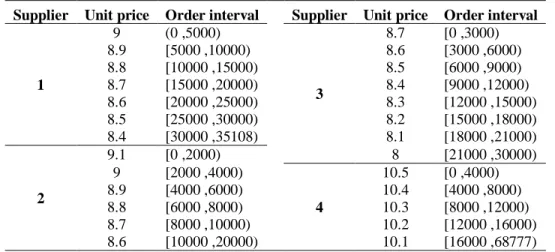
We present numerical examples in this section. There are 4 suppliers in the example. The supplier-related parameters are taken from Kamali et al. (2011) and shown in tables 1 and 2. The annual demand of buyer is 100,000, the buyer’s inventory holding cost is $ 2.6 and the capacity of each vehicle is 5,000 units. The fuzzy fixed cost of each vehicle per unit of distance is assumed to be C = (400,530,640). Other fuzzy parameters are also given in table 3.
Table 1. Suppliers information in the example Parameter Supplier
1 2 3 4 S 43 39 42 30 P 35108 29898 35785 68777 A 40 19 25 39
h 2.29 1.96 2.74 0.54 dis 25 20 15 17
Table 2. Quantity discount offered by suppliers
Supplier Unit price Order interval Supplier Unit price Order interval
1
9 (0 ,5000)
3
8.7 [0 ,3000) 8.9 [5000 ,10000) 8.6 [3000 ,6000) 8.8 [10000 ,15000) 8.5 [6000 ,9000) 8.7 [15000 ,20000) 8.4 [9000 ,12000) 8.6 [20000 ,25000) 8.3 [12000 ,15000) 8.5 [25000 ,30000) 8.2 [15000 ,18000) 8.4 [30000 ,35108) 8.1 [18000 ,21000)
2
9.1 [0 ,2000) 8 [21000 ,30000)
9 [2000 ,4000)
4
10.5 [0 ,4000) 8.9 [4000 ,6000) 10.4 [4000 ,8000) 8.8 [6000 ,8000) 10.3 [8000 ,12000) 8.7 [8000 ,10000) 10.2 [12000 ,16000) 8.6 [10000 ,20000) 10.1 [16000 ,68777)
Table 3. Fuzzy parameters in the example
Supplier 𝒄̃ 𝑯̃ 𝒓̃ 𝒘̃
1 (3, 4.04, 4.9) (0.019, 0.031, 0.043) (0.0307, 0.0344, 0.0389) (0.4, 0.44, 0.48) 2 (6, 6.48, 7.12) (0.037, 0.041, 0.056) (0.0498, 0.0551, 0.0674) (0.55, 0.64, 0.67) 3 (7, 7.17, 7.8) (0.042, 0.052, 0.062) (0.0116, 0.0121, 0.0149) (0.71, 0.72, 0.78) 4 (5, 5.87, 6.23) (0.032, 0.038, 0.051) (0.0205, 0.0215, 0.0265) (0.55, 0.57, 0.62)
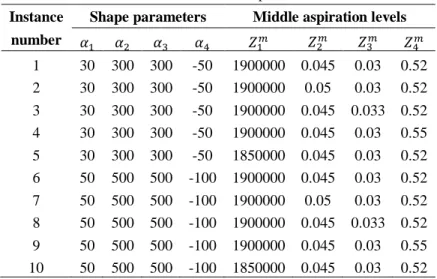
We generate 10 instances with different shape parameters and DM’ middle aspiration levels of goals. The main attributes of the problem instances are summarized in table 4. The degree of satisfaction of DM
211
related to the set of the middle aspiration levels’ values and the shape parameters’ values of problem instance 1, are illustrated in figures 1. Note that all the generated functions are monotone and follow the S-shaped form.
Table 4. Main attributes of the problem instances Instance Shape parameters Middle aspiration levels
number 𝛼1 𝛼2 𝛼3 𝛼4 𝑍1𝑚 𝑍2𝑚 𝑍3𝑚 𝑍4𝑚
1 30 300 300 -50 1900000 0.045 0.03 0.52 2 30 300 300 -50 1900000 0.05 0.03 0.52 3 30 300 300 -50 1900000 0.045 0.033 0.52 4 30 300 300 -50 1900000 0.045 0.03 0.55 5 30 300 300 -50 1850000 0.045 0.03 0.52 6 50 500 500 -100 1900000 0.045 0.03 0.52 7 50 500 500 -100 1900000 0.05 0.03 0.52 8 50 500 500 -100 1900000 0.045 0.033 0.52 9 50 500 500 -100 1900000 0.045 0.03 0.55 10 50 500 500 -100 1850000 0.045 0.03 0.52
The proposed genetic algorithm is implemented in MATLAB 2012 and run on an Intel Core i3 2.10 GHz, HP Pavilion g6 at 4 GB RAM under a Microsoft Windows 7 environment. We set the algorithm parameters as follows: population (N=500), crossover rate (𝑃𝑐= 0.7), mutation rate (𝑃𝑚= 0.2) and number of iterations as stopping criteria (It = 500).
The computational results are summarized in table 5. For each instance, the value of 𝜽 and the corresponding membership degree (𝜼), the value of objectives and order quantities are reported. Note that the other variables of the problem are not shown here, since they can easily be calculated. For example, in the instance 1, the total order quantity per cycle is Q= 3837 + 0 + 1799 + 12407 = 18043 and the corresponding cycle time is 𝑇 = 𝑄/𝐷 = 18043/100000 = 0.18 year. Furthermore, the value of Q1 and Q3 fall into the first price interval, so we have y11=1 and y31=1; the value of Q4 fall into the 4th price interval, and we have y44=1. Moreover, the required vehicles for supplier 1, 2, 3 and 4 are 1, 0, 1 and 3, respectively.
212
(a) (b)
(c) (d)
Fig 1. Degree of satisfaction in respect of: (a) cost, (b) rate of late delivered products, (c) rate of defective products, (d) purchasing value
Table 5. Computational results of the problem instances Instance
𝜽 𝜼 objective values order quantities
number Z1 Z2 Z3 Z4 Q1 Q2 Q3 Q4 1 1.78 0.856 1873056 0.039 0.024 0.563 3837 0 1799 12407 2 2.585 0.93 1827762 0.041 0.021 0.593 9999 0 20459 55300 3 1.909 0.871 1788521 0.039 0.026 0.558 20141 4000 8142 49580 4 1.463 0.812 1768722 0.04 0.025 0.579 22686 2623 20031 30000 5 1.769 0.854 1841438 0.039 0.024 0.564 2890 0 1347 9334 6 2.986 0.952 1822766 0.039 0.024 0.562 10097 0 4972 30671 7 4.246 0.986 1885730 0.042 0.022 0.598 1303 0 2867 8836 8 3.351 0.966 1798057 0.038 0.025 0.554 20412 744 7391 42953 9 2.552 0.928 1875879 0.04 0.025 0.576 3132 825 2178 12690 10 2.965 0.951 1848369 0.039 0.024 0.564 3474 0 1635 11255
6- Conclusion
Supplier selection is one of the most vital processes of the current competitive market in the supply chain management. Organizations rely more on suppliers to reduce their costs, to improve the quality of their products, or to focus on a specific part of their operations. The supplier selection process is complex, since, both quantitative and qualitative criteria must be taken into account. The process becomes more
0 0.5 1
1.4 1.6 1.8 2 2.2 2.4
μ_Z
1
Z1
0 0.5 1
0.02 0.03 0.04 0.05 0.06 0.07
μ_Z
2
Z2
0 0.5 1
0 0.02 0.04 0.06
μ_Z
3
Z3
0 0.5 1
0.4 0.44 0.48 0.52 0.56 0.6 0.64
μ_Z
4
213
complicated if parameters are incomplete or uncertain. On the other hand, the inventory management is usually included in the supplier selection process and it usually studied in the issue of supplier selection and order allocation (SSOA) problems. In this paper, we study a SSOA problem by taking transportation costs, quantity discount, fuzzy type uncertainty and some practical constraints into account. We assume four common objectives and utilize a max-min approach such that the min-operator finds the fuzzy decision that simultaneously satisfies all the fuzzy objectives. Then the maximizing decision is determined to be the maximum degree of membership for the fuzzy decision. We use the non-linear S-shape membership functions to express the vague aspiration levels of the DM’s objective. A genetic algorithm (GA) is applied to solve the multi objective fuzzy SSOA problem. Computational results are presented using numerical examples. There are some direction for future study as following: Other fuzzy approaches such as two-stage method can be applied in order to compare the results. Other meta-heuristic algorithms such as Simulated Annealing (SA) and Scatter Search (SS) can be designed to compare the results with those of GA. Moreover, other quantity discount schemes i.e. incremental quantity discount can be assumed in the problem.
References
Aköz, O., & Petrovic, D. (2007). A fuzzy goal programming method with imprecise goal hierarchy. European Journal of Operational Research, 181(3), 1427-1433.
Amid, A., Ghodsypour, S. H., & O’Brien, C. (2009). A weighted additive fuzzy multiobjective model for the supplier selection problem under price breaks in a supply chain. International Journal of Production Economics, 121(2), 323-332.
Arikan, F. (2013). A fuzzy solution approach for multi objective supplier selection. Expert Systems with Applications, 40(3), 947-952.
Ballou, R. H. (1992). Business Logistics Management. Upper Saddle River, NY Prentice Hall.
Littger, K. (1992). Auswahl von theoriebezogenen Veröffentlichungen. In Optimierung (pp. 197-237). Springer, Berlin, Heidelberg.
Burke, G. J., Carrillo, J., & Vakharia, A. J. (2008). Heuristics for sourcing from multiple suppliers with alternative quantity discounts. European Journal of Operational Research, 186(1), 317-329.
Çebi, F., & Otay, İ. (2016). A two-stage fuzzy approach for supplier evaluation and order allocation problem with quantity discounts and lead time. Information Sciences, 339, 143-157.
Chen, L. H., & Tsai, F. C. (2001). Fuzzy goal programming with different importance and priorities. European Journal of Operational Research, 133(3), 548-556.
Dahel, N. E. (2003). Vendor selection and order quantity allocation in volume discount environments. Supply Chain Management: An International Journal, 8(4), 335-342.
Demirtas, E. A., & Üstün, Ö. (2008). An integrated multiobjective decision making process for supplier selection and order allocation. Omega, 36(1), 76-90.
Ebrahim, R. M., Razmi, J., & Haleh, H. (2009). Scatter search algorithm for supplier selection and order lot sizing under multiple price discount environment. Advances in Engineering Software, 40(9), 766-776.
214
Erginel, N., & Gecer, A. (2016). Fuzzy multi-objective decision model for calibration supplier selection problem. Computers & Industrial Engineering, 102, 166-174.
Govindan, K., Rajendran, S., Sarkis, J., & Murugesan, P. (2015). Multi criteria decision making approaches for green supplier evaluation and selection: a literature review. Journal of Cleaner Production, 98, 66-83.
Govindan, K., Darbari, J. D., Agarwal, V., & Jha, P. C. (2017). Fuzzy multi-objective approach for optimal selection of suppliers and transportation decisions in an eco-efficient closed loop supply chain network. Journal of Cleaner Production, 165, 1598-1619.
Govindan, K., Darbari, J. D., Agarwal, V., & Jha, P. C. (2017). Fuzzy multi-objective approach for optimal selection of suppliers and transportation decisions in an eco-efficient closed loop supply chain network. Journal of Cleaner Production, 165, 1598-1619.
Hamdan, S., & Cheaitou, A. (2017a). Supplier selection and order allocation with green criteria: An MCDM and multi-objective optimization approach. Computers & Operations Research, 81, 282-304. Hamdan, S., & Cheaitou, A. (2017b). Dynamic green supplier selection and order allocation with quantity discounts and varying supplier availability. Computers & Industrial Engineering, 110, 573-589.
Kamali, A., Ghomi, S. F., & Jolai, F. (2011). A multi-objective quantity discount and joint optimization model for coordination of a single-buyer multi-vendor supply chain. Computers & Mathematics with Applications, 62(8), 3251-3269.
Kannan, D., Khodaverdi, R., Olfat, L., Jafarian, A., & Diabat, A. (2013). Integrated fuzzy multi criteria decision making method and multi-objective programming approach for supplier selection and order allocation in a green supply chain. Journal of Cleaner production, 47, 355-367.
Kokangul, A., & Susuz, Z. (2009). Integrated analytical hierarch process and mathematical programming to supplier selection problem with quantity discount. Applied mathematical modelling, 33(3), 1417-1429. Lee, E. S., & Li, R. J. (1993). Fuzzy multiple objective programming and compromise programming with Pareto optimum. Fuzzy sets and systems, 53(3), 275-288.
Li, X. Q., Zhang, B., & Li, H. (2006). Computing efficient solutions to fuzzy multiple objective linear programming problems. Fuzzy sets and systems, 157(10), 1328-1332.
Mansini, R., Savelsbergh, M. W., & Tocchella, B. (2012). The supplier selection problem with quantity discounts and truckload shipping. Omega, 40(4), 445-455.
Moghaddam, K. S. (2015). Fuzzy multi-objective model for supplier selection and order allocation in reverse logistics systems under supply and demand uncertainty. Expert Systems with Applications, 42 (15-16), 6237-6254.
Pazhani, S., Ventura, J. A., & Mendoza, A. (2016). A serial inventory system with supplier selection and order quantity allocation considering transportation costs. Applied Mathematical Modelling, 40(1), 612-634.
215
Razmi, J., & Maghool, E. (2010). Multi-item supplier selection and lot-sizing planning under multiple price discounts using augmented ε-constraint and Tchebycheff method. The International Journal of Advanced Manufacturing Technology, 49(1-4), 379-392.
Tiwari, R. N., Dharmar, S., & Rao, J. R. (1987). Fuzzy goal programming—an additive model. Fuzzy sets and systems, 24(1), 27-34.
Wang, T. Y., & Yang, Y. H. (2009). A fuzzy model for supplier selection in quantity discount environments. Expert Systems with Applications, 36(10), 12179-12187.
Wu, Y. K., & Guu, S. M. (2001). A compromise model for solving fuzzy multiple objective linear programming problems. Journal of the Chinese Institute of Industrial Engineers, 18(5), 87-93.
Xia, W., & Wu, Z. (2007). Supplier selection with multiple criteria in volume discount environments. Omega, 35(5), 494-504.
Zadeh, L. A. (1965). Fuzzy sets. Information and control, 8(3), 338-353.
Zadeh, L. A. (1999). Fuzzy sets as a basis for a theory of possibility. Fuzzy sets and systems, 100(1), 9-34. Zimmermann, H. J. (1978). Fuzzy programming and linear programming with several objective functions. Fuzzy sets and systems, 1(1), 45-55.