Rachel R Voorhis
UNC Chapel Hill, Institute for the Environment at the College of Arts and Sciences, Chapel Hill, NC 27514
Abstract:Human provisioning (feeding) of otherwise wild animals has been shown to significantly alter their body condition and behavior as compared to other members of the population. However, the vast majority of these studies tends to focus on either physiology or behavior, and thus do not provide a holistic assessment of the impact of provisioning. The recent population boom of grey seals (Halichoerus grypus) in the western Atlantic and their proximity to humans makes them an ideal candidate for such a study. Morphological data was collected and GPS tags deployed for several seals in Chatham Harbor, Massachusetts in June 2013. Movement analysis suggested one seal was provisioned via the Chatham Fish Pier, and the assumption was later verified by photo identification. The provisioned female (#709) was particularly small in terms of length, weight and girth for her age, and exhibited significantly decreased blubber thickness compared to other female seals in the study. Stable isotope analysis determined that #709 was foraging (or was fed) prey items from a higher tropic level than normal, as well as indicated high levels of inshore feeding. Home range, trip and behavioral analysis generated by GPS tag data suggest that the provisioned seal deviated from ‘normal’ patterns of movement including number, location and length of foraging trips, home range size and location, and breeding behavior. The cumulative analysis is limited by a small sample size, but implies that further research of this type could support a direct link between human provisioning and significant deviations in grey seal ecology.
KEY WORDS: grey seals • Halichoerus grypus • human provisioning • ecology • Cape Cod, Massachusetts
1. Introduction
The grey seal (Halichoerus grypus) is a large, size-dimorphic pinniped species. There are three distinct populations worldwide: the Northwest Atlantic, Northeast Atlantic and the Baltic Sea (Ampela 2009), each with slightly different morphological and behavioral characteristics. Males and females in the Northwest Atlantic attain mature lengths of 2.65 m and 2.20 m respectively (Beck et al 2003). Females in the wild generally do not live over 35 years and reach sexual maturity between 4 and 5 years of age; in contrast, males generally live to 25, with sexual maturity reached between 6 and 7 years of age (Hewer 1963). Diving, and thus foraging (as the two are highly correlated), behaviors also differ significantly by sex. Studies by Beck et al (2003, 2007) found that maximum dive depths differed by more than 30m between males and females. Additionally, while females on average spent more effort (hours/day) diving and visited more individual locations than males, males tend to forage in deeper waters at locations further offshore (Breed et al 2009). It is thought that while some behavioral dissimilarities, such as dive depth, can be attributed to size-dimorphism, Beck suggests that sexual differences in behavior result from the tradeoffs associated with long-term energy storage needed for reproduction (Beck et al 2003).
135,000 grey seals (Halichoerus grypus) had been killed in Massachusetts and Maine (Bidgood 2013) for both subsistence purposes and assumed threats to human fishing activities (Ampela 2009). By the 1980’s the grey seal was virtually extinct in US waters. In the last 40 years, the Western Atlantic population has rebounded rapidly due to amplified legal protections and public concern for the survival of marine mammals. The Northwest Atlantic grey seal population has seen 12% growth annually in that time (Breed et al 2009). NOAA’s stock assessment of Cape Cod found only 2,035 grey seals in 1994; the same survey counted over 15,700 in 2011 (NOAA 2012).
The recent seal population boom has generated mixed reactions in the surrounding community. While tourism has increased from the development of a seal-watching boat-tour industry, fishermen accuse seals for a declining fish harvest, especially in the case of Atlantic cod (Gruber 2014). Although we are aware that seals in this area do prey on Atlantic cod, sand lance is a far more exploited food source in most seasons (Ampela 2009). There remains a considerable amount of conflicting opinions across Canada, Europe and the US to whether or not seals are to blame for the decline (Cook et al 2016; Trzcinski et al 2006; Chouinard et al 2005), and overfishing is generally considered a more probable explanation. Seal expansion has also been cited as a primary catalyst for the recent increase in Great white shark activity off the Massachusetts coast (Skomal 2012), which the public fears could have a negative effect on recreational water activities (Gruber 2014). In August 2015, researches confirmed spotting 17 individual great whites off the coast in a single day. In the same month, officials issued a swimming suspension for Nauset Light Beach in Eastham, Massachusetts after a great white attacked a seal within 60 – 90 ft. of the shore (Fraser 2015).
Though research is limited to a few species, the impact of human provisioning on the ecology of wild animals is fairly well documented. However, few studies have examined both behavioral and physiological effects. Provisioned bottlenose dolphins, for instance, have been studied numerous times for changes in movement, behavior and mother/calf dynamics during and post-human provisioning (Samuels and Bejder 2004, Panama City, Florida; Foroughirada and Mann 2013, Shark Bay, Australia), but not for physiological changes. In both of these cases, provisioning of the dolphins was intentional and utilized to encourage interactions between the animals and tourists. In the case of dolphins at Panama City, the study found that food provisioning was a strong incentive for free-ranging dolphins to consistently engage with visitors. Dolphins that were considered ‘food conditioned’ to humans at the beach (i.e. were fed on a semi-regular basis by people) engaged with swimmers 77% of the time during observations, while the percentage was much lower for non-conditioned dolphins in the same area. Additionally, conditioned dolphins remained within 1 nautical mile of the site during observation periods (only travel was from vessel to vessel). In contrast, researchers recorded that non-conditioned individuals did not travel between vessels i.e. investigate when a new vessel arrived, and regularly swam several nautical miles off the coast and into the bay during observation (Samuels and Bejder 2004). At Shark Bay, Australia, dolphin feeding has been a regular, daily activity since the 1960’s, and has been regulated by the Department of Environment and Conservation (DEC) since 1989. This study, which employed a ‘BACI’ (Before-After-Control-Impact) experimental design, found that parent-offspring interactions and activity budgets were markedly affected by participation in a provisioning program. Surprisingly, calves born to provisioned females rested less often given that their home ranges are smaller than the non-provisioned group, and spent more time foraging (Foroughirada and Mann 2013). Such studies are of particular relevance to this one, as they examine behavioral changes of a common, marine predator.
with humans at Stingray City Sandbar (SCS) in the Cayman Islands – an ecotourism destination where stingrays are fed multiple times per day – southern stingrays are excellent candidates for such investigations (Corcoran et al 2013; Semeniuk and Rothley 2008). Corcoran et al (2013) found that a much higher level of spatial overlap in habitat use demonstrated by female stingrays at SCS compared to wild stingrays suggests that impact of provisioning activities has likely altered the normal population dynamics. The daily pattern of movement was also significantly altered at SCS, where stingrays occupied a much reduced area during daytime feeding, but were consistently moving from tourist to tourist. Wild stingrays, in contrast, spend more time resting and generally forage at night. Other studies conducted at the site found that the nearly constant interaction of multiple stingrays at SCS has a significant impact on the animals physically. Compared to wild stingrays, SCS individuals were, “more likely to have lower body condition, be injured by boats and predators, be susceptible to ecto-dermal parasites, and be engaged in intense interference competition (Semeniuk and Rothley 2008).” These studies, taken together, offer a more complete picture of the impact of provisioning on the ecology of southern stingrays and can be utilized when implementing management practices. Similar studies for other marine organisms that experience frequent human interaction would be similarly useful.
2. Methods and Analysis
2.1 Capture, Tagging and Measuring
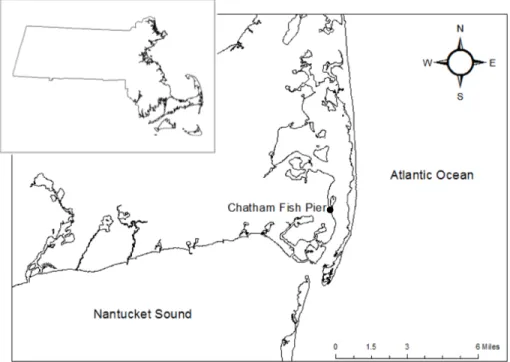
Fieldwork was conducted between June 12th and 17th, 2013 at a tidally-dependent sand bar hull-out site (41.67 N, 68.95 W) within Chatham Harbor, MA (one rehabilitated seal was tagged opportunistically in September 2012). Methods utilized in a study capturing and marking harbor seals (Jeffries et al 1993) were adapted for this purpose. Seals were either captured at the haul-out site or swimming in shallow water in a net deployed from a boat. The seal was then transported to another, largely unoccupied sandbar to be tranquilized and measured (see footage of the capture and tagging process at: https://www.youtube.com/watch?v=HYkaFW5HHfM).
Veterinarians monitored the seals’ physical condition throughout the process. Seals were anesthetized intramuscularly with 0.58 – 0.8 mg/kg of 100mg/mL tiletamine/zolazepam (TZ) in a 1:1 ratio (Sharp et al). Basic morphometrics – weight, girth, head and flipper length, and standard length – were measured on site during sedation. Two 8mm blubber biopsy samples were collected from both the dorsal and lateral flanks of the animal to measure bubbler thickness. Approximately 1 μg blood samples were drawn for stable isotope analysis. One lower incisor from each animal was removed after a local anesthetic was injected to estimate age (Bernt et al 1996). GSM/GPRS tags (Global System for Mobile Communications/General Packet Radio System, SMRU Instrumentation, St. Andrews, Scotland) measuring 10cm x 7cm x 4cm and weighing 370 g were attached to the head or neck of the seal (location determined by body size) using an epoxy based adhesive (Jessop et al. 2013). The tags relayed time spent diving, surfing and hauled-out, as well as various diving metrics (depth and duration of dives, time of dives, and temperature during the dive), every 4 hours. They also gathered high-resolution movement data. In total, the metrics of 12 seals were collected and 8 received GPS tags. Photos used for identification of the provisioned seal were collected by members of the International Fund for Animal Welfare (IFAW) Marine Mammal Rescue and Research Program.
2.2 Body Condition
We compared the body condition of the provisioned female to that of the other five identified females. Males were excluded in this analysis, as body size and blubber accumulation are significantly different between sexes as a result of differing diet, foraging and breeding strategies (Breed at al 2009). Blubber fat thickness was calculated by ultrasound image analysis in the lab (as described by Miller et al 2011). Girth, weight, standard length and blubber thicknesses were used to determine relative body condition. Mahalanobis distance statistical analysis was used to compare girth, weight and standard length between the females, and a Grubbs test was conducted to analyze blubber thickness and determine whether there were any statistical outliers.
2.3 Stable Isotope Analysis
Stable isotopes of carbon have been shown to accurately distinguish between foraging areas. Cherel and Hobson (2007) show that δ13C values designate spatial foraging segregation of penguins at a sub Antarctic archipelago, with higher values being indicative of more inshore feeding, and lower values indicating more offshore/oceanic feeding. Additionally, ecologists in both terrestrial and aquatic ecosystems have utilized stable nitrogen isotopes as a measure of the trophic level of prey (Sponheimer et al 2003; Cabana and Rasmussen 1994; Kelly 2000). Animals feeding at higher trophic levels will maintain a greater percentage of δ15N (‰) in their blood.
Stable isotope analysis was conducted by the Polito Lab at Louisiana State University. The process by which stable isotopes were extracted can be found in Rey and Polito, et al 2012. Studies have shown that male and female grey seals forage differently and likely on different prey (Breed et al 2009); thus, stable isotope figures - δ15N (‰) and δ13C (‰) - of females alone was analyzed. A multivariate outlier analysis using Mahalanobis Distances were conducted using both nitrogen and carbon level, and Grubbs outlier analysis was conducted for each isotope individually.
2.4 Tag Data – Behavior and Movement
To account for the observed change in behavior between seasons, a breakpoint was established, as previous studies have shown that both sexes made longer trips and spent more time foraging in the colder seasons (Breed et al 2009). Using this information, a breakpoint was set by fitting the segmented model iteratively with breakpoints between October 1 and January 1, and anchoring the breakpoint at the partition that minimizes deviance (Moxley 2016). The breakpoint (BP) utilized for the remainder of this report is November 5, separating our data into warm (June – November 5) and cold (November 5 – March) seasons, as tags were deployed in June, and most remained intact and active through March the following year. Apart from obvious breeding pressures, it is also thought that the observed temporal behavioral change is linked to the presence or absence of great white sharks in the Western Atlantic during the warmer months (Skomal 2012).
encompasses a 95% probability of observing that animal. This can be interpreted as the space used by the animal 95% of the time during that season (Moxley 2016).
Data for offshore foraging trips, average number of trips, duration, total distance travelled and maximum distance offshore, was also calculated seasonally. Foraging trips are identified by multi-hour movements to areas beyond 2 km from the coast and include the movement between the coast and the 2 km buffer. Distance travelled is the number of km the animal travelled between departing the coast and returning to the coast i.e. the location with minimum distance to shore. Maximum distance offshore is the maximum number of km away from the coast the animal reached during that trip. Trip duration is the time (in days) the trip lasted (Moxley 2016). The average for each metric was calculated for female seals (excluding the provisioned seal) and for all seals as a whole (again, excluding the provisioned female) for comparison purposes.
Activity budgets – the proportion of each 4-hour period that a tagged animal spent at the surface (< 1 m deep), at depth/diving (> 1 m deep), or hauled out (on a beach) – were recorded by the GPS units, along with average/max dive depth. The seasonal average for four behavior metrics – percent time diving, at the surface and hauled-out on land and max dive depth – were utilized to examine whether distinct male and female patterns of behavior could be identified. Analysis was conducted using a K-Mean cluster analysis (n clusters = 2), and examined where the provisioned female fell within the range of the identified patterns. Additionally, averages for all four metrics were calculated for female and male seals in the study to compare to the provisioned female (#709).
3. Results
3.1 Photo Identification
3.2 Body Condition
Compared to other females, provisioned female #709 did not significantly differ in terms of weight, girth or standard length.). Figure 2 shows a positive correlation between standard length and girth/weight of the female seals. Seal #709 falls along this correlation line i.e. no single measure appeared significantly abnormal compared to other morphological measurements. It should be noted, however, that seal #652 (11 yr), the largest in the group across all metrics, is younger than our provisioned female (12 yr). This is significant as female grey seals generally do not stop growing until 15 years of age, and can attain lengths of 2.20 (#652 was 181cm long at the time of this study). Thus, female #709 appears significantly smaller than would be expected for her age, and is closer in size to much younger seals, those around 6 years of age. Lateral blubber thickness did not appear to be a clear measure of overall blubber content, as a great deal of variation exists within both genders. Dorsal blubber thickness, in contrast, was fairly consistent within both sexes (Fig. 3). The Grubbs outlier test using dorsal fat thickness (α = 0.05) found that the provisioned female was nearly a statistical outlier (p > |G| = 0.065). Blubber thickness did not appear to be correlated to any other metric in our analysis.
3.3 Stable Isotope Analysis
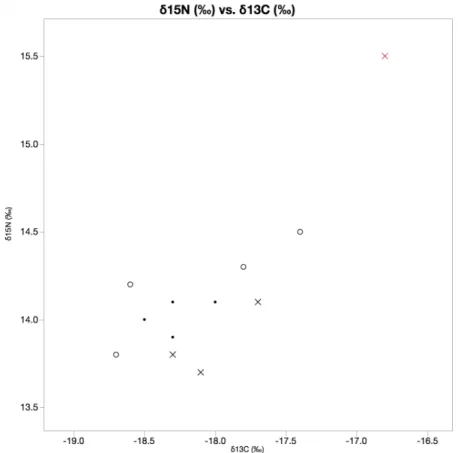
A stable isotope analysis was conducted for each of the tagged seals, as well as other individuals that were captured on the same day. Figure 4 shows δ15N (‰) vs. δ13C (‰) for male and female seals, as well those for which sex was unknown. In our analysis, there was no significant different shown between the isotope levels of males and females, though other studies have shown the sexes have different foraging strategies (Nitrogen: female avg. – -18.2, male avg. – -18.3; Carbon: female avg. – 13.9, male avg. – 14.0). It is evident simply from visual analysis that the blood of provisioned female #709 contained significantly higher levels of each isotope than any other tested animal (Fig. 4). Individual Grubbs outlier tests of each isotope found that the δ15N (‰) value of the provisioned female was a statistical outlier (p > |G| = 0.00123), while the δ13C (‰) was nearly an outlier (p > |G| = 0.07513). A multivariate statistical analysis using Mahalanobis Distances (α = 0.05) determined that when taken together, δ15N (‰) and δ13C (‰) values for the provisioned female were statistical outliers (Fig. 5).
3.4 Tag Data – Behavior and Movement
Provisioned female #709 did not make any offshore trips during the warm season, as shown in Fig. 8., thus no warm season comparisons between #709 and other non-provisioned seals could be made. The data comparing mean female and mean all seal data helps to substantiate claims made by previous studies as to the differences between male and female grey seal foraging behavior (Beck et al 2003, 2007). In the warm season, male and female behavior is much more closely correlated across all metrics, as is also described in Breed et al (2009). Figure 8 presents a clear example of the seasonal shift in behavior between summer and winter, and is further justification for differentiating date by season in the remainder of this paper. During the winter months, we can see that #709 made significantly more trips than the mean of other females and all seals. However, these trips appear to be shorter both in duration and distance, and stick closer to shore than the trips of other tagged individuals. This follows with our knowledge of her home range, as described below.
Simple visual analysis of the six most complete (longest tag duration) GPS seal tracks shows great variation between individuals and sexes. It is evident that the provisioned female displayed deviant behavior during the course of the study, as evidenced by her significantly decreased overall range (Fig. 9). All others seals of both sexes participated in at least one extended offshore excursion, either north towards Canada or south of Nantucket Island. In addition, the waters between the mainland, Martha’s Vineyard and Nantucket (or Nantucket Sound) remain largely unutilized by non-provisioned seals, though the two ‘normal’ females do appear to use the sound to migrate to the breeding colony (Muskeget Island, west of Nantucket). In contrast, the provisioned female makes several trips within the sound (Fig. 9), which could explain the shallow diving behavior described previously (if we assume that the sound is generally more shallow than the open Atlantic Ocean). Additionally, the area covered by the provisioned female #709 is much lower than other seals of both sexes in the warm season (Table 1). In the cold season, the size jumps significantly, about to that of the other females. However, as discussed, the location of this range is highly dissimilar.
4. Discussion
Accounting for the multitude of variables – body condition, stable isotope analysis, behavior and movement – it appears that human provisioning from the fish pier may have multiple impacts on grey seal ecology. Analysis of body condition showed that the provisioned female does not outwardly appear dissimilar from the rest of the subset (females, sub-adults or adults over four years of age) in terms of weight, girth or standard length. As the provisioned female was the eldest of the group (12 years), we would expect her to be the largest overall. Overall size tends to increase until around 15 years of age in female grey seals (Hewer 1963), with mature adult lengths reaching 2.20m in this population (Beck et al 2003). Due to the small sample size, it was not possible to say for certain whether the observed small size of seal #709 was significant, as it could in theory be a product of natural genetic variation within the population. However, #709’s dorsal blubber fat content is also significantly lower than other females, even those a third of her age. Lateral blubber fat thickness is also on the lower end of the spectrum, though not significantly so. Blubber thickness does not appear to be correlated to any other body metric in the analysis of the data. Seal #709’s substantial lack of blubber could reasonably impact her overall fitness, as she has less insulation from the cold. This could be related to her lack of offshore trips.
than female seals (Fig. 6). Previous reports show that grey seals demonstrate consistently high rates of reproduction between the ages of 5 and 30 (Hammill and Gosselin 1994). Similarly, Bowen et al (2006) found that 68 – 73% of female grey seals 4-15 years old in Halifax, Nova Scotia, Canada gave birth, further supporting the hypothesis that lack of breeding for a 12 year old seal is likely deviant behavior. If we assume sufficient blubber thickness is an indicator of overall fitness, it may be inferred that #709 did not have the capability to breed. Various studies of mammalian species show that females in poor condition are less likely to be pregnant or carry the pregnancy to term (Beck et al 2003). Miller et al. published a study in 2011 that showed, in right whales, thicker blubber may indicate a better nutritional regime and likely contributes to more stable and successful reproductive performance. More research would be needed to conclude whether blubber thickness in grey seals is similarly linked to reproduction.
Analysis of stable carbon and nitrogen isotopes provides insight into how human provisioning may have affected the diet of #709. In our analysis, there was no significant difference found between the isotope levels of males and females, though other studies have shown the sexes have different foraging strategies that would likely impact these levels. Higher δ15N (‰) and δ13C (‰) levels in the blood of #709 indicate consumption of fish of a higher trophic level and more inshore foraging as compared to the rest of the population. This confirms the assumption that #709 fed successfully at the pier frequently enough that she significantly altered the composition of stable isotopes in her blood. Each ~3% enrichment of δ15N (‰) in the blood is indicative of a step higher on the food chain (Sponheimer et al 2003). Seal #709’s blood δ15N (‰) level was ~7% higher than the conspecifics, signifying that her average prey was approximately two trophic levels above the norm. It also suggests that the type of fish that #709 was receiving at the pier were not the sort that grey seals would normally catch on their own (for overview of fish typically caught by grey seals in this area, see Ampela 2009). Diets low in lipid content and periods of low prey abundance are both positively correlated with low blubber thickness in right whales (Miller et al 2011); nutritional changes or low prey consumption caused by human provisioning could reasonably be having a similar impact on seal #709.
The total absence of offshore trips during the warm season for #709 is significant on its own, and expected given our knowledge of provisioning. We assume animals that remain in any small area for extended periods are likely in favorable habitat, as explained by the optimal foraging theory (Breed et al 2009). The consistent presence of easily retrieved food at the pier made a small area (Chatham Harbor) an optimal habitat for #709. The food obtained through provisioning may have been of ‘lower quality’, or at least less conducive to generating fat reserves than the normal prey of grey seals in Cape Cod, though this it is impossible to know for sure as cause and effect cannot be distinguished by this study. During the cold season (post-BP) #709 conducted more offshore trips than other seals in the study (and more than the average), though these trips were much shorter in duration, total distance travelled and max distance offshore (Fig. 8). This follows with what we know of her geographic location during this time, with nearly all offshore trips occurring within the Nantucket sound. It would be much easier for #709 to continually return to shores/sandbars on the coast while foraging in the sound than it would be for ‘normal’ conspecifics foraging primarily in the open Atlantic. It may be that feeding at the pier lowered her physical capability to fish efficiently offshore, or that #709 is an inherently physically unfit individual, and thus developed this particular foraging habit as a means of survival.
One of the limitations of this study – as mentioned previously – is the small sample size. The presence of a single provisioned animal made statistical comparisons difficult; further research would need to be conducted in order to validate and clarify these findings. This could be remedied by measuring/tagging other individual seals that utilize the pier for food. Another source of limitation is the relatively small age range represented by the seals in this study. The provisioned animal in this case was the oldest across both sexes. This could potentially confound results, as it is possible that some of the behavior changes are associated with age. While the data collected from another female seal of comparable age (11 yr) helps to validate the hypothesis that provisioning, not age, is the primary driver of observed differences, a larger age range would be needed to close the window of potential error. Though narrow, this study presents enough evidence to suggest that provisioning by humans is likely impacting grey seals that use Chatham Harbor and the Fish Pier as a primary foraging site. More research investigating the scope of this impact is necessary to corroborate the results found here, and to accurately inform future management plans for the marine wildlife of Cape Cod.
Acknowledgements
Research was conducted under NMFS Scientific Research Permit #17670 and Cape Cod National Park Service Special Use Permit CACO-2013-SCI-0015 issued to the Northeast Fisheries Science Center. The project was approved by the NMFS Atlantic IACUC Committee (IACUC-2011-005). I am grateful for the support and guidance provided by Dr. David Johnston as well as the rest of the Johnston Lab at the DUML. Special thanks to the following people and their respective organizations for their invaluable contributions…
S.M. Sharp 1, J.H. Moxley 2, A. Barratclough 3,4, A. Bogomolni 5,6,R. DiGiovanni 7, M.O. Hammill 8, D.W. Johnston 2, K.M. Moore 1, M.J. Moore 1,6, W.B. Sharp 1, G. Waring 9, M. Polito 6, L. Sette10
1 International Fund for Animal Welfare Marine Mammal Rescue and Research, Yarmouth Port, MA 02675, USA 2 Division of Marine Science and Conservation, Nicholas School of the Environment Duke University Marine Laboratory, 135 Duke Marine Laboratory Rd., Beaufort, NC 28516, USA
3 Zoological Society of London, Regents Park, London, NW1 4RY 4 Royal Veterinary College, Royal College Street London, NW1 0TU 5 University of Connecticut, Storrs, CT 06269, USA
6 Woods Hole Oceanographic Institution, Woods Hole, MA 02543
7 Riverhead Foundation for Marine Research and Preservation, Riverhead, NY 11901 8 Maurice Lamontagne Institute, Fisheries and Oceans Canada, Box 1000, Mont-Joli, QC 9 Northeast Fisheries Science Center, Woods Hole, MA 02543
Figure 2 (left). Girth, weight and standard length for all female seals. Provisioned female indicated in red.
Figure 4. Stable nitrogen and carbon concentrations from blood samples; (x) – females, () – males, (¢) – unknown gender. Red (x) indicates provisioned female.
Figure 6. K means cluster analysis for warm (left) and cold (right seasons) based on 4 behavioral metrics (max dive depth (m) and % time diving, at the surface, and hauled out). (x) – Female, () – Male. Circled “x” indicates provisioned female. Cluster 1 indicates normal female behavior, cluster 2 normal male behavior.
Literature Cited
Ampela, K. "The Diet and Foraging Ecology of Gray Seals (Halichoerus Grypus) in United States Waters." PhD diss., The City University of New York, 2009.
file:///Users/rachelvoorhis/Downloads/out.pdf. Beck, C.A., W. Don Bowen, Jim I. Mcmillan, and Sara J. Iverson. "Sex
Differences in the Diving Behaviour of a Size-dimorphic Capital Breeder: The Grey Seal." Animal Behaviour 66, no. 4 (2003): 777-89.
Beck, C.A., Sara J. Iverson, W. Don Bowen, and Wade Blanchard. "Sex Differences in Grey Seal Diet Reflect Seasonal Variation in Foraging Behaviour and Reproductive Expenditure: Evidence from Quantitative Fatty Acid Signature Analysis." Journal of Animal Ecology 76 (2007): 490-502.
Bernt, K.E., Mike O. Hammill, and Kit M. Kovacs. "Age Estimation Of Grey Seals (Halichoerus Grypus) Using Incisors." Marine Mammal Sci Marine Mammal Science 12, no. 3 (1996): 476-82.
Bidgood, J. "Thriving in Cape Cod’s Waters, Gray Seals Draw Fans and Foes." NY Times, August 16, 2013.
Bowen, W.D., S. J. Iverson, J. I. Mcmillan, and D. J. Boness. "Reproductive Performance in Grey Seals: Age-related Improvement and Senescence in a Capital Breeder."
Journal of Animal Ecology 75, no. 6 (2006): 1340-351. Breed, G.A., Ian D. Jonsen, Ransom A. Myers, W. Don Bowen, and
Marty L. Leonard. "Sex-specific, Seasonal Foraging Tactics of Adult Grey Seals (Halichoerus Grypus) Revealed by State–space Analysis." Ecology 90, no. 11 (2009): 3209-221.
Cabana, G. "Comparison of Aquatic Food Chains Using Nitrogen Isotopes." Proceedings of the National Academy of Sciences 93 (1996): 10844-10847.
Chouinard, G.A., D.P. Swain, M.O. Hammill, and G.A. Poirier. "Covariation between Grey Seal (Halichoerus Grypus) Abundance and Natural Mortality of Cod (Gadus Morhua) in the Southern Gulf of St. Lawrence." Canadian Journal of Fisheries and Aquatic Sciences 62, no. 9 (2005): 1991-2000.
Cook, R., and Vanessa Trijoulet. "The Effects of Grey Seal Predation and Commercial Fishing on the Recovery of a Depleted Cod Stock." Can. J. Fish. Aquat. Sci. Canadian Journal of Fisheries and Aquatic Sciences, 2016.
Corcoran, M.J., Bradley M. Wetherbee, Mahmood S. Shivji, Matthew D. Potenski, Demian D. Chapman, Guy M. Harvey, and Konstantinos I. Stergiou. "Supplemental Feeding for Ecotourism Reverses Diel Activity and Alters Movement Patterns and Spatial Distribution of the Southern Stingray, Dasyatis Americana." PLoS ONE 8, no. 3 (2013): 1-11. Foroughirad, V., and J. Mann. "Long-term Impacts of Fish Provisioning
on the Behavior and Survival of Wild Bottlenose Dolphins." Biological Conservation 160 (2013): 242-49. Fraser, D. "Cape's Great White Sharks Head Closer to Shore."
Capecodtimes.com. Accessed March 30, 2016.
http://www.capecodtimes.com/article/20150831/NEWS/ 150839888.
Gruber, C. “Social, Economic, and Spatial Perceptions of Gray Seal (Halichoerus grypus) Interactions with Commercial Fisheries in Cape Cod, MA.” Master’s Thesis, Nicholas School of the Environment of Duke University, 2014. Hammill, M.O., and J.F. Gosselin. "Grey Seal (Halichoerus Grypus the
Northwest Atlantic: Female Reproductive Rates, Age at
First Birth, and Age of Maturity in Males." Canadian Journal of Fish and Aquatic Science 52 (1995): 2757-761. Hewer, H.R. "The Determination of Age, Sexual Maturity, Longevity
and a Life-Table in the Grey Seal (Halichoerus Grypus)."
Proceedings of the Zoological Society of London 142, no. 4 (1963): 593-623.
Jeffries S., Brown RF, Harvey JT. 1993. “Techniques for capturing, handling and marking harbour seals.” Aquatic Mammals.
19:21–25.
Jessop, M., M. Cronin, and T. Hart. 2013. “Habitat-mediated dive behavior in free-ranging gray seals.” PLoS ONE 8(5): e63720. doi:10.1371/ journal.pone.0063720. Kelly, J.F. “Stable isotopes of carbon and nitrogen in the study of
avian and mammalian trophic ecology.” Journal of Canadian Zoology 78, no. 1 (2000): 1-27.
Miller, C.A., D. Reeb, Pb Best, Ar Knowlton, Mw Brown, and Mj Moore. "Blubber Thickness in Right Whales Eubalaena Glacialis and Eubalaena Australis Related with Reproduction, Life History Status and Prey Abundance." Marine Ecology Progress Series Mar. Ecol. Prog. Ser. 438 (2011): 267-83.
Moxley, Jerry. “Investigating foraging utilization distributions and rapid seasonal expansion of space use in the context of pre-breeding costs for Cape Cod gray seals.” Chapter 3 of Dissertation. Unpublished. 2016.
NOAA. “GRAY SEAL (Halichoerus grypus grypus): Western North Atlantic Stock.” Stock assessment (2012).
Rey, A.R., Michael Polito, Diego Archuby, and Néstor Coria. "Stable Isotopes Identify Age- and Sex-specific Dietary Partitioning and Foraging Habitat Segregation in Southern Giant Petrels Breeding in Antarctica and Southern
Patagonia." Marine Biology Mar Biol 159, no. 6 (2012): 1317-326.
Samuels, A. and Bejder, L. "Chronic Interaction between Humans and Free-ranging Bottlenose Dolphins near Panama City Beach, Florida, USA." J. CETACEAN RES. MANAGE. 6, no. 1 (2004): 69-77.
Semeniuk, C., and Kd Rothley. "Costs of Group-living for a Normally Solitary Forager: Effects of Provisioning Tourism on Southern Stingrays Dasyatis Americana." Marine Ecology Progress Series 357 (2008): 271-82.
Sharp, S.M., J.H. Moxley, A. Barratclough, A. Bogomolni, R. DiGiovanni, M.O. Hammill, D.W. Johnston, K.M. Moore, M.J. Moore, W.B. Sharp, G. Waring.
“Tiletamine/zolazepam sedation in healthy wild gray seals (Halichoerus grypus).” Unpublished. 2014.
Skomal, G.B., John Chisholm, and Steven J. Correia. "Implications of increasing pinniped populations on the diet and abundance of white sharks off the coast of
Massachusetts." Global Perspectives on the Biology and Life History of the White Shark’.(Ed. ML Domeier.) pp (2012): 405-418.
Sponheimer, M; Robinson, T; Ayliffe, L; et al. “Nitrogen isotopes in mammalian herbivores: hair (delta(15)N values from a controlled feeding study.” International Journal of Osteoarchaeology no. 13 (2003):80-87.