Stefanie N. Protasowicki. Usability Study Methodologies of Electronic Health Record Systems: A Systematic Review. A Master’s Paper for the M.S. in IS degree. July, 2015. 57 pages. Advisor: Javed Mostafa
This study is a systematic review of literature on electronic health record systems (EHRs) and the evaluation methods performed to study their usability. The purpose was to
identify and review the extent of usability testing methods in their respective clinical environments. Full text review was completed for 121 of 753 titles intentionally identified, and 70 final articles were included.
The majority of methodologies reviewed were well established in HCI and the most common was the questionnaire. There was a wide range of study designs in terms of user populations (physicians, nurses, pharmacists, nurse practitioners, physical therapists and others), clinical settings (inpatient and outpatient, ambulatory, pediatric, intensive care units, and others), testing time (pre-implementation or post), and qualitative data analysis. Chosen methodologies and study designs closely depended on study goals, but all of them had large implications for the future of quality healthcare and how to achieve it.
Headings:
Health sciences literature -- Reviews Research techniques
USABILITY STUDY METHODOLOGIES OF ELECTRONIC HEALTH RECORD SYSTEMS
by
Stefanie N. Protasowicki
A Master’s paper submitted to the faculty of the School of Information and Library Science of the University of North Carolina at Chapel Hill
in partial fulfillment of the requirements for the degree of Master of Science in
Information Science.
Chapel Hill, North Carolina July 2015
Approved by
Table of Contents
Usability study methodologies of electronic health record systems ... 2
Table of Contents ... 1
Introduction ... 2
Motivation ... 3
1.1 The Definition of Usability ... 5
1.2 The Definition of EHR ... 7
1.3 Pressure to Modernize Healthcare ... 9
Methods ... 11
1.4 Search Strategy ... 11
1.5 Inclusion/Exclusion General Criteria ... 13
Figure 1. Initial inclusion/exclusion criteria for PubMed………...….…….…16
1.5.1 Inclusion Criteria ... 16
1.5.2 Exclusion Criteria ... 18
1.6 Data Extraction and Management ... 20
Figure 2. Study Types and Methods ... 21
Results ... 21
Table 1: Number of usability methods by study type ... 22
Discussion ... 23
1.7 Testing Environment ... 23
1.7.1 Test Setting ... 23
Table 2: Types of Clinical Environments Reviewed………..………...25
Table 3: Countries ... 25
Table 4: Types of Users Reviewed ... 26
1.8 Time and Frequency of Testing ... 27
1.8.1 Testing Motivation ... 27
1.9 Controlled Testing ... 28
1.10 Data Relevance and Generalizability ... 29
1.10.1 Perceptions and Outcomes of Usability ... 29
1.11 Study Designs ... 31
1.12 Data Validity ... 33
1.12.1 Qualitative Data Analysis ... 33
1.12.2 Questionnaires ... 34
Limitations ... 36
Introduction
Welcomed by some, and begrudgingly adopted by others, electronic health records (EHRs) have become one of the most anticipated and discussed topics in healthcare today. There has been a large push for EHR adoption mainly because they have become important for improving patient safety, healthcare quality, and efficiency (Bates, 2002; Bates, & Gawande 2003; Bates, 2005). Intensified demand for quality health care, combined with rising costs of these services, has led to increased attention in the use of health information technology (HIT) as viable solutions (Jamal, McKenzie, & Clark, 2009). There are several kinds of HIT solutions being proposed EHR, however remains the core and the highest priority among the proposed solutions. Despite being a fairly new innovation, there is a lot of literature about various topics and studies regarding many aspects of EHR. A preliminary look at research shows that introduction of EHRs can improve quality of care (Adams, Mann, & Bauchner, 2003; Chaudhry et al., 2006). Financial performance (Samaan, Klein, Manosur, & DeWitt, 2009; Spalding, Mayer, Ginde, Lowenstein, & Yaron, 2011), and patient outcomes (Poissant, Pereira, Tamblyn, & Kawasumi, 2005).
Their promise is alluring but in some cases they remain ambiguous. Decision makers in care settings around the world are under pressure from vendors, clinicians, and the public alike (Wyatt, 2003) to implement EHRs and support medical practices.
higher officials are serious about making these systems work. However, There is a good portion of studies also pointing out problems arising from EHRs. Although the benefits of health IT are beginning to emerge in small and large providers alike, a recent review of health information technology literature found that provider dissatisfaction with EHRs remain a significant problem. A problem large enough that it has the potential to act as a barrier to widespread adoption and meaningful use of EHRs (Buntin, Burke, Hoaglin, & Blumenthal, 2011). Likewise, the push toward EHR implementation has aroused many issues related to acceptance of the technology, and in particular challenges relating to user acceptance (Despont-Gros, Mueller, & Lovis, 2005; Holden, & Karsh, 2010). The only way EHRs are going to reach the full medical potential many people envision for them, is if the causes of low user acceptance are understood.
Motivation
usability testing can be conducted by vendors themselves, external third-party
organizations, or general researchers. In particular, EMR usability testing has proven difficult for clinicians at point of purchase because proper evaluation requires in-depth study using unfamiliar skills (HIMSS, 2009). EMR technology is new enough to where most users have not experienced another system outside the one they currently use. This is where hiring a third-party consulting group could help. However, while third-party consulting groups have done a lot of work surveying current users, these are rarely provided directly by clinical end-users (HIMSS, 2009). In addition, industry survey instruments used to collect data usually are not constructed to provide reliable usability data. Many only provide ratings for user satisfaction, which is a single component of usability.
and other environments). The study was confined to usability testing of EMR systems as a whole, or some traditional part of an EMR system as long as it was currently embedded in an EMR. This study does not address issues of EMR implementation or adoption, user training, change-management, system validation, or requirements gathering. Although all of these do affect adoption rates they were excluded in order to narrow the focus on user-centered design and usability.
1.1
The Definition of Usability
Part of what make usability testing so hard, is coming up with an encompassing definition that is inclusive, yet specific to the goals of an organization or setting.
Usability is traditionally defined with a wide net and touches on many different academic fields. In general, usability can address a myriad of issues including how well the product fits with the tasks and goals at hand, workflow, user thinking, information presentation, content sequencing, and screen layout (Staggers, Jennings, & Lasome, 2010). A usability test can address one of these areas or multiple at a time. Product usability is considered essential for good system design (Shneiderman, & Plaisant 2004; Nielsen, 1993; Landauer, 1995; Virzi, 1992). Usability principles were slow to enter healthcare (Staggers, Jennings, & Lasome, 2010). Even though computerized health systems had existed for a while, it was not until the mid 1990s that experts acknowledged the
importance of their usability. Once this fact was realized, there was a rush to define and apply usability in terms of healthcare.
Organization for Standardization (ISO) 9241 defines usability as the “extent to which a product can be used by specified users to achieve goals with effectiveness, efficiency, and satisfaction in a specified context of use” (International, 2006). Looking at this definition, it is important to note interaction between user, ‘goals’ which are basically tasks, and ‘context of use’ which is otherwise known as environment. In short, the definition of usability can be stated as the successful interaction between users and tasks given their environment. Usability testing is then the measurement of the extent to which all three of these components have been integrated into the product being tested. These are the definitions that will be used in this review.
1.2
The Definition of EHR
There is major confusion surrounding the definition of EHR and the difference
between an electronic medical record (EMR) and an electronic health record (EHR). The extent of confusion has permeated people in the press, the US healthcare industry, and even the government. Many people use the terms interchangeably. According to a few, yet authoritative, sources there is a difference. The HIMSS chooses to distinguish the definitions based on a report by HIMSS Analytics (Garets, & David, 2006).
In general, an EMR is the legal record created in the clinical environment that acts as “the source of data for the EHR” (Garets, & David, 2006, p. 2). On the other hand, an EHR is representative of “the ability to easily share medical information among stakeholders and to have a patient’s information follow him or her through the various modalities of care engaged by that individual” (Garets, & David, 2006, p. 2).
Stakeholders are the patients, healthcare providers, employers, payers or insurers, including the government. The definition of EMR encompasses the application
environment which is composed of the clinical data repository, clinical decision support (CDS), controlled medical vocabulary, computerized order entry, pharmacy, and clinical documentation applications. It is an internal legal record of what happened during the encounter and is owned by the respective care delivery organization (CDO). Meanwhile, an EHR is just a subset of the EMR, summaries, like HL7’s Continuity of Care
Document, that is owned by the patient and spans several CDOs in the region, state, or in some countries the entire country.
analytics to assess the status of EMR implementation. This model demonstrates that US hospitals are a long way away from even achieving EHR visions proposed by
Washington, D.C. (Garets, & David, 2006).
1.3
Pressure to Modernize Healthcare
Since publication of the report by the Institute of Medicine in 1999, To Err Is Human, there has been an increased awareness and focus on prevention of medical error. This report, which focused on measuring the quality of healthcare, found that 44,000-98,000 Americans die every year from preventable medical errors made in hospitals (Wakefield, 2000). This led to a rise in consumer empowerment and a demand for quality
improvement in healthcare. On top of that, the government started pushing for improvements in healthcare.
In 2007 the Institute of Medicine release another report, Future of Medicine, that listed adoption of information systems as a key recommendation for improvement and
modernization of emergency health services (Clancy, 2007). This was due to rising concern about the unintended medical errors caused by complex systems with known usability issues (Ash, Berg, & Coiera, 2004; Ash, Sittig, Poon, Campbell, Guappone, Campbell, Dykstra, 2007; Ash, Sittig, Dykstra, Campbell, & Guappone, 2009). Before the use of EHRs, healthcare systems were paper-based or in a hybrid state with portions of computerized systems that were inconsistent or incomplete. Unusable computerized systems negatively affect users’ efficiency, effectiveness. In turn this affects user trust of data and they began to doubt accuracy of the applications (Preece, Rogers, & Sharp 2002; Shneiderman, 2004). This is something that needs to be avoided to ensure continued patient care.
initiative was the Health Information Technology for Economic and Clinical Health (HITECH) Act. This was one of the first US laws to encourage adoption of HIT by promoting the meaningful use of EHRs. The law issued that the Department of Health and Human Services (DHHS), along with partner agencies, encourage public adoption of HIT. Legislation mandated that all U.S. health records be computerized by 2014 (Public Law 111-5, 2009). Starting in 2011, any providers who adopted and then proved
meaningful use of interoperable systems received extra Medicare payments (Blumenthal, 2009). As time goes on these incentives will turn to financial disincentives to those that do not prove meaningful use of use of EHRs and associated data exchange by 2015 (Blumenthal, 2009). Companies invested in healthcare, and the clinics/hospitals attached to them, are being forced to adopt technology in their processes. Already, the HITECH act has spurred increases in EHR implementation (Xierali et al., 2013; DesRoches, Worzala, Joshi, Kralovec, & Jha, 2012).
8.7% (DesRoches et al., 2012). This slow rise in usage is likely due to the perceived difficulty of implementing an EHR. In fact, many of the health information system projects that have been implemented fail, due to lack of systematic consideration of human-centered computing issues such as usability, workflow, and organizational change (Zhang, 2005). As late as April 2009, one study indicated that even leading clinical information systems did not provide clinicians sufficient cognitive support (Stead, & Linn, 2009). A global study found that physicians in Canada, the U.S., and France lag behind in basic EMRs while those in Australia, Italy, the Netherlands, New Zealand, Sweden, and the United Kingdom have nearly universal EMRs. This means that in order to expand use of EHR and to ultimately achieve a state of high quality care of which usability testing is key so as to design and develop EHRs correctly from the start.
Methods
A systematic review of published literature was conducted to identify usability methodologies used to test EHRs in clinical settings. Methods used for this review replicate those by Yen and Bakken (2012). Included studies were of diverse design, user population, and environment so as to gain a broad understanding of current state-of-the-art usability in EHR.
1.4
Search Strategy
examine the usability methods themselves. Due to this methodological focus commentaries, case studies, editorials and other reviews were excluded.
The search was conducted on June 17, 2015 and produced 753 titles and abstracts for preliminary review. In order to find studies about the usability of EHR systems, a strategy was formed to find the intersection between both of these contexts. To start, MeSH headings were searched through the online MeSH browser.
Using the MeSH tree structure, the heading “electronic health records” was selected to find content about EHRs. As a preferred term it captured alternative entry terms for the singular “electronic health record” and “electronic medical record/s”. It was determined as sufficient as the scope note was consistent with the definition of EHR described earlier. There is no direct MeSH heading for usability testing. Therefore headings were chosen based on a previous review of Health IT usability. Usability MeSH headings were “task performance and analysis” and “attitude to computers”. The heading
“user-computer interface” was purposefully excluded because it is not specific to usability. While an interface may be designed based on usability criteria, heading is too general in this sense. It was assumed that this heading would retrieve a lot of articles based on design rather than evaluation. Authors of the previous review also used the “user performance” heading, however, this heading could not be located in June and was thus excluded. Upon exploring the tree structure, the heading “software validation” was found and determined to be about usability testing. It was included in the final MeSH heading query.
record, electronic patient record, electronic health record, computer-stored patient record, ambulatory medical record, computer-based medical record, and computerized patient record (Carter, 2008). For the sake of this review, these other names were considered to be synonyms for EHR. In order to capture studies that may be about EHRs but under a different name, all of these names were used in the keyword search. Once again, finding keywords for usability were much less straightforward. Usability keywords included: usability, system evaluation, task performance, attitude to computers, usefulness, and efficiency. Some of these terms were chosen from previous reviews. For example, system evaluation and efficiency. Others were discovered by browsing through MeSH catalogue for placement of known usability methods. For example, the term “task performance” is used as a keyword because there were a couple usability methodologies that fell under a similarly named MeSH heading. The MeSH heading “task performance and analysis” included subheadings “Time and Motion Studies” and “work simplification”, both of which were known usability methodologies. Since there was no direct MeSH term for usability testing, it was unquestioningly included as a keyword.
1.5
Inclusion/Exclusion General Criteria
Studies included in this review stated EHR usability as their primary objective. First, titles and abstracts were reviewed for inclusion. Once included, the full-text was retrieved and examined for final eligibility. General guidelines, informed by other reviews guided this process. An overview is seen in Figure 1. A large part of inclusion was dependent on EHR context. The operational definition of EHR was taken from a report by the
systems for public health, education, research purposes, and bioinformatics. Also any studies about animals or with a patient end user were excluded. Anything that did not mention EHR or a synonym in this context was excluded.
The other part of inclusion depended on usability context. Studies were excluded if they used EHRs to answer a research question without actually evaluating it because these were seen as not having usability as a primary focus. For example, studies about information seeking behavior or information needs. Also, those studies that evaluated a system for the purpose of education or training were considered out-of-scope. If the point of an article was to discuss adoption, implementation, or barriers of a system rather than the usability the article was excluded. Program evaluations, system demonstrations, general evaluations of a computer or personal assistant, and computer literacy/security were excluded due to little to no usability testing. Likewise, studies evaluating existing methods, models, or frameworks of evaluation were excluded since these were not usability studies of an actual EHR system. Finally, non-English and duplicate studies were removed. After initial inclusion/exclusion, 121 articles remained and were subject to full review.
Figure 1. Initial inclusion/exclusion criteria for PubMed (Yen & Bakken, 2012)
1.5.1 Inclusion Criteria
1. The study specifically mentioned that the system being evaluated was an EHR, component of an EHR that is/will be embedded in and EHR (and that is why they are testing it), or be a system that has been classified by a health organization that it is an EHR just with a different name. For example, literature simply evaluating an Information System will be excluded.
a. Studies that used one of the following synonyms instead of “EHR”: electronic medical record, electronic patient record, electronic health record, computer-stored patient record, ambulatory medical record, computer-based medical record, computerized patient record
2. Any studies that tested one of the 8 core functional areas of EHR’s identified by the IOM (IOM, 2003). These are: health information and data, patient support, results management, electronic communication and connectivity, decision-support management, reporting and population health, order entry/management,
administrative process.
a. The study must say the functional area is embedded in an EHR that was evaluated
c. EHR Operating Room Management Systems (EHR OR) were considered EHRs as the name seems to imply they are the same and so does a quick online search (“Offering”, 2015).
3. Studies about systems being developed that implied usability evaluation. These could be excluded later if there were no usability methods.
4. The user of the system being evaluated must be human and must be a clinician. a. Definition of a “clinician” is a person (such as a doctor or nurse) who
works directly with patients rather than in a laboratory or as a researcher (Merriam-Webster’s online dictionary, 2015).
b. By this definition a student can be included if it is through a system that works directly with patients.
c. Dentists do not count as clinicians for the purpose of this review. d. The user in the usability evaluation must not be the researcher himself.
This then excludes system validation studies.
a. Testing of a clinical system in a simulated clinical environment if the purpose of simulation is to avoid damage or injury before use in a real clinic (i.e. usability).
b. Residential aged care settings were not counted as clinical for this purpose. However, specialty care facilities with a focus on the elderly were included.
6. Studies about the safety and effectiveness of a system. Both measures are parts of the ISO usability definition, so studies about these outcomes can be considered usability.
7. Articles that assessed financial impact of EHR’s. Cost-Benefit analysis is one of the kinds of evaluation noted in past reviews (Yen & Bakken, 2012).
8. System evaluations that had more than one purpose, as long as one of them was usability of an EHR.
9. Articles that discussed gathering attitudes toward the implementation of an EHR. 10.The whole study must be completed at the time the paper is written.
1.5.2 Exclusion Criteria
1. Studies about requirements gathering. Studies that fall under this category are studies about clinicians’ information needs in order to develop some system that is not directly evaluated in given study.
answer. There is usually a gold standard that the output is compared to in order to validate whether the system gets the correct answer or not. Also, the purpose this review is usability evaluation in the sense of human usability of a system.
Therefore, it is not considered system evaluation by this definition.
3. Studies where the EHR is used to select cohorts. This is not EHR usability because this is not patient care, rather it is for research purposes.
4. Studies about usability of an EHR component requiring solely patient input were excluded. These are parts of the EHR system that were perhaps paper-based but have been put online and are being studied for usability.
5. Studies about patient portals. These are also called Personal Health Record Systems in some literature. This is because these are intended to only help patients view and access medical data. Usually they are read-only and reflect information already known by the clinician. Therefore a clinician does not use them to treat patients.
6. Studies about centralized data management systems that pull from various EHRs if the central management system is 1) de-identified and thus 2) for research purposes. De-identification is a sign of research purpose rather than patient care. 7. Studies about Health Information Exchange Systems exist as connections between
EHRs rather than actual EHR systems themselves. 8. Residential care facilities for the elderly.
“clinician” users. Likewise, use of an educational EHR does not count as a clinical setting.
10.Studies using the data of an EHR to evaluate their own project is not synonymous with evaluating an EHR system.
a. A system (such as a reporting tool) being developed to simply interact with the EHR (using a certain field, data, or patient type) but not actually be an intrinsic part of the EHR often points to a research purpose, like a system being developed to study how drugs interact or how Parkinson’s Disease progresses verses actually trying to treat a given patient
11.Studies about tools developed to measure usability of a system.
12.Articles that provided guidance/standards on how to promote safety and
effectiveness of EHRs that do not actually test a system within the study. Some of these articles may be literature reviews in nature.
13.A Nursing Information System is not EHR. The exceptions would be Nursing Information Systems embedded in EHRs.
1.6
Data Extraction and Management
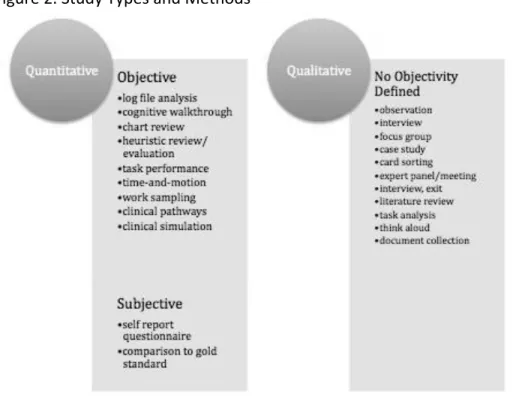
Google Sheets was used to organize all the data and Google Documents was used to organize the coding process. Information extracted from all the included articles were theoretical frameworks mentioned, research methods, participants, sample size, study measures, study design, analysis methods, study type (quantitative vs. qualitative), and objectivity. Initial usability method types were gathered from multiple sources
Bakken. Study types were based on traditional social research techniques (Babbie, 2015). This review organized studies based on the study type and the method type (Figure 2). Figure 2. Study Types and Methods
Results
The MEDLINE search returned a total of 753 references that fit the final search query. These references were then read to make sure they fit the contexts of usability of an EHR by clinicians and in a clinical setting as the primary study focus. After reading titles and abstracts while following inclusion/exclusion 121 articles were accepted for full-text review. After full review, 70 articles were accepted and classified into testing
Table 1: Number of usability methods by study type
There were three study methodologies revealed through the review process that were not originally in the methodology schema for this review: document collection, clinical simulation, and patient pathways. All of these actions are traditionally seen as part of another methodology--for example, a researcher might collect relevant documents during an observation study. However, all three were referred to as their own separate
simulations in their study about workflow of clinical decision support. This method is quite new and mimics clinical workflow in order to allow for complementary evaluation of use and impact on workflow. In the study they set up the lab to look like a clinic and allow the user to interact with video clips of standardized trained patient actors enacting realistic clinical scenarios. According to study results, the future use of this method is very feasible.
Discussion
1.7
Testing Environment
1.7.1 Test Setting
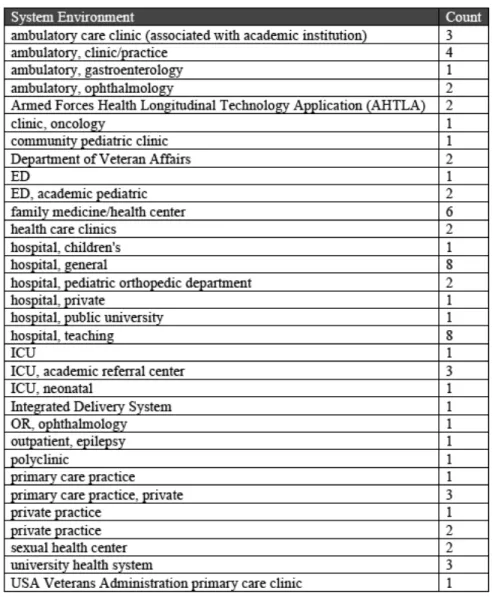
All of the studies that focused on testing a pilot EHR component were tested in a lab. Occasionally, this lab was set up to look like the typical office setting (Li et al., 2012). This effort to make the environment as realistic as possible is a great idea considering the socio-technical nature of EHRs means a constant interaction of task, user, and
environment. On the other hand, studies about adoption of EHR with both pre/post testing all took place in the field. All other studies had a varied approach as to when they tested and where. Overall, there were 35 field studies, 8 lab studies, and 27 general surveys.
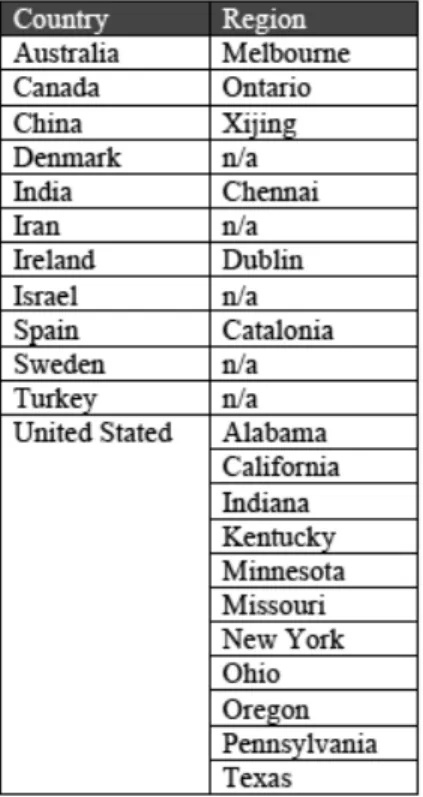
Table 3: Countries
1.8
Time and Frequency of Testing
1.8.1 Testing Motivation
There seemed to emerge three motivations for performing a usability test in the included literature: 1.) adoption or implementation of a new system 2.) system redesign 3.) general review. Adoption or implementation of a new system has to do with either the implementation of a whole new EHR system, or the pilot of a new EHR functional part. A functional part can include a new clinical decision support system (Bauer, Carroll, & Downs, 2013; Imperiale, Sherer, Balph, Cardwell, & Qi, 2011), alert system (Smith et al., 2013), or any other functional area of an EHR. There were 15 studies on focused on piloting. Most studies of these focused on testing user acceptance, utilization, and satisfaction with the tool. There were three studies about the prototype’s effects on workflow (Mc Quaid et al., 2010; Pickering et al., 2015; Li et al., 2012). Considering most of these prototypes were trying to increase efficiency it is surprising that this number was not higher. Actual EHR implementations made up 21% (n=15) of all the studies reviewed. Some of the researchers were moving from paper-based systems (Mathison, & Chamberlain, 2011) or hybrid electronic and paper systems (Pandit, & Boland, 2013).
overhaul of a current EHR system. This included components that when implemented would make large uniform changes across the whole system--for example changes in interface (Ahmed, Chandra, Herasevich, Gajic, & Pickering, 2011). This finding agrees with previous research stating how limited research exists for evaluating transitions between EHR systems. This seems to suggest that clinicians face a number of unique challenges when transitioning from an older EHR to a new one (Zandieh, Yoon-Flannery, Kuperman, Langsam, Hyman, Kaushal, 2008).
1.9
Controlled Testing
All of the EHR system adoption studies took place either post implementation or both pre and post implementation. Pre/post testing had the slight majority (n=8) over just post testing (n=7). Of the studies performing post testing only, the majority of them were either longitudinal studies or had multiple intervals that were tested post-implementation (ex. data was collected every month for three months). Only two implementation cases tested post-implementation with only one collection period (ex. data was collected once, nine months after implementation). Considering EHR systems operate in such high-risk environments, it makes sense to test them as much as possible. The results were similar with component implementation studies. The majority tested both pre and post
studies was vendor-run and they actually stated how they wanted to test the system before they expanded (Corrao, Robinson, Swiernik, & Naeim, 2010). All of the general reviews were either post-testing only, or pre/post. In fact the majority 31-3 were post-testing only. This is something that should be considered in detail considering how overall, post/pre tests are most informative for studies involving implementations. It is hard to get rid of an multi-million dollar system and take a risk a new, unknown system, especially when it has not been proven that the new one is going to be more efficient, usable, or effective. Waiting times and sampling frequencies were highly varied between the studies. The studies lasting the longest tended to be those testing the adoption of new EHR systems. The longest consistent testing time period here lasted from four years post
implementation to four years post. There were a couple studies that were tested on systems that were already ten years old, but these were general review studies that included very large online polling of many different kinds of clinicians and systems. In this case the range existed because the researchers did not put many limits on who made a valid user. After throwing out these outliers, the average time for pre/post study timelines is between 3 months pre- 1 year pre testing and same thing again for post testing.
1.10
Data Relevance and Generalizability
1.10.1 Perceptions and Outcomes of Usability
An encouraging finding was that many researchers are beginning to better understand the socio-technological nature of health informatics and how to evaluate EHRs
environment must be studied in the context of the tool. The inter relatedness of the human means studying their behaviors and attributes, and the technology includes outcome like system processed, tasks, and quality dimensions (Mc Quaid et al., 2010). In usability testing, it is important to test physical outcomes of using a system, as well as people’s attitudes and perception toward the system. Normally, outcomes are measured using some objective data point, for example length of stay (Sung et al., 2013), percent task success (Clarke, Belden, & Kim, 2014), or even mouse clicks per minute (Street et al., 2014). Meanwhile, the human aspect is measured using subjective measures like comfort or satisfaction with a new system (Zandieh et al., 2012) or confidence in system
prescribing decisions (Overby, Devine, Abernathy, McCune, & Tarczy-Hornoch, 2015). In this review there were 17 studies focused on outcomes alone and 28 focused on user’s perceptions and attitudes alone. The remaining 25 examined both, usually using mixed methods like a subjective questionnaire and an objective analysis of a chart review or log to back it up (Pickering, Gajic, Ahmed, Herasevich, & Keegan, 2013; Imperiale, Sherer, Balph, Cardwell, & Qi, 2011; Hum et al., 2014). Sometimes it makes sense to only focus on a single perspective and the choice depends on the study goals. For
researchers are testing the usability of a rounding report they just integrated into an EMR. They hypothesized that it would reduce workload, and yet they took no objective
outcome measurement, like time spent documenting. Instead, they created an online survey that asked users about their perceptions on time spent updating the documentation. Reviewing these studies it is clear that the goals of the study need to match the measures that are going to be examined.
While there are plenty of studies that only measure one or the other, the best usability tests cover both outcomes and user perspectives. For example, in the study by Hum et al. (2014), the goal was to develop and implement a clinical decision support tool to improve antibiotic prescribing and then evaluate user acceptance. They used a survey to gather everything related to user perception, like how easy the tool was to use. They even asked for future recommendations at the end of the survey. At the same time as analyzing the surveys, researchers performed a log analysis to gauge how much the system was actually utilized. Despite the fact that 63% of respondent said they were aware of the tool in the survey, only 37% of them were found to have actually used it in their most recent rotation. This goes to show how studying outcomes and perspectives at the same time gives a better perspective of usability.
1.11
Study Designs
Traditionally, randomized experimental design is considered the strongest when trying to examine causal relationships. Meanwhile, non-experimental designs are typically
considered the weakest with respect to internal validity and causal assessment abilities (Trochim, 2006). That is not to say that non-experimental design is not relevant to healthcare. In fact experimental design is usually used in fields where it is impractical to do randomized experiments due to high costs or danger. When dealing with patient care, this is often the case as it is too dangerous to risk patient’s lives.
In this review most of the studies were Quasi-experimental (n=35). This number included both longitudinal (Kjeldskov, Skov, & Stage, 2010; Chisolm, Purnell, Cohen, & McAlearney, 2010) and cross sectional studies (Secginli, Erdogan, & Monsen, 2014). Experimental design occurred the least with only 5 studies. Specific designs in this category included randomized trials (Overby, Devine, Abernathy, McCune, & Tarczy-Hornoch, 2015) and stepped wedge cluster randomized trials (Pickering et al., 2015). There were 30 studies with non-experimental design. By definition, none of them tested the system being implemented pre or post implementation. Non-experimental studies tended to have qualitative methods as their only, or principal form of data collection. For example, interviews and observations of clinicians. Also, in this category are studies that only examined the system once (i.e. only had pre-implementation testing or
1.12
Data Validity
1.12.1 Qualitative Data Analysis
There seems to high demand for more studies with prospective and randomized experimental designs as opposed to survey (Fontaine, Ross, Zink, & Schilling, 2010; Job, Bachmann, Schmid, Thiel, & Ivic, 2013) or even methods requiring qualitative review (ex. interviews, think-aloud, observations). The goal of qualitative studies is to create as detailed description as possible, so some degree of subjectivity is expected (). In the article reviewed, there were a set of common principles, models and methods used to minimize side effects of qualitative analysis.
dissolve disagreements about the coding schema since inter-rater reliability is another way to gain credibility (Staggers, Jennings, & Lasome, 2010). There were a couple studies that did not take as rigorous approach to their qualitative analysis. For example, in one study evaluating the usability of different ePrescribing CPOEs in EHRs, all
interviews and questionnaires were analyzed by one researcher (Jäderlund, Rudebeck, Petersson 2011). This can be risky if biases are not clearly stated. It is easy to see how teams ensure higher validity and less bias.
Another principle is to use external rating scales or theory to justify coding methods. Grounded theory approach is a known inductive process to identify themes as they emerge in the data (Howard et al., 2013). Another methodology used was rapid ethnographic methods. Instead of a traditional ethnographic approach this one uses a team-based approach for data collection and analysis. The observation is focused on as specific issue from the start of the study. For example, the study by Flanagen, Saleem, Millitello, Russ, and Doebbeling (2013) uses this methodology to observe the specific issue of EHR use and related workarounds from the start. Finally, some researchers used rating scales from other literature to validate their coding schemas. The study by Staggers et al. (2010) used a health-tailored version of the Severity Ratings Usability Problems Scale. Originally developed by Jakob Nielsen, this scale gives guidance on how to determine the severity of a usability problem. All of these principles are important to ensuring a study's credibility and trustworthiness.
1.12.2 Questionnaires
previously validated, well-known questionnaires. They included the Rapid Estimate of Adult Literacy in Medicine (REALM), System Usability Scale (SUS), NASA Task Load Index, Questionnaire for User Interaction Satisfaction (QUIS), and a survey that has since been incorporated into the AHRQ Care Coordination Measures Atlas (Imperiale, Sherer, Balph, Cardwell, & Qi, 2011; Clarke, Belden, & Kim, 2014; Ahmed, Chandra,
Herasevich, Gajic, & Pickering, 2011; Kjeldskov, Skov, & Stage, 2010; Gardner, & Pearce, 2013; Graetz et al., 2014).
studies in “invalidated studies” were not lifted from any well-known studies and did not clearly state any self validation in any way. This is questionable considering the high standards needed for healthcare systems. With quantitative measures the evaluator is expected to choose methods that are reliable (repeatable with same end result) and valid (measures what it claims to measure). It is often hard to devise a methodology that is both reliable and valid given limited resources (Wyatt, 2003). Therefore, the best option is to use questionnaires that have already been developed and validated. Not using validated measurements can lead to hidden variables that cause false and variable data.
Limitations
Conclusions
This review confirmed the complexity of healthcare system evaluation, particularly EHRs. There is no one way to conduct usability testing, even in the world of software development. Added complexities of trying to test a system as precarious as an EHR makes the task even more daunting. The closest thing to flawless usability standards are guides published by health influential organizations such as HIMSS (2009) and ISO. Usability gurus, like Jakob Nielsen are great places to start formulating ideas. As seen in this review, many researchers used previous literature to back up their some aspect of their research. A lot of methods usually included a questionnaire, for which researchers often leveraged content from previously validated survey tools made by the influential organizations and usability gurus. However, it is important to be extra meticulous in methods for EHR usability testing because an error can cost a life. Study design is really important to avoiding such losses. Quantitative and qualitative data are both really important to making a system usable. Using mixed method approaches is the best way to ensure that both outcomes and users’ perceptions about the system are being captured. Without measurement of outcomes, a fatal technological error could occur, and there is not any hard evidence to base conclusions on about efficiency or patient outcomes. On the other hand, a newly designed EHR system could be the most efficient thing at saving lives on Earth, but no human is going to use it if they do not know where to start or it makes no sense to the point where they introduce error into the system. User perception and satisfaction play just as big of role in making usable system as outcomes.
references to increased adherence to guidelines, enhanced surveillance and monitoring, and decreased errors (Bates, Evans, Murff, Stetson, Pizziferri, & Hripcsak 2003;
Yourman, Concato, & Agostini 2008) that as soon as some negative results are published they are quick to throw it in the pile of “growing evidence” against EHRs instead of trying to figure out what went wrong and how to fix it. Looking at the actual study by (Tsai, Pancoast, Duguid, & Tsai, 2014), the researchers performed a time-and-motion study to examine clinician workflow. Their results indicated that doctors had higher task frequencies (i.e. were repeating the same tasks more often) post EHR implementation. Therefore, their study “adds to the growing evidence showing no improvement in efficiency” (Tsai et al., 2014, p. 613). The researchers are not wrong in saying this, it is true that by the outcome variable, time, there was no improvement in efficiency.
However, looking at how long after implementation they began their study--six months-- it is easy to see how there may not have been enough time for doctors to situate to the system.
Looking at all the other new EHR adoption testing time periods, the longest time period lasted from four years pre-implementation to four years post implementation. That is a significantly longer period of time and may be unrealistic. However, the average of all time periods for similar post-implementation studies (excluding the four year outlier) was just over nine months. Not that this says anything about how long after an
implementation is long enough to test, but it does suggest that the chances of doctors learning by that point is not great. In fact, many other studies have shown that after initial decreases in efficiency measures the metrics returned to near pre-implementation
longer study might have show more of a comeback (Read-Brown et. al, 2013). All of these studies go to show how EHR transition is not without consequences (Pandit, & Boland, 2013). In fact, many EHR implementations tend to shift around workflow but not in a way that is necessarily bad. For example, in the study by Victores, Coggins, & Takashima (2015), implementation changed resident activities so that more time was shifted from direct patient care to indirect. Less time was spent talking and more time was spent reviewing, presumably reviewing issues that were made known by the EHR instead of asking for a patient history.
In terms of combating the problem of decreased efficiency, the researchers Tsai et al. (2014) said that many hospital administrators needed to use shadowing scribes to update records for them. This is not the first time scribes have been suggested to combat the increased documentation time of EHR implementation. Any health care decision maker would reasonably invest in scribes because of many comments like it. Looking at a similar study by Howley, Chou, Hansen, & Dalrymple (2014), there was also a reported loss in productivity. However, in these conclusions the authors note the potential use of scribes but make sure to point out how it would just be a workaround to the real usability issues. Investing in a scribe would take up as much revenue gains of about $3000 per provider per quarter. So instead of investing to enhance the EHR functionality, investing in a scribe would be to invest in a work-around (Howley et al., 2014).
logistics, and ethical reasons as the reason for not being able to perform individual randomization (Hussey, & Hughes, 2007), times are changing. There is now good reason to believe that randomized studies are becoming more feasible as most health care data collections go fully electronic (Pandit, & Boland 2013). In addition, variety can be added by trying out new methods like the patient pathways, clinical simulations, and document collection. All of them were able to ascertain usability issues in the systems they were tested on. For future EHR usability testing, it would be worth looking into how to
Bibliography
111th U.S. Congress. American Recovery and Reinvestment Act of 2009. Title XXX – Health Information Technology and Quality. In:
http://frwebgate.access.gpo.gov/cgibin/getdoc.cgi?dbname=111_cong_bills&doci d=f:enr.pdf
Adams, W. G., Mann, A. M., & Bauchner, H. (2003). Use of an electronic medical record improves the quality of urban pediatric primary care. Pediatrics, 111(3), 626–632. http://doi.org/10.1542/peds.111.3.626
Ahmed, A., Chandra, S., Herasevich, V., Gajic, O., & Pickering, B. W. (2011). The effect of two different electronic health record user interfaces on intensive care provider task load, errors of cognition, and performance. Critical Care Medicine, 39(7), 1626–1634. http://doi.org/10.1097/CCM.0b013e31821858a0
Ammenwerth, E., Gräber, S., Herrmann, G., Bürkle, T., & König, J. (2003). Evaluation of health information systems-problems and challenges. International Journal of Medical Informatics, 71(2-3), 125–135.
http://doi.org/10.1016/S1386-5056(03)00131-X
Ash, J., Berg, M., & Coiera, E. (2004). Some unintended consequences of information technology in health care: the nature of patient care information system-related errors. Journal of the American Medical Informatics …. Retrieved from
Ash, J. S., Sittig, D. F., Dykstra, R., Campbell, E., & Guappone, K. (2009). The unintended consequences of computerized provider order entry: Findings from a mixed methods exploration. International Journal of Medical Informatics, 78(SUPPL. 1), 69–76. http://doi.org/10.1016/j.ijmedinf.2008.07.015
Ash, J. S., Sittig, D. F., Poon, E. G., Guappone, K., Campbell, E., & Dykstra, R. H. (2007). The extent and important of unintended consequences related to
computerized provider order entry. Journal of the American Medical Informatics Association, 14(4), 415 – 23. http://doi.org/10.1197/jamia.M2373
Audet, A.-M., Doty, M. M., Peugh, J., Shamasdin, J., Zapert, K., & Schoenbaum, S. (2004). Information Technologies: When Will They Make It Into Physicians’ Black Bags? Medscape General Medicine, 6(4), 2.
Babbie, E. (2012). The practice of social research. Wadsworth Publishing.
Bates, D. W., Evans, S., Murff, H., Stetson, P., Pizziferri, L., & Hripcsak, G. (2003). Detecting Adverse Events Using Information Technology. Journal of the American Medical Informatics Association, 10(2), 115–128.
http://doi.org/10.1197/jamia.M1074
Bauer, N. S., Carroll, A. E., & Downs, S. M. (2013). Understanding the acceptability of a computer decision support system in pediatric primary care. Journal of the
American Medical Informatics Association : JAMIA, 1–8.
http://doi.org/10.1136/amiajnl-2013-001851
Bloom, M. V., & Huntington, M. K. (2010). Faculty, resident, and clinic staff’s
evaluation of the effects of EHR implementation. Family Medicine, 42(8), 562–566. Blumenthal, David,M.D., M.P.P. (2009). Stimulating the adoption of health information
technology. The New England Journal of Medicine, 360(15), 1477-9. doi:http://dx.doi.org/10.1056/NEJMp0901592
Carter, J. H. (2008). Electronic health records: a guide for clinicians and administrators. ACP Press.
Chaudhry B, Wang J, Wu S, Maglione M, Mojica W, Roth E, et al. Systematic Review: Impact of Health Information Technology on Quality, Efficiency, and Costs of Medical Care. Ann Intern Med. 2006;144:742-752. doi:10.7326/0003-4819-144-10-200605160-00125
Chisolm, D. J., Purnell, T. S., Cohen, D. M., & McAlearney, A. S. (2010). Clinician perceptions of an electronic medical record during the first year of implementaton in emergency services. Pediatric Emergency Care, 26(2), 107–110.
http://doi.org/10.1097/PEC.0b013e3181ce2f99
Clancy, C. M. (2007). Keynote Address: Closing the Research-to-practice Gap in Emergency Medicine. Academic Emergency Medicine, 14(11), 932–935. http://doi.org/10.1197/j.aem.2007.06.028
Clinician. 2015. In Merriam-Webster.com, Retrieved June 2015, from http://www.merriam-webster.com/dictionary/clinician.
Corrao, N. J., Robinson, A. G., Swiernik, M. a, & Naeim, A. (2010). Importance of testing for usability when selecting and implementing an electronic health or medical record system. Journal of Oncology Practice / American Society of Clinical Oncology, 6(3), 120–124. http://doi.org/10.1200/JOP.200017
Denomme, L. B., Terry, A. L., Brown, J. B., Thind, A., & Stewart, M. (2011). Primary health care teams’ experience of electronic medical record use after adoption. Family Medicine, 43(9), 638–642.
Despont-Gros, C., Mueller, H., & Lovis, C. (2005). Evaluating user interactions with clinical information systems: A model based on human-computer interaction models. Journal of Biomedical Informatics, 38(3), 244–255.
http://doi.org/10.1016/j.jbi.2004.12.004
DesRoches, C. M., Worzala, C., Joshi, M. S., Kralovec, P. D., & Jha, A. K. (2012). Small, nonteaching, and rural hospitals continue to be slow in adopting electronic health record systems. Health Affairs, 31(5), 1092-9. Retrieved from
http://search.proquest.com/docview/1015189802?accountid=14244
Fontaine, P., Ross, S. E., Zink, T., & Schilling, L. M. (2010). Systematic review of health information exchange in primary care practices. Journal of the American Board of Family Medicine : JABFM, 23(5), 655–670.
http://doi.org/10.3122/jabfm.2010.05.090192
Friedman, A., Crosson, J. C., Howard, J., Clark, E. C., Pellerano, M., Karsh, B.-T., … Cohen, D. J. (2014). A typology of electronic health record workarounds in small-to-medium size primary care practices. Journal of the American Medical Informatics Association : JAMIA, 21(e1), e78–83.
http://doi.org/10.1136/amiajnl-2013-001686
Galimany-Masclans, J., Garrido-Aguilar, E., Girbau-García, M. R., Lluch-Canut, T., & Fabrellas-Padrés, N. (2011). New Technologies and Nursing: Use and Perception of Primary Healthcare Nurses About Electronic Health Record in Catalonia, Spain. Telemedicine and E-Health, 17(8), 635–639.
http://doi.org/10.1089/tmj.2011.0008
Garets D, David M. Electronic medical records vs. electronic health records: yes, there is a difference. HIMSS Analytics. January 26, 2006. Retrieved July 23, 2015,
from www.himssanalytics.org/docs/WP_EMR_EHR.pdf.
Gardner, C. L., & Pearce, P. F. (2013). Customization of electronic medical record templates to improve end-user satisfaction. Computers, Informatics, Nursing : CIN, 31(3), 115–21.
http://doi.org/10.1097/NXN.0b013e3182771814
HIMSS: Defining and Testing EMR Usability: Principles and Proposed Methods of EMR Usability Evaluation and Rating. (2009). Retrieved July 23, 2015, from
http://www.himss.org/files/HIMSSorg/content/files/himss_definingandtestingemr usability.pdf;
Häyrinen, K., Saranto, K., & Nykänen, P. (2008). Definition, structure, content, use and impacts of electronic health records: A review of the research literature.
International Journal of Medical Informatics, 77(5), 291–304.
http://doi.org/10.1016/j.ijmedinf.2007.09.001
Holden, R. J., & Karsh, B.-T. (2010). The technology acceptance model: its past and its future in health care. Journal of Biomedical Informatics, 43(1), 159–172.
http://doi.org/10.1016/j.jbi.2009.07.002
Hollin, I., Griffin, M., & Kachnowski, S. (2012). How will we know if it’s working? A multi-faceted approach to measuring usability of a specialty-specific electronic medical record. Health Informatics Journal, 18(3), 219–232.
http://doi.org/10.1177/1460458212437008
Howard, J., Clark, E. C., Friedman, A., Crosson, J. C., Pellerano, M., Crabtree, B. F., … Cohen, D. J. (2013). Electronic health record impact on work burden in small, unaffiliated, community-based primary care practices. Journal of General Internal Medicine, 28(1), 107–113.
http://doi.org/10.1007/s11606-012-2192-Howley, M. J., Chou, E. Y., Hansen, N., & Dalrymple, P. W. (2014). The long-term financial impact of electronic health record implementation. Journal of the American Medical Informatics Association, (January 2014), 443–452.
Hum, R. S., Cato, K., Sheehan, B., Patel, S., Duchon, J., DeLaMora, P., … Saiman, L. (2014). Developing Clinical Decision Support within a Commercial Electronic Health Record System to Improve Antimicrobial Prescribing in the Neonatal ICU. Applied Clinical Informatics, 5(2), 368–387.
http://doi.org/10.4338/ACI-2013-09-RA-0069
Hussey, M. a., & Hughes, J. P. (2007). Design and analysis of stepped wedge cluster randomized trials. Contemporary Clinical Trials, 28(2), 182–191.
http://doi.org/10.1016/j.cct.2006.05.007
Imperiale, T. F., Sherer, E. a., Balph, J. A. D., Cardwell, J. D., & Qi, R. (2011). Provider acceptance, safety, and effectiveness of a computer-based decision tool for colonoscopy preparation. International Journal of Medical Informatics, 80(10), 726–733. http://doi.org/10.1016/j.ijmedinf.2011.07.001
Institute of Medicine. Key capabilities of an EHR system: Letter report. Washington, D.C. 2003.
International standards for HCI and usability. (2006). Retrieved July 23, 2015, from http://www.usabilitynet.org/tools/r_international.htm#9241-11
Jäderlund Hagstedt, L., Rudebeck, C. E., & Petersson, G. (2011). Usability of
computerised physician order entry in primary care: assessing ePrescribing with a new evaluation model. Informatics in Primary Care, 19(3), 161–168.
Jamal, A., McKenzie, K., & Clark, M. (2009). The impact of health information
Job, O., Bachmann, L. M., Schmid, M. K., Thiel, M. a, & Ivic, S. (2013). Assessing the efficacy of the electronic patient record system EDeR: implementation study--study protocol. BMJ Open, 3(4), 1–5. http://doi.org/10.1136/bmjopen-2012-002478 Kahouei, M., Zadeh, J. M., & Roghani, P. S. (2015). The evaluation of the compatibility
of electronic patient record (EPR) system with nurses’ management needs in a developing country. International Journal of Medical Informatics, 84(4), 263– 270. http://doi.org/10.1016/j.ijmedinf.2014.12.006
Kjeldskov, J., Skov, M. B., & Stage, J. (2010). A longitudinal study of usability in health care: Does time heal? International Journal of Medical Informatics, 79(6), e135– e143. http://doi.org/10.1016/j.ijmedinf.2008.07.008
Kochendorfer, K. M., Morris, L. E., Kruse, R. L., Ge, B., & Mehr, D. R. (2010).
Attending and resident physician perceptions of an EMR-generated rounding report for adult inpatient services. Family Medicine, 42(5), 343–349.
Kushniruk, A. W., & Patel, V. L. (2004). Cognitive and usability engineering methods for the evaluation of clinical information systems. Journal of Biomedical Informatics, 37(1), 56–76. http://doi.org/10.1016/j.jbi.2004.01.003
Lakbala, P., & Dindarloo, K. (2014). Physicians’ perception and attitude toward electronic medical record. SpringerPlus, 3(1), 63.
Landauer, T. K. (1995). The trouble with computers : usefulness, usability, and productivity. Cambridge, Mass.: MIT Press.
Li, A. C., Kannry, J. L., Kushniruk, A., Chrimes, D., McGinn, T. G., Edonyabo, D., & Mann, D. M. (2012). Integrating usability testing and think-aloud protocol analysis with “near-live” clinical simulations in evaluating clinical decision support.
International Journal of Medical Informatics, 81(11), 761–772.
http://doi.org/10.1016/j.ijmedinf.2012.02.009
Mathison, D. J., & Chamberlain, J. M. (2011). Evaluating the Impact of the Electronic Health Record on Patient Flow in a Pediatric Emergency Department. Applied Clinical Informatics, 2(1), 39–49. http://doi.org/10.4338/ACI-2010-08-RA-0046
Mc Quaid, L., Breen, P., Grimson, J., Normand, C., Dunne, M., Delanty, N., … Fitzsimons, M. (2010). Socio-technical considerations in epilepsy electronic patient record implementation. International Journal of Medical Informatics, 79(5), 349–360. http://doi.org/10.1016/j.ijmedinf.2010.01.013
Nielsen, J. (1993). Usability engineering. Boston: AP Professional. Offering an
Integrated, Comprehensive Approach to Operating Room Management. (2015). Retrieved July 1, 2015, from
http://www.mckesson.com/providers/health-systems/department-solutions/surgical-solutions/
Pandit, R. R., & Boland, M. V. (2013). The impact of an electronic health record
transition on a glaucoma subspecialty practice. Ophthalmology, 120(4), 753–760. http://doi.org/10.1016/j.ophtha.2012.10.002
Pickering, B. W., Dong, Y., Ahmed, A., Giri, J., Kilickaya, O., Gupta, A., … Herasevich, V. (2015). The implementation of clinician designed, human-centered electronic medical record viewer in the intensive care unit: A pilot step-wedge cluster randomized trial. International Journal of Medical Informatics, 84(5), 299–307. http://doi.org/10.1016/j.ijmedinf.2015.01.017
Pickering, B. W., Gajic, O., Ahmed, A., Herasevich, V., & Keegan, M. T. (2013). Data utilization for medical decision making at the time of patient admission to ICU. Critical Care Medicine, 41(6), 1502–10.
http://doi.org/10.1097/CCM.0b013e318287f0c0
Pohl, J. M., Tanner, C., Hamilton, A., Kaleba, E. O., Rachman, F. D., White, J., & Zheng, K. (2014). Medication safety after implementation of a commercial electronic health record system in five safety-net practices: A mixed methods approach. Journal of the American Association of Nurse Practitioners, 26(8), 438–444.
http://doi.org/10.1002/2327-6924.12089
Poissant, L., Pereira, J., Tamblyn, R., & Kawasumi, Y. (2005). The impact of electronic health records on time efficiency of physicians and nurses: a systematic review. Journal of the American Medical Informatics Association : JAMIA, 12(5), 505–516.
Read-Brown, S., Sanders, D. S., Brown, A. S., Yackel, T. R., Choi, D., Tu, D. C., & Chiang, M. F. (2013). Time-Motion Analysis of Clinical Nursing Documentation During Implementation of an Electronic Operating Room Management System for Ophthalmic Surgery. AMIA Annual Symposium Proceedings, 2013, 1195– 1204.
Rothenhaus, T. C., FACEP, M., Kamens, D., FAAEM, M. F., McClay, J., & Coonan, K. (2007). Emergency Department Information Systems (EDIS) Functional Profile. Samaan, Z., Klein, M., Mansour, M., & DeWitt, T. (2009). The Impact of the Electronic
Health Record on an Academic Pediatric Primary Care Center. The Journal of Ambulatory Care Management, 32(3), 180–187.
Sanders, D. S., Read-Brown, S., Tu, D. C., Lambert, W. E., Choi, D., Almario, B. M., … Chiang, M. F. (2014). Impact of an electronic health record operating room
management system in ophthalmology on documentation time, surgical volume, and staffing. JAMA Ophthalmology, 132(5), 586–92.
http://doi.org/10.1001/jamaophthalmol.2013.8196
Schoen, C., Osborn, R., Doty, M. M., Squires, D., Peugh, J., & Applebaum, S. (2009). A survey of primary care physicians in eleven countries, 2009: perspectives on care, costs, and experiences. Health Affairs (Project Hope), 28(6).
http://doi.org/10.1377/hlthaff.28.6.w1171
Secginli, S., Erdogan, S., & Monsen, K. a. (2014). Attitudes of health professionals towards electronic health records in primary health care settings: a questionnaire survey. Informatics for Health & Social Care, 39(1), 15–32.
Shneiderman, B., Plaisant, C. (2004). Designing the user interface : strategies for effective human-computer interaction (4th ed.). Boston: Pearson/Addison Wesley.
Smith, M., Murphy, D., Laxmisan, A., Sittig, D., Reis, B., Esquivel, A., & Singh, H. (2013). Developing software to “track and catch” missed follow-up of abnormal test results in a complex sociotechnical environment. Applied Clinical
Informatics, 4(3), 359–75. http://doi.org/10.4338/ACI-2013-04-RA-0019
Soares, N., Vyas, K., & Perry, B. (2012). Clinician perceptions of pediatric growth chart use and electronic health records in kentucky. Applied Clinical Informatics, 3(4), 437–47. http://doi.org/10.4338/ACI-2012-06-RA-0023
Spalding, S. C., Mayer, P. H., Ginde, A. a., Lowenstein, S. R., & Yaron, M. (2011). Impact of computerized physician order entry on ED patient length of stay. American Journal of Emergency Medicine, 29(2), 207–211.
http://doi.org/10.1016/j.ajem.2009.10.007
Staggers, N., Jennings, B. M., & Lasome, C. E. M. (2010). A usability assessment of AHLTA in ambulatory clinics at a military medical center. Military Medicine, 175(7), 518–524.
Stead, W. W., & Lin, H. S. (Eds.). (2009). Computational Technology for Effective Health Care: Immediate Steps and Strategic Directions. Washington, DC, USA: National Academies Press.
Sung, K. H., Chung, C. Y., Lee, K. M., Lee, S. Y., Ahn, S., Park, S., … Park, M. S. (2013). Application of clinical pathway using electronic medical record system in pediatric patients with supracondylar fracture of the humerus: a before and after comparative study. BMC Medical Informatics and Decision Making, 13(1), 87. http://doi.org/10.1186/1472-6947-13-87
Technology, C. on C. I. (2011). Health Information Technology and the Medical Home. Pediatrics, 127 (5 ), 978–982. http://doi.org/10.1542/peds.2011-0454
Terry, a. L., Brown, J. B., Bestard Denomme, L., Thind, a., & Stewart, M. (2012). Perspectives on Electronic Medical Record Implementation after Two Years of Use in Primary Health Care Practice. The Journal of the American Board of Family Medicine, 25(4), 522–527.
http://doi.org/10.3122/jabfm.2012.04.110089
Top, M., & Gider, Ö. (2012). Nurses’ views on electronic medical records (EMR) in turkey: An analysis according to use, quality and user satisfaction. Journal of Medical Systems, 36(3), 1979–1988.
http://doi.org/10.1007/s10916-011-9657-6
Trochim, W. (2006, October 20). Types of Designs. Retrieved July 25, 2015, from http://www.socialresearchmethods.net/kb/destypes.php
Tsai, C.-Y., Pancoast, P., Duguid, M., & Tsai, C. (2014). Hospital rounding – EHR’s impact. International Journal of Health Care Quality Assurance, 27(7), 605–615. http://doi.org/10.1108/IJHCQA-07-2013-0090
http://www.usability.gov/how-to-and-tools/methods/usability-evaluation/index.html Victores, A. J., Coggins, K., & Takashima, M. (2015). Electronic health records and
resident workflow: A time-motion study of otolaryngology residents. The Laryngoscope, 125(3), 594–598. http://doi.org/10.1002/lary.24848
Virzi, R. a. (1992). Refining the Test Phase of Usability Evaluation : How Many Subjects Is Enough ? Human Error and Clinical Systems, 34(4), 457–468.
http://doi.org/10.1177/001872089203400407
Wakefield, M. (2000). To err is human: An Institute of Medicine report. Professional Psychology: Research And Practice, 31(3), 243-244.
doi:10.1037/h0092814
Ward, M. J., Landman, A. B., Case, K., Berthelot, J., Pilgrim, R. L., & Pines, J. M. (2014). The effect of electronic health record implementation on community emergency department operational measures of performance. Annals of Emergency Medicine, 63(6), 723–730.
http://doi.org/10.1016/j.annemergmed.2013.12.019
Wyatt, J. (2003). When and how to evaluate health information systems? International Journal of Medical Informatics, 69(2-3), 251–259.
http://doi.org/10.1016/S1386-5056(02)00108-9
Xierali, I. M., Hsiao, C.-J., Puffer, J. C., Green, L. A., Rinaldo, J. C. B., Bazemore, A. W., … Phillips, R. L. (2013). The Rise of Electronic Health Record Adoption Among Family Physicians. Annals of Family Medicine, 11(1), 14–19.
doi:10.1370/afm.1461
study methodologies. Journal of the American Medical Informatics Association, 19(3), 413–422. http://doi.org/10.1136/amiajnl-2010-000020
Yourman, L., Concato, J., & Agostini, J. V. (2008). Use of computer decision support interventions to improve medication prescribing in older adults: a systematic review. The American Journal of Geriatric Pharmacotherapy, 6(2), 119–129. http://doi.org/10.1016/j.amjopharm.2008.06.001
Zandieh, S. O., Abramson, E. L., Pfoh, E. R., Yoon-Flannery, K., Edwards, a., & Kaushal, R. (2012). Transitioning between ambulatory EHRs: a study of practitioners’ perspectives. Journal of the American Medical Informatics Association, 19(3), 401–406.
http://doi.org/10.1136/amiajnl-2011-000333
Zandieh, S. O., Yoon-Flannery, K., Kuperman, G. J., Langsam, D. J., Hyman, D., & Kaushal, R. (2008). Challenges to EHR Implementation in Electronic- Versus Paper-based Office Practices. Journal of General Internal Medicine, 23(6), 755– 761. doi:10.1007/s11606-008-0573-5
Zhang, J. (2005). Human-centered computing in health information systems Part 1: Analysis and design. Journal of Biomedical Informatics, 38(1), 1–3.