ABSTRACT
JEFETIEY L. KING. Application of an ANOVA Model To Evaluate Occupational Exposure to Formaldehyde. (Under the Direction of Stephen M. Rappaport, Ph.D.)
Occupational exposure to formaldehyde was evaluated at a large chemical
facility. Of particular interest was the validity of so-called Homogeneous
Exposure Groups (HEGs) in which it is assumed that all individuals are exposed, on average, to the same level of contaminant. As a preliminary step a field study was conducted comparing the use of diffusion monitors to sorbent tubes for personal air sampling. Results from 26 matched pairs showed the two methods to be comparable [mean difference (badge - tube) = 0.03 ppm; mean (badge) = 0.17 ppm]. Six HEGs were formed based on job tasks and location. Using a
randomized design, multiple full-shift samples were collected (with monitors) from
representative workers in each HEG (127 measurements from 44 workers).
Application of an analysis of variance (ANOVA) model indicated that the total variation in exposure across the entire sample population was partitioned as follows: 79% within-worker, 8% between-worker (within HEG), and 13%
m
TABLE OF CONTENTS
INTRODUCnON...1
Defining an HEG...2
Purpose...3
METHODS and MATERIALS...5
Facility - Process Review...5
Job Title - Task Review...8
HEG Formation...10
Random Selection of Workers and Sample Days...14
Field Study Comparing Sampling Methods for Airborne Formaldehyde...16
Statistical Evaluation of Sampling Data...19
RESULTS...26
Tests ofLognormality...28
ANOVA Results...29
DISCUSSION...33
CONCLUSIONS...37
CITED REFERENCES...38
GENERAL REFERENCES...39
APPENDIX A...40
Floor Plans APPENDIXB...48
Randomization Procedure APPENDIX C...51
Sample Day By Date APPENDDCD...53
Field Study Data and Analysis APPENDIXE...56
HEG Sampling Data
ACKNOWLEDGEMENTS
I would like to thank my research advisor Dr. Stephen Rappaport for his
guidance and support, and for the wisdom he shared with me during my studies at the University of North Carolina. I am also indebted to Dr. Hans Kromhout for his statistical expertise, and to Drs. Michael Flynn and Lori Todd for their
time and critical review of this report.
I also appreciate the opportunity and advise I received from Stephen Kemp, Michael Buczynski, and all the personnel at the facility where the work for this project was conducted. Others I wish to thank for contributing to the effort include: Brian Cawley, Esther Johnson, Susan Rappaport, and Elaine
Symanski.
Lastly, I am eternally grateful to my wife Susie, for her love, devotion, and patience, to my son Matthew, for his smile, and to my parents and siblings, for their unconditional love and support over the last 28 years.
This project was conducted as part of a graduate training program and
was supported in part by a National Institute of Occupational Safety and Health
INTRODUCTION
One of the primary duties of an occupational hygienist is monitoring the work environment to determine levels of exposure to airborne contaminants.
Sampling campaigns are undertaken for a variety of reasons: to ensure
compliance with governmental occupational exposure limits (OELs), to establish
baseline levels of exposure, to evaluate the effectiveness of engineering controls,
and to provide exposure information for future epidemiological investigations.
Regardless of the reason for monitoring, it is important for the hygienist to collect
samples which accurately reflect the level of exposure and which are sufficiently
representative to allow meaningful decisions to be made regarding the exposures.
Much progress has been made in the last fifty years to improve the accuracy and
precision of environmental sampling methods. However, the issue of
representative sampling in the field of occupational health has much room for
improvement. While the idea of representative sampling is nothing new nor
conceptually difficult, the how-to and application of a method of representative
sampling still presents difficulties for the occupational hygienist.
The problem is two-fold: usually not every worker can be monitored at all
times, and there exists a great deal of variability in the level of exposure across a
population of workers in a given work environment. Furthermore, occupational
hygienists have a limited amount of time and resources to devote to workplace
monitoring. Thus it is important to structure the monitoring program such that a maximum amount of information regarding exposures can be obtained from a minimum number of samples, while maintaining an acceptable degree of
sometimes termed homogeneous exposure groups (HEGs), where it is assumed
that all workers within a group are exposed, on average, to the same level of
contaminant.
Defining an HEG
The American Industrial Hygiene Association's (AIHA) Exposure
Assessment Strategies Committee (1991) defines an HEG as follows:
"A group of employees who experience agent exposures similar enough that monitoring agent exposures of any worker in the group provides data
useful for predicting exposures of the remaining workers. Such groups are used in stratified sampling of workplace exposures, thereby improving the
power of statistical decision tools. The categorization of workers into such
groups often involves categorization by process, job description, and agents, although finer separation can be attained by further dividing on
the basis of task analysis."
While this definition provides a useful qualitative description of an HEG, it gives the reader no guidance in terms of a quantitative description of such a group. In
fact, even though the word "statistical" appears in the definition, to date this
group, nor any other consensus group in the field of occupational health, has
specifically dealt with the defining attributes of an HEG, from a statistical
viewpoint.
Rappaport (1991) addresses the issue of defining discrete exposure groups
from a statistical viewpoint by defining two other terms. First, the author defines
a 'monomorphic' group as "a collection of individuals whose mean exposures can
be adequately described by a single log-normal distribution (between-persons)."
A 'uniformly exposed' group of workers is then defined as "a monomorphic group
this definition of a uniformly exposed group is arbitrary and possibly too restrictive, it does provide a quantitative framework with which to assess the homogeneity of a given EGEG. A metric based on this definition is denoted by the
author as R0.95, b ^^ is presented in an upcoming section.
There are essentially two approaches one can use to establish HEGs. One
involves classification of workers a priori, based on observational techniques.
The other method groups workers subsequent to random sampling of exposures,
and is hence considered a ;7<95fenon (Rappaport, 1991).
An a priori classification of workers into discrete groups called "exposure zones" was described by Com and Esmen (1979). The concept involves
prospective assignment based on task, agent, and work process similarities. A randomly selected sub-group of workers within each exposure zone is
subsequently sampled and assumed to represent the level of exposure for the entire group.
Purpose
This study was initiated to evaluate occupational exposure to
formaldehyde at a chemical manufacturing facility using HEGs based on an
observational approach. Of particular interest is the uniformity of exposures to
workers within such an established HEG. To address this issue, several HEGs were formed a priori using information on occupational title, job tasks, and work location. Multiple full-shift, breathing zone samples were subsequently collected using a randomized design from a representative sub-group of workers within
each HEG. The homogeneity of the data is evaluated statistically by means of an
analysis allows a judgment to be made regarding the success of the observational approach in this case, and provides valuable information on the distribution of
exposures at this facility, to help guide future monitoring programs.
The work for this report was conducted during a ten week industrial
hygiene internship served at this facility. Given the limited time and resources
available, and the research nature of the project, it was not intended to be a
comprehensive assessment of all exposures at this facility. The focus of the study
was limited to potential formaldehyde exposure for a segment of the workforce, albeit that segment which was deemed to have the greatest potential.
First, results are presented from a field study comparing two methods of
I)ersonal sampling for airborne formaldehyde. The preliminary study was initiated
to demonstrate the efficacy of passive monitors relative to the pump-sorbent tube method, which traditionally had been the standard formaldehyde sampling
METHODS and MATERIALS
Facility - Process Review
The workplace monitored for this project is a medium-sized chemical
facility located in western New York State. The plant produces phenolic resin
(approximately 30 million Ibs./year) and phenolic molding compound
(approximately 50 million Ibs./year). The production of both materials involves
batch-type operations, with the ability to produce hundreds of different
formulations depending on the specific application. These resins are used, for
example, in the aerospace industry as thermal barriers, in the abrasives industry as
adhesives, and in the coatings industry as ingredients in paints and varnishes.
Molding compounds are utilized extensively in the automotive industry as brake
parts, pulleys, motor frames, and ashtrays.
The plant consists of about 40 buildings spanning 66 acres of land, though
only a few are actively involved in production. Phenolic resin is produced in two
separate buildings, while molding compound is produced in one building. The
facility employs 120 salaried and 240 hourly personnel.
Phenolic resins, in general, are the polymerization product of a
condensation reaction involving phenol and an aldehyde. The vast majority of
phenolic resins consist of the phenol-formaldehyde variety, which is the type
made at this facility. In particular, this plant produces two types of
phenol-formaldehyde resin: a one-stage resole, and a two-stage novolac.
A resole is produced by reacting phenol and excess formaldehyde (50%
charged with all reactants needed for the final polymer; specifically, enough formaldehyde is added to make the resin thermosetting, or infusible once heated to a certain temperature. Production of a novolac, on the other hand, involves a two-stage process where an acid catalyst and a portion of the necessary
formaldehyde (80%) are reacted with phenol. The first stage forms partially
reacted, low molecular weight linear polymers. At this point the resin is
considered thermoplastic, or fusible since application of heat will not chemically
alter the material. The remainder of the formaldehyde necessary for final cure is
added at a later time during the second stage, typically in the form of
hexamethylenetetramine, which decomposes in the presence of heat and moisture to formaldehyde and ammonia. The latter acts as a catalyst.
Once a kettle is charged with the reactants it is generally heated to a boil
and refluxed for an amount of time determined by the given formulation. Upon
reaching a desired end-point (e.g. viscosity or percent free formaldehyde
remaining), the kettle is rapidly cooled and dehydrated to remove water and
unreacted phenol, which prevents the resin from advancing beyond the desired stage. The cycle time for resin production at this facility ranges from several hours to several days, depending on the specific resin. Upon completion, the molten resin is transferred from the kettle and may or may not undergo further processing, again depending on the specific resin and customer specifications. If it is sold as a liquid resin, it will either be packed-out in 55 gallon drums, or
transferred directly to a tank wagon for transport. It may also be transferred to a tank farm for storage as a liquid.
Alternatively, the resin can be converted to a solid form via additional
solidify. The solid mass is pulverized using a crusher and hammer mill. Once pulverized, it may be packed-out into boxes or bags, or used to make molding compound. Flake resin is formed using either a drum dryer or a belt flaker,
depending on the type of resin (novolac or resole). Once formed, it too is either
packed out or used for molding compound production.
The other primary manufacturing process at this facility is the production
of phenolic molding compound. In this process, pulverized resin is mixed with
various fillers, lubricants, and plasticizers in large ribbon blenders. The resulting
mixture is fed onto a set of counter-rotating heated rolls, where the material is
transformed into a thermosetting compound. From there the material goes
through a grinder, a sifter, and another blender prior to pack-out in drums, boxes, or bags. Figure 1 depicts the process, from resin production to molding
compound production.
Finally, there are a multitude of other support activities performed by
personnel at this facility. A quality control lab provides analytical services for
raw materials and resins in various stages of production. Maintenance operations include a welding shop, an electrical shop, and a metal fabrication shop.
FORMALDEHYDE SUPPUY WIEIGH
TANK
PHENOL (^'^ fO«M*4.D(M*Qt HOLD TANK I I "O'-0'-« '
r^^l^
AC 10 PUMP
RELIEF DISK
z:r2_
"^ ' i COMOCNUR \COOLIMG nATEn OUT
r=PK
.^ ͣ i :^ cooLiw; OH ^^:^ VACUUM PUMT it ATING MEDIUMOLINCCOH ^—^---U—ͣ
---ͣ
^ COOtiNCCOOLINC PANS
Amvcvon It DLLS FINfS r\r\ RINDCR ͣ LCNOED t Resin
^-'"' I Molding
'^ Compound
OnUMFACKOUT INAL PRODUCT
Job Title - Task Review
DRUM Off fOA POSSlSLC RtTUAM TOMIvcn
D \ OS
0 U n U 3 T 0An analysis of job tides and associated tasks was performed, focussing on
those which were judged to have the highest potential for formaldehyde
exposure. Information on job titles was obtained from a 'weekly locator,' which
listed all personnel (by job tide) and their weekly shift assignment, and from
interviews with personnel. Job task information was ascertained through
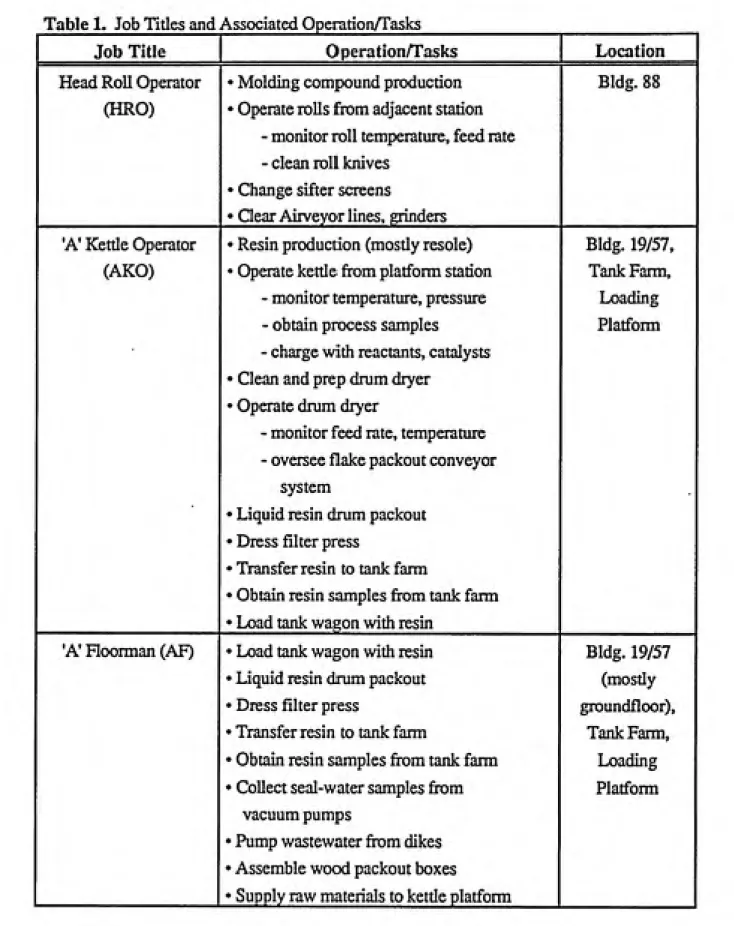
observation and interviews with personnel. Table 1 provides a summary of the
Table 1. Job Titles and Associated Operation/Tasks
Job Title Operation/Tasks Location
Head Roll Operator • Molding compound production Bldg. 88 (HRO) • Operate rolls from adjacent station
- monitor roll temperature, feed rate
- clean roll knives
• Change sifter screens
• Qear Airveyor lines, grinders
'A' Ketde Operator • Resin production (mostly resole) Bldg. 19/57, (AKO) • Operate kettle from platfonu station Tank Farm,
- monitor temperature, pressure Loading
- obtain process samples Platform
- charge with reactants, catalysts
• Clean and prep drum dryer • Operate drum dryer
- monitor feed rate, temperature
- oversee flake packout conveyor
system
• Liquid resin drum packout • Dress filter press
• Transfer resin to tank farm
• Obtain resin samples from tank farm
• Load tank wagon with resin
'A' Hoorman (AF) • Load tank wagon with resin Bldg. 19/57
• Liquid resin drum packout (mostly
• Dress filter press groundfloor).
• Transfer resin to tank fann Tank Farm,
• Obtain resin samples from tank fanii Loading • Collect seal-water samples from Platform
vacuum pumps
• Pump wastewater from dikes
• Assemble wood packout boxes
10
Job Title Operation/Tasks Location
'A' Kettle Operator • Resin production (mosdy novolac)
• Operate kettle from platfonu station
- monitor temperature, pressure - obtain process samples
- charge with reactants, catalysts • Clean and prep belt or dram flaker
• Operate belt or dram flaker • Flake resin dram/box/bag packout
• Liquid resin dram packout
• Liquid resin pan job • Dress filter press
• Load tank wagon with resin
Bldg. 3/12
Lift Truck/Conveyor
Operator (LTO)
• Operate lift track - material transport
• Clean and prep belt or dram flaker • Operate belt or dram flaker
• Rake resin dram/box/bag packout • Liquid resin dram packout
• Liquid resin pan job • Dress filter press
• Load tank wagons with resin
Bldg. 3/12 (mostiy groundfloor)
Control Lab Specialist
(SFl)
• Run routine analyses on raw materials
and resins
- cures, titrations, pH, freeze point,
viscosity, refractive index, etc.
Control Lab
HEG Formation
After obtaining information on job title, task, and location, workers were
11
following four defining attributes of exposure zones (HEGs), as described by
Com and Esmen (1979):
1. Work similarity - workers in each HEG must perform similar job
tasks.
2. Hazardous agent similarity - workers in each HEG must share
potential exposure to the same agent(s).
3. Environment similarity - workers must perform job duties in similar
environments, such that exposures are influenced by similar controls
and processes.
4. Identifiability - there should exist a means of identifying workers
within an HEG to facilitate any future tracking efforts.
Based on these criteria, six HEGs were established, as presented in Table 2.
Table 2; Summary of Formaldehyde HEGs
HEG No. Job Classification Location No. of Workers
1 Head Roll Operator Bldg. 88 6
2 A Kettle Operator Bldg. 3/12 12
3 A Ketde Operator Bldg. 19/57 28
4 Lift Truck/Conveyor Operator Bldg. 3/12 4
5 AFloorman Bldg. 19/57 6
6 Control Lab Specialist Control Lab 12
Total 68
Each HEG represents a group of workers perceived to have a unique
potential for exposure to formaldehyde, given the job functions performed in the
specific work environment. In this case, each HEG represents a different job title,
or, for HEG 2 and 3, a different work location. It was not possible to further
define HEGs within job classifications based on job tasks, because of task
performed the same tasks based on a daily rotation procedure. Workers were not
"pigeon-holed" into performing specific tasks every shift; all tasks were rotated.
Therefore, it was assumed that all workers in a given job classification (and work
environment) over time were uniformly exposed and hence represented by a
discrete HEG.
HEG 1 is comprised of Head Roll Operators for Building 88, which
produces molding compound (see Appendix A for floor plan). It was estimated
that workers in this job classification are the only ones in the compound building
to have any significant potential for formaldehyde exposure. Formaldehyde, as a
raw product, is not present in this building. The job of a Roll Operator is to
monitor a set of differential rolls from an adjacent work station. Exposure may
occur as free-formaldehyde (unreacted) is vaporized during the heating of
pulverized phenolic resin as it is applied to the hot rolls. The amount of
free-formaldehyde present in a resin varies based on the given resin formulation and
the particular batch. Estimates of the percent of free-formaldehyde in resins
produced at this facility were as high as 14%, though the majority fall in the 0.5 to
5.0% range. Formaldehyde exposure for this job classification was also
dependant on the efficacy of the local exhaust ventilation (LEV) system for this
operation, which, it was noted, varied day to day. There were several factors
which seemed to influence its ability to remove generated contaminants. One
was process equipment operation, which itself was dependent on many factors,
such as the relative proportion of resin to fillers, the temperature of the rolls, the
relative humidity, and the feed rate. If conditions were not optimal, the process
generated contaminants in excess of what the LEV system could handle, resulting
in releases to the work environment. The other factor which influenced the LEV
system was the presence of air-flow disturbances, primarily cross-drafts from large
13
HEGs 2 and 3 are made up of Kettle Operators. Their job is to produce
phenolic resins. This facility has two separate resin production buildings, each of
which tends to make a different type of resin. Building 3/12 makes mostiy two-step novolac resins, while Building 19/57 produces mostly one-two-step resoles (see Appendix A for floor plans). Given the different work locations and the fact that
each building makes a different type of resin, two separate HEGs were formed,
one for the Kettle Operators in each building. Because formaldehyde is one of two primary raw materials used in the production of phenolic resins, this job
involves a number of exposure opportunities, even though it is primarily a closed
system. For example, charging kettles with formaldehyde can result in releases to the work environment when the manway is opened to make a visual check or, as a result of minor leaks during transfer of the charge from the facility holding system to the weigh case or pressurized charge tank. Another task that may
involve significant release to the work environment is when a kettle is charged
with formaldehyde in solid form (paraformaldehyde). This requires addition
through an open manway and hence more direct contact. Collecting raw material or process samples presents another opportunity for exposure. Kettle Operators
in Building 19/57 also risk exposure while operating a drum dryer, which
converts liquid resin into flake form through a dehydration process. Other tasks
involving potential exposure opportunities include liquid resin packout and
cleaning filter presses. The exposures relating to most of these tasks are
influenced to some degree by LEV. However, the effectiveness of these systems
is dependent upon the same factors mentioned previously for the LEV system in the compound building.
Lift Truck/Conveyor Operators in Building 3/12 make up HEG 4. This job
requires operating a lift truck on the ground level of Building 3/12, as well as resin
exposure opportunities associated with this job, though not as numerous as for
Kettle Operators. Tasks with the highest potential for exposure include cleaning
the filter press and the belt flaker, liquid resin packout into drums, and liquid resin pan jobs. Also, these workers risk exposure simply by working on the ground
floor of this resin production building.
HEG 5 is comprised of A Floormen in Building 19/57. This job is roughly
analogous to the Lift Truck/Conveyor Operators in Building 3/12. It involves
packout duties on the ground floor of Building 19/57, supplying raw materials to
the kettle platform, and loading tank wagons with liquid resin. The main
difference is that these workers spend significantly more time outside loading
tankwagons and transferring resins to and from the tank farm.
Finally, HEG 6 includes Control Lab Specialists who work in the Control
Lab in Building 21 (see Appendix A for floor plan). These workers conduct
specification analyses on resin samples from Buildings 3/12 and 19/57. Samples
taken from kettles at various production stages may arrive at the lab at high
reaction temperatures, resulting in potential exposures for workers. Certain
analytical procedures, such as cure tests, also involve potential formaldehyde
exposure.
Random Selection of Workers and Sample Days
In order to make valid estimates of the distribution of formaldehyde exposures at this facility and to comply with assumptions inherent to the
statistical model used for data analysis, randomization was incorporated into the
sampling campaign. That is, workers to be sampled from each HEG were selected at random, as were the days on which to sample each worker. To ensure
^^"^^isff-'UH^m^
15
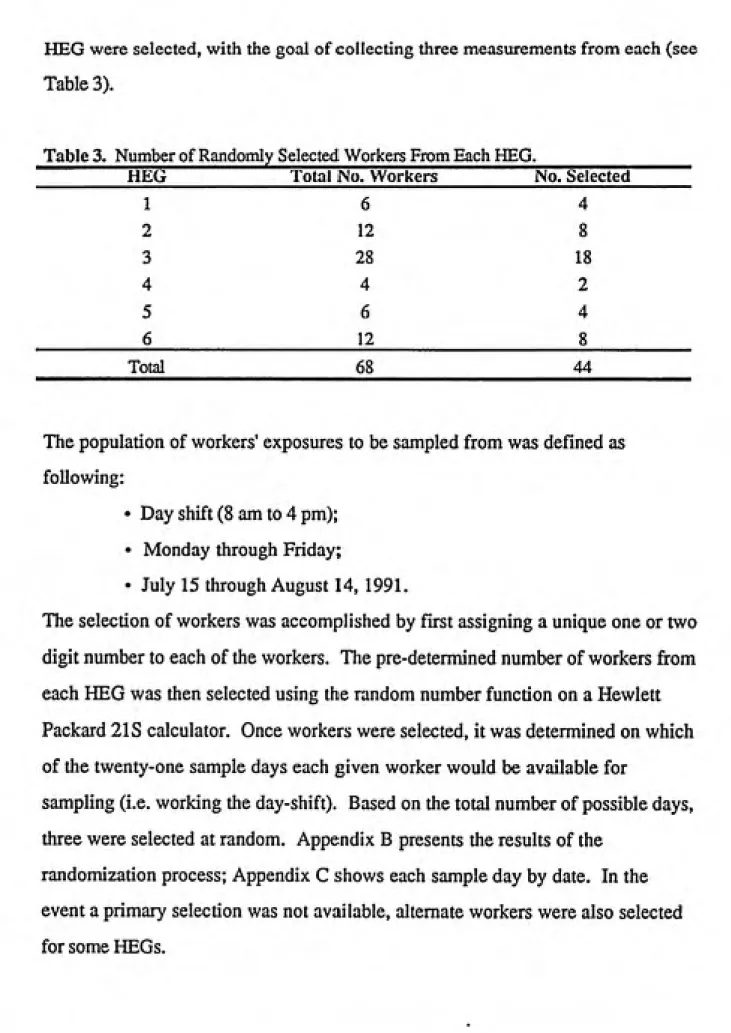
HEG were selected, with the goal of collecting three measurements from each (see Tables).
Table 3. Number of Randomly Selected Workers From Each HEG.________________ _________HEG_____________Total No. Workers__________No. Selected______
1 6 4 2 12 8 3 28 18
4 4 2 5 6 4
___________6_____________________12_____________________8___________
__________Total____________________68_____________________44__________
The population of workers' exposures to be sampled from was defined as following:
• Day shift (8 am to 4 pm);
• Monday through Friday;
• July 15 through August 14, 1991.
The selection of workers was accomplished by first assigning a unique one or two
digit number to each of the workers. The pre-determined number of workers from
each HEG was then selected using the random number function on a Hewlett Packard 21S calculator. Once workers were selected, it was determined on which of the twenty-one sample days each given worker would be available for
sampling (i.e. working tiie day-shift). Based on the total number of possible days,
three were selected at random. Appendix B presents the results of the
randomization process; Appendix C shows each sample day by date. In the
event a primary selection was not available, alternate workers were also selected
Field Study Comparing Sampling Methods for Airborne Formaldehyde
Prior to the random sampling of HEGs, a preUminary field study was
conducted to compare two personal sampling methods for airborne
formaldehyde. The study incorporated a matched-pair design and was initiated to
demonstrate the efficacy of passive diffusion monitors relative to the
pump-sorbent tube method.
The passive monitors utilized for this study were manufactured by Air
Quality Research (AQR), model PF - 20 (PEL). This device uses a dry proprietary
collector which converts formaldehyde to a stable intermediate, prior to
regeneration and analysis by the chromotropic acid method. It is designed to
monitor exposures for intervals ranging from one to eight hours. The monitors
were compared to sorbent tubes manufactured by SKC, model XAD - 2 (Treated).
These tubes also employ a dry collection media, but require the use of personal
sampling pumps to draw air through the device at a uniform rate. Sampling
pumps used were Gilian Personal Air Samplers with Constant Low Flow
Modules. Nominal sampling rate for 4-hour samples was 100 cc/min, and 50
cc/min for 8-hour samples. Pumps were calibrated before and after each sample
interval with a Mini-Buck Calibrator (Model M-5), and were checked periodically
in the field with a precision low-flow rotometer. Two field blanks of each type
were prepared each day and all samples were stored at 40-45°F. Soft bristle
brushes were used to remove any visible dust from outer membrane on diffusion
monitors prior to sealing. AQR monitors were analyzed by the manufacturer at
their facility in Research Triangle Park, North Carolina, while the SKC sorbent
tubes were analyzed by NATLSCO Environmental Sciences Laboratory located
17
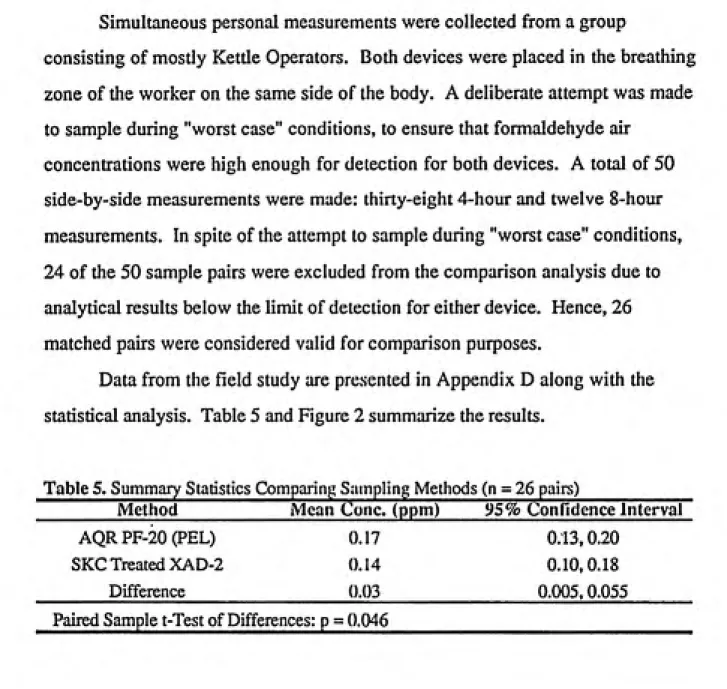
Simultaneous personal measurements were collected from a group
consisting of mosdy Kettle Operators. Both devices were placed in the breathing
zone of the worker on the same side of the body. A deliberate attempt was made
to sample during "worst case" conditions, to ensure that formaldehyde air
concentrations were high enough for detection for both devices. A total of 50
side-by-side measurements were made: thirty-eight 4-hour and twelve 8-hour
measurements. In spite of the attempt to sample during "worst case" conditions,
24 of the 50 sample pairs were excluded from the comparison analysis due to analytical results below the limit of detection for either device. Hence, 26 matched pairs were considered valid for comparison purposes.
Data from the field study are presented in Appendix D along with the
statistical analysis. Table 5 and Figure 2 summarize the results.
Table 5. Summary Statistics Comparing Sampling Methods (n = 26 pairs)___________
Method Mean Cone, (ppm) 95% Confidence Interval
0.13,0.20
AQR PF-20 (PEL) 0.17
)KC Treated XAD-2 0.14
Difference 0.03
0.10,0.18 0.005,0.055
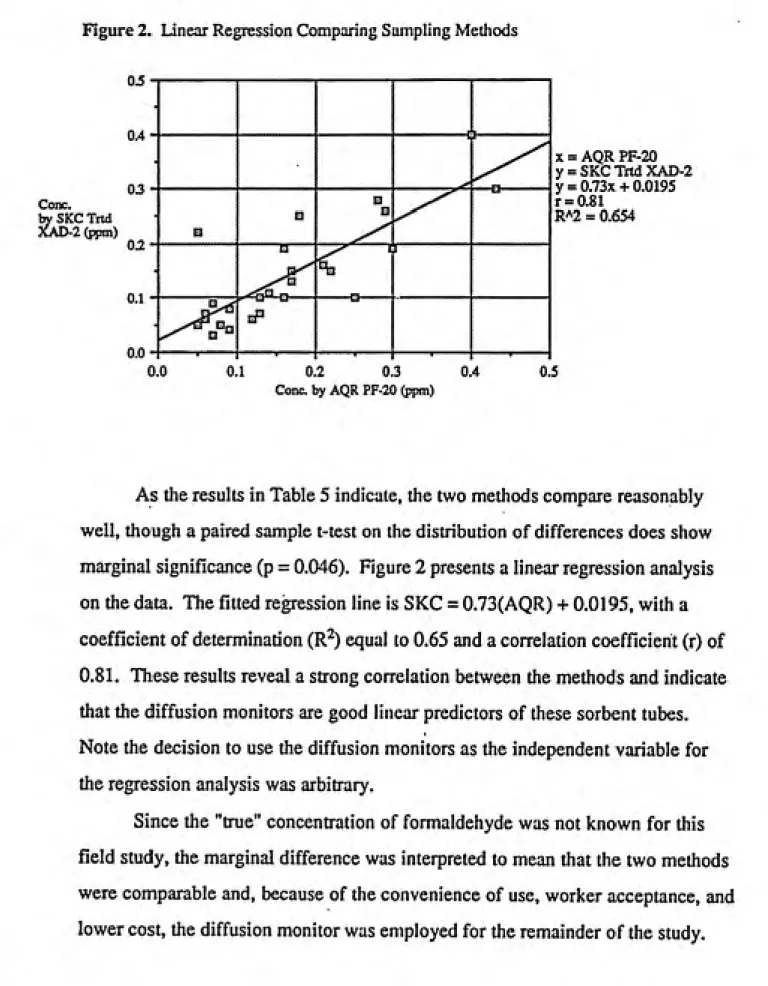
Figure 2. Linear Regression Comparing Sampling Methods
0.5
0.4
03
Cone.
by SKC Trtd 36U3-2(ppm)
0.2
0.1
0.0
---ij---B
a B
,...—»^
---B---B
^y^
...IS...
1*^
< I
^"^
L-^
eP0.0 0.1 0.2 0.3 0.4
Cone, by AQR PF-20 (pirni)
X = AQR PF-20 y = SKC Trtd XAD-2 y = 0.73x + 0.0195 r = 0.81
R'^2 = 0.654
0.5
As the results in Table 5 indicate, the two methods compare reasonably
well, though a paired sample t-test on the distribution of differences does show
marginal significance (p = 0.046). Figure 2 presents a linear regression analysis
on the data. The fitted regression line is SKC = 0.73(AQR) + 0.0195, with a
coefficient of determination (R^) equal to 0.65 and a correlation coefficient (r) of
0.81. These results reveal a strong correlation between the methods and indicate
that the diffusion monitors are good linear predictors of these sorbent tubes.
Note the decision to use the diffusion monitors as the independent variable for
the regression analysis was arbitrary.
Since the "true" concentration of formaldehyde was not known for this
field study, the marginal difference was interpreted to mean that the two methods
were comparable and, because of the convenience of use, worker acceptance, and
19
Statistical Evaluation of Sampling Data
Sampling results were evaluated statistically with SAS software by means of an analysis of variance (ANOVA) based on the random effects model. This
model can be used to determine means and variance components for a given
variable based on repeated observations from a factor across numerous levels.
For example, estimating average exposures within and across groups of workers based on repeated measurements from each worker. For this study, two versions
of the model are used: a one-way classification, and a two-way nested
classification.
The one-way classification ANOVA was used to evaluate the exposure
variability within and between workers in each HEG. The equation for the model
is,
Yij = |I-H Ai-F Eij.
The term Yy represents the log-transformed exposure concentration received by
the ith worker during the jth sample interval (shift). The symbol \i is the mean
exposure for the population of workers, where Ai is the difference in mean
exposure of the ith worker from that of the population as a whole and ey is the
difference between each individuals' mean exposure (jij) and the exposure
received by that individual on any given day. The terms Aj and ey are both
2 2
assumed to be normally distributed with a mean of zero and variance ae and a^
2
respectively, and are considered independent. Thus oq represents the
between-2
worker component of variation, and Ow the within-worker component. It is also
assumed that)!, is normally distributed with a mean \i and variance Or, and that
the within-worker variance is uniform across all workers in the population.
Another assumption inherent to this model is that each observation is a random
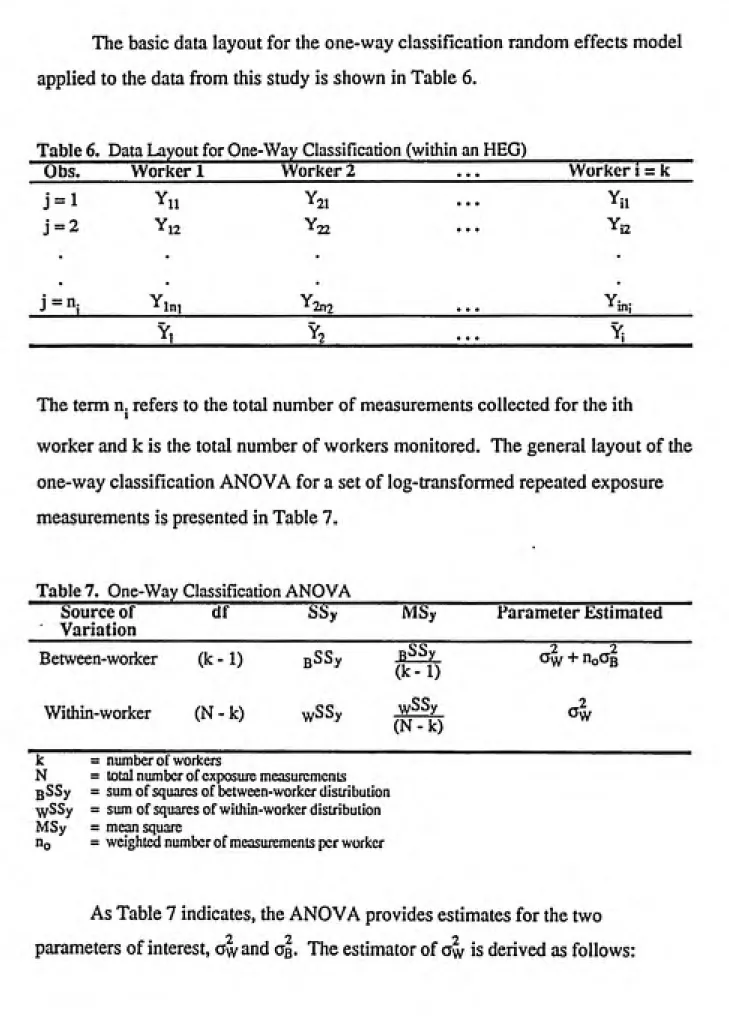
The basic data layout for the one-way classification random effects model
applied to the data from this study is shown in Table 6.
Table 6. Data Layout for One-Way Classification (within an HEG)_________________
Obs._____Worker 1________Worker 2___________;_;_;_________Worker i = k
j = 1 Yii Y21 ... Yji
j = 2 Y12 Y22 ... Yi2
J ="i_________Yin^______________Y2n2 ... _____________^^mj_______
_______________%________________%________________.^________________%
The term n. refers to the total number of measurements collected for the ith
1
worker and k is the total number of workers monitored. The general layout of the
one-way classification ANOVA for a set of log-transformed repeated exposure
measurements is presented in Table 7.
Table 7. One-Way Classification ANOVA Source of
Variation
df SSy MSy Parameter Estimated
Between-worker
Within-worker
(k-1)
(N-k)
gSSy
wSSy
uSSy
(k-1) wSSy (N-k)
2 2
Oxv + noOg
k = number of workers
N = total number of exposure measuremcnus gSSy = sum of squares of between-worker distribution ^SSy = sum of squares of within-worker distribution MSy = mean square
Hq = weighted number of measurements per worker
As Table 7 indicates, the ANOVA provides estimates for the two
2 2 1
21
i J
wSy - wMSy - (N - k)
The quantity.
n
Yi =
lYi
i=l
Hi '
is the estimated mean of the i-th worker's log-transformed exposure measurements. The ANOVA estimator
computed from the following equation:
2
measurements. The ANOVA estimator for the other component of variance, as, is
2_ [(sMSy-vyS^)]
B^ - n„k 2
The term no= N - (LnJN) and represents the weighted number of measurements
i
per worker. Finally, because the total variance is simply the sum of the within and
between components, an estimate of the total variance is.
2 _ 2 2
T-Sy - ^Sy + gSy .
The two-way nested classification for the random effects model is used to
assess exposure variability not only within and between workers in a group, but
also between groups or, in this case, HEGs. The random effects model is
unchanged except for one additional term:
Yhij = |i + Bh + Ahi-H £hij.
For this model, Yhij is the log-transformed exposure concentration received by the
the mean across the entire group, but Bh represents random deviations of the
mean of the hth HEG about the grand mean and is normally distributed with mean
zero and variance anEG- As with the first model, the Ahi term corresponds to
between-worker deviations and £hij to within-worker deviations, and both are
2 2normally distributed with a mean of zero and variance as and aw, respectively.
Finally, each term is assumed to be an independent variable and all measurements
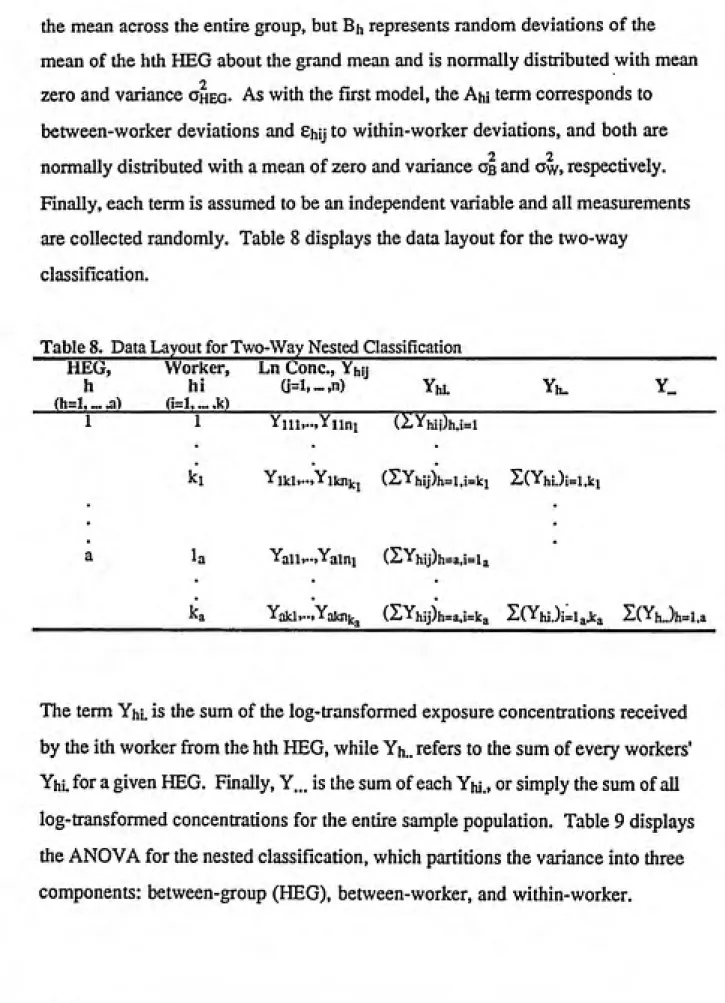
are collected randomly. Table 8 displays the data layout for the two-way
classification.
Table 8. Data Layout for Two-Way Nested Classification___________
HEG, Worker, Ln Cone, Yhy
h hi a=l,-,n) Yhi. Yh.
(h=l,... ,a)_____(i=l,... ,k)_____________________
i i Yiii,..,Yiini (ZYhii)h.i=l
ki Yiki,..,Yiknijj (SYhij)h=i,i=ki S(Yhi.)i=i,ki
Yaiiv.,Yaini (2)Yhij)h=a.i=la
Yakl.-.,Yaknk^ (ZYhij)h=a.i=ka X(Yhi.)i=i^jca S(Yh..)h=l,a
The term Yhi. is the sum of the log-transformed exposure concentrations received
by the ith worker from the hth HEG, while Yh.. refers to the sum of every workers'
Yhi. for a given HEG. Finally, Y... is the sum of each Yy., or simply the sum of all
log-transformed concentrations for the entire sample population. Table 9 displays
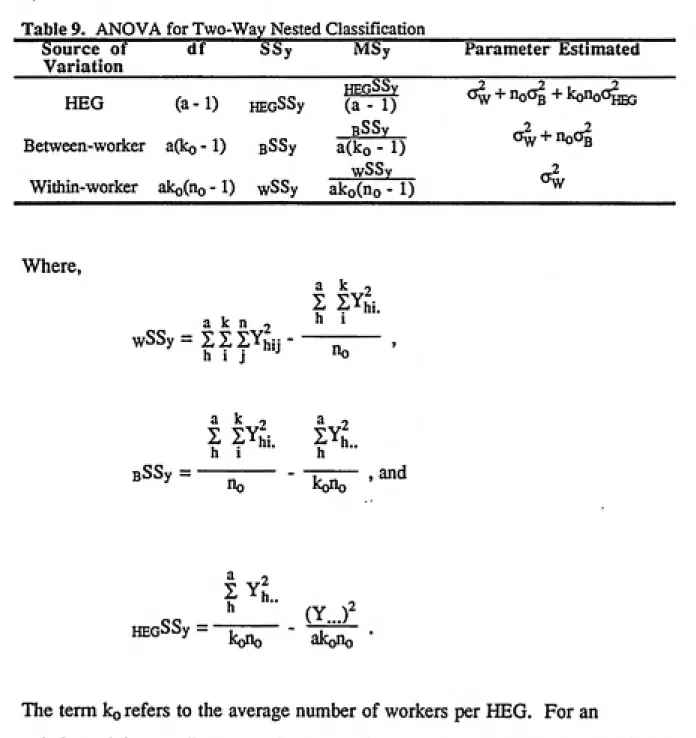
the ANOVA for the nested classification, which partitions the variance into three
23
Table 9. ANOVA for Two-Way Nested Classification
Source of d^ ^Sy MSy Parameter Estimated
Variation
HEG (a-1) HEcSSy
HEcSSy
(a- 1) <^w
+ Doag + koHoCJ^p,
Between-worker a(ko-l) sSSy
sSSy
a(ko - 1) (% + noOg
Within-worker ako(no -1) wSSy
wSSy
ako(no - 1)
elf
Where,
a k ^
I IYh':
a k n 2 ^ ^
wSSy = X Z I^hij
hi.
h i j '"J no
? ?^hi. SYJ..
h 1 hiyJ..
________(Y...)
koUo akoUo
The term ko refers to the average number of workers per HEG. For an
unbalanced data set (i.e. unequal number of workers in each HEG, and unequal
measurements per worker), Uq and ko are estimated as follows:
(N-k
(S
i
n-)/ N)
, and
ilo-K - 1
ko =
a
Ik,
h
Where, K is the total number of workers sampled for the entire population, and A
is the total number of HEGs sampled. Thus, estimates of each component of
variance are:
wS? = wMSy = ajjnji),
2 _ fiMSy-wMSy
B^ - no
2
2 _ HEpMSy - wMSy - npeSy
HEcSy - k^n^
2222 222 2
Finally, the total variance ot = <^w + Ob + cjheg» hence jSy = ^Sy + gSy + ^^QSy.
To assess the degree of exposure homogeneity between workers within
HEGs and across the total group, a metric described by Rappaport (1991) was
used. The metric defines a 'uniformly exposed' group of monomorphic workers as
a group in which 95% of the individual mean exposures are within a factor of 2,
This implies that the ratio of the 97,5th percentile to the 2,5th percentile, denoted
by bRo.95. is not greater than 2, Where,
bRo.95 = exp [3.92 ag],
and Gg is the standard deviation of the between-worker distribution of the
log-transformed exposures. In this study, the true value of Gg was not known so the
estimate of bRo.95 (designated g R0.95) was used as the measure of uniformity.
This estimate,
25
2
where ySs is the between-person component of variance obtained from the
random effects ANOVA on the log-transformed measurements.
Clearly, the assumption that the exposure concentrations are lognormally
distributed is an important one. To verify the validity of this assumption, a formal
goodness-of-fit test was used, in addition to a less rigorous qualitative method.
The goodness-of-fit test employed for this study was the Shapiro-Wilk W test,
which is considered to be a statistically powerful and superior omnibus test of the
fit to the lognormal model (Waters, et al, 1991). AW statistic and corresponding
p-value was computed for each HEG and for the population as a whole,
A visual representation of the fit was also made by means of a
log-probability plot, where the cumulative probabilities are plotted against the
corresponding geometric mean exposure concentration for each worker across
the entire sample population. Each workers' cumulative probability was derived
from [i / (k + 1)], where i is the rank from low to high of each mean from the
between-worker distribution of k workers (Rappaport, 1992). Only balanced
data were used, that is, only cases with three measurements per worker. Due to
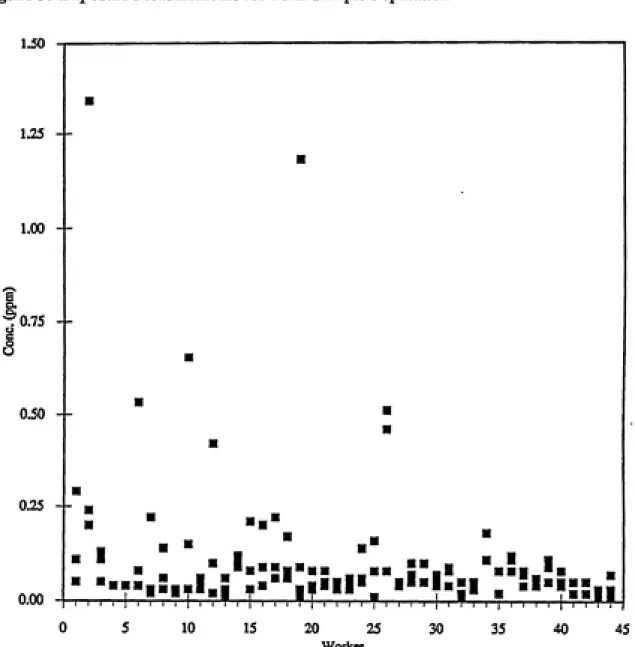
Results from the random sampling of the six HEGs are displayed in Figure
3 and are presented in tabular form in Appendix E. Each sample represents a
full-shift, 8-hour time-weighted average (TWA) concentration.
Figure 3. Exposure Measurements for Total Sample Population
1^
1.25
1.00
--I '0.75
0.50
0.25
--0.00
ͣ
I
10 15 20 25
Worker
27
A total of 130 measurements were made, two less than the desired number.
Table 10 accounts for the actual number obtained per HEG versus the number
desired.
Table 10. Measurements Collected Per HEG
HEG____________No. Desired________________No. Collected________
1 12 11 2 24 24 3 54 55
4 6 6
5 12 10
6 ______________24________________________24____________
Total_______________132_______________________130____________
For HEG 1, two of the four workers selected for monitoring were transferred to a
differentjobafter one measurement was made on each. Three samples were
subsequently collected for the alternate, as well as for the other two workers
originally selected. For HEG 3, a fourth measurement was made for one
previously selected worker, when a no-show from HEG 5 made available an extra
monitor on that day. Likewise, one other worker from HEG 5 did not show on
their scheduled day, resulting in a total of two measurements less than desired for
this group. It should also be noted that alternate workers, which were selected at
random, were used for HEGs 2 and 6. Finally, the samples from a worker
belonging to HEG 6 were excluded from the analysis because their job during the
sample interval was in a location different from that of the other workers in this
group. A temporary laboratory had been setup in one of the resin buildings.
Hence, the total number of measurements included in the analysis was 127, which
3 0.8787 0.3207
8 0.9328 0.5462
18 0.9226 0.1472
2 1.0 1.0
2 1.0 1.0
7 0.9776 0.9458
Tests of Lognormality
Table 11 presents the results of the Shapiro-Wilk W test on the
goodness-of-fit of the data to the lognormal model.
Table 11. Results of Shapiro-Wilk W Test for Lognormality
HEG k W Statistic P Value
1
2
3
4 5
________6__________________________________________________________
Total Population__________40_____________0.9737____________0.5827
At an alpha level of 0.05, the null hypothesis of lognormality was not rejected for
any group. Clearly the test results for groups 1, 4, and 5 are without meaning,
given the small sample sizes. The degree of non-significance for the total group,
however, does indicate that the assumption of lognormality was reasonable, at
least for the total between-worker distribution of exposures. Further evidence
that the total group was monomorphic can be seen in Figure 4, which shows a
log-probability plot of the between-worker distribution for the total group. It
appears to be approximately linear. Finally, the results for groups 2, 3, and 6
indicate that the assumption of lognormality was reasonable, thus each can be
29
Figure 4. Log-Probability Plot for Total Between-Worker Distribution
i.
§
U
u
I
i
o
0.1
o:^-aO... 00
<P^
.00^.<^o
oo
QQI ' < < ' "'"^ I I r iiriiliiiii I . I I MiliiMiiirilriiili.iiluifliiiiln.rlri..li.iMi.iilrii I I...I,i... i liri.i,
0.01 0.1 1 5 10 20 30 4050 60 70 80 90 95 99 99.9 99.99
Cumulative % Less Than Indicated Cone.
ANQVA Results
Complete results from the analyses of variance performed on the exposure
measurements for these groups are presented in Tables 13-20. First, Table 12
provides a summary of the results. A total of seven one-way ANOVAs were
completed, one for each HEG and one for the total population, in addition to a
nested two-way analysis using HEGs as the primary factor. The one-way
classifications partition the variance into estimates of the within and between
m
classification reveals any reduction in between-worker variability as a result of
the grouping scheme, and is used to gauge the success of the process for this
population.
Table 12. Summary Statistics from One-Way Classification ANOVAs
HEG N k X (± sd)
[ppm]
y
T^
yfSy(% of Total) (% of Total) B ^0.95
1 11 5 0.24 (± 0.38) -2.08 1.129 0.712 (58.8) 0.498 (41.2) 15.9 2 24 8 0.12 (± 0.17) -2.82 1.226 1.215 (99.0) 0.012 (1.0) 1.5
3 55 18 0.11 (±0.17) -2.66 0.685 0.714 (100.0) - 0.030 (0.0) 1.0 4 6 2 0.04 (± 0.02) -3.50 0.431
0.369 (78.3) 0.102 (21.7) 3.5
5 10 4 0.09 (± 0.04) -2.56 0.381
0.241 (58.4) 0.171 (41.6) 5.1
6 21 7 0.05 (± 0.03) -3.28 0.439 0.308 (67.8) 0.146 (32.2) 4.5 Total 127 44 0.11 (± 0.18) -2.77 0.841 0.691 (81.9) 0.152(18.1) 4.6
N
k sd
k
w^
B*y
8^0.95
= number of exposure measurements per group
= number of woricers monitored = arithmetic mean
= sample standard deviation = mean of log-transformed data = total variance of log-transformed data = within-worker variance component = between-worker variance component
= estimated ratio of 97.5* and 2.5'*' percentile ftom the between-worker distribution
Table 13. One-Way Random Effects ANOVA for HEG 1
Variance Source df ^S MS Variance
Component
Percent of
Total
Between-Worker 4 7.0173 1.7543 0.4983 41.16
Within-Worker 6 4.2743 0.7124 0.7124 58.84
31
Table 14. One-WayRandom Effects ANOVA for HEG 2
Variance Source df SS MS Variance
Component
Percent of Total
Between-Worker 7 8.7534 1.2505 0.0119 0.97
Within-Worker 16 19.4364 1.2148 1.2148 99.03
Total 23 28.1898 1.2256 1.2267 100.00
Table 15. One-WayRandom Effects ANOVA for HEG 3
Variance Source df SS MS Variance
Component
Percent of
Total
Between-Worker 17 10.5860 0.6227 - 0.0300 0.00
Within-Worker 37 26.4253 0.7142 0.7142 100.00
Total 54 37.0113 0.6854 0.7142 100.00
Table 16. One-Way Random Effects ANOVA for HEG 4
Variance Source df SS MS Variance
Component
Percent of
Total
Between-Worker 1 0.6766 0.6766 0.1024 21.71
Within-Worker 4 1.4774 0.3694 0.3694
78.29
Total 5 2.1540 0.4308 0.4718
100.00
Table 17. One-Way Random Effects ANOVA for HEG 5
Variance Source df SS MS Variance
Component
Percent of
Total
Between-Worker 3 1.9882 0.6627 0.1711 41.56
Within-Worker 6 1.4438 0.2406 0.2406 58.44
Table 18. One-Way Random Effects ANOVA for HEG 6
Variance Source df SS MS Variance
Component
Percent of Total
Between-Worker 6 4.4789 0.7465 0.1462 32.21
Within-Worker 14 4.3092 0.3078 0.3078 67.79
Total 20 8.7881 0.4394 0.4540 100.00
Table 19. One-Way Random Effects ANOVA for Total Population Variance Source df SS MS Variance
Component
Percent of
Total Between-Worker 43 48.6258 1.1308 0.1524 18.07 Within-Worker 83 57.3663 0.6912 0.6912 81.93
Total 126 105.9921 0.8412 0.8436 100.00
Table 20. Two-Way Nested Random Effects ANOVA for Total Population___________
Variance Source df SS MS Variance Percent of
________________________________________________Component______Total
HEG 5 15.1253 3.0251 0.1151 13.20
Between-Worker 38 33.5005 0.8816 0.0660 7.56
Within-Worker 83 57.3663 0.6912 0.6912 79.24
DISCUSSION
The sampling results clearly indicate that the vast majority of
formaldehyde exposures at this facility are well below the OSHA PEL of 1.0
ppm as an 8-hour TWA. In fact, out of 127 measurements, only two were above
the OEL (Figure 3, Appendix E). The mean exposure across the entire sample
population was 0.11 ppm with a standard deviation of 0.18 ppm.
Table 12 shows that the Head Roll Operators (HROs) in HEG 1 had the
highest mean exposure of all six groups (0.24 ppm), while HEG 4 had the lowest
(0.04 ppm). The analyses of variance reveal that for most groups and the
population as a whole, the total variation in exposures was predominantly
within-worker, that is, day-to-day. Estimates of the percent of total variation belonging
to the within-worker component ranged from 58.4% to 100.0 %. The low
degree of between-worker variation indicates relatively homogeneous exposure
conditions at this facility. However, using the definition of a uniformly exposed
group described earlier (i.e. g Rq 95 ^ 2), only two of the six groups would be
considered uniformly exposed: HEG 2 and 3. Given the extremely small
components of between-worker variation for each of these groups, accounting
for 1.0% and 0.0%, respectively, of the total variation, this result is not
A
surprising. Compared to the total population, with a g R095 of 4.6, the grouping
scheme reduced the g Rq 95 and the between-worker variation in four of the
HEGs. Yet, for groups 1, 4, and 5, with the total number of samples collected
34
These results also indicate that the between-worker variation across the
entire sample population was relatively low. In fact. Tables 12 and 19 show that
between-worker variance accounted for less than 20% of the total variance. This
implies that the subclassification of workers into discrete exposure groups, in an
effort to reduce variability between workers, would have limited effect for this
population since a "perfect" grouping would only account for about 20% of the
total variation across the population. Hence, a 20% reduction in exposure
variability is the most that could have been achieved through the use of HEGs.
As the nested ANOVA in Table 20 reveals, this effort was able to account for
roughly 13% of the total variation or two-thirds of the 20% which could be dealt
with in this manner.
In addition to providing information on the homogeneity of exposures, the
analyses of variance also offer insight on the nature of exposures at this facility.
Specifically, since the total variation in exposure across the entire population,
and for each HEG, was predominantly within-worker, exposures are governed
mostly by production processes or environmental conditions which are common
to the entire group. This implies that in general, individual jobs or work tasks
are not contributing to wide fluctuations in exposure to formaldehyde between
workers at this facility. Given the practice of rotating tasks within job classes,
this is, perhaps, to be expected.
However, the results indicating such a large degree of within-worker
variation (accounting for 99.0% and 100.0% of the total, respectively) for HEGs
2 and 3 was surprising. At first glance, the sampling results displayed in
Appendix E for these two groups do not appear to support this finding. Yet,
upon closer inspection, the fact remains that there were indeed very large
35
within-person differences were so large that for the statistical analysis,
differences between the means of individual workers were obscured.
So, the relevant question is why were day to day fluctuations in exposure
so great. One contributory factor may relate to the type of processes involved
with the production of resin at this facility, specifically the intermittent nature of
the operation. When resin undergoes production, kettles are charged, samples
are collected and analyzed, and product is processed; there is opportunity for
exposure. If kettles are not producing resin, there is minimal opportunity for
exposure. Clearly, exposures will fluctuate based on the production of resin.
Another factor which accounts for day to day variability is certain job tasks
performed fairly infrequently, but which can impact the level of exposure for
workers in an entire building. In particular, the task of charging a kettle with
paraformaldehye is not performed every day, but leads to higher exposures for
the majority of workers present in the building on those days when it is
performed. For example, on the July 30, Worker 1 from HEG 2 started the shift
that day by finishing the task of charging Kettle 323 widi paraformaldehyde (see
Appendix E). This operators' exposure on this day was 0.53 ppm, significantly
higher than the other measurements made for this worker on other days. In
addition, note that on this same day two other operators were monitored
(Workers 2 and 3), and their exposures were also higher than those received on
subsequent sample days. The end result is that this intermittent task contributed
greatly to the within-worker variation for each operator, yet did not confer a
large degree of between-worker variation.
Another factor which may have contributed to within-worker variance, by
and Floormen, from Buildings 3/12 and 19/57, respectively. However, the converse did not occur. That is. Lift Truck Operators or Floormen never performed tasks directly related to kettle operation. In any case, a potential consequence of task overlap is a reduction in between-worker variation, since performing similar tasks generally involves similar potential for exposure.
Finally, the fact that Head Roll Operators in HEG 1 received the highest exposures, on average, was unexpected, given that formaldehyde as a raw product is not present in Building 88. Formaldehyde is released, as described previously, during the heating of pulverized phenolic resin as it is applied to the nip of the heated rolls. Apparently, the process is capable of releasing more formaldehyde than the author thought possible, and the engineering controls are not adequately removing all of the contaminant generated. A brief investigation of the circumstances involved with the single exposure above the OEL received by a worker from this job class, revealed that the operator did experience
difficulties with the process on that day. The other possibility which might
account for the higher than expected results for this group is contamination of the monitor with resin dust, which is very prevalent for this process. It is
possible that dust trapped in the outer membrane of the monitor after it is sealed, continues to off-gas any free formaldehyde which was present in the dust.
However, there are two reasons why this possibility is thought to be unlikely.
For one, measures were taken to remove all visible dust from the outer
CONCLUSIONS
For this study, the use of diffusion monitors for full-shift personal
sampling of formaldehyde exposure provided results comparable to sorbent
tubes. Even though the monitors tended to read marginally higher compared to
the sorbent tubes, the benefits outweigh any loss in accuracy, if it actually exists.
The monitors require less labor, are more readily acceptable to workers, and are
more cost efficient. The end result is an increased number of samples, which
leads to a more accurate characterization of the distribution of exposures.
The observational approach used to assign workers to HEGs in this case
was only marginally effective. In terms of reducing between-worker variability
in exposures, the a priori groupings were successful for one-half of the groups
based on an analysis of variance of sampling results. However, the most
significant finding of this study was the fact that between-worker variability
accounted for only 20% of the total variation for the population.
Between-worker variation was obscured by the large degree of within-Between-worker variation,
or fluctuations day to day, which was likely a result of the batch nature of the
operation and task overlap between groups.
Given the relatively uniform exposure conditions between workers within
groups and across groups, much effort could have been avoided if the entire
population had been randomly sampled prior to the assignment of workers into
exposure groups which were perceived to be discrete. This illustrates the benefit
of an a posteriori approach to assessing exposures across a population of
American Industrial Hygiene Association, A Strategy for Occupational Exposure
Assessment AIHA, Akron, OH, 1991, p. 160.
Com, M., and Esmen, N.A., "Workplace Exposure Zones for Classification of Employee Exposures to Physical and Chemical Agents," American Industrial
Hygiene Association Journal. Vol. 40, Jan. 1979, pp. 47-57.
Kromhout, H., et ai, "Agreement Between Qualitative Exposure Estimates and
Quantitative Exposure Measurements," American Journal of Industrial Medicine.
Vol. 12,1987, pp. 551-562.
Rappaport, S.M., "Assessment of Long-Term Exposures to Toxic Substances in Air," Annals of Occupational Hygiene. Vol. 35, No. 1,1991, pp. 61-121.
Rappaport, S.M., "Interpreting Levels of Exposures to Chemical Agents," Patty's Industrial Hygiene and Toxicology. Vol. IIIA, 3rd Edition, In Publication.
GENERAL REFERENCES
Billmeyer, F.W., Textbook of Polymer Science. Wiley, New York, 1962.
Brown, B.W,, and Hollander, M., Statistics: A Biomedical Introduction. WUey,
New York, 1977.
Searle, S.R., Linear Models for Unbalanced Data. Wiley, New York, 1987.
Snedecor, G.W., and Cochran, W.G., Statistical Methods. Iowa State Univ. Press,
Ames, lA, 1989.
Walker, J.F., Formaldehyde. Krieger Publishing, Huntington, NY, 1964.
Woolson, R.F. Statistical Methods for the Analysis of Biomedical Data. Wiley,
41
Building 3/12 Floorplan - Ground Level
Office
Bay Door
Liq. Resin
Packout
Bay Door Bay Door
Drum Flaker
Flake Packout
mm]
/ Kettle \
^ Stairs to Platf(Min
Liq. Resin Packout
/ Kettle \
KZJ
Stairs to Platform
Kettle
301
nnnn
Ketfle
312
Belt Flaker
;:• ::
Flake Packout
Storage
Tank 344
O
WeighCase
Bay Door
Building 3/12 Floorplan - Platform Level
Break Area
KetUe 323
to Ground
Floor
CH20 Charge
Tanks
OS.
Kettle 314
Vacuum
^-^ Pumps
B Stairsjo
E Ground Floor
^---"V, *
f Kettle \
Kettie 301
Balcony
Filter Press
Lockers
Storage
Legend:
O.S. = Operator Station
C.P. = Control Panel
S^^^^p^^
43
Building 19/57 Hoorplan - Ground Level
stairwell
Storage Tank
Liq. Resin Packout
KetUe
1914
Kettle 1912
Kettle
5708 Liq. Resin
Packout
Drum Dryer OJS.
Kettle 5709
Kettle
5713
Liq. Resin
Packout
{ Kettle \
I 5715 J
Flake Packout Conveyor System
J Tubes
m
Filter Pi (upst;
esses aprs)
Stairs
Bay Door Bay Door
Stairwell
Building 19/57 Floorplan - Platform Level
Legend:
O^. = Operator Station
C J*. = Control Panel
Stairwell
Kettle
1912 KetUe
1914
Kettle 5708
K5704 KS706
Kettle
5713 Kettle
5709
K5705 K5707
I KetUe 1
Office OS.
m
45
Building 88 Floorplan - Ground Level
stairwell
Offke
Bay Doors
Ribbon Blenders
Compound Packout
Bay Door
Legend:
Building 88 Floorplan - Upper Level
stairwell
Rolls
Legend:
O.S. = Operator Station C.P. = Control Panel
Control Lab - Floorplan
47
Lab Hood \, Lab Hoods
Ovens
imni Qnnn Dnnn
Computer Room
Storage Room
1 Legend: 1
49
Appendix B Random Selection of Workers and Sample Days; Number of Samples Collected
Per WorkerHEG Worker Shift Selected Sample Days Randomly Actual No.
ID No. (V) on Day Shift Selected Sample Days
Samples
Collected
1 1 i ͣ 10-13 " 11,12,13 3
2 1
3 2 V 1-5,14-18 3,16,17 3
4 2 V(Alt) 14-18 16,17,18 3
5 3
i
6-9,19-21 6,9,20 16 3 V 6-9,19-21 8,19,20 1
2 ͣ 01 1 V ~ 10-13 ͣ 10,11,12 3
2 02 1
i
10-13 10,12,13 32 03 1 i 10-13 10,11,13 3
2 04 1 V 10-13 11,12,13 3
2 05 2
2 06 2 V 1-5,14-18 4,5,14 3
2 07 2 V 1-5,14-18 2,3,17 3
2 08 2
2 09 3 V 6-9,19-21 7,8,9 3
2 10 3 V(Alt) 6-9,19-21 9,19,21 3
2 11 3
2 12 3
f
6-9,19-21 6,9,19 0
3 ͣ 01 V (Alt 1) 1-5,19-21 1,5,20
3 02
3 03
i
1-5,19-21 2,4,19 33 04
i
1-5,19-21 3,5,19 33 05 i 1-5,19-21 1,5,19 3
3 06 i 1-5,19-21 1,4,20 3
3 07
i
1-5,19-21 1,5,20 33 08 K
, V
14-18 14,15,16 (17*) 43 09 K V(Alt2) 14-18 15,16,18
3 10 K V 14-18 15,17,18 3
3 11 K
3 12 K V 14-18 14,15,17 3
3 13 K
3 14 K
V,
14-18 14,15,16 33 15 L
i
6-9 7,8,9 33 16 L V 6-9 6,7,8 3
3 17 L
^
6-9 6,7,9 33 18 L V 6-9 7,8,9 3
3 19 L
3 20 L
3 21 L
3 22 M
3 23 M V 10-13 10,11,12 3
3 24 M V 10-13 10,11,13 3
3 25 M V 10-13 10,11,12 3
3 26 M V 10-13 10,11,12 3
3 27 M V 10-13 10,11,13 3
"HE(r Worker Shift Selected Sample Days Randomly Actual No.
ID No. (V) on Day Shift Selected Sample
Days
Samples
Collected
4 1 1
4 2 2 V 1-5,14-18 3,14,16 3
4 3 3 V 6 - 9,19 - 21 19,20,21 3
4 4 3
5 1 J V " 1-5,19-21 3,4,19 2
5 2 K V 14-18 14,16,17 2
5 3 K
5 4 L V 6-9 6,7,9 3
5 5 M V 10-13 10,12,13 3
5 6 M
6 01 J "
6 02 J V 1-5,19-21 1,3,21 0
6 03 J V (Alt 1) 1-5,19-21 4,5,20 3
6 04 K V 14-18 14,15,17 3
6 05 K
6 06 K V 14-18 15,17,18 3
6 07 L i 6-9 6,7,8 3
6 08 L
i
6-9 6,8,9 36 09 L
i
6-9 6,7,8 36 10 M V 10-13 10,12,13 3
6 11 M V(Alt2) 10-13 11,12,13
6 12 M V 10-13 11,12,13 3
Alt = Alternate in the event any selected worker was not available
* = Indicates day on which 4th sample was collected; worker was randomly selected to wear monitor after
Appendix C Sample Day by Date
Sample Day Date
1 July 15
2 16
3 17
4 18
5 19
6 22
7 23
8 24
9 25
10 30
11 31
12 August 1
13 2
14 5
.15 6
16 7
17 8
18 9
19 12
20 13
APPE^fDIXD
Appendix D Data from Sampling Methods Field Study and Statistical Analysis
AQR PF-20 (PEL) Cone. SKC Treated XAD-2 Cone. Difference [AQR - SKC]
(ppm) (ppm) (ppm)
0.09 0.04 0.05
0.14 0.11 0.03
0.18 0.25 -0.07
0.08 0.05 0.03
0.17 0.13 0.04
0.13 0.10 0.03
0.25 0.10 0.15
0.13 0.07 0.06
0.16 0.10 0.06
0.30 0.19 0.11
0.40 0.40 0.00
0.29 0.26 0.03
0.07 0.09 -0.02
0.07 0.03 O.M
0.43 0.30 0.13
0.22 0.15 0.07
0.16 0.19 -0.03
0.28 0.28 0.00
0.17 0.15 0.02
0.12 0.06 0.06
0.21 0.16 0.05
0.05 0.05 0.00
0.09 0.08 0.01
0.05 0.22 -0.17
0.06 0.07 -0.01
55
n = 26 Matched Pairs
Sample Mean:
AQR=:0.17ppm
SKC = 0.14 ppm
Difference (d) = 0.026 ppm
Sample Standard Deviation: AQR = 0.10 ppm SKC = 0.09 ppm Difference (s^) = 0.062
Paired Sample t-Test on Differences:
d-ix,
t = 2.105
Probability that 11| > 2.105 = 0.046
Result: At a 0.05 level of significance, borderline rejection of the null hypothesis
of no significant difference between the two methods.
HEG Worker ID Date 8-Hr TWA
No. (ppm)
Job Title PF-20 ID
No.
Location
(Bldg.)
Operation/Job Task
1 1 073191 0.13 HRO 1090359 88 Downstairs Rolls
1 1 080191 0.05 HRO 1090371 88 Downstairs Rolls/General Cleanup
1 1 080291 0.11 HRO 1090383 88 Cleaned Pulverizers/General Cleanup/Downstairs Rolls
1 3 071791 0.29 HRO 1090288 88 Upstairs Rolls/Cleaned Sifters
1 3 080791 0.11 HRO 1090415 88 Upstairs Rolls
1 3 080891 0.05 HRO 1090425 88 Upstairs Rolls
1 4 080791 0.24 HRO 1090416 88 Main Floor Materials Handling/Downstairs Rolls
1 4 080891 0.20 HRO 1090424 88 Downstairs Rolls
1 4 080991 1.34 HRO 1090431 88 Downstairs Rolls
1 5 072591 0.04 HRO 1090337 88 General CleanupAJpstairs Rolls
1 6 072491 0.04 HRO 1090327 88 Packout Ehities
2 1 073091 0.53 AKO 1090347 3M2
2 1 073191 0.04 AKO 1090360 3\12
2 1 080191 0.08 AKO 1090380 3M2
2 2 073091 0.22 AKO 1090354 3M2
2 2 080191 0.03 AKO 1090372 3M2
2 2 080291 0.02 AKO 1090384 ?M2
2 3 073091 0.14 AKO 1090348 3\12
2 3 073191 0.06 AKO 1090367 3M2
2 3 080291 0.03 AKO 1090385 3\12
2 4 073191 0.02 AKO 1090361 3M2
2 4 080191 0.03 AKO 1090373 3M2
2 4 080291 0.03 AKO 1090386 3M2
2 6 071891 0.65 AKO 1090295 3M2
2 6 071991 0.15 AKO 1090303 3M2
2 6 080591 0.03 AKO 1090395 3V12
2 7 071691 0.05 AKO 1090286 3M2
2 7 071791 0.06 AKO 1090289 3U2
K323-Finished Charging With Paraform
Pan Job on Gelled Resin
K323
K301 -Charged With Phenol and Sulfuric Acid Drained T344 into Pans/K301 K323/Relieved Drum Flaker Packout
K314
K323
K312
K301
Dramed T344 into Pans/K312
K312-Caustic Wash
K323-Charged With Paraform
K301
K323
K312-Phenol Boa/K301-Charged With Xylene
Belt Flaker Packout/Cleaned Roof Dust Collector