Susan M. Metallo. Reading About Readers: A Content Analysis of the Reading
Behaviors Modeled by Characters in Popular Children’s Fiction. A Master’s Paper for the M.S. in L.S. degree. April, 2012. 59 pages. Advisor: Brian Sturm
This study examines the portrayal of reading in popular children’s fiction. Content analysis was used to determine to what extent characters in a sample of fifteen high-circulating novels for middle grade readers displayed the following positive reading behaviors: reading continuous texts, reading voluntarily, reading for recreation or general interest, sharing reading experiences, and experiencing reading as pleasurable. The study also examined whether male and female readers were equally represented with regard to these positive behaviors. Both male and female readers were represented in the sample texts and exhibited roughly equivalent positive reading behaviors. Models of recreational reading were limited, and texts varied in the positivity or negativity of their depictions of reading, though free voluntary reading was portrayed positively fairly consistently. The study includes an assessment of which texts provide the most positive male and female reading models overall.
Headings:
Characters & characteristics in literature Children -- Books & reading
by
Susan M. Metallo
A Master’s paper submitted to the faculty of the School of Information and Library Science of the University of North Carolina at Chapel Hill
in partial fulfillment of the requirements for the degree of Master of Science in
Library Science.
Chapel Hill, North Carolina April 2012
Approved by
Table of Contents
Introduction………..2
Literature Review………...4
Research Questions………17
Methodology………..18
Results and Discussion………..28
Conclusions and Future Research………...…...44
References………..50
Appendix A………53
Appendix B………54
Introduction
In designing services for children, libraries prioritize literacy development as a foundational skill. In addition to new technology and information literacies, traditional literacy skills remain important for decoding and comprehending information in a variety of print and electronic formats. Studies have demonstrated that the practice of pleasure reading develops literacy skills more effectively than many other forms of literacy education, such as direct vocabulary instruction. In order to encourage the development of a pleasure reading habit that will hopefully remain with children throughout their lives, libraries strive to promote the pleasure of reading through reader’s advisory and
programming. But despite these efforts, librarians encounter many reluctant readers who are not willing to engage with the type of free voluntary reading that allows a pleasure reading habit to develop.
Peer attitudes toward reading and modeled adult behavior have been demonstrated to greatly affect children’s perception of reading as positive or negative. If children
perceive that certain types of reading are not socially accepted, they are less likely to read such materials—even if their own interests would otherwise lead them to read in those areas. Negative social pressure is especially problematic for boys, who see few examples of male pleasure readers among adults, among their peers, and in popular culture. In addition to real life models, the behaviors of characters in television shows, movies, and even the books that children check out from the library may influence children’s
perception of socially acceptable behavior.
Literature Review
The Importance of Reading
Our society revolves around the assumption that people can read. Everything from applying for a job to reading a bus schedule requires at least basic literacy skills. Although a relatively low percentage of the United States population lacks literacy skills entirely, many adults read at a level too low to negotiate society’s “complex literary demands” (Krashen, 2004, p. x). Adults must be able both to read documents and to “use them effectively” (Ross, McKechnie, & Rothbauer, 2006, p. 3). Studies have found a
correlation between reading and academic achievement, writing ability, IQ, second language learning ability, and “verbal intelligence”—i.e., vocabulary and factual
knowledge about the world (MacDonell, 2004, p. 30; Schutte & Malouff, 2006, p. 125). In the adult world, poor reading ability results in lower paying jobs, lower
socio-economic status, and fewer opportunities to improve reading skills (Schutte & Malouff, 2006, p. 11-12).
grammar, reading comprehension, and writing ability. Students also improved their test scores in history and literature (Krashen, 2004, p. 35).
The aforementioned studies encouraged a particular type of reading: the reading of continuous texts outside of reading instruction. Kirsh et al. (2000) defines “continuous texts” as texts “typically composed of sentences that are, in turn, organised into
paragraphs. These may fit into even larger structures such as sections, chapters and books” (p. 27). Most reading studies have focused on books (fiction or nonfiction), but
some also included newspapers, magazines, comics, and even gaming manuals. Reading continuous texts has a number of advantages. Encountering words and phrases in context helps a reader develop the strategies he needs to decode increasingly complicated
grammar and syntax. This leads to greater reading speed and comprehension and
improves written composition skills (Krashen, 2006a, p. 44; Schutte & Malouff, 2006, p. 3).
Reading continuous texts also strengthens vocabulary. Studies indicate that ordinary conversation involves a limited vocabulary of only the 5,000 most frequent words. Even the “lightest” reading materials (such as comics and magazines) provide a
much broader range of vocabulary (Krashen, 2004, p. 103-104). Although targeted instruction can also help supplement vocabulary growth, Nagy, Herman, and Anderson (1985) argue that for children to build their vocabularies quickly, they cannot rely on “word-by-word” vocabulary instruction alone; the results of the study suggest that reading in context is the “most effective way to produce large-scale vocabulary growth”
Children do not have to read highly literary texts to develop their vocabularies and reading comprehension. Texts that teachers and librarians often do not consider “real” reading have been demonstrated to improve the same literacy skills as literary
novels. A 1976 study found that when boys read newspapers, magazines, and popular fiction regularly for one year, their reading comprehension SAT scores improved by a margin 64% greater than that of the control group (Krashen, 2004 p. 4). Even the lightest superhero comics have more sophisticated vocabulary than students encountered in daily conversation, and the reading of comics and graphic novels has been connected to improvements in reading comprehension, as well (Krashen, 2004, p. 98-99). Sperzl (1948) demonstrated that both the reading of comics and other more “serious” reading
material resulted in gains in vocabulary and reading comprehension; there was no difference in the level of improvement between the comics-readers and other readers (quoted in Krashen, 2004, p. 101).
Still, in order to reach the highest levels of reading comprehension and
vocabulary, a mixture of “light” and “denser” reading may be necessary. Krashen (2004) argues that “reading comprehension and vocabulary are related to what is read” (p. 114). Superhero comics are likely to teach the word “indestructible,” but perhaps less likely to teach the word “ennui.” Furthermore, while magazine reading was linked to “superior gains on standardized tests of reading,” it did not seem to improve grammar or spelling
(Krashen, 2004, p. 114). Still, librarians and educators should recognize the value of both “light” and more literary texts in enhancing literacy skills, as well as motivating
Reading for pleasure. In addition to building vocabulary and comprehension skills, reading comics, magazines, and other “light” texts can cultivate a child’s interest in
reading itself. Enjoyed reading of any kind encourages more reading in general: more comics, more magazines, and maybe even some of the literary novels of which parents and teachers approve. When people suggest that graphic novels or magazines should have no place in the library, librarians often respond with anecdotes of children who started reading comic books and ended up reading 400 page novels.
Although this approach may perpetuate the image of graphic novels as a form of “lesser” reading that leads to “real” reading, it highlights an important source of reading
motivation: enjoyment of reading. Ross et al. (2006) cite the pleasure of reading as an essential factor in sparking and maintaining reading motivation (p. 4). Newkirk (2002) criticizes the tendency of parents and educators to stress the “moral” value of reading— that it is inherently good, useful, and vital for intellectual growth. He argues that this tactic fails to motivate readers:
“unless there is some pleasure in the means for attaining [an] ideal, most people fail to persevere. . . . unless we can persuade students that reading is a form of deep, sustained pleasure, they will not choose to read; and because they will not choose to read, they will not develop the skills to make them good readers” (p.63-65).
For this reason, early literacy experts encourage parents and educators to read aloud to young children, introducing them to books in a way that “involves visual, auditory, interactive, and attention processes in a pleasureable context” (MacDonell, 2004, p. 30).
“children who participate in these programs are more involved in free voluntary reading after the program ends than those in traditional programs” (p. 81). This has been
demonstrated even with the most reluctant readers.
By experiencing the pleasure of reading, young readers develop an intrinsic motivation to read. Schutte and Malouff (2004) cite studies that demonstrate that intrinsic motivation (an inner desire to read) prompts people to read more successfully than extrinsic motivation (an attempt to reap rewards or avoid punishment)--both short and long term (p. 277). If a text sparks a reader’s curiosity, that interest will likely
motivate her to read (Rog, 2005, p. 45). In fiction, “effective characterization” may be the key to creating interest for many readers. Rog (2005) suggests that “readers need to care what happens to the characters and how their problems will be resolved in the story. This is particularly important for reluctant readers” (p. 47). The level of a reader’s
interest also affects how much he engages with a text and may determine the extent to which the reading experience promotes literacy development (Schutte & Malouff, 2004, p. 277-278). The development of reading comprehension and related literacy skills requires that a reader actively engage with the text and apply reading strategies. Krashen (2004) argues that “reading for meaning, reading about things that matter to us, is the cause of literate language development” (p. 150).
Choice and social reading. Reading interests vary widely, which can make effective reader’s advisory a challenge. Ross et al. (2006) describe reading preference as “highly personal” and go on to say that when adults select books for individual children based on broad “group trends,” the books are unlikely to motivate the children to read (p.
Krashen (2004) argues that the pleasure of reading comes from “free voluntary reading”
(FVR), which allows each child to choose his own reading material and to change reading materials until he discovers a text that engages him (p. 2).
Providing choice not only allows children to tailor their reading experiences to their individual interests but also gives them a sense of control over their reading
(Allington, 2012, p. 73; MacDonell, 2004, p. 30; Mackey, 2003, p. 51). Mackey (2003) describes control as “one of the social and psychological triumphs” that fosters positive
reading experiences (p. 51). A child who feels forced to read will associate reading with work—a task to be completed before he can have fun. Krashen and Von Sprecken (2002) note that even “avid readers might . . . object to enforced reading” (p. 12). Especially for
readers who are already reluctant, the negative associations with enforced reading can stifle any potiential motivation for pleasure reading. For intrinsic motivation to develop, readers need to be able to self-determine their reading experiences (Schutte & Malouff, 2004, p. 277).
In addition to choice, the social aspects of reading can also cultivate a desire to read for pleasure. Allington (2012) argues that when a reader engages with the text, she connects to the text through her own experience (text-to-self), through other texts she has read (text-to-text), and through her wider knowledge of the world (text-to-world). Discussing texts with others reinforces these connections and improves reading
comprehension (p. 125-6). Many children begin experiencing reading as social from a young age while listening to adults read aloud, a practice which both promotes early literacy skills and frames reading as “a shared, social-bonding experience” (Ross et al.,
The desire to engage with texts in community continues beyond early childhood. School-age, adolescent and adult pleasure readers often discuss their reading experiences and share reading materials with friends. The reading habits of peers seem to be one of the most influential factors in determining what children read. Krashen (2004) found that “some students, in fact, felt compelled to read what their friends were reading and
ignored their own reading interests” (p. 90). For all of the emphasis on reading choice
and individual reading interests, it seems that the social aspect of reading is an interest in itself. The desire to share a reading experience with peers provides enough incentive for a reader to engage with a text.
The “Reader” and the “Non-reader”
Unfortunately, social expectations surrounding reading can act as a deterrent from free voluntary reading (FVR). A substantial body of research on reading motivation seems to indicate that children lose interest in reading as they grow older, beginning around fourth grade (Krashen & Von Sprecken, 2002, p. 11). Krashen and Von Sprecken (2002) criticize the methods of many of these studies, dismissing some and arguing that for others, a more astute interpretation of the results would suggest that beginning around fourth grade, students lose interest in certain types of reading—specifically the types of reading associated with schoolwork (p. 16). Krashen and Von Sprecken also note that students who say that they “hate reading” often simultaneously report enjoying
magazines, comics, and other “light” reading (Krashen & Von Sprecken, 2002, p. 12).
magazines, etc.) as “not real reading” can cause children with those reading interests to
believe that they are not readers (p. 11).
While a child’s perception of himself as a non-reader may not deter him from
continuing to read comics, it may deter him from exploring diverse reading materials or engaging with texts outside of his narrow area of interest. A 1998 report from the British Qualifications and Curriculum Authority linked boys’ undervalued reading interests to
their lower English and reading scores and their reluctance to read more widely (p. 11). Schunk (2003) also suggests that people who do not see the inherent value of an activity are less likely to practice it (p. 161). Because a person’s level of literacy development
relates directly what he reads, the most advanced readers will be those who do not avoid more advanced texts out of principle (Krashen, 2004, p. 114). If we hope that the
pleasure of reading will motivate children to read extensively and push the boundaries of their comprehension and vocabularies, it is important that young people consider
themselves “readers.”
Research has highlighted the importance of “the perception of the self as a reader.” In a study conducted with adults, Schutte and Malouff (2007) found the
perception of the self as a reader to be strongly connected to reading motivation and enjoyment (p. 483). This study defined the perception of the self as a reader through the participant’s categorization of reading as a “meaningful” or vital part of his life and whether the participant felt he “modeled” good reading behavior to others (Schutte &
Malouff, 2007, p. 488). This self-awareness becomes most pronounced in adulthood, but a person’s perception of his own propensity toward reading begins to affect motivation
of identity in adolescence (Schutte & Malouff, 2007, p. 482-483; Shell, 1995, p. 386). Fry (1985) argues that very young children who mimic reading behavior “see themselves as readers,” and this self-perception forms the basis for their future success as readers (p.
94). If adults do not encourage children to “see themselves as readers . . . they will not learn to read” (Fry, 1985, p. 94).
Many social factors can influence the perception of the self as a reader. A narrow definition of reading may affect reading motivation for specific types of texts, though not others. There are factors, however, that relate more directly to a reader’s identity and
may heavily influence his motivation to undertake the task of reading at all. One of the most prominent issues is gender.
Male readers. The hegemonic construction of masculinity prescribes certain behaviors that a “real man” should exhibit. Some of the most commonly cited include
aggression, courage, responsibility, physical strength, emotional control, and being active—both in terms of physical athleticism and of taking social or professional
leadership (Johnson & Greenbaum, 1980, p. 494; Nodelman, 2002, p. 6; Taylor, 2009 p. 11; Vandello, Bosson, Cohen, Burnaford, & Weaver, 2008, p. 1326). Considering the emphasis on activity and physical strength, it comes as little surprise that the sedentary activity of reading is often perceived as non-masculine (Horton, 2005, p. 31; Nodelman, 2002, p. 14). A series of studies conducted at Kean University from 1995-2000 found that the overwhelming majority of children and adult men and women viewed reading as a “mostly feminine” activity (Baron, 1996, p. 5; McKenna, 1997, p. 5; Vadon, 2000 p. 7;
Winchock, 1995, p. 6).1 Similar studies in Australia found that boys associated reading
1
“with girls . . . and with anti-masculine practice” (Alloway, Freebody, Gilbert, &
Muspratt, 2002, p. 48).
Behaviors modeled by adults perpetuate these stereotypes. In a 1996 study, only 5.6% of the participating children reported that their father read books more often than their mother while 56% associated book reading with their mothers (Newkirk, 2002, p. 42). Additional studies in the United States, Britain, and Australia cite a lack of male role models as a key factor in a child’s perception of reading as feminine (Alloway et al.,
2002, p. 48; Horton, 2005, p. 31; QCA, 1998, p. 10; Sullivan, 2004, p. 36). As boys identify with male role models, the lack of examples of males reading can discourage boys from practicing or admitting to enjoying reading.
Expectations of peers also influence the perception of males as non-readers. In a 1998 British study, boys said that “they had to be cautious about admitting their pleasure
in reading because of negative peer group pressure . . . . Boys and girls asserted that it was easier for girls to be known as hard workers and enthusiastic readers and still retain credibility with their peers” (QCA, 1998, p. 11). Both Newkirk (2002) and Schutte and
Malouff (2006) also found that girls valued reading more than boys, which made boys reluctant to openly show enthusiasm for reading (p. 39; p. 175). To enjoy reading would require a break from social conventions and potential alienation from their peer group. From society, boys learn that they are not supposed to be pleasure readers.
In part because they practice complex reading less often, boys tend to score lower on reading comprehension tests and struggle more with reading fluency (“Boys and
books,” 2006, p. 1; Gunzelmann & Connell, 2006, p. 94; QCA, 1998, p. 13). Reading
difficulty can further decrease a child’s intrinsic motivation to read, as low self-efficacy (beliefs about one’s own ability to perform certain tasks at an appropriate level) causes
people to associate negative emotions with the challenging task (Henk & Melnick, 1995, p. 470). Children who feel negatively about reading naturally spend less time reading voluntarily (Horton, 2005, p. 30; Schunk, 2003, p. 162; Schutte & Malouff, 2006, p. 127). Thus a child’s reluctance to practice reading leads to greater reading difficulty and
therefore greater reluctance to read.
Changing Perceptions of the Non-Reader
The perception of the self as a non-reader is complex. Part of the solution must be a more inclusive definition of “reading” so that children who favor lighter reading do
not feel disconnected from other types of literature. Librarians have long been aware of the need to encourage diverse reading interests and alternative formats. Indeed, it is now difficult to imagine a library-related conference without at least one session devoted to graphic novels. Our efforts in promoting all reading materials equally and educating parents and teachers about the value of perceived “light” reading should continue.
But for boys who consider themselves non-readers due to gender stereotypes, more is required. We must produce positive images of males reading for pleasure (Kenney, 2007, p. 11). Models play an important role in shaping a child’s perception of
people who read are “more likely to have a father who reads at least sometimes” and “a mother who reads all the time” (quoted in Horton, 2005, p. 30). Exposure to positive models of reading can lead a child to establish the “patterns of behavior” that lead to
productive and life-long reading (Schutte & Malouff, 2006, p. 23).
Models must represent all types of readers, especially those groups more likely to be viewed as “non-readers.” Pasco (2007) notes that children expect to see certain types
of models based on their preconceived notions about who reads; she uses English teachers as her example, although librarians would certainly fall into this category as well. She encourages educators to make an effort to “promote reading in ‘unlikely places,’ expanding a child’s conception of who reads” (p. 23). As the research indicates
that children do not see many adult or peer models of male readers (Alloway et al., 2002, p. 48; Horton, 2005, p. 31; QCA, 1998, p. 10; Sullivan, 2004, p. 36), a particular effort must be made to make male readers visible to children, particularly boys.
In addition to real-life observation, children can acquire behaviors and beliefs about social norms from models in literature and popular culture. In a case study of a thirteen year old boy, Young (2000) found that his hegemonic gender beliefs stemmed primarily from television and books, as well as life experiences (p. 322). Schutte and Malouff (2006) study the psychology of “engagement with text” and argue that “models
of the self presented in text may influence changes in the reader’s self. For example, the sense of self and purpose ascribed to the characters in stories may encourage us to modify our own sense of self” (p. 156). Fry (1985) also stresses that people “learn from the
Research Questions
Given the importance of portrayals of reading in popular culture, this study explores the type of reading behaviors modeled in popular children’s fiction. The study
sought to determine whether the books children read provide them with models of positive reading behaviors and whether those models represent both male and female readers. The following questions guided my research:
1. To what extent do characters in popular middle-grade fiction model the following behaviors that support the development of literacy skills:
Reading continuous texts;
Reading voluntarily;
Reading for recreation or general interest (not exclusively out of
immediate information need);
Sharing reading experiences with others; and Experiencing reading as pleasurable?
2. To what extent are males represented as readers and do they exhibit the above behaviors more or less often than female characters?
Based on the research, I expected that male readers would appear less often than female readers and that they would be less likely to exhibit the positive reading behaviors. I also predicted that male characters would struggle with reading more often than female
Methodology
Sample
This study used content analysis to examine the portrayal of reading in fifteen popular chapter books targeted at an audience of middle grade readers. The sample of books for this study was taken from the circulation statistics of the Jefferson-Madison Regional Library System. A list was generated of books catalogued as juvenile fiction that circulated twenty-five or more times in the period between 1 January 2011 and 1 August 2011. That list was then narrowed to books that School Library Journal recommended for grades 4-6, or any age range that encompassed at least two of those grades (e.g., 5-8, 4-9, or 3-5, but not 6-8 or 2-4). If more than one book from the same series appeared on the list, only the highest circulating book of the series was considered. Books with animal protagonsists were also eliminated. These restrictions resulted in a list of thirty-five titles. From that short-list, the fifteen highest-circulating books were examined in this study (see Appendix A).
Coding
Definitions of “reading” and “readers” can vary, from a focus on books alone to
letters that tell a story) would also be valuable to promoting literacy skills as they contain the narrative prose context that proves so beneficial to developing vocabulary and
comprehension. All of these types of reading fall under PISA’s category of continuous texts. Non-continuous texts include maps, signs, lists, etc. (Kirsh, 2000, p. 27-29). These promote some literacy skills, but research suggests that they are less effective in building vocabulary, spelling skills, and reading comprehension. In addition, they were not found to encourage either life-long interest in reading or reading enjoyment (Krashen, 2004, p. 15).
This study collected data on characters’ reading of both continuous and non-continuous texts but focused on non-continuous texts. Reading of non-non-continuous texts was still examined, as such reading can provide indications of reading difficulty and overall volume of reading. In the areas of reading choice, motivation, and enjoyment, however, only continuous texts were coded since it is these texts that have the potential to be the type of “free voluntary reading” that supports the literacy skills mentioned above.
A “reader” in a book was defined as any character that is described reading words
in any format or material. Reading was coded both when it occured at the moment it was described and when it was reported retrospectively. Instances of reading were not limited to uses of the verb “to read.” Other verbs can indicate reading of a text, such as
“examined,” “looked over,” or “studied.” If the narration followed a particular character’s point of view and described the contents of a text (e.g., “The sign over the door read. . .” or “The book said that . . .”), this was considered a reading experience, as
described or directly reported were not counted. For example, if a character gave a teacher a book report, one might assume that the character read a book on which to base the report. If the character’s reading of the book was never mentioned in the text,
however, this assumed reading experience was not recorded.
Each time a character read, the type of reading material was recorded (fiction book, non-fiction book, map, letter, graphic novel, etc.), and coded with the following criteria:
A)Was the text continuous or non-continuous? By PISA’s definition, continuous
texts “are typically composed of sentences that are, in turn, organised into paragraphs.
These may fit into even larger structures such as sections, chapters and books” (Kirsh,
2000, p. 27). Continous texts include narration, exposition, description,
argumentation, instruction, documents and records, and hypertext (Kirsh, 2000, p.
27-8). In contrast, non-continous texts “consist of a number of entries that share some
property(ies)” (Kirsh, 2000, p. 28). Examples of non-continuous texts include charts
and graphs, tables, diagrams, maps, lists, forms, information sheets, advertisements,
vouchers, and certificates (Kirsh, 2000, p. 28-9). Labels, signs, and other collections
of words that are not organized into sentences were also considered non-continuous
texts.
If the text is continuous:
1. Indications of Choice:
authority over the reading character. Assigned reading would include reading notes from teachers, parents, or other authority figures, but would not include reading notes from peers or other non-authority figures, unless that peer had gained power over the character in order to coerce him/her into reading (such as through blackmail or threats of violence). Voluntary reading occurred when a character chose to read, whether for pursuing a personal information need, for recreation, or for curiosity. Voluntary reading was not motivated by a command from an authority figure. b) Did the character exercise free choice in the selection of the text or
was it provided by another character? If provided by another
character was the reading material the only option provided or one of
two or more options? A character may be assigned to read and still exercise choice in the selection of the text. A real-life example of such a situation would be Sustained Silent Reading (SSR) in schools. The act of reading is required by a teacher during these periods, but the choice of reading material is often left to the students. In this study, “free choice” refers to reading material chosen by a character that was not directly provided by another character. There is one exception to this rule. If a character sought a specific reading material that he had selected himself and found a character who was able to provide that material, this was considered “free choice” because the choice was made before the reading
further distinguished by whether only one option was provided versus two or more options from which the character could choose. If multiple options were given, the choice showed a character’s preference for one material over another, but it did not clearly indicate the character’s reading interests, which may or may not have been represented in the limited resources provided. This was considered a “restricted choice.”
2. Indications of the Motivation Behind Reading:
a. Did the character read to satisfy a specific information need, or was
the reading motivated by recreation or general interest? As Schutte & Malouff (2006) observe, all reading can be seen as motivated by
informational needs; even the reading of fiction has an informational component insofar as it is an opportunity for personal learning and growth to meet social, cognitive, and emotional needs (p. 19-22). For the
purposes of this study, however, a distinction was drawn between the broader developmental needs of curiosity, vicarious emotional or social experience, etc., and the need for factual information in some area that contributed to the completion of a task or solution to a problem the
order to learn techniques that the character would use to play that sport was also reading for an information need, as the purpose of gathering the information was to apply it. Reading informational books with no immediate need or application for that knowledge, however, was considered general interest or recreation.
3. Indications of Shared or Social Reading:
a) Did the character discuss the reading material with another
character? This included discussing the information learned through the reading material; discussing his or her reaction to the reading material; or discussing the plot, characters, themes, or other elements contained in the material.
b) Was the reading material suggested by another character? Suggestion included recommendations from both peers and adults/authority figures where the material itself was not a mandatory assignment that was provided as a single option (i.e., if the character desired, s/he could have selected a different material).
c) Did the reading character share the reading material with another
character? Sharing included both verbal recommendation of the book to another character as well as providing the character with a copy of the reading material directly. It also included reading the text aloud to another character(s).
a) Was the reading experience associated with positive or negative
emotions? This category was only coded where there was an explicit emotional cue associated with a reading experience. Emotional cues included any words describing positive emotions (excitement, interest, enjoyment, etc.) or negative emotions (boredom, disappointment, frustration, etc.), as well as actions suggesting positive or negative
emotions (such as laughter, groaning, throwing a book aside, etc.). These could be in response to the act of reading as well as to the contents of the text being read. If there were no emotional cues associated with the reading experience, was recorded as “not mentioned” (NM).
B) Was the reading experience easy, difficult, or not mentioned? In most cases, instances of reading passed without comment on the difficulty or ease. Only
instances where there was an explicit indication of reading difficulty or ease were coded in this category. Indications of difficulty included (a) attempting to read a word and being unable to decode it or misreading a word; (b) verbally expressing frustration with reading; and (c) mentally reflecting on a reading experience as difficult. Indications of reading ease included (a) being described as reading
unusually quickly or unusually well; (b) verbally expressing ease of reading; and (c) mentally reflecting on the ease of reading. If there was no direct indication of the ease or difficulty of the reading experience, it was recorded as “not mentioned” (NM).
C) Is the character male or female?
D) Is the character the main protagonist? Protagonist was defined as any character whose point of view is taken in the narration (either by first person narration or third person close narration) for 25% of the book or more. In some books there was one protagonist, while others had multiple protagonists. It was also possible for a book to have no protagonists, if the point of view of the narration was split among the
perspectives of many characters so that the reader does not hear the perspective of any single character for 25% of the book or more. This definition attempts to focus attention on the characters whose perspective the reader takes for a substantial portion of the novel.
Additional indications of reading attitudes
I also recorded any indication of attitudes toward reading that occurred
independently of reading experiences, such as characters being described as “lovers of
books.” These indications of reading attitudes were compared to the data collected during coding to complement the data and make sure that the results of the coding accurately reflected the overall portrayal of character attitudes toward reading.
Analysis
determine whether the trends depicted in these novels mirror the stereotypes of boys being reluctant and/or non-readers or whether any of these novels contain characters who challenge those stereotypes and provide positive models of male readers.
Limitations
A sample limited to high circulating titles is an imperfect reflection of children’s
literature as a whole. It is possible that books which reflect cultural norms more
accurately may circulate more or, on the other hand, that books which depict characters who enjoy reading are more likely to be read frequently by children who enjoy reading, therefore circulating more. In addition, only surveying popular titles may not illuminate some good but lesser known titles which could—and perhaps should—be brought to the forefront. Future research may explore less popular titles that have the potential to be better marketed to this age group. This study, however, aims to identify trends in popular literature to see what models of reading behavior children encounter frequently. These books may also be more easily marketed toward reluctant readers, since they may already be popular among their peers.
This study is also limited in that there was no provision for measuring the volume of reading performed in a single reading experience. A character may be described as reading “books” or reading “a page of a book” and each was counted as one reading
provided that seemed credible (for example “she read thirty-two books”), but in others, an expression of specific volume may have been an exaggeration (for example, “we
Results and Discussion
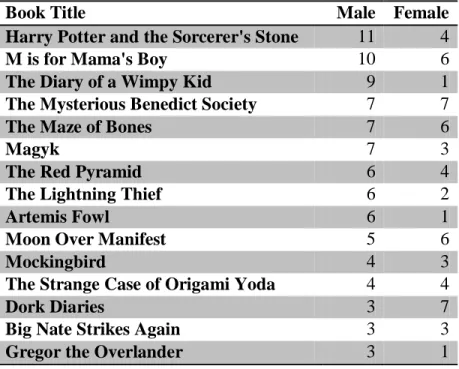
As depicted in Table 1, male readers outnumbered female readers in most texts— even texts with a female protagonist. Rather than indicating that female characters are less likely to read, this discrepancy may stem from the underrepresentation of female characters. Out of the fifteen books studied, only three had a sole female protagonist, while eight had a sole male protagonist. As this study did not collect data on the total number of characters in each text and their genders, more research would be needed to confirm that female characters were underrepresented overall and to compare the percentages of male and female characters who were depicted reading.
Table 1. Characters who read any text (continuous or non-continuous)
Book Title Male Female
Harry Potter and the Sorcerer's Stone 11 4
M is for Mama's Boy 10 6
The Diary of a Wimpy Kid 9 1
The Mysterious Benedict Society 7 7
The Maze of Bones 7 6
Magyk 7 3
The Red Pyramid 6 4
The Lightning Thief 6 2
Artemis Fowl 6 1
Moon Over Manifest 5 6
Mockingbird 4 3
The Strange Case of Origami Yoda 4 4
Dork Diaries 3 7
Big Nate Strikes Again 3 3
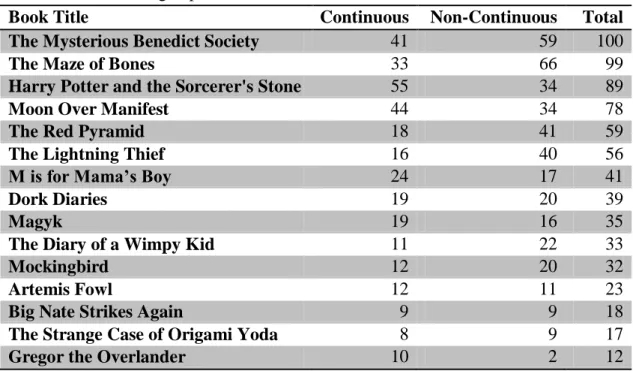
The total number of reading experiences in each book ranged from as few as 12 to as many as 100 (Table 2). The number of continuous reading experiences ranged from 8 to 55. In six of the books, continuous reading experiences outnumbered non-continuous reading experiences. In eight books, the opposite was true.
Table 2. Total reading experiences
Book Title Continuous Non-Continuous Total
The Mysterious Benedict Society 41 59 100
The Maze of Bones 33 66 99
Harry Potter and the Sorcerer's Stone 55 34 89
Moon Over Manifest 44 34 78
The Red Pyramid 18 41 59
The Lightning Thief 16 40 56
M is for Mama’s Boy 24 17 41
Dork Diaries 19 20 39
Magyk 19 16 35
The Diary of a Wimpy Kid 11 22 33
Mockingbird 12 20 32
Artemis Fowl 12 11 23
Big Nate Strikes Again 9 9 18
The Strange Case of Origami Yoda 8 9 17
Gregor the Overlander 10 2 12
In most cases, the protagonist(s) of each book had the most total reading experiences. The only exception was the female protagonist of Artemis Fowl, Holly Short, who had fewer reading experiences than one non-protagonist and an equal number of reading experiences to two additional non-protagonists. In thirteen of the fifteen books, the number of continuous reading experiences of each protagonist was equal to or greater than the number of continuous reading experiences of any other character in the novel. In The Mysterious Benedict Society and M is for Mama’s Boy, the protagonist’s
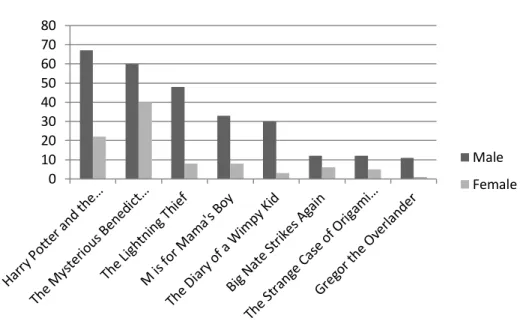
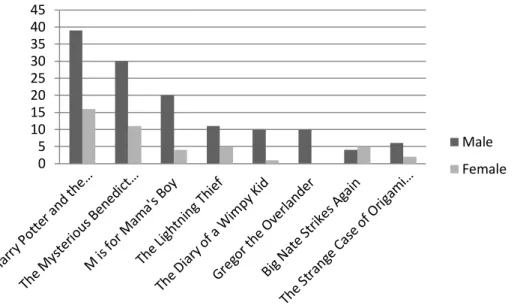
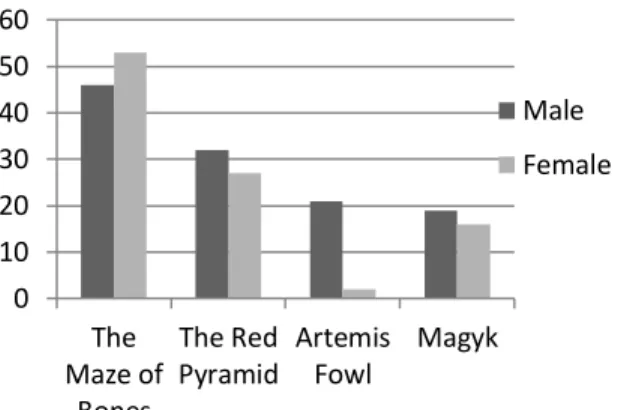
As a result, the gender that showed more overall reading experiences in each novel matched the gender of the protagonist. This proved true for both total reading experiences (Figs. 1-2) and continuous reading experiences (Figs. 3-4), with only one exception. Even if the protagonist was removed from the data, the gender of the protagonist still had the most reading experiences. This may be due to the tendency of the protagonists’ friend groups to consist largely of characters of the same gender (true of most, though not all books). In the four books which had protagonists of each gender or no protagonist, however, three of the four showed a dominance of male readers (Figs. 5-6).
Figure 1. Total reading experiences in books with only male protagonists 0
10 20 30 40 50 60 70 80
Male
Figure 2. Total reading experiences in books with only female protagonists
Figure 3. Continuous reading experiences in books with only male protagonists
Figure 4. Continuous reading experiences in books with only female protagonists
0 10 20 30 40 50 60 70
Male
Female
0 5 10 15 20 25 30 35 40 45
Male
Female
0 10 20 30 40 50
Male
Figure 5. Total reading experiences in books with protagonists of neither gender exclusively
Figure 6. Continuous reading experiences in books with protagonists of neither gender exclusively
Voluntary Reading
While in most cases the percentage of reading experiences that were undertaken voluntarily was greater for female characters than male characters, the overall
Figure 7. Percentage of voluntary reading by gender
In this and all gender comparisons, it is important to keep in mind that for many books, the non-dominant gender (the gender opposite of the protagonist) had fewer than ten continuous reading experiences from which to extrapolate. Therefore, minor
differences between male and female reading behaviors should not be overemphasized. For example, Dork Diaries shows 100% of male reading as voluntary, but in that instance, n = 2. The Strange Case of Origami Yoda shows 0% of female reading as voluntary, but again n = 2. The Diary of a Wimpy Kid shows 100% of female reading as voluntary, but n = 1. The Red Pyramid has a slightly more meaningful indication of female voluntary reading as n = 5. The most meaningful indications of female volutary reading are Dork Diaries (n = 17), The Maze of Bones (n = 21), Harry Potter and the Sorcerer’s Stone (n = 16), and Moon Over Manifest (n = 39). All of these books depicted
a level of female voluntary reading near or above 90%. The books with similar sample sizes for male readers indicate slightly lower levels of voluntary reading. Harry Potter
0 10 20 30 40 50 60 70 80 90 100
Male
and the Sorcerer’s Stone (n = 39), The Mysterious Benedict Society (n = 30), and M is for Mama’s Boy (n = 20) each depicted a level of male voluntary reading below 75%.
Reading Motivation
In most cases, a specific information need motivated characters to read. The total percentage of reading motivated by a desire for recreation or by general interest in a subject area without a specific practical use for the information only exceeded 40% in one instance (Table 3).
Table 3. Percentage of character reading motivated by recreation or general interest
Book Title % Recreation/ General
Interest
Moon Over Manifest 59.1
M is for Mama's Boy 37.5
Magyk 36.8
The Diary of a Wimpy Kid 36.4
The Red Pyramid 33.3
Big Nate Strikes Again 33.3
The Lightning Thief 31.3
Gregor the Overlander 30.0
Mockingbird 16.7
Artemis Fowl 16.7
The Mysterious Benedict Society 14.6
The Maze of Bones 12.1
Dork Diaries 10.5
Harry Potter and the Sorcerer's Stone 9.1
The Strange Case of Origami Yoda 0
more recreational reading in every book with a sole female protagonist and in two books with sole male protagonists. In four texts, males exhibited no recreational reading, and in four different texts, females exhibited no recreational reading (Fig. 8).
Figure 8. Percentage of recreational or general interest reading by gender
Based on these data, it appears that every text depicts one gender as the primary recreational readers, but which gender varies by text and does not show an overall trend toward one or the other. Only two books showed either gender reading recreationally more often than for information, however, and in both cases that gender was female.
Shared or SocialReading
Female characters tended to exhibit one or more social reading behaviors slightly more often than male characters (Fig. 9). But five of the texts depicted male readers as substantially more social (Mockingbird, The Maze of Bones, M is for Mama’s Boy, Gregor the Overlander, and Artemis Fowl), and in three of the texts (Moon Over
Manifest, Magyk, and Dork Diaries), the difference between male and female characters 0
10 20 30 40 50 60 70 80
Male
was within ten percentage points. Again, some of the highest outliers are mitigated by low sample sizes. For male readers in Mockingbird, n = 3. For female readers in The Strange Case of Origami Yoda, n = 2, and in The Diary of a Wimpy Kid, n = 1. Some of the low percentages are more meaningful in this graph. The books with larger sample sizes of female readers (The Maze of Bones, Harry Potter and the Sorcerer’s Stone, Moon Over Manifest, and Dork Diaries) all depict substantially less social reading than they did voluntary reading. Male social reading in the books with larger sample sizes (M is for Mama’s Boy, Harry Potter and the Sorcerer’s Stone, and The Mysterious Benedict Society) are also fairly low and appear to be similar to female readers in this category.
Figure 9. Percentage of social reading by gender
Positive and Negative Reading Experiences
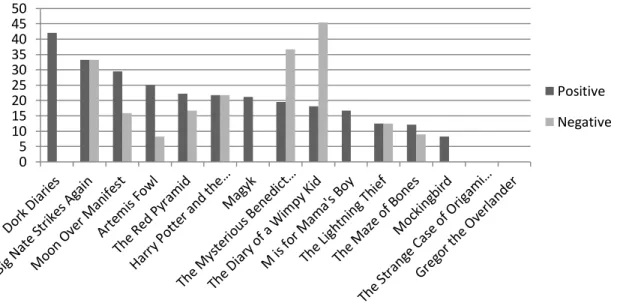
As expected, most reading occurred without a direct indication of the positivity or negativity of the experience. The books with the highest percentage of positive
continuous reading experiences were Dork Diaries, Big Nate Strikes Again, Moon Over 0
10 20 30 40 50 60 70 80 90 100
Male
Manifest, and Artemis Fowl. Of these, however, Big Nate Strikes Again had an equally high percentage of negative reading experiences. M is for Mama’s Boy, Dork Diaries, Magyk, and Mockingbird had no negative reading experiences, while The Diary of a Wimpy Kid and The Mysterious Benedict Society had fairly high percentages of negative reading experiences (Fig. 10). While most books tended toward positivity, across all books, 42.9% of the time that an emotional response was attached to reading, that emotion was negative.
Figure 10. Percentage of reading experienced as positive or negative
In this category in particular, the quantitative data must be considered in context. In many cases, the context supported the data. The Diary of a Wimpy Kid depicted the greatest overall negativity toward reading, which was consistent with the protagonist’s perception of reading as work: “Today at school we got assigned to reading groups. . . . I
was pretty disappointed to find out I got put in the Gifted group, because that just means a lot of extra work” (Kinney, 2007, p. 13-14). Dork Diaries depicts many positive
reading experiences and features two major characters who express an intense love of 0
5 10 15 20 25 30 35 40 45 50
Positive
reading, to the point that when offered an opportunity to meet famous authors, they “started jumping up and down and screaming their heads off” (Russell, 2009, p. 145). It
is worth noting that other characters in the novel consider their enthusiasm for reading unusual; the protagonist describes them as “SO WEIRD!!” (Russell, 2009, p. 145). The high number of positive reading experiences in Moon Over Manifest reflects the novel’s focus on “the power of story.” Driving the plot, the protagonist, Abiliene, explores her town’s past by reading old newspapers and letters and collecting oral histories. When the
head of the town newspaper asks her if she would like to look through the archived papers, Abiliene “nodded, thinking that [she] would find that interesting” (Vanderpool, 2010, p. 15). Later, describing the old newspapers and letters “that [she] read like bedtime stories,” Abiliene remarks, “there is power in a story” (Vanderpool, 2010, p.
144).
Magyk and M is for Mama’s Boy do not depict an overly high percentage of positive reading experiences, but their absence of negative reading experiences is consistent with the attitudes expressed by characters in the text. In Magyk, the home of the main characters is described as full of “books, books, books, and yet more books” (Sage, 2005, p. 21). When given his choice of leisure activities, one of the more major characters, Boy 412, “just sat by the fire reading his way through Aunt Zelda's stock of
books, immersing himself in a whole new world. . . . Aunt Zelda kept him supplied with a happy mixture of adventure stories and Magyk books, which Boy 412 soaked up like a sponge" (Sage, 2005, p. 323). In M is for Mama’s Boy, one major character (Albert)
Rick Riordan’s three books (The Maze of Bones, The Red Pyramid, and The
Lightning Thief) also depicted a fairly equal amount of positive and negative reading experiences, which stems from his tendency to cast one major character as an avid pleasure reader while providing a second who dislikes reading. In The Red Pyramid, Carter reads “a lot—pretty much anything [he] could get [his] hands on, from . . . history books to fantasy novels” (Riordan, 2010, p. 2), while his sister, Sadie, does not read for
pleasure and considers her brother a nerd. In The Maze of Bones, the genders are
reversed as the sister, Amy, loves to get “lost in books”, a pastime her brother, Dan, finds
boring and isolating (Riordan, 2008, p. 7). The Lightning Thief also depicts a female pleasure reader (Annabeth) and a male reader (Percy, the protagonist) who avoids reading whenever possible. When he thinks that a teacher may have discovered that he
plagiarized a paper on Tom Sawyer without reading the book, Percy panics that “they
were going to take away [his] grade. Or worse, they were going to make [him] read the book" (Riordan, 2005, p. 12).
Harry Potter and the Sorcerer’s Stone also showed fairly equal positive and negative reading experiences. This balance reflects the enjoyment that the protagonist and his friend Hermione both experience in reading informational books (sometimes without an immediate information need) and the frustration that they experience when finding the information they need proves difficult (Rowling, 1998, p. 216). If the
In two additional books, the circumstances surrounding negative reading
experiences mitigate their negativity. Although Big Nate Strikes Again had a fairly large percentage of negative reading experiences, the data do not reveal that although Nate begins reading with a negative attitude, he ends up with a very positive reading
experience when he stumbles upon a non-fiction book that matches his interests. When a librarian forces him to sit down and study, he remarks, “I'm stuck reading about some
guy who's been worm food for a couple of centuries. Except. . . You know what? This Ben Franklin dude was actually pretty cool! . . . I got so wrapped up in my work that [when the bell rang,] I didn't hear a thing" (Peirce, 2010, p. 67-8).
The Mysterious Benedict Society also appears to depict a highly negative attitude toward reading, but the circumstances of the reading must be taken into account. Most reading experiences took place in a negative school environment where the characters were forced to read for memorization, not for meaning. Outside of that negative school environment, many characters (particularly the protagonist and two additional male characters) express a deep love of reading for pleasure. When the protagonist, Reynie, arrives at Mr. Benedict’s house, he finds that it is stuffed with books, to the point that there is almost no place to sit. When Reynie asks Mr. Benedict if he has read all of the books in the house, “Mr. Benedict smile[s], gazing fondly about at the many books in his
remembers everything he reads (Stewart, 2007, p. 35). Only when reading is attached to a frustrating school assignment do the characters experience it as negative.
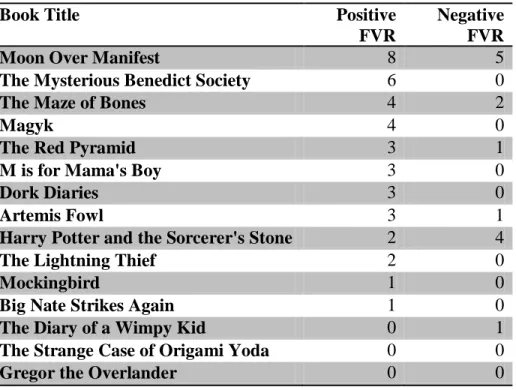
In most books, a discrepancy appeared in the positivity of voluntary reading experiences where the character exercised choice (either free or restricted) in the selection of the text versus assigned reading and voluntary reading where no choice of text was allowed. In nine of the fifteen books, there were no negative experiences with free voluntary reading (FVR), and in only two cases (Harry Potter and the Sorcerer’s Stone and The Diary of a Wimpy Kid) did the negative experiences outnumber the positive (Table 4).
Table 4. Number of instances of FVR experienced as positive or negative
Book Title Positive
FVR
Negative FVR
Moon Over Manifest 8 5
The Mysterious Benedict Society 6 0
The Maze of Bones 4 2
Magyk 4 0
The Red Pyramid 3 1
M is for Mama's Boy 3 0
Dork Diaries 3 0
Artemis Fowl 3 1
Harry Potter and the Sorcerer's Stone 2 4
The Lightning Thief 2 0
Mockingbird 1 0
Big Nate Strikes Again 1 0
The Diary of a Wimpy Kid 0 1
The Strange Case of Origami Yoda 0 0
Gregor the Overlander 0 0
Reading Difficulty
Only one book depicted readers who experienced difficulty decoding words in their own language. In The Lightning Thief, Annabeth Chase and Percy Jackson are both described as dyslexic. Riordan explicitly characterizes eight of Percy’s forty total
reading experiences as difficult. He also characterizes one of Annabeth’s seven reading experiences as difficult; on the same occasion, however, he reiterates that she “loves” reading, despite its difficulty (Riordan, 2005, p. 171).
In The Mysterious Benedict Society, Reynie, Sticky, Constance, and Kate all experience difficulty reading during distracting background noise (Stewart, 2007, p. 218). On multiple other occasions, however, Reynie and Sticky (both male characters) are described as exceptionally skilled readers who enjoy reading. In no other book does any character experience reading as difficult more often than he or she experiences reading as explicitly easy. (Reading experiences where ease or difficulty was not mentioned were not considered for this calculation.)
Most Positive Models Overall
The following books had consistent high scores across all categories: The Maze of Bones by Rick Riordan
Dork Diaries: Tales from a Not-So-Fabulous Life by Rachel Renee
Russell
Magyk by Angie Sage
If the overall number of reading experiences were discounted, we would also see consistent high scores in one additional title:
Big Nate Strikes Again by Lincoln Peirce
It is worth noting that two of the three books with a sole female protagonist appear on this list. Two of the books have neither gender dominant as a protagonist and only Big Nate has a sole male protagonist. Therefore the most positive reading models tend to be found in books with main female characters.
Looking specifically for male models, the following books demonstrated high scores for male characters consistently across all categories:
M is for Mama’s Boy by Michael Buckley Big Nate Strikes Again by Lincoln Peirce
The Red Pyramid by Rick Riordan
Harry Potter and the Sorcerer’s Stone by J.K. Rowling
Two additional books had strong, though less frequent, examples of males modeling free voluntary reading:
Magyk by Angie Sage
Conclusions and Future Research
In some ways, the depiction of reading in these fifteen texts reflected the trends discussed in reading research literature. Consistent with Krashen’s suggestions about free voluntary reading as a positive motivator for children, characters tended to have more positive reactions than negative reactions to free voluntary reading. Negative emotions more often accompanied assigned reading, particularly school work. Social reading appeared less often than would have been expected, based on the research literature’s emphasis on the influence of peer reading preferences. Still, examples of
social reading were present in all texts.
Every text depicted characters reading at some point, but the amount of recreational reading (reading without a specific information objective in mind) was relatively low. Few characters read for recreation or general interest, and those who read with those motivations did so infrequently. The lack of pleasure reading is not
necessarily surprising or even disappointing; recreational reading rarely drives the plot of a novel while informational reading often allows characters to complete plot-related tasks. The major exception in this sample was Moon Over Manifest, which had a plot driven by the protagonist’s desire to explore stories and histories as a means of
commended for depicting characters as pleasure readers, even if their reading was unnecessary for plot development.
In terms of gender, this study revealed that the prominence of the character and not the gender of the character correlated with his or her number of reading experiences. Female characters seemed more likely overall to read voluntarily, to read socially, and to read for recreation regardless of whether the protagonist was male or female, but these distinctions were slight. Considered with similarity between genders in terms of positivity of reading experiences, the results suggests that there was no overall trend in the portrayal of reading as either masculine or feminine.
The balance in portayals of male and female reading challenges the stereotype of reading as feminine. Children may perceive reading as a “girl activity,” but their books depict more male readers than female readers, and male and female characters exhibit similar levels of positive behaviors, when considering the sample as a whole.
Biases appeared within individual books, however. Not all of the books sampled in this study presented strong examples of both male and female readers. Boys who see the negative male model in The Diary of a Wimpy Kid may not see the positive male model in The Red Pyramid, a signficantly longer and therefore potentially more daunting read for a reluctant reader. It seems likely that children will read more than one of these books, based on the high circulation of these titles and the evidence that peer preferences influence reading choices. Still, librarians should be aware of which titles present
Librarians must also be aware that circulation statistics do not provide any indication of popularity among different peer groups. The two books with the lowest circulation on this list, The Mysterious Benedict Society and M is for Mama’s Boy, depict
characters who are unpopular and ridiculed for their love of reading. In both cases, these characters are protagonists, and the reader is expected to easily relate to them. We must question whether these books are popular among reluctant readers or only among those children who identify with “nerdy,” bookish characters.
We must also wonder whether these books—and any books that associate reading with “nerdy” and unpopular characters—may reinforce a perception that reading is “uncool.” In The Mysterious Benedict Society and M is for Mama’s Boy, the protagonists
experienced reading as positive, but were ridiculed for it. In The Maze of Bones, the female protagonist was criticized by her brother for reading too much, and in Dork Diaries, the secondary characters who had the most positive reaction to reading were described as “weird.”
But in most of the books in the sample, characters were not stigmatized for
enjoying reading. Harry Potter and the Sorcerer’s Stone and Big Nate Strikes Again both feature female characters who are criticized as “know-it-alls” for enjoying school, but these female characters actually read considerably less than the male protagonists. Both Harry and Nate have positive reactions to reading both for school and for pleasure and are fairly popular among their peers, both being accomplished members of sports teams.
Furthermore a distinction should be drawn between reading as “uncool” and
expect that the books which portray males reading, particularly reading for pleasure, will either introduce or reinforce the concept that males can be readers. These models may not reinforce the idea that “cool” kids can be readers, but they associate reading with males who (in the books sampled) are not depicted as overtly anti-masculine. In both The Mysterious Benedict Society and M is for Mama’s Boy, for example, the “nerdy”
protagonists are secret government agents who engage in physical and intellectual skirmishes with a criminal mastermind. Additional research would be needed to
determine whether there is any variation in the appearance of hegemonic masculine traits in male characters who enjoy reading versus in male characters who dislike it. But the male characters in these books who exhibit positive reading behaviors also exhibit at least some hegemonic masculine traits and behaviors—such as athleticism, aggression,
leadership, and rational thinking.
Reading may not be portrayed as gendered, but this study did inadvertently uncover a different gender bias in the sample. Only three of the fifteen books had a sole female protagonist, and male characters seemed to be better represented overall. In terms of seeking male models of reading behavior, the wealth of male characters worked
three books with a sole female protagonist were realistic fiction and one was historical fiction. This may indicate a bias in the types of literature that authors or publishers associate with males versus females. More research would be required to investigate this discrepancy.
Another issue this study uncovered was the lack of depiction of struggling
readers. Only four characters in any of the sample books experienced reading as difficult more often than than they experienced reading as explicity easy. Again, more research is needed to determine whether this bias exists in the writing and publishing of books or in the popularity of books with such characters. As struggling readers are another group with low perception of the self as a reader, finding books that depict struggling readers having positive reading experiences (such as The Lightning Thief’s Annabeth Chase)
could be incredibly valuable.
Although the relative merits of each of the books in this study may vary in other areas, the books that appear to present the most positive models of reading behavior are The Maze of Bones, Dork Diaries: Tales from a Not-So-Fabulous Life, Magyk, Moon Over Manifest, and Big Nate Strikes Again. The most positive male models of reading behavior are found in Magyk, Big Nate Strikes Again, M is for Mama’s Boy, Harry Potter and the Sorcerer’s Stone, The Red Pyramid, and The Mysterious Benedict Society. Each
of these books depicts characters who read voluntarily, read socially, read for recreation or general interest, and enjoy reading. They may provide valuable models of these behaviors not just for reluctant readers, but for all children. By challenging their
References
Anderson, R. C., Wilson, P. T., & Fielding, L. G. (1988). Growth in reading and how children spend their time outside of school. Reading Research Quarterly 23(3), 285-303.
Baron, J. (1996). Sexism attitudes towards reading in the adult learner population. (Master’s Thesis). Retrieved from the Educational resources information center. (ED393092)
Boys and books: Boys’ education stirs much debate, brings little consensus. (2006). Reading Today 24(1), 1-4.
Gunzelmann, B. & Connell, D. (2006). The new gender gap: Social, psychological, neuro-biological, and educational perspectives. Educational Horizons 82(2), 94-101.
Henk, W. A., & Melnick, S. A. (1995). The reader self-perception scale (RSPS): A new tool for measuring how children feel about.. Reading Teacher, 48(6), 470-482.
Horton, R. (2005). Boys are people too: Boys and reading, truth and misconceptions. Teacher librarian (33)2, 30-2.
Johnson, C. S. & Greenbaum, G. R. (1980). Are boys disabled readers due to sex-role stereotyping? Educational Leadership 37(6), 492-6.
Kirsch, I., de Jong, J. Lafontaine, D., McQueen, J., Mendelovits, J., & Monseur, C. (2000). Reading for change: Performance and engagement across countries: Results from PISA. Organisation for Economic Co-operation and Development.
Krashen, S. (2004). The power of reading. Westport, CT: Libraries Unlimited.
--- (2006a). Free reading: Is it the only way to make kids more literate. School Library Journal 52(9), 43-45.
Krashen, S. & Von Sprecken, D. (2002). Is there a decline in the reading romance? Knowledge Quest 29(3), 11-17.
MacDonell, C. (2004). Making the case for pleasure reading. Teacher Librarian, 31(4), 30-32.
Mackey, M. (2003). Risk, safety, and control in young
people's reading experiences. School Libraries Worldwide, 9(1), 50-63.
McKenna, E. (1997). Gender differences in reading attitudes. (Master’s Thesis). Retrieved from Educational resources information center. (ED407653)
Nagy, W. E., Herman, P. A., & Anderson, R. C. (1985). Learning words from context. Reading Research Quarterly 20(2), 233-253.
Newkirk, T. (2002). Misreading masculinity: Boys, literacy, and popular culture. Portsmouth, NH: Heinemann.
Nodelman, P. (2002). Making boys appear: The masculinity of children’s fiction. In J. Stephens (Ed.), Ways of being male: Representing masculinities in children’s literature and film (1-14). New York: Routledge.
Pasco, R. (2007). If you read it, they will come!: Motivating readers by modeling reading. School library media activities monthly (24)2, 22-23.
Qualifications and Curriculum Authority. (1998). Can do better: Raising boys’ achievement in English. London: Davies, J. et al.
Rog, L., & Kropp, P. (2005). Reaching struggling readers in the intermediate grades with books they can and want to read. School Libraries in Canada (Online), 25(1), p. 44-49.
Ross, C. S., McKechnie, L., & Rothbauer, P. M. (2006). Reading matters: What the research reveals about reading, libraries, and community. Westport, CT: Libraries Unlimited.
Schunk, D. H. (2003). Self-efficacy for reading and writing: Influence of modeling, goal setting, and self-evaluation. Reading & Writing Quarterly, 19(2), 159-172.
--- (2006). Why we read and how it transforms us: The psychology of engagement with text. Lewiston, NY: Edwin Mellen Press.
--- (2007). Dimensions of reading motivation: Development of an adult reading motivation scale. Reading Psychology 28, 469-489.
Shell, D. F., & Colvin, C. (1995). Self-efficacy, attribution, and outcome expectancy mechanisms in reading and writing achievement.. Journal of Educational Psychology, 87(3), 386.
Sullivan, M. (2004). Why Johnny won’t read. School Library Journal, 50(9), 36-39.
Taylor, F. (2009). Content analysis and gender stereotypes in children's books. Sociological Viewpoints 25, 5-22.
Vadon, A. M. (2000). Gender and cultural differences in attitude toward reading in an adult population. (Master’s Thesis). Retrieved from Educational resources information center. (ED438527)
Vandello, J. A., Bosson, J.K., Cohen, D., Burnaford, R.M., & Weaver, J.R. (2008). Precarious manhood. Journal of Personality & Social Psychology 95(6), 1325-39.