Rachel V. Meeks. Weathering the Storm: A Systematized Review of Public Library
Disaster Literature. A Master's paper for the M.S. in L.S. degree. April, 2017. 28
pages. Advisor: Mary White
This study was conducted in order to uncover ways in which public libraries help their
communities before, during, and after hurricane events. A systematized review of the
literature found in six Library and Information Science and Health Sciences databases
revealed public libraries offer services that contribute to the user’s fulfillment of
multiple needs. Results from twenty full-text articles were categorized and four
themes were identified: physical needs, emotional or mental needs, logistical needs,
and information needs. By identifying how these public libraries have provided
outreach in their communities during hurricane events, other libraries will have the
opportunity to learn from their experiences.
Headings:
Disasters
Hurricanes
Public Libraries
WEATHERING THE STORM: A SYSTEMATIZED REVIEW OF PUBLIC LIBRARY DISASTER LITERATURE
by
Rachel V. Meeks
A Master's paper submitted to the faculty of the School of Information and Library Science of the University of North Carolina at Chapel Hill
in partial fulfillment of the requirements for the degree of Master of Science in
Library Science.
Chapel Hill, North Carolina April 2017
Approved by:
Introduction 1
Literature Review 2
Methodology 5
Explanation of Methods 5
Search Strategy 5
Inclusion and Exclusion Criteria 6
Results 8
Demographics 9
Data Synthesis 10
Discussion 14
Limitations 17
Conclusion 18
References 19
Appendix A 24
Introduction
For this study, a review of the Library and Information Science (LIS) literature pertaining to hurricanes, a specific type of natural disaster, was conducted. Using online databases to search for information and analyzing the resulting articles uncovered trends in the actions of public libraries before, during, and after a hurricane.
This particular topic was chosen due to the researcher’s personal experiences during Hurricane Irene in 2011 and Hurricane Sandy in 2012 while residing in New Jersey. After Hurricane Sandy tore through the Jersey Shore, many public libraries suffered a total loss of both their collection and their building. The New Jersey and New York libraries that escaped the storm with minimal damage opened their doors to
Literature Review
As defined for this study, a natural disaster is a catastrophic weather event that disrupts the normal functions of a community. Furthermore, the Oxford Dictionary of Environment and Conservation defines natural hazard as “a process or event in the physical environment that occurs naturally, is usually not entirely predictable, and that is capable of injuring or killing people and damaging property” (2017). Hurricanes can produce a combination of heavy rain, high winds, and thunderstorms which have the potential to cause tremendous damage to the community they strike, especially coastal areas (MedlinePlus, 2015).
The National Aeronautics and Space Administration (NASA) succinctly explains how tropical cyclones, the scientific term for hurricanes, form. Tropical cyclones form over warm ocean water near the equator. Warm air rises which causes an area of low pressure below. Air with higher air pressure is pushed in to the low-pressure area creating a system of clouds and wind that begins to rotate faster and faster until eventually
weakening when coming into contact with land. Before that weakening in the storm system occurs due to a lack of energy from the warm ocean water, a tropical cyclone has the potential to cause damage on the coast as well as further inland before it dissipates completely (2016).
Gulfport, Mississippi and New Orleans, Louisiana and caused an estimated $108 billion worth of damage in total (CNN Library, 2005/2016). Hurricane Sandy impacted New York and New Jersey at the end of October in 2012. The hurricane was the cause of 48 deaths in New York, twelve deaths in New Jersey, and another twelve in other states. New Jersey estimated the total cost of Sandy was roughly $36.8 billion and New York estimated damage totals at $41.9 billion (CNN Library, 2012/2016).
Hurricane hazards can include storm surges along the coastal region of the United States, dangerous waves causing rip tides, flooding from heavy rain, and high winds with the potential for producing tornadoes (“Hurricane Safety Tips”, n.d.). The damage
created by these hazards can contribute to the loss of life, financial loss, a loss of productivity, and making it necessary to rebuild homes and businesses. Hurricane Matthew, weakened to a category one hurricane by the time it hit the North Carolina coast, caused 26 deaths and $1.5 billion worth of damage for the state in October 2016 (Federal Emergency Management Agency, 2017).
Public libraries are specially equipped to assist a community after a hurricane because they have the capacity to address community needs and respond to immediate challenges (Garmer, 2014). It is important to study the potential roles for a public library before, during, and after a hurricane has struck a community because of the services they are equipped to offer. These types of services could include preparation tips and
information before an expected weather emergency, access to computers and charging stations, and assistance with applications and forms following a disaster.
building, collection materials, and personnel, not with the communities that the libraries serve (“Community Disaster Response”, 2013). The American Library Association (ALA) recognizes the strengths that a library can bring to community users during a disaster. In their policy manual, section B.8.11, The Role of Libraries in Providing E-government and Emergency Services, the ALA supports library services in emergency response and recovery, and encourages other organizational groups to recognize this potential (American Library Association, 2010).
Public libraries’ roles in community response have long been underestimated. A recent Pew Research Center survey found 69% of respondents said that their local public libraries contribute “a lot” to providing a safe place for people to spend time, but only 19% thought that their local libraries contribute “a lot” during a natural disaster in the community (Horrigan et al., 2016). People do not realize the ways in which their
community library can help during times of crisis. Libraries actually have a lot to offer in terms of hurricane preparation and recovery and this review will clarify what those services are.
Methodology
Explanation of Methods
Because the review was done by the author alone, it is inaccurate to call it a systematic review. A systematic review includes qualities of quantitative, qualitative, and mixed methods studies in order to compile all of the known knowledge on a topic area (Grant & Booth, 2009). A systematized review models the systematic review process, but cannot claim to be the latter because it lacks one or more of the necessary procedures, such as collaboration between two or more researchers. A systematized review enables a researcher to do a comprehensive search and demonstrates an awareness of the systematic review process (Grant & Booth, 2009). With the absence of additional reviewers in this particular methodology there is the potential for bias which is discussed in the limitations section.
A systematized review was conducted in order to answer the question: “What role do public libraries play in the community in preparation for, during, or after a hurricane event?”
Search Strategy
Public Health. Databases were chosen based on their connection to library and information science concepts and those covering topics more related to the health sciences.
The search terms used were public library, public librarian, and disaster, crisis, emergency, and hurricane, along with their plural forms. The actual search strategies used are included in the Appendix. Boolean operators such as “AND” and “OR” were used to connect the search terms and the same search terms were utilized for every database.
Some search strategies were modified to include more focused results. For example, in Library and Information Science Source (LISS) and Academic Search Premier (ASP), the “Abstract” search was used instead of the “Full Text” search to retrieve a more manageable, relevant, and comparable set of articles. In the databases other than those two, no search modification was made, searching the default Title, Abstract, and Keywords.
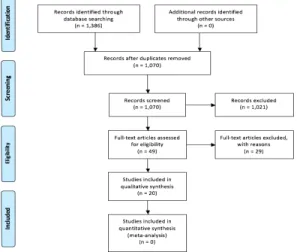
The number of combined results from the six databases totaled 1,386. The results were then imported into F1000Workspace be screened for duplicate articles. During the deduplication process, 316 articles were removed leaving 1,070 results to be included in title and abstract screening using Covidence.
Inclusion and Exclusion Criteria
Results
All of the inclusion and exclusion criteria were put in place in order to best answer the research question, “How do libraries play a role in the community before, during, or after a hurricane?”
The results from the screening and its progression can be found in the PRISMA flow diagram in Figure 1. The title and abstract screening resulted in an exclusion of 1,021 articles from the initial 1,070 results. This left 49 articles to be reviewed in the full-text screening. Twenty-nine articles were excluded because their library type wasn’t public, they did not talk about hurricanes, they did not discuss community outreach, or the articles were not in English. This resulted in a total number of 20 articles to be analyzed for this systematized review. A complete list of the final articles is available in Appendix B.
Demographics
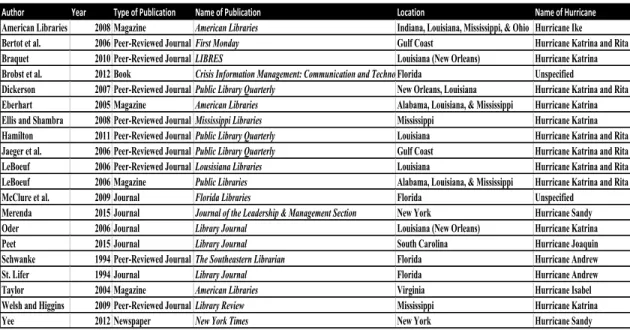
The full-text analysis dealt with twenty articles covering a variety of roles the public library plays in their community after a hurricane. After analyzing each article more closely, it was advantageous to document the demographics in order to account for similarities and differences between them. Six attributes were examined; name of the author, the year the article was published, both the name and type of publication the article appeared in, the location of the hurricane discussed, and the name of the
hurricane(s). Two (10%) of the articles discussed hurricanes in New York state with the other eighteen (90%) located in the Southern United States. Six (30%) articles covered both Hurricane Katrina and Hurricane Rita and five (25%) examined Hurricane Katrina alone. The majority (45%) were published in peer-reviewed journals. For more
demographic information, refer to Table 1 below.
Table 1. Attributes of Included Articles
Author Year Type of Publication Name of Publication Location Name of Hurricane
American Libraries 2008 Magazine American Libraries Indiana, Louisiana, Mississippi, & Ohio Hurricane Ike Bertot et al. 2006 Peer-Reviewed JournalFirst Monday Gulf Coast Hurricane Katrina and Rita
Braquet 2010 Peer-Reviewed JournalLIBRES Louisiana (New Orleans) Hurricane Katrina
Brobst et al. 2012 Book Crisis Information Management: Communication and TechnologiesFlorida Unspecified
Dickerson 2007 Peer-Reviewed JournalPublic Library Quarterly New Orleans, Louisiana Hurricane Katrina and Rita Eberhart 2005 Magazine American Libraries Alabama, Louisiana, & Mississippi Hurricane Katrina Ellis and Shambra 2008 Peer-Reviewed JournalMississippi Libraries Mississippi Hurricane Katrina Hamilton 2011 Peer-Reviewed JournalPublic Library Quarterly Louisiana Hurricane Katrina and Rita Jaeger et al. 2006 Peer-Reviewed JournalPublic Library Quarterly Gulf Coast Hurricane Katrina and Rita LeBoeuf 2006 Peer-Reviewed JournalLousisiana Libraries Louisiana Hurricane Katrina and Rita LeBoeuf 2006 Magazine Public Libraries Alabama, Louisiana, & Mississippi Hurricane Katrina and Rita
McClure et al. 2009 Journal Florida Libraries Florida Unspecified
Merenda 2015 Journal Journal of the Leadership & Management Section New York Hurricane Sandy
Oder 2006 Journal Library Journal Louisiana (New Orleans) Hurricane Katrina
Peet 2015 Journal Library Journal South Carolina Hurricane Joaquin
Schwanke 1994 Peer-Reviewed JournalThe Southeastern Librarian Florida Hurricane Andrew
St. Lifer 1994 Journal Library Journal Florida Hurricane Andrew
Taylor 2004 Magazine American Libraries Virginia Hurricane Isabel
Welsh and Higgins 2009 Peer-Reviewed JournalLibrary Review Mississippi Hurricane Katrina
Data Synthesis
Four themes emerged during thematic analysis and all fell under the umbrella concept of “Needs”. The themes included; physical needs, emotional or mental needs, logistical needs, and information needs. The articles discussed what the community needed and what the public libraries had to give.
Theme 1: Physical Needs. Food, warmth, and shelter compose the most
fundamental level of the 1943 concept, Maslow’s Hierarchy of Needs. When these most basic needs are not met, individuals are unable to progress to the next level of the hierarchy (Bayne, 2015). During a disaster event, when homes are destroyed and the infrastructure of a community is damaged, access to food, warmth, and shelter is compromised. In an effort to ease the burden during times of upheaval, many of the libraries discussed in the articles found during the review showed a willingness to open their doors and provide these most basic necessities.
Public libraries offered shelter during the day and a place to sleep overnight for displaced community members (Jaeger, 2006; Peet, 2015). In South Carolina, a library arranged for free tetanus shots through the health department and distributed safe drinking water to those in need (Peet, 2015). Following Hurricanes Katrina and Rita, some librarians offered snacks and food at the library or volunteered to cook at local shelters and churches (LeBoeuf, 2006b).
Theme 2: Emotional or Mental Needs. Hurricanes can be traumatic experiences
responses may not surface immediately. NIMH recommends trying to maintain normal routines and warns that those previously experience mental health problems and lack a support system are more likely to develop severe symptoms (National Institute of Mental Health, 2017). Visiting the local library following a traumatic hurricane event can assist with the goal of regaining a sense of normalcy.
In Louisiana, libraries provided storytimes, craft workshops, tutoring, and homework help for the children of the community in order to help with regaining that sense of normalcy (LeBoeuf, 2006; Hamilton, 2011; Dickerson, 2007). After Hurricane Ike, a public library held a “fun day” program on the front lawn for the evacuees who were provided housing inside the library building (American Libraries, 2008). Reading books for entertainment because there was no television or internet services occurred following Hurricane Sandy and a mobile library provided books from the libraries regular collection (Yee, 2012). Many visitors to the library just wanted to talk about their
experiences and get the emotional support and comfort they desperately needed. (Schwanke, 1994; Brobst, 2012; Eberhart, 2005).
Theme 3: Logistical Needs. Following a hurricane, the normal activities of
When libraries had the ability to open to the public after a hurricane, community members found a place to warm up and charge their devices in a convenient location (American Libraries, 2008; Eberhart, 2005; Merenda, 2015). Access to computers with Internet access allowed library visitors to contact family members, fill out e-government services, and check for new and updates about conditions in evacuated communities (Jaeger, 2006). Many libraries waived borrowing card fees and issued temporary cards to non-residents and extended hours because of the influx of patrons (Dickerson, 2007; LeBoeuf, 2006b). When transportation was a problem, a library offered round-trip shuttle service to and from library branches in cooperation with the local transit agency
(Shwanke, 1994). Another brought water, supplies, and books to homebound residents (Peet, 2015).
Theme 4: Information Needs. During times of upheaval one thing that may
make a positive impact is accurate information. Not knowing what to do to prepare for a hurricane, who is there to help after it is over, or where to go when home is no longer safe can impede the recovery process. Public libraries should be prepared and equipped to answer questions both before and after a hurricane event.
Discussion
A consistent message throughout the articles was the importance of computer and the Internet access. While all of the services offered by the libraries made a difference in the experiences of library users during a hurricane, the ability to log-on and access the information provided through a digital platform was the most common request. There are a range of activities that cannot be completed after a disaster without a computer and an Internet connection. Many of the applications needed to file claims with insurance companies and fill out government forms, like FEMA’s aid forms requires the Internet. When telephone lines and cell phone towers are damaged, e-mail becomes the most efficient means of contacting family and friends.
There was very little mention of how the libraries documented the use of the library before, during, and after a hurricane. Many of the articles were first-hand accounts of disaster situations, including interviews with library administration and staff, discussed the services offered, but not how statistics were recorded if they were at all. While times of disasters disrupt the normal functions of a library, keeping detailed accounts and documentation of services rendered and the number of users will provide concrete evidence of the impact a public library can have on a community.
changed its policy and allowed libraries to be eligible for temporary relocation during disasters and emergencies, acknowledging that libraries are essential community organizations. This change places libraries in the same rank as police departments, fire protection and emergency services, medical care, education, and utilities (Kelley, 2011).
The recognition of services libraries provide during a disaster is not enough to ensure they have the opportunity to without proper funding. With extended hours, comes librarians working overtime and with more patrons using the facilities, comes higher utility bills and added expenses do not end there. All of these additional costs can be devastating to already meager budgets for public libraries. The current presidential administration’s threat against federal funding for the Institute of Museum and Library Services (IMLS) displays a lack of awareness of all the benefits to having public libraries. By showcasing real-world evidence of libraries providing essential services during disaster situations through reviews of existing literature like this study, supporters will have a greater chance of swaying those in charge of dispensing funds that libraries are in fact beneficial to the community.
Limitations
As a systematized review and not a systematic review, this paper lacks the assurance of minimal bias. For many systematic reviews in the health sciences field, guidelines for the conduct of a review are provided for the search, appraisal, and synthesis of results. Without this use of established guidelines and the absence of a second reviewer to corroborate the analysis, potential biases should be considered limitations of this study (Grant & Booth, 2009).
The choice to exclude results written in a language other than English and the elimination of articles discussing public libraries or hurricane events outside the United States generates another potential bias in this study. While the choice was made to only investigate library responses to hurricanes, the review is now missing those responses to other natural disasters as well as man-made disasters. Other types of disasters may have shown different interventions by the library and may have affected the library in different ways. These differences have the potential to impact a library’s ability to serve the
Conclusion
Public libraries can play a role in community response to disasters, but little has been discussed in the academic literature to demonstrate this. This study adds to the scholarly discussion by pulling together examples from multiple sources of ways that public libraries have devised and provided outreach services in communities due to a hurricane’s impact. Furthermore, this review exhibits the need for cooperation between public libraries and their community’s local service organizations during disaster events. With collaborative preparation and partnership before, during, and after a hurricane, organizations like the public library, police and fire departments, and local utility services can better provide assistance for the community.
References
American Libraries. (2008, November). “Libraries Reach Out after Hurricane Ike”. (2008). American Libraries, 39(10), 23–24.
American Library Association. (2010, August 4). “ALA Policy Manuel”. Retrieved from http://www.ala.org/aboutala/governance/policymanual/updatedpolicymanual/table ofcontents
Barr-Walker, J. (2017). Evidence-based information needs of public health workers: A systematized review. Journal of Medical Library Association, 105(1), 69-79. doi: 10.5195/jmla.2017.109
Bayne, H. (2015). Maslow’s hierarchy of needs. The SAGE encyclopedia of theory in counseling and psychotherapy. 2, 632-634. doi: 10.4135/9781483346502.n224 Bertot, J. C., Jaeger, P. T., Langa, L. A., & McClure, C. R. (2006). Public access
computing and Internet access in public libraries: The role of public libraries in e-government and emergency situations. First Monday, 11(9). doi:
10.5210/fm.v11i9.1392
Braquet, D. M. (2010). Library experiences of Hurricane Katrina and New Orleans flood survivors. LIBRES: Library and Information Science Research Electronic
Brobst, J. L., Mandel, L. H., & McClure, C. R. (2012). Public libraries and crisis management: roles of public libraries in hurricane/disaster preparedness and response. In C. Hagar (Eds.), Crisis Information Management. 155–173. doi:10.1016/B978-1-84334-647-0.50009-
“Community Disaster Response”. (2013, May 22). American Library Association. Retrieved from http://www.ala.org/tools/community-disaster-response
CNN Library. (2005/2016). “Hurricane Katrina Statistics Fast Facts”. Retrieved from http://www.cnn.com/2013/08/23/us/hurricane-katrina-statistics-fast-facts/ CNN Library. (2012/2016). “Hurricane Sandy Fast Facts”. Retrieved from
http://www.cnn.com/2013/07/13/world/americas/hurricane-sandy-fast-facts/ Dickerson, L. (2007). Capitalizing on disaster to create quality services: Some lessons
from Hurricane Katrina. Public Library Quarterly, 26(1-2), 101-115. doi: 10.1300/J118v26n01_06
Eberhart, G., Flagg, G., Goldberg, B., Goodes, P., Kniffel, L., Landgraf, G., & Stone, A. (2005, October 1). Katrina’s Terrible Toll. American Libraries. 36(9), 14–25. Ellis, J. B., & Shambra, J. (2008). Reshaping Public Services after a Disaster. Mississippi
Libraries, 72(3), 51–53.
Federal Emergency Management Agency. (2017). North Carolina Hurricane Matthew. Retrieved from https://www.fema.gov/disaster/4285
Garmer, A. (2014). Rising to the Challenge: Re-Envisioning Public Libraries. Washington, D.C.: The Aspen Institute. Accessible from
Grant, M.J. & Booth, A. (2009). A typology of reviews: an analysis of 14 review types and associated methodologies. Health Information Library Journal, 26(2), 91-108. doi: 10.1111/j.1471-1842.2009.00848.x
Hamilton, R. (2011). The State Library of Louisiana and public libraries’ response to hurricanes: Issues, strategies, and lessons. Public Library Quarterly, 30(1), 40-53. doi: 10.1080/01616846.2010.525385
Horrigan, J. B. (2016). “Libraries 2016”. Pew Research Center: Internet, Science & Tech. Retrieved from http://www.pewinternet.org/2016/09/09/libraries-2016/
“Hurricane Safety Tips and Resources” (n.d.). National Weather Service. Retrieved from http://www.nws.noaa.gov/om/hurricane/index.shtml
Jaeger, P. T., Langa, L. A., McClure, C. R., & Bertot, J. C. (2006). The 2004 and 2005 gulf coast hurricanes: Evolving roles and lessons learned for public libraries in disaster preparedness and community services. Public Library Quarterly, 25(3-4), 199–214. doi:10.1300/J118v25n03_17
Kelley, M. (2011, January 11). “ALA Midwinter 2011: FEMA Recognizes Libraries as Essential Community Organizations”. Library Journal. Retrieved from
http://lj.libraryjournal.com/2011/01/industry-news/ala-midwinter-2011-fema-recognizes-libraries-as-essential-community-organizations/#_
LeBoeuf, M. C. (2006a). Disasters Strike, Public Libraries Prevail: The Impact of Hurricanes Katrina and Rita on Louisiana Public Libraries. 68(4), 3–7. LeBoeuf, M. C. (2006b). Ill Winds: Hurricanes and Public Libraries along the Gulf
McClure, C. R., Ryan, J., Mandel, L. H., Brobst, J., Hinnant, C. C., Andrade, J., & Snead, J. T. (2009). Hurricane Preparedness and Response for Florida Public
Libraries. Florida Libraries, 52(1), 4–7.
MedlinePlus. (2015, November 9). “Hurricanes”. Retrieved from https://medlineplus.gov/hurricanes.html
Merenda, C. A. (2015). How the Westbury Library Helped the Community after Hurricane Sandy. Journal of the Leadership & Management Section, 11(2), 32– 34.
NASA. (2016). “How do hurricanes form?”. NASA Space Place. Retrieved from https://spaceplace.nasa.gov/hurricanes/en/
National Institute of Mental Health (2017). Coping with Traumatic Events. Retrieved from
https://www.nimh.nih.gov/health/topics/coping-with-traumatic-events/index.shtml
O’Neill, E. (2013, February 19). 5 Jersey Shore Libraries Wait for Next Chapter After Hurricane Sandy. NJ.com. Retrieved from http://www.nj.com/news/index.ssf /2013/02/sandy_damages_keeps_doors_clos.html
Oder, N. (2006). “How’d You Come Out?”. Library Journal, 131(10), 38–42.
Park, C. & Allaby, M. (2017). “Natural Hazard”. In A Dictionary of Environment and Conservation. Oxford, UK: Oxford University Press. eISBN 9780191826320. Peet, L. (2015, October 9). South Carolina Libraries Respond to Flooding. Library
Schwanke, H. (1994). Hurricane Andrew: Community information services disaster relief - CIS to the rescue. Southeastern Librarian, 44(2), 69–71.
St. Lifer, E. (1994). Andrew’s aftermath. Library Journal, 119(10), 48-50. Taylor, A. (2012, November 1). “Hurricane Sandy: The Aftermath”. The Atlantic.
Retrieved from https://www.theatlantic.com/photo/2012/11/hurricane-sandy-the-aftermath/100397/
Taylor, D. D. (2004). Hurricane survival tactics: A public library offers emergency service of EPIC proportions. American Libraries, 35(10), 42–43.
Welsh, T. S., & Higgins, S. E. (2009). Public libraries post-Hurricane Katrina: a pilot
study. Library Review, 58(9), 652–659. doi:10.1108/00242530910997937 Xu, J., Kang, Q., & Song, Z. (2015). The current state of systematic reviews in library
and information studies. Library & Information Science Research, 37(4), 296-310. doi: 10.1016/j.lisr.2015.11.003
Appendix A
Search Terms
(“Public library” OR “public libraries” OR “public librarian” OR “public librarians”) AND
Appendix B
List of Analyzed Articles
American Libraries. (2008, November). “Libraries Reach Out after Hurricane Ike”. (2008). American Libraries, 39(10), 23–24.
Bertot, J. C., Jaeger, P. T., Langa, L. A., & McClure, C. R. (2006). Public access
computing and Internet access in public libraries: The role of public libraries in e-government and emergency situations. First Monday, 11(9). doi:
10.5210/fm.v11i9.1392
Braquet, D. M. (2010). Library experiences of Hurricane Katrina and New Orleans flood survivors. LIBRES: Library and Information Science Research Electronic
Journal, 20(1), 1-23.
Brobst, J. L., Mandel, L. H., & McClure, C. R. (2012). Public libraries and crisis management: roles of public libraries in hurricane/disaster preparedness and response. In C. Hagar (Eds.), Crisis Information Management. 155–173. doi:10.1016/B978-1-84334-647-0.50009-6
Dickerson, L. (2007). Capitalizing on disaster to create quality services: Some lessons from Hurricane Katrina. Public Library Quarterly, 26(1-2), 101-115. doi: 10.1300/J118v26n01_06
Eberhart, G., Flagg, G., Goldberg, B., Goodes, P., Kniffel, L., Landgraf, G., & Stone, A. (2005, October 1). Katrina’s Terrible Toll. American Libraries. 36(9), 14–25. Ellis, J. B., & Shambra, J. (2008). Reshaping Public Services after a Disaster. Mississippi
Libraries, 72(3), 51–53.
Hamilton, R. (2011). The State Library of Louisiana and public libraries’ response to hurricanes: Issues, strategies, and lessons. Public Library Quarterly, 30(1), 40-53. doi: 10.1080/01616846.2010.525385
Jaeger, P. T., Langa, L. A., McClure, C. R., & Bertot, J. C. (2006). The 2004 and 2005 gulf coast hurricanes: Evolving roles and lessons learned for public libraries in disaster preparedness and community services. Public Library Quarterly, 25(3-4), 199–214. doi:10.1300/J118v25n03_17
LeBoeuf, M. C. (2006a). Disasters Strike, Public Libraries Prevail: The Impact of Hurricanes Katrina and Rita on Louisiana Public Libraries. 68(4), 3–7. LeBoeuf, M. C. (2006b). Ill Winds: Hurricanes and Public Libraries along the Gulf
McClure, C. R., Ryan, J., Mandel, L. H., Brobst, J., Hinnant, C. C., Andrade, J., & Snead, J. T. (2009). Hurricane Preparedness and Response for Florida Public
Libraries. Florida Libraries, 52(1), 4–7.
Merenda, C. A. (2015). How the Westbury Library Helped the Community after Hurricane Sandy. Journal of the Leadership & Management Section, 11(2), 32– 34.
Oder, N. (2006). “How’d You Come Out?”. Library Journal, 131(10), 38–42. Peet, L. (2015, October 9). South Carolina Libraries Respond to Flooding. Library
Journal. Retrieved from http://lj.libraryjournal.com/2015/10/public-services/south-carolina-libraries-respond-to-flooding/
Schwanke, H. (1994). Hurricane Andrew: Community information services disaster relief - CIS to the rescue. Southeastern Librarian, 44(2), 69–71.
St. Lifer, E. (1994). Andrew’s aftermath. Library Journal, 119(10), 48-50.
Taylor, D. D. (2004). Hurricane survival tactics: A public library offers emergency service of EPIC proportions. American Libraries, 35(10), 42–43.
Welsh, T. S., & Higgins, S. E. (2009). Public libraries post-Hurricane Katrina: a pilot study. Library Review, 58(9), 652–659. doi:10.1108/00242530910997937 Yee, V. (2012). Despite Ruin, Library Offers Books and Community. New York Times,