Özgür Özgören
1, A–D, Hakan Develioglu
2, A, D–F, Güliz Güncü
3, C,
Abdullah Akman
3, C, Ezel Berker
3, A, BThe Adjunctive Effect of Tenoxicam During
Non-Surgical Periodontal Treatment on Clinical
Parameters and Gingival Crevicular Fluid Levels
of MMP-8 and TNF-α in Patients with Chronic
Periodontitis – Randomized, Double-Blind Clinical Trial
1 Darıca Mouth and Tooth Health Center, Kocaeli, Turkey2 Department of Periodontology, Faculty of Dentistry, Cumhuriyet University, Sivas, Turkey 3 Department of Periodontology, Faculty of Dentistry, Hacettepe University, Ankara, Turkey
A – research concept and design; B – collection and/or assembly of data; C – data analysis and interpretation;
D – writing the article; E – critical revision of the article; F – final approval of article; G – other
Abstract
Background. Matrix metalloproteinases (MMPs) and cytokines play a role of extracellular matrix degradation and remodelling, and are significantly involved in the course of periodontal disease.
Objectives. The purpose of this study was to evaluate the adjunctive effect of administering an oxicam non-steroidal anti-inflammatory drug (NSAID), tenoxicam, during non-surgical (phase 1) periodontal treatment on clinical param-eters and gingival crevicular fluid (GCF) levels of MMP-8 and TNF-α in subjects with chronic periodontitis.
Material and Methods. A total of 32 subjects with chronic periodontitis were randomized into two groups: 1) phase I periodontal treatment + NSAID and 2) phase I periodontal treatment + placebo.Phase I periodontal therapy consisted of scaling and root planning (SPR), which was provided by a single therapist masked with respect to group assignment. Patients in group 1 received a systemic NSAID (20 mg tenoxicam tablet once daily for 10 days). Clinical measures and GCF samples were obtained immediately prior to periodontal treatment and 30 days afterwards from all subjects. Clinical measures included a plaque index, gingival index, gingival bleeding time index, probing depth, and clinical attachment level. The MMP-8 and TNF-α levels in the GCF were assayed using an enzyme-linked immunosorbent assay.
Results.With the exception of clinical attachment level, all clinical measures showed a significant (p < 0.05) improvement following non-surgical treatment in both the NSAID and placebo groups. A significant decrease in MMP-8 levels (p < 0.05) was observed at post-treatment in the NSAID group but not in the placebo group (p > 0.05). Treatment exhibited no effect on TNF-α levels (p > 0.05). There was also no statistically significant dif-ference in clinical measurements after treatment between the two groups (p > 0.05). Moreover, the post treatment MMP-8 level in group 1 was statistically significant higher than the placebo group (p < 0.05).
Conclusions. The adjunctive administration of tenoxicam during phase I periodontal treatment decreases MMP-8 levels in gingival crevicular fluid in patients with chronic periodontitis. But no benefits were observed (Adv Clin Exp Med 2014, 23, 4, 559–565).
Key words: MMP-8, TNF-α, chronic periodontitis, anti-inflammatory drug.
Adv Clin Exp Med 2014, 23, 4, 559–565 ISSN 1899–5276
ORIGINAL PAPERS
© Copyright by Wroclaw Medical University
Periodontitis is characterized by chronic infec-tion, inflammainfec-tion, and destruction of the support-ing periodontal tissues [1]. Matrix metalloproteinases (MMPs) are a family of important enzymes that re-model and degrade connective tissue in pathological tissue turnover [2–4]. Polymorphonuclear leukocytes
to contribute to periodontitis [9]. MMP-8 is detect-ed in GCF samples from sites of periodontitis and plays a key role in destroying periodontal supporting tissues during chronic periodontal disease [10, 11]. Several studies have shown the potential utility of MMP-8 as a marker of periodontal treatment effec-tiveness and for identifying patients at risk of con-tinuing attachment loss [12–15].
Among the many inflammatory and immune mediators identified in GCF, cytokines have attracted considerable attention because of their potential role in inflammation-related destruction and repair of the periodontal tissues. Increased levels of several cytok-ines, including interleukin (IL)-1, IL-2, IL-6, IL-8, and tumor necrosis factor (TNF)-α have been observed in the GCF of patients with periodontal disease [16]. Considerable interest has focused on the potential for cytokines to serve as diagnostic or prognostic mark-ers for periodontal disease activity and wound heal-ing [17]. TNF-α, for instance, has an extremely broad spectrum of biological activity and plays a central role in many inflammatory diseases [18].Elevalated levels of TNF-α have been found in the inflamed gingival tissue and GCF of patients with periodontal disease. TNF-α can induce/up-regulate MMP-8 expression via gingival fibroblasts [19].
Non-steroidal anti-inflammatory drugs (NSAIDs) are selective inhibitors of the cyclooxygenase path-way, thereby preventing the synthesis of prostaglan-dins, thromboxanes, and prostacycline. NSAIDs given as an adjunct to non-surgical periodontal treatment reduced gingival inflammation, rate of at-tachment loss, and alveolar bone loss[20]. Numer-ous studies have characterized the ability of NSAIDs to modify the host response in animal models and human trials [20, 21]. The recent reports that cy-clooxygenase (COX) exist in at least two isoforms (COX-1 and COX-2) has led to the suggestion that the therapeutic benefits resulting from classi-cal NSAID use are derived from a COX-2 blockade, whereas a concomitant COX-1 blockade by these drugs provokes side effects. Tenoxicam is one of the NSAIDs and had not studied before as an adjunct to periodontal treatment[22].Therefore, the purpose of this study was to evaluate the adjunctive effect of administering tenoxicam, an oxicam NSAID, on clinical parameters and GCF levels of MMP-8 and TNF-α in subjects with chronic periodontitis.
Material and Methods
Patient Selection
and Clinical Procedures
A total of 32 subjects were enrolled in the pres-ent randomized, double-blind, placebo-controlled
study. A power analysis was performed with α = 0.05, β = 0.10 and (1-β) = 0.90, and the pow-er was calculated as p = 0.90833. Additionally, the sample size was found to be sufficient. Thirty-two subjects with chronic periodontitis (CP) were randomly divided into two groups. Group 1 was comprised of 16 subjects (7 females and 9 males, 40.9 ± 8.2 years of age, range 31 to 57 years) that underwent scaling and root planing and received a systemic NSAID (20 mg tenoxicam tablet, once daily for 10 days). Group 2 was comprised of 16 patients (7 females and 9 males, 42.3 ± 7.3 years of age, range 31 to 59 years) that underwent scal-ing and root plannscal-ing and received placebo tablets once daily for 10 days.
study sites to ensure SRP standardization. The fol-lowing day, GCF samples were obtained and base-line clinical scores were recorded from the selected sites. The same teeth were chosen for clinical re-cording and GCF sampling for all groups to main-tain standardization. The subjects were instructed on how to perform daily plaque control and to take the drugs at the same time each day. Subjects did not take any other drugs during administration of tenoxicam (Drogsan, Ankara, Turkey) or placebo. Drug intake was started on the same day as initial therapy. SRP was performed by sharp sickles and Gracey and universal curets in the study sites under local anesthesia for 10–11 min per tooth. Oral hy-giene instructions were reinforced after the thera-py. Clinical measurements and GCF samples were obtained again at 30 day. Additionally, periodontal treatment was performed on the other teeth.
GCF Sampling and Processing
The GCF samples were collected using perio-paper(Oraflow, Plainview, NY, USA) strips. The sample sites (the upper 4 incisors) were gently air-dried and all supragingival plaque removed. The area was isolated carefully with cotton rolls and a saliva ejector was used to prevent saliva contami-nation. The paper strip was inserted into the pock-et until slight resistance was felt and left in place for 30 s [26]. Care was taken to avoid mechanical injury of the gingival tissues. Strips contaminated by bleeding or exudate were discarded. Four sam-ples per patient were placed into Eppendorf tubes and stored at –80°C until analysis.
MMP-8 and TNF-α
The levels of MMP-8 and TNF-α in GCF samples were assayed using commercially avail-able sandwich enzyme linked immunosorbent as-say (ELISA) kits(RayBio, Norcross, GA, USA and Invitrogen, Carlsbad, CA, USA). All assay proce-dures were carried out according to the manufac-turers’ instructions, using human recombinant protein standards. First, the GCF samples were eluted from the strips using a centrifugal method [27]. Elution was carried out with the addition of 1000 μL phosphate buffer solution (pH 7.4). Next, the eppendorf tubes containing the strips and buf-fer were centrifuged for 20 min at 3,000 × g. Af-ter centrifugation, the fluid remaining in the tubes was used to measure MMP-8 and TNF-α levels us-ing ELISA. The amount of crevicular MMP-8 and TNF-α in each sample was determined by stan-dard calibration curves. The tetramethylbenzidine (TMB) substrate solution for MMP-8 or stabilized chromogen for TNF-α was added to the wells and
the color reaction assessed using a reader set to a wavelength of 490 nm. Results were calculated based on ELISA concentration values and reported as total enzyme and cytokine amounts (picogram ± SD) per sample.
Statistical Analysis
Statistical analysis was performed using SPSS version 14.0 (Microsoft Corp, Chicago, IL, USA). A Wilcoxon test was used for evaluation of the differences before and after treatment of the 2 groups. A Mann-Whitney U test was used for evaluation of the differences between group 1 and group 2. The correlation between clinical indices and MMP-8 and TNF-α levels was analyzed with a Pearson’s correlation test. Statistical significance was set at p < 0.05.
Results
Clinical Results
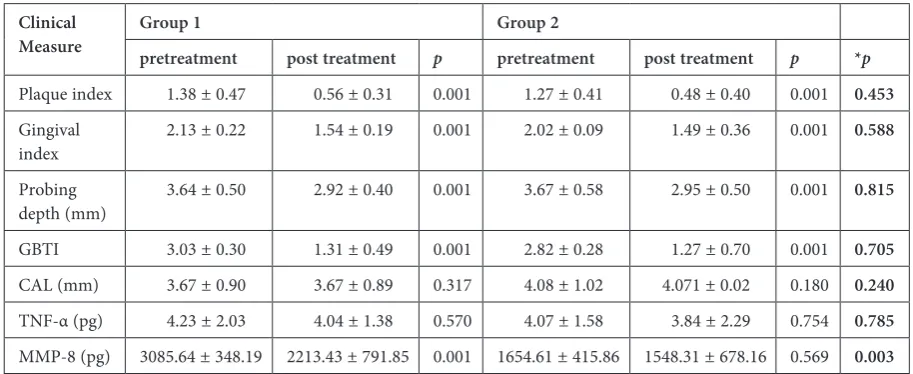
The PI, GI, and GBTI scores were significantly reduced in the tenoxicam and placebo groups af-ter therapy compared to baseline values (p < 0.05) (Table 1). CAL scores remained unchanged fol-lowing treatment in each group (p > 0.05). More-over, post-therapy values for clinical measures in the two groups are shown in Table 1. There was no significant difference in clinical measurements be-tween group 1 and 2 after treatment (p > 0.05).
Laboratory Results
The pre- and post-treatment GCF parameters in groups 1 and 2 are given in Table 1. Athough a reduction was observed in the TNF-α values af-ter treatment in both groups 1 and 2, this differ-ence was not significant (p > 0.05). The post-treat-ment level of MMP-8 was significantly lower in the tenoxicam group compared to baseline (P < 0.05) but not for the placebo group (p > 0.05) (Table 1). Moreover, the post-treatment MMP-8 level in group 1 was statistically significantly higher than in the placebo group (p < 0.05) (Table 1).
Discussion
Periodontal disease results from a coloni-zation of pathogenic bacteria and activation of host-derived lytic enzymes [28]. The importance of the host response in tissue damage has been highlighted by studies demonstrating that inhibi-tion of prostaglandins can significantly reduce the amount of periodontal destruction [29, 30]. Pros-taglandins have been shown to promote inflamma-tion and are a potent stimulus for connective tis-sue loss and bone resorption [31].Based on these findings, many studies have focused on NSAIDs in the modulation of the host inflammatory re-sponse. Pelletier and Pelletier [32] examined the effects of two NSAIDs, nimesulide and naproxen, on the breakdown of the proteoglycan matrix and metalloprotease synthesis of human osteoarthritic
cartilage. These NSAIDs significantly reduced pro-teoglycan degradation and stromelysin synthesis
in vitro. Salmon et al. [33]reported that leukocyte
accumulation is inhibited by the NSAIDs indo-methacin and flurbiprofen.
In this study, subjects with CP used tenoxicam as an adjunct to phase I periodontal treatment for 10 days. We found a significant improvement in all clinical parameters except CAL for both NSAID and placebo treatment; pre- and post-therapy val-ues were not significantly different between the two groups, which can be attributed to the limited sam-ples sizes. These findings suggest that tenoxicam treatment has no therapeutic effect on periodon-tal parameters whereas in some studies, a short time effect was found [34]. The improvements af-ter therapy, therefore, are primarily attributable to mechanical instrumentation and oral hygiene.
Moreover, the difference in baseline MMP-8 levels between the two groups could be attributed to the severity of the inflammation.
Multiple studies have examined the effect of NSAIDs on periodontal status. Vogel et al. [35] re-ported that sulindac does not reduce gingival in-flammation, whereas Johnson et al. [36] found that naproxen reduces gingival inflammation. Heas-man and Seymour [37] failed to demonstrate an ef-fect of NSAIDs on PI, GI, PD, CAL or bone resorp-tion; however, NSAIDs were shown to reduce GCF volume. Lee et al. [38] showed that NSAIDs ad-ministration did not reduce collagenase and gelati-nase in human gingival tissues. Moreover, to them, in contrast, low dose doxycline was effective. Addi-tionally, a 3rd group of subjects receiving a
combi-nation of the two drugs showed a synergistic effect in reducing the matrixmetalloproteinases.
Table 1. Clinical measures before and after Phase I Treatment with NSAID (group 1) and placebo (group 2)
Clinical
Measure Group 1pretreatment post treatment p Group 2pretreatment post treatment p *p
Plaque index 1.38 ± 0.47 0.56 ± 0.31 0.001 1.27 ± 0.41 0.48 ± 0.40 0.001 0.453
Gingival
index 2.13 ± 0.22 1.54 ± 0.19 0.001 2.02 ± 0.09 1.49 ± 0.36 0.001 0.588 Probing
depth (mm) 3.64 ± 0.50 2.92 ± 0.40 0.001 3.67 ± 0.58 2.95 ± 0.50 0.001 0.815 GBTI 3.03 ± 0.30 1.31 ± 0.49 0.001 2.82 ± 0.28 1.27 ± 0.70 0.001 0.705
CAL (mm) 3.67 ± 0.90 3.67 ± 0.89 0.317 4.08 ± 1.02 4.071 ± 0.02 0.180 0.240
TNF-α (pg) 4.23 ± 2.03 4.04 ± 1.38 0.570 4.07 ± 1.58 3.84 ± 2.29 0.754 0.785
MMP-8 (pg) 3085.64 ± 348.19 2213.43 ± 791.85 0.001 1654.61 ± 415.86 1548.31 ± 678.16 0.569 0.003
Data is presented as mean ± standard deviation, n = 16.
GBTI – gingival bleeding time index; CAL – clinical attachment loss; Comparison before and after treatment (Wilcoxon rank test)
* P – Comparison of post treatment values of groups (Mann-Whitney U test).
Table 2. Correlations between MMP-8, TNF-α and the clinical parameters
Clinical
parameter MMP-8r p TNF-α r p
MMP-8 (collagenase-2) plays a key role in connective tissue destruction. Several studies have demonstrated higher levels of collagenase activi-ty in the GCF of progressive periodontitis patients compared to stable and gingivitis patients [39–42]. MMP-8 at physiological (low) levels presumably provides a protective function against periodon-tal pathogens [43].Kinane et al. [44] reported that MMP-8 levels in GCF decrease after phase I thera-py, but the reduction reaches significant levels only after 8 weeks or longer. In our study, MMP-8 lev-els were reduced in both the NSAID and placebo groups at 30 days after phase I treatment, but it was significant only in the NSAID group. The lat-ter findings suggest that one of the benefits of ad-junctive tenoxicam may be to shorten the healing period by inhibiting MMP-8 activity. Moreover, in our study, no adverse effects were observed due to Tenoxicam intake. In contrast, some investigations have shown that some adverse effects such as esoph-agus, stomach/duodenum, small intestine and colon damage could be seen due to NSAIDsintake [45]. Barracchini et al. [46] found that meloxicam and in-domethacin can inhibit the activities of MMPs from human arthritic synovial fluid in vitro. Williams et al. [47] suggested that flurbiprofen given in con-junction with periodontal treatment has a positive clinical and therapeutic effect. Interpretation of studies examining MMP-8, however, must be un-dertaken with some caution, since the results may reflect differences related to the MMP-8 antibod-ies used in immunoassays [48, 49].
Several studies have suggested that enhanced TNF-α production is an important factor in
periodontal disease progression based on its in-creased expression in inflamed gingiva and rel-atively high levels in the GCF of periodontitis patients [50, 51]. Rossomando et al. [52] report-ed that TNF-α might be a risk marker for peri-odontitis because of its increased levels prior to clinical attachment loss. We found no significant difference in TNF-α levels between our experi-mental groups, both before and after treatment. In the present study, TNF-α values observed in the control group might indicate the presence of subclinical gingival inflammation. Lee et al. [53] also reported that TNF-α may be a predictor of periodontitis. In addition, Erdemir et al. [54] examined the effect of non-surgical periodon-tal treatment on GCF TNF-α levels and reported a demonstrable decrease at 6 months after initial therapy. We observed a nonsignficant reduction in TNF-α levels after therapy and did not find an adjunctive benefit of tenoxicam. Thus, tenoxi-cam does not appear to provide additional inhi-bition of TNF-α early in wound healing. Similar to our results, Keçeci [55] reported that naprox-en with phase I treatmnaprox-ent does not further inhibit TNF-α over 6 weeks.
Within the limits of the study, the clinical ben-efits were demonstrated of SRP with or without an NSAID (tenoxicam) in systemically healthy pa-tients with chronic periodontitis after the initial phase of periodontal therapy. Additional inhibi-tion of MMP-8, but not TNF-α, in the GCF was observed. Further studies are needed to clarify the adjunctive effect of Tenoxicam on periodon-tal treatment.
Acknowledgements. We are thankful to Dr. Mark Reynolds from the Faculty of Dentistry, Baltimore, University of Maryland, USA, for his valuable help in editing this paper.
References
Kinane DF, Lappin DF:
[1] Clinical, pathological and immunulogical aspects of periodontal disease. Acta Odontol Scand 2001, 59, 154–160.
Ingman T, Sorsa T, Michaelis J, Konttinen YT:
[2] Immunohistochemical study of neutrophil and fibroblast-type
collagenases and stromelysin-1 in adult periodontitis. Scand J Dent Res 1994, 102, 342–349.
Birkedal-Hansen H:
[3] Role of matrix metalloproteinases in human periodontal diseases. J Periodontol 1993, 64, 474–484.
Reddy NR, Roopa D, Babu DS, Kumar PM, Raju CM, Kumar NS:
[4] Estimation of matrix metalloproteinase-3
lev-els in gingival crevicular fluid in periodontal disease, health and after scaling and root planing. J Indian Soc Periodontol 2012, 16, 549–552.
Woolley DE, Davies RM:
[5] Immunolocalization of collagenase in periodontal tissues. J Periodontal Res 1981, 16, 292–297.
Hernández Ríos M, Sorsa T, Obregón F, Tervahartiala T, Valenzuela MA, Pozo P, Dutzan N, Lesaffre E, [6]
Molas M, Gamonal J: Proteolytic roles of matrix metalloproteinase (MMP)-13 during progression of chronic periodontitis: initial evidence for MMP-13/MMP-9 activation cascade. J Clin Periodontol 2009, 36, 1011–1017.
Sorsa T, Ding YL, Ingman T:
[7] Cellular source, activation and inhibition of dental plaque collagenase. J Clin Periodontol 1995, 22, 709–717.
Sorsa T, Tjaderhane L, Salo T:
[8] Matrix metalloproteinases (MMPs) in oral diseases. Oral Dis 2004, 10, 311–318.
Sorsa T, Uitto VJ, Suomolainen M, Vauhkonen M, Lindy S:
[9] Comparison of interstitial collagenases from human
Söder B, Airila Mansson S, Söder P-Ö, Kari K, Meurman J:
[10] Levels of matrix metalloproteinases-8 and -9 with
simultaneous presence of periodontal pathogens in gingival crevicular fluid as well as matrix metalloprotein-ase-9 and cholesterol in blood. J Periodontal Res 2006, 41, 411–417.
Buduneli N, Vardar S, Atilla G, Sorsa T, Luoto H, Baylas H:
[11] Gingival crevicular fluid matrix
metalloprotei-nase-8 levels following adjunctive use of meloxicam and initial phase of periodontal therapy. J Periodontol 2002, 73, 103–109.
Gangbar S, Overall CM, McCulloch CA, Sodek J:
[12] Identification of polymorphonuclear leukocyte collagenase
and gelatinase activities in mouthrinse samples: correlation with periodontal disease activity in adult and juvenile periodontitis. J Periodontal Res 1990, 25, 257–267.
Haerian A, Adonogianaki E, Money J, Manos A, Kinane DF:
[13] Effects of treatment on gingival crevicular
col-lagenase, stromelysin and tissue inhibitor of metalloproteinases and their ability to predict response to treatment. J Clin Periodontol 1996, 23, 83–91.
Romero AM, Mastromatteo-Alberga P, Escalona L, Correnti M:
[14] MMP-3 and MMP-8 levels in patients with
chronic periodontitis before and after nonsurgical periodontal therapy. Invest Clin 2013, 54,138–148.
Hernández M, Gamonal J, Tervahartiala T, Mäntylä P, Rivera O, Dezerega A, Dutzan N, Sorsa T:
[15] Associations
between matrix metalloproteinase-8 and -14 and myeloperoxidase in gingival crevicular fluid from subjects with progressive chronic periodontitis: a longitudinal study. J Periodontol 2010, 81,1644–1652.
Kamma JJ, Giannopoulou C, Vasdekis VG, Mombelli A
[16] : Cytokine profile in gingival crevicular fluid of
aggres-sive periodontitis: influence of smoking and stress. J Clin Periodontol 2004, 31, 894–902.
Genco RJ:
[17] Host responses in periodontal diseases: current concepts. J Periodontol 1992, 63, 338–355.
Choy EHS, Panayi GS:
[18] Cytokine pathways and joint inflammation in rheumatoid arthritis. N Engl J Med 2001, 344, 907–916.
Hanemaaijer R
[19] , Sorsa T, Konttinen YT: Matrix metalloproteinase-8 is expressed in rheumatoid synovial fibro-blasts and endothelial cells. Regulation by tumor necrosis factor-alpha and doxycycline. J Biol Chem 1997, 272, 31504–31509.
Howell TH, Williams RC:
[20] Nonsteroidal anti-inflammatory drugs as inhibitors of periodontal disease progression. Crit Rev Oral Biol Med 1993, 4, 177–196.
Offenbacher S, Braswell LD, Loos AS:
[21] Effects of flurbiprofen on the progression of periodontitis in Macaca mulat-ta. J Periodontal Res 1987, 22, 473–481.
Penglis PS, James MJ, Cleland LG:
[22] Cyclooxygenase inhibitors: any reservations? Review. Intern Med 2001, 31, 37–41.
Silness J, Löe H
[23] : Periodontal disease in pregnancy. II. Correlation between oral hygiene and oral condition. Acta Odontol Scand 1964, 22, 121–135.
Löe H:
[24] The gingival index, plaque index, and the retention index systems. J Periodontol 1967, 38, 610–616.
Nowicki D, Vogel RI, Mekers S, Deasy MJ:
[25] The gingival bleeding time index. J Periodontol 1981, 52, 260–262.
Kiili M, Cox SW, Chen HY:
[26] Collagenase-2(MMP-8) and collagenase-3(MMP-13) in adult periodontitis: Molecular forms and levels in gingival crevicular fluid and immunolocalisation in gingival tissue. J Clin Periodontol 2002, 29, 224–232.
Griffiths GS, Curtis MA, Wilton JM:
[27] Selection of a paper with optimum properties for the collection of gingival crevicular fluid. J Periodontal Res 1988, 23, 33–38.
Miller DR, Lamster IB, Chasens AI:
[28] Role of the polymorphonuclear leukocyte in periodontal health and disease. J Clin Periodontol 1984, 11, 1–15.
Offenbacher S, Odle BM, Green MD:
[29] Inhibition of human periodontal prostaglandin E2 synthesis with selected agents. Agents Actions 1990, 29, 232–238.
Williams RC, Jeffcoat MK, Wechter WJ, Johnson HG, Kaplan ML, Goldhaber P:
[30] Non-steroidal
anti-inflamma-tory drug treatment of periodontitis in beagles. J Periodontal Res 1984, 19, 633–637.
Shelling SH, Wolfe HJ, Jr. Tashijian AH:
[31] Role of the osteoclast in prostaglandin E2 stimulated bone resorption.
Lab Invest 1980, 42, 290–295.
Pelletier JP, Pelletier JM:
[32] Effects of nimesulide and naproxen on the degradation and metalloproteinase synthesis of human osteoarthritic cartilage. Drugs 1993, 1, 34–39.
Salmon JA, Simmons PM, Moncada S:
[33] The effects of BW755C and other anti-inflammatory drugs on eicosanoid concentrations and leukocyte accumulation in experimentally-induced acute inflammation. J Pharm Pharmacol 1983, 35, 808–813.
Kurtis B, Tüter G, Serdar M, Pınar S, Demirel I, Toyman U:
[34] GCF MMP-8 levels in smokers and
non-smok-ers with chronic periodontitis following scaling and root planning accompanied by systemic use of flurbiprofen. J Periodontol 2007, 78, 1954–1961.
Vogel RI, Copper SA, Schneider LG, Goteiner D
[35] : The effects of topical steroidal and systemic non-steroidal anti-inflammatory drugs on experimental gingivitis in man. J Periodontol 1984, 55, 247–251.
Johnson RH, Armitage GC, Francisco C, Page RC:
[36] Assesment of the efficacy of a non-steroidal
anti-inflamma-tory drug, naprosyn, in treatment of gingivitis. J Periodont Res 1990, 25, 230–235.
Heasman PA, Seymour RA:
[37] An association between long term non-steroidal anti-inflammatory drug therapy and the severity of periodontal disease. J Clin Periodontol 1990, 17, 654–658.
Lee HM, Ciancio SG, Tüter G, Ryan ME, Komaroff E, Golup LM:
[38] Subantimicrobial dose doxycycline efficacy
Lee W, Aitken S, Sodek JA, McCulloch C:
[39] Evidence of a direct relationship between neutrophil collagenase activ-ity and periodontal tissue destruction in vivo: role of active enzymes in human periodontitis. J Periodont Res 1995, 30, 23–33.
Romanelli R, Mancini S, Laschinger C, Overall CM, Sodek J, McCulloch CA:
[40] Activation of neutrophil
collage-nase in periodontitis. Infect Immun 1999, 67, 2319–2326.
Mancini S, Romanelli R, Laschinger CA, Overall CM, Sodek J, McCulloch CA:
[41] Assessment of a novel
screen-ing test for neutrophil collagenase activity in the diagnosis of periodontal diseases. J Periodontol 1999, 70, 1292– –1302.
Marcaccini AM, Meschiari CA, Zuardi LR, de Sousa TS, Taba M Jr, Teofilo JM, Jacob-Ferreira AL, Tanus-[42]
Santos JE, Novaes AB Jr, Gerlach RF: Gingival crevicular fluid levels of MMP-8, MMP-9, TIMP-2, and MPO decrease after periodontal therapy. J Clin Periodontol 2010, 37, 180–190.
Kuula H, Salo T, Pirilä E, Tuomainen AM, Jauhiainen M, Uitto VJ:
[43] Local and systemic responses in matrix
metalloproteinase 8-deficient mice during Porphyromonas gingivalis-induced periodontitis. Infect Immun 2009, 2, 850–859.
Kinane DF, Darby IB, Said S:
[44] Changes in gingival crevicular fluid matrix metalloproteinase-8 levels during peri-odontal treatment and maintenance. J Periodont Res 2003, 38, 400–404.
Inaba T, Ishikawa S, Miyoshi M, Kurahara K:
[45] Present status of gastrointestinal damage due to non-steroidal anti-inflammatory drugs (NSAIDs). Nihon Rinsho 2013, 71, 1109–1115.
Barracchini A, Franceschini N, Minisola G:
[46] Meloxicam and indomethacin activity on human matrix
metallopro-teinases in synovial fluid. Ann N Y Acad Sci 1999, 878, 665–666.
Williams RC, Jeffcoat MK, Howell TH:
[47] Altering the progression of alveolar bone loss with the non-steroidal anti-inflammatory drug flurbiprofen. J Periodontol 1989, 60, 485–490.
Leppilahti JM, Ahonen MM,
[48] Hernández M: Oral rinse MMP-8 point-of-care immuno test identifies patients with strong periodontal inflammatory burden. Oral Dis 2011,17, 115–122.
Sorsa T, Mäntylä P, Tervahartiala T, Pussinen PJ, Gamonal J, Hernandez M:
[49] MMP activation in diagnostics of
periodontitis and systemic inflammation. J Clin Periodontol 2011, 38, 817–819.
Smith MA
[50] , Braswell LD, Collins JG: Changes in inflammatory mediators in experimental periodontitis in the rhesus monkey. Infect Immun 1993, 61, 1453–1459.
Stashenko P, Jandinski JJ, Fujiyoshi P, Rynar J, Socranski SS:
[51] Tissue levels of bone resorptive cytokines in
peri-odontal disease. J Periodontol 1991, 62, 504–509.
Rossomando EF, Kennedy JE, Hadjımichael J:
[52] Tumor necrosis factor alpha in gingival crevicular fluid as a pos-sible indicator of periodontal disease in humans. Arch Oral Biol 1990, 35, 431–434.
Lee HJ, Kang IK, Chung CP, Choi SM
[53] : The subgingival microflora and gingival crevicular fluid cytokines in refractory periodontitis. J Clin Periodontol 1995, 22, 885–890.
Erdemir EO, Duran I, Haliloğlu S:
[54] Effects of smoking on clinical parameters and the gingival crevicular fluid levels of IL-6 and TNF-α in patients with chronic periodontitis. J Clin Periodontol 2004, 31, 99–104.
Kececi A:
[55] Determining the TNF- α levels in GCF of patients with adult periodontitis and the effect of NSAIDs. Dissertation 1998, University of Gazi.
Address for correspondence:
Hakan Develioğlu
Department of Periodontology Cumhuriyet University Sivas 58140
Turkey
Fax: 346 2191237
E-mail: [email protected] Conflict of interest: None declared Received: 22.05.2013