R E S E A R C H
Open Access
Evaluation of forecasting methods from
selected stock market returns
M. Mallikarjuna
*and R. Prabhakara Rao
* Correspondence:mmallikarjuna@ sssihl.edu.in
Doctoral Research Scholar, Department of Economics, Sri Sathya Sai Institute of Higher Learning, Vidyagiri, Prasanthi Nilayam, AP, India
Abstract
Forecasting stock market returns is one of the most effective tools for risk management and portfolio diversification. There are several forecasting techniques in the literature for obtaining accurate forecasts for investment decision making. Numerous empirical studies have employed such methods to investigate the returns of different individual stock indices. However, there have been very few studies of groups of stock markets or indices. The findings of previous studies indicate that there is no single method that can be applied uniformly to all markets. In this context, this study aimed to examine the predictive performance of linear, nonlinear, artificial intelligence, frequency domain, and hybrid models to find an appropriate model to forecast the stock returns of developed, emerging, and frontier markets. We considered the daily stock market returns of selected indices from developed, emerging, and frontier markets for the period 2000–2018 to evaluate the predictive performance of the above models. The results showed that no single model out of the five models could be applied uniformly to all markets. However, traditional linear and nonlinear models outperformed artificial intelligence and frequency domain models in providing accurate forecasts.
Keywords:Financial markets, Stock returns, Linear and nonlinear, Forecasting techniques, Root mean square error
JEL codes:C22, C53, G15, G17
Introduction
Theoretical and empirical studies have shown that a positive relationship exists be-tween financial markets and economic growth (e.g., Levine,1997; Rajan and Zingales, 1998; Rousseau and Watchel, 2000; Beck et al.,2003; Guptha and Rao, 2018). Given the significance of financial markets, forecasting financial returns occupies a para-mount position in investment decision making. However, stock markets are character-ized by high volatility, dynamism, and complexity (Johnson et al.,2003; Cristelli,2014; Wieland,2015). Movements in stock markets are influenced by several factors, such as macro-economic factors, international events, and human behavior. Hence, forecasting stock returns can become a challenging task. The profitability of investments in stock markets highly depends on the predictability of stock movements. If a forecasting model or technique can precisely predict the direction of the market, investment risk and uncertainty can be minimized. It would enhance investment flows into stock
markets and also be useful for policymakers and regulators in making appropriate deci-sions and taking corrective measures.
There are two distinct schools of thought—namely, fundamental analysis and tech-nical analysis—for predicting stock price movements. Fundamentalists forecast stock prices on the basis of financial analyses of companies or industries. Technical analysts, meanwhile, use historical securities data and predict future prices on the assumption that stock prices are determined by market forces and that history tends to repeat itself (Levy, 1967). These theories coexisted for several decades as strategies for investment decision making. These approaches were challenged in the 1960s by random walk the-ory, popularly known as the efficient market hypothesis (Fama, 1970), which proposes that future changes in stock prices cannot be predicted from past price changes. Some empirical studies have shown the presence of‘random walk’in stock prices (e.g., Tong et al.,2014; Konak and Seker,2014; Erdem and Ulucak,2016). However, most empirical studies have found that stock prices are predictable (Darrat and Zhong, 2000; Lo and MacKinlay,2002; Harrison and Moore,2012; Owido et al.,2013; Radikoko,2014; Said, 2015; Almudhaf,2018).
Various forecasting techniques are available for time series forecasting. Autoregres-sive integrated moving average (ARIMA) models were proposed by Box and Jenkins (1970) for time series analysis and forecasting. Some studies have been conducted by employing ARIMA models to forecast stock market returns (Al-Shaib, 2006; Ojo and Olatayo, 2009; Adebiyi and Oluinka, 2014; Mondal et al., 2014). Quite a few studies found that ARIMA models produced inferior forecasts for financial time series data (Zhang,2003; Adebiyi and Oluinka,2014; Khandelwal et al.,2015). To account for non-linearities resulting from regime changes in economies, some researchers have used Markov regime-switching models and threshold autoregressive (TAR) models assuming nonlinear stationary processes to predict stock prices (Hamilton, 1989; Tong, 1990). Tasy (1989) proposed a simple yet widely applicable model-building procedure for threshold autoregressive models as well as a test for threshold nonlinearity. Gooijer (1998) considered regime switching in a moving average (MA) model and used valid-ation criteria for self-exciting threshold autoregressive (SETAR) model selection. Some empirical studies comparing different methods with SETAR found that this method produced superior results to linear models (e.g., Clements and Smith, 1999; Boero and Marrocu,2002; Boero,2003; Firat,2017).
In the late 1980s, a class of artificial intelligence (AI) models—such as feedforward, backpropagation, and recurrent neural network models—were introduced for forecast-ing purposes. The distforecast-inguishforecast-ing features of artificial neural networks (ANN) are that they are data-driven, nonlinear, and self-adaptive, and they have very few apriori as-sumptions. This makes ANNs valuable and attractive for forecasting financial time series. Among ANN models, the feed-forward neural network with a single hidden layer has become the most popular for forecasting stock market returns (Zhang,2003). Many studies have shown that these models yield more accurate forecasts compared to naïve and linear models (e.g., Ghiassi et al., 2005; Mostafa,2010; Qiu et al.,2016; Aras and Kocakoc,2016).
Taiwan Stock Exchange. The results showed that CAMC NN made more accurate fore-casts than support vector regression and back-propagation neural network (BPNN) models. Guresen et al. (2011) observed that classical ANN models and multilayer per-ceptron (MLP) outperformed GARCH-class models for the NASDAQ index. Lahmiri (2016) employed variational mode decomposition (VMD) based general regression neural networks (GRNN) for four economic and financial data sets and found that VMD-GRNN models outperformed the ARIMA model and other neural network models. Nayak and Misra’s (2018) genetic algorithm-based condensed polynomial neural network (GA-CPNN) improved the accuracy of forecasting stock indices com-pared to radial basis function neural network (RBFNN) and multilayer perceptron and genetic algorithm (MLP-GA) models. Zhong and Enke (2019) observed that techniques such as deep neural networks using principal component analysis (PCA) and artificial neural networks performed better than traditional models. However, most studies have found that traditional ANN models, as well as ANN models combined with linear models, produce more accurate forecasts than other models (e.g., Asadi et al., 2010; Wang et al.,2011; Khandelwal et al.,2015; Mallikarjuna et al.,2018).
Recently, frequency-domain models, such as spectral analysis, wavelets, and Fourier transformations, have been proposed to improve the forecasting accuracy of financial time series. One widely used technique is singular spectrum analysis (SSA), which is a robust nonparametric method with no prior assumptions about the data (Golyandina et al., 2001; Hassani et al.,2013a). SSA decomposes a time series data into its compo-nents and then reconstructs the series by leaving the random noise component before using the reconstructed series to forecast the future points in the series (Hassani,2007; Ghodsi and Omer, 2014). Since most financial time series data sets exhibit neither purely linear nor purely nonlinear patterns, the combination of linear and nonlinear, i.e., hybrid techniques to model complex data structures for improved accuracy has been proposed (Asadi et al., 2010; Khashei and Bijari, 2010; Khashei and Bijari, 2012; Khandelwal et al., 2015; Ince and Trafalis, 2017). Khashei and Hajirahimi (2017) com-pared linear and nonlinear models with hybrid models (HM) and concluded that hybrid models perform better than individual models.
Only a few studies have aimed to find a suitable method for forecasting the stock returns of a group of markets. Guidolin et al. (2009) evaluated the performance of lin-ear and nonlinlin-ear models for forecasting the financial asset returns of G7 countries. They found that nonlinear models, such as threshold autoregressive (TAR) and smooth transition autoregressive (STAR) models, performed better than linear models in the case of US and UK asset returns. Meanwhile, simple linear models such as random walk and autoregressive models were better for French, German, and Italian asset returns. This suggests that no single model is suitable for forecasting the returns of all stock markets. Awajan et al. (2018) compared the performance of several forecasting methods by applying them to six stock markets and found that the empirical mode de-composition Holt–Winters method (EMD-HW) provided more accurate forecasts than other models.
different forecasting techniques—namely, ARIMA, SETAR, ANN, SSA, and HM models, representing linear, nonlinear, artificial intelligence (AI), frequency domain, and hybrid methods, respectively—as applied to individual stock markets. This study also examined the suitability of different forecasting methods for each category of the world stock markets—namely, developed, emerging, and frontier. Finding a single method that can produce optimal forecasts for all markets could help investors save time and resources and make better decisions. This study is mainly useful for inter-national investors and foreign institutional investors who wish to minimize risks and diversify their portfolios, with the aim of maximizing profits. The objectives of the present study are outlined below.
Objectives
1. To forecast stock market returns using linear, nonlinear, artificial intelligence, frequency domain, and hybrid methods.
2. To find the most appropriate forecasting techniques among the five above-mentioned techniques for developed, emerging, and frontier markets.
3. To check whether any single technique can be applied to all markets to obtain optimal forecasts.
The rest of this paper is organized as follows. Section 2 describes the data and methods employed in the study. Section 3 presents the empirical results. Finally, the conclusions are given in section 4.
Data and methodology
In accordance with the objectives of this study, we considered three types of markets— developed, emerging, and frontier—based on the Morgan Stanley Capital International classification (MSCI, 2018). The market indices taken for the developed category are Australia (ASX 200), Canada (TSX Composite), France (CAC 40), Germany (DAX), Japan (NIKKEI 225), South Korea (KOSPI), Switzerland (SMI), United Kingdom (FTSE 100), and the United States (S&P 500). Those for emerging markets are Brazil (BOVE-SPA), China (SSEC), Egypt (EGX 30), India (SENSEX), Indonesia (IDX), Mexico (BMV IPC), Russia (MOEX), South Africa (JSE 40), Thailand (SET), and Turkey (BIST 100). Lastly, those in the frontier category are Argentina (S&P MERVAL), Estonia (TSEG), Kenya (NSE 20), Sri Lanka (CSE AS), and Tunisia (TUNINDEX). The daily closing prices of these indices for the period 1 January 2000 to 30 December 2018 were ob-tained from the websitewww.investing.com.
Asset returns (Rt) were calculated from the closing prices of all indices using the
formula:
Rt¼
Pt−Pt−1
ð Þ
Pt−1
100 ð1Þ
Where,Ptis the price of the asset in the current time period andPt−1is the price of
Autoregressive integrated moving average (ARIMA)
Proposed by George Box and Gwilym Jenkins in 1970, ARIMA models are among the most popular linear models. In ARIMA models, the future value of a variable is ob-tained through a linear function of some past observations of the variable and some random errors. The process that generates the time series has the form of:
yt ¼cþϕ1yt−1þϕ2yt−2……:;ϕpyt−pþθ1εt−1þθ2εt−2…:θqεt−qþet; ð2Þ
where ytis the variable that will be explained at time t; c is the constant or intercept ;ϕi(i = 1, 2,…p) andθj(j = 1, 2,…. q) are the model parameters;pand qare integers and are often referred to as AR and MA orders of the model, respectively; andetis the error term. The assumption regarding the random errors εt is that they are independently and identically distributed with a mean zero and constant variance of σ2. This model involves a three-step iterative process of identification, estimation, and diagnostic checking. The identification step involves specifying a tentative model by deciding the order of the AR (p) and MA (q) terms. Once a tentative model is specified, the parame-ters of the model must be estimated, in such a way that the overall measure of errors is minimized, which is generally done with a nonlinear optimization procedure. After the estimation of parameters, diagnostic checking for the adequacy of the model must be done, which involves testing whether the model assumptions about the errors εt are satisfied. If the model is adequate, one can proceed to forecast; if not, a new tentative model must be identified following the parameter estimation and model verification. This process with three steps must be repeated until a satisfactory model is selected to forecast the data.
Self-exciting threshold autoregressive (SETAR)
The SETAR model, developed by Tong (1983), is a type of autoregressive model that can be applied to time series data. This model has more flexibility in the parameters which have regime-switching behavior (Watier and Richardson,1995). Regime switch-ing in this model is based on the dependent variable’s self-dynamics, i.e. self-exciting. In other words, the threshold value in the SETAR model is related to the endogenous variable whereas, in the TAR Model, it is related to an exogenous variable. This model assumes a different autoregressive process in accordance with particular threshold values. SETAR models have the advantage of capturing a commonly observed nonlinear phenomenon which cannot be captured by linear models like exponential smoothing and ARIMA models.
A Threshold Autoregressive model can be transformed into a SETAR model if the threshold variable is taken as a lagged value of the time series itself. The SETAR model with two regimes is specified as:
yt ¼
α0þ
Xp
i¼1
αiyt−iþεtif yt−d≤τ
β0þ
Xp
i¼1
βiyt−iþεtif yt−d>τ
;
8 > > > < > > > :
ð3Þ
that are independent and identically distributed with mean 0 and variance σ2ε.τis the value of the threshold, and if the value ofτis known, the observations can be separated based on their value in comparision to the threshold, i.e. whether yt−d is below or above the threshold. Then, by using the ordinary least squares method, the AR model is estimated (Ismail and Isa,2006). The threshold value must be determined along with other parameters of the SETAR model, since the threshold value is unknown in general.
Artificial neural networks (ANN)
Artificial Neural Networks are one of the flexible computing frameworks, that can be used for modeling a broad range of nonlinear data. The major advantages of ANN models are that they are data-driven and universal approximators, which can approxi-mate a large class of functions with great accuracy. This model-building process does not require any prior assumptions about the model form since the characteristics of the data determine the network model. A feedforward neural network with a single hidden layer is one of the most widely used method to forecast the time series data (Zhang, 2003). The structure of the model is defined by a network of three layers of simple processing units connected by acyclic links. The mathematical representation of the relationship between outputytand the inputs (yt−1,yt−2,…..yt−p) can be defined
as:
yt ¼w0þ
Xq
j¼1
wj:g w0;jþ
Xp
i¼1
wij:yt−1
!
þεt; ð4Þ
wherewj(j = 0, 1, 2,…,q) andwij(i = 0, 1, 2,…..,p; j = 0, 1, 2,…,q) are the connection weights or the model parameters,pis the number of input nodes, andqis the number of hidden nodes. The transfer function of the hidden layer is given by the logistic function:
Sig xð Þ ¼ 1
1þ expð Þ−x : ð5Þ
Hence, the ANN model in eq. 4 performs the nonlinear functional mapping from past observations (yt−1,yt−2,…..yt−p) to the future valueyt—that is,
yt ¼ f yt−1;…::;yt−p;w
þεt; ð6Þ
Where f is a function determined by the network structure and connection weights, and w is a vector of all parameters. Thus, this neural network model is similar to an autoregressive model with nonlinear functionality.
q, it is ready for training. This is done with efficient nonlinear optimization algorithms, such as gradient descent algorithms and conjugate gradient algorithms, other than the basic backpropagation training algorithm (Hung,1993).
In ANNs, the most widely used activation functions are the sigmoid functions. Recently, in deep learning, several other functions have been suggested as alternatives to the sigmoid function, such as the hyperbolic tangent (tanh) function, rectified linear units (ReLU), softmax, and Gaussian. These functions are given below.
The hyperbolic tangent (tanh) function is one of the alternatives to the sigmoid func-tion. It can be defined as:
tanhð Þ ¼x 1−e −2x
1þe−2x: ð7Þ
This function is similar to the sigmoid function, however, it compresses real-value number to a range between−1 and 1; i.e., tanh (x)∈(−1, 1).
Rectified linear units (ReLU) are defined as:
f xð Þ ¼ max 0ð ;xÞ; ð8Þ
Where x is the input for a neuron. In other words, the activation is simply set at a threshold of zero. The range of the ReLU is between 0 and∞.
The softmax function, also called as normalized exponential function is a generalization of the logistic function that‘compresses’aK-dimensional vectorZ from random real values to a K-dimensional vector σ(z) of real values in the range [0,1], which add up to 1. The function is defined as:
σð Þz j¼ e
zj
XK
k¼1
ezk
;j¼1;2;…;K: ð9Þ
The Gaussian activation functions are bell-shaped curves that are continuous. The node output is interpreted depending on how close the net input is for a chosen value of average, i.e. it is interpreted in terms of class membership (1 or 0). The function is defined as:
f xð Þ ¼ ffiffiffiffiffiffiffiffi1
2πσ
p e−ðx−μÞ
2
2σ2 ð10Þ
Singular Spectrum analysis (SSA)
Some studies have employed the SSA method to forecast financial time series (Hassani et al.,2013b; Ghodsi and Omer,2014). The SSA method comprises two stages, one is de-composition and the other is reconstruction. In the first stage, the time series is decom-posed to separate the signal and noise, then in the second stage, the series with less noise is reconstructed and applied to forecast by using the following steps (Hassani,2007):
Step 1. Embedding. Embedding can be considered a mapping that transfers a one-dimensional time series YN= (y1,…, yN) to a multi-dimensional series X1,…,XKwith
vec-tors Xi= (yi,…, yi + L−1)Tϵ RL, where L (2≤L≤N−1) is the window length, and K = N
Χ¼½Χ1;…;ΧK ¼ Χij L;K i;j¼1
Step 2. Singular value decomposition (SVD). In this step, the SVD of X is imple-mented. Denoted byλ1…. , ,λLthe eigenvalues of XXTarranged in decreasing order (λ1, ,
≥…≥λL ≥0) and by U1…. , ,ULthe corresponding eigenvectors. The SVD ofXcan be
written asX= X1+…+ XL, where, Xi¼
ffiffiffiffi
λi p
UiVTi.
Step 3. Grouping. This step involves splitting the elementary matrices into several groups and then adding the matrices within each group.
Step 4. Diagonal averaging. The main objective of diagonal averaging is to transform a matrix into the Hankel matrix form, which can be later converted into a time series.
Step 5. Forecasting. There exist two forms of SSA forecasting: recurrent singular spectrum analysis (RSSA) and vector singular spectrum analysis (VSSA). In this study, we employed RSSA. Let V2¼π2
1þ…þπ2r where πi is the last component of the
eigenvector Ui(i= 1,…,r). Additionally, for any vectorUϵ RL, denote byU∇ϵRL−1the
vector comprising of the first L− 1 components of the vector U. Let YN+ 1, …YN+h
show the hterms of the SSA recurrent forecast. Then, we can obtain the h-step ahead forecasts by using the following formula.
yt ¼
e
yifor i¼1;…;N XL−1
j¼1
αjyi−j for i¼Nþ1;…Nþh;
8 > < >
: ð11Þ
where yeiði¼1;…;NÞ is the reconstructed series, and vectorA= (α1,…,αL−1) can be
computed by
A¼ 1
1−v2
Xr
i¼1
πiU∇i: ð12Þ
Hybrid model (HM)
Either purely linear or purely nonlinear models might not be adequate for predicting stock returns since the stock returns are complex in nature. Even data-driven ANNs have produced mixed results in forecasting the time series data. For example, Denton (1995) used simulated data and found that when there is multicollinearity or outliers in the data, neural networks can forecast the data better than the linear regression models. The sample size and noise level play a crucial role in determining the performance of ANNs for linear regression problems (Markham and Rakes, 1998). Therefore, it might not be useful to apply ANNs for all types of data.
Given the complexities in the stock market data, a method that can handle both the linear and nonlinear data, i.e., hybrid model might be an alternative for forecasting. Lin-ear and nonlinLin-ear aspects of the underlying patterns in the data can be captured by combining different models.
It might be useful to consider time series data consisting of linear autocorrelation structure and a nonlinear component. That is,
yt ¼LtþNt; ð13Þ
where Ltrepresents the linear component andNtdenotes the nonlinear component.
linear model would contain only the nonlinear relationship. These residuals can be defined as: Letetdenote the residual at timetfrom the linear model, then:
et ¼yt−ytþL^t; ð14Þ
Where, ^Lt is the forecast value at timetfrom the estimated relationship from eq. 13. Residuals are very crucial in diagnosing the adequacy of linear models because the pres-ence of linear correlation in the residuals indicates the inadequacy of the linear model. In addition, any significant nonlinear pattern in the residuals also indicates the limita-tion in the linear model. Nonlinear relalimita-tionships can be discovered by modeling resid-uals using ANNs. The ANN model for residresid-uals withninput nodes will be:
et ¼ f eð t−1;et−2;…::et−nÞ þεt; ð15Þ
Where fis a nonlinear function determined by the neural network, andεtis the
ran-dom error. Denoting the forecast from (13) as N^t, the combined forecast will be:
^yt ¼^LtþN^t; ð16Þ
where ^yt is the estimated value from the hybrid model, which is a combination of lin-ear and nonlinlin-ear models. We used the inverse mean square forecast error (MSFE) ra-tio to determine the optimal weights for the hybrid models as it is a widely used method with a robust theoretical background (Bates et al.,1969).
ForMmodels, the combinedh-step ahead forecast is:
^ytþh¼X
M
m¼1
wm;h;t^ytþh;m; ð17Þ
wm;h;t ¼
1=msfem;h;t
k
PM
j¼1 1=msfem;h;t
k; ð18Þ
where ^ytþh;m is the point forecast for h steps ahead at time tfrom model m. In sum-mary, this hybrid method contains two steps. The first step is to employ the ARIMA to model the linear part of the data. The second step is to apply ANN to model the resid-uals obtained from the ARIMA, these residresid-uals have information about the nonlinearity in the data. The results from the ANN model can be used as forecasts for the error terms for the ARIMA model. In the manner mentioned above, the hybrid model encompasses the characteristics of the ARIMA and ANN models in modeling time series data. Thus, it could be beneficial to employ hybrid models to improve the accur-acy of the forecasts.
Forecast performance measures
previous studies (Lu and Wu, 2011; Wang et al.,2011; Hyndman and Athanasopoulos, 2015; Makridakis et al.,2015). Also, Chai and Draxler (2014) suggested that RMSE is a suitable measure for models with normally distributed errors. The present study found that the errors in most of the models follow the normal distribution.
If Yt is the actual observation for time period t, andFt is the forecast for the same
period, then the error is defined as:
et ¼Yt−Ft; ð19Þ
MAE¼1
n
Xn
t¼1
et
j j; ð20Þ
MPE¼1
n
Xn
t¼1
PEt; ð21Þ
MAPE¼1
n
Xn
t¼1
PEt
j j; ð22Þ
Where,
PEt¼
Yt−Ft
Yt
100 ð23Þ
The mean squared error (MSE) is:
MSE¼1
n
Xn
t¼1
et2; ð24Þ
and the root mean square error (RMSE) is:
RMSE¼
ffiffiffiffiffiffiffiffiffiffiffiffiffiffiffiffiffiffi
1
n
Xn
t¼1
et2:
s
ð25Þ
Empirical results
Here, we present the empirical results, comprising descriptive statistics and the per-formance measures of various forecasting methods for stock returns in developed, emerging, and frontier markets.
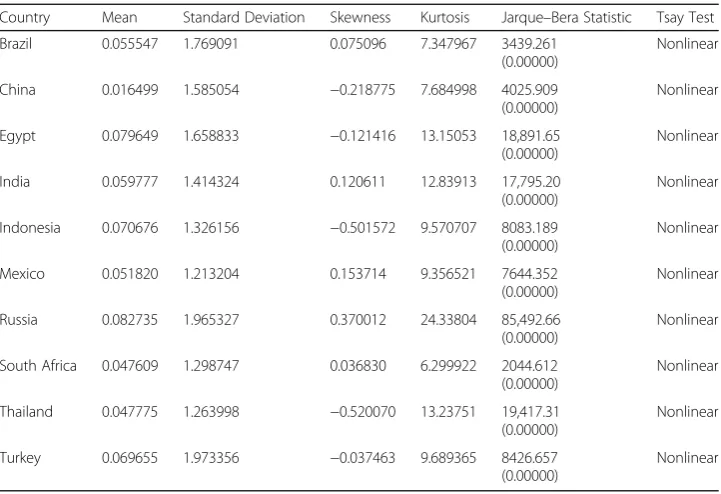
Descriptive statistics of stock returns
Results of forecasting methods
Before applying the forecasting methods, we divided the data into the training set and the test set; we used 80% of the data for training the models and the remaining 20% for testing the models. To forecast the returns using the ARIMA (p, d, q) model, it was ne-cessary to check stationarity to have valid inferences. To test the stationarity of the returns series, we employed the augmented Dickey–Fuller (1979) and Phillips–Perron (1988) tests; the results showed that the returns of all of the markets were stationary. We determined the optimal lag length for the autoregressive (p) and moving average (q) components using the Akaike information criterion (AIC). We observed different
Table 1Descriptive Statistics for Developed Markets
Country Mean Standard Deviation Skewness Kurtosis Jarque–Bera Statistic Tsay Test
Australia 0.016900 0.981318 −0.366178 8.451780 5732.678 (0.00000)
Nonlinear
Canada 0.016719 1.043102 −0.466783 13.58932 21,277.95 (0.00000)
Nonlinear
France 0.005790 1.429676 0.141474 8.712746 6275.928 (0.00000)
Nonlinear
Germany 0.021703 1.475373 0.097060 8.111260 4987.257 (0.00000)
Nonlinear
Japan 0.019562 1.501151 −0.211389 9.413287 7642.163 (0.00000)
Nonlinear
Korea 0.040316 1.384506 −0.350392 9.724636 8473.831 (0.00000)
Nonlinear
Switzerland 0.007731 1.174780 −0.012284 10.18851 9766.624 (0.00000)
Nonlinear
UK 0.009243 1.171826 −0.004334 9.918071 9061.453 (0.00000)
Nonlinear
US 0.020694 1.147998 −0.089045 12.10219 15,630.08 (0.00000)
Nonlinear
Table 2Descriptive Statistics for Emerging Markets
Country Mean Standard Deviation Skewness Kurtosis Jarque–Bera Statistic Tsay Test
Brazil 0.055547 1.769091 0.075096 7.347967 3439.261 (0.00000)
Nonlinear
China 0.016499 1.585054 −0.218775 7.684998 4025.909 (0.00000)
Nonlinear
Egypt 0.079649 1.658833 −0.121416 13.15053 18,891.65 (0.00000)
Nonlinear
India 0.059777 1.414324 0.120611 12.83913 17,795.20 (0.00000)
Nonlinear
Indonesia 0.070676 1.326156 −0.501572 9.570707 8083.189 (0.00000)
Nonlinear
Mexico 0.051820 1.213204 0.153714 9.356521 7644.352 (0.00000)
Nonlinear
Russia 0.082735 1.965327 0.370012 24.33804 85,492.66 (0.00000)
Nonlinear
South Africa 0.047609 1.298747 0.036830 6.299922 2044.612 (0.00000)
Nonlinear
Thailand 0.047775 1.263998 −0.520070 13.23751 19,417.31 (0.00000)
Nonlinear
Turkey 0.069655 1.973356 −0.037463 9.689365 8426.657 (0.00000)
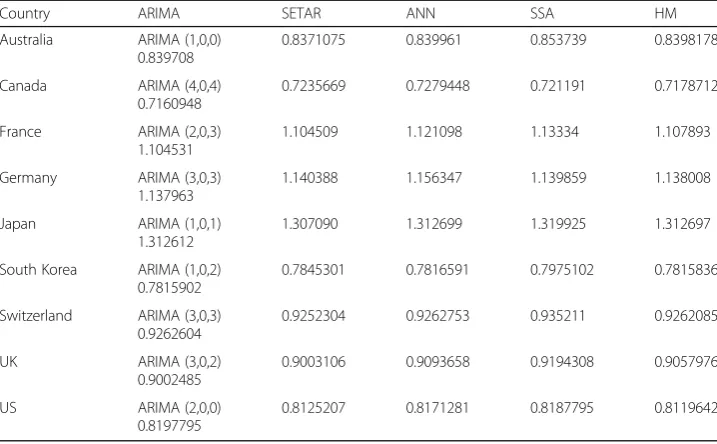
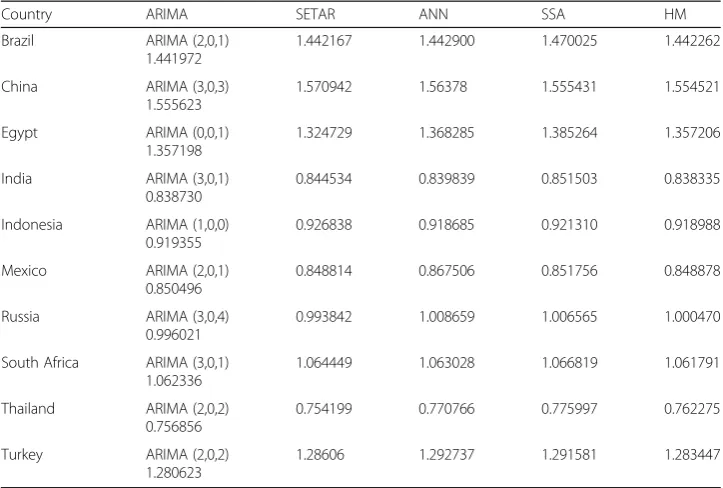
orders of AR and MA for different series and present them along with RMSE values in Tables 4, 5, and6. In the SETAR model, the series exhibited nonlinear trends, and we identified two regimes by the minimum AIC values. Then, the model was used to fore-cast the returns of the markets. To forefore-cast stock returns using the ANN model, we employed feedforward neural networks since many studies have shown that they fit well with asset return data (Zhang,2003; Qiu et al.,2016). We employed a recurrent singu-lar spectrum analysis (RSSA) model to forecast the returns after decomposing and reconstructing the original returns series by following the four steps involved in fore-casting with SSA: embedding, reconstructing, grouping, and diagonal averaging. For the hybrid model, which is a combination of ARIMA and ANN, we fit the model by employing the widely used inverse mean square forecast error (MSFE) ratio (Bates et al., 1969; Winkler and Makridakis, 1983) for assigning the optimal weights for the models in forecasting. Tables4,5, and6present the RMSE values of the test sets of the forecast series for all techniques (i.e., ARIMA, SETAR, SSA, ANN, and HM) for devel-oped, emerging, and frontier markets, respectively. The model with the lowest RMSE was chosen as the most appropriate model. In addition, we tested RMSE significance
Table 3Descriptive Statistics for Frontier Markets
Country Mean Standard Deviation Skewness Kurtosis Jarque–Bera Statistic Tsay Test
Argentina 0.120985 2.162861 0.018419 7.202958 3230.709 (0.00000)
Nonlinear
Estonia 0.052646 1.036820 0.316893 14.29612 24,406.12 (0.00000)
Nonlinear
Kenya 0.012726 0.831383 0.555709 15.16038 28,057.55 (0.00000)
Nonlinear
Tunisia 0.035152 1.292467 0.603647 20.46153 59,408.84 (0.00000)
Nonlinear
Sri Lanka 0.066494 1.128874 0.993308 43.75095 300,319.2 (0.00000)
Nonlinear
Table 4RMSE Values of the Forecasting Models for Developed Markets
Country ARIMA SETAR ANN SSA HM
Australia ARIMA (1,0,0) 0.839708
0.8371075 0.839961 0.853739 0.8398178
Canada ARIMA (4,0,4) 0.7160948
0.7235669 0.7279448 0.721191 0.7178712
France ARIMA (2,0,3) 1.104531
1.104509 1.121098 1.13334 1.107893
Germany ARIMA (3,0,3) 1.137963
1.140388 1.156347 1.139859 1.138008
Japan ARIMA (1,0,1) 1.312612
1.307090 1.312699 1.319925 1.312697
South Korea ARIMA (1,0,2) 0.7815902
0.7845301 0.7816591 0.7975102 0.7815836
Switzerland ARIMA (3,0,3) 0.9262604
0.9252304 0.9262753 0.935211 0.9262085
UK ARIMA (3,0,2)
0.9002485
0.9003106 0.9093658 0.9194308 0.9057976
US ARIMA (2,0,0)
0.8197795
using the Diebold–Marino test (1995) and found that the RMSE of all of the models was significant, except for Japan, South Africa, and Sri Lanka.
From Tables 4,5, and6, we can observe that no single method performed uniformly for all markets. However, the nonlinear model (i.e., SETAR) performed better than the other models, producing optimal forecasts for 10 markets (i.e., four developed, four emerging, and two frontier markets). This result contrasts with Guidolin et al. (2009). In the case of developed markets, the SETAR model produced optimal forecasts for four of the nine markets (Australia, France, Japan, and Switzerland). The ARIMA model was optimal for Canada, Germany, and the UK, and the HM model was optimal for South Korea and the US. Thus, we can say that nonlinear models are more suitable for developed markets. Meanwhile, ANN and SSA models are not at all useful for de-veloped markets since they did not provide any optimal forecasts.
For emerging markets, the SETAR model was found to be appropriate for four mar-kets (Egypt, Mexico, Russia, Thailand). HM models were appropriate for three marmar-kets (China, India, and South Africa) and ARIMA models for two (Brazil and Turkey). The ANN model was appropriate for only one market (Indonesia), while the SSA model
Table 5RMSE Values of the Forecasting Models for Emerging Markets
Country ARIMA SETAR ANN SSA HM
Brazil ARIMA (2,0,1) 1.441972
1.442167 1.442900 1.470025 1.442262
China ARIMA (3,0,3) 1.555623
1.570942 1.56378 1.555431 1.554521
Egypt ARIMA (0,0,1) 1.357198
1.324729 1.368285 1.385264 1.357206
India ARIMA (3,0,1) 0.838730
0.844534 0.839839 0.851503 0.838335
Indonesia ARIMA (1,0,0) 0.919355
0.926838 0.918685 0.921310 0.918988
Mexico ARIMA (2,0,1) 0.850496
0.848814 0.867506 0.851756 0.848878
Russia ARIMA (3,0,4) 0.996021
0.993842 1.008659 1.006565 1.000470
South Africa ARIMA (3,0,1) 1.062336
1.064449 1.063028 1.066819 1.061791
Thailand ARIMA (2,0,2) 0.756856
0.754199 0.770766 0.775997 0.762275
Turkey ARIMA (2,0,2) 1.280623
1.28606 1.292737 1.291581 1.283447
Table 6RMSE Values of the Forecasting Models for Frontier Markets
Country ARIMA SETAR ANN SSA HM
Argentina ARIMA (1,0,0) 2.058513
2.046473 2.059416 2.067785 2.061399
Estonia ARIMA (1, 0, 2) 0.554262
0.576389 0.593064 0.567850 0.574015
Kenya ARIMA (2,0,2) 0.679084
0.656696 0.656707 0.680819 0.684070
Sri Lanka ARIMA (0,0,2) 0.443346
0.449314 0.444426 0.473222 0.445437
Tunisia ARIMA (1,0,0) 0.460538
was not suitable for any emerging market. Though no single model was suitable for all emerging markets, the SETAR and HM models were relatively more useful. Regarding frontier markets, SETAR was suitable for Argentina and Kenya, ARIMA for Estonia and Sri Lanka, and SSA for Tunisia. The ANN and HM models were not appropriate for any market.
Out of twenty-four stock market indices, the SETAR model produced optimal fore-casts for ten, ARIMA for seven, HM models for five, and ANN and SSA models for one market each. From these results, we can observe that nonlinear models are more useful for developed, emerging, and frontier markets alike. Another interesting observa-tion is that the AI and frequency domain models were found to be appropriate only for one market each. Thus, we can say that, even with advancements in AI and frequency domain models, traditional statistical models have not become obsolete; they are still useful and in fact better than AI and frequency domain models for forecasting financial time series data.
Summary and conclusions
Over the years, stock markets have become alternative avenues for surplus funds among individual and institutional investors, especially following globalization and the integration of world financial markets. Given the inherent risk, uncertainty, and dynamic nature of stock markets, accurately forecasting stock returns can help to minimize investors’risks. Thus, forecasting techniques can help with better investment decision making.
This study considered daily data for stock market returns during the period 1 January 2000 to 30 December 2018 to compare forecasting techniques (i.e., ARIMA, SETAR, ANN, SSA, and HM models) representing linear, nonlinear, AI, frequency domain, and hybrid methods. We took the stock indices of 24 stock markets in three market categories (nine developed, ten emerging, and five frontier) to find suitable forecasting techniques for each category. The results showed that no single forecasting technique provided uni-formly optimal forecasting for all markets. However, SETAR performed better for ten markets, ARIMA for seven, HM for five, and ANN and SSA for one market each. SETAR and ARIMA techniques can thus be considered the clear winners in forecasting stock market returns for developed, emerging, and frontier markets, as these two methods pro-vided optimal forecasts for seventeen of the twenty-four markets.
Abbreviations
AI:artificial intelligence; ANN: artificial neural networks; AR: autoregressive; ARIMA: autoregressive integrated moving average; EMD-HW: empirical mode decomposition Holt-Winters method; HM: hybrid model; MA: moving average; MSCI: Morgan Stanley Capital International; MSE: mean squared error; RMSE: root mean square error; RSSA: recurrent singular spectrum analysis; SETAR: self-exciting threshold autoregressive; SSA: singular spectrum analysis; STAR: smooth transition autoregressive; TAR: threshold autoregressive; VSSA: vector singular spectrum analysis
Acknowledgments
We thank the editor and the anonymous reviewers for their valuable comments and suggestions that greatly improved the paper.
Authors’contributions
Both the authors have made significant contribution jointly and are in agreement with the contents of this paper.
Funding
This research did not receive any grant from funding agencies in the public, commercial, or not-for-profit sectors.
Availability of data and materials
Competing interests
The authors declare that they have no competing interests.
Received: 26 April 2019 Accepted: 16 October 2019
References
Adebiyi AA, Oluinka A (2014) Comparision of ARIMA and artificial neural network models for stock market prediction. Journal of Applied Mathematics.https://doi.org/10.1155/2014/614342
Almudhaf F (2018) Predictability, Price bubbles, and efficiency in the Indonesian stock-market. Bull Indones Econ Stud 54(1): 113–124
Al-Shaib M (2006) The predictability of the Amman stock exchange using Univariate autoregressive integrated moving average (ARIMA) model. Journal of Economic and Administrative Sciences 22(2):17–35
Aras S, Kocakoc ID (2016) A new model selection strategy in time series forecasting with artificial neural networks. IHTS Neurocomputing 174:974–987
Asadi S, Tavakoli A, Hejazi SR (2010) A new hybrid for improvement of auto-regressive integrated moving average models applying particle swarm optimization. Expert Syst Appl 39:5332–5337
Awajan AM, Ismail MT, Wadi SA (2018) Improving forecasting accuracy for stock market data using EMD-HW bagging. PLoS One 13(7):1–20
Bates JM, Granger CWJ (1969) The combination of forecasts. Operational Research Society 20(4):451–468 Beck T, Levine R (2003) Stock markets, banks and growth: panel evidence. J Bank Financ 28:423–442
Boero G (2003) The performance of SETAR models: a regime conditional evaluation of point, interval and density forecasts. Int J Forecast 20:305–320
Boero G, Marrocu E (2002) The performance of non-linear exchange rate models: a forecasting comparison. J Forecast 21(7): 513–542
Bouchauda JP, Potters M (2001) More stylized facts of financial markets: leverage effect and downside correlations. Physica A 299:60–70
Box GEP, Jenkins GM (1970) Time series analysis: forecasting and control. Holden-Day, San Francisco
Chai T, Draxler RR (2014) Root mean square error (RMSE) or mean absolute error (MAE)?–arguments against avoiding RMSE in the literature. Geo Scientific Model Development 7:1247–1250
Clements MP, Smith J (1999) A Monte Carlo study of the forecasting performance of empirical SETAR models. J Appl Econ 14:124–141
Cristelli M (2014) Complexity in financial markets. Springer International Publishing, Cham. https://doi.org/10.1007/978-3-319-00723-6
Darrat AF, Zhong M (2000) On testing the random walk hypothesis a model Comparision approach. The Financial Review 35: 105–124
Denton JW (1995) How good are neural networks for causal forecasting? The Journal of Business Forecasting Methods and Systems 14(2):17–23
Dickey D, Fuller W (1979) Distribution of the estimators for autoregressive time series with a unit root. Journal of American Statistical Association 74(366):427–431
Diebold FX, Marino RS (1995) Comparing predictive accuracy. J Bus Econ Stat 13(3):134–144
Erdem E, Ulucak R (2016) Efficiency of stock exchange markets in G7 countries: bootstrap causality approach. Economics World 4(1):17–24
Fama EF (1970) Efficient capital markets:a review of theory and empirical work. J Financ 25(2):383–417
Firat EH (2017) SETAR (self-exciting threshold autoregressive) non-linear currency Modelling in EUR/USD, EUR/TRY and USD/ TRY parities. Mathematics and Statistics 5(1):33–55
Ghiassi M, Saidane H, Zimbra DK (2005) A dynamic artificial neural network model for forecasting series events. Int J Forecast 21:341–362
Ghodsi Z, Omer HN (2014) Forecasting energy data using singular Spectrum analysis in the presence of outlier(s). International Journal of Energy and Statistics 2(2):125–136
Golyandina N, Nekrutkin V, Zhigljavsky A (2001) Analysis of time series structure SSA and related techniques. Chapman and Hall/CRC, Newyork
Gooijer DJ (1998) On threshold moving-average models. J Time Ser Anal 19(1):1–18
Guidolin M, Hyde S, McMillan D, Ono S (2009). Non-linear predictability in stock and bond returns: when and where is it exploitable. Federal Reserve Bank of St. Louis: working paper series no 2008-010B
Guptha SK, Rao RP (2018) The causal relationship between financial development and economic growth experience with BRICS economies. Journal of Social and Economic Development 20(2):308–326
Guresen E, Kayakutlu G, Daim TU (2011) Using artificial neural network models in stock market index prediction. Expert Syst Appl 38:10389–10397
Hamilton JD (1989) A new approach to the economic analysis of nonstationary time series and the business cycle. Econometrica 57:357–384
Harrison B, Moore M (2012) Stock market efficiency, non-linearity, thin trading and asymmetric information in MENA stock markets. Economic Issues 17(1):77–93
Hassani H (2007) Singular spectrum analysis: methodology and comparison. Journal of Data Science 5(2):239–257 Hassani H, Soofi A, Zhiglavsky A (2013a) Forecasting UK industrial production with multivariate singular Spectrum analysis. J
Forecast 32(5):395–408
Hassani H, Soofi A, Zhiglavsky A (2013b) Predicting inflation dynamics with singular Spectrum analysis. J R Stat Soc 176(3): 743–760
Humala A (2013) Some stylized facts of return in the foreign exchange and stock markets in Peru. Stud Econ Financ 30(2):139–158 Hung SL, Adeli H (1993) Parallel backpropagation algorithms on CRAY Y-MP8/864 supercomputer. Neurocomputing
Hyndman R, Athanasopoulos G (2015) Forecasting principles and practice. Otexts, Melbourne. Available at:https://otexts.com/ fpp3/. Accessed 20 Mar 2019.
Ince H, Trafalis TB (2017) A hybrid forecasting model for stock market prediction. Economic Computation and Economic Cybernetics Studies and Research 21:263–280
Ismail MT, Isa Z (2006) Modelling exchange rate using regime switching models. Sains Malaysiana 35(2):55–62 Johnson NF, Jefferies P, Hui PM (2003) Financial market complexity. Oxford University Press, Oxford
Khandelwal I, Adhikari R (2015) Time series forecasting using hybrid ARIMA and ANN models based on DWT decomposition. Procedia Computer Science 48:173–179
Khashei M, Bijari M (2010) An artificial neural network model for time series forecasting. Expert Syst Appl 37:479–489 Khashei M, Bijari M (2012) A new class of hybrid models for time series forecasting. Expert Syst Appl 39:4344–4357 Khashei M, Hajirahimi Z (2017) Performance evaluation of series and parallel strategies for financial time series forecasting.
Financial Innovation 3(24):1–24
Konak F, Seker Y (2014) The efficiency of developed markets: empirical evidence from FTSE 100. J Adv Manag Sci 2(1):29–32 Lahmiri S (2016) A variational mode decomposition approach for analysis and forecasting of economic and financial time
series. Expert Syst Appl 55:268–273
Levine R (1997) Financial development and economic growth: views and agenda. J Econ Lit 35:688–726 Levy RA (1967) The theory of random walks: a study of findings. Am Econ 11(2):34–48
Lo AW, Mackinlay AC (2002) An non-random walk down Wall street. Princeton University Press, Princeton Lu CJ, Wu JY (2011) An efficient CMAC neural network for stock index forecasting. Expert Syst Appl 38:15194–15201 Makridakis S, Wheelwright SC, Hyndman RJ (2015) Forecasting: methods and applications. Wiley India, New Delhi Mallikarjuna M, Arti G, Rao RP (2018) Forecasting stock returns of selected sectors of Indian capital market. SS International
Journal of Economics and Management 8(6):111–126
Mallikarjuna M, Guptha KS, Rao RP (2017) Modelling Sectoral volatility of Indian stock markets. Wealth International Journal of Money Banking and Finance 6(2):4–9
Markham IS, Rakes TR (1998) The effect of sample size and variability of data on the comparative performance of artificial neural networks and regression. Comput Oper Res 25:251–263
Mondal P, Shit L, Goswami S (2014) Study of effectiveness of time series Modelling (ARIMA) in forecasting stock prices. International Journal of Computer Science, Engineering and Applications 4(2):13–29
Mostafa MM (2010) Forecasting stock exchange movements using neural networks: empirical evidence from Kuwait. Expert Syst Appl 37:6302–6309
MSCI (2018) MSCI Announces the Results of Its Annual Market Classification Review. Available at:https://www.msci.com/ market-classification. Accessed 25 Mar 2019
Nayak SC, Misra BB (2018) Estimating stock closing indices using a GA-weighted condensed polynomial neural network. Financial Innovation 4(21):1–22
Ojo JF, Olatayo TO (2009) ON the estimation and performance of subset of autoregressive integrated moving average models. Eur J Sci Res 28:287–293
Owido PK, Onyuma SO, Owuor G (2013) A GARCH approach to measuring efficiency: a case study of Nairobi securities exchange. Research Journal of Finance and Accounting 4(4):1–16
Phillips PCB, Perron P (1988) Testing for unit roots in time series regression. Biometrika 75:335–346
Qiu M, Song Y, Akagi F (2016) Application of artificial neural network for the prediction of stock market returns the case of the Japanese stock market. Chaos, Solitons and Fractals 85:1–7
Radikoko I (2014) Testing weak-form market efficiency on the TSX. J Appl Bus Res 30(3):647–658 Rajan R, Zingales L (1998) Financial dependence and growth. Am Econ Rev 88:559–586
Rousseau PL, Watchel P (2000) Equity markets and growth: cross-country evidence on timing and outcomes, 1980-1995. J Bank Financ 24(12):1933–1957
Said A (2015) The efficiency of the Russian stock market: a revisit of the random walk hypothesis. Academy of Accounting and Financial Studies Journal 19(1):42–48
Tong H (1983) Threshold models in non-linear time series analysis. Springer, Berlin. https://doi.org/10.1007/978-1-4684-7888-4 Tong H (1990) Non-Linear Time Series: A Dynamical System Approach. Oxford University Press, Oxford
Tong T, Li B, Benkato O (2014) Revisiting the weak form efficiency of the Australian stock market. Corp Ownersh Control 11(2):21–28
Tsay R (1989) Testing and modeling threshold autoregressive processes. Journal of American Statistical Association 84:231–240 Wang JZ, Wang JJ, Zhang ZG, Guo SP (2011) Forecasting stock indices with backpropagation neural network. Expert Syst
Appl 38:14346–14355
Watier L, Richardson S (1995) Modelling of an epidemiological time series by a threshold autoregressive model. Journal of Royal Statistical Society 44(3):353–364
Wieland OL (2015) Modern financial markets and the complexity of financial innovation. Universal Journal of Accounting and Finance 3(3):117–125
Winkler RL, Makridakis S (1983) The combination of forecasts. J R Stat Soc 146(2):150–157
Zhang GP (2003) Time series forecasting using a hybrid ARIMA and neural network model. Neurocomputing 50:159–175 Zhong X, Enke D (2019) Predicting the daily return direction of the stock market using hybrid machine learning algorithms.
Financial Innovation 5(4):1–20
Publisher’s Note