R&D Funding and Technological Innovation —— A
Research Based Financing Environmental Perspective
C
HUNHUIL
I1,*1School of Economics and Management, Wuhan University, Wuhan, Hubei 430072, China *Corresponding author: [email protected]
Online published August 20, 2016
Abstract: Based on data of China’s 31 provinces for the year 2003-2014 with panel threshold regression method, we studied the relevance of R&D investment and technological innovation from the perspective of financing environmental. The results show that, R&D funding and technological innovation are significantly positive correlated, and the financial structure and financial support are also significantly positive correlated with the scientific and technological innovation, and the realization of technological innovation and foreign investment intensity are significantly negative correlated. The R&D investment and technological innovation have a higher correlation with higher market-driven degree and financial support degree. While the correlation between R&D investment and technological innovation is lower with foreign investment degree.
Keywords: R&D funding; Technological innovation; Financing environment; Panel threshold regression; http://dx.doi.org/10.18686/fam.v1i1.1
1. INTRODUCTION
Needless to say, lots of theories and researches show that tech-nological innovation is very important in promoting economic growth; technological innovation is risky, turning research and development into application, and then to economic benefits, needs not only long term of theoretical research and practical experience, it also needs support of sufficient R&D funding. According to pecking order theory, if a corporate is financing for their technological innovation, priority will be given to use internal surplus for the purpose of maximising the value of company, then follow by external debt financing, and finally to external equity financing. In terms of our country’s presence, there are three major sources of external funds: financial system, government, and foreign investment. The financing of financial system is usually refers to funding technological innovation by the way of debt and equity in financial market; the financing of government is usually refers to provide fund and safeguard to corporate’s innovative projects by venture capital, risk compen-sation, subsidy, etc; the financing of foreign investment refers to direct investment of foreign business and participating in domestic technological innovation. R&D funding is essential for supporting technological innovation; features of the three fund-ing sources have together constituted the financfund-ing environment of innovation subject, and affecting the bind of R&D funding and technological innovation.
From a structural point of view, financial system can be cate-gorised as bank-oriented or market-oriented. Bank credits have
taken up the majority of social financing in the former, and stocks and bonds have taken up the majority in the latter. Both finan-cial structures have big differences in the aspects of financing efficiency, corporate governance, and risk diversification. Due to the wide variation of assets, credits, risks and creativity in innovation subject, an appropriate financing structure could ef-fectively meet and match the financing requirement of scientific and technological innovation. In order to enhance the overall strength of our country’s science and technological innovation, the government is vigorously promoting with establishing a lots of scientific and technological programmes and founda-tions, such as National Natural Science Foundation of China, 863 Programme, etc. However, our enterprises are still weak in creativity, and yet to be innovation subject. In recent years, all levels of government have tried many ways to encourage corpo-rate to invest in their science and technology, it stimulates the forming of scientific and technological innovation, and linkages between financial systems, and forms a superimposed effect of fiscal and financial. In pace with foreign direct investment, science & technology and R&D capabilities in developed coun-tries have transferred abroad, besides funding local science and technological innovation projects, they have effectively pushed on the establishment and implementation of innovative projects by local corporates. By participating in the industry chain, col-laboration, mergers and acquisitions of foreign companies, the local corporates get to remedy for the disadvantages of techno-logical lag and creativity shortage. Although some of the foreign
business is not funding in their direct investment, the influences of the technology spill overs on local scientific and technological innovation must not be neglected. The capital investment in our country has maintained a steady growth all the way through, an expanding scale of capital investment may gradually show the effect of diminishing marginal product; meanwhile, the financ-ing environment in this article is also changfinanc-ing. The change of financing environment is affecting R&D funding through many ways and mechanisms, and thereby influencing the develop-ment of technological innovation. Studying impacts over the relation of current financing environment for R&D funding and technological innovation is helpful to enhance the expanding scale of R&D funding efficiency from the point of view of im-proving financing environment, in order to unleash the effects of R&D funding in promoting technological innovation, as well as references for social financing system and technological inno-vation system, and thereby to propel our innovative society. 2. LITERATURE REVIEW
Regarding to the relation between financial structure and tech-nological innovation, there are three main standpoints. The first standpoint is when financial system is fully effective or fully legal protected, financial structure is not related to innovation; however, these two circumstances do no fully meet in the reality. The second standpoint believes that bank is better than market, because bank has more advantages than market in providing a stable and credible funding, and implementing early corporate governance. In a research by Ayyagari, Demirgüç-Kunt, and Maksimovic (2012) [1], they found that acquisitions of external financing is related to more business innovation, for SMEs in developing countries that are lack of efficient financial market, the most possible external financing is bank financing; at the same time, comparing to other sources of financing, such as internal fund, fund investment, stock and etc., they found that bank financing is related to higher level of innovation. In a research by Amore, Schneider, and Žaldokas (2013) [2] shows those geographically diversified banks are easier to assume high risk loans after America has eased the regulation of Interstate Banking, and is significantly affecting corporate patent growth. The third standpoint believes that market is better than bank, because the market could simultaneously distract risks and an intense competition could give impetus to corporates to engage in R&D, it also comes along with effective corporate governance. This standpoint also indicates that high interest from bank to reduce risks of loan projects would harm the ability and en-couragement of corporates to engage in technological innova-tion. The research result by Brown, Martinsson, and Petersen (2012) [3] shows external equity financing plays a major role in corporate’s R&D, the performance in development and liberali-sation of stock market that increases corporates’ innovation has highlighted it. However, more evidences are revealing that there is only the most appropriate financial structure; the generally optimal financial structure does not exist. A multinational re-search by Hsu, Tian, and Xu (2014) [4] shows the development of stock market encourages innovation, but the development of credit market discourages innovation; at the same time, in rising countries and strong shareholder and weak creditor pro-tection countries, the influences of financial development to innovation is evident. An empirical research by Lin Yifu and Xu Lixin (2012) [5] believes that corresponding to a certain stage of development, a specific financial structure might able to raise and allocate fund effectively, but the generally optimal financial
structure does not exist. According to a cross-sectoral research by Maskus, Neumann, and Seidel (2012) [6], developing differ-ent forms of financing could stimulate differdiffer-ent levels of R&D investment; obtaining any form of financing is a key factor to encourage R&D investment, a well-developed domestic finan-cial market with loosen restrictions on foreign direct investment flow is very effective in establishing high intelligence capital area of R&D. In a study by Sun Wuqin and Wang Pei (2013) [7] believes that both financial intermediaries and financial market have their advantages and disadvantages in risk management, information processing, etc, each is suitable to different char-acteristics and different and different stages of technological innovation. Due to unpredictable, high risk, high information cost, and diversified opinions during the stage of creation in technological innovation, it is more suitable to market-oriented financial structure; while predictable, low risk, low information cost, and unitary opinion during the stage of transformation and application in technological innovation, it is more suitable to bank-oriented financial structure. China is still in the stage of transformation and application in technological innovation, and therefore is more suitable to bank-oriented financial structure. An empirical research by Lu Di and Wang Tianjiao (2013) [8] shows different influences of bank and financial market’s over imitative and initiative innovation in pace with changes of dif-ferent stages in economic development. The article also reveals that banks are still playing the main role in the influence on China’s economy and technological innovation, but by creating a healthy and stable financial market would promote China’s initiative innovation. In a research by Yao Yaojun and Dong Gangfeng (2013) [9] has discovered the relation between the pro-portion of financial intermediaries and financial market and the improvement of technology is not stable.
Many studies have pointed out that public finance has pos-itive effects on technological innovation, it is mainly reflected in fiscal funding for scientific and technological innovation projects, risk diversification, and investment leverage. In a re-search by Baldock and North (2012) [10] shows government’s eq-uity projects could solve the financing difficulties and financing needs, and helps the funded projects to carry on. A research by Meuleman and De Maeseneire (2012) [11] has discovered many countries spend huge amount of fiscal fund to subsidise R&D, in order to narrow the gap between debt and equity of the R&D enterprise; meanwhile, with the support of R&D subsidy, SMEs have lit positive signals in quality and performance, and make them easier to obtain a long term debt. In the researches by Li Rui and Zhou Ping (2012) [12], Huergo and Moreno (2014) [13], Einiö (2014) [14] et al., believe that government’s R&D subsidy is a tool of policy for the government to lead enterprises to techno-logical innovation and to enhance their initiative R&D capability; the researches’ results reveal government’s R&D subsidy has the effect of encouraging R&D investment. A research by Brander, Du, and Hellmann (2014) [15] has discovered that the financing obtainment from both government and private venture capital is more than receiving from private venture capital alone, and private investment has expanded with the increasing of govern-ment funding; the role of governgovern-ment funding is not to replace venture capital, but to enhance it, this is meaning the govern-ment could lead and increase the participation of private invest-ment through subsidising technological innovation projects. A research by Ye Lin and Zhao Xuduo (2013) [16] into the case of Oxfordshire in UK proves the basis for such innovation, in which enterprises, government, and research organisations in-teract with each other efficiently to power the growth of regional
innovative system, this may represent the latest trend in the world of science and technology innovation. The influence of China finances over science and technology is having problems as well. In a research by Wu Yun (2014) [17] shows the using efficiency of governmental investment funds in promoting tech-nological innovation is lower. In a research by He Ruiya and Zhang Yuxi (2013) [18] shows the supporting role of science and technology finance to the foundational stage of science and tech-nology finance is stronger in short term; it is weaker in the stage of transformation and industrialisation, this requires to increase the financial support, and fully unleash governmental guidance and support.
There are different results of the research in the impacts of FDI on local technological innovation. Some people think FDI brings positive influences to the innovation. In a research by Maskus, Neuman, and Seidel (2012) [6] discovers that the va-riety of domestic financial development is an important factor to determine the intensity of R&D investment, while interna-tional finance only has FDI is illustrious. In a research by Gao and Zhang (2013) [19] shows foreign investment can improve the ability of local innovation, and can promote investment by spreading technology, in order to obtain regional environmen-tal benefits. Chen Feiqiong, Zhong Fangfang and Chen Yao (2013) [20] believe that there are two ways to enhance the capa-bility of technological innovation in China, one is the initiative innovation that base on local R&D investment, and another is re-innovation that base on introduction, absorption and digestion of foreign technology. This shows FDI boosts technological inno-vation in China. There are also some people think FDI is harmful to local technological innovation. Zhou Wei (2012) [21] believes that due to the existence of competitive effect and technology gap, FDI brings negative influences to China’s economic growth and technological innovation. The result of a research by Yao Zuowen and Chen Xinwei (2012) [22] shows the impact of FDI to Chinese technological innovation is not obvious overall, it has negative spill over effect on the capability of technology innova-tion, FDI cannot enhance the capability of technology innovation substantively. However, such an adverse effect is also related to industry, region, system and economic status. In a research by Jeon, Park, and Ghauri (2013) [23] has revealed FDI could easily bring in negative effect to Chinese industries and enterprises, especially to those low technological level industries, but the effect could be positive to other industries.
Most of the researches is currently inadequate with linear regression analysis, the starting point of research findings are mostly be limited to the significance of correlation between tech-nological innovation and the three factors, financial structure, finance and foreign investment. R&D funding is closely related to technological innovation, and financing environment is also closely related to R&D funding. Under different conditions of financing environment, the relation between R&D funding and technological innovation may be varied. However, many litera-ture only use financing environment as explanatory variable to join the regression equation of technological innovation during the empirical process, instead of studying the relation between technological innovation and the implementation of financing environment into R&D investment; and the literature of studies in the combination of financing environment, R&D investment and technological innovation is even in shortage. For this reason, this article will combine these three factors with nonlinear panel threshold regression to analyse and discuss the role of financing environment in the stimulation of R&D funding in technological innovation.
3. RESEARCH PLAN A. Model
The basic idea of threshold regression is having the value of threshold variable as boundary, the independent variable and dependent variable regression results will show different linear relation. This article is based on panel data from 31 provinces of China, with applying panel threshold regression of Hansen (1999) and financing environment as threshold variable to study the relation between technological innovation and R&D invest-ment under different financing environinvest-ment, and thereby to explore the actual effect of current financial structure, govern-mental support, and FDI to technological innovation. The basic model of panel threshold regression is as follows:
scie&techc,t=β0+β1Kc,tI(f_e≤γ1) +β2Kc,tI(f_e>γ2)+ β3Lc,t+
∑
βif_ei,c,t+∑
βncontrolsn,c,tIn the model, “scie&tech” indicates technological innovation, “K” indicates R&D investment, “I(*)” indicates threshold variable and dummy variable, “f_e” indicates one of the financing envi-ronments among financial structure, fiscal support and foreign direct investment, “γ” indicates the threshold value of financing environment variables, when one of financial structure, govern-mental support and foreign direct investment acts as threshold variable, the other two become control variables and join the regression, “L” indicates R&D human capital investment, “con-trols” indicates control variable.
This article is not intended to search for “U” shape, “S” shape, “L” shape and other trends’ sudden change inflection point on the traditional threshold regression. Based on the threshold of endogenous non-subjective determination, the data is organised according to the threshold area and divided into a number of in-tervals. By using the threshold regression techniques to explore and understand the relation between the threshold variables and the dependent variables under different threshold value. Therefore, the unexpected change effect of threshold shall not be the focus of this article. The most important is each independent variable being steady in trend and significant under different values of threshold variable, and thereby to determine the rela-tion between independent variable and dependent variable, and how it relies on the changes of threshold variable.
4. VARIABLE
Explained variable. The highest usage of index in technolog-ical innovation is patents, and among them, invention patent application and authorisation have the most recognition. Patent application is regarded as the effort in scientific and techno-logical innovation, and patent authorisation is regarded as the achievement of scientific and technological innovation; thence, this article is taking invention patent application and authorisa-tion as explained variable.
Explanatory variable. If patents that are representing sci-entific and technological innovation are regarded as products, according to the typical model of production, science and tech-nology need human and capital investment. The participants and contributors of scientific research and technological inno-vation activities are mainly scientists and engineers, therefore, the number of scientists and engineers are as the human capital for technological innovation. There is a special indicator for technological innovation, which is research and experimental development (R&D) capital investment, thus this article is
re-garding R&D investment as capital investment of technological innovation.
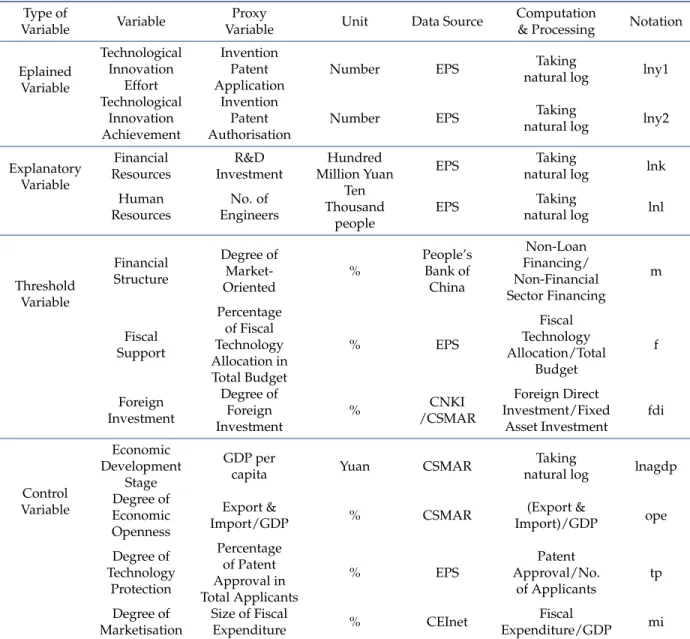
Threshold variable. The regression coefficient of R&D in-vestment to technological innovation may rely on threshold variable such as financing structure. The financing environment influences technological innovation by influencing the finance, usage and governance of R&D fund, therefore the indicator of R&D investment is the key indicator to connect financing envi-ronment and technological innovation in this article. When all the indicators of financing environment have become threshold variable, the influences will fall on the relation between R&D investment and technological innovation. Base on the above analysis, this article sets three financing environment variable as threshold variable: financial structure, intensity of fiscal support, and intensity of foreign investment. Firstly, financial structure is using market-oriented to scale, it is implying the percentage of financing, other than bank loan, in social financing; secondly, the intensity of fiscal support is showing the level of supporting in technological innovation, judging with the proportion of fiscal scientific and technological funding in local expenditure; thirdly, the intensity of foreign investment is indicating the compara-tive ratio of foreign investment to the local, judging with the proportion of investment in fixed assets by the foreign investors. Control variable. In order to control factors other than ex-planatory variable and threshold variable on the influence to technological innovation, adding degrees of economic develop-ment, economic openness, technical protection, marketization, etc., into the model as control variable. Details of all variables, such as proxy variable, source, computation and notation, are listed in Table 1, definition and explanation of variables.
5. DATA
Getting the data for each variable according to the computation and processing method in the table of variable definition. By using winsorize method for all variables of the two-tailed 1% reduction treatment to eliminate the impact of extreme value analysis. Data is ultimately shown in descriptive statistics table as follows.
The key of observation falls on the three threshold variables (financing environment variables): degree of market-oriented (m), percentage of fiscal support (f), and degree of foreign in-vestment (fdi). The observation finds that the degree of market-oriented in most provinces is less than 30%, mean and median are at around 10%, it is clearly that the current Chinese financial market structure is bank-oriented; percentage of fiscal support in most provinces is less than 4%, mean and median are at around 1.5%, the fiscal support in technological innovation is not high overall; degree of foreign investment is less than 20%, mean and median are about 4%, it is noteworthy that the degree of foreign investment has a bigger difference in the sample.
Due to the overall range of each threshold variable is smaller, the possibility of sudden change by financing environment in the relation between R&D investment and technological devel-opment is unlikely, but it is possible for enhancing or weakening the relation between R&D investment and technological inno-vation. Therefore, this article is using single threshold model. However, in order to prevent unobserved sudden changes in single threshold model, dual threshold model is using at the same time as reference, for seeking a stable result and analysis.
6. EMPIRICAL RESEARCH
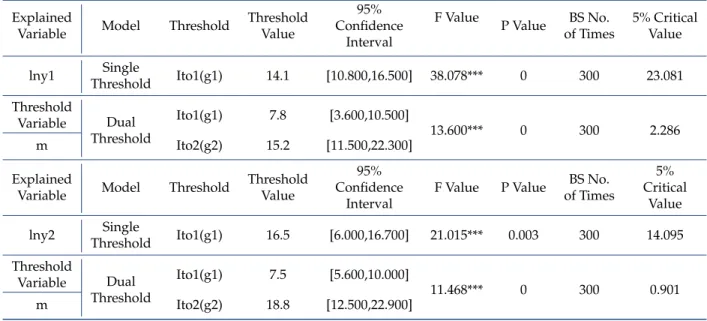
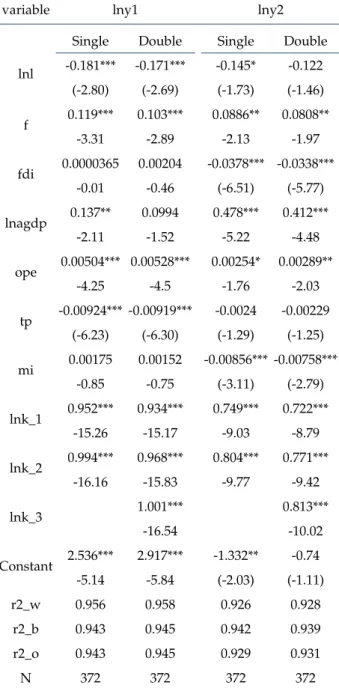
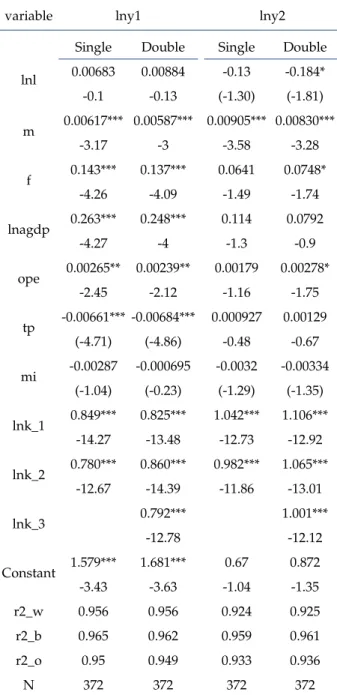
First of all, investigating the significance of threshold value for all three threshold variables, the investigation is done on the ba-sis of minimum residual rules with using a grid search method, in order to get the corresponding confidence interval. The inves-tigation has applied bootstrapping for 300 times for F statistic. The threshold value and its significance is shown as follows. In terms of threshold value, when financial structure is taken as threshold, the single threshold value for patent application is 14.1%, and the single threshold value for patent authorization is 16.5%, both are slightly different; when the intensity of fiscal support is taken as threshold, the single threshold values for patent application and authorization are 2.62% and 2.53%, they are having a higher consistency; when the degree of foreign investment is taken as threshold, the single threshold values for patent application and authorization are 11.7% and 12.5%, both are slightly different. In terms of patent application and patent authorisation, the single threshold values for financing environment are closer and consistent in general. In terms of the threshold significance, the models are having single and dual threshold significance under 10% confidence level, except for the intensity of fiscal support and the degree of foreign investment. Based on the investigation of threshold above, three financing en-vironmental threshold regression models are established. Firstly, observe the regression coefficients of the three financing envi-ronment variables which are as the control variables in each threshold regression model, and has found the coefficients of financial structure are positive and consistent with patent appli-cation and authorization; the coefficients of fiscal support are positive but unstable to invention patent application, and are corresponding to invention patent authorization; the coefficients of foreign investment to invention patent application are obvi-ously different in directivity and significance, but the coefficients to invention patent authorisation are all negative. This result shows that an increasing market-oriented level is possibly giv-ing impetus to efforts (attempts) and achievements (qualities) of technological innovation; the influences of an increasing in-tensity of fiscal support to attempts and efforts in technological innovation is stimulating, it is positive but unstable; the influ-ences of an increasing degree of foreign investment to efforts in technological innovation is not clear enough, but it has sig-nificant negative influences to the achievement of technological innovation. Then observe the interaction of lnk and dummy vari-able that is generated according to each threshold, the regression coefficients of lnk_*(*=1,2,3). The result of financial structure threshold regression shows no matter in single or dual threshold model, the coefficient for lnk_* is always positive, and will sig-nificantly increase along with financial structure threshold value. In the model with fiscal support as threshold, the coefficient of lnk_* has same characteristic with financial structure threshold model, that is showing positive and will increase along with the threshold value. However, in the model of foreign investment threshold, although the coefficient of lnk_* is positive, the overall coefficient decreases when foreign investment threshold value increase. This is meaning a higher degree of market-oriented and fiscal support brings higher correlation of R&D funding and patent, while a higher degree of foreign investment will weaken the correlation of R&D funding and patent. A higher degree of financial market-oriented brings a higher correlation of R&D funding and technological innovation, it may because of bank-oriented and market-oriented are different in financ-ing, risk management, information processfinanc-ing, and corporate
Table 1.Definition and explanation of variables
Type of
Variable Variable
Proxy
Variable Unit Data Source
Computation
& Processing Notation Eplained
Variable
Technological Innovation
Effort
Invention Patent Application
Number EPS Taking
natural log lny1
Technological Innovation Achievement
Invention Patent Authorisation
Number EPS Taking
natural log lny2
Explanatory Variable
Financial Resources
R&D Investment
Hundred
Million Yuan EPS
Taking
natural log lnk
Human Resources
No. of Engineers
Ten Thousand
people
EPS Taking
natural log lnl
Threshold Variable
Financial Structure
Degree of Market-Oriented
%
People’s Bank of
China
Non-Loan Financing/ Non-Financial Sector Financing
m
Fiscal Support
Percentage of Fiscal Technology Allocation in Total Budget
% EPS
Fiscal Technology Allocation/Total
Budget
f
Foreign Investment
Degree of Foreign Investment
% CNKI
/CSMAR
Foreign Direct Investment/Fixed
Asset Investment
fdi
Control Variable
Economic Development
Stage
GDP per
capita Yuan CSMAR
Taking
natural log lnagdp Degree of
Economic Openness
Export &
Import/GDP % CSMAR
(Export &
Import)/GDP ope
Degree of Technology
Protection
Percentage of Patent Approval in Total Applicants
% EPS
Patent Approval/No.
of Applicants
tp Degree of
Marketisation
Size of Fiscal
Expenditure % CEInet
Fiscal
Expenditure/GDP mi
Table 2.Descriptive statistics of variables
variable lny1 lny2 lnk lnl m f fdi lnagdp ope tp mi
min 2.375 1.099 -1.029 -3.297 0 0.377 0.126 8.343 3.929 30.447 8.076
p5 4.511 3.135 0.668 -2.207 0 0.7 0.418 8.64 5.309 36.33 9.125
p25 6.405 4.938 2.922 0.215 3.45 1.015 1.645 9.34 8.54 47.518 12.877
p50 7.4 5.975 4.08 1.03 9.2 1.265 3.31 9.908 12.898 55.871 16.646
mean 7.423 5.981 3.891 0.733 11.701 1.722 5.78 9.89 32.572 55.201 20.391
p75 8.606 7.099 5.086 1.584 17.65 2.15 8.278 10.433 35.411 61.966 22.237
p95 10.192 8.776 6.393 2.491 28.7 3.96 18.13 11.12 144.105 74.133 36.918
max 10.91 9.727 6.97 2.836 61.416 5.952 28.101 11.418 166.386 95.139 107.077
sd 1.689 1.696 1.683 1.297 10.874 1.131 5.912 0.742 41.07 11.614 14.735
governance of technological innovation. Banks control risk by examining scientific and technological projects, granting loans
to low risk projects, and intervening in borrower’s corporate governance to reduce its business risk, in a certain degree, these
Table 3.Threshold significance investigation of financial structure
Explained
Variable Model Threshold
Threshold Value
95% Confidence
Interval
F Value
P Value BS No. of Times
5% Critical Value
lny1 Single
Threshold Ito1(g1) 14.1 [10.800,16.500] 38.078*** 0 300 23.081
Threshold
Variable Dual
Threshold
Ito1(g1) 7.8 [3.600,10.500]
13.600*** 0 300 2.286
m Ito2(g2) 15.2 [11.500,22.300]
Explained
Variable Model Threshold
Threshold Value
95% Confidence
Interval
F Value P Value BS No. of Times
5% Critical
Value
lny2 Single
Threshold Ito1(g1) 16.5 [6.000,16.700] 21.015*** 0.003 300 14.095
Threshold
Variable Dual
Threshold
Ito1(g1) 7.5 [5.600,10.000]
11.468*** 0 300 0.901
m Ito2(g2) 18.8 [12.500,22.900]
Table 4.Threshold significance investigation of fiscal support
Explained
Variable Model Threshold
Threshold Value
95% Confidence
Interval
F Value P Value BS No. of Times
5% Critical Value
lny1 Single
Threshold Ito1(g1) 2.62 [1.510,2.620] 35.121*** 0.01 300 21.347
Threshold
Variable Dual
Threshold
Ito1(g1) 1.56 [1.260,2.130]
23.852*** 0.003 300 0.285
f Ito2(g2) 2.13 [0.950,2.530]
Explained
Variable Model Threshold
Threshold Value
95% Confidence
Interval
F Value P Value BS No. of Times
5% Critical Value
lny2 Single
Threshold Ito1(g1) 2.53 [2.320,2.620] 42.722*** 0 300 11.057
Threshold
Variable Dual
Threshold
Ito1(g1) 1.7 [0.830,2.040]
4.374 0.2 300 11.191
f Ito2(g2) 2.32 [2.320,2.530]
actions form barriers to the establishment and implementation of high risk technological innovation projects; collecting interest from borrowers and withdrawing fund on time is limiting the liberty in R&D funding usage, and is reducing its efficiency by adding on pressure to technological innovation enterprises, thus, it has generated certain limitations and restrictions to techno-logical innovation. Financial market provides investors with higher risk diversification mechanism and mobility, furthermore investors direct invest in R&D funding will undertake and enjoy the risks and profits that bring directly from the technological innovation projects. Not rushing to withdraw the profit, giving priority to the growth of enterprises and their projects, encourag-ing establishment and implementation of technological projects, having lesser pressure than banks to technological innovation enterprises, from this point of view, although both banks and markets can promote the development of technological innova-tion, the increasing level of financial market orientation is more effective for R&D funding as the role in promoting
technolog-ical innovation at the moment. In condition of a higher fiscal support degree, it is higher correlation between R&D funding and technological innovation. This may because of the finance improves the efficiency of technological innovation with R&D funding by providing finances, risk sharing, investment lever-age, and external corrective action. Finances supplies physical capital to technological innovation by funding, provides and trains personnel for technological innovation to accumulate hu-man capital, in order to amend all kinds of externalities during the process of technological innovation through establishing a complete technological innovation system. Fiscal support can provide high quality research equipment, environment, talents, and soft environment to technological innovation; this can save a lot of R&D funding for the principal part of technological in-novation from investing in these aspects, and R&D funding can be more concentrate on using in technological innovation, in order for a higher efficiency of R&D funding. Furthermore, the fiscal support to technological innovation is helping in reducing
Table 5.Threshold significance investigation of foreign investment
Explained
Variable Model Threshold
Threshold Value
95% Confidence
Interval
F Value P Value BS No. of Times
5% Critical Value
lny1 Single
Threshold Ito1(g1) 11.7 [10.240,12.640] 26.593*** 0 300 12.15
Threshold
Variable Dual
Threshold
Ito1(g1) 0.887 [0.694,7.569]
1.427 0.267 300 6.609
fdi Ito2(g2) 11.435 [9.128,12.640]
Explained
Variable Model Threshold
Threshold Value
95% Confidence
Interval
F Value P Value BS No. of Times
5% Critical Value
lny2 Single
Threshold Ito1(g1) 12.448 [0.694,12.640] 18.193*** 0.01 300 11.281
Threshold
Variable Dual
Threshold
Ito1(g1) 2.062 [0.694,7.750]
6.217* 0.063 300 7.009
fdi Ito2(g2) 12.448 [0.694,12.640]
the cost and risk of technological innovation, and thereby to attract and encourage private innovation subjects to invest in technological innovation spontaneously. By increasing foreign investment intensity, the correlation between R&D funding and technological innovation has decreased, and this is correspond-ing to the negative correlation between the foreign investment intensity as control variable and the implementation of techno-logical innovation. This has shown a negative side of foreign direct investment to Chinese technological innovation. The dom-inance and financial advantages of multinational corporation technology are attacking and crowing local market, local corpo-rations are at disadvantage in the market competition; they have strangled the seeding of local innovation, and have terminated the technological innovations, the human and capital invest-ments are wasted. Local technological innovation subjects are too busy for technological innovation. In order to compete with foreign enterprises, they use a lot of money for buying compara-tively underdeveloped readymade from overseas, and cause the local technological innovation subjects are lack of energy and funding for the innovation activities, and weaken their ability of independent technological innovation. Even if local enterprises proceed to digest, absorb and innovate on the basis of purchased technology, due to the underdeveloped technology, it is difficult to improve the core ability of technological innovation. The above results show explanatory variable, that is R&D funding, is correspondent to the result of technological innovation, but the correlation is different according to the distribution of threshold variable. As for threshold variable, financial structure and fiscal support which are in sample interval are having smaller range in index, and is in the uplink interval with correlation of R&D funding and technological innovation, their improvement will enhance the relation between R&D funding and technological innovation; it has to be aware of the effects of R&D funding from foreign investment to technological innovation, the inten-sity of foreign investment is seemingly to weaken the positive correlation between R&D funding and technological innovation, and yet to reach the level of negative correlation between R&D funding and technological innovation. Imitating marginal in-vestment is equal to the perspective of marginal product, for
R&D funding and technological innovation, the intensity of for-eign investment can continue to increase, until the correlation between F&D funding and technological innovation is close to 0 under foreign investment intensity threshold model.
7. CONCLUSION
This study has supported the view of financial structure and fis-cal support have positive influence on technologifis-cal innovation. On the relation between foreign investment and technological innovation has shown the complexity, the positive influences and negative influences of foreign investment to technological innovation are seem to be coexisting, but from the interpretation of the result in this study, negative influences are seem to be the mainstream. However, this is still a complicated and highly controversial topic.
From the point of view of financial structure, the best or uni-versal use of financial structure does not exist, the optimization of financial structure adjusts dynamically according to the eco-nomic development; the best financial structure is the one that suits the current stage, and has the highest efficiency. Due to the financial structure that has dominated by indirect financing in our country will not have fundamental change in near future, reforming and innovating the current financial system, estab-lishing a financial environment that is suitable for promoting technological innovation, and a financial system that is relatively supplementing in differentiation, specialization and function, in order to comply the integration and mutual complementarity of indirect financing and direct financing, to enhance the driv-ing force of finance to technological innovation. Developdriv-ing direct financing and expanding capital market is very important to technological innovation. We should further improve the structure and function of financial market and consummate the system and mechanism, fully unleash the importance of mar-ket in social resources allocation, and leads the social capital flows to innovative enterprises and projects. As for finances, there should be additional fiscal support to technological by increasing the percentage of fiscal technology allocation in total budget, as well as play the guiding role of fiscal support and fiscal policy to encourage the society, especially the enterprises,
Table 6.Financial structure threshold regression
variable lny1 lny2
Single Double Single Double
lnl -0.181*** -0.171*** -0.145* -0.122 (-2.80) (-2.69) (-1.73) (-1.46) f 0.119*** 0.103*** 0.0886** 0.0808**
-3.31 -2.89 -2.13 -1.97
fdi 0.0000365 0.00204 -0.0378*** -0.0338***
-0.01 -0.46 (-6.51) (-5.77)
lnagdp 0.137** 0.0994 0.478*** 0.412***
-2.11 -1.52 -5.22 -4.48
ope 0.00504*** 0.00528*** 0.00254* 0.00289**
-4.25 -4.5 -1.76 -2.03
tp -0.00924*** -0.00919*** -0.0024 -0.00229 (-6.23) (-6.30) (-1.29) (-1.25) mi 0.00175 0.00152 -0.00856*** -0.00758***
-0.85 -0.75 (-3.11) (-2.79)
lnk_1 0.952*** 0.934*** 0.749*** 0.722***
-15.26 -15.17 -9.03 -8.79
lnk_2 0.994*** 0.968*** 0.804*** 0.771***
-16.16 -15.83 -9.77 -9.42
lnk_3 1.001*** 0.813***
-16.54 -10.02
Constant 2.536*** 2.917*** -1.332** -0.74
-5.14 -5.84 (-2.03) (-1.11)
r2_w 0.956 0.958 0.926 0.928
r2_b 0.943 0.945 0.942 0.939
r2_o 0.943 0.945 0.929 0.931
N 372 372 372 372
Note: 1) lnk_1 indicates threshold variable is smaller than threshold value in single threshold model, or the interaction of dummy variable and lnk that are generated when threshold variable is smaller than first thresh-old value in dual threshthresh-old model. lnk_2 indicates threshthresh-old variable is greater than or equal to threshold value in single threshold model, or the interaction of dummy variable and lnk that are generated when threshold variable is greater than or equal to first threshold value but smaller than second threshold value in dual threshold model. lnk_3 indicates the in-teraction of dummy variable and lnk that are generated when threshold variable is greater than or equal to second threshold value in dual thresh-old model. Each threshthresh-old value is increased successively. 2) The brackets under the coefficients are T values.
to increase their investment, and establishing a pluralistic in-vestment system with multi channels. The implementation and completion of fiscal policy stimulates the technological innova-tion and technological result by taxing, corporate finance, asset management, etc., they enhance the approval efficiency for tech-nological innovation funds and projects, and create a favourable policy environment to technological innovation and
technologi-Table 7.Fiscal support threshold regression
variable lny1 lny2
Single Double Single Double
lnl -0.0522 -0.051 -0.0831 -0.112
(-0.67) (-0.67) (-0.90) (-1.21) m 0.00831*** 0.00811*** 0.0102*** 0.00998***
-4.23 -4.26 -4.55 -4.43
fdi -0.00621 -0.0123*** -0.0428*** -0.0429*** (-1.45) (-2.90) (-7.80) (-7.72) lnagdp 0.157** 0.209*** 0.204*** 0.207***
-2.57 -3.48 -2.59 -2.64
ope 0.00228** 0.00174* 0.00245** 0.00366***
-2.04 -1.69 -1.99 -3.05
tp -0.00676*** -0.00594*** 0.000571 0.000445
(-4.79) (-4.33) -0.33 -0.26
mi -0.00113 0.00106 -0.00406 -0.00472* (-0.35) -0.33 (-1.57) (-1.83) lnk_1 0.908*** 0.841*** 0.882*** 0.909***
-14.82 -13.75 -11.57 -11.89
lnk_2 0.959*** 0.881*** 0.968*** 0.877***
-15.58 -14.56 -12.75 -11.53
lnk_3 0.925*** 0.965***
-15.64 -12.76
Constant 2.590*** 2.220*** 0.602 0.517
-5.75 -5.04 -1.05 -0.9
r2_w 0.939 0.942 0.927 0.928
r2_b 0.968 0.955 0.933 0.935
r2_o 0.953 0.947 0.936 0.937
N 372 372 372 372
Note: 1) lnk_1 indicates threshold variable is smaller than threshold value in single threshold model, or the interaction of dummy variable and lnk that are generated when threshold variable is smaller than first thresh-old value in dual threshthresh-old model. lnk_2 indicates threshthresh-old variable is greater than or equal to threshold value in single threshold model, or the interaction of dummy variable and lnk that are generated when threshold variable is greater than or equal to first threshold value but smaller than second threshold value in dual threshold model. lnk_3 indicates the in-teraction of dummy variable and lnk that are generated when threshold variable is greater than or equal to second threshold value in dual thresh-old model. Each threshthresh-old value is increased successively. 2) The brackets under the coefficients are T values.
cal result. In view of the intensity of foreign investment brings certain positive influence and significant negative impact to our technological innovation, it indicates that besides continuing in promoting foreign investment, we need to be careful in the process of using foreign capital. We should integrate applied finance and fiscal tools, guide and adjust the distorted compe-tition within industry, integrate the advantages of enterprises’
Table 8.Foreign investment intensity threshold regression
variable lny1 lny2
Single Double Single Double
lnl 0.00683 0.00884 -0.13 -0.184*
-0.1 -0.13 (-1.30) (-1.81)
m 0.00617*** 0.00587*** 0.00905*** 0.00830***
-3.17 -3 -3.58 -3.28
f 0.143*** 0.137*** 0.0641 0.0748*
-4.26 -4.09 -1.49 -1.74
lnagdp 0.263*** 0.248*** 0.114 0.0792
-4.27 -4 -1.3 -0.9
ope 0.00265** 0.00239** 0.00179 0.00278*
-2.45 -2.12 -1.16 -1.75
tp -0.00661*** -0.00684*** 0.000927 0.00129
(-4.71) (-4.86) -0.48 -0.67
mi -0.00287 -0.000695 -0.0032 -0.00334 (-1.04) (-0.23) (-1.29) (-1.35) lnk_1 0.849*** 0.825*** 1.042*** 1.106***
-14.27 -13.48 -12.73 -12.92
lnk_2 0.780*** 0.860*** 0.982*** 1.065***
-12.67 -14.39 -11.86 -13.01
lnk_3 0.792*** 1.001***
-12.78 -12.12
Constant 1.579*** 1.681*** 0.67 0.872
-3.43 -3.63 -1.04 -1.35
r2_w 0.956 0.956 0.924 0.925
r2_b 0.965 0.962 0.959 0.961
r2_o 0.95 0.949 0.933 0.936
N 372 372 372 372
Note: 1) lnk_1 indicates threshold variable is smaller than threshold value in single threshold model, or the interaction of dummy variable and lnk that are generated when threshold variable is smaller than first thresh-old value in dual threshthresh-old model. lnk_2 indicates threshthresh-old variable is greater than or equal to threshold value in single threshold model, or the interaction of dummy variable and lnk that are generated when threshold variable is greater than or equal to first threshold value but smaller than second threshold value in dual threshold model. lnk_3 indicates the in-teraction of dummy variable and lnk that are generated when threshold variable is greater than or equal to second threshold value in dual thresh-old model. Each threshthresh-old value is increased successively. 2) The brackets under the coefficients are T values.
resources, enhance the competitive ability of local enterprises to cope with foreign investment, and fully unleash the positive effect from foreign investment to technological innovation. REFERENCES
1. Ayyagari M., Demirgü-kunt A., & Maksimovic V. (2012). Firm Innovation in Emerging Markets: the Role of Finance, Governance, and
Competi-tion. Journal of Financial and Quantitative Analysis, 46(6), 1545–1580. 2. Amore M. D., Schneider C., & Aldokas A. (2013). Credit Supply and Corporate Innovation. Journal of Financial Economics, 109(3), 835–855. 3. Brown J. R., Martinsson G., & Petersen B. C. (2012). Do Financing Constraints Matter for R&d. European Economic Review, 56(8), 1512– 1529.
4. Hsu P., Tian X., & Xu Y. (2014). Financial Development and Innovation: Cross-country Evidence. Journal of Financial Economics, 112(1), 116– 135.
5. Lin Y. F., Xu L. X., Kou H., et al. (2012). Financial Structure and Economic Development. Financial Regulation Research, (3), 4–20.
6. Maskus K. E., Neumann R., & Seidel T. (2012). How National and International Financial Development Affect Industrial R&d. European Economic Review, 56(1), 72–83.
7. Sun W. Q., & Wang P. (2013). Research on China’s Financial Devel-opment to Promote Technology Innovation. Management World, (6), 172–173.
8. Lu D., & Wang T. J. Technical Innovation and Financial Development. (2013). On Economic Problems, (5), 36–40+99.
9. Yao Y. J., & Dong G. F. (2013). Financial Development, Financial Struc-ture and Technological Progress: Empirical Evidence from China’s Provincial Panal Data. Contemporary Finance & Economic, (11), 56–65. 10. Baldock R., & North D. (2012). The Role of UK Government Equity Funds in Addressing the Finance Gap Facing SMEs with Growth Poten-tial. Conference Paper, Dublin.
11. Meuleman M., & De maeseneire W. (2012). Do R&d Subsidies Affect SMEs’ Access to External Financing. Research Policy, 41(3), 580–591. 12. Li R., & Zhou P. (2012). Government Behavior and Independent In-novation Based on the Perspective of Supply and Demand. Forum on Science and Technology in China, (3), 11–17.
13. Huergo E., & Moreno L. (2014). National Or International Public Fund-ing Subsidies Or Loans EvaluatFund-ing the Innovation Impact of R&d Support Programmes. University Library of Munich, Germany.
14. Eini E. (2014). R&d Subsidies and Company Performance: Evidence From Geographic Variation in Government Funding Based on the Erdf Population-density Rule. Review of Economics and Statistics, 96(4), 710–728.
15. Brander J. A., Du Q., & Hellmann T. (2014). The Effects of Government-sponsored Venture Capital: International Evidence. Review of Finance. 16. Ye L., & Zhao X. D. (2013). State-market Relationship in Technology Innovation: Lessons from Oxfordshire, UK. Journal of Public Administra-tion, 2013, (5), 36–59+178.
17. Wu Y. (2014). Impact of Governmental Investment on Science & Tech-nology Innovation: Empirical Test Based on Panel Data of 40 countries from 1982 to 2010. Science of Science and Management of S.&.T., (1), 16–22.
18. He R. Y., & Zhang Y. X. (2013). Dynamic Contribution of S&T Public Expenditure to S&T Innovation in China – An Empirical Analysis Based on SVAR Model. R&D Management, (5), 127–134.
19. Gao X., & Zhang W. (2013). Foreign Investment, Innovation Capacity and Environmental Efficiency in China. Mathematical and Computer Modelling, 58(5), 1040–1046.
20. Chen F. Q., Zhong F. F., & Chen Y. (2013). Chinese OFDI and Technol-ogy Innovation. Journal of Zhejiang University (Humanities and Social Sciences), (4), 170–181.
21. Zhou W. (2014). Inward FDI, Independent R&D and Economic Growth: Empirical Analysis from China. Nanjing Journal of Social Sciences, (12), 15–22.
22. Yao Z. W., & Chen X. W. (2012). Impact and Evolution of FDI and R&D on China’s Technological Innovation Capability: From the Perspective of Lagged-effect. Forecasting, (2), 44–49.
23. Jeon Y., Park B. I., & Ghauri P. N. (2013). Foreign Direct Investment Spillover Effects in China: Are They Different Across Industries with Different Technological Levels. China Economic Review, 26, 105–117.