Object Tracking
Dmytro Mykheievskyi1, Dmytro Borysenko1, and Viktor Porokhonskyy1⋆
Samsung R&D Institute Ukraine (SRK), 57 L’va Tolstogo Str., Kyiv 01032, Ukraine {d.borysenko,d.mykheievsk,v.porokhonsk}@samsung.com
Abstract The present study aims at learning class-agnostic embedding, which is suitable for Multiple Object Tracking (MOT). We demonstrate that the learning of local feature descriptors could provide a sufficient level of generalization. Proposed embedding function exhibits on-par per-formance with its dedicated person re-identification counterparts in their target domain and outperforms them in others. Through its utilization, our solutions achieve state-of-the-art performance in a number of MOT benchmarks, which includes CVPR’19 Tracking Challenge.
1
Introduction
Multiple Object Tracking (MOT) problem has been receiving considerable atten-tion from the computer vision community due to its significance to a number of practical tasks, such as scene understanding[1], activity recognition[2], behavior analysis[3], etc. Over the past few years, MOT solutions have gained considerable performance improvement[4–6] partially due to the advance in Object Detection. Namely, detectors rapidly progressed from Ada-Boost-based solutions, such as ACF detector[7], to CNN-based ones[8–12]. While the former are capable of re-turning bounding boxes with the fixed aspect ratio for a single category, the latter successfully deal with multiple categories and arbitrarily shaped objects. This progress was started by the invention of a two-stage detector[11]. It was further stimulated by the introduction of a single-stage paradigm[10] and conse-quent competition between the two[8,9,12]. The invention of Feature Pyramid Network (FPN)[13], backbone efficiency improvement[14,15], Regression Cas-cades[16], Deformable Convolutions[17,18] also resulted in considerable accuracy gains. This progress was one of the main reasons why Detection-Based Tracking (DBT), which is also known as tracking-by-detection, has become the dominat-ing paradigm in MOT domain[19]. It essentially breaks MOT problem into the following sub-tasks: detection, embedding function application to the image area corresponding to each detect, and data association. Making the detection stage independent of the remaining two, DBT facilitates the adoption of modern de-tectors. In its turn, any gain in Multiple Object Detection Accuracy (MODA)
⋆
strongly positively affects the main MOT metrics[19–21], such as Multiple Ob-ject Tracking Accuracy (MOTA), via False Positive (FP) and False Negative (FN) counts.
At the same time, contemporary DBT solutions do not live up to the full potential of their detection stage. In particular, most of them keep relying on embeddings learned with single category datasets, thus making the scope of the entire solution restricted to that single category. Moreover, the choice of categories themselves is quite limited as long as the public datasets[5,6,22–24] are concerned. The main two options are pedestrians and vehicles. Even though a few DBT solutions have managed to keep their scope up with the scope of the corresponding detector, so far all of them are associated with costly compromises. For example, SORT[20] became applicable to multiple categories via the sacrifice of appearance information. Relying solely on the intersection-over-union (IoU) between considered detects at the data association stage obviously reduces its accuracy and limits the applicability. Quite an opposite path was taken by Wang et al. [25], who proposed to Jointly learn the Detection and Embedding (JDE) model in a multi-task manner so that the detector and embedding could deal with the same set of categories. However, such simultaneous training requires ID annotation to be available throughout the corresponding dataset. Besides the batch formation procedure for embedding learning, in this case, is expected to be less flexible compared to a devoted one.
All in all, a wide application of contemporary DBT solutions in practice is somewhat impeded by either the necessity of specific dataset creation or their compromised accuracy and applicability. Due to the former factor, the tracking of arbitrary objects (e.g. animals, robots, biological cells, etc.) becomes pro-hibitively expensive for the vast majority of applications.
Perhaps, the most radical solution to the problem of restricted DBT scope would be the utilization of class-agnostic embedding functions. Among tentative candidates for this role, one could mention Learned Local Features Descriptors (LLFD)[26–29]. While corresponding embedding functions shall obviously be sensitive to object appearance, to the best of our knowledge their utilization for object representation has not been reported. Indeed, there are a few factors that make such endeavor questionable. In the first place, the representation of objects in the case of LLFD could hardly correspond to the conventional one. Namely, the objective of typical DBT embedding function is to produce compact and separable object manifolds, when the loss formulation is adopted from metric learning[30]. The same loss combined with a different sampling approach in the case of LLFD is expected to result in extended and non-separable manifolds. At the same time, one could argue that visually similar samples, even if attributed to different manifolds, would tend to get mapped close to each other in the met-ric space. Along with the gradual evolution of object appearance observed in typical MOT setting, such property could potentially serve as a trade-off for lost manifold compactness and separability. Next, susceptibility to background vari-ation and/or occlusions is another point of concern. Finally, the discriminative capability of LLFD may suffer from a rather low resolution of its input.
As the nature of listed above concerns calls for an empirical approach, in this study we report our rather successful results of LLFD utilization for Multiple Object Tracking. In addition, we discuss the essential features of object repre-sentation, which corresponds to the employed embedding. Finally, the aspects, which turn out to have a positive impact on its efficiency, are indicated.
The paper is organized in the following way: the second section is dedicated to related work. Section3 is devoted to the preparation of our DBT MOT solu-tion, which takes into account the object representation expected from LLFD. In particular, we consider the necessary adjustments, which ameliorate embedding function performance. Among them are the resolution of input patches, preserv-ing color information, etc. For the sake of reproducibility, the details on the detector and the association stage are provided as well. In the following section, our MOT solution is evaluated and compared with other methods. In Section5, the properties of the proposed embedding function are discussed.
2
Related Work
The two approaches to embedding learning, which are relevant to our study, are the following: person re-identification (Re-ID) and learned local feature descrip-tors. While being similar in some aspects, they exhibit a conceptual difference regarding the criteria, according to which given two samples are treated as such that belong to the same category or, in other words, could form a positive sample pair during training. In the case of person Re-ID, image patches representing a given category have to depict the same object. The difference in object appear-ance in these patches remains disregarded during the label assignment. In the case of LLFD, however, the appearance of samples affects label assignment in a more profound manner. Namely, it is required that the patches ascribed to a given category depict the same pattern. At the same time, it could be viewed from different perspectives and/or under various lighting conditions[26,31]. Typ-ically each such pattern represents the vicinity of a particular local keypoint. Due to their nature, the patterns normally do not possess any specific bound-ary. As a consequence, the patterns extend right to the borders of corresponding patches. This is another important difference from the case of person Re-ID, where the image patches serving as training samples depict objects with well-defined boundaries. And these boundaries rarely extend to the patch borders. Some other aspects of these two approaches are summarized below.
2.1 Embedding Learning: Person Re-ID
Let us consider some person Re-ID aspects, which are relevant to MOT problem. While several approaches are being used in this domain the solutions applied to MOT task usually rely on metric learning. The employed backbone topologies vary from those adopted from classification domain to the specifically designed ones, as e.g. OSNet[32]. ResNet-50[14] became de facto the standard option in the former case. Out of several representation options, global features turn out
to be the most popular in DBT paradigm[19]. Successful solution tend to benefit from attention utilization[30,33,34]. Multi-scale feature learning is another topic of active research, which is approached explicitly by e.g. OSNet[32].
As far as training data are concerned, it is worth mentioning the following factors. There is a number of widely used image and video datasets, see Ref. [30] for an extensive list. Some of them are restricted to cropped patches, while oth-ers contain entire scenes. The annotation quality depends on whether a manual or automatic method was employed. The latter may include the application of Object Detectors (OD), trackers, and Re-ID solutions. However, even in the for-mer case, the noise rate remains non-negligible[30]. Occlusions are quite frequent due to the scene and objects nature.
2.2 Embedding Learning: Local Feature Descriptors
Due to this task nature, it is desirable to start with the description of public datasets. Among the most influential options in this area are UBC PhotoTour[31] and HPatches[26]. Despite being introduced in 2007, UBC PhotoTour provides a sufficient amount of data for CNN training. Being a patch-based dataset it con-tains more than 106 grayscale patches extracted from three scenes. The patches
represent image areas around local keypoints. The positive samples correspond to the matching keypoints. Recently introduced HPatches[26] addresses several limitations inherent in UBC PhotoTour, such as scarce diversity with respect to data, tasks, and the type of features. In particular, it consists of 116 sequences containing 6 RGB images each. These sequences form two groups: 59 sequences with significant viewpoint change and 57 with illumination change. In addition to the extracted grayscale patches, the dataset includes the set of original images in RGB format as well as the homography matrices representing the transfor-mation between the images belonging to the same sequence.
The necessity to process numerous features per image imposes certain lim-itations on the network topologies. For this reason, specific lightweight CNN topologies find use in this domain. In recent years fully convolutional 7 layer CNN design of L2-Net[28] has been enjoying broad utilization[27,35–38].
Since the training task is usually formulated as a metric learning problem, a lot of effort is being invested into the following two directions: formulation of more efficient loss function; and rising the proportion of so-called hard training samples. The former activity is mainly related to modifying the triplet loss. The latter deals with the fact that a fair portion of randomly formed triplets tends to satisfy the objective function right away. Balntas et al. [29] approach this problem by means of the anchor swap, also known as hard-negative sampling within the triplet. In HardNet[27] the hardest-in batch sampling strategy was proposed. In this case, triplet loss reads
Lt= 1 N N X i=1 max xi−x+i 2+ 1−minj6=ikxi−xjk2,0 , (1)
where (xi, x+i )i=1...N designate descriptors corresponding to a set of N positive
pairs. Each pair originates from the same local keypoint. This method gained broad recognition[35,36] due to its straightforward implementation and lack of side-effects. As examples of triplet loss modification, it is worthwhile to mention the following. Zhang et al.[39] proposed a regularization term named Global Orthogonal Regularization in order to achieve a more uniform distribution of embedding vectors over the unit hypersphere. The authors of SOS-Net[36] put forward an additional term named Second-Order Similarity aimed at improving cluster compactness in the metric space. In terms of Eq.1, the net loss function, in this case, assumes the next form
L=Lt+ 1 N N X i=1 v u u t N X j6=i,j∈ci kxi−xjk2− x+i −x+j 2 2 , (2) where cj= xi∈KN N(xj)∨x+i ∈KN N x+j (3) withKN N(xi) being a set ofknearest neighbors in the euclidean space.
3
ODESA-based Tracker
In order to assess the applicability of LLFD for MOT problem we prepare a DBT solution, which accounts for the peculiarities in corresponding object rep-resentation, and test its performance with relevant benchmarks. Regarding these peculiarities, we make the following assumptions. Gradual appearance evolution of objects observed between adjacent frames in a typical MOT environment being combined with local descriptor capability to relate similar patterns is expected to produce object manifolds that evolve in the metric space in a non-abrupt manner. At longer time scales, certain objects may exhibit drastic changes in appearance. Thus corresponding manifolds could likely become quite extended. Periodic motion potentially could produce closed ”trajectories” in the metric space. Also, the embedding derived from LLFD is assumed to exhibit better discrimination properties, if color information is preserved. This assumption is based on much lower probability to encounter lighting condition variations in a MOT environment compared to e.g. the case of image retrieval, where LLFD are typically find use. We also assume them to benefit from higher resolution of input patches. To distinguish the embeddings that were modified according to our assumptions from their LLFD origin, we will refer to them, hereafter, as Object DEscriptor that is Smooth Appearance-wise (ODESA).
The rest of this section is devoted to the description of our DBT solution, which in many aspects turns out to be similar to DeepSORT[40]. The subsections devoted to its components are ordered in accordance with DBT processing flow.
3.1 Object Detector
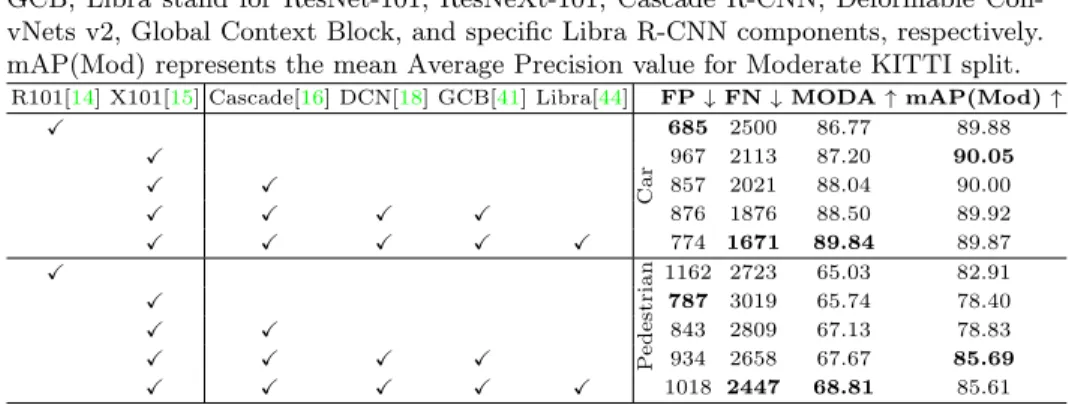
The main objective for detector design was to obtain a competitive solution constructed from the building blocks reported elsewhere[11,13–16,18,41]. In
Table 1: Ablation analysis of object detector components. R101, X101, Cascade, DCN, GCB, Libra stand for ResNet-101, ResNeXt-101, Cascade R-CNN, Deformable Con-vNets v2, Global Context Block, and specific Libra R-CNN components, respectively. mAP(Mod) represents the mean Average Precision value for Moderate KITTI split.
R101[14] X101[15] Cascade[16] DCN[18] GCB[41] Libra[44] FP↓FN↓MODA↑mAP(Mod)↑
X C a r 685 2500 86.77 89.88 X 967 2113 87.20 90.05 X X 857 2021 88.04 90.00 X X X X 876 1876 88.50 89.92 X X X X X 774 1671 89.84 89.87 X P e d e st ri a n 1162 2723 65.03 82.91 X 787 3019 65.74 78.40 X X 843 2809 67.13 78.83 X X X X 934 2658 67.67 85.69 X X X X X 1018 2447 68.81 85.61
particular, the component implementations of MMDetection repository[42] were reused. KITTI Tracking Benchmark[4] was considered as the main target.
The two-stage detector based on Faster R-CNN[11] was taken as the starting point. ResNet-101[14] and ResNeXt-101[15] pre-trained on ImageNet[43] were opted for the backbone. The following components were utilized as extension options: FPN[13], Regression Cascades[16], the deformable convolution[18], and Global Context Blocks (GCB)[41]. Also, IoU-balanced Sampling, Balanced Fea-ture Pyramid, and Balanced L1 Loss of Libra R-CNN[44] were considered.
For experiments conducted on KITTI dataset[22], separate detectors were prepared forCarandPedestriantargets. 7481 training images for the detection task were divided into a trainset of 4418 images and a local validation set of 3063 images so that the former does not contain any samples from 21 training sequences for the tracking task. 4418 KITTI images were supplemented with a sub-set from BDD[45] dataset, where 4975 suitable images were selected. Each detector was configured to output two categories. These were eitherCarandVan
orPedestrian andCyclist. Such a configuration helps to get better accuracy. The models were trained using SGD optimizer with momentum 0.9 and weight decay 10−4. The learning rate was set to linearly increase from 3×10⁻⁴
to 10−2 over the initial 500 warm-up training steps. The resulting rate was used
for 15 epochs. Finally, it was set to 10−3 for the last 10 epochs. The training
was performed with a batch size of 16 on 8 GPUs. As augmentation, we applied multi-scale training and random horizontal flips. During evaluation and infer-ence, the input images were resized to bring the shorter side to 700 pixels with preserved aspect ratio. The results of detector evaluation on 21 KITTI tracking train sequences are presented in Table1.
3.2 ODESA Embedding
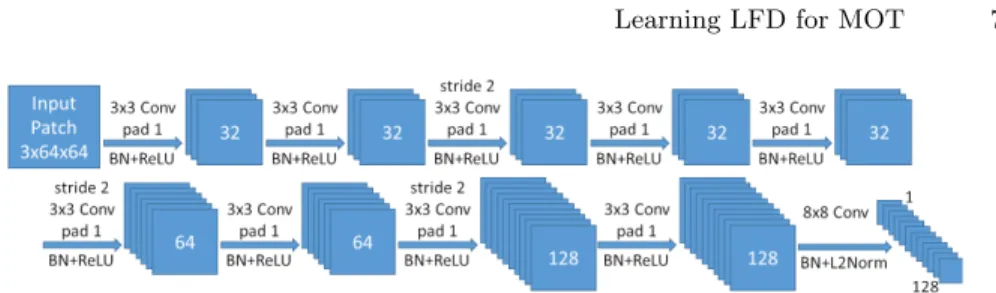
The topology of CNN adopted for ODESA models, which is depicted in Fig.1, was derived from L2-Net[28]. The modifications are related to adopting
multi-Fig. 1. CNN topology of ODESA(HSV64/128) model. The last seven convolutions correspond to L2-Net. The three layers introduced at the beginning reduce the lateral dimension of feature maps to 32x32, which is the standard size of LLFD input patch.
channel input and the increase of input patch resolution.
For training, we utilize exclusively the data from HPatches dataset[26]. In particular, the original set of RGB images and corresponding homography ma-trices were used as the starting point for patch extraction. By conducting this procedure by ourselves we obtained a set of patches with preserved color informa-tion. The original set is accessible in the grayscale format only. And to the best of our knowledge, the corresponding keypoint parameters are not publicly available. As for the patch extraction routine itself, we followed the procedure of Ref. [26]. The random transformations of keypoints with respect to their position, scale, and orientation were reproduced as well. Unless explicitly stated otherwise, they were applied before projecting keypoints into related images in order to sim-ulate the detection noise. As it will be discussed later these transformations significantly affect embedding properties. Single intentional modification of the patch extraction routine concerned with the choice of local keypoint detectors. Namely, as an alternative to the original option, i.e. a combination of Differ-ence of Gaussian, Hessian-Hessian, and Harris-Laplace1 the following learnable
Keypoint Detectors were considered: LF-Net[47] and D2-Net[48]. Hereafter, the former will be referred to as HandCrafted Keypoint Detectors (HCKD).
The loss function of Eq.2 was used with the default settings from Ref. [36]. SGD optimizer with the momentum value of 0.9 and the weight decay of 10−4
was used. The learning rate was configured to decrease linearly from the initial value of 0.1 to zero over 20 epochs. Xavier[49] weight initialization method was employed. The batch size was set to 512. Random horizontal flips were used.
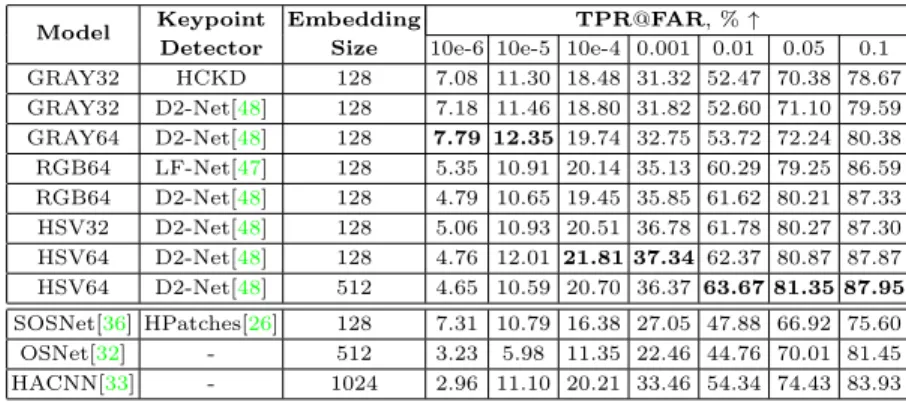
The embedding model for our tracking solution was selected via the vali-dation procedure described in Ref. [25]. Essentially this routine estimates True Positive Rate at a given value of False Acceptance Rate (TPR@FAR) for a re-trieval task set on a combination of person Re-ID datasets[24,50,51]. The results of such validation are presented in Table 2. As long as the range of FAR val-ues from 10−4 to 10−1 is concerned, about every next entry in Table 2shows a
gradual improvement of TPR. In particular, the increase of input patch resolu-tion from 32x32 to 64x64 results in higher performance. The patch sizes beyond 64x64 do not bring any considerable improvement. This observation indicates
1
Table 2: Embedding validation results obtained according to the routine described in Ref. [25] on a set of public person Re-ID datasets. The model name in the first column refers to the color space and the size of square input patch in pixels. A number of person Re-ID and LLFD models were added to serve as a reference.
Model Keypoint Embedding TPR@FAR, %↑
Detector Size 10e-6 10e-5 10e-4 0.001 0.01 0.05 0.1 GRAY32 HCKD 128 7.08 11.30 18.48 31.32 52.47 70.38 78.67 GRAY32 D2-Net[48] 128 7.18 11.46 18.80 31.82 52.60 71.10 79.59 GRAY64 D2-Net[48] 128 7.79 12.35 19.74 32.75 53.72 72.24 80.38 RGB64 LF-Net[47] 128 5.35 10.91 20.14 35.13 60.29 79.25 86.59 RGB64 D2-Net[48] 128 4.79 10.65 19.45 35.85 61.62 80.21 87.33 HSV32 D2-Net[48] 128 5.06 10.93 20.51 36.78 61.78 80.27 87.30 HSV64 D2-Net[48] 128 4.76 12.01 21.81 37.34 62.37 80.87 87.87 HSV64 D2-Net[48] 512 4.65 10.59 20.70 36.37 63.67 81.35 87.95 SOSNet[36] HPatches[26] 128 7.31 10.79 16.38 27.05 47.88 66.92 75.60 OSNet[32] - 512 3.23 5.98 11.35 22.46 44.76 70.01 81.45 HACNN[33] - 1024 2.96 11.10 20.21 33.46 54.34 74.43 83.93
that the upscaling of training patches from their original size of 65x65 pixels could be the limiting factor here. The datasets obtained by means of the learned keypoint detectors[47,48] permit to learn models, which consistently outperform the combination of hand-crafted keypoint detectors. The color information ap-pears to be beneficial for this particular dataset. As will be shown later, the same conclusion holds for MOT datasets as well. We assume that this observation is related to limited changes in lighting conditions in typical person Re-ID or MOT scenes. HSV color space consistently outperforms other checked options, such as LAB, YUV, HLS, etc. Finally, the embedding dimensionality increase beyond 128 brings only moderate performance gains. The extended version of Table2is provided in the supplementary material.
3.3 Data Association Stage
The Hungarian algorithm[52] was employed to perform the association between incoming detects and known tracks. The appearance of each detect was reflected by a single embedding vectorxjof dimensionalityk. The manifoldsHi={xt}Dt=1
containing up toDmaxmost recent embedding vectors, which were linked to each other in the past, represented the known tracks. Keeping in mind our assump-tions about the non-compact nature of ODESA object representation and grad-ual appearance evolution, in the most general case we calculate the assignment matrix in the following way
ci,j= (1−λ)min 1 2 s X k xk t −xkj 2 |xt∈ Hi +λ(1−IoU(i, j)). (4) Here each matrix element is represented by the normalized weighted sum of two terms. The first one reflects the distance in the metric space betweenj-th detect
and its closest element of i-th manifold. The second one depends on the IoU value between the same detect and the most recent element from the considered manifold. In other words, such cost formulation promotes association with the closest manifold. Due to the second term, the association with the most recent manifold element may get an additional boost. λvalues were kept up to 0.1 in all cases, where IoU was used in combination with the appearance information. In order to incorporate motion information, we used the Mahalanobis gate. It was based on possible object location predicted by the Kalman filter[53,54] as described in DeepSORT[40]. The association was regarded as permitted, i.e.
bi,j = 1, on condition that Mahalanobis gating got passed and its final cost
turned out to be smaller than the threshold valueτ:
bi,j= 1l [ci,j≤τ]. (5)
Comparing our data association stage with those reported elsewhere[19,20,40], one could notice that it does not contain any unique components. The single requirement to it, which follows from the assumed object representation, is re-lated to the criterion of visual similarity estimation. The expectations regard-ing considerable manifold extent make the minimal distance the simplest and, at the same time, quite a reasonable choice. By applying this or similar crite-rion, about any DBT solution could be adjusted to the utilization of LLDF or ODESA-like embeddings. On condition that the same ID restoration after object re-appearance is of interest, the utilization of larger Dmax values makes an ob-vious sense. In our experiments, we keptDmax≤100, as further increases were not related to any accuracy gains. Such settings are also quite usual in DBT solutions[19,40].
4
Results
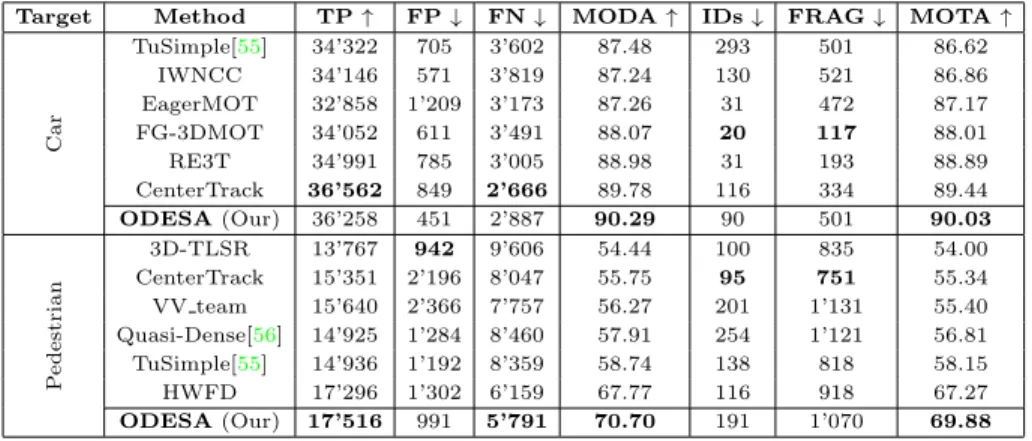
The evaluation results for our tracking solution on the testset of KITTI Tracking Benchmark[4] are presented in Table 3 along with the top-performing submis-sions. In this particular case, the following settings were applied: the Kalman filter was switched off, Dmax was set to 1, and λ in Eq. 4 was equal to 0.1. HSV64/128 model was employed as the embedding function. It is evident from this table that our trackers achieve state-of-the-art performance in both leaderboards. They outperform other methods according to MODA metric while demonstrating reasonable ID Switch (IDs) counts. In order to make direct com-parison between ODESA and a number of embeddings that often find use in MOT domain our DBT solution was adjusted to accept the latter as alterna-tive options. In this case, the influence of the detection and data association stages becomes separated. The results are summarized in Table 4. Here each entry corresponds to the case, where the model listed in the first column was employed in our DBT solution as the embedding function. All person Re-ID models were trained on Market-1501[58] dataset, which is a common practice
2
Table 3: Top-performing solutions from KITTI Tracking Benchmark leaderboards.2 MOTA is being the main evaluation criterion.
Target Method TP↑ FP↓ FN↓ MODA↑ IDs↓ FRAG↓ MOTA↑
C a r TuSimple[55] 34’322 705 3’602 87.48 293 501 86.62 IWNCC 34’146 571 3’819 87.24 130 521 86.86 EagerMOT 32’858 1’209 3’173 87.26 31 472 87.17 FG-3DMOT 34’052 611 3’491 88.07 20 117 88.01 RE3T 34’991 785 3’005 88.98 31 193 88.89 CenterTrack 36’562 849 2’666 89.78 116 334 89.44 ODESA(Our) 36’258 451 2’887 90.29 90 501 90.03 P e d e st ri a n 3D-TLSR 13’767 942 9’606 54.44 100 835 54.00 CenterTrack 15’351 2’196 8’047 55.75 95 751 55.34 VV team 15’640 2’366 7’757 56.27 201 1’131 55.40 Quasi-Dense[56] 14’925 1’284 8’460 57.91 254 1’121 56.81 TuSimple[55] 14’936 1’192 8’359 58.74 138 818 58.15 HWFD 17’296 1’302 6’159 67.77 116 918 67.27 ODESA(Our) 17’516 991 5’791 70.70 191 1’070 69.88
Table 4: Comparison with state-of-the-art person Re-ID embeddings on 21 KITTI tracking training sequences forCarandPedestriantargets. The association is restricted
solely to visual similarity, i.e.λ= 0 in Eq.4.
Method Car Pedestrian
MODA↑IDs↓FRAG↓MOTA↑MODA↑IDs↓FRAG↓MOTA↑ SOSNet[36] 89.84 47 304 89.65 68.81 98 540 67.93 HardNet++[27] 43 298 89.66 93 537 67.97 OSNet[32] 65 317 89.57 78 523 68.11 MLFN[57] 57 312 89.61 88 532 68.02 HACNN[33] 50 305 89.63 81 525 68.08 AGW[30] 51 308 89.63 81 522 68.08 ODESA(GRAY64/128) 31 288 89.71 88 530 68.02 ODESA(HSV64/128) 35 292 89.70 84 527 68.05 ODESA(HSV64/512) 40 296 89.69 81 525 68.08
for MOT solutions. The remaining models were trained on HPatches[26]. The detects employed for these experiments correspond to the detector entries, which achieve the highest MODA values for a given target in Table1. Let us consider IDs count, which appears to be more discriminative compared to Fragmenta-tion (FRAG). Our most universal target-wise model, which is HSV64/128, with 84 IDs is about 8% behind OSNet[32]. The latter with 78 switches turns out to be the best-performing embedding for Pedestrian target. At the same time HACNN[33], which has the lowest IDs count forCar target, is outperformed by the same ODESA model by 43%. Also for both targets, our models show consis-tently lower IDs counts compared to the contemporary LLFD models represented by HardNet++[27] and SOSNet[36]. These results are also consistent with the retrieval experiments summarized in Table 2. ODESA achieves such accuracy level while operating with smaller input patches, shorter embedding vector, and exhibiting faster inference time compared to the person Re-Id models.3
3
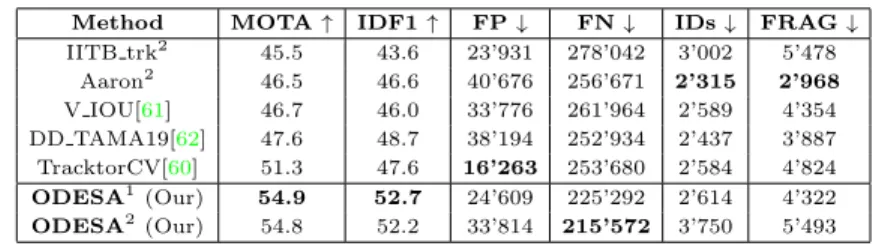
Table 5: The results of the top-performing solutions from CVPR19 Tracking Challenge Leaderboard. MOTA serves as the main evaluation criterion.
Method MOTA↑ IDF1↑ FP↓ FN↓ IDs↓ FRAG↓ IITB trk2 45.5 43.6 23’931 278’042 3’002 5’478 Aaron2 46.5 46.6 40’676 256’671 2’315 2’968 V IOU[61] 46.7 46.0 33’776 261’964 2’589 4’354 DD TAMA19[62] 47.6 48.7 38’194 252’934 2’437 3’887 TracktorCV[60] 51.3 47.6 16’263 253’680 2’584 4’824 ODESA1(Our) 54.9 52.7 24’609 225’292 2’614 4’322 ODESA2(Our) 54.8 52.2 33’814 215’572 3’750 5’493
For further validation, our ODESA-based tracking solution was adjusted to the conditions of CVPR’2019 Tracking Challenge[59]. The modifications ac-counted for the requirement of relying exclusively on the set of public detects. In particular, we prepared a detector based on ResNet-101[14], FPN[13], and Regression Cascade[16] using the training protocol described in Section 3.1. RPN[11] block was then stripped from the detector. Its output was replaced with either the items from the public set of detects, which correspond to earlier frames, or the detects derived from them in the manner described in Ref. [60]. However, no data association was performed at this point. HSV64/128 was em-ployed as the embedding function. The history depthDmaxwas set to 100. The
matching was performed in two stages. At the first oneλin Eq.4was set to zero. It accounted for about 97% of the associations. At the second oneλwas set to 1 and the Kalman filter was turned off. The results of our two submissions, which differ solely by the rejection routine settings at the detect refinement stage, are presented in Table 5. Both show comparable performance, while the last table entry turned out to be the challenge winner.
Thevideosrepresenting the output of our tracker for the benchmarks
men-tioned above have been made available for visual inspection.
5
Discussion
5.1 ODESA Object Representation
Let us check the assumptions which were made at the beginning of Section 3 about the object representation expected from ODESA. For this purpose, we utilize ALOI[63] dataset. It contains the images for 1000 objects taken on a ro-tating stage every 5◦against a uniform background. Due to such restricted angle
increment, each set of images could be regarded as representing gradual appear-ance evolution. Uniform background and absent occlusions also help to model a simplified version of MOT environment. A few samples from ALOI dataset are depicted in the top row of Fig.2. For each object, a set of 72 embedding vectors was extracted by HSV64/128 model. t-SNE projections for corresponding man-ifolds are shown in Fig. 2(a), where the original ALOI object number to color correspondence is provided as well. Our assumption about the non-compact na-ture of ODESA object representation can be readily checked via the estimation
508 4 8 364 132 62 162 461 4 8 62 132 162 364 461 508 (a) 90 180 270
Azimuth angle, degree 0.00 0.25 0.50 0.75 1.00 1.25 E u cl id ea n d is ta n ce (b)
Fig. 2. Object mapping into the metric space for ODESA(HSV64/128) model. (a) t-SNE projection for all embedding vectors corresponding to the objects depicted at the top. (b) (Solid) and (dashed lines) represent the distances from a given sample
embedding vector to its furthest element of the same manifold and its two closest angle-wise neighbors halved, respectively. Best viewed in color.
of the corresponding manifold extent. Due to ODESA embedding vector normal-ization, i.e. projection to the unit hypersphere, the maximal extent is limited to the value of two. It can be deduced from the solid lines in Fig.2(b), which repre-sent the distance from the embedding vector corresponding to a given azimuth angle to its most distant member of the same manifold. These curves indicate that for one of the examined objects the maximal extent exceeds the value of 1.25. At the same time, rather compact manifolds could also be observed, on condition that the appearance of objects does not vary much within considered set of images. This is the case of objects #508, 4, and 8. The distribution of the object manifold extent across the entire ALOI dataset is shown in Fig.4for HardNet++ and HSV64/128 models. This figure confirms that for the majority of objects the extent is significant, thus validating our initial assumption. It is also worthwhile to note that while t-SNE projection does not reflect the manifold extent, together with the solid lines in Fig.2(b) it is indicative of the symmetry exhibited by the objects #8, 132, 162, and 461.
To estimate the manifold continuity, the average distance from each embed-ding vector to its two closest angle-wise neighbors was calculated. It is shown in Fig.2(b) by the dashed lines as a function of azimuth angle. We assume that rotation by 5◦ shall not affect the object appearance significantly. Therefore,
any discontinuity is expected to manifest itself as a sharp peak in such a curve. Our data indicate that the distance to neighbors is rather uniformly distributed and scales with the manifold extent. The former conclusion is also supported by the t-SNE projection. These observations are rather supportive of our
assump-(a) 0.03 0.05 0.08 0.10 0.12 (b) 0.4 0.6 0.8 1.0 (c)
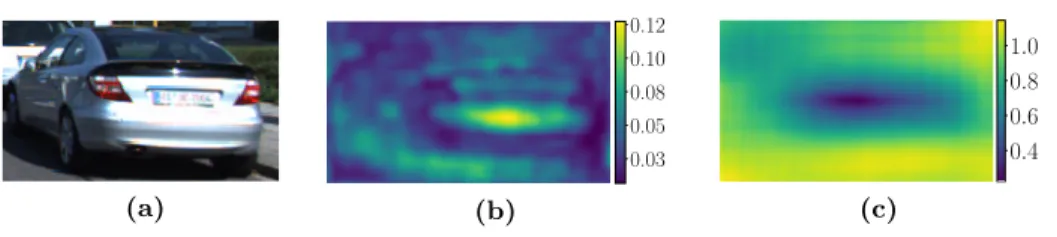
Fig. 3.The influence of occlusions and the bounding box misalignment on embedding vector: (a) image patch, (b)Do, and (c)Dmas the function ofδxandδy. The occluder sizesamounts 10% of the patch heighth. Best viewed in color.
tion about the non-abrupt nature of ODESA mapping. The utilization of color information tends to scale down the manifold extent, as shown in Fig. 4, and the distance between the angle-wise neighbors. The evolution of these properties from LLFD to ODESA models is discussed in the supplementary material.
5.2 Sensitivity to Occlusions, Background and Detection Noise
In Section1, we mentioned the factors which cast doubts on LLFD utilization as global object features. A few of them are related to the nature of object bound-ing boxes. Namely, they usually contain a certain amount of background, could be occluded and could deviate from the ground truth shape and position due to the detection noise. The first two factors do not take place in LLFD domain. The sensitivity of ODESA models to them could be estimated by examining the influence of an occlusion applied in the sliding window manner. As a measure of such influence, one could use the distance between the embedding vector corre-sponding to the original patchP(x, y, h, w) and those originating from occluded ones. Such distance could be calculated as the function of the occluder position
Do(δx, δy) =kf(P(x, y, h, w))−f(P(x, y, h, w)⊙Tδx,δy(O(x, y, s, s)))k2,
(6) wheref(·) - embedding function,⊙designate pixel-wise replacement operation,
Tδx,δy is a translation operation, O(x, y, s, s) - the square occluding patch of sizesfilled with noise. An example of such estimation is shown in Fig.3, where (a) depicts the image area within the ground truth bounding box, (b) contains
Do(δx, δy). In this case, the occluder size s amounted as much as 10% of the
patch heighth. Figure3(b) indicates that the modification of the patch periphery does not result in any considerable displacement of embedding vectors in the metric space. At the same time, the central part of the patch plays a rather significant role. Figure5represents our attempt to generalize these conclusions. It showsDoaveraged over 198 and 149 detects from KITTI dataset belonging to pedestrian and car categories, respectively. The detects of the highest resolution with unique IDs were selected for this purpose. To eliminate the aspect ratio, scale, andDo magnitude differences, at first, relative Do for individual detects was calculated. Then the patch area was split into 10 bands. Each band was limited to the area between adjacent rectangles resulted from the bounding box
0.5 1.0 1.5 2.0 Manifold Extent 0 25 50 75 100 125 O b je ct C ou nt HSV64/128 HardNet++
Fig. 4. Distribution of manifold ex-tent across the entire ALOI dataset for HSV64/128 and HardNet++ models.
0.05 0.1 0.15 0.2 0.25 0.3 0.35 0.4 0.45 0.5 Area Band 0.0 0.5 1.0 1.5 R el at iv e D0 Cars HSV64−−/128 Cars HSV64/128 Pedestrians HSV64−−/128 Pedestrians HSV64/128
Fig. 5.RelativeDo(δx, δy) averaged over a number of detects from KITTI dataset for HSV64/128 and HSV64--/128 models.
scaling with a decrement of 5% height- and width-wise. Finally, the relative intensity was averaged over each band across all detects and shown in Fig. 5. This procedure was performed for HSV64/128 and HSV64--/128 models. The latter was learned while the random patch transformations and flips were both turned off. The data from Fig.5indicate that these options contribute to making the embedding models considerably less susceptible to the patch periphery.
Finally, the influence of the detection noise could be estimated by examining the embedding vector displacement due to the bounding box misalignment with its ground truth position
Dm(δx, δy) =kf(P(x, y, h, w))−f(P(x+δx, y+δy, h, w))k2. (7)
An example of Dm(δx, δy) produced by means of HSV64/128 model is shown
in Fig. 3(c). The corresponding distribution of distances is quite shallow for (δx, δy) values up to about 20% of the bounding box size. The displacement values tend to grow as the misalignment increases. Such a picture appears to be typical for the majority of examined samples. Fig. 3(c) indicates that ODESA models, as well as LLFD ones, could put up with a certain level of the detec-tion noise. In the supplementary material, we indicate that the random patch transformations applied during dataset preparation[26] have a profound effect onDm(δx, δy). By controlling their strength, one could either get a model with a better generalization or higher discriminative capability.
6
Conclusions
Our study shows that starting with LLFD it is possible to derive a class-agnostic embedding function, which being deployed as a part of DBT solution is capable of achieving competitive results in MOT domain. It produces meaningful ob-ject manifolds with predictable properties. Corresponding obob-ject representation turns out to be compatible with the association stages of contemporary DBT solutions. For this reason, ODESA could be readily deployed with about any DBT solution.
References
1. Grant, J.M., Flynn, P.J.: Crowd scene understanding from video: A survey. ACM Trans. Multimedia Comput. Commun. Appl.13(2017)
2. Choi, W., Savarese, S.: A unified framework for multi-target tracking and collective activity recognition. In Fitzgibbon, A., Lazebnik, S., Perona, P., Sato, Y., Schmid, C., eds.: Computer Vision – ECCV 2012, Springer Berlin Heidelberg (2012) 215– 230
3. Weiming Hu, Tieniu Tan, Liang Wang, Maybank, S.: A survey on visual surveil-lance of object motion and behaviors. IEEE Transactions on Systems, Man, and Cybernetics, Part C (Applications and Reviews)34(2004) 334–352
4. Geiger, A., Lenz, P., Urtasun, R.: Are we ready for autonomous driving? The KITTI vision benchmark suite. In: Conference on Computer Vision and Pattern Recognition (CVPR). (2012)
5. Milan, A., Leal-Taix´e, L., Reid, I., Roth, S., Schindler, K.: MOT16: A benchmark for multi-object tracking. arXiv preprint arXiv:1603.00831 (2016)
6. Wen, L., Du, D., Cai, Z., Lei, Z., Chang, M., Qi, H., Lim, J., Yang, M., Lyu, S.: UA-DETRAC: A new benchmark and protocol for multi-object detection and tracking. arXiv preprint arXiv:1511.04136 (2015)
7. Doll´ar, P., Appel, R., Belongie, S., Perona, P.: Fast feature pyramids for object detection. Pattern Analysis and Machine Intelligence, IEEE Transactions on 36
(2014) 1532–1545
8. He, K., Gkioxari, G., Doll´ar, P., Girshick, R.B.: Mask R-CNN. arXiv preprint arXiv:1703.06870 (2017)
9. Li, Y., Qi, H., Dai, J., Ji, X., Wei, Y.: Fully convolutional instance-aware se-mantic segmentation. In: The IEEE Conference on Computer Vision and Pattern Recognition (CVPR). (2017)
10. Liu, W., Anguelov, D., Erhan, D., Szegedy, C., Reed, S.E., Fu, C., Berg, A.C.: SSD: single shot multibox detector. arXiv preprint arXiv:1512.02325 (2015) 11. Ren, S., He, K., Girshick, R.B., Sun, J.: Faster R-CNN: towards real-time object
detection with region proposal networks. arXiv preprint arXiv:1506.01497 (2015) 12. Tan, M., Pang, R., Le, Q.: EfficientDet: Scalable and efficient object detection.
arXiv preprint arXiv:1911.09070 (2019)
13. Lin, T., Doll´ar, P., Girshick, R.B., He, K., Hariharan, B., Belongie, S.J.: Feature Pyramid Networks for Object Detection. arXiv preprint arXiv:1612.03144 (2016) 14. He, K., Zhang, X., Ren, S., Sun, J.: Deep residual learning for image recognition.
arXiv preprint arXiv:1512.03385 (2015)
15. Xie, S., Girshick, R.B., Doll´ar, P., Tu, Z., He, K.: Aggregated residual transforma-tions for deep neural networks. arXiv preprint arXiv:1611.05431 (2016)
16. Cai, Z., Vasconcelos, N.: Cascade R-CNN: high quality object detection and in-stance segmentation. arXiv preprint arXiv:1906.09756 (2019)
17. Dai, J., Qi, H., Xiong, Y., Li, Y., Zhang, G., Hu, H., Wei, Y.: Deformable convo-lutional networks. arXiv preprint arXiv:1703.06211 (2017)
18. Zhu, X., Hu, H., Lin, S., Dai, J.: Deformable ConvNets v2: More deformable, better results. arXiv preprint arXiv:1811.11168 (2018)
19. Luo, W., Xing, J., Milan, A., Zhang, X., Liu, W., Zhao, X., Kim, T.K.: Multiple object tracking: A literature review. arXiv preprint arXiv:1409.7618v4 (2017) 20. Bewley, A., Ge, Z., Ott, L., Ramos, F., Upcroft, B.: Simple online and realtime
tracking. In: 2016 IEEE International Conference on Image Processing (ICIP). (2016) 3464–3468
21. Yu, F., Li, W., Li, Q., Liu, Y., Shi, X., Yan, J.: POI: Multiple object tracking with high performance detection and appearance feature. In: IEEE European Conference on Computer Vision (ECCV). (2016)
22. Geiger, A., Lenz, P., Stiller, C., Urtasun, R.: Vision meets robotics: The KITTI dataset. International Journal of Robotics Research (IJRR) (2013)
23. Gray, D., Brennan, S., Tao, H.: Evaluating appearance models for recognition, reacquisition, and tracking. In: In IEEE International Workshop on Performance Evaluation for Tracking and Surveillance, Rio de Janeiro. (2007)
24. Zheng, L., Zhang, H., Sun, S., Chandraker, M., Tian, Q.: Person re-identification in the wild. arXiv preprint arXiv:1604.02531 (2016)
25. Wang, Z., Zheng, L., Liu, Y., Wang, S.: Towards real-time multi-object tracking. arXiv preprint arXiv:1909.12605v1 (2019)
26. Balntas, V., Lenc, K., Vedaldi, A., Mikolajczyk, K.: HPatches: A benchmark and evaluation of handcrafted and learned local descriptors. In: CVPR. (2017) 27. Mishchuk, A., Mishkin, D., Radenovic, F., Matas, J.: Working hard to know your
neighbor’s margins: Local descriptor learning loss. arXiv preprint arXiv:1705.10872 (2017)
28. Tian, Y., Fan, B., Wu, F.: L2-Net: Deep learning of discriminative patch descriptor in euclidean space. In: The IEEE Conference on Computer Vision and Pattern Recognition (CVPR). (2017) 6128–6136
29. Vassileios Balntas, Edgar Riba, D.P., Mikolajczyk, K.: Learning local feature descriptors with triplets and shallow convolutional neural networks. In Richard C. Wilson, E.R.H., Smith, W.A.P., eds.: Proceedings of the British Machine Vi-sion Conference (BMVC), BMVA Press (2016) 119.1–119.11
30. Ye, M., Shen, J., Lin, G., Xiang, T., Shao, L., Hoi, S.C.H.: Deep learning for person re-identification: A survey and outlook. arXiv preprint arXiv:2001.04193 (2020) 31. Winder, S., Brown, M.: Learning local image descriptors. In: CVPR. (2007) 32. Zhou, K., Yang, Y., Cavallaro, A., Xiang, T.: Omni-Scale feature learning for
person re-identification. In: ICCV. (2019)
33. Li, W., Zhu, X., Gong, S.: Harmonious attention network for person re-identification. arXiv preprint arXiv:1802.08122 (2018)
34. Song, C., Huang, Y., Ouyang, W., Wang, L.: Mask-guided contrastive attention model for person re-identification. In: The IEEE Conference on Computer Vision and Pattern Recognition (CVPR). (2018)
35. Keller, M., Chen, Z., Maffra, F., Schmuck, P., Chli, M.: Learning deep descriptors with scale-aware triplet networks. In: The IEEE Conference on Computer Vision and Pattern Recognition (CVPR). (2018)
36. Tian, Y., Yu, X., Fan, B., Wu, F., Heijnen, H., Balntas, V.: SOSNet: Second order similarity regularization for local descriptor learning. In: CVPR. (2019)
37. Zhang, L., Rusinkiewicz, S.: Learning local descriptors with a CDF-based dynamic soft margin. In: International Conference on Computer Vision (ICCV). (2019) 38. Zhang, X.Y., Zhang, L., Zheng, Z.Y., Liu, Y., Bian, J.W., Cheng, M.M.:
AdaSam-ple: Adaptive sampling of hard positives for descriptor learning. arXiv preprint arXiv:1911.12110 (2019)
39. Zhang, X., Yu, F.X., Kumar, S., Chang, S.F.: Learning spread-out local feature descriptors. arXiv preprint arXiv:1708.06320 (2017)
40. Wojke, N., Bewley, A., Paulus, D.: Simple online and realtime tracking with a deep association metric. In: 2017 IEEE International Conference on Image Processing (ICIP), IEEE (2017) 3645–3649
41. Cao, Y., Xu, J., Lin, S., Wei, F., Hu, H.: GCNet: Non-local networks meet squeeze-excitation networks and beyond. arXiv preprint arXiv:1904.11492 (2019)
42. Chen, K., Wang, J., Pang, J., Cao, Y., Xiong, Y., Li, X., Sun, S., Feng, W., Liu, Z., Xu, J., Zhang, Z., Cheng, D., Zhu, C., Cheng, T., Zhao, Q., Li, B., Lu, X., Zhu, R., Wu, Y., Dai, J., Wang, J., Shi, J., Ouyang, W., Loy, C.C., Lin, D.: MMDetection: Open mmlab detection toolbox and benchmark. arXiv preprint arXiv:1906.07155 (2019)
43. Russakovsky, O., Deng, J., Su, H., Krause, J., Satheesh, S., Ma, S., Huang, Z., Karpathy, A., Khosla, A., Bernstein, M.S., Berg, A.C., Li, F.: ImageNet large scale visual recognition challenge. arXiv preprint arXiv:1409.0575 (2014)
44. Pang, J., Chen, K., Shi, J., Feng, H., Ouyang, W., Lin, D.: Libra R-CNN: towards balanced learning for object detection. arXiv preprint arXiv:1904.02701 (2019) 45. Yu, F., Xian, W., Chen, Y., Liu, F., Liao, M., Madhavan, V., Darrell, T.:
BDD100K: A diverse driving video database with scalable annotation tooling. arXiv preprint arXiv:1805.04687 (2018)
46. Vedaldi, A., Fulkerson, B.: VLFeat: An open and portable library of computer vision algorithms (2008)
47. Ono, Y., Trulls, E., Fua, P., Yi, K.M.: LF-Net: Learning local features from images. arXiv preprint arXiv:1805.09662 (2018)
48. Dusmanu, M., Rocco, I., Pajdla, T., Pollefeys, M., Sivic, J., Torii, A., Sattler, T.: D2-Net: A trainable CNN for joint detection and description of local features. arXiv preprint arXiv:1905.03561 (2019)
49. Glorot, X., Bengio, Y.: Understanding the difficulty of training deep feedforward neural networks. In Teh, Y.W., Titterington, D.M., eds.: AISTATS. Volume 9 of JMLR Proceedings., JMLR.org (2010) 249–256
50. Doll´ar, P., Wojek, C., Schiele, B., Perona, P.: Pedestrian detection: A benchmark. In: The IEEE Conference on Computer Vision and Pattern Recognition (CVPR). (2009)
51. Xiao, T., Li, S., Wang, B., Lin, L., Wang, X.: Joint detection and identification feature learning for person search. In: The IEEE Conference on Computer Vision and Pattern Recognition (CVPR). (2017)
52. Kuhn, H.W.: The Hungarian Method for the assignment problem. Naval Research Logistics Quarterly2(1955) 83–97
53. Kalman, R.: A new approach to linear filtering and prediction problems. Journal of Basic Engineering82(1960) 35–45
54. Welch, G., Bishop, G.: An Introduction to the Kalman filter. University of North Carolina at Chapel Hill, Chapel Hill, NC (1995)
55. Choi, W.: Near-online multi-target tracking with aggregated local flow descriptor. In: Proceedings of the IEEE International Conference on Computer Vision. (2015) 3029–3037
56. Pang, J., Qiu, L., Chen, H., Li, Q., Darrell, T., Yu, F.: Quasi-dense instance similarity learning. arXiv:2006.06664 (2020)
57. Chang, X., Hospedales, T.M., Xiang, T.: Multi-level factorisation net for person re-identification. arXiv preprint arXiv:1803.09132 (2018)
58. Zheng, L., Shen, L., Tian, L., Wang, S., Wang, J., Tian, Q.: Scalable person re-identification: A benchmark. In: Computer Vision, IEEE International Conference on. (2015)
59. Dendorfer, P., Rezatofighi, S.H., Milan, A., Shi, J., Cremers, D., Reid, I.D., Roth, S., Schindler, K., Leal-Taix´e, L.: CVPR19 tracking and detection challenge: How crowded can it get? arXiv preprint arXiv:1906.04567 (2019)
60. Bergmann, P., Meinhardt, T., Leal-Taix´e, L.: Tracking without bells and whistles. arXiv preprint arXiv:1903.05625 (2019)
61. Bochinski, E., Eiselein, V., Sikora, T.: High-speed tracking-by-detection without using image information. In: International Workshop on Traffic and Street Surveil-lance for Safety and Security at IEEE AVSS 2017, Lecce, Italy (2017)
62. Yoon, Y., Kim, D.Y., Yoon, K., Song, Y., Jeon, M.: Online multiple pedestrian tracking using deep temporal appearance matching association. arXiv preprint arXiv:1907.00831 (2019)
63. Geusebroek, J.M., Burghouts, G.J., Smeulders, A.W.M.: ALOI: Amsterdam li-brary of object images. International Journal of Computer Vision61(1), 103-112
(2005)
64. Hermans, A., Beyer, L., Leibe, B.: In defense of the triplet loss for person re-identification. arXiv preprint arXiv:1703.07737 (2017)