ISSN: 1992-8645 www.jatit.org E-ISSN: 1817-3195
1091
POCS-VF: PROXIMATE OPTIMUM CHANNEL SELECTION
THROUGH VOID FILLING AND BURST SEGMENTING FOR
BURST SCHEDULING IN OBS NETWORKS
1V. KISHEN AJAY KUMAR, 2K. SURESH REDDY, 3M.N. GIRI PRASAD
1Research Scholar, JNTUA, GPREC Research center, Department of Electronics and Communications,
Kurnool, India
2Professor & HOD, G. Pulla Reddy Engineering College (Autonomous), Department of Electronics and
Communications, Kurnool, India
3Professor, Department of Electronics and Communications, JNT University, Anantapuram, India
E-mail: 1[email protected], 2[email protected], 3[email protected]
ABSTRACT
The burst scheduling in OBS networks is critical research objective that attained the interest of many researchers in last few years. OBS is phenomenal and promising data transfer strategy for present and future internet communication requirements. It is clearly quoted in acclaimed recent reviews on burst scheduling in OBS networks that optimal burst scheduling models are in considerable need in the context of minimizing the burst drop ratio and maximizing the channel utilization. Hence in this regard, a novel burst scheduling with burst segmenting and void filling strategy called “Proximate Optimum Channel Selection through Void Filling and Burst Segmenting” strategy for burst scheduling in OBS networks is proposed here in this manuscript. The experimental study done on simulation environment evincing that the proposed model is optimal with minimal burst drop ratio, maximum channel utilization and minimal average time to schedule that compared to the contemporary benchmark model called MSBFVF found in recent literature.
Keywords: Burst Scheduling, Optical burst switching, Void filling, Burst drop ratio
1 INTRODUCTION
Scheduling of an OBS network could be stated as the process of allocation or reserving of resources for a burst arriving in to the network. The key objective of the scheduling is to ensure that any kind of idle spaces that are generated amidst the burst and schedules are minimized. Unlike the traditional internet scenario, in the case of OBS [1] networks, there is hardly any support of optical buffers for temporary storage and forwarding during the instance of a contention. Hence in the bursts are usually forwarded to the next node in the direction of destination, within quick turnaround time or the burst is dropped.
Scheduling algorithm has to effectively handle the packets and also ensure that any voids that are existing have to be addressed in efficient manner. A void can be defined as unused or idle space amidst of two consecutive bursts scheduled for a channel.
Few of the key strategies adapted in burst scheduling can be classified as:
Minimum Starting Void [2]
LAUC-VF [3]
Horizon Scheduling [4]
Constant Time Burst Resequencing (CTBR)
[5]
1092 CTBR [5] can be defined as process of “optimum wavelength scheduling”. In CTBR, rather than processing the burst as soon as it arrives, the emphasis is on delaying the burst scheduling and processing, based on the orders that are expected as Burst Arrival time. BHP is carried as arrival time for the data bursts, time of data bursts rather than processing them according to the arrival time. LAUC-VF [3], is higher than the case of horizon scheduling, but it might be slower with the rising number of voids.
The contribution of this manuscript is a burst scheduling strategy that aimed to limit the constraints of these traditional models.
2 RELATED WORK
Among the contemporary solutions of the domain, OBS [1], is a profound development as it facilitates optical packet switching and circuit switching to take place in combined form. Data classification from the control packets is dispatched using the payload information to reserve the path for destination. Scheduler adapts wavelength scheduling algorithm [6] for controlling the packet by focusing on intermediate node for ensuring that burst is scheduled using only a wavelength channel. Based on information comprised in control packets, certain critical information like arrival time and duration for a data burst is gathered. Even the scheduler ensures availability of time slots to every wavelength and schedule for a data burst from a channel depending on the chosen scheduling algorithm.
It is imperative from the review of literature that there are numerous scheduling algorithms have been proposed earlier, for improving the schedule payload or data burst. However, the complexities and the burst loss rations have varied in the proposed solutions, based on the channel selection strategy adapted. Also, the classification of such channel selection could be categorized to Horizon or Void filling algorithm based on the chosen channel selection approach. For instance, in the case of Horizon, the algorithm [7] considers the channels that do not have any scheduled burst during or after current time t.
Void filling algorithms [3], [8] [9] [10] [11] [12] take in to account void channels comprising unused duration amidst the two scheduled data bursts. In Contrary, non-segmentation Horizon algorithms like [6] [7] and segmentation horizon
algorithm like [13] do not considering void channels.
Despite of higher burst loss ratio, still Horizon algorithms are much easier in terms of implementation. In the case of Void Filling algorithms, the burst loss ratio is lower, but implementation of it needs complex switching. Profoundly [8], [12] considers one side as void. There is possibility of smaller data burst getting scheduling to bigger void and also the scope of burst getting dropped for bigger data getting dropped, which could lead to underutilization of the higher bursts.
In [13], a new channel scheduling algorithm that can efficiently utilize existing void within a channel has been proposed, which gives raise to higher channel utilization and in terms of lowering blocking probability.
In [14] authors have proposed for the OBS networks. The solution PI-OBS [14] proposed as scheduling strategy for OBS-Networks, which is depending on void filling to optimize the wavelength allocation, and to achieve minimal delay transmission, and evincing the ability to differentiate the traffic. PIOBS is one of its kind solution proposed for parallel-iterative scheduler for OBS switches. It supports in allowing parallel electronic execution that is in common to ones in VOQ [15] schedulers comprising deterministic response time.
In [16] two new techniques have been proposed, one of that is using the process of triangular estimation to depict the drop zone and the other is based on the burst drop history. In the first model, the bursts that fall in to the category are considered as the ones that have lower scope of finding apt wavelength and hardly any efforts will be put forth in scheduling them. Depending on the drop history, the drop zone is dynamically defined in the second approach, and thus the algorithms reduce the void checks or number of channels assigned, leading to improvement in overall scheduling capacity.
ISSN: 1992-8645 www.jatit.org E-ISSN: 1817-3195
1093 Handling congestion is the objective of the contribution depicted in [18]. The proposed method is four paths selection strategy. Among these four paths, initial two paths comprising the ability of wavelength conversion under streamline effect to handle the contention. The other two strategies satisfy the constraint of wavelength endurance to address the contention.
FSR (Forward Segment Redundancy) has been proposed in [19] which is a proactive technique for preventing data loss in the instance of contentions in the optical core. In the context of contention, this model adds redundant TCP segments for each burst in edge, and then performs redundant burst segmentation. It is evident from the studies that FSR is effective that doubled the performance of the TCP against overwhelmed loads. Such strategies should maintain varied set of information about the channel [3] [9] [20]. For instance, maintaining information like the LAUT [20] (Latest Available Unscheduled Time) or horizon, the gaps and voids for every outgoing data channel.
NP-MOC-VF scheduling [11] [12] [21] maintains the time of start and end for every data burst over every data channel. Objective of such log tracking is to ensure optimum utilization of voids comprised in data burst segments over every data channel. In the instance of availability of one or more channel, the data channel comprising void that minimizes the gap is selected, else in the case of no channels observed to be free, the channels having minimum loss is chosen for assigning to unscheduled. In NP-DFMOC-VF algorithm, the delay is estimated till first voids of very channel is considered and accordingly the channel having minimum delay is chosen. In case of a channel being available, the unscheduled burst is scheduled over the free channel comprising minimal gap.
In the instance of channels being busy and the starting time of first void is higher than or equal to the cumulative end time, entire unscheduled burst is dropped [6] [20]. Else, the unscheduled burst is delayed until the start of first void in a channel selected for the process. However, in the case of first void being higher than the aggregation of start time as, for the unscheduled burst with MAX DELAY, the unscheduled burst is delays for MAX DELAY. In furtherance, the burst segments that are non-overlapping to any unscheduled bursts are scheduled and the overlapping bursts are chosen to be dropped.
NP-MOC-VF method do not delay the process for incoming burst and there are potential chances of bursts getting dropped are much higher. NP-DFMOC-VF delays [22] incoming burst if
contention found, and reschedules the burst. As a
result, it affects the performance in terms of ratio of burst loss and the utilization of bandwidth.
MSBFVF [22] which is a modified segmented solution, the emphasis is on maximizing the use of bandwidth available, and in terms of increasing the channel utilization in OBS networks in the FDL [23] based algorithms. The incoming burst is segmented and segmented portion shall be delayed till it is scheduled over a proper channel. MSBFVF is categorized in to segment of first scheduling algorithm, as it incorporates the burst rescheduling with maximum utilization of channel, which is conceptually very close to the model proposed here in this article.
SBFVF or MSBFVF rescheduling algorithm proposed estimates the delay till the first void over every channel and accordingly selects the channel comprising minimum delay. Upon finding a channel with availability, unscheduled bursts are scheduled to such a channel with minimal gap. However, in the instance of all channels being occupied, and start time for the first void is much higher than cumulative of end time for unscheduled burst, the entire unscheduled burst gets dropped or the task is delayed till the start of first void in the channel chosen for process, whilst overlapping burst segments are dropped. The channel selection in both contexts of recementing the burst and void filling is intricate that results significant burst loss.
From the lessons learnt from these contemporary models, the model proposed here in this manuscript is an adaptive burst scheduling strategy that enables the effective use of void depicted in channels that already scheduled. In addition, the proposed model enables the dynamic resegmenting of the burst that are incompatible to schedule on available channels. The significance of the proposed model is the minimal burst loss ratio, and maximum utilization of the channel under minimal process complexity.
3 PROXIMATE OPTIMUM CHANNEL SELECTION THROUGH VOID FILLING ANDBURSTSEGMENTING
1094 and Burst Segmenting (POCS-VF)” is relied on Void filling, which denotes the unused capacity of a channel is adapted as fundamental process in the proposed solution. The proposed solution ensures the sequence in assembling bursts, and transmitting scheduling requirements like required bandwidth, transmission time, volume of the burst, and time of arrival of each burst in sequence as a control packet. The Eq1 in following depicts the process of estimating the influx time of the corresponding burst.
( )i ( )i ( i)
at b tr b pt cp (Eq1)
Here in the above equation (Eq1), the
notation at b( )i indicates the absolute influx time of
the burstbi, the time required to transmit the
burstbi from assembler to scheduler is tr b( )i , the
notation pt cp( i)indicates the time taken to process
the control packet cpi of respective burst bi, and
the notation is threshold representing the elapsed
time.
( ) ( )
i j
i b c
j
v b rtf
bw c
(Eq2)
Here in the above equation, the
notationrtfbicjindicates the required timeframes at
channel cjto transmit the burst bi, he notation
( )i
v b represents the volume of the burstbi, the
notation is the threshold that allows the ratio is
rounded to whole number, and the notation ( )j
bw c represents the bandwidth available at
channel cj
If available bandwidth at a channel is greater than the volume of the burst, then the one-time frame of the respective channel is required. 3.1 POCS-VF Scheduling Strategy
On the basis of receiving consequential control packet
cp
iof burstb
i, the scheduler tracesthe burst
b
i properties such as influx time, volumeof the burst, required time frames that proportionate to available bandwidth. Then channel allocation process under POCS-VF occurs in three phases as follows:
3.2 Idle Channel Selection
Considers the channels with idle time frames and then ranks those channels under the
metric idle time frames count such that each channel contains a rank that representing the absolute and less difference between of available and required idle timeframes. The allocation of ranks is done in ascending order of the difference between required and available timeframe. The required timeframes can be measured as explored in Eq2. The available timeframes also measured in similar passion, which is as follows:
( ) ( )
( ) j j
j
idt c atf c
abw c
(Eq3)
The above equation (Eq3), determines the
number of available timeframes atf c( )j at
channelcj. Here in this equation the notation
( )j
idt c indicates the idle time of the channelcj,
the notation is the threshold that truncates the
resultant number of available timeframes to whole
number and the notation abw c( )j indicates the
available bandwidth at channel cj
The channel optimality can be defined under aforesaid metrics as
The idle time frames of the channel are
more than the time frames required to transmit the burst to be scheduled in queue, such that the absolute and less difference between available time frames and required time frames is more optimal. The channel ranking by idle time frames count is depicted in Figure 1. The channels C1, C2 and C3 are having idle time frames with absolute difference from required time frames. The difference observed in the case of channel C1 is absolute and much less that compared to other two channels, hence this channel is ranked as 1 among all three channels.
Figure 1: The depiction of the required time frames and available channels.
The less transmission intervened scope is
ISSN: 1992-8645 www.jatit.org E-ISSN: 1817-3195
1095 delay will be ranked 1, since the ranking of the channels under this transmission intervened scope will be in ascending order.
3.3 Multichannel Composition
If none of the channels meet the criteria under aforesaid metrics, such that no channel available with required number of idle time frames, then also the channels are ranked according to their absolute difference between required and available idle time frames, which is done in ascending order of the absolute difference observed, which is depicted in Figure 2. And then selects more than one channel and segments the burst into selected channel number of tuples such that each tuple compatible to one of the selected channels under aforesaid metrics.
The criteria to select multiple channels is that the least number of channels should be selected such that absolute difference between the required burst transmission time required and the overall idle time, which is the aggregate value of the idle time available at selected channels must be minimal. The channel composition explored in following:
Figure 2: Depiction of channels availability with required time frames shortage.
The channels that are having idle timeframes will be selected as a set.
Then possible number of subsets from the selected channels will be formed, such that each subset contains one or more channels. According to set theory [24], if the selected number of channels is n then the number of possible subsets is2n1.
Further, the subsets will be pruned under either of the following conditions
(i) If the sum of available timeframes of the channels in a set is less than the required number of timeframes to transmit the target burst, then that set will be pruned
(ii) If the sum of available timeframes of the channels in a set is more than or equal to the required number of timeframes to transmit the
target burst and that set is subset of any other set, then the respective superset will be discarded.
Upon the completion of aforesaid process, a set tf
cc of channel compositions are formed in
respective of available time frames.
Further, Rank the channel compositions
found incctf, which is in the ascending order of the
absolute difference between available and required
timeframes respectively. Further, Select top m
channel compositions from the set. Then choose
best composition among these m compositions,
which is based on the aggregate transmission intervene scope of the channels found in respective composition.
If no channel is available to schedule then the third phase of the scheduler will be initiated. The scheduler initiates to select the channels those are having considerable interval between two consequent schedules with significant reserves of bandwidth of the respective channels, which is denoted as void filling. In this process, the channels are sorted in descending order of their void time (interval between two schedules). Then depicted model initiates to select one or more channels with void time and required bandwidth to schedule the target burst. Here in this context, the channels selection criteria similar to multiple idle channels
composition that explored in aforesaid
multichannel selection criteria.
If either of the phase not fit to schedule the target burst then burst eventually dropped and the same will be acknowledged to the burst assembler. The formulation of the scheduling algorithm proposed as POCS-VF is follows:
Algorithm 1: Depiction of POCS-VF Algorithm.
POCS: Begin
1. Let control packet
cp
i is representingburst
b
i that received by schedulersch
j,2. poc
//proximate optimal channel selected to
schedule the target burst
br
that set to null( ) { , , }
cp br v tr s
// control packet of the respective burst br
that contains the volume of the burstv,
transmission time of the burst to travel
1096
3. pocsearchPOC cp br
( )
//finding the proximate optimal channel and passing parameters to schedule the respective
burst br
4. If (
poc
) Begin //proximate optimalchannel found for burst
b
i5. pocc // let pocc be the proximate optimal channel composition that is initialized to null
6. poccsearchPOCC cp br occl
( ),
// invoking the phase two of the scheduler that depicts the proximate channel composition 7. if pocc( ) Begin // if failed find theproximate optimal channel position 8. pocvf // let pocvf be the
proximate optimal channel or composition with void filling that is initialized to null
9. pocvf searchPOCVF cp br
( )
// finding the proximate optimal channel with void10. if pocvf
Begin// if no proximate optimal channel with void filling found 11. Burst br eventually drops and scheduleracknowledges the same to burst assembler
12. End // of step 10 13. Else Begin
14. Schedule the proximate optimal channel composition with void filling to target burst br
15. End //of step 13 16. End //of step 7
17. Else Begin // condition in step 7
18. Segment the burst br into tuples such that each tuple can optimally be scheduled on corresponding channel in composition
19. Schedule the proximate optimal channel composition to target tuples of the burst
br
20. End // of step 17
21. End // of step 4
22. Else Begin
23. Schedule proximate channel poc to the
target burst br
24. End //of step 22
End // of POCS
Algorithm 2: The depiction of proximate optimal channel selection Algorithm.
( ( ))
searchPOC cp br
Begin1. Let CLbe the list channels scheduled by
the scheduler s
2. icl // list that contains idle channels,
which is initially set to null
3.
poc
//The proximate optimalchannel to be found that is initially set to null
4. ocl // is a list containing all idle
channels with available timeframes that are more than the required
5. occl // is a list containing all idle
channels with available timeframes that are less than the required
6. Find influx timeat br( )of the burst br (see
Eq1)
7. | |
1
CL
i i
i c c CL Begin //For each channel
i
c of the channel list CL
8. if
((ssci 1) & &((ste c( )i )at br( ))) || (ssci 0) Begin// if schedule state of the channel is 1 then channel already scheduled
// the end of present schedule time ste c( )i of
channel ci is less than the arrival time at br( )
of the burst b
// or if schedule state of the channel is 0 then channel is idle
9. iclci // move the channel cito the idle
channel list icl
10. Find required timeframes rtf brci( )to
transmit br through channel ci (see Eq2)
11. Find available timeframes atf c( )i of
channel ci corresponding to burst br (see
Eq3)
12. if rtf br
ci( )atf c( )i
oclci// available timeframes at channel ci are more
than the required, hence selecting to assess the channel is proximate optimal or not
13. Else occlci
// available timeframes at channel ci are less
than the required, hence selecting to assess the channel is proximate optimal or not in channel composition
ISSN: 1992-8645 www.jatit.org E-ISSN: 1817-3195
1097
15. End // of step 7
16. if ocl( ) Begin
17. Order the channels listed in ocl in
ascending order of the absolute difference between available and required time frames.
18. Find the channel pocfrom sorted list of
channelsoclthat ranked best, which is also
having bandwidth less than the required bandwidth
19. End //of step 16
20. Return poc
21. End // of search POC
Algorithm 3: Depiction of burst segmenting and scheduling Algorithm
1.
searchPOCC cp br occl
( ( ),
)
: Begin// The notationcp br( )is the control packet of the
burstbrand the notation occl is the list of
channels having available timeframes less than the required, which are found step 12 of the Algorithm 2
2.
pocc
//proximate optimal channel composition, which is a list that initialized with null
3. Find all 2- channel compositions as unique
list called CP from the channels listed in
occl
4. Let tCP is an empty list
5. | |
1
CP
i i i p p CP
Begin // for each unique
pattern of channel compositions found in
CP
6. | |
1
occl
j j j c c occl
Begin // for each channel
listed in occl
7. tCPpicj
// union of the channel composition pi available
and channel ci creates new composition, which is
moved to list tCP
8. End // of step 6
9. End //of step 5
10. if tCP( CP) Begin //the newly formed list
tCP is not the subset of the CP
11. CP CP tCP U
12. tCP
13. Got to Step 5
14. End // of step 10
15. | |
1
CP
i i i p p CP
// for each compositionpi of
list CP
16. if atf p( ( )i rtf br p( , )i Begin // if available
timeframes of the composition pi , which is
the sum of timeframes available at all channels in corresponding composition is less than the required
17. CPCP pi // discarding composition pi
from the list CP
18. End // of step 16
19. Else Begin
20. | |
1
CP
k k
k p p CP Begin // for each
compositionpi of list CP
21. if
(pi pk) & &(pk pi)
CPCP p\ k // If pi and pk are not identical and pk is superset of pi then discard pk22. End // of step 20
23. End //of step 19
24. End // of step 15
25. if CP null( ) Begin
26. Sort the channel composition list CP in
ascending order of the absolute difference between aggregate available timeframes of respective channel and required number of timeframes.
27. Return composition with best rank with
minimal transmission intervene scope, which is the aggregate intervene scope of the all
channels involved the respective
composition.
28. End // of step 25
29. Else return null
30. End // of search POCC
Algorithm 4: Formulation of void filling phase in POCS-VF
1.
findVFC b chlst
( ,
i)
: Begin2. Let scl be the list representing channels
already scheduled
3. Let occl be the list contains possible
channels to void filling, which is initially set to null
4. | |
1
scl
i i
i c c scl Begin
For each channel that exists in scl
5. if at c
( )i tfu c( )i
Begin// if channel ci is having void timeframes,
1098 ( )i
tfu c is the timeframes in use
6. occlci// move channel ci to listoccl
7. End // of step 5
8. End //step 4
9. poccsearchPOCC( ( ),cp br occl) 10. if pocc null( ) burst eventually drops
and the same will be acknowledged to assembler
11. Else return pocc
In the proposed POCS-VF, the process attempts to identify the proximate optimal channel. In case of not finding an optimal channel partitions the burst in to multiple bursts and applies scheduling strategy on resultant bursts. Process is repeated till a proximate optimal channel is found. The portioning of the burst carries in to two tuples, such that one is feasible to schedule on depicted optimal channel and the other is rest of the original burst that demands channel search and allocation process. In instance of a failed scheduling and segmenting, the void filling process shall be initiated.
This practice tends to nullify the burst loss due to overlapping bursts, enables the maximum utilization of the channels with ability of void filling. Moreover, the process of the burst resegmenting that adapted in proposal is novel and adaptive, which due to the practice of segmenting the burst under had known conditions of the channel’s idle time and voids availability.
4 EXPERIMENTAL SETUP AND EMPIRICAL ANALYSIS
The experimental setup and results analysis is cited in this section. The NSF network topology is simulated with thirty-eight users associated below 1-way transmission with bidirectional order by using JAVOBS [25]. Each burst size is framed as set in the range of 512 packets to 1024 packets and each packet size is of 64 bytes. The total 16 transmission channels with divergent sizes of bandwidth and timeframes used in simulation. The average simulation time was 10 minutes. The specifications related to the simulations are projected in Table 1. The experiments were conducted on proposed model POCS-VF and other contemporary benchmark model with similar concept and divergent approach called MSBFVF [22].
Topology NSF
Data Sources 21
Transmission channels 16
Dedicated channels for control packets transmission
7
Burst Sizes range 32KB to 1024KB
Range of bandwidth allocated per channel 2 mb/s Error scope of the thresholds used 0.25
Up time of the network 900,000s
[image:8.612.90.530.66.202.2]Range of time frames 10s to 50s
Table 1: statistics of the simulation environment The metrics used to estimate the performance are (i) burst loss ratio against divergent burst load and fixed size of time frame, (ii) burst loss ratio against divergent sizes of time frames and fixed burst load, (iii) channel utilization ratio against divergent burst loads and fixed size of the time frame, (iv) channel utilization ratio against divergent sizes of the time frames and fixed burst load, (v) and average scheduling time. The burst loss ratio is the total bursts dropped against total bursts considered for scheduling. The channel utilization ratio is the ratio between channels in use and number of channels available. The average scheduling time is the mean of the time taken to schedule each burst in load of the bursts given. The burst loads used in the experiments are in the range of 10 to 90 and the divergent sizes of timeframes in
the range of 10s to 50s were used.
4.1 Performance Analysis
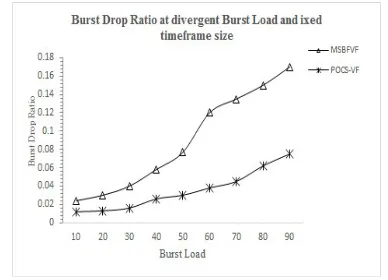
The results attained from the simulation study evincing that the proposed burst scheduling model called POCS-VF is out preformed the contemporary model called MSBFVF that compared under divergent performance metrics stated above. The burst loss ratio against divergent
burst with fixed timeframe size (35s) is depicted
in Figure 3, which is stating that burst loss under POCS-VF is average of 6% less than the burst loss observed for MSBFVF.
[image:8.612.320.514.559.699.2]ISSN: 1992-8645 www.jatit.org E-ISSN: 1817-3195
1099 The burst loss ratio against divergent size of time frames with fixed burst size (35840 bytes) is average of 5% lesser than the burst loss observed for MSBFVF, which is depicted in Figure 4.
Figure 4: Depiction of Burst Drop Ratio against Divergent size of timeframes and fixed burst size of 35480 bytes
The channel utilization ratio is average of 5% and 6% more in POCS-VF than MSBFVF in particular order of divergent burst load with fixed time frame and divergent time frame sizes with fixed burst load, which is depicted in Figure 5.
Figure 5: Depiction of Channel utilization ratio under divergent burst load and fixed timeframe of size 35
Figure 6: Depiction of Channel Utilization under divergent sizes of timeframes and fixed burst load of 35680 bytes.
[image:9.612.325.509.162.301.2]The Figure 6 shown that the average of 13% less scheduling time is observed for POCS-VF than the MSBFVF for both cases divergent burst load with fixed time frame and divergent time frame sizes with fixed burst load.
Figure 7: Depiction of Average time to schedule bursts: divergent burst loads with fixed timeframe of size 35
Figure 8: Depiction of Average time to schedule bursts: divergent sizes of timeframes and fixed burst load of 35680 bytes
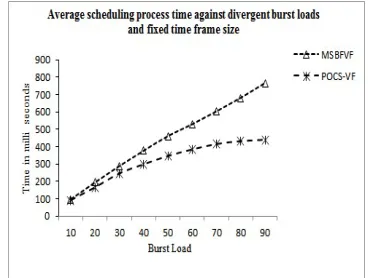
Further the average time taken to schedule under divergent burst loads with fixed timeframe size of
35sand under divergent sizes of timeframes with
fixed burst load of size 35680 bytes is described in Figure 7 and Figure 8 respectively. In both of these cases the average time taken to schedule the burst are proximately same and the time taken by POCS-VF is significantly low that compared to MSBFPOCS-VF.
5 CONCLUSION
[image:9.612.103.284.163.286.2] [image:9.612.327.508.359.496.2] [image:9.612.93.293.399.509.2] [image:9.612.91.295.538.693.2]1100 endeavored to escalate the channel utilization with maximum throughput on burst transmissions. The depicted model is having three phases which are in respective order of selecting optimal channel, if not found, selecting set of optimal channels and recementing the burst according to selected number of channels, and if second phase of the scheduler lapses then attempt to schedule the bursts by void filling. Unlike the contemporary model MSBFVF, the proposed model is simplifying the scheduling process and maximizing the optimal channel selection, which is clearly evinced in experimental study done under simulation environment. The proposed model is considering the fair enough channels to schedule, which is often not true. In this regard, the contributions of this manuscript encouraging the future research to focus on quality factors of the channels to optimize the burst transmission with maximal throughput, minimal burst loss with tolerable process overhead. Also the other dimension of future work can aim to depict batch scheduling algorithms for burst scheduling.
REFERENCES
[1] Koduru, Kishore Reddy. "New contention
resolution techniques for optical burst switching." (2005).
[2] Xu, Jinhui, et al. "Efficient channel scheduling
algorithms in optical burst switched networks." INFOCOM 2003. Twenty-Second Annual Joint Conference of the IEEE Computer and Communications. IEEE Societies. Vol. 3. IEEE, 2003.
[3] Xiong, Yijun, Marc LJ Vandenhoute, and
Hakki C. Cankaya. "Control architecture in optical burst-switched networks." U.S. Patent No. 6,721,315. 13 Apr. 2004.
[4] Chen, Yuhua, and Jonathan S. Turner. "WDM
burst switching for petabit capacity routers."
Military Communications Conference
Proceedings, 1999. MILCOM 1999. IEEE. Vol. 2. IEEE, 1999.
[5] Chen, Yuhua, Jonathan S. Turner, and Pu-Fan
Mo. "Optimal burst scheduling in optical burst switched networks." Journal of Lightwave Technology 25.8 (2007): 1883-1894.
[6] Dolzer, Klaus, et al. "Evaluation of reservation
mechanisms for optical burst switching." AEU-International Journal of Electronics and Communications 55.1 (2001): 18-26.
[7] Wei, John Y., and Ray I. McFarland.
"Just-in-time signaling for WDM optical burst switching networks." Journal of light wave technology 18.12 (2000): 2019-2037.
[8] Ljolje, Marije, Robert Inkret, and Branko
Mikac. "A comparative analysis of data scheduling algorithms in optical burst switching networks." 2005 Conference on Optical Network Design and Modeling. 2005.
[9] Yoo, Myungsik, Chunming Qiao, and Sudhir
Dixit. "QoS performance of optical burst switching in IP-over-WDM networks." IEEE Journal on selected areas in communications 18.10 (2000): 2062-2071.
[10]Golab, Wojciech, and Raouf Boutaba.
"Resource allocation in user-controlled circuit-switched optical networks." High Speed Networks and Multimedia Communications (2004): 776-787.
[11]Yang, Mei, S. Q. Zheng, and Dominique
Verchere. "A QoS supporting scheduling algorithm for optical burst switching DWDM
networks." Global Telecommunications
Conference, 2001. GLOBECOM'01. IEEE. Vol. 1. IEEE, 2001.
[12]Xu, Jinhui, et al. "Efficient channel scheduling
algorithms in optical burst switched networks."
INFOCOM 2003. Twenty-Second Annual
Joint Conference of the IEEE Computer and Communications. IEEE Societies. Vol. 3. IEEE, 2003.
[13]Vokkarane, Vinod M., and Jason P. Jue.
"Segmentation-based non-preemptive
scheduling algorithms for optical burst-switched networks." Proceedings of First International Workshop on Optical Burst Switching (WOBS). 2003.
[14]Pavon-Marino, Pablo, et al. "PI-OBS: a
parallel iterative optical burst scheduler for OBS networks." High Performance Switching and Routing, 2009. HPSR 2009. International Conference on. IEEE, 2009.
[15]Hung, Chun Kit, Mounir Hamdi, and Chi-Ying
Tsui. "Design and implementation of high-speed arbiter for large scale VOQ crossbar switches." Circuits and Systems, 2003.
ISCAS'03. Proceedings of the 2003
International Symposium on. Vol. 2. IEEE, 2003.
[16]Papazoglou, Chrisoula, et al. "Techniques for
improved scheduling in optical burst switched
networks." Autonomous Decentralized
Systems, 2009. ISADS'09. International Symposium on. IEEE, 2009.
[17]Cao, Xiaojun, Yichuan Wang, and Alex
Zelikovsky. "Scheduling bursts using interval graphs in optical burst switching networks."
Global Telecommunications Conference,
ISSN: 1992-8645 www.jatit.org E-ISSN: 1817-3195
1101
[18]Barradas, Alvaro L., and R. Medeiros Maria
do Carmo. "Pre-planned optical burst switched routing strategies considering the streamline effect." Photonic Network Communications 19.2 (2010): 161-169.
[19]Charbonneau, Neal, Deepak Chandran, and
Vinod M. Vokkarane. "Improving TCP performance over optical burst-switched (OBS) networks using forward segment
redundancy." Photonic Network
Communications 23.1 (2012): 1-15.
[20]Vokkarane, Vinod M., et al. "Channel
scheduling algorithms using burst
segmentation and FDLs for optical burst-switched networks." Communications, 2003. ICC'03. IEEE International Conference on. Vol. 2. IEEE, 2003.
[21]Qiao, Chunming. "Labeled optical burst
switching for IP-over-WDM integration." IEEE communications Magazine 38.9 (2000): 104-114.
[22]Mandloi, A., and V. Mishra. "A segmentation
based channel scheduling scheme for improving channel utilization in OBS networks." Optik-International Journal for Light and Electron Optics 125.10 (2014): 2437-2441.
[23]Li, Jikai, et al. "Maximizing throughput for
optical burst switching networks." IEEE/ACM Transactions on networking 15.5 (2007): 1163-1176.
[24]Jech, Thomas. Set theory. Springer Science &
Business Media, 2013.
[25]O. Pedrola, S. Rumley, M. Klinkowski, D.