3087
RECOGNITION OF HANDWRITTEN TIFINAGH
CHARACTERS USING GRADIENT DIRECTION FEATURES
1LAHCEN NIHARMINE, 2BENACEUR OUTTAJ, 3AHMED AZOUAOUI
1
SIME Lab, ENSIAS, Mohamed V University, Rabat, Morocco 2
Computer Science Department, Mohamed V University, Rabat, Morocco 3
Computer Science Department, Chouaib Doukkali University, El Jadida, Morocco E-mail: [email protected], [email protected], [email protected]
ABSTRACT
Optical Character Recognition system goal is to convert handwritten characters input images to an editable text. Many OCR techniques have been developed by researchers for Latin and Arabic languages. Amazigh language still have few works in this area. This paper emphasizes a new methodology to recognize the Tifinagh characters using zoning gradient features with a high accuracy and recognition rate. The new methodology is based on gradient direction as features and artificial neural networks as a classifier. The novelty of the new proposed system is the high accuracy and the training time which is very small compared with other classifiers.
Keywords: Tifinagh alphabet, Optical Character Recognition, Gradient Direction Features, Artificial Neural Networks.
1. INTRODUCTION
The Optical Character Recognition is a growing field of artificial intelligence area. New Techniques of Character recognition have widely evolved during the last two decades. The purpose of the OCR is to simulate the human behavior to read the text from images and convert it into a readable text file. OCR applications are used in many fields such as reading bank checks, bar code and control of vehicles. Despite this OCR still a big challenge for computer vision researchers. Several researches have been accomplished for Latin, Chinese, Hindi and Arabic alphabets. An excellent OCR system should have three specifications which are: speed, flexibility and a good accuracy. Researchers have carried out important works about Tifinagh OCR [1],[2],[3], [4] and ,[5] . The choice of the classifier and the technique used to extract the features of the character image are the main keys to judge the recognition accuracy and the capability of an OCR system. Those two factors are widely studied and analyzed by experts in order to realize an optimal, speed and flexible system.
The last phase of an OCR system is the classification and the recognition of the character. The algorithm of this step outputs the accuracy and performance of the system. The system computes the mapping between the data set features and the
target class in order to choose the class to which belongs the input image character. Most of projects achieved for Tifinagh character use one of the below approaches to classify and recognize handwritten characters.
1.1 Support Vector Machine (SVM)
The SVM is one of the best supervised learning methods. It’s used in classification, regression and outlier’s detection. It is distinguished by a separating hyper plane. The algorithm selects a suitable hyper plane which identifies new examples using a training data with different classes. The SVM algorithm requires a training dataset and a testing dataset for the pattern recognition. The SVM classifies the character based on the feature extracted from the input image of the character [6].
1.2 K-Nearest Neighbors (KNN)
3088 available cases and classifies new cases based on resemblances measures with stored data in the database.
1.3 Hidden Markov Model (HMM)
It’s one of the most used models of machine learning and natural language processing. A Markov Model can be defined as the probabilistic relationship between various sequences. HMM has been used in different applications of computer vision e.g. face recognition, pattern recognition and finger recognition.
1.4 Artificial Neuronal Networks
The ANN imitates the behavior of the human brain. Each ANN contains many interconnected elements called neurons. The ANN is constructed by a group of neurons which can be activated by the pixels of an input image. The network architect builds a function to transform and weight these neurons which are passed in to other neurons. This simulation is repeated until the output neuron computes the best accuracy of the system.
In this paper we present a new approach to recognize Tifinagh characters. The proposed system realized with Matlab uses gradient direction function as a feature extraction method and the artificial neural networks as a classifier. The main sections of the paper are organized as following: in section II an overview of Tifinagh character is discussed. In section III we introduce a brief review of Tifinagh OCR previous works. In section IV we discuss the methodology adopted to extract features and build the characters database then we provide a full description of the used classifier. In section V we discuss the achieved OCR system results after testing it with different characters sentences. Finally, section VI presents the conclusion and future trends.
2. THE TIFINAGH ALPHABET
Tamazight language is spoken by North Africa populations which are mainly based in Morocco, Algeria, Tunisia, Libya, Mali, Niger and Siwa Oasis of Egypt. The language possesses a model of writing used for over 2200 years called Tifinagh. The Touareg in Mali were the first nation to write with this alphabet. In 2011 Moroccan government has made Tamazight official language and introduce it in different governmental sectors
especially media and education. IRCAM (Royal Institute of Amazigh Culture) has adopted Tifinagh (Figure. 1) as the character models of the language. Tifinagh was also adopted by the International Organization of Standardization (ISO). Many researches and projects were launched by Moroccan and Algerian Institutes in order to standardize the Tamazight language.
Figure 1: Tifinagh Alphabets adopted by IRCAM
IRCAM Tifinagh alphabet contains 33 characters as illustrated in the above figure 1, 5 composed characters and 28 non-composed characters. Comparing with other alphabet Latin and Arab, the Amazigh alphabet is not cursive. This will facilitates the operation of segmentation. The Amazigh script is written from left to right; it uses conventional punctuation marks accepted in Latin alphabet. Capital letters, nonetheless, do not occur neither at the beginning of sentences nor at the initial of proper names. So there is no concept of upper and lowercase characters in Amazigh language.
3. LITTERATURE REVIEW
Many researchers have contributed in different projects toward Tifinagh OCR. In this section we present most influential achievements related to this topic.
Amrouch et al. [1] have proposed a system using direction feature and Hidden Markow Model as a classifier. The system has proved a good recognition rate 90.4%.
El Kessab et al [2] have developed a new system which uses mathematical morphology as a feature extraction method. The classification was done with a Multi-Layer Perceptron MLP and HMM. Experimental results have shown that the ANN can perform better recognition accuracy compared with the HMM model.
3089 extraction was performed by mixing the Legendre moments, Zernike moments, Hu moments, Walsh transform, a GIST and texture methods. The classification phase was done using the combination of Nearest Neighbors, Multiclass SVM, ANN and Bayesian Network. The recognition rate result of the system was very good but too slow during the execution.
Sabir et al. [4] has worked on the resolution of the high confusion between some Tifinagh alphabets using multiple classifiers. Initial steps were image preprocessing, noise reduction, binarization and segmentation. The classification and the recognition of the character were done using Neuronal Network. The ANN will decide for each image character the corresponding alphabet class. They use a multiple classifier to identify characters with a high confusion. Despite the accuracy of the system which is between 90-100%, the execution time for the 33 characters still too high.
Bencharef et al. [5] has proposed a new feature extraction method which consists to calculate geodesic distances between the four geometric extremities of each Tifinagh character. The first step of this OCR system is the noise elimination and contour detection. Afterward the system locates extremities of the character image in order to compute geodesic distances. The classifier used to validate this approach is based on neural networks. The system can single out all characters except composed characters. To resolve this issue the system operate the recognition with an hybrid classifier composed of decision trees and neural network. Tests results show a good accuracy of the system tested with only 10 to 20 samples.
Gounane et al. [7] in this paper the problem of handwritten character recognition has been solved by combining a K-Nearest Neighbor algorithm and the bigram language model. After preprocessing steps (word segmentation, thinning, slant correction and smoothening) the feature extraction was done by computing the gravity center distance method and the pixel density method. In the recognition phase the KNN algorithm select characters depending on their membership degree. The bigram language model is used to improve the recognition rate by calculating the probability for each character sequence.
4. OCR SYSTEM DESIGN
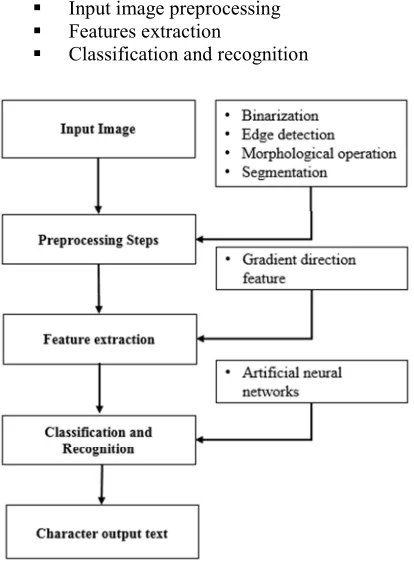
The OCR system includes functionally tree essential parts as described in the below schema figure 2.
Input image preprocessing Features extraction
[image:3.612.315.522.107.389.2]Classification and recognition
Figure 2: OCR system design
4.1 Preprocessing
Preprocessing steps are implemented to reduce variations in the writing style of different people. The order of preprocessing steps (Figure. 2) are as follows: Image acquisition, scanned images are binarized using Otsu’s algorithm of global thresholding. A large amount of noise such as salt and pepper noise may exist in the image acquired by scanning. So in order to reduce this noise to some extent, we have applied a 3 × 3 median filter. In the segmentation process.
• Binarization
• Edge detection
• Morphological operation
• Segmentation
4.1.1 Binarization and edge detection
3090 value by computing the histogram given by the following equation:
∑ (1)
: Represents the number of pixels with level i in the image.
The separation is based on the mean and the variance:
∑ ∗ (2) ∑ (3)
For each value of k=1 to k=255 we compute the following operation:
We note NT=256, where 256 is the total number of gray levels.
∗ 1 ∗ ∗
(4)
The level that maximizes the criterion function (4) is considered as the threshold for binarization of the image. Therefore, the threshold value is obtained when for a given k we have:
max (5)
The edge detection is a variety of methods that aims to make the segmentation and object detection. We keep only objects which have more than 30 pixels. An edge is a location of strong intensity contrast explained as a fast change in intensity.
The output image is shown in the figure 3.
Figure 3: Image binarization and pixel deletion
4.1.2 Morphological operation
Morphological operation are usually applied on binary images. The purpose of these operations is to affect the form, structure or shape of an object. The two principal morphological operations are dilation and erosion [9].
[image:4.612.321.513.170.286.2]During this step we make image dilation and image erosion. The dilation purpose is to add pixels to the boundaries of the image. The next step is to fill the image in order to prepare it to the next step of segmentation as illustrated in the figure 4.
Figure 4: Image dilation
Image erosion is also applied to binary images. It is similar to dilation but we move pixels to background as shown in the figure 5.
4.1.3 Segmentation
[image:4.612.96.282.535.613.2]Each image is segmented into sub-images. Each sub image contains a single character. Various segmentation methods can be applied [10]. The count of character in the image was performed and each character is separated with others. The output of the character after segmentation is shown in the figure 5.
Figure 5: Single character after segmentation
4.2 Handwritten character database
preparation
3091 different pens of various people. The character image samples are built by 20 different people. Each person writes 20 samples of the complete Tifinagh alphabet. In this way we collect 20x33 character image samples. The below stages have been accomplished to prepare the image to the feature extraction phase.
Convert the image to binary image using Otsu algorithm [6] with threshold = 0,8
Remove noise on the image using adaptative median filter [10]
Segmentation of the image.
[image:5.612.345.489.123.446.2]Check the size of the image, resize it to 50x50, an example of the output image is shown in the figure 6.
Figure 6: Characters samples of the constructed Tifinagh database
4.3 Feature extraction Technique
Reduction in processing time and higher recognition are the two major factors that motivate the researchers to focus on new techniques and methods for character recognition. The selection of appropriate feature extraction method is probably the single most important factor in achieving high recognition performance [11]. There are many feature extraction methods are available such as Projection Histograms, Contour profiles, Zoning, Geometric moment invariants, Zernike Moments, Spline curve approximation, Fourier descriptors, Gradient feature and Gabor features Template matching, Deformable templates, Unitary Image transforms, Graph description. In our work we have choose to use Gradient direction feature
Feature extraction is the most important and complicated phase in the OCR system. The purpose of this step is to prepare a data and extract attributes which can be used in the classification stage. During this phase each character has a feature vector which contains various information identifying its characteristics and specifications. For our system the feature extraction method is the gradient direction feature. The first step consists to prepare the dataset of 28 non-composed characters.
The schema of the features extraction phases is described as below in the figure 7.
Figure 7: Feature extraction phases
4.3.1 Zoning
[image:5.612.107.279.313.383.2]The zoning method is one of the most known techniques used in the OCR to extract different features of the characters [12]. This technique divides the image into sub-zones. We have chosen nine zones for each character image. Feature extraction will be computed for each zone in order to have sufficient information in the data set output. An example of the character subzones is shown in the following figure 8.
[image:5.612.330.503.635.697.2]3092
4.3.2 Gradient directional features
The main purpose of the feature extraction phase is to extract information from handwritten characters images that can maximize detection rates in the classification stage. The choice of a robust and efficient feature extraction plays a very important role in building a performant character recognition system.
[image:6.612.353.487.198.317.2]The image has been divided into 9 sub-zones in the previous step. The gradient algorithm made directional gradients. In the input image the gradient characterize the color changes progressively. The gradient computes the magnitude and the direction of each pixel neighbors. To calculate the gradient we use the means of the Sobel operator [13]. We compute Sobel’s mask to find the horizontal gradient gx and vertical gradient gy to locate the gradient as described in the figure 9.
Figure 9: Template of Sobel gradient, Horizontal and Vertical gradient.
For an input image we map for every neighborhood pixel these templates to find the X and Y components, g# and g$, respectively [13]. The mathematical formulas of these components are presented with the following equations (6) and (7)
%& , ( =) 1, ( * 1 * 2) , ( * 1 *
) * 1, ( * 1 ) 1, ( 1 2) , ( 1 ) * 1, ( 1 … . 6
%/ , ( ) 1, ( 1 2) 1, (
* ) 1, ( * 1
) * 1, ( 1 2) * 1, ( ) * 1, ( * 1 … 7
The gradient directional and magnitude feature can be deducted from the gradient vector 1g# g$23 as shown in the below equations (8) and (9).
The Gradient magnitude equation:
, ( 4%& , * %/ , ( 8
The Gradient direction equation: 6 , ( 7 8 %& ,
%/ , ( 9
[image:6.612.115.268.344.400.2]After extracting the vector of each pixel the gradient image is splited into 12 directions features as illustrated in the figure 10.
Figure 10: Orientation of directions
The character image was divided into 9 zones (3 horizontal and 3 vertical). The twelve directions features have been computed for all 9 zones of the input image. Therefore we acquire a vector of 108 features (9x12) which will be the input of our artificial neural network classifier.
4.4 Classification and Recognition
Artificial Neural Networks, as a branch of artificial intelligence, are widely used in the character recognition field. This is due to its ability to solve complex problem and automatic recognition. The single neuron or formal neuron is a mathematical modeling which simulates the biological neuron. The mathematical presentation of the neuron is described as follow by the equation (5)
: ;.
<<<<= >=
=
∑ ; >
(5)x : input vector , w : weights , y : output of the neuron
The activation function is the transfer function which connects the weighted summing to the output class. There are many types of activation function [14]
3093 The architecture of the ANN is depicted in the figure 11.
Figure 11: Architecture of the neural network
In the feed forward neural network the processing elements in adjacent layers are connected [15]. The ANN sends the input character to the input layer neurons which connect the input values to the hidden layer. The hidden layer compute sum weights of its input and provide the result to the output layer of the neural network. The number of hidden nodes depends on the system input values and used data set. The choice of this number is still a challenging problem [16].
5. EXPERIMENTAL RESULTS AND
DISCUSSION
[image:7.612.314.520.185.385.2]The size of the data set used for training is 2160 (108x20 characters) input vectors, 38 hidden layers and 20 classes’ outputs nodes. Twenty possible patterns have been used to train the network. The architecture of the used ANN is shown in the figure 12. The network has been trained with a vector containing 108 features. The ANN has been tested and proved very satisfying results. The ANN training has been done in 7sec with 253 iterations and no validation checks failed.
Figure 12: Architecture of the tested neural network
The evaluation of our neural network was done using the Receiver Operating Characteristic as shown in the figure 13. ROC curve is a plot of
sensitivity (versus) and specificity (basis). A perfect result is demonstrated by points in the upper-left corner with 100% sensitivity or true positive rate. The specificity or false positive rate is calculated using the formula (1-sensitivity). For our test the network is perfect. The true positive rate reaches 100% for almost all classes.
Figure 13. Receiver Operating Characteristic
The neural network simulation outputs an accuracy between 98,8% and 99.5%, only two wrong cases has been observed (0.5%) . These excellent results are due to the sufficient information we have in the feature vector (12 direction features).
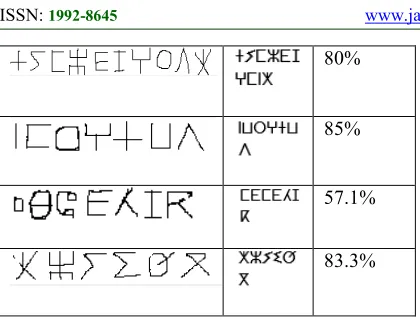
[image:7.612.312.522.530.719.2]The below table provides the recognition rate of testing some Tifinagh handwritten sentences. Tests have covered all twenty selected characters.
Table 1: Tests results for some handwritten sentences
Input image Text
output
Recogniti on rate 83.3%
83.3%
100%
85.7%
71.4%
[image:7.612.91.303.601.673.2]3094 80%
85%
57.1%
83.3%
According to the result of tests presented in the above table we can conclude that we have two main issues which are:
• Confusion between alphabets « » and
« » , the same issue was observed for English alphabets « S » and « B » on work [17]
• Confusion between characters « » and « »
The ANN has been trained also for 28 Tifinagh characters except composed characters ,
) the accuracy of the system was 81.1%
[image:8.612.91.301.71.233.2]The below table provides a comparison of our system performance with previous works. Our system accuracy is very good comparing with other works. Nevertheless, it needs improvement in term of recognition of some sentences. This issue will be handled in a future work.
Table 2: Performance results of previous works
Work Performance of the
system
Amrouch et al. [1] 97.89%
El Kessab et al. [2] 85.00%
Oujaoura et al. [3] 99.39%
Sabir et al. [4] 99%-100%
Bencharef et al. [5] 99.00%
Gounane et al. [7] 91.05%
Our methodology 99.50%
6. CONCLUSION AND FUTURE SCOPE
We have developed a new technique to recognize Tifinagh handwritten characters. The new OCR system is based on artificial neural networks
as a classifier and gradient direction function as a feature extraction. Experimental results show that the system achieves an excellent accuracy of the ANN 99.5% and a recognition rate of Tifinagh sentences between 57.1% and 100%.
In future work we will try to increase the recognition rate by resolving the problem of
confusion between some characters e.g « » and « ». The classification phase can be improved by expanding the dataset to include all characters of Tifinagh alphabet and use a new approach of classification such as MLP, KNN or Support Vector Machine
REFERENCES
[1] M. Amrouch, Y. Es saady and A. Rachidi,M. El Yassa and D. Mammass, “Printed Amazigh Character Recognition by a Hybrid Approach Based on Hidden Markov Models and the Hough Transform”, International Journal of Modern Engineering Research (IJMER), 2009. [2] B. El Kessab, C. Daoui and B.
Bouikhalene."Handwritten Tifinagh Text Recognition using Neural Networks and Hidden Markov Models", International Journal of Computer Applications (0975–8887) Volume 75–No.18, August 2013.
[3] Oujaoura, B. Minaoui, M. Fakir and B. Bouikhalene, R. El ayachi and O. Bencharef, “Invariant Descriptors and Classifiers Combination for Recognition of Isolated Printed Tifinagh Characters” , (IJACSA)
International Journal of Advanced Computer Science and Applications, special issue on selected papers from 3rd international symposium on automatic amazigh processing SITACAM13, Vol. 3, No. 2, pp.22–28, 2013. Published by The Science and Information Organization, New York, USA.
[4] B. Sabir , Y. Khazri and A. Jadir, B. Touri and M. Moussetad , “Multiple Classifiers Combination Applied to OCR of Tifinagh Alphabets”, International Journal of Engineering and Innovative Technology (IJEIT) Volume 4, Issue 5, November 2014 [5] O. Bencharef, M. Fakir and B. Minaoui,
3095 [6] K. Freedman, “A Cognitive Model of
Character Recognition Using Support Vector Machines”, World Academy of Science, Engineering and Technology 58 2009.
[7] S. GOUNANE, M. FAKIR and B.
BOUIKHALEN, "Handwritten Tifinagh Text Recognition Using Fuzzy K-Nearest Neighbor and Bigram Language Model", International Journal of Engineering Science and Innovative Technology (IJESIT) Volume 2, Issue 4, July 2013
[8] N. Otsu, "A Threshold Selection Method from GrayLevel Histograms", IEEE Transactions on System, Man, and Cybernetics, SMC-9(1), 1979.
[9] Umbaugh Scot E, Computer Vision and Image Processing, Prentice Hall, NJ, 1998, ISBN 0-13-264599-8
[10]N. Dave, “Segmentation Methods for Hand Written Character Recognition”, International Journal of Signal Processing, Image Processing and Pattern Recognition, Vol. 8, No. 4(2015), pp. 155-164.
[11] P. Kumar Garg, ,P. Verma and A. Bhardwaz, “ A Survey Paper on Various Median Filtering Techniques for Noise Removal from Digital Images” , American International Journal of Research in Formal, Applied & Natural Sciences. AIJRFANS 14-334, 2014.
[12]D. Impedovo and G. Pirlo, "Zoning methods for handwritten character recognition: A survey", Pattern Recognition, 47(3):969–981, 2014.
[13]A.N. Holambe,R.C.Thool and S.M.Jagade, “Printed and Handwritten Character & Number Recognition of Devanagari Script using Gradient” International Journal of Advanced Research in Computer Science and Software Engineering. Volume 2, Issue 5, May 2012. [14]P. Sibi, S.A. Jones and P. Siddarth, “Analysis
of Different Activation Functions Using Backpropagation neural networks” Journal of Theoretical and Applied Information Technology. 31 st January 2013. Vol. 47 No.3 [15]Ajeet Kaur, Randhir Singh, Bhanu Gupta,
“Feed Forward Backpropagation Neural Network Image Compression for Better SNR , PSNR and BPP ” Jammu University , Jammu, J&K, India. International Journal of Scientific and Technical Advancements, Volume 2, Issue 1, pp. 119-122, 2016.
[16]Saurabh Karsoliya, “Approximating Number of Hidden layer neurons in Multiple Hidden Layer BPNN Architecture” Maulana Azad National Institute of Technology Bhopal, India , International Journal of Engineering Trends and Technology -Volume 3 Issue 6-2012 [17]R. Abd. Rahim, L. U. Abdul Khalik and