3457
INTELLIGENT ROUTING TOPOLOGY FOR BEACON DATA
TRANSFER
1BYONG-KWON LEE, *2SEOK-HUN KIM
1Dept. of Multimedia Engineering, College of Engineering Dongguk University, 04620, Korea
2Dept. of Electronic Commerce, PaiChai University, 35345, Korea
E-mail: : 1[email protected], 2[email protected](Corresponding Author)
ABSTRACT
Indoors the positioning technique retrieves the position of users by the intensity of the signal and the identifier information generated in the beacon node. However, user location measurement is designed without considering the movement path of the data, the energy amount of the beacon node, the distance and the number of hops. Also, beacon nodes often lose data due to the disappearance of the data path depending on the installed state in a building. In this paper, we have studied routing topology configuration method that delivers the energy amount, the distance between nodes and the number of hops efficiently in a real environment. In conclusion, we have solved the problems of loss for local energy and data in fixed path models.
Keywords: Beacon Routing, Effective Routing Topology, Intelligent Routing
1. INTRODUCTION
We use general GPS technology [1] [2] to find the location of the user outdoors. Also, in a building, a beacon device is installed at a ceiling or a specific location to measure the position of the user [3].
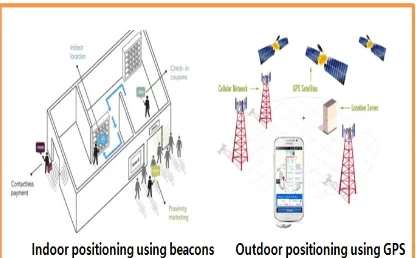
[image:1.612.91.299.503.632.2]"Fig.1," shows how to collect the location of a user with beacon nodes on ceilings and walls, and how to search for outdoor locations by GPS.
Figure 1: Beacon and GPS positioning
In this paper, we studied the configuration of optimal routing topology for data transmission with the strength of signal and identifier information as indoor position measurement element.
The proposed optimal routing policy can be applied to distance within neighboring beacons, the amount of energy remaining in the beacon node, and the number of hops with the location acquisition server. The adaptive fuzzy algorithm is applied to the topology of the beacon network [4].
2. RELATED WORK
2.1 Indoor location measurement
Bluetooth BLE technology is used to find indoor user location with low-power wireless beacon technology [5]. In other words. Bluetooth beacons are hardware transmitters - a class of Bluetooth low energy (LE) devices that broadcast their identifier to nearby portable electronic devices. The technology enables smartphones, tablets and other devices to perform actions when in close proximity to a beacon.
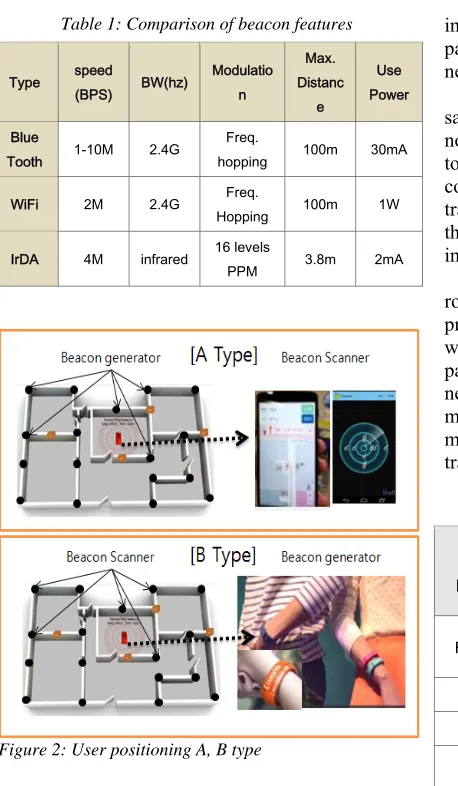
3458 Table 1: Comparison of beacon features
Type speed
(BPS) BW(hz)
Modulatio n
Max. Distanc
e
Use Power
Blue
Tooth 1-10M 2.4G
Freq.
hopping 100m 30mA
WiFi 2M 2.4G Freq.
Hopping 100m 1W
IrDA 4M infrared 16 levels
PPM 3.8m 2mA
Figure 2: User positioning A, B type
2.2 Wireless Sensor Network Routing
Wireless sensor network routing comprises 'Flat Networks Routing' based on node location, 'Hierarchical Networks Routing' forming the virtual hierarchy and 'Location Based Routing' using location information for routing when nodes identify their location[5].
The fuzzy routing protocol proposed in this paper is 'Flat Networks Routing' protocol and was used for comparing the adaptive wireless sensor network routing algorithm proposed in this paper.
For Flooding[6] protocol, all nodes transfer the packets to the neighboring nodes by broadcasting the packets which they identify among the packets they receive. It is used to deliver beacon signals to all sensor nodes in most routing protocol. DSR[7] protocol transfers beacon packets including the IDs of nodes which it passes through and transfers data packets in the reverse order of path. The disadvantage of this method is that the packet size increases in accordance with the
increase of the number of nodes included in the packet paths. Accordingly, it is not suitable for the networks with a quantity of nodes.
For GBR[8] protocol, beacon packets save the hop count from the sink to the destination node whenever they pass through nodes and return to the sink by selecting the path with lower hop count when selecting the routing path for data transfer. However, since data packet is transferred through the path with lower hop count, some nodes in all sensor nodes may cause local energy loss.
AODV[9] protocol works as preparing the routing table in vector type with the directional property. IDs of nodes receiving packets are saved when beacon packets are transferred and data packets are delivered to the sink through the neighboring nodes. This approach is applied with more than one neighboring nodes. It comprises two methods, selecting one among target nodes and transfer of all nodes to neighboring node.
Table 2: Routing Protocol
Routing Protocol
Path Selection
element
Data Collection
Table Preparation
Flooding All Path distribute
Path X
DSR Packet Info Static Path X
GBR Hop Static Path X
AODV Random Distribute
Path 0
3. OPTIMAL BEACON DATA TRANSFER
TOPOLOGY
3.1 Beacon Data Transmission
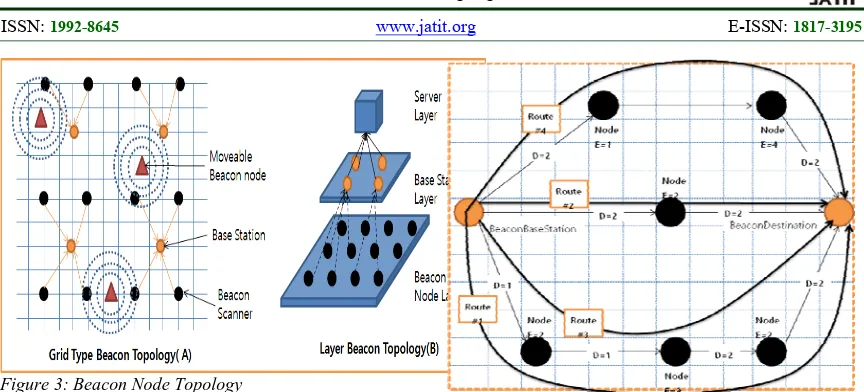
[image:2.612.91.320.87.480.2]3459 Figure 3: Beacon Node Topology
3.2 Situation Adaptive Routing Protocol
Situation adaptive routing protocol identifies the path with the highest degree of fulfillment using fuzzy control and back-propagation. This Section describes the effective routing technique using fuzzy concept and explains the fuzzifier required for fuzzy reasoning and the process to produce fuzzy rules basis and design fuzzy reasoning engine. Furthermore, it proposes the technique to reduce time required for fuzzy operation and finally analyzes the performance of routing protocol performance proposed in this paper.
The elements determining the routing path for wireless sensor network include remaining energy, distance between nodes, hop count, radio field intensity and node location.
This paper assessed the proposed protocol using three elements determining the routing path, energy(E), distance(D) and hop count(H).
In “Figure. 3” when S is Sink Node and D is Destination Node, four paths can be produced using energy, distance and hop count:
R1(E=6,D=6,H=4), R2(E=4,D=3,H=3),
R3(E=3,D=2,H=2), and R4(E=5, D=6, H=3). When only maximum energy is considered, the selected routing path is R1 with the high energy. When selecting the routing path using the minimum distance between S and D, R2 with the shortest distance is selected.
R3 is selected when using the minimum hop count. As described above, the path selection varies on the conditions to select a routing path. Thus, the semantic analysis is required to supplement the conditions to select a routing path. “Table 3” describes the priority by semantic analysis on the routing conditions for the routing paths in “Figure. 4”
Figure 4: Beacon Node Topology
Table 3: Comparison of beacon features
Collected values Convert to Fuzzy Logic Prioritie s Path Energy Distance Hop Energy Distance Hop
R1 6 6 4 High High Medi
um 3
R2 4 3 3 Medium Little low Little
Low 1
R3 3 4 2 Low Medium Low 2
R4 5 6 3 Little
high High Little
Low 3
The standards for preparation of “Table 3” were energy, distance and hop count. The standards for language set for fuzzification are "1:Very Small, 2: Low, 3:Little Low, 4: Medium, 5: Little High, 6: High, 7:Very High".
As the conditions to determine the path priority, higher energy and lower distance and hop count are preferred. For R1 and R3, the priority is 3. While R4 is higher than R1 by 1 in energy, R4 is higher by 1 in hop count. Accordingly, they have the same priority. For R2 and R3, R2 is superior than R3 in energy and distance. With respect to energy, distance and hop count, R2 is the most suitable.
The adaptive wireless sensor routing protocol proposed in this paper identifies the optimum routing path for wireless sensor network using the fuzzy operation enabling the semantic analysis.
3.3 Fuzzy Set Description
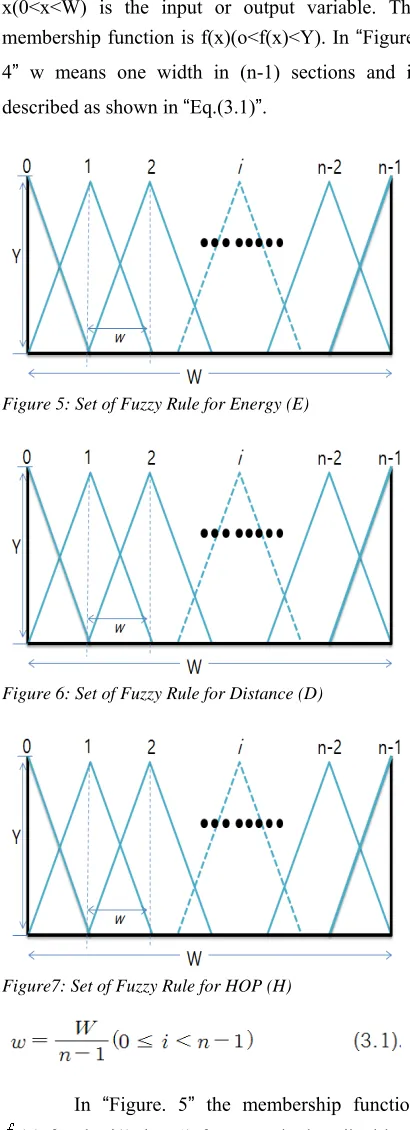
This Paragraph explains how to describe conditional and consequent fuzzy sets. As shown in
3460 scope of the control value for the membership function of fuzzy. W is the width of input value. x(0<x<W) is the input or output variable. The membership function is f(x)(o<f(x)<Y). In “Figure. 4” w means one width in (n-1) sections and is described as shown in “Eq.(3.1)”.
[image:4.612.90.293.472.671.2]Figure 5: Set of Fuzzy Rule for Energy (E)
Figure 6: Set of Fuzzy Rule for Distance (D)
Figure7: Set of Fuzzy Rule for HOP (H)
In “Figure. 5” the membership function (x) for the i(0<i<n-1) fuzzy set is described by a linear equation with the positive gradient and that with the negative gradient as shown in “Eq. 3.2”.
The fuzzy rule base is the set of rules connecting the conditional fuzzy set for the input variables to the consequent fuzzy set. Let's suppose that , is the number of rules for energy, , the number of rules for distance, , the number of rules for hop count and , the number of consequent rules.
Let's suppose that is the scope of input for the energy value e in the input values using fuzzifier, and and are the input socpe for the distance d and the hop count h, respectively.
<Equation 3.3> shows the number of rules where input value e, d and has included. Whereas, [x] is the integer which doesn't exceed the value x. i=(0<i< ), j=(0<i< ), and k=(0<k< )
Three input values above were analyzed in 3D space in this paper. The distance from the point 0 to the number of relevant rule(i,j,k) was divided by the number of consequent rule to determine the number of consequent rule. , the number of consequent rule estimated, is presented in Eq.3.4.
Let's taken an example. When =
= =4, = = =0~60, =11, e=10, d=40,
h=24, i, j and k are [0.5]=0, [1.2]=1, and [2.0]=2, respectively and =[4.73]=4. Thus, it is connected to the 4th consequent rule.
3461 height, width and depth in 3D space. Matching is to save estimated value in a memory and bring it later. The second solution is to simplify the calculation using , the height, depth and width, instead
of the 3D space distance .
3.4 Fuzzy Reasoning and Control
Fuzzy reasoning generates one fuzzy control value by calculating the degree of fulfillment using the fuzzy operation and convolution operation on energy, distance and hop count entered into the fuzzifier.
The degree of fulfillment for several routing paths is estimated when the fuzzy control theory is applied for routing. The path with the highest degree of fulfillment is selected. So it doesn't require defuzzification.
Next paragraph will be described the process to generate one fuzzy control value in accordance with general fuzzy control theory and determine the routing path. Also be last paragraph described the simple fuzzy routing algorithm.
“Figure. 8” is the MAX Operation Algorithm with the conditional fuzzy set using the input fuzzy variables, e, d and h.
Void fuzzy_edh(int e, int d, int h){ fuzzyCalc(IWIDTH-e, FE); fuzzyCalc(d, FD); fuzzyCalc(h,FH); }
void fuzzyCalc(int x, int *f) { int i, region;
for( i=0; i<NO_IRULES; i++) { region = x/IW-i;
switch (region) {
case -1 : f[i]= IHEIGHT*x/IW-(i-1)* IHEIGHT; break; case 0 : f[i]= -IHEIGHT*x/IW+(i+1)*IHEIGHT; break; default : f[i]= 0; break;
} } } (1) (2) (3) (4) (5) (6) (7) (8) (9) (10) (11) (12) (13) (14) (15) (16)
Figure 8: MAX Operation Algorithm
Line (2) calculates by taking energy from IWDTH, the width of input variable because energy has the inverse relation with hop count and distance.
In case of higher energy and lower distance and hop count when selecting routing path, the priority is higher. With lower energy and higher distance and hop count, the priority is lower.
The function fuzzyCalc in Line (6) saves FE, FD and FH, the degree of fulfillment of three variables used for MAX operation and the fuzzy set for the input value e, d and h.
Line (8) to (15) calculates the fuzzy function value in <Equation 3.2>. "region" in Line
(9) is to calculate the fuzzy trigonometrical function. The sentence identifies the side where input fuzz variable x is included, among two gradients of the ith trigonometrical function. If the sentence is -1, it is the linear equation with the positive gradient. If the sentence is 0, it is the linear equation with the negative gradient.
As described above, the degree of fulfillment for all fuzzy control variables(e, d and h) is calculated.
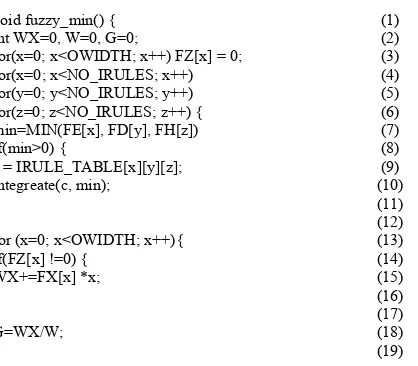
“Figure. 9” illustrates the defuzzification process after selecting the MIN value of FE, FD and FH, the buffers saving MAX vlaues.
void fuzzy_min() { int WX=0, W=0, G=0;
for(x=0; x<OWIDTH; x++) FZ[x] = 0; for(x=0; x<NO_IRULES; x++) for(y=0; y<NO_IRULES; y++) for(z=0; z<NO_IRULES; z++) { min=MIN(FE[x], FD[y], FH[z]) if(min>0) {
c = IRULE_TABLE[x][y][z]; integreate(c, min);
} }
for (x=0; x<OWIDTH; x++){ if(FZ[x] !=0) {
[image:5.612.317.526.250.433.2]WX+=FX[x] *x; } } G=WX/W; } (1) (2) (3) (4) (5) (6) (7) (8) (9) (10) (11) (12) (13) (14) (15) (16) (17) (18) (19)
Figure 9: Defuzzification for Min Value of FE, FD and FH
The minimum value is estimated using the function MN in Line (7). The degree of fulfillment for the MIIN value is estimated using the function Integrate in Line (10).
FZ produced by convolution operation is used to estimate the center of gravity during defuzzification process. Finally, the center of gravity, the control point G, is identified in Line (18).
The process above is the algorithm to estimate the fuzzy control value for one path. Fuzzy routing algorithm estimates the control value G for each path and the path with the highest G value is selected as the routing path.
3.5 Fuzzy Engine Simplication
Routing estimation in sensor network doesn't estimate the control value for a specific device or unit. Thus, it doesn't require defuzzification process. It just estimates the priority of paths using routing data generated.
3462 slow operation speed uses the complicated fuzzy operation, load according to operation may increase too much.
This paper proposes the fuzzy routing algorithm simplified in two steps. The first step determines the direct path by estimating the rank without defuzzification. The second step removes multiple loop operation included in the process.
As shown in “Figure. 10” the existing approaches estimate the control point for the degree of fulfillment for each path which can be taken from a node to a sink node and selects the path with the highest value. In other words, since the center of gravity is not the value to get, it can be simplified to estimate the output rule number with the most optimum degree of fulfillment.
Accordingly, the degree of fulfillment is estimated in Line (5) as shown in <Figure 10>. The output rule number corresponding to the most optimum degree of fulfillment is considered as the rank for the input set in Line (10).
MAX=0;
for (x=0; x<NO_IRULES; x++) for (y=0; y<NO_IRULES; y++) for(z=0; z<NO_IRULES; z++) min=MIN(FE[x], FD[y], FH[z]); if(min>0) {
c=IRULE_TABLE[x][y][z]; if(min>MAX) {
MAX=min; Rank = c; } } }
(1) (2) (3) (4) (5) (6) (7) (8) (9) (10) (11) (12) (13)
Figure 10: Degree of fulfillment for routing path
Finally, the path with the highest rank is selected as comparing only rank values. Defuzzification step can be removed using the process above.
The second step is to remove triple loops as shown in “Figure. 11”
Triple loop in “Figure. 10” includes the process to estimate the output rule for the coordinates with the highest value in the axis in the space of energy, hop count and distance.
The process above is the same as that for getting the maximum value in the axis and finding the rules on the maximum value in the axis.
Accordingly, as shown in “Figure. 10” and
“Figure. 11” one loop can be used. The complexity of calculation is also reduced from O[ ] to O[ ], and means the number of input rules.
X=Y=Z=0;
for (x=1; x<NO_IRULES; x++) { if(FE[x] < FE[x]) X=x;
if(FD[y] < FD[y]) Y=x; if(FH[z] < FH[z]) Z=x; }
Rank = IRULE_TABLE[X][Y][Z];
(1) (2) (3) (4) (5) (6) (7)
Figure 11: Degree of fulfillment for routing path:
3.7 Fuzzy Routing Process
The proposed fuzzy routing protocol comprises the forwarding process determining the path by broadcasting beacon and the data collection process transferring data from the destination.
[image:6.612.312.515.348.619.2]The forwarding process flow is presented in Figure 12. The nodes including the sink in the forwarding process transfer the beacon packets including their location coordinates, ID and destination data to the sensor network in flooding method.
Figure 12:Delivery process forward
The node receiving data packet executes the routing based on the fuzzy rank value when it is not the sink.
(R=Max(readTable())), At first, the path R having the maximum rank value for the potential path is saved.
3463 Finally, the rank value for the selected path is calculated for routing of the next data packet(fuzzyV=FuzzyCalc()) and the data is transferred through the path R(Send()). After completing the transfer of data packet once, the new rank value calculated is referenced when transferring the next data packet. Accordingly, the possibility that the same path is selected is reduced. Then, the disperse path is made when transferring data packet. “Figure 13” illustrates the process to collect desired data from the destination and transfer it to the sink node.
Figure 13:The data collection process
4. EXPERIMENTAL
4.1 Performance Experiment and Analysis
For simulation and performance analysis, the fuzzy routing protocol was implemented using nesC language working on the basis of TinyOS, the sensor network operating system, and the experiment was implemented using TOSSIM simulator and TinyViz.
The scales for performance comparison include operational complexity of routing protocol, energy histogram on the energy usage of node arranged on the sensor network and average consumption energy and standard deviation of sensor nodes.
As shown in Table 4.1., the sensor nodes were randomly arranged in the grid for the topology of sensor network.
Since routing data is required as many as the neighboring nodes for the proposed wireless sensor network routing, the number of neighboring nodes was 4 in the grid arrangement and 2~7 in th random arrangement. Thus, 10 elements were arranged on the routing table.
Data packet used TOS_Msg structure from TinyOS. One packet size was 36 bytes combining 7 packet header bytes and 29 data area bytes.
Data area includes the address, sensing time and sensing value. The energy to transfer and receive one data packet is 2 to transfer and 1 to receive as the weight.
Before the experiment on the proposed protocol, the number of conditional and consequent fuzzy sets for routing needs to be determined.
Table 4: Experimental Condition
ITEM Condition
Topology Grid, Random
Routing determinants element Energy(E), Distance(D), Hop(H)
The number of fuzzy sets Condition 10, conclusion 10 Transmission distance
between nodes Spread sensitivity 100%
Experimental methods
energy 10 of node Reduced transmission of 2 Reduced receiving of 1 Data collection methods Data transfer to the sink node
Comparison protocol DSR, GBR, AODV
Table 5: Conditional Part fuzzy decision table
The number of fuzzy sets
Condition Part conclusion part
Average deviation Standard Average deviation Standard
2 70.6 43.6 74.0 54.5
4 68.8 42.1 74.2 55.4
6 67.4 44.8 74.1 49.0
8 69.1 43.1 74.1 50.4
10 69.1 40.1 70.0 47.7
12 70.4 43.7 70.6 48.5
14 70.4 44.5 69.3 47.9
Table 5 presents the average and standard deviation of energy used by node when fuzzy routing protocol worked for the identified fuzzy sets.
[image:7.612.309.530.481.611.2]3464 The number of consequent fuzzy sets was changed with 10 conditional rules. Accordingly, 10 consequent fuzzy sets showed low energy consumption average and low standard deviation.
The fuzzy routing protocol was implemented using the values above and the performance was compared to other routing protocols.
Table 6 presents the required memory size and operational complexity of other protocols which were compared to the proposed routing protocol.
Table 6: Protocol performance evaluation factors
Protocol
Item DSR GBR AODV Fuzzy Routing
Routing info
Passed a node ID
Neighb orhood ID Numbe
r of
hops
Neighbor hood ID
-Neighborhood ID
-Sum of Energy -Sum of Hops -sum of distance -Fulfillment
Usage Memory
Routin gInfo* Path
Routin gInfo* Path
RoutingI
nfo*Path RoutingInfo*Path
Comple
xity O(1) O(n) O(1) O(n)+O(m)
Since DSR includes only ID data of node transferred, the memory usage was the same as the number of paths.
However, the operational complexity is o(1) because the path is predefined in the packet.
GBR works by selecting one path with low hop count using the data on ID and hop count of the neighboring nodes. Thus, the operational complexity is O(n).
The operational complexity of AODV is O(1) because it works by generating the table using the ID data of neighboring nodes.
5. Since fuzzy routing technique selects the best degree of fulfillment, its operational complexity is O(n). O(m) is added because it executes the process to find out "Rnak" value when calculating the degree of fulfillment depending on the energy change.
4.2 Energy Histogram
Fig 14 is the energy histogram on the number of nodes related to the energy consumption acquired by continuously transferring the packets until the packets couldn't be transferred any more due to energy depletion of some sensor nodes.
AODV(b) showed the worst result because it had a lot of nodes using energy a lot.
Fuzzy routing(a) had the nodes using less energy than other routing protocols(c)(d) since the scope of energy used was mainly between 10 to 40%.
[image:8.612.313.520.202.427.2]Fuzzy routing technique using energy histogram showed the even usage of energy by the nodes in accordance with the comparison with other protocols on the basis of the energy quantity used by all nodes.
Figure 14:Energy Histogram
[image:8.612.308.526.561.735.2]The average and standard deviation of energy consumption were used as the scales to numerically express the results above. In accordance with the experiment results in Table 7 the average and standard deviation on the consumption energy of the fuzzy routing technique were lower than other protocols and the routing path was dispersed.
Table 7: average and standard deviation of the energy consumption node
Topology Item Routing Fuzzy AODV DSR GBR
Grid(9)
Average 86.0 89.0 86.6 88.0
Standard
deviation 21.9 22.3 21.4 22.1
Random(49)
Average 84.2 93.6 86.7 85.1
Standard
deviation 23.3 17.6 22.5 22.5
Grid(100)
Average 59.3 61.1 59.8 62.5
Standard
deviation 25.4 25.5 27.8 26.1
Random(100)
Average 53.3 71.7 59.3 63.8
Standard
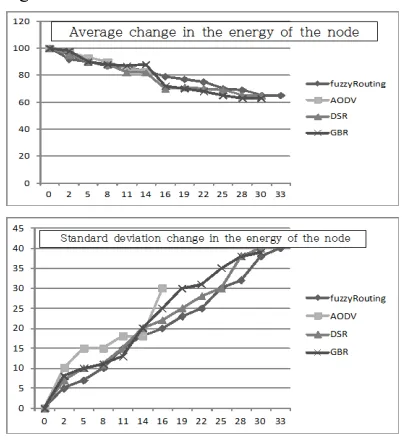
3465 100 nodes were randomly arranged for measuring the sensor network lifetime. Energy average and standard deviation in accordance with the change of the time when network was implemented and disconnected were measured.
It also showed the comparison results of the proposed fuzzy routing protocol, AODV, DSR and GBR protocols.
While average energy change was similar for the proposed fuzzy routing, DSR and GBR protocols, the network lifetime was longer for the proposed fuzzy routing protocol.
AODV had short network lifetime for about 14 minutes. For DSR and GBR protocols, the network was disconnected after about 30 minutes. However, the proposed protocol had the network lifetime of 33 minutes, 2 minutes longer than existing protocols.
4.3 Lifetime
100 nodes were randomly arranged for measuring the sensor network lifetime. Energy average and standard deviation in accordance with the change of the time when network was implemented and disconnected were measured
[image:9.612.92.294.395.616.2]“Figure. 9”
Figure 15: Average and Standard deviation Energy
Usage
“Figure. 9” illustrated the results by setting the first energy of node to 100 and dividing the average change of energy by time. It also showed the comparison results of the proposed fuzzy routing protocol, AODV, DSR and GBR protocols.
While average energy change was similar for the proposed fuzzy routing, DSR and GBR protocols, the network lifetime was longer for the proposed fuzzy routing protocol.
AODV had short network lifetime for about 14 minutes. For DSR and GBR protocols, the network was disconnected after about 30 minutes. However, the proposed protocol had the network lifetime of 33 minutes, 2 minutes longer than existing protocols.
5. CONCLUSIONS
Selection of the routing method in the beacon Routing Topology network can be the important element to determine the beacon network lifetime.
Existing routing protocols transfer and receive packets in consideration of one specific element. Thus, the energy consumption of local nodes occurring by repeatedly using the same path causes the reduction of beacon network lifetime.
This paper selected energy, distance and hop count in various elements which could be considered for selecting the path and proposed the routing protocol which could extend the network lifetime as energy of each node was evenly used by fuzzy operation.
The path awareness was improved by combining the fuzzy control technology which made judgment in the similar way to the human awareness.
For applying the complicated fuzzy control theory to the beacon topology routing technique, the fuzzy control value was not calculated and only rank value for the input variable was used to determine the path. In this process, the technique to implement using the single loop was also applied to the sensor node with the limited resource.
While average energy change was similar for the proposed fuzzy routing, DSR and GBR protocols, the beacon network lifetime was longer for the proposed fuzzy routing protocol.
AODV had short network lifetime for about 14 minutes. For DSR and GBR protocols, the network was disconnected after about 30 minutes. However, the proposed protocol had the network lifetime of 33 minutes, 2 minutes longer than existing protocols.
3466 required to assess the performance by applying to actual nodes. In addition, it will be necessary to consider the radio field intensity as well as the existing scales. Further study needs to investigate how to reduce the operational complexity more by applying the approximate value to the conditional and consequent rule mapping process.
ACKNOWLEDGEMENT
This work was supported by the research grant of Pai Chai University in 2017.
REFRENCES:
[1] Theiss, A, David C. Yen, and Cheng-Yuan Ku. (2004), “Global Positioning System: an analysis of applications, current development and future implementations”, Science Direct. 9th Jun (2004)
[2] McNeff, J., “The Global Positioning System”, IEEE Transactions on Microwave theory and techniques, VOL 50, No.3, March (2002) [3] Bulusu. N, Heidemann. J, Estrin. D, Adaptive
beacon placement, in: Proc. 21st IEEE International Conference on Distributed Computing Systems, IEEE Computer Society, Los Angeles, CA, United States, (2001), pp. 489-498.
[4] C.S.Raghabendra, Krishna M. Sisvailngam and Taieb Znati Wireless Sensor Networks, KAP, (2004).
[5] I.F.Akyildiz, W,Su, Y.Sankarasubramaniam and E.Cayirci, A Survery on Sensor Networks, Proc. IEEE. pp.102-114, August (2002).
[6] S. Hedtniemi and A, Liestman, “ A survey of gossiping and broadcasting in communication networks” IEEE Networks, Vol, 18. No. 4, pp.319-349. (2003).
[7] D. B. Johnson and D. A. Maltz, “Dynamic Source Routing in Ad-hocWireless Networks,” In T. Imielinksi and H, Korth, Mobile Computing, pp. 153-181. Kluwer Academic Publishers, (2003).
[8] J.Gao, Energy efficient routing for wireless sensor networks, Ph.D. Dissertation, UCLA (2001).