BIROn - Birkbeck Institutional Research Online
Topp, Leslie (2012) Complexity and coherence. Journal of the Society of
Architectural Historians 71 (1), pp. 8-41. ISSN 0037-9808.
Downloaded from:
Usage Guidelines:
Please refer to usage guidelines at
or alternatively
Complexity and Coherence: The Challenge of the Asylum Mortuary in Central Europe,
1898–1908
Author(s): Leslie Topp
Reviewed work(s):
Source: Journal of the Society of Architectural Historians, Vol. 71, No. 1 (March 2012), pp.
8-41
Published by:
University of California Press
on behalf of the
Society of Architectural Historians
Stable URL:
http://www.jstor.org/stable/10.1525/jsah.2012.71.1.8
.
Accessed: 12/03/2013 11:19
Your use of the JSTOR archive indicates your acceptance of the Terms & Conditions of Use, available at
.
http://www.jstor.org/page/info/about/policies/terms.jsp.
JSTOR is a not-for-profit service that helps scholars, researchers, and students discover, use, and build upon a wide range of content in a trusted digital archive. We use information technology and tools to increase productivity and facilitate new forms of scholarship. For more information about JSTOR, please contact [email protected].
.
University of California Press and Society of Architectural Historians are collaborating with JSTOR to digitize, preserve and extend access to Journal of the Society of Architectural Historians.
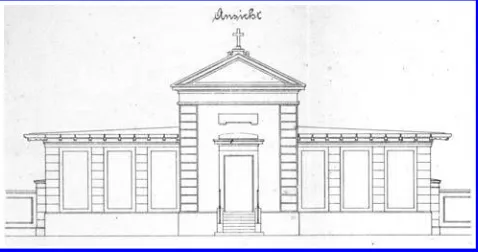
Figure 1 Carlo von Boog and Erich Gschöpf (?), Emperor Franz Josef Crown Land Asylum at Mauer-Öhling, Lower Austria, 1902, mortuary (Der Architekt 9 [1903], 39)
Figure 2 Asylum at Mauer-Öhling, site plan, with mortuary at 20 (Die Kaiser Franz Joseph-Landes-Heil- und Pflege-Anstalt in Mauer-Öhling: Festschrift
[image:3.612.51.409.375.638.2]Journal of the Society of Architectural Historians71, no. 1 (March 2012), 8–41. ISSN 0037-9808, electronic ISSN 2150-5926. © 2012 by the Society of Architectural Historians. All rights reserved. Please direct all requests for permission to photocopy or reproduce article content through the University of California Press’s Rights and Permissions website, http://www.ucpressjournals.com/reprintInfo.asp. DOI: 10.1525/jsah.2012.71.1.8.
leslie topp
Birkbeck College, University of LondonComplexity and Coherence
The Challenge of the Asylum Mortuary in Central Europe,
1898–1908
I
n 1903 the progressive Vienna-based journal DerArchi-tekt published an illustrated article on the buildings of
the Lower Austrian Crown Land Lunatic Asylum at Mauer-Öhling, which had been opened the previous year.1
The text described all forty buildings in the asylum complex as being executed in “the modern style.”2 The images
pro-vided of the administration building, a patient pavilion, and the combined chapel and social center showed a combination of flat roofs, compact volumes, and abstracted classical orna-ment loosely based on the formal approach developed at the time in Vienna by Otto Wagner and his students. One build-ing stood out as more seriously and self-consciously modeled on Wagner-school designs: the asylum mortuary (Figure 1).
The Mauer-Öhling asylum established a pattern that was repeated across the Habsburg Empire in the years lead-ing up to the First World War. Like all new asylums in Ger-many and Austria-Hungary at the time, it corresponded to the villa system, meaning that in place of a single rambling building, a complex of free-standing structures serving dif-ferent purposes was spread out across the asylum grounds (Figure 2). Resembling small suburban villa colonies or even towns, the new asylums contained separate buildings for common functions such as administration, worship, food
preparation, laundry, and farming, in addition to structures for housing and treating patients. At Mauer-Öhling we see for the first time the association of modern asylum planning with an openness to a new, progressive architectural and urbanistic language, an association repeated, with varying inflections, in the asylums at Steinhof in Vienna, and at Krom íž in Moravia.3
Asylum mortuary buildings thus had multilayered pro-grams that required intricate coordination of site, access, and circulation. Each element of the program was connected with thorny, emotionally charged and ideologically loaded issues, with their own spatial and building-related dimen-sions. The practice of pathological anatomy (via autopsies of dead patients) was implicated in debates about the causes of mental illness and the role of the asylum (as opposed to the university) as a site for research. The multiple identities of the patient as research resource, member of the asylum com-munity, and individual with connections to the world beyond the asylum were played out in the cramped spaces of the mortuary, as was the anxiety about patients dying within the asylum rather than leaving it cured. And the mortuary had to play its part in the presentation of a modern, humane public face for the asylum, while keeping the mourning public at a distance.
Behind the self-conscious simplicity of the building illustrated in Der Architekt was an unstable compound of death, mental illness, scientific research, publicity, and iden-tity. The aim of this article is to interrogate the relationship between that architectural simplicity and the program’s com-plexity. It will also present an alternative to the traditional narrative tracing the establishment of new building types in modernity; two subsequent asylum mortuary commissions, at the Steinhof asylum in Vienna and the Moravian asylum at Krom íž, both of which were undertaken in full aware-ness of the Mauer-Öhling solution, resulted in sharply contrasting designs. All three buildings were designed in the sphere of progressive influence, and specifically Wagner-school ideas, but each offered a fundamentally dif-ferent interpretation of largely similar requirements. The relationship between program and envelope subverts expec-tations: the purest Wagner-school example, at Mauer-Öhling, is the least expressive, indeed most suppressive, of purpose; the mortuary at Steinhof, part of a complex in which Wagner himself played the dominant design role, is the least coherent; and the Krom íž example, the only one designed by a Wagner-Schüler, stretches that language until it can cope with contradiction.
The early modernist aspiration to reaffirm purpose as the starting point for all designs was radically challenged when faced with a program containing abrupt juxtapositions and unresolved contradictions. Architectural communica-tion was challenged as well. Anthony Alofsin has argued that in early-twentieth-century multilingual Habsburg Central Europe in, the onus was on architects to create buildings that “spoke.” In an era of competing cultures and political instability, nothing could be taken for granted about archi-tectural communication; a generic muteness was not an
option.4 This article posits that the transformation of
insti-tutions and the resulting proliferation of new and increas-ingly complex programs and requirements—often combined with the early modernist orientation toward purpose—put extra pressure on architectural communication and, impor-tantly, on architectural coherence. Architects were pushed to articulate the specifics of a brief (including practical and ideological requirements) while creating buildings that made sense. The abrupt juxtapositions of madness and death, science and religion, and institutional and “outside” realms in the program for the asylum mortuary threatened potential meaninglessness, and put particular pressure therefore on architects to create meaning, in an era before overt and visible incoherence of expression was an accept-able architectural solution.
The Mortuary Becomes Visible
In the early twentieth century, when a patient died in a public hospital or asylum in the Habsburg Empire, the body was dealt with according to an established protocol. It was moved rapidly from the hospital ward or place of death to a cool space set aside for the storage of corpses. Almost always, an autopsy was then performed. The heavy demands on facili-ties for autopsies in these mortuaries stem from what medical historian Tatjana Buklijas has referred to as an “idiosyn-cratic” set of assumptions and practices regarding death and dissection in the empire. Whereas in other parts of Europe, especially in the Anglo-Saxon world, there was a history of public anxiety and protest surrounding post-mortem dissec-tion for research purposes, in Austrian lands there was a tra-dition of tolerant attitude to autopsy, a product, as Buklijas explains, of religious and political forces. Corpses of people who had died in a hospital as wards of the state were dissected as a matter of course right through the nineteenth century.5
The central importance of pathological anatomy to the inter-nationally renowned Vienna medical school was supported by the ready supply of corpses from hospitals in Vienna and beyond. By the early twentieth century, the influence of pathological anatomy on a wide range of medical disciplines, including psychiatry, was well established, and the demand for corpses continued to grow.6
While the legal framework around autopsies on people who had died outside of a hospital or state institution was tightened, “institutional corpses” (Anstaltsleichen) were still considered fair game, and valued as a crucial research resource.7 An 1887 law in Lower Austria, for instance, required
11
hospital could be dissected and an autopsy performed with-out prior permission.8 And indeed not only could deceased
patients be subject to an autopsy, autopsies were conducted routinely.9 According to the statutes of the three institutions
discussed in this article, only if the family specifically requested, on the death of the patient, that his or her body not be examined (and then only if the hospital authorities were satisfied that there was no important reason—scientific or forensic—why the autopsy should happen) would the body be buried undissected.10 It seems that such objections were
rarely raised for asylum patients: at the Mauer-Öhling asy-lum, for instance, of the eighty-one patients who died from July 1906 to June 1907, seventy-one were given autopsies.11
After the dissection the body was cleaned, sewn up, dressed, and made outwardly presentable by a hospital employee specifically charged with these duties, then put in a coffin and laid out for mourners in a hospital space designed for this purpose.12 Assuming the patient was Roman
Catho-lic, a funeral ceremony was performed in the funeral chapel. The body was then usually transported to a public cemetery or, in some rural asylums, buried in the institution’s own burial ground.
The idea that new hospitals should include designated buildings for dealing with dead patients was relatively common by the beginning of the twentieth century, though practice in the nineteenth century had varied considerably. Friedrich Oswald Kuhn, writing in the volume devoted to hospitals in a turn-of-the-century German architecture handbook, was encouraged that the previously accepted practice of storing and dissecting corpses in the basement of hospital buildings, and even, he claimed, under patient wards, had been largely abandoned.13 In Henry Burdett’s
multivolume Hospitals and Asylums of the World, published in London between 1891 and 1893, distance was seen as of utmost importance. Setting out guidelines for the construc-tion of post-mortem rooms and spaces for the storage and laying out of corpses in hospitals, he stressed “the paramount necessity of completely isolating these offices from anything approaching near proximity to the wards”—a requirement presumably driven by hygienic considerations.14 Burdett
favored a separate structure at the far corner of the site where possible.15 What this meant for Burdett’s vision of the ideal
modern asylum is seen in the model plans he provided. The asylum was designed as a symmetrical arrangement of large blocks connected by corridors, creating enclosed yards. The model plan for an asylum with three hundred beds contained, at the far end of two service wings (a laundry wing on the women’s side, and a workshop wing on the men’s) tiny spaces for male and female mortuaries, tucked into the corner of a walled yard.16 The spaces for the dead in Burdett’s ideal
asylum were distant and intentionally non-descript, without focused architectural elaboration.
In corridor-plan asylums built in the Austrian half of the empire in the 1860s and 70s, facilities for handling corpses were similarly set apart. Site plans of the asylums at Brno (in Moravia), Graz (in Styria) and Pergine (in Tyrol) show large attenuated asylum buildings dominating the grounds, with administrative spaces, chapels, kitchens, and other common services incorporated into the body of the building or attached by corridors, while the mortuary was one of very few separate structures. The arrangement could be very tight and compact, as at Pergine, where the mortuary was placed at the tail end of the main axis and enclosed within a walled compound.17 At
Brno and Graz, in contrast, the mortuary buildings existed completely outside the organizing framework of the central asylum building, sitting isolated in the far corner of the irreg-ularly-shaped asylum grounds.18 Any architectural impact
these buildings might have had was overwhelmed by the massed wings of the asylum proper; the only one of the three mentioned above to be visible in an image included a 1912 illustrated guide to Austrian asylums (the mortuary at the Pergine asylum) was a diminutive and reticent structure (Figure 3).19 The audience for the mortuaries as buildings
was in any case a small one, restricted to staff and mourners— they did not present a face to the outside world. The devel-opment of the separate asylum mortuary thus preceded the widespread adoption of the villa system by asylum plan-ners—that is, the disintegration of the single monolithic hospital building into a complex of individual buildings, each serving a distinct function. But in the villa asylum, where the separate, free-standing building was the norm, and each building received its own architectural articulation, the mor-tuary was not only separate, but drew attention to itself.
Site plans and descriptions of pavilion hospitals and villa asylums show a range of terms being used for what I am call-ing the mortuary. Many, such as Prosektur, and padiglione per
la necroscopia, put the emphasis on the building as a space for
autopsies and scientific research.20 But the most common
term was Leichenhaus (best translated in English as mortuary), which linked these buildings with what by the twentieth century was an established building type in the more general funerary context. Most mortuaries were built for the gen-eral public and not connected to hospitals, but they too con-tained an awkward and shifting combination of medical and religious functions. As Hans-Kurt Boehlke has shown, the Leichenhaus emerged at the end of the eighteenth century in Germany and Austria in the context of public health reforms.21
the medical function of the mortuaries used by the general public came to be limited to the hygienic handling of corpses (and the occasional autopsy). Since patients who died in Habsburg asylums needed not only to be handled hygien ically, but also to undergo autopsy as a matter of course and in such a way that—at least in theory—fostered not only public health but also medical research, the room for autopsies shifted from an optional to a necessary requirement in the mortuary belonging to the asylum (or hospital).
The purpose of autopsies performed on patients who died in asylums was, according to a 1901 article in a German psychiatric journal, not to determine the cause of death, but “to confirm the diagnosis and to uncover the source of [men-tal] disease.”25 The confidence in dissection (and in the
sub-sequent examination of histological specimens of the brain) was a product of the anatomical emphasis in psychiatry in the German-speaking world. The search for the seat and cause of mental illness in the physical substance of the brain was the most high-profile ambition of psychiatry in the second half of the nineteenth century, and by the early twentieth century, pathological anatomy was firmly embedded in the practices of mainstream psychiatric research, thanks to the efforts and example of the Viennese pathologist, asylum prosector, and professor of psychiatry Theodor Meynert, among others.26
But as Eric Engstrom has shown, psychiatric research in this period was enmeshed in a web of institutional politics, and the asylum’s relationship to the anatomical orientation in psy-chiatry was particularly fraught.27 The rise of the anatomical
orientation was closely linked to the rise of the university-based psychiatric clinic, which usurped the asylum as the classes of the population who did not occupy large
dwell-ings.22 The purpose of the early mortuaries was on the one
hand to control the interaction between dead and living bod-ies, and thus prevent infection. But it also, in a way that seems strange to us, provided a space in which Scheintod (apparent death) could be detected and the person revived, preventing the burial of a living person.23
At the core of the public mortuary were spaces for pre-paring and laying out dead bodies, spaces that were at once hygienic, equipped with emergency medical facilities (in case a corpse turned out not to be a corpse after all), and suitable for the cultural and religious rituals of paying last respects to the dead. Usually living quarters for an attendant were also provided. Sometimes the medical function was broadened to include a room for autopsies; and sometimes the religious function extended to a funeral chapel. The functional program shifted, and there were also wide varia-tions in the spatial and visual articulation of the mortuary building. Ursula Stein’s study of mortuary architecture in late eighteenth- and early nineteenth-century Germany shows that uncertainty existed from the period of the first mortuaries onward about an appropriate architectural image, with both domestic and sacred architectures being used.24 There was no one accepted architectural approach
to the mortuary building type to which asylum architects could attach themselves.
The Body, the Laboratory and the Asylum
[image:7.612.55.381.87.319.2]The fear of being buried alive faded as doctors were able to determine the moment of death with greater certainty, and
13
respected location of psychiatric knowledge and progress. Prestigious psychiatric research (especially brain dissections and investigations of the resulting specimens) took place in makeshift laboratories, in close proximity to other university-based research, rather than in the distant asylum, which might have elaborate purpose-built facilities, but which was seen to exist in a kind of rural stagnation, warehousing chronic patients.28 At the same time, asylum-based
psychia-trists continued to devise model asylums and to think and write about how patients might be cured, or at least brought into line with expectations of normal behavior, through a combination of physical, psychological, and environmental therapies. Their focus was the empirical observation and treatment of live patients, rather than the development of etiological theories based on the dissection of dead ones. That said, the inclusion in many asylum mortuaries of facilities not just for autopsies, but also for the investigation of anatomical specimens gained in the course of these autopsies, shows that asylum psychiatrists were also interested in (or expected to be interested in) the dead patient as a research resource.29 Josef
Starlinger, director of the Mauer-Öhling asylum, expressed in 1906 the asylum-based psychiatrist’s ambivalence toward laboratory research in spatial terms: “The emphasis in the [university] clinic is—apart from healing—on teaching and research, and therefore its primary work spaces are, besides the ward, the lecture hall and the laboratory. In the asylum it is true that scientific endeavors should not be completely neglected—we do not want to become mere practitioners— but the asylum is more and more a laboratory for the care of
the insane.”30
The mortuaries’ autopsy facilities and laboratories, then, had an awkward status: needed by doctors, perhaps fetishized by some as evidence of the scientific seriousness of their activities, but also thought to be foreign to the modern emphasis of asylum-based psychiatry on living patients.
Identity and a Space for Death
Asylum mortuaries almost always housed spaces for funerary rites, alongside the autopsy facilities. Institutions’ statutes show that every deceased patient was guaranteed a simple funeral, at the cost of the public authority that had been responsible for his or her maintenance in the institution. More expensive and elaborate funerals were also permitted, as long as the extra expense was covered by relatives or friends of the deceased.31 A person who died while a patient
in a Habsburg asylum had a double status, then: as a research resource, and as an individual whose passing was marked according to the custom of the world beyond the borders of the institution. This double status was condensed within the
compact spaces of the mortuary, but it also paralleled the dual identity of people living as patients in these institutions. They were, on the one hand, objects of medical diagnosis, observation, statistical calculation, and physical and pharma-ceutical treatment. On the other hand, they were expected as much as possible to lead a normal life—in the context of the model community constructed by the planners of the asylum—consisting of work, diversion, and religious obser-vation. The spatial distinction in mortuary buildings between science and commemoration was also echoed in the wider institutional complex. There were spaces in which patients were observed and treated (mostly large wards with beds, bath facilities, rooms for physical therapy), and spaces (agri-cultural fields, a theater, a church, workshops, laundries) in which they conformed to an institutional notion of the normal life.
The place of death in this normal life was awkward. On the one hand, the asylum represented a world unto itself, and the mortuary and, in some cases, cemetery, could be seen alongside the church, theater, and farm as elements of this parallel world, of the facilities necessary for a normal life (and normal death) within the walls of the institution. On the other hand, people were not born in asylums, and they were not supposed to die in them. In theory, they were supposed to be cured and released during their lifetimes.32 In corridor-style
asylums, death received little acknowledgment in the visible architecture of the place. With the villa system, asylums were recast as cities unto themselves, and the mortuary developed into a distinct building with its own identity.
That said, a separate structure could also mean one that was set apart and concealed, and building briefs for the asy-lums being studied here did call for the mortuary to be located on the edge of the asylum grounds and hidden as much as possible from the day to day life of the asylum. The familiar desire to conceal death from the living was com-pounded by the concern that hospital patients would be par-ticularly disturbed and discouraged by the reminder of death represented by the mortuary building.33 But there was
mortuary is at 20). The former acted as a filter through which patients were admitted and released according to set proto-cols, and through which members of the public also had to pass on their way to controlled visits to the institution. Mortuaries were also conduits for the release of patients into the outside world, but only, of course, when they could no longer experience this release. For members of the public, they were very shallow spaces, barriers more than bridges, since they were specifically designed to prevent any contact between the mourners and the “interior” of the institution (and indeed to keep mourners contained in a particular part of the mortuary building, away from the rooms where corpses were dissected and prepared for laying out).34 They
were more than barriers, though: they provided a setting for funeral rituals and were the face of the institution shown to people whose relatives and friends had died there.
Mortuaries, Publicity, and Split Buildings
The idea that the institution should present a particular sort of face to the outside world through its buildings should be seen in the context of the publicity campaign mounted by supporters of asylum psychiatry in this period. Asylum psy-chiatrists were highly sensitive to popular prejudice and sensationalist press accounts that equated asylums with pris-ons and emphasized their closed character, isolated from the world. The layout and architecture of new institutions were crucial elements in a new, more accessible and welcoming imagery. Asylum advocates saw the widespread adoption of the villa system as particularly important, replacing the oppressive impression created by the sprawling, monolithic corridor-style asylum with the more familiar and accessible image of a small settlement or community.35
Precisely how could mortuary buildings participate in psychiatric institutions’ architectural publicity? To whom would they speak, and about what? A distinction needs to be made between the two aspects of what were usually split buildings: the private side that opened onto the asylum grounds, and the public one accessible to mourners and directly connected to and seen from the public road and by those attending patients’ funerals. In some cases, photo-graphs of the mortuary were reproduced in the publicity material on the institution, intended either for a psychiatric audience, or for those interested in architecture or social institutions.36 These photographs invariably showed the
public side of the building (see Figure 1). The façade and public reception spaces of the mortuary spoke of the pater-nalistic attention to the dignity of each patient’s life and death, a message sadly nuanced by an understanding that the patient would probably live in the asylum forever. While
progressive institutions around 1900 welcomed even general visitors through their front gates, designers were required to make sure that mourners did not enter the grounds.37 In fact,
these friends and family members had very likely already been welcomed into the institution to admit and visit the patient. The mortuary building kept at bay those whose pres-ence marked the failure of the institution to deliver (living) patients back into the outside world.
The building briefs for these asylums were composed by committees of psychiatrists and government officials and contain sections devoted to the mortuary, and some contain detailed instructions to the architect about how the multiple purposes of the building should interrelate. The brief for the earliest of the three, the asylum at Mauer-Öhling (brief, 1897; building completed 1902) proposed a single-story structure with basement.38 Intensive and tightly coordinated
use should be made of both ground floor and basement lev-els, their conventional separation undermined by the move-ment of corpses from level to level in an elevator. The room in which bodies, having been transported to the mortuary, were stored and kept cool was in the basement, accessible from the entrance by single short flight of steps to facilitate the carrying in of bodies on stretchers. An elevator would transport bodies from the storage room to the room for autopsies on the ground floor.39 The basement would also
contain a storage room for coffins. On the ground floor, in addition to the dissection chamber and a small apartment (a living room, bedroom, kitchen, and dining room) for an attendant, was a room, accessible to mourners, for the laying out of the body and for the funeral ceremony.
The split character of such a building was acknowledged and further emphasized by the writers of the brief in their guidelines for the mortuary’s location: at the edge of the asylum grounds, within easy reach of a public road, at once accessible to those coming from outside to attend funeral services and hidden as much as possible from the patients. The brief called for the mortuary to be built into the asylum wall itself, with the spaces accessible to the mourners open-ing onto an area outside the wall, and the rest of the buildopen-ing facing the asylum grounds.
Inflections: Approaches to Complexity
15
applications of a preexisting model or type, as repeated exer-cises in reassembling the elements of this program. The Mauer-Öhling mortuary is the earliest of the three, and the designers at Steinhof and Krom íž were familiar with it.40
But their buildings, while adapting some of the elements of the earlier design, were far from applications of a prototype. The briefs for all three mortuaries set out more or less the same set of requirements but analysis of each building (and knowledge from the examination of the others of how it could be done otherwise, that is, of the range of ways these requirements could be interpreted) emphasizes the constructed, bespoke qualities of each—the absence of the standardizing influence of a type. In terms of what the buildings “do,” the brief is a starting point, but spatial analysis of the mortuaries as built betrays particular inflections of use, circulation and spatial hierarchy. Moreover, close readings of the three buildings show architectural inflections which are markedly distinct.
At Mauer-Öhling, the design draws on a simplifying, regularizing, and self-contained modern language of the sub-lime to overcome the intricacy of the program and the ten-sions around the patient’s death to create a unified, powerful, and deliberately inscrutable publicity image. At Steinhof, the program is inflated in both its religious and medical dimen-sions; the architectural interpretation splits the building into funerary and scientific elements, drawing on contrasting architectural languages while hitched together by a central axis. The mortuary at Krom íž represents a third way: an alternative, non-axial, modernism, inspired by the vernacular that injects the program, in all its complexity, with a kind of naturalness.
Inscrutable Unity: Mauer-Öhling
The authorship of the design of the Mauer-Öhling asylum and mortuary is uncertain, but it is clear that the mortuary was designed in a context in which Wagner school ideas were circulating. Plans for an early version of the building, dated 1899, were signed by Carlo von Boog, the director of the Lower Austrian Office of Public Works (Landesbauamt), who was credited in 1903, a year after the opening, in Der
Archi-tekt as the lead architect on the complex as a whole.41 Erich
Gschöpf and Anton Winter were acknowledged as “first-rate collaborators” with Boog on the “purely architectural” aspects of the project.42 Boog and Winter were trained as
engineers, while Gschöpf—only twenty-two when he was hired by Boog as a draftsman in 1896—had trained as an architect at the Vienna State Trade School
(Staatsgewerbe-schule) and later (1894–97) at the Academy of Fine Arts under
Victor Luntz.43 We know that Boog came to the project with
advanced structural ideas about the advantages of reinforced concrete, which was used widely in the asylum’s buildings,
but the extent to which he was responsible for the early use of progressive, Wagner-school influenced volumetric and ornamental forms in the asylum is unclear, especially since his other work is unknown.44 It is also perhaps significant
that the 1899 mortuary elevation bearing Boog’s signature (Figure 4) is an essay in restrained classicism (though the signature, on a version of the plan submitted for building permission, may be evidence only of Boog’s position as director of the Office of Public Works, and not of architec-tural authorship). We know that Gschöpf was working on a new pavilion for the Haschhof agricultural colony (an annex of the Lower Austrian asylum at Kierling-Gugging) while Mauer-Öhling was being designed, and the new pavilion also showed immersion in the Wagner school stylistics of the period around 1900 (Figure 5).45 The question of who took
the lead on the design of the asylum, including the mortuary, remains open. One could speculate that Boog devised the mortuary’s internal spatial configuration (ground plans and circulation routes) in accordance with the brief, and estab-lished the basic volumetric divisions—all present in the early plan—and Gschöpf then transformed what were in the words of the critic from Der Architekt the “purely architectural” aspects of the building.46
[image:10.612.322.561.572.698.2]Mourners approached from the north or south along the road that connected the towns of Amstetten and Ulmerfeld. The bird’s-eye view shows that they drove through dense forest on either side (Figure 6). On the east side of the road, they approached an opening in the forest, a cleared area marked by a wall with a wrought-iron gate at its midpoint. Alighting here, they had an uninterrupted view, at the back of the enclosure directly opposite the gate, of the tall, white central bay of the mortuary and the inscription, Friede (peace), over the centrally placed door (Figure 7). The simple cemetery extended on either side of the path to a white enclosing wall with forest beyond. Low, windowless wings
on axis with the entranceway.47 The space was not large, but
it was high and light, with pale walls and floor, and soft daylight entering through clerestory windows filled with lozenge-shaped glass bricks. The priest emerged from a door at the back of the room and performed the funeral rites at a balanced the tapered central bay of the mortuary building
[image:11.612.53.539.178.717.2]and the uninterrupted enclosure wall extended to and abut-ted these wings on either side. The mourners entered the funeral space through the single, monumental portal, and saw the deceased laid out in a coffin in front of the altar, itself
Figure 5 Erich Gschöpf, Pavilion for the Hasch hof Agricultural Colony, Lower Austrian Provincial Asylum at Kierling- Gugging, 1903 (Bildarchiv der ÖNB, Vienna)
17
small white altar using simple gold liturgical vessels. Above the altar, a plain, large plaster cross hung below a verse from the Gospel of John: “I am the resurrection and the life.” The coffin was closed and carried out through the main entrance to the chapel (through which the mourners had entered), down the shallow flight of stairs, and over to the prepared cemetery plot. After the burial, the mourners left through the main gate, back onto the public road.
An aesthetically similar but spatially different experience of the same building can be traced if one recreates the prog-ress of the deceased patient from the place of death to the beginning of the funeral.48 Those assigned to retrieve the
deceased (probably male nurses) removed the body on a stretcher and transferred it to some sort of vehicle. They drove through the institution, past the main entrance façades of the pavilions (as opposed to the garden façades, with their balconies, on which patients were encouraged to stand and look out) to the point between pavilions 2 and 4 where the
road to the mortuary began (see Figure 2). Turning off here, they wound through forest, past the small pavilion for infec-tious patients on the left and the infirmary on the right (unless of course their journey had begun at one of these buildings), and re-entered the forest. Coming to a fork in the road, they took the road on the left, eventually reaching a clearing and, in the center of the clearing, a small, white single-story pavilion flanked by low white walls extending to the left and right (Figure 8).
Pulling up to the main entrance, a high glazed double door, they waited for the mortuary attendant—perhaps just emerging from the door of his apartment to the left of the main entrance—to admit them (Figure 9). They carried the stretcher inside onto a light, simply appointed landing, with short flights of stairs leading up to the main floor and down to the basement. They proceeded down the stairs, and into one or the other of two rooms (one for corpses bearing infec-tion) in which bodies were kept cool on slabs of slate and prepared for autopsy and laying out.49 At this point the
mor-tuary attendant took over.
Before the body was dissected, the attendant removed the clothes and washed the body. It was rolled on a gurney into the elevator (Aufzug on the floor plans), which had doors on both long sides. The doors provided direct access to one of the morgues (Leichenkammer) in the basement, and to the dissection chamber (Obduction) on the other, on the main floor. At this point in the body’s journey, a doctor took charge. The uncluttered dissection chamber had two large windows facing southwest, and was dominated by a marble-topped dissection table. Once the autopsy was completed and the results recorded, the body was returned, via the elevator, to the morgues below, where it was made presentable by the attendant and laid out in one of the coffins brought in from an adjacent room (Sarg-Depot). When the time came for the funeral, corpse and coffin were taken back up in the elevator, this time exiting in the other direction, into the chapel (Aufbahrung), to await the mourners, who were unaware of the other goings-on.
Site plans published shortly after the institution’s open-ing allow us now, and permitted a range of audiences then, to hover above the mortuary and discern different aspects of the program-architecture interaction, especially the tension between isolation from and connection to the institution and the outside world (see Figure 2).50 The central group of
[image:12.612.74.313.86.447.2]buildings at the Mauer-Öhling asylum was planned in a highly compact manner, based on rigorous geometry, symmetry, and repetition. Most of the pavilions face their mirror images across an axis; the main axis intersects with a series of subsidiary axes to create a crystalline composition of equilateral triangles and diamonds. The strict adherence to
impression it gives of detachment from the organizing ethos of the rest of the institution. It is also the only structure with direct and immediate access to the main inter-city road in the vicinity; and it is the only structure on the corresponding stretch of that road.
The mortuary building and its site are largely intact. The impression of forlorn isolation is counteracted some-what when one visits the mortuary building and examines the bird’s-eye view of the institution published in Heinrich Schlöss’s 1912 guide to Austrian asylums (see Figure 6).51
[image:13.612.53.380.87.304.2]geometrical regularity and symmetry at the core of the com-plex means that any deviation from the central organizing principle is noticeable. At the south end of the complex, one of the paths forming a subsidiary axis within the central group takes a slight jog to the right, runs past the pavilion for infectious patients and the infirmary, forks off to the left, and ends at the mortuary. On the site plan, the mortuary is, of all the forty-two structures comprising the institution, the one set farthest apart in terms of physical distance and the breadth and directness of the connection, but also in terms of the
[image:13.612.51.540.160.542.2]Figure 9 Carlo von Boog (?), preliminary plans for the ground floor (left) and basement (right) of the mortuary at Mauer-Öhling asylum, 1899 (Lower Austrian Provincial Archive, St. Pölten)
19
The building itself is the centerpiece of a small axial compo-sition. The mortuary bisects the back wall of a large enclo-sure (containing the institution’s cemetery), the opposite side of which abuts the main road. The building itself is axially planned and a path runs from its main entrance to the gate in the center of the wall running alongside the road. The grave plots, according to the 1912 view, are arranged in sym-metrical rows at right angles to this central path. In the bird’s-eye view there is a strong visual parallel between the arrangement of mortuary and cemetery and the large patient pavilions, with their dominant central bays and symmetrical wings and their rectangular enclosed gardens. There is also a striking inversion. While the pavilions are tightly bound into the core geometry, their gardens are laid out informally, with winding, asymmetrical paths. A winding path leads to the mortuary, but its garden (the cemetery) is strictly ordered. The spatial disjunction of the mortuary apparent in the site plan is compensated for by complex visual connections in the bird’s-eye view.
The aesthetic simplicity of this spatially intricate build-ing was the result of considered architectural intervention. A comparison of the building with an early elevation (see Figures 1, 4) shows a unification and heightening of archi-tectural rhetoric during revisions. Confronting the complex-ity of the program, the contradictions between the various meanings the patient’s body carried in this one small build-ing, and perhaps dissatisfied with the options offered by the official language of reduced classicism, the architect turned to recent architectural innovation in Vienna, where, as an employee of the Lower Austrian administration he would have been based while designing the building. On the public façade, the central bay has become more dominant, and its slightly tapering form and isolated graphic embellishments give it a self-consciously sublime, hieratic quality. The whole building, despite being divided by the asylum wall into pub-lic and institutional halves, and despite its intricately divided routing, is conceived as a unified composition. It is reduced to two integrated rectilinear volumes: single story base and central, double-height chapel, wrapped in a white skin scored into continuous bands, with subtle repeated ornamental accents.
The strongest compositional parallels are with Wag-ner’s station buildings for the Vienna Stadtbahn (such as Westbahnhof from 1896 and Karlsplatz from 1898) and with Joseph Maria Olbrich’s Secession building of 1898, all of which used double-height central entrance bays flanked by lower, windowless, white wings. The Secession building’s white blankness and tapered pylons holding the openwork dome conjured temples and tombs for contemporary critics, allusions that are echoed in the simple white mass of the
mortuary building, with its inclined central volume and inscription: Friede. Again there is a telling inversion. The Secession building’s internal organization is simple and straightforward: a vestibule opening onto a large undivided space for exhibitions. In the round, though, the unity of its cubic volumes is disrupted (in a way much commented on by contemporary critics) by the sloping roofs of its skylights, visible from the sides and back of the building—a realist gesture at odds with the façade’s associations with higher matters.52 At Mauer-Öhling, the mortuary’s complex internal
organization is contained within an emphatically coherent exterior form. Its cubic simplicity is evident in photographs such as that in Der Architekt (see Figure 1), where the slightly oblique angle gestures toward the building as a sculptural entity, despite the two-dimensional visual experience sug-gested by the building’s insertion in the enclosure wall. The site’s isolation and wooded surroundings augment its impact; careful visual connections are made in the plan among mor-tuary, cemetery, and the patient pavilions with their walled gardens. The result is an architecture which is emphatically modern and coherent and at the same time inscrutable and opaque. The mortuary building is not so much a mask for a complicated and unpalatable program as it is a powerful abstraction of it, which says something about modern insti-tutional death, although that something is deliberately imprecise.
Pragmatic Incoherence: Steinhof
The brief for the mortuary for the Lower Austrian Provin-cial Institution for the Care and Cure of Mental and Nervous Illness “am Steinhof” was devised in 1901 according to the same basic criteria used for Mauer-Öhling. But at this much larger institution, on the edge of the imperial capital and with, it seems, higher ambitions in the area of pathological-anatomical research, more elaborate spaces were called for—both scientific and funerary. In addition to r equiring the spaces present at Mauer-Öhling, the brief called for a room for “chemical and bacteriological investigations,” another for storing preserved specimens for research, a room dedicated to the preparation of the body for the funeral ceremony, a room for laying out the bodies, and a separate funeral chapel and adjoining sacristy.53 According
for non-Catholics, a study for the prosector (the medic responsible for autopsies) and two more laboratories.54
The responsibility for the design is, as at Mauer-Öhling, difficult to determine. Boog was again responsible for the plans at a very preliminary stage, and when he died sud-denly in 1905, Franz Berger—also a government-employed engineer—succeeded him in the Office of Public Works and assembled a of staff thirty-five, including six architects (among them Erich Gschöpf ), devoted to building the insti-tution.55 Berger took personal responsibility for the
archi-tectural section of the team “because of his extensive experience with hospital and social welfare buildings.”56
Otto Wagner’s design of the site plan for the institution pro-vided the framework within which the siting and orientation of the building was determined.
Like Mauer-Öhling’s mortuary, the Steinhof mortuary opens into the asylum grounds in one direction (Figure 10) and into a transitional space giving access to a public road on the opposite side (Figure 11); it is also similarly built into the institution’s enclosure wall, preventing circumnavigation of the building. But here the interaction of program and archi-tecture reinforces division and disunity. Reconstructing the trajectories of the building’s two zones of users helps us to envision the spatial, functional, and visual experience of the split building. The facilities for scientific research on the dead body are more extensive than at Mauer-Öhling, and more elaborate in their spatial organization; they also con-tribute more to the external appearance of the building. Therefore, for Steinhof, it is instructive to begin not with the mourners, but with the body.
The building brief—written with intimate knowledge of the arrangements at Mauer-Öhling—had specified not only that the mortuary itself should be isolated, but that “the building should be placed in such a way that the transporta-tion of corpses is as distant as possible from patients’ field of vision.”57 On a more densely built site, and in the absence of
thick forest, planners did not have the option used at Mauer-Öhling of putting a long, winding road surrounded by forest between the mortuary and the rest of the asylum. When cal-culating the potential routes to be taken with a corpse, they had to consider precisely what patients’ field of vision would tend to be on a site where the natural contours of the land, which might have provided some concealment, had been smoothed out, offering aesthetic unity as well as the clear sightlines needed for effective surveillance. That said, though the plan opened up sightlines for staff, it controlled those of patients, at least when they were in their pavilions. All the verandas and pavilion gardens, as well as most of the day rooms, were oriented to the south, leaving the north flanks of the patients’ pavilions for staff circulation, and the main roads, along which any transport of deceased patients would have taken place, ran along these north flanks (Figure 12).58
[image:15.612.51.379.511.736.2]Once the vehicle with the body arrived at the western, asy-lum entrance to the mortuary, it would in theory have been at a considerable distance from the field of vision of any patients (because of buffer offered by the adjacent grid sections having been left unbuilt). In addition, the nearest pavilions to the mortuary—those from which the patient might have had any type of view of the arrival of a corpse, were pavilions for the “noisy” (14) and “bedridden” (20);
21 Figure 11 Steinhof asylum mortuary, view of façade toward public road (author’s photograph)
bedridden patients stayed inside, and noisy patients had use of a garden surrounded by a high wall.59
So we can imagine the journey of dead patient and attendants from pavilion dormitory to mortuary entrance as an efficient and unemotional one, assisted by the careful engineering of the institution’s circulation and classification systems as well as of patients’ fields of vision. In the mortuary itself, the body entered another kind of circulation system in which sightlines were carefully manipulated. From the vantage point of the asylum grounds, the building seemed to be a neutral container for modern functions, similar to the patient pavilions: from this angle, it was another variation on the basic pattern of a simple, modern, flat-roofed building, rectilinear volumes symmetrically laid out around a central axis, built of exposed brick with bands of whitewashed stucco, its large windows surrounded by flat moldings and a glass and iron canopy over the main entrance (see Figure 10). It was a building that seemed, in its straightforward unpretentious-ness, unlikely to be disguising anything—although it was attempting to do precisely that, acting as a screen for the rest of the building, which spoke much more explicitly of death.
The dead body and its attendants pulled up in front of a double door—not the central door under the glass and iron canopy, but a subsidiary entrance a few steps to the north of this one. The ground floor plan (Figure 13) indicates that this door opened directly into an elevator (labeled
Leichen-Aufzug, “corpse-elevator”); the attendants would have used
this device to transport the body directly into the cool
storage rooms in the basement (Figure 14), one for infectious corpses (the space labeled Infektions-Leichen on the plan) and one for noninfectious (Beisetz-Kammer). The transportation of bodies was thus kept separate from the circulation route of doctors and researchers entering and leaving by the main entrance on this façade, under the glass canopy. The doctor responsible for autopsies occupied a suite of rooms on the first floor (above ground level) and when he was ready to perform an autopsy the designated corpse was, according to a contemporary account, transferred onto a gurney (Rollwagen) from its place of storage in the basement back into the elevator and taken up to the first floor (Figure 15). The elevator, which opened on three sides, issued on the first floor directly into a vestibule to the room for autopsies, which had a wide doorway into the autopsy room itself (Obduktion), through which the corpse could be rolled, then transferred onto the large marble self-draining dissection table in the middle of the room.60
[image:17.612.51.380.473.741.2]The published regulations for Steinhof’s doctors include detailed instructions for the prosector, responsible for autop-sies: “In the interest of science, the autopsies must be con-ducted with the greatest care; for each one, a comprehensive record of findings must be kept in writing. . . . It is the duty of the prosector to undertake, on the request of the director, anatomical, histological, microscopic or bacteriological investigations of specific specimens. . . . It is [also] the duty of the prosector to preserve scientifically interesting speci-mens in the facilities set aside for the specimen collection.”61
23
The patient’s body, then, was opened up to view, and yielded specimens (Objekte in German) that were distributed among further light-filled spaces on the first floor of the asylum-oriented section of the mortuary, where, stored in jars or transferred onto slides, they were gazed upon and investi-gated. The first-floor plan includes, in addition to the autopsy room and its vestibule, an office for the prosector,
two rooms marked as laboratories, one labeled “Chemistry” (Chemie) and three further spaces for the preservation and storage of the specimen collection (Präparate), all with built-in and freestandbuilt-ing furnishbuilt-ings and fittbuilt-ings built-indicated built-in detail.62 Two photographs from around 1950 show the
inte-riors of one of the laboratories on the south end of the first floor, with views through open doors into an adjacent
[image:18.612.73.403.197.740.2]Figure 15 Steinhof asylum mortuary, plan of first floor (N.-Ö. Landes- Heil- und Pflege-anstalten, plate 44. Lower Austrian Provin-cial Library, St. Pölten)
laboratory and specimen room (Figures 16, 17).63 Many of
the fittings drawn in the 1907 floor plan remain in place; high ceilings, tiled floors and wall surfaces, simple white-painted furniture and door surrounds create an image of a space custom-designed for orderly and serious scientific research on inanimate remains, visible in labeled glass jars and slides. This suite of rooms can be seen as a built riposte to those who doubted whether the asylum was a productive place for research in pathological anatomy—but one that might con-firm the prejudices of those who saw asylum-based research facilities as more show than substance.64
The corpse, post-autopsy, re-entered the vertical circu-lation system. It was wheeled back into the elevator and
returned to the basement, where, in spaces much darker, lower, and more cramped (one room was designed to hold up to ten corpses at a time, and another two further “infec-tious” corpses), an attendant washed, dressed, and laid it in one of the coffins stored in a space in the basement reserved as a coffin depot.65 When the time came for the funeral
cer-emonies, the coffin was put back in the elevator and brought up to the ground floor.
[image:19.612.52.383.274.734.2]For a patient’s relatives who had been used to traveling to the asylum for visits using the tram linking Steinhof to the town center, the trip to the funeral in a carriage or car would have had an unaccustomed solitude and formality. Instead of pulling up at the busy main entrance along the south flank of
Figure 16 Steinhof asylum mortuary, labora-tory, ca. 1950 (Courtesy of Otto-Wagner-Spital, Vienna)
25
the complex, where the great institution laid itself open— physically and visually—to visitors, they probably would have skirted the band of park to the south of the institution grounds and continued for a short distance along the enclo-sure wall to the point at which it was interrupted by a green wrought-iron fence on a light-colored plastered brick podium punctuated by pillars. There the mortuary building came into view, in the first years clearly visible and later through a dark green and brown filter of pine trees. The site design encour-aged carriages and cars approaching from the south to deposit mourners at the central gate, before proceeding to the open-ing givopen-ing access to the semi-oval turnopen-ing drive a few feet further north.
What mourners then encountered, proceeding on foot in a stately fashion up a flight of stone stairs set into the gar-den, aligned with the building’s central axis, was the other side of the same building to which the dead patient had been delivered (see Figure 11). The view from the ground and the road of the slightly elevated building completely excluded the building’s other half. From here, the visual field was dominated by a central bay, projecting in front of and tower-ing over the stower-ingle-story wtower-ings on either side. Tapertower-ing pil-lars concluding in urns (which were later removed) and a sculptural group at the gable of mourning angels flanking a large cross reinforced a loosely Italian Renaissance architec-tural vocabulary (segmental arches with keystones, springing from pilasters), the whole signifying that visitors had entered the realm of death in a Roman Catholic context.66 Any
curi-ous visitor wanting to get a view of the building as a whole and its relationship to the rest of the institution would have been blocked by the enclosure walls abutting the building on either side of the low brick wings.
Up to three deceased patients at a time could be laid out for mourners in Steinhof’s mortuary (see Figure 13), two Roman Catholics in the laying-out halls (Aufbahrung) in the wings on either side of the central bay (which contained the funeral chapel) and one non-Catholic in a smaller room reserved for this purpose on the ground floor but within the asylum zone of the building (labeled Akatholiken on the ground-floor plan). The provision of multiple entrances and the careful separation of circulation routes for different groups of users, which we saw on the asylum side, is also evident on the public side. Each of the two laying-out rooms for Catholics was accessible via a dedicated entrance from one of the open arcades flanking the central volume of the funeral chapel (the arcades also gave access to visitors’ lava-tories). Mourners attending a funeral would proceed directly from the garden up the flight of steps either left or right of the main funeral chapel entrance, across the shallow arcade and into the room, low and dimly lit, where the body of the
patient was laid out. At the appointed time, attendants would carry the coffin into the funeral chapel through a double door in the adjoining wall, followed by the mourners. The priest, having prepared himself in the sacristy, would meet them, entering from the back.67 The funeral chapel was
double-height and in the form of a small parish church, a long rectangular volume with a barrel vault, clerestory win-dows, an altar with crucifixion group in relief on the end wall, and a lunette over the door, in stained glass.68 After the
funeral, coffin, attendants, and mourners would depart cer-emoniously through the chapel’s high central door, where carriages and hearse would await to transport them out through the southernmost gate to the public road and on to a cemetery for the burial. The smoothness of this process, and the carefully limited experience gained of the mortuary build-ing by most mourners, is thrown into relief by the awkwardness of the experience offered to mourners at non-Catholic funerals. The two potential routes from the mortuary’s front garden to the room for laying out non-Catholics—either cutting through one of the other laying-out rooms, or needing to be admitted through an opening in the enclosure wall to a side entrance into the corridor off which the relevant room was located—both took the mourner deeper into the building, and risked encounters with bodies, attendants and researchers.
Immersion in the intricacies of the building’s multiple interior and exterior spaces and levels gives way to the ele-vated position of the master planner in the institution’s widely publicized site plan and in an elaborate 1908 scale model.69
The mortuary building at Steinhof was physically less distant from the rest of the asylum than the Mauer-Öhling mortuary, but it was in other ways more distinct. Compared to the site plan for Mauer-Öhling, Wagner’s plan for the Steinhof asylum had to encompass many more buildings, all of which were grouped together on the west-facing slope of the site, leaving the top of the rise empty for farmland for the institu-tion (see Figure 12). The carefully proporinstitu-tioned series of axial grids devised by Wagner was received at the time as “organic,” in the sense that the whole complex seemed to work aes-thetically as a united whole, oriented to the node of Wagner’s church at the top of the main axis of common buildings.70 As
at Mauer-Öhling, the way the mortuary building at Steinhof was situated deviated from the governing geometric system. It was described by Berger as “positioned separately from the other buildings,”71 but the separation here was not so much
while the buildings of the main asylum complex to the west of the mortuary are planned on axes all oriented roughly north-south, and the smaller group of buildings of the asy-lum farm to the north are oriented east-west, the mortuary building’s axis is shifted 45 degrees into a northwest to south-east orientation, and it is the only building in the complex of sixty to stand alone, outside of a group of structures with a shared axial organization. It is also the only one to be ori-ented toward the road that runs southwest to northeast along the eastern boundary of the asylum (the boundary on which the mortuary is situated), and in the site plan it is the angle of this road, and of another road bisecting it and terminating on axis with the mortuary, that provide the visual motivation for the mortuary’s deviation from the organizing geometry of the whole.
Also visible in site plan and model is the relationship of the mortuary building to the circulation routes within and beyond the asylum grounds, as well as its connection to the boundary between these two realms. The mortuary abuts the grid of roads around which the main asylum is orga-nized, and this grid, supplemented by a curving road from the direction of the farm, provides several access routes to the side of the building opening into the asylum grounds. The other, eastern side of the building, opens onto a walled, half-oval transitional area that is part garden and part turn-ing route for vehicles which enter from and depart onto the public road through gates.72 These two gates, along with the
third, for pedestrians, on axis with the building, are set into the passage of wrought-iron fence described above, which interrupts the line of the asylum’s enclosure wall and pro-vides passers-by with a view of the southeast, public side of
the mortuary. While this passage of fence interrupts the line of the wall, the wall itself continues, swinging back from the road to abut the mortuary building on each flank, forming the border of the half-oval transitional area mentioned above, and preventing any movement from the asylum ter-ritory into the mortuary forecourt and road, and vice versa. The mortuary building, built into the wall of the institution, represents a visual and physical opening of the institution to the outside, while at the same time maintaining a strict sep-aration between institution and outside.
At Mauer-Öhling, the walls abutting each side of the mortuary reinforced functional separation between the asylum and public sides of the building and its surround-ings, but the forceful unity of the building’s volumes and external articulation visually counteracted that separation. At Steinhof, by contrast, the formal qualities of the build-ing emphasize the absence of unity, even if the formal dis-junctions do not correspond exactly with the splits evident in the program. The building is axial and additive, and while cohering from some perspectives, it falls apart from others.
[image:21.612.53.539.514.712.2]The elevation published in the volume of plans and drawings issued to mark the completion of Steinhof capital-izes on the unifying force of the central axis (Figure 18). It shows the building from the public, funerary side, and the central bay containing the funeral chapel provides a unifying focal point (its own axiality reinforced by repeated mirroring forms—angels, urns, pilasters, mullions—as well as by the centrally placed cross at the peak of the roof ). Around it are coherently grouped the low, flanking wings with their arcades, the sections of enclosure wall on either side, and,
27
forming a neutral backdrop, the rectangular form of the two-story asylum side of the building. The flattening effect of the drafting technique deemphasizes the projections and reces-sions (and resulting shadows and concealments) of the public side of the building, and underplays the contrast with the planar quality of the asylum side.
A section taken along the central axis and reproduced alongside the elevation in the commemorative volume, undermines the elevation’s impression of coherence. The stark disjunction in height between the funeral chapel and the asylum-oriented section of the building is not softened, and only the asylum side extends below ground into a base-ment level. The gable over the funeral chapel entrance, with its cross and mourning angels, is revealed to be a thin surface element unconnected to the volume of the roof behind it. A transitional space (shown in the floor plans to be a corridor bisecting the building horizontally) is marked at roof level by a bell tower too lightweight in construction and narrow in diameter to create a nodal point. This bell tower, almost Gothic in the, delicacy of its thin members, departs formally from both the heavy, abstracted neo-Renaissance forms of the funeral chapel entrance and the planar, graphic quality of the side of the building oriented toward the asylum.
[image:22.612.72.560.88.383.2]In a contemporary photograph taken from an oblique angle the lantern watches over a variegated roofscape on five different levels (Figure 19). The low, arcaded wings in brick on the public side of the building, invisible in the section, are shown in the photograph to consist of a shal-low element, one bay deep, its inclined roof truncated, abutting a lower, stuccoed and whitewashed structure (displaying narrow rectangular windows lighting the lava-tories and sacristies), with flat roofs on two levels, punc-tured by a skylight, illuminating the rooms for laying out corpses. It is here that we can see that the building’s formal contrasts do not always correspond to the division between the scientific and funerary aspects of its program. On the flank visible in the photograph there is an abrupt break between the surface articulation of the arcade serving as an entrance porch to the laying-out room, on the one hand, and that of the outer wall of the volume containing the laying-out room, the mourners’ lavatory, and the sac-risty, on the other; the course created by the capital mold-ings from which the arches spring is interrupted, the rooflines do not join up, and the surface material changes suddenly from exposed brick to coursed whitewashed stucco. But there is continuity between the surface and courses of the lavatory/sacristy/laying-out room and the
asylum-oriented section of the building that it abuts to the west.
The Steinhof mortuary, then, is a building character-ized on a formal level by abrupt juxtapositions, additive combinations of elements, and multiple architectural vocab-ularies. The multifaceted, potentially self-contradictory character of the program permeates the building on a visual and spatial level as well. One review of the newly opened asylum in the building trade press presented the aesthetic qualities of all of the asylum buildings not designed by Otto Wagner in terms of absence and failure: the exterior archi-tecture, the author argued, was characterized by the “usual mediocrity” seen in projects executed by government archi-tects. An opportunity had been missed to exploit “the serious, young, enthusiastic Viennese artistic community,” by which the author would have meant the Wagner school.73 Even
putting the partisan evaluation aside, one can still acknowl-edge, at least in the case of the mortuary, that the author has pinpointed an important difference in approach. The exis-tence in the same institution of Wagner’s St Leopold’s church (Figure 20), with its central plan, simple, self-consciously
coherent forms, and totalizing surface articulation showed what the architect of the Steinhof mortuary was not attempt-ing to do.
The mortuary’s design can be seen as partaking of a pragmatic eclecticism. It is an individual solution to a pro-gram that sought to do multiple things for multiple audi-ences and uses, and that changed and developed over the time during which the building was designed and built. Wag-ner himself advocated a design process that took the purpose of the building as its starting point, but equally important for his vision of modern architecture was the unifying idea, the “inner truth” of the program, which was always for Wagner an impulse toward coherence, no matter how multifaceted the program was or how many potential contradictions were inherent in the brief. Wagner’s design of the urban plan for Steinhof (see Figure 12), and the massive, exquisitely propor-tioned and landscaped grid according to which the institu-tion was laid out, is itself an example of this design process at work. In this, rationalism and coherence trump ambivalence and complexity.74 The Mauer-Öhling mortuary strives for
just this kind of combination of straightforwardness and uni-fying rhetoric.
The Steinhof mortuary, on the other hand, is an exam-ple of truth to purpose combined with inattention to inner truth—or indeed to any cohering principle. The planar, light-filled, ahistorical simplicity of the asylum side of the building uses a Wagner-school vocabulary to speak to Steinhof’s doctors about how well provided they are with facilities for high-prestige anatomical research, while it also, in its similarity to the other buildings in the complex, obscures from patients the morbid character of this asylum building. The conventional rhetoric of the public side of the mortuary communicates to mourners an appropriately pious and dignified attitude to the death of their relative or friend. For passers-by, this same conventionality and pro-priety softens the potentially disruptive presence of a funer-ary architecture in an institution that was supposed to be curative. The architect’s approach to audience is limited and pragmatic. There are key groups (doctors, patients, mourners, travelers on the public road) who see the build-ing from the asylum, or from the front garden, or from the road, and they are spoken to directly, in the language appro-priate to their respective needs. No more distanced point of view is imagined, no concession made to the evaluative perspective that wants to understand the building as a whole.
Allusive Balance: Krom íž
[image:23.612.52.290.375.704.2]The mortuary of the Moravian Crown Land Asylum at Krom íž (German Kremsier), is different again (Figure 21).
![Figure 1 Carlo von Boog and Erich Gschöpf (?), Emperor Franz Josef Crown Land Asylum at Mauer-Öhling, Lower Austria, 1902, mortuary (Der Architekt 9 [1903], 39)](https://thumb-us.123doks.com/thumbv2/123dok_us/8877276.944580/3.612.51.409.375.638/figure-gschopf-emperor-asylum-ohling-austria-mortuary-architekt.webp)