Available online: http://internationaljournalofresearch.org/ P a g e | 460
Design and Development of School
Management System with Database
Encryption and Decryption
Harsha H. K.
PG Scholar
Dept. Of .ECE, SJCE, Mysuru Email:[email protected]
Thyagaraja Murthy A.
Associate Professor Dept. Of .ECE,SJCE, Mysuru
Email:[email protected]
Abstract- School Management System is an information system primarily developed to computerize, integrate and control all the activities involved in the collation and processing of student data mostly the academic records. The system not only makes student results collation fast but also easy and error free. It also makes the pool of data possible and information readily available and decision making fast. The system provides solution to the problems encountered in school management. There are numerous challenges and difficulties faced by school managers in making sure they come up with vital decisions and quality services to her valued students and customers. These things cannot be achieved through manual operations. Though, the use of paper works in school administration cannot be completely written off, the School Management System is developed to enhance and boast the general school administration. The System is implemented to specifications using NET BEANS IDE 8.1 at the front end and SQLite database at the back end. Symmetric data encryption model is used to ensure maximum security, since the validity and integrity of information depends on who had an access to it. School Management System is able to generate academic results, transcripts, timetable, registration of students, matters regarding welfare of students among other things.
Keywords- School Management System, Symmetric data encryption,
1.INTRODUCTION
The title of the project is “Design and Development of School Management system With
Database Security”. This project will handle whole the activities of the school. SMS has most of the facilities that a modern school requires to computerize its day-to-day jobs. It provides facilities to keep the records of student, fees, teaching and office staff with all their required details along with all required transaction handling. It has facilities to generate various types of reports, which are required by the management during normal business operations to operate the business effectively. Now a day’s education plays a great role in development of any country. Many of education organizations try to increase education quality. One of the aspects of this improvement is managing of school resources.
For the last two decades the themes of governance and management have continuously been on the top of education policy agendas in most countries in the world, and a great number of educational problems were attributed to bad management or inappropriate mechanisms of governance. Furthermore, information has become a critical resource to organizations and individuals and should be managed in a suitable way to ensure its cost effective use, and every aspect of management relies on information to succeed. So, to improve the performance of the organization, the management must be economical, efficient and effective and secured.
Available online: http://internationaljournalofresearch.org/ P a g e | 461 goals. Thus, nowadays the deployment of
information systems in organizations has been highly interconnected with each other and the development and the use of a School management system (SMS) leads to better planning, better decision-making and better results. Encryption is a secure process for keeping personal and confidential information private. It is a process by which bits of data are mathematically jumbled using a password key. The encryption process makes the data unreadable unless or until decrypted.
Data encryption can be an effective information protection control when managing staff or student personal data. School board/authority employees should understand that data encryption is not a substitute for other information protection controls such as access control, authentication, or authorization; that data encryption should be used in conjunction with those other controls; and that data encryption implementations should be proportional to the protection needs of the data.
2. LITERATURE SURVEY
Today, which we call information age as many technologic developments have been experienced; the biggest risk that an organization could take is to stay insensitive to change. Many significant factors such as continuous developments in information technologies, information exchange, increasing expectations of the society, modern managing perceptions and applications cause organizations all over the world to develop new applications in order to survive. Because of their priority in modern societies, Information Technologies have reached a state of high priority in education, too. Recently, contributions of information technologies to education have been among the mostly emphasized subjects. Every country aims to provide their citizens with the most contemporary education in line with their financial efficiency. For this reason, big investment plans about the use of information systems have been put into action all over the world. In our country too.
2.1 Reviews
There is probably no single best information system solution that can meet the needs of all public schools, school districts, private schools, and numerous education agencies in states and outlying areas. However, there are certain steps that could help all education organizations to determine the best solution for their particular situations. This booklet can lead education organization decision-makers through the process of making the best and most cost-effective decisions about information management systems devoted to individual student records. Tom
Cassidy says that Information and Communication Technology (ICT) is widely believed
To be important potential levers to introduce and sustain education reform efforts.
Despite evidence of increasingly widespread use of IT in education initiatives around the world, yet there is little guidance available for policy makers and donor staff specifically targeted at countries contemplating using IT to meet the education-related Millennium Development Goals. Jain and Jain states that once an automatic computer has been provided with data and instructed through a program, it can process the data without further human intervention. He further highlighted the computing pattern that divides processing work for transaction application that runs among diverse system types which he describes as cooperative processing.
2.2 Related Work
A number of steps are necessarily adopted in realizing depth knowledge of what is to done and how it would be done. The Data Flow Diagrams (DFDs) and Entity Relationship(ER) diagram are has been deplored to ensure proper analysis. At this phase, relevant diagrams such as DFDs are used to show clearly the movement of data traffic within the system. From the analysis above, the security problem should be revolved as the corresponding method on each layer. So the strategy includes the system of username/password, authentication control, fire wall, virus prevention and cure, data encryption, and backup, etc. The following is the elaboration.
Available online: http://internationaljournalofresearch.org/ P a g e | 462 For a system linking to the Internet, the
establishment of fire wall, between the Internet and Intranet, can protect the security of the Internet, avoid the damage from outside network to the NMIS, and prevent the important information from being stolen by the hacker. The fire wall is a series of network equipment and software, with the purpose of strengthening the access control among two or even more networks. The exact service that the fire wall can provide involves that: rejecting the unauthorized visit, stopping the unauthorized user save or read sensitive information, and permitting the legal user to visit the resources on net. And the installation of fire wall in the NMIS has to obey the strategy that the system need, in another word, the types of the information which is allowed in and out the fire wall has to be defined in advance. The duty of the fire wall, according the strategy, is checking the data which is flowing between the Internet and Intranet in order to reject the illegal data. At present, there are many commercial products in the market for enterprise to choose according their requirement.
b. System of Username/password
System of username/password can provide the authentication for the user's identity promising the system information cannot be damaged or stolen by these users. Due to the relaxed password management, the holes of NMIS currently release illegal user enter the system. Considering this actuality, the effective password management is very important. Firstly, the accounts without password should not exist in the system in order to keep the visit in order. Secondly, some compelling measure should be adopted to keep the validity of the password. For instance, changing the password frequently, limiting the minimal length of the password, and canceling the evident password are all feasible.
c. Backup
Once NMIS suffers the damage to the illegal user or attack from the virus, with the result of the destruction to the system, then backup can resume the system to keep the usability.
3. SOFTWARE REQUIREMENTS
A Software Requirements Specification (SRS) is a finished portrayal of the conduct of the framework to be created. It incorporates the useful and nonfunctional necessity for the product to be created. The useful prerequisite incorporates what the product ought to do and nonfunctional necessity incorporates the limitation on the outline or execution of the framework. Prerequisites must be quantifiable, testable, identified with recognized needs or opportunities, and characterized to a level of point of interest adequate for framework plan.
3.1 Functional Requirements
The platform shall enable the interface to be customized, including being able to change the display. It is the responsibility of a platform provider to ensure appropriate accessibility guidelines are followed. It is recognized that there needs to be a sensible balance between universal accessibility and the provision of the required information in an understandable format.
Conformance with current legislation and the requirements of the Data Protection Act 1998 for personal data shall be required. It is the responsibility of the school to conform to the act rather than the information platform provider; however. The platform shall not prevent the school from fulfilling this responsibility.
3.2 Non Functional Requirements
Security requirements are important factors in this system as classified data will be stored in the database. User validation will be done during login to insure that the user is valid and that the user only has access to his or her permission data. General users will only have access through the user interface.
The system will have consistent interface formats and button sets for all forms in the application, will have a form based interface for all data entry and viewing formats, and will generate reports that are formatted in a table and that should look like the existing manual report formats for user friendliness.
Available online: http://internationaljournalofresearch.org/ P a g e | 463 shall respond as fast as possible in generating report
and producing the timetable.
3.3 Performance Requirements
The software developed shall be designed to exhibit optimal performance behavior for
functionality execution completion. The main performance considerations to be noted are:
Operations must provide instant saving action to the database to developer for Analysis.
Support all functionalities for SCHOOL MANAGEMENT SYSTEM.
Compatibility Analysis to be performed within prescribed limits as per software requirements.
4. SOFTWARE DESIGN
Software sometimes can be a complex entity. Its development usually follows what is known as Software Development Life Cycle (SDLC). Typically a Software Development Life-cycle (SDLC) has four stages: Requirements, Design, Coding and Testing. The second stage in the SDLC is the Design Stage. The objective of the design stage is to produce the overall design of the software.
4.1 Design Considerations
There are several design consideration issues that need to be addressed or resolved before getting down designing a complete solution for the system. The coming sections consist of the assumptions and dependencies of the software, any global limitations or constraints that have significant impact on the software, the method or approach used for the development and the architectural strategies. Also it includes system design that provides a high level overview of the functionality and responsibility.
4.2 Analysis Model
To produce a model of the system which is correct, complete and consistent we need to construct the analysis model which focuses on structuring and formalizing the requirements of the system. Analysis
model contains three models: functional, object and dynamic models. The functional model can be described by use case diagrams. Class diagrams describe the object model. Dynamic model can also be described in terms of sequence, state chart and activity diagrams. For the purpose of this project we have described the analysis model in terms of the functional model and dynamic models using use case and sequence diagrams.
a. Use case Diagram
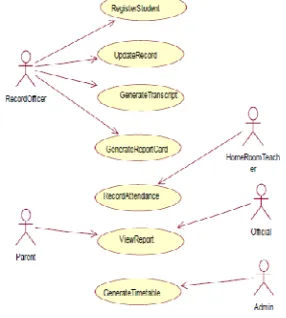
Use cases of the system are identified to be
“ADDStudent”, “Attendance”, “GenerateTranscript”, “GenerateReportCard”, “ViewReport” and
“ProduceTimetable”. The diagram
Figure 4.1 Use Case Diagram of the SMS
depicted in Figure 4.1 shows the use case diagram of the system.
Flow of Event:
(1) Student wants to be registered as a student of the school
(2) Record officer verifies that the student is eligible
Available online: http://internationaljournalofresearch.org/ P a g e | 464 (4) The student completes the registration form
that contains student’s full name, address, parent name, emergency person names and addresses and other detail information.
(5) RecordOfficer of the school checks whether the contents of the registration form is properly completed
(6) RecordOfficer fills and submits the form to the system
(7) System registers
(8) Use case ends
4.3 Sequence Diagrams
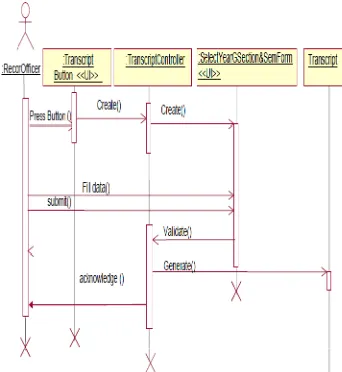
Sequence diagrams show the interaction between participating objects in a given use case. They are helpful to identify the missing objects that are not identified in the analysis object model. To see the interaction between objects, the following describe the sequence diagram of each identified use cases.
Figure 4.2 Sequence Diagram for Student Registration
In Figure 4.2 , once the user has activated the registration module by interacting with the boundary object “NewRegisterationButton” button, the control object named “RegisterationControl” manages the activities involved in “registerStudent” use case. First the”RegisterationControl” creates registration form which will be filled by the secretary and submitted. The registration control sends the record to a Persistent storage.
Figure 4.3. Sequence Diagram for Transcript Generation
5.DETAILED DESIGN AND IMPLEMENTATION
In the previous chapter we have identified the functional and non-functional requirements of the system and produced the analysis model. The following are discussed in this chapter: design goals, system architecture, system decomposition, deployment and database design.
5.1 Design Goals
Available online: http://internationaljournalofresearch.org/ P a g e | 465 Design goals are grouped into five categories. These
are
• Performance
• Dependability
• Maintenance
• End User Criteria
5.2 Architecture of the System
The proposed system is expected to replace the existing manual system by an automated system in all facets. It is mainly based on the system Analysis document
Figure 5.1 Architecture of the System.
5.3 Subsystem Decomposition
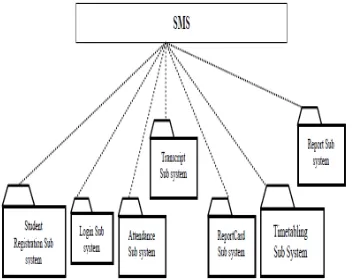
Subsystem decompositions will help reduce the complexity of the system. The subsystems can be considered as packages holding related classes/objects. The SMS under consideration is decomposed into subsystems as shown in Figure 5.2. These subsystems are further decomposed into other subsystems. The major subsystems identified are “StudentRegistration”, “Login”, “Attendance”, “ReportCard”, “Transcript”, “Timetable” and “Report” subsystems.
Users are classified in to roles. The “Login” subsystem authenticates a user to grant access based on the role of the user. The “StudentRegistration” subsystem registers a student offline. It allows recording the detail information of the student including parental and emergency person.
“Transcript” and “ReportCard” subsystems are used to generate transcript and report card respectively. The “Timetable” subsystem generates a timetable,
which involves allocating a time slot to a subject teacher for a class of students.
The “Attendance” subsystem facilitates recording absent students on the school day by the homeroom teacher to control absentees and to report to parents and the administrator to take corrective measures. The “Report” subsystem generates reports to parents, and teachers in order to facilitate viewing students’ status and course achievement.
Figure 5.2 Layered Representation of the System
Figure 5.3 Subsystem Decomposition Diagram
5.4 Persistent Data Management
Available online: http://internationaljournalofresearch.org/ P a g e | 466 persistent data and hence stored on a database
management system. This allows all the programs that operate on the SMS data to do consistently. Moreover, storing data in a database enables the system to perform complex queries on a large data set
The schools register students every year in thousands per grade level. For complex queries over attributes and large dataset SQLITE is implemented.
5.5 ENCRYPTION DECRYPTION USING ADVANCED ENCRYPTION STANDARD
Fast evaluation of digital data exchange occurs in recent years. Due to that security of information is much important in data storage and transmission process. Security of internet banking account passwords, email accounts password etc. requires text protection in digital media. In the same way image transmission and storage during industrial and research processes requires image protection. The National Institute of Standards and Technology (NIST) have initiated a process to develop Federal information Processing Standard (FIPS) which should be most flexible, secure, fast and which can replace Data Encryption standard. This new standard is recognized by name Advanced Encryption Standard (AES).
Features of data are depends on its types. Therefore same encryption technique cannot be used for all types of data. Images have large data size and also has real time constrain problem hence similar method cannot be used to protect images as well as text from unauthorized access. However with few variations in method AES can be used to protect image as well as text. In this project I have implemented encryption and decryption for text and image using AES.
a. Text encryption and decryption by AES
Rounds in AES
Length of the input output block and the State is 128 for AES algorithm. This is represented
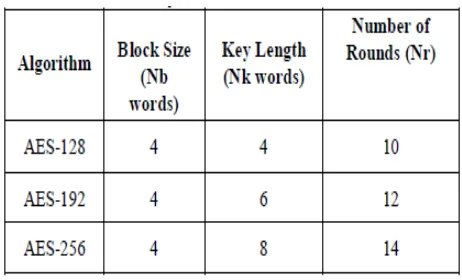
by Nb = 4, which reflects the number of 32-bit words (number of columns) in the State. For the AES algorithm 128, 192, or 256 bits is the length of the Cipher Key, K. The key length of the block is denoted by Nk and its value is 4, 6, or 8. This value reflects the number of 32-bit words (number of columns) in the Cipher Key.
Table 5.1: Key-Block-Round Combinations
For the AES algorithm, during the execution of algorithm the numbers of rounds to be performed are dependent on the key size. Nr is used to represent the number of rounds. The combinations of Key-Block-Round that conform to this standard are given in table 1 above. AES algorithm uses a round function for both its Cipher and Inverse Cipher. This function is composed of four different byte-oriented transformations: A) Using a substitution table (S-box) byte substitution, B) By different offsets shifting rows of the State array, C) mixing the data within each column of the State array, and D) adding a Round Key to the State. No. of round keys generated by key-expansion algorithm is always one more than the actual no. of rounds present in the algorithm. Therefore the equation can be made as follows:
Number of round keys = Nr+1 (1)
We refer to the round keys as K0, K1, K2……….KNr
The Algorithm
Available online: http://internationaljournalofresearch.org/ P a g e | 467 Round Key, Sub Bytes, Shift Rows and Mix
Columns, perform various operations on the state to calculate the output state (the final cipher text). Except for Add Round Key each of these operations are invertible. Inv Method ( Method( a ) ) = a (2)If Add Round Key operates on a variable twice, the variable itself is returned.
Transformation in AES
To perform all these transformations above, some mathematical operations are needed to
understand which are given as below.
1. Add Round Key Routine
The Add Round Key routine is simple XOR addition of round key and a portion of expanded key into
plaintext.
2. Sub Bytes
Sub byte is the SBOX for AES. It operates on each byte in the state and performs a non-linear substitution in the GF(28) field, which is what makes AES a non-linear cryptographic system. In order to be invertible each value of b’ must be generated from a unique value of b. A look up table can also be implemented for Sub Bytes. Sub Byte operation performs an affine transformation on the inverse of byte b, and adds it to 0xC6.
3. Shift Rows
Shift Rows operates on individual rows of the state. It provides diffusion throughout the AES
algorithm. The first row is not changed. The second row is shifted one byte to the left, with the left most byte wrapping around. The third row shifts two bytes to the left, and the fourth row shifts three bytes to the left with appropriate wrapping to the right. This description is for AES128, the number of shifts for each row changes based on the key size.
Table 5.2: Number of shifts in Shift Rows
4. Mix Columns
Mix Columns operates on individual columns of the state. It provides diffusion throughout the AES algorithm. The columns are considered polynomials over GF(28) and multiplied modulo x4+1 with a(x) where a(x) = {03}x3 + {01}x2 + {01}x + {02} NOTE: x4+1 is relatively prime to a(x). This can be represented as a matrix equation:
Available online: http://internationaljournalofresearch.org/ P a g e | 468 As shown in figure 5.5 and 5.6 below the AES
algorithm loops through certain sections Nr times. The Add Round Key is performed at the beginning and at the end of the cipher in order to provide initial and final randomness to the algorithm. Without this operation, anyone can easily deduct the first or last portion of the cipher, and therefore it would be irrelevant to the security of the cipher. In order to make the encryption and decryption routines more similar the last round in the cipher is completely different from the other rounds. It reduces the complexity in hardware, and software, implementations.
Figure 5.5: AES encryption algorithm
Figure 5.6: AES decryption algorithm
IMPLEMENTATION
I have successfully implemented the AES text encryption using java. I got all the desired results of encryption as well as correct decryption of text message and produces original message. The maximum positions in the input message as well as in key should not exceed 16 positions in length. Because I use the 128 bit size of data and key. Therefore each position whether it is alphabet, number, symbol or blank space is encrypted into 8 bit sequence.
Available online: http://internationaljournalofresearch.org/ P a g e | 469 6.TESTING AND RESULTS
Table 6.1: Test Case of Software module
Test case Id
Descripti on
Test data Expecte d result Actu al resul t TC_ 01 Clicking the login button with the invalid username and password Username=xy z Password=xy z Message box should display “invalid username and password ” Pass TC_ 02 Clicking the login button with the invalid username and password Username=ad min Password=ad min Redirecte
d to
specific home page Pass TC_ 03 Clicking the save/upd ate button.
Student name details and etc… Database should saved with encrypte d data. Pass TC_ 04 Clicking the search button.
Selecting or providing a student name in search box.
Encrypte d data in database should be decrypte d and display in the GUI. Pass TC_ 05 Clicking the report button with valid details of student in report part.
Providing the valid student data.
A PDF report should be saved in the predefine d
directory. Pass
A test case in a software engineering is a group of settings or variables under which a tester will conclude whether an application or software system is suitably working or not. The instrument for formative whether a software program or structure has passed or failed.
Test Case ID: To Design the Test Case ID also we are following a standard: If a test case belongs to application not specifically related to a particular Module then we will start them as TC001, if we are expecting more than one expected result for the same test case then we will name it as TC001.1. If a test case is related to Module then we will name it as M01TC001, and if a module is having a sub-module then we name that as M01SM01TC001. So that we can easily identify to which Module and which sub-module it belongs to. And one more advantage of this convention is we can easily add new test cases without changing all Test Case Number so it is limited to that module only.
Test case description: Every test case has a description, which describes what functionality of software to be tested.
Expected result and actual result: These are implemented in respective API. As the testing is done for the application or software actual result will be available within the log page.
This is the result of the above action. It specifies what the specification or user expects from that particular action. It should be clear and for each expectation we will sub-divide that Test Case. So that we can specify pass or fail criteria for each expectation.
Available online: http://internationaljournalofresearch.org/ P a g e | 470 Encryption of private data contained in a
database server should be provided through the use of whole disk encryption or through features native to the database server software. Encryption capabilities native to database server software may allow for encryption of specific tables or columns of a database and may also be required to segregate access rights among multiple applications that utilize a single database server.
The window which shows the encrypted data is shown below
FIGURE 6.1: THE ENCRYPTED DATA
FIGURE 6.2: LOGIN PAGE
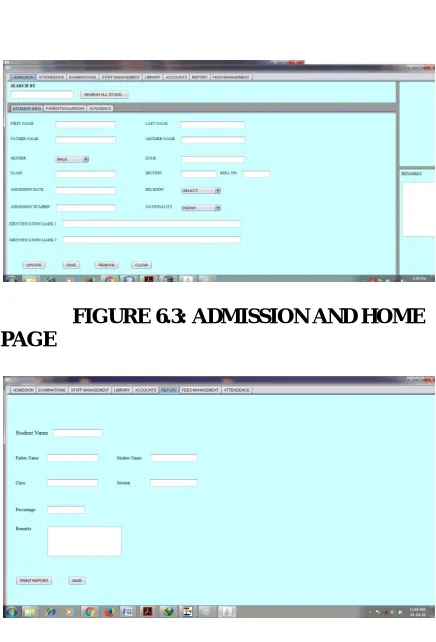
The roles for the Windows application are Record Officer, System Administrator and Principal. Can login through the login window and if he enters the wrong password or user name it will give error message and will not logged in.
FIGURE 6.3: ADMISSION AND HOME PAGE
FIGURE 6.4: REPORT PAGE
The other role of the record officer is to record marks and generate transcript and report cards. These are routine tasks which take much of the times of the user, but once the marks are recorded the tasks are simplified. When the user wants to generate report cards or transcripts, he/she selects the corresponding sub menu from the “Reports” menu and a form is displayed to facilitate generation of the reports.
7.CONCLUSION AND FUTURE SCOPE
Available online: http://internationaljournalofresearch.org/ P a g e | 471 networking of information management for college
student, and promotes the management of college students to carry out high efficiently.
The School Management System which capable of storing school resources such as students and staff of the school and their relationship was implemented. It is easily to track the relations of students and courses they have taken in school, courses and teacher they are given by using the friendly interface of the system.
FUTURE SCOPE
Nothing is perfect in this world. In this way, we are additionally no exemption. Despite the fact that, we have attempted our best to show the data successfully, yet, there can be further improvement in the Application like implementing in all government schools and also can implement in security applications and more. We have dealt with all the basic angles, which need to deal with amid the advancement of the Project. Like the things this anticipate likewise has a few impediments and can further be upgrades by somebody, in light of the fact that there are sure disadvantages that don't allow the framework to be 100% exact.
The system can be easily extended by introducing new modules. An example of such, future work is evaluation questions module that can be used to evaluate teachers, and output the statistics of the evaluation.
References
[1]. Al-adaileh, R, 2008. “Essentials of Management Information Systems”, Yazeed Publications, Karak-Jordan.
[2]. Alavi, M., Carlson, E & Brooke, G. (1989). The ecology of MIS research: A 20 year status review. In J. I. Degross, J. Henderson & B. Konsynski (Eds), Proceedings of Tenth International Conference on Information Systems (pp. 363-376). Boston, MASS.
[3]. Business Survival and Management
Information System,
http://www.upazahle.net/documents/mis/ch 01.doc Viewed March 20, 2011.
[4]. CHAOS Report (1994), The Standish Group,
http://www.standishgroup.com/sample_rese arch/chaos_1994_1.php. Viewed April 17, 2008.
[5]. Cronin, J.J., Taylor, S.A., 1994. SERVPERF versus SERVQUAL: reconciling performance-based and perceptions-minus-expectations
measurements of service quality. Journal of Marketing 58, 125–131.
[6]. DeLone, W.H. & McLean, E.R, 1992. “Information Systems Success: The Quest for the Dependent Variable”, Information Systems Research, Vol. 3, No. 1, pp. 60--95.
[7]. DeLone, W.H. & McLean, E.R, 2003. “The DeLone and McLean Model of Information Systems Success: A ten-Year Update”, Journal of Management Information Systems, Vol. 19, No. 4, pp. 9--30.
[8]. General Statistics Office of Vietnam (GOS), 2009, “Statistical Yearbook of Vietnam”.
[9]. Goodhue, D. (1992). User evaluations of MIS success: What are we really measuring? In J. E Nunamaker & R. H. Sprague (Eds), Proceedings of the Twenty-Fifth Annual Hawaff International Conference on System Sciences (Vol. 4, pp. 303-314). IEEE Computer Society Press.
[10]. E. Burke and W. Erben. Practice and Theory of Automated Timetabling, Third International Conference, Germany, Springer Private Limited, August 2000
Available online: http://internationaljournalofresearch.org/ P a g e | 472 http://www.ascilite.org.au/ajet/ajet8/hedberg.ht
ml