1134
SIMPLE IMAGE ENCRYPTION FOR MOBILE PHONES
1,2
MANAL ABDULLAH AL-SHMRANI, 1ABDUL RAOUF KHAN
1
Department of Computer Sciences, King Faisal University, Saudi Arabia 2
Departmeny of Computer Sciences, Hafar Al-Batin University, Saudi Arabia
E-mail: [email protected] , [email protected]
ABSTRACT
People generally save pictures in mobile phones or transmit to one another using several mobile applications. However, privacy of such images and pictures are of some importance to many people. Generally, for common people the threat to the privacy of the pictures may be very low; however, people prefer to have a certain level of security. In this paper, a simple encryption technique, based on two-dimensional cellular automata has been proposed. The local neighborhood pixel values of an image are used as part of the encryption key to encrypt the image, based on certain cellular automata rules. The quality of encryption technique and Peak Signal to Noise Ratio has been calculated and reported in this paper. A hardware architecture has been proposed to implement the scheme in mobile phones.
Keywords: Image Encryption, Cellular Automata, Two Dimensional CA, Mobile Phone security , Privacy
1.INTRODUCTION
The images contain information that is often private; security thus becomes increasingly important in the storage and transmission of digital images. In order to guarantee security, we need to process the images and make the contents of the image unintelligible by encrypting them. There are several conventional encryption methods, which are often used to encrypt images. In this paper, a simple approach is used to encrypt the images than that of the traditional cryptographic algorithms. This method is based on Cellular Automata (CA).
CA is simple mathematical idealizations of a system [1]. John Von Neumann [2] proposed an emerging concept of CA, which is discrete in nature and consists of cells in the form of grids. The cells update themselves according to some deterministic rules, depending on the present state of the cell and the state of neighborhood cells. This makes the images cells change their state at any step. We need to recover the images (decrypt) and therefore, the transformations must be reversible. CA Group Rules have the property of returning to the original state, after say number of cycles. Thus, we need to apply the transformation, at the encryption side for say number of times and apply the remaining number of transformations at the decryption side. CA offers various advantages including the simplicity of locally interconnected and being
regular and modular. This makes CA a right candidate for VLSI implementations [3].
In this paper, an encryption scheme for mobile phones has been proposed. The scheme is based on experiments done on various standard images using two-dimensional Cellular Automata (2DCA).
2.REVIEW OF EARLIER WORK
CA is considered as an attractive research field due to its simplicity, regularity, modularity and local interconnections [3]. Furthermore, it is one of the efficient candidates for image cryptosystems due to its essential characteristics, such as unpredictability, homogeneity and parallelism. Another reason for the wide deployment of CA is its simple implementation in both hardware and software systems [4]. This in turn makes the CA an efficient option for involved applications.
1135 as the ones explored by Wolfram [5] and Nandi et al. [7]. Then other researchers studied the one dimensional CA (1DCA) RNG, where they proved that CA is suitable for producing pseudorandom numbers and illustrated their advantage in comparison with other deployed schemes [8]. Alvarez and Hernandz [9], proposed an efficient graphic cryptosystem using 1D reversible CA, to encrypt defined images by any number of colors.
Two-dimensional Cellular Automata (2DCA) was later explored to implement images as one block in its natural form to implement 2DCA based encryption model. A novel scheme for the generation of pseudorandom numbers using 2DCA was presented by Chowdhury et al. [10]. The obtained outcomes demonstrated that the 2DCA outperformed the 1DCA when compared using the same terms of pseudorandom numbers quality. An advanced pixel randomness test was presented by Suyambu et al. [11] with the use of a non-parametric technique. Specific approaches for security analysis were initially used to access the encryption method strength, where then the used non-parametric technique was deployed for determining the pixel randomness. However, deployment in hardware design was not possible, due to the need for use of parametric techniques.
Another model for image encryption was proposed by Ping et al. [12], using 2DCA by applying specific nonlinear balanced rules. These rules were used to carry out the confusion operation, while local interactions between cells were used to get the diffusion operation. Based on deploying a secured 144-bit key, authors in [13] presented a simple, sensitive and fast image encryption model. Yampolskiy et al. [14] proposed a new scheme and showed how to utilize the ability of CA to generate pseudorandom patterns. The efficiency of this scheme is better than the original Visual Cryptography approach. In [15] Khan proposed an encryption scheme based on 2DCA rules. However, the scheme proposed is general in nature and is stressing on the idea only, no experimentation results and rule selection was performed.
In this paper, the encryption scheme proposed is based on experimental results, selection of rules can be made based on the quality of encryption. In the next section, a brief preliminary concepts and definitions of CA have been reported.
3.CAPRELIMINARIES
Cellular Automata (CA) are composed of cells available in a specific n-dimensional cellular space. Neighbors of a cell can be defined as those cells that are at a specific distance from the cell. The cell itself
may be considered as one of the neighboring cells while going through a transformation. A 1DCA is the simplest CA form, where all cells are located on a line, each having two states only. The CA is said to change its state in the next clock period based on the present state of the cell and/or the present state of its neighboring cells. The number of neighboring cells involved to change the next state is generally referred to as CA rule. For example, rule 90 states that the next state of a cell depends on the present state of the right and the left cells. Similarly, rule 150 states that the next state of the cell depends on the present state of the right and the left cell and the cell itself. Mathematically, the rule transitions for these two rules are given below [4].
1
⊕
1
⊕
⊕
Where
1
is the next state of the CA and
is the present state of the CA cell at
position
.
A CA is considered as a regular or uniform CA, when one rule is deployed for all cells in it. Conversely, it is called hybrid when various rules are deployed for various cells in it. In addition, it is called periodic when its extreme cells are close for each other. But, when its extreme cells are linked with logic 0-state, the CA then is called a null boundary. Based on considering rules of logic gates, when neighborhoods are based on rules of EXOR or EXNOR only, the CA is known as an additive CA. Particularly; the linear CA uses the rules of XOR gate only. On the other hand, when the transformation of the CA is invertible, which means that the whole states in the diagram of state transition lie in a specific cycle, the CA is then called Group CA. Else, it is known as a non-group CA [16].
1136
Table I: Two Dimesional CA rule convention
64 128 256
32 1 2
16 8 4
Assuming represents the 2D matrix of binary information, as the initial sate of the 2DCA. Then, defined by a certain rule, the next state 1 will be the EXOR operation among the states of related neighbors, defined by that rule. Since there are nine neighbors of each cell (including the cell itself), the number of possible uniform rules are 512, including both group and non-group rules. In this paper, only group rules have been considered as it is important for the transformation to be invertible, to decrypt the images. The total number of 2DCA Group rules and their classifications have been reported in [17]. The next section, presents various experimental results along with PSNR.
4.RESULTS AND DISCUSSION
The 2DCA group rules have been classified into four different categories, based on certain Characterization Matrix [17]. The images were initially encrypted based on primary rules [16]; however, the results showed that the image encryption quality was not perfect as shown in Fig.1. In each case, the image was first converted into binary image before applying the CA rule.
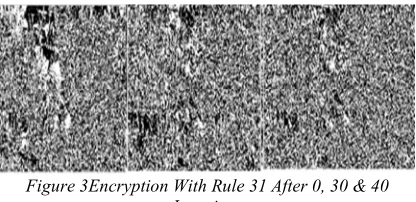
Fig. 2 shows the results of encryption with class 2 rules (rule 17 and rule 30) for number of iterations. The results shows improved encryption quality for class 2 rules. Consequently, all other rules in Class 1, class 2, class 3 and class 4 group rules were applied. The Group Rules showed the confusion and diffusion property of encryption of pixel values of the images. Statistical analysis of the results were carried out as reported next.
4.1 Measurement of Encryption Quality
In practice, the PSNR is considered as a helpful system performance measure, where it represents the ratio among a component mean square difference between two images and the maximum possible difference that can be present among them.
Figure 1Encryption using primary rules
[image:3.612.314.522.318.419.2]Figure 2: Encryption With Rule 17 After 0, 30 & 40 Iterations
Figure 3Encryption With Rule 31 After 0, 30 & 40 Iterations
The PSNR is mainly represented in a decibel value. Its value is directly related to the recovered image quality. Let P and P be the given image
and encrypted image respectively, then the PSNR is represented as
20 225 √" # Where MSE is Mean Square Error [18]
4.1 Determining the RULE for Encryption
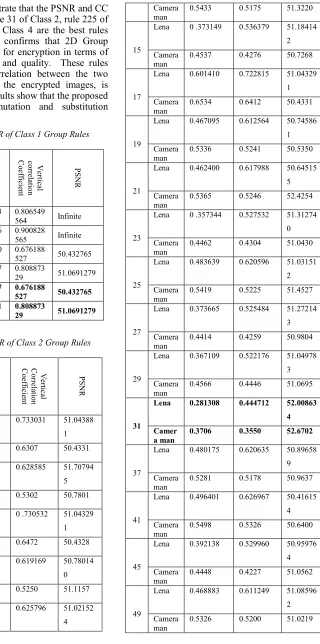
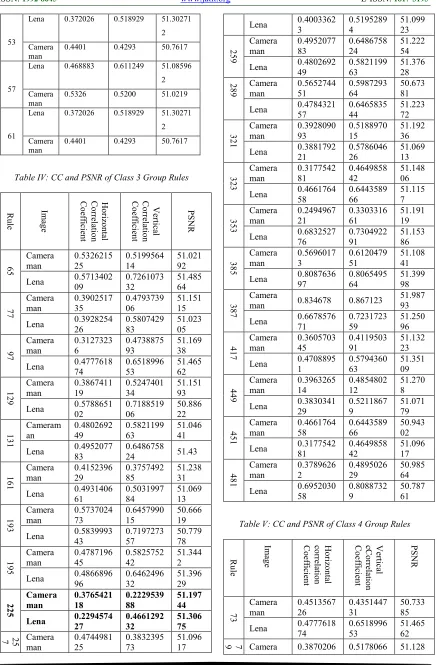
1137 These results demonstrate that the PSNR and CC for rule 33 of Class 1, rule 31 of Class 2, rule 225 of Class 3 and rule 135 of Class 4 are the best rules from each class, which confirms that 2D Group Rules is the best method for encryption in terms of encryption effectiveness and quality. These rules show that there the correlation between the two adjacent cell values, in the encrypted images, is negligible. Hence, the results show that the proposed rules have good permutation and substitution properties.
Table II: CC and PSNR of Class 1 Group Rules
ru le Im ag e H o riz o n ta l co rr el at io n C o ef fic ie n t V er tic al co rr el at io n C o ef fic ie n t P S N R 1 Camera man 0.8100773 33 0.806549
564 Infinite
Lena 0.841393604 0.900828565 Infinite
3 Camera man
0.6753360 14
0.676188
527 50.432765
Lena 0.7019347 76
0.808873
29 51.0691279
3 3 Camera man 0.6750547 89 0.676188
527 50.432765
Lena 0.7018241
58
0.808873
29 51.0691279
Table III: CC and PSNR of Class 2 Group Rules
R u le Im ag e H o riz o n ta l C o rr el at io n C o ef fic ie n t V er tic al C o rr el at io n C o ef fic ie n t P S N R 5
Lena 0.608399 0.733031 51.04388
1
Camera man
0.6449 0.6307 50.4331
7
Lena 0 .464838 0.628585 51.70794
5
Camera man
0.5477 0.5302 50.7801
9
Lena 0.618008 0 .730532 51.04329
1
Camera man
0.6694 0.6472 50.4328
11
Lena 0.471966 0.619169 50.78014
0
Camera man
0.5400 0.5250 51.1157
13
Lena 0.487267 0.625796 51.02152
4
Camera man
0.5433 0.5175 51.3220
15
Lena 0 .373149 0.536379 51.18414
2
Camera man
0.4537 0.4276 50.7268
17
Lena 0.601410 0.722815 51.04329
1
Camera man
0.6534 0.6412 50.4331
19
Lena 0.467095 0.612564 50.74586
1
Camera man
0.5336 0.5241 50.5350
21
Lena 0.462400 0.617988 50.64515
5
Camera man
0.5365 0.5246 52.4254
23
Lena 0 .357344 0.527532 51.31274
0
Camera man
0.4462 0.4304 51.0430
25
Lena 0.483639 0.620596 51.03151
2
Camera man
0.5419 0.5225 51.4527
27
Lena 0.373665 0.525484 51.27214
3
Camera man
0.4414 0.4259 50.9804
29
Lena 0.367109 0.522176 51.04978
3
Camera man
0.4566 0.4446 51.0695
31
Lena 0.281308 0.444712 52.00863
4
Camer a man
0.3706 0.3550 52.6702
37
Lena 0.480175 0.620635 50.89658
9
Camera man
0.5281 0.5178 50.9637
41
Lena 0.496401 0.626967 50.41615
4
Camera man
0.5498 0.5326 50.6400
45
Lena 0.392138 0.529960 50.95976
4
Camera man
0.4448 0.4227 51.0562
49
Lena 0.468883 0.611249 51.08596
2
Camera man
1138 53
Lena 0.372026 0.518929 51.30271
2
Camera man
0.4401 0.4293 50.7617
57
Lena 0.468883 0.611249 51.08596
2
Camera man
0.5326 0.5200 51.0219
61
Lena 0.372026 0.518929 51.30271
2
Camera man
[image:5.612.93.530.80.745.2]0.4401 0.4293 50.7617
Table IV: CC and PSNR of Class 3 Group Rules
R u le Im ag e H o riz o n ta l C o rr el at io n C o ef fic ie n t V er tic al C o rr el at io n C o ef fic ie n t P S N R 6 5 Camera man 0.5326215 25 0.5199564 14 51.021 92
Lena 0.5713402 09 0.7261073 32 51.485 64 7 7 Camera man 0.3902517 35 0.4793739 06 51.151 15
Lena 0.3928254 26 0.5807429 83 51.023 05 9 7 Camera man 0.3127323 6 0.4738875 93 51.169 38
Lena 0.4777618 74 0.6518996 53 51.465 62 1 2 9 Camera man 0.3867411 19 0.5247401 34 51.151 93
Lena 0.5788651 02 0.7188519 06 50.886 22 1 3 1 Cameram an 0.4802692 49 0.5821199 63 51.046 41
Lena 0.4952077 83
0.6486758
24 51.43
1 6 1 Camera man 0.4152396 29 0.3757492 85 51.238 31
Lena 0.4931406 61 0.5031997 84 51.069 13 1 9 3 Camera man 0.5737024 73 0.6457990 15 50.666 19
Lena 0.5839993 43 0.7197273 57 50.779 78 1 9 5 Camera man 0.4787196 45 0.5825752 42 51.344 2
Lena 0.4866896 96 0.6462496 32 51.396 29 2 2 5 Camera man 0.3765421 18 0.2229539 88 51.197 44
Lena 0.2294574
27 0.4661292 32 51.306 75 2 5 7 Camera man 0.4744981 25 0.3832395 73 51.096 17
Lena 0.4003362 3 0.5195289 4 51.099 23 2 5 9 Camera man 0.4952077 83 0.6486758 24 51.222 54
Lena 0.4802692 49 0.5821199 63 51.376 28 2 8
9 Camera man 0.565274451 0.598729364 50.67381
Lena 0.4784321 57 0.6465835 44 51.223 72 3 2 1 Camera man 0.3928090 93 0.5188970 15 51.192 36
Lena 0.3881792 21 0.5786046 26 51.069 13 3 2 3 Camera man 0.3177542 81 0.4649858 42 51.148 06
Lena 0.4661764 58 0.6443589 66 51.115 7 3 5 3 Camera man 0.2494967 21 0.3303316 61 51.191 19
Lena 0.6832527 76 0.7304922 91 51.153 86 3 8 5 Camera man 0.5696017 3 0.6120479 51 51.108 41
Lena 0.8087636 97 0.8065495 64 51.399 98 3 8 7 Camera
man 0.834678 0.867123
51.987 93
Lena 0.6678576 71 0.7231723 59 51.250 96 4 1 7 Camera man 0.3605703 45 0.4119503 91 51.132 23
Lena 0.4708895 1 0.5794360 63 51.351 09 4 4 9 Camera man 0.3963265 14 0.4854802 12 51.270 8
Lena 0.3830341 29 0.5211867 9 51.071 79 4 5 1 Camera man 0.4661764 58 0.6443589 66 50.943 02
Lena 0.3177542 81 0.4649858 42 51.096 17 4 8 1 Camera man 0.3789626 2 0.4895026 29 50.985 64
Lena 0.6952030 58
0.8088732 9
50.787 61
Table V: CC and PSNR of Class 4 Group Rules
R u le Im ag e H o riz o n ta l co rr el at io n C o ef fic ie n t V er tic al cC o rr el at io n C o ef fic ie n t P S N R 7 3 Camera man 0.4513567 26 0.4351447 31 50.733 85
Lena 0.4777618 74 0.6518996 53 51.465 62 7 9
1139
man 22 54
Lena 0.5713402 09 0.7261073 32 51.485 64 8 1 Cameram an 0.4626647 34 0.5727996 48 50.933 07
Lena 0.4777618 74 0.6518996 53 51.465 62 8 9 Camera man 0.3887470 1 0.5269926 62 51.258 88
Lena 0.5896484 4 0.7270815 47 50.376 4 1 0 5 Camera man 0.4732554 73 0.5784026 98 51.271 2
Lena 0.7018241 58 0.8088732 9 51.069 13 1 1 3 Camera man 0.5690029 82 0.6440146 63 50.998 33
Lena 0.5896484 4 0.7270815 47 50.376 4 1 2 1 Camera man 0.4012857 36 0.4826801 71 51.173 65
Lena 0.5839993 43 0.7197273 57 50.779 78 1 3 3 Camera man 0.4787196 45 0.5825752 42 51.344 2
Lena 0.4866896 96 0.6462496 32 51.396 29 1 3 5 Camera man 0.3105210 53 0.4004439 52 51.236 73
Lena 0.4078630
2 0.6486577 62 51.211 94 1 4 5 Camera man 0.4020498 63 0.5190294 83 51.151 15
Lena 0.5923790 25 0.7264811 77 50.862 26 1 7 7 Camera man 0.4903123 59 0.5847377 04 51.045 65
Lena 0.4907863 02 0.6486577 62 51.211 94 2 0 9 Camera man 0.4020498 63 0.5190294 83 51.151 15
Lena 0.5923790 25 0.7264811 77 50.862 26 2 4 1 Camera man 0.4754592 88 0.5847156 54 51.119 92
Lena 0.7060412 81 0.8059381 99 51.069 13 2 6 1 Camera man 0.5785176 02 0.6525604 01 51.469 79
Lena 0.5956074 27 0.7239537 65 50.759 23 2 6 3 Camera man 0.4821928 7 0.5830510 67 51.476 45
Lena 0.7060412 81 0.8059381 99 51.069 13 2 6 5 Camera man 0.5747992 28 0.6490010 27 50.767 37
Lena 0.5923790 25 0.7264811 77 50.862 26 2 6 9 Camera man 0.4806872 4 0.5863753 93 50.937 49
Lena 0.4963993 3 0.6505415 58 50.840 6 2 7 1 Camera man 0.3122158 32 0.4078730 05 51.084 72
Lena 0.6931406 61 0.8031997 84 51.069 13 3 8 9 Camera man 0.5703647 62 0.6537670 53 51.020 05
Lena 0.5800489 98
0.7251267 4
51.374 24
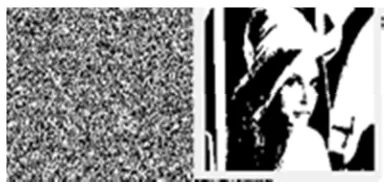
[image:6.612.90.531.52.738.2]The four rules (33, 31, 225 and 135) were applied to the input image, after converting the image to binary, as shown in Fig 4. The resulting encrypted and decrypted images are as shown in Fig 5, Fig 6, Fig 7 and Fig 8.
Figure 4: Input image converted to binary image
[image:6.612.329.523.298.382.2]
Figure 5: Encrypted and Decrypted Image with rule 33
[image:6.612.327.520.422.515.2]1140
Figure 7: Encrypted and Decrypted Image with rule 225
Figure 8: Encrypted and Decrypted image with rule 135
5.PROPOSEDARCHITECTURE
The design of all digital circuits has been influenced by Very Large Scale Integration (VLSI) technology. Regular, modular and cascadable structures are in demand for implementing complex functions in terms of hardware components. CA structure has also been found a better alternative to implement such functions, because of the fact that CA based circuits have the advantage of regularity, shorter delays and structure being modular and cascadable [3]. In this section, an architecture for implementing the encryption scheme based on the above stated rules is discussed. The scheme can be implemented in mobile phones, by inserting a CA memory preceding the main memory as illustrated in Fig 9. Images shot by the mobile camera must go through the CA chip, for encryption, before being stored in the main memory of the mobile. Similarly, before images being properly displayed must again be decrypted in the CA memory. The encryption process must have an encryption “key”, chosen by the user. The key value depends on the rule to be applied and the number of CA cycles (iteration) chosen. The user can use the key value in the form of a PIN value, which can be encoded into CA rules to be applied and the number of cycles the CA will run.
The general architecture of the CA memory is illustrated in Fig 10. Since each cell of a CA is representing a logic 0 or 1, each cell is represented by a D-type Flip-Flop having the output Q representing the CA state. The output Q of each Flip-Flop is updated, on each clock, based on the
[image:7.612.314.522.123.250.2]state of its neighboring D- Flip Flops, representing a rule.
Figure 9: Proposed Scheme
The inputs to EXOR circuit depend on the rule to be applied. Depending upon the number of rules considered for encryption, the selection of one of the rules is to be done. The selection can be done using a multiplexer circuit as shown in Fig 10. Now the multiplexer circuits needs to be a k-to-1 line multiplexer, with two select lines. Moreover, the value of S0 and S1 will be part of the encryption key.
Figure 10: CA Memory Architecture
6.CONCLUSION
[image:7.612.101.286.208.289.2] [image:7.612.322.518.400.541.2]1141 REFERENCES
[1] A. Singh1, S. Sangeeta,"Cryptographic Algorithm Using Cellular Automata Rules” ,
International Journal Of Computer Application, Vol 3, No 4, Pp 57-64, 2014. [2] J. V. Neumann, "The Theory Of
Self-Reproducing Automata", (Edited By A. W. Burks) Univ. Of Illinois Press Urbana, 1996. [3] P.P. Chaudhuri, D.R. Chowdhury, “Additive
Cellular Automata Theory And Application”, Vol.1. John Wiley And Sons, 1997.
[4] X.Zhang, C.Wang; S. Zhong And Q. Yao, “Image Encryption Scheme Based On Balanced Two-Dimensional Cellular Automata”, Mathematical Problems In Engineering, Vol. 2013, Article Id 562768, 10 Pages, 2013.
[5] S. Wolfram, “Cryptography With Cellular Automata”, Advances In Cryptography: Crypto’85 Proceedings, Lecture Notes In Computer Science, Vol. 218, Springer, Pp 429-432, 1986.
[6] R. Ye And H. Li, “A Novel Image Scrambling And Watermarking Scheme Based On Cellular Automata”. Proc. International Symposium Electronics Commerce And Security, Ieee Cs Press, Pp 938-941, 2008.
[7] S. Nandi, B. K. Kar, “Theory And Applications Of Cellular Automata In Cryptography”, Ieee Transactions On Computers, Vol. 43. No 12, Pp 1346-1357, 1994.
[8] M. Tomassini, M. Sipper, M. Perrenoud,”On The Generation Of High-Quality Random Numbers By Two-Dimensional Cellular Automata”, Ieee Transactions On Computers, Vol.49. No 10, Pp 291-305, 2000.
[9] G. Alvarez, A. Hernandez, “A New Graphic Cryptosystem Based On One-Dimensional Memory Cellular Automata”, Proceedings Ieee 39th Annual 2005 International Conference On Security Technology, 2005.
[10]D.R. Chowdhury, I.S. Gupta, And P.P. Chaudhuri, “A Class Of Two-Dimensional Cellular Automata And Applications In Random Pattern Testing”, J. Electronic Testing: Theory And Applications, Vol.5, Pp.65-80, 1994.
[11]B. Suyambu, R. Radha, R. Rama, “New 2d Ca Based Image Encryption Scheme And A Novel Non-Parametric Test For Pixel
Randomness”, Arxiv:1505.00920v1 [Cs.Cr], 2015.
[12]P.Ping, X.Feng. W.Zhi-Jiang, “Color Image Encryption Based On Two Dimensional Cellular Automata”, International Journal Of Modern Physics C, Vol. 24, No 10, 2013. [13]P. Pareek, “Design And Analysis Of Novel
Digital Image Encryption Scheme”, Ijnsa, Vol. 4, No. 2, 2012.
[14]R. Yampolskiy, J. Rebolledo, M. Hindi, "Password Protected Visual Cryptography Via Cellular Automaton Rule 30", Transcations On Dhms Ix, Lecture Notes In Cs 8363, Pp 57-67,2014.
[15]A.R. Khan, “Image Encryption Using Cellular Automata", Information Journal, Vol. 16 No. 8a, Pp 5581-5590, 2014.
[16]A. R Khan, Et Al, “Vlsi Architecture Of Cellular Automata Machine”, Computers And Mathematics With Applications, Vol. 33 No.5, Pp 79-94, 1997.
[17]A. R Khan, “ Classification Of 2d Cellular Automata Uniform Group Rules”, European Journal Of Scientific Research, Vol. 64, No. 3, Pp 51-57, 2011.