AGENT-BASED MODELING OF TAG-BASED
COOPERATION IN MOBILE ENVIRONMENT
1 NOR EFFENDY OTHMAN, 2ROSILAH HASSAN,
1, 2
Network and Communication Technology Lab, Software Technology and Management Research Centre,
Faculty of Information Science and Technology, Universiti Kebangsaan Malaysia, Selangor, Malaysia.
E-mail: [email protected], [email protected]
ABSTRACT
Building on a review of cooperation enforcement in mobile ad hoc networks and tag-based cooperation literature in [1] and the design of mobility-aware tag-based cooperation enforcement approach [2], this article will forward the research by describing the process of building a generic model to test and evaluate the proposed approach for tag-based cooperation in mobile environment. The generic model is an agent-based model. Therefore, this article will begin by introducing agent-agent-based modeling and describing the tools that can be used to develop agent-based models and explains the design of agent-based model for tag-based cooperation in mobile environment. The evaluation of the agent-tag-based model is presented and discussed.
Keywords: Agent-Based Modeling, Tag-Based Cooperation, Mobile Environment.
1. INTRODUCTION
In self-organized mobile ad hoc networks (MANETs) such as civilian MANETs, each node acts as its own authority and may not share common goals with other nodes. Moreover, nodes in such networks are self-interested and tempted to drop others’ packets to preserve of their own
limited resources e.g. battery power and
computational capability. Such selfishness and non-cooperative behavior can make it impossible to achieve multi-hop communication and have a negative effect on the overall network performance. A large number of studies have proposed different cooperation enforcement mechanisms for MANETs to mitigate the selfishness problem and increase cooperation rate between nodes in MANETs [1].
In [1], we discussed the rationale of cooperation enforcement in MANETs and the characteristics of a cooperation enforcement model. We also reviewed different types of existing
approaches to cooperation enforcement in
MANETs and analyze them in order to provide justification for moving towards tag-based approach in enforcing cooperation between nodes in MANETs. Based on our analysis on existing tag-based approach, we designed mobility-aware tag based cooperation [2] that serves as a guideline for the work presented in this article. Before we deal with the effects of mobile networking on our proposed solution, we are interested to investigate
whether our proposed solution works without any interference from network environment. In doing this, agent-based modeling is the best choice.
Agent-based modeling is a method of modeling systems that comprise autonomous entities called agents who can interact between them and with their environment. Each agent has the ability to decide its future action locally based on a set of interaction rules [3]. Moreover an agent in an agent-based model is able to make local decisions without any centralized mechanism [4] and respond to changes in its environment with a goal-directed response [5]. In our view, with these characteristics of an agent, agent-based modeling is suitable for modeling cooperation between mobile agents in a decentralized system. In such a system, where there is no authority, each mobile agent should be autonomous in deciding whether it should cooperate or defect with other agents. Moreover, each mobile agent has to be responsive to changing mobile environment and as its goal is to maximize its own payoff, its response should increase its payoff. For justification of developing tag-based cooperation approach and critical literature review of this research area, we would like to refer the reader to [1].
pedestrian movement patterns [9], human immune systems [10] and computer-aided driving [11].
Tools that are available for agent-based models development include, but not limited to, Ascape [12, 13], MASON [14], Swarm [15] and Repast [16].
As this research involves developing an agent-based model and a network model that are related to each other, the tools for developing both models should be selected by considering that they would not complicate the transition from agent-based model to network model. One way to ensure this is to use the same programming language in both tools. At this point, we have decided that we will be using Java-based JiST/SWANS [17] to implement and simulate the network model. Therefore, based on this, we have to use an agent-based modeling tool that is also Java-based. Ascape, MASON and Repast are Java-based while Swarm has Java-based and Objective-C versions.
One of the main aspects of our simulation is the mobility of agents. In our simulation, agents will be moving based on random waypoint mobility. However, random waypoint mobility (RWM) model and all other mobility models are not available in agent-based modeling tools. Therefore, we have to implement RWM model in the selected agent-based modeling tool. All four tools mentioned above were being considered as they are Java-based. They were evaluated in terms of how feasible it is to implement random waypoint mobility model in each of them. Based on our investigation, we found that Repast Simphony requires the least effort to implement random waypoint mobility model, compared to the other three. The architecture of Repast Simphony allows agents mobility to be managed at environment level instead of agent level. This means that we can easily implement RWM model that conforms to the RWM model implemented in JiST/SWANS and let the simulation environment manages agents’ movement based on the inputs fed into the RWM model. The architectures of the other three, on the other hand, only allow agents movement to be managed at agent level. This means that for each simulation run, we have to manually input a set of location points for each agent and during the simulation, each agent would need to refer to the set in order to move. Although the location points could be generated from external random waypoint mobility generator such as BonnMotion [18], we would have to do this everytime before we run a simulation. Based on this, we think that selecting Repast Simphony would save us more time than if we select one of the other three. Therefore, Repast
Simphony will be used for the development of the abstract model described in this article.
2. DESIGN OF TACME
We develop an agent-based model, TACME, to study how the proposed tag-based mechanism performs in a mobile environment. TACME is a generic model in which agents interact without MANET protocol. Thus, this model provides an ideal, error-free environment for evaluating the performance of tag-based cooperation approach in mobile environment. The model inherits the design of mobility-aware tag based cooperation (MaTaCo). For details on the solution design, methodology and analysis criteria, we would like to refer the reader to [2].
The idea is to ensure that our approach works as expected before moving on to implementing it in a mobile network simulator. If we implement the proposed approach in a mobile network simulator without first evaluating it in agent-based model and then find out that the approach is not working as expected, it would be hard to determine the cause of the problem; whether the approach just simply would not work or it is affected by MANET protocol. By first implementing our approach in TACME, at least we would know whether it works as expected or not, without involving MANET protocol. This section describes the design of TACME model in three parts i.e. agent, interaction and algorithm.
2.1 Agent
Agents in TACME model are mobile agents that employ the MaTaCo mechanism described in [2]. The MaTaCo approach was adapted to use distances between agents for measuring tags similarity, instead of using received power levels,
RxPr as in the original MaTaCo approach. This
section describes the agent component design in three parts i.e. tag, strategy and mobility.
Instead of using the received power, RxPr as
agents’ tags, we use the real distances between transmitting and receiving agents as the basis of agents’ tags in TACME model. This is because TACME model only captures the mobility of nodes and not the networking part of MANETs. Moreover, TACME model assumes an ideal, error-free environment and the simulator knows the physical location of all agents. Therefore, we use Friis’ free space transmission formula [19] to derive
and the distance between transmitting and receiving agents, d as follows:
RxPr α 1/d2 (1)
and
RxPrtwo/RxProne α d2one/d2two (2)
where:
• d2one = distance between transmitting and
receiving agents for the first successive transmission, and
• d2two = distance between transmitting and
receiving agents for the second successive transmission.
Based on this, we modify eq. (1) in [2] as follows:
MrelY(X) = 10log10d2oneX → Yd2 twoX → Y (3)
Hence, the tags of two agents X and Y are similar if eq. (3) satisfies eq. (2) in [2]. Note that the mechanism of exchanging tags between agents is the same as described in [2]. However, instead of
recording RxProneand RxPrtwo, in TACME model,
an agent records d2one and d 2
two of its neighbors.
Each agent in TACME model has two traits of
strategy, S1 and S2 as described in [2]. The
movement of agents in TACME model is based on random waypoint mobility (RWM) model. RWM model is one of the most widely used mobility models in MANET simulation [20]. In this mobility model, each node selects a random destination
within the simulation area and a speed v from an
input range [vmin,vmax] where vmin is the minimum
speed allowed for the mobile node and vmax is the
maximum allowable speed. The node then moves towards the destination at its selected speed. Once it reaches the destination, it stays for a predefined pause time. At the end of the pause time, it selects another destination and speed and resumes movement. The process is repeated until the end of simulation time.
2.2 Interaction
In TACME model, agents play prisoner’s dilemma (PD) game with each other. The rationale behind the choice of PD game as the scenario is
that PD game captures the situation of forwarder’s
dilemma explained in [1]. Similar to forwarder’s dilemma, in a PD game, an agent always gets a higher score by defecting than cooperating,
independent of its opponent’s move. Therefore
defection (D) is the dominant strategy; assuming
that agents are rational in the sense that they are always trying to maximize their payoff, both agent
would always choose D. However, the dilemma is
that if they cooperate with each other, their payoff would be better than if they both defect. Thus, it is in our interest to evaluate whether the MaTaCo mechanism can enforce the agents to resist the defection and choose to cooperate in a mobile environment. Note that a rational agent is an agent that has the ability to determine how to achieve its preferred outcomes, given the actions of other agents [21].
PD game can be classified as one-shot or iterated PD (IPD) game. In IPD game, a pair of agents play more than one round of PD game with each other. Agents are assumed to recognize each other and remember their history of interactions. In our work, we assume repeated interactions between two agents are rare because of the mobility of agents. Moreover, tag-based mechanisms do not rely on history of interactions. Therefore, instead of using IPD game, we choose one-shot PD game as the abstract scenario.
The payoff is defined according to the Prisoner’s Dilemma game. In Prisoner’s dilemma game, both players or agents receive a reward payoff, R for mutual cooperation and a punishment payoff, P for mutual defection. However, when an agent plays different move than its opponent, the defector receives a temptation to defect payoff, T and the cooperator receives a sucker payoff, S. The payoffs must comply with these two rules; the payoffs ranking T > R > P > S and the restriction 2R > T + S. The reproduction of agents in TACME model follows the learning interpretation of reproduction described in [2].
2.3 Algorithm
We adapt the algorithm described in [2] to apply the design of TACME model. The adapted algorithm is described in the following steps:
1. Send first location coordinate to
neighboring agents.
2. Measure the distance, d2one, of each
neighbor based on the received first coordinates.
3. Send second coordinate to neighboring
agents.
4. Measure the distance, d2two, of each
5. If the second coordinate of a neighbor is not received within a time interval, discard the neighbor from neighbors list.
6. Calculate Mrel for each neighbor.
7. Choose an opponent, i, randomly from the
neighbor list
8. Play PD game with the opponent; choose
S1 if playing with a neighbor with Mrel > 0
, otherwise choose S2.
9. Calculate payoff.
10. Compare payoff with a randomly selected
neighbor, j.
11. Copy j’s S1 and S2 if j’s payoff is higher than own’s payoff.
12. Reset payoff.
13. Repeat from step 1 for next generation.
3. EVALUATION
This section details the evaluation of our mobility-aware tag based approach to enforcement of cooperation in mobile environment by means of simulation. First it describes the experimental setup used to conduct the evaluation. Then the rest of this section focuses on the experiments used for the evaluation, as well as their analysis and outcomes.
3.1 Description of TACME
The TACME model is composed of a set of N
agents that have limited view radius and move according to random waypoint mobility model. Limited view radius is a representation of limited transmission range of a node in MANET. Each
agent has a set of n neighbors that are moving
within its view radius. For instance, agent A
becomes agent B’s neighbor only if it is moving
within agent B’s view radius. If agent A then moves
away and exit agent B’s view radius, then agent A is
no longer a neighbor of agent B. The relationship
between agent A and B is bidirectional, meaning
that if A is B’s neighbor, then B is also A’s neighbor and vice versa. Furthermore, each agent has two strategy bits. One bit indicates whether it will cooperate or defect with agents that possess similar
tag, S1 and another one indicates whether it will
cooperate or defect with agents that have different tags than itself, S2. Both the neighbor list and the strategy bits are only known to itself.
Periodically, each agent sends its first location coordinate to its neighbors and calculates the first distances between itself and its neighbors. Then, each agent sends a second, updated coordinate and calculates the updated distances. After that, each agent choose a neighbor randomly from its list of
neighbors. They play a one-shot PD game between them. If they have similar tags, both of them play
S1. Otherwise, both play S2. Each agent receives
payoff after playing a game. Then, each agent selects a random neighbor from its list to compare payoffs between them. If the selected neighbor has a higher payoff, then the agent copies the
neighbor’s S1 and S2. Otherwise, the selected
neighbor copies the agent’s S1 and S2. If their
payoffs are the same, then nothing is copied.
3.2 Baselines for Comparison
We compare the adapted Mataco approach against three baselines:
• No tag: this baseline allows agents in TACME to interact with each other
without employing any tag-based
mechanism. Therefore, for this baseline, agents just play PD game with their neighbors in mobile environment. The performance of this baseline justifies whether a cooperation enforcement system is really needed or not. Good performance of this baseline indicates that mobile agents can cooperate with each other without any cooperation enforcement system, and vice versa.
• RCA: RCA is implemented as described
in [22] except that interactions between
agents are contained within their
neighborhood in order to take into account limited view radius of each agent. In the original approach, agents can interact with any other agents from the population. The significance of having RCA as one of the baselines is that we can evaluate whether using real numbers as tags is enough to
enforce cooperation in mobile
environment.
• HE: HE is implemented as explained in
[23]. However, similar to RCA, limited view radius characteristic of each agent is taken into account. For similar reason as RCA, by having HE as one of the baselines, we can determine whether using lists of neighbors as tags can enforce cooperation between mobile agents.
3.3 Performance Metrics
• Percentage of conditional cooperators: the percentage of conditional cooperators is the percentage of agents that cooperates with other agents that have similar tags and choose to defect when playing against agents with different tags. It indicates
whether agents discriminate when
cooperating. Cooperation enforcement
aims at increasing the percentage.
• Cooperation rate: for a given agent, the cooperation rate is the number of times that an agent cooperates over the number of times that the agent plays PD game. It indicates the probability of an agent cooperates when interacting with other agents. Cooperation enforcement aims at increasing the rate.
As the simulation involves many agents, we use a collective metric which is the average cooperation rate (ACR) per agent. The percentage of conditional cooperators in the population at a given time is also used to monitor the ongoing performance. Better performance in terms of the metrics outlined is critical to a tag-based cooperation enforcement approach. The metrics represent the degree to which the main goal of increasing cooperation is met.
3.4 Simulation Hardware and Software
The evaluation environment consisted of the implementation of the adapted MaTaCo approach within the Repast Simphony simulator. Repast Simphony 2.0 package for Windows was used. A machine with Intel Core 2 Duo processor with a clock speed of 2.4 GHz and 3 GB of memory was utilized. Windows XP SP2 was installed on the machine. The Eclipse Compiler for Java (ECJ) in Eclipse SDK version 3.6.1 with Java Runtime Environment (JRE) version 1.6.0.22 was utilized by Repast Simphony.
3.5 Experimental Parameters
The general parameters, listed in Table 1 were used in the simulation, unless specified otherwise. The values of the parameters were chosen such that they emulate a scenario of civilian MANET. The values of population size, area size and view radius follow the suggestion by [24]. Therefore the justification for the choices is similar to what have been discussed by them. 50 agents were placed in an area of 1000m by 1000m. This represents the center of a city at a time when it is not busy. Each agent has a view radius of 250m which conforms to
the radio range value of an off-the-shelf wireless interface device [24]. All agents move according to the RWM model with speeds uniformly distributed from 0m/s to 10m/s and each has a pause time of 30 seconds. The speed represents a range of users that are staying at fixed locations, walking, cycling and also driving slowly while the pause time represents users that are stopping at certain locations such as a pedestrian who is stopping at a shop for a quick buy or a car driver who is stopping at a junction. We used the values suggested by [23] to define PD
payoffs where T = 1.9, R = 1, and P = 0.0001.
However, instead of using S = P, we define S = 0 to
enforce T > R > P > S. This is to ensure the payoffs comply with the rules of a PD game.
Table 1: General parameters of the simulation. All experiments used the values stated in this table,
unless specified otherwise.
Parameter Value
Population size
50 agents
Minimum speed
0m/s
Maximum speed
10m/s
Pause time 30s
Simulation time
1100s
Area width 1000m
Area length 1000m
View radius 250m
Interaction start time
100s
Interaction end time
1000s
Conditional cooperators
50%
Unconditional defectors
Payoff T = 1.9,
R = 1,
P = 0.0001
S = 0
Each simulation ran for 1100 seconds of simulated time. Interactions between agents started at 100 seconds and ended at 1000 seconds. Therefore, interactions between agents lasted for 900 seconds in each simulation. The chosen simulation and interaction time give agents adequate time to potentially travel the whole simulation area and interact and compare their payoffs between them, respectively. In addition, the first and last 100 seconds of the simulation gave agents time to move to random positions before starting to interact and prevented the interactions from sudden halt due to the end of the simulation respectively. The population started with 50 percent
conditional cooperators and 50 percent
unconditional defectors. This is to ensure that there is no bias towards either cooperative environment or selfish environment at the start of simulation. A
conditional cooperator has S1 = C and S2 = D,
meaning that it only cooperates with agents that have similar tags. An unconditional defector or
selfish agent, on the other hand, has S1 = D and S2
= D. The results were averaged over ten runs, each
with a different seed. The seed value influences the placement and movement of agents in the simulation.
3.6 Performance over Time
This experiment evaluates the performance of the adapted MaTaCo in comparison to the baselines described before, over time. Figure 1 and 2 show the average cooperation rate and the percentage of conditional cooperators, respectively, over time for the adapted MaTaCo, No-tag, RCA and HE.
We observe that if mobile agents play one-shot PD games without tag mechanism, as in No-tag case, the average cooperation rate and the percentage of conditional cooperators decrease to zero over time. This justifies the need of a cooperation enforcement system such as a tag-based system to promote cooperation.
Existing tag-based models such as RCA and HE are not capable of promoting cooperation between mobile agents, as shown in the figures. The results indicate that they could only delay the
population from reaching total defection. The adapted MaTaCo, however, increases the average cooperation rate and the percentage of conditional cooperators over time. Conditional cooperators increases from 50% at the start of simulation to 80% at the end of simulation, while the average cooperation rate rises from 0.44 to 0.73. This shows that the adapted MaTaCo is capable of promoting cooperation between agents in mobile environment. The reason it performs better than RCA and HE is that it takes into account the mobility of agents in enforcing cooperation, thus makes it responsive and adaptive to changing mobile environment. RCA and HE, on the other hand, were not targeting to enforce cooperation in mobile environment.
Figure 1 Average Cooperation Rate Over Time
Figure 2 Percentage Of Conditional Cooperators Over Time
3.7 Impact of Mobility
uniformly distributed between 0 to 10m/s which represents a range of users that are staying at fixed locations, walking, cycling or driving at maximum 36km/h. In scenario 3, the speed is uniformly distributed between 0 to 15m/s which represents a range of users that are staying at fixed locations, walking, cycling or driving at maximum 54km/h. Finally in scenario 4, the speed is uniformly distributed between 0 to 20m/s which represents a range of users that are staying at fixed locations, walking, cycling or driving at maximum 72km/h.
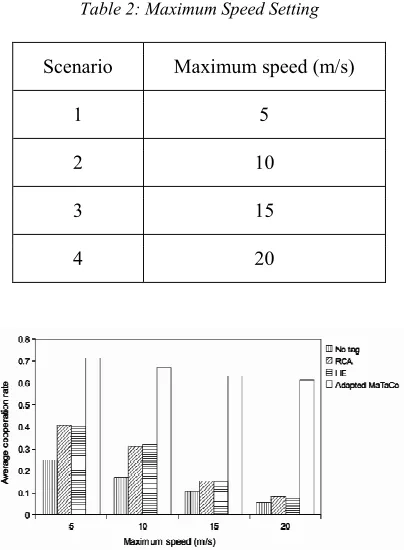
The average cooperation rate, and the percentage of conditional cooperators at the end of simulation of the adapted MaTaCo are compared with the implementation of No-tag, RCA and HE. It is expected that the adapted MaTaCo will achieve higher average cooperation rate and percentage of conditional cooperators, as it takes into account agents’ mobility in enforcing cooperation. Figure 3 illustrates the average cooperation rate achieved for a maximum speed of 5 m/s, 10 m/s, 15 m/s, and 20 m/s for the adapted MaTaCo, No-tag, RCA and HE. It shows that the adapted MaTaCo achieves a higher average cooperation rate than the baselines. As maximum speed increases, the average cooperation rate of the adapted MaTaCo drops slightly. This is due to the increase in variation of agents’ speeds which decreases the probability of finding agents with similar tags. However, the adapted MaTaCo still perform very well compared to the baselines.
Figure 4 shows the percentage of conditional cooperators at the end of simulation. The population starts with 50% selfish agents and 50% conditional cooperators. Therefore, at the end of simulation, the adapted MaTaCo increases the percentage of conditional cooperators in the population by 24 to 37% depending on the maximum speed setting. No-tag, RCA and HE, on the other hand, decrease the percentage of conditional cooperators in the population in each of the maximum speed setting. This is expected as the approaches were not designed for mobile environment.
[image:7.612.318.520.106.381.2]The results also show that even in low mobility environment i.e. 5 m/s maximum speed, No-tag, RCA and HE are not capable of increasing the percentage of conditional cooperators in the population. The adapted MaTaCo, on the other hand, increases the percentage even in high mobility environment i.e. 20 m/s maximum speed. Therefore, we expect that the adapted MaTaCo will outperform No-tag, RCA and HE in all scenarios described in the next sections as the scenarios are fixed at 10 m/s maximum speed.
Table 2: Maximum Speed Setting
Scenario Maximum speed (m/s)
1 5
2 10
3 15
[image:7.612.315.522.420.527.2]4 20
Figure 3 Average Cooperation Rate With Respect To Agents’ Maximum Speed
Figure 4 Percentage Of Conditional Cooperators At The End Of Simulation With Respect To Agents’ Maximum
Speed
3.8 Impact of Selfish Agents
This experiment evaluates the adapted
selfish agents than 50% at the start of simulation would further degrade the baselines’ performance. Therefore, in this experiment, we chose the values ranging from 10% to 40% selfish agents in order to provide a bias towards cooperative environment and evaluate whether it will have any effect on the baselines and also our approach.
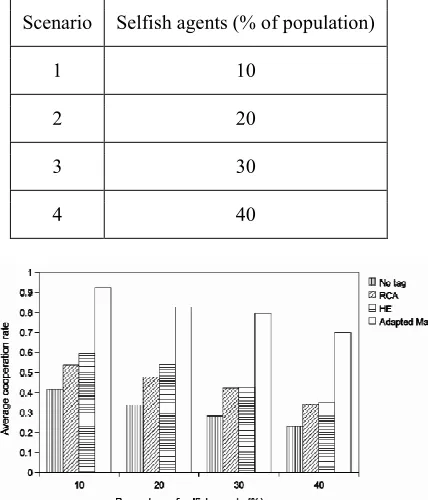
[image:8.612.315.523.78.206.2]Both figures show that the baselines do not promote higher cooperation even when there is only 10% selfish agents at the start of simulation. The average cooperation rate and the percentage of conditional cooperators increase only if agents employ the adapted MaTaCo. With an increasing percentage of selfish agents, both the average cooperation rate and the percentage of conditional cooperators decrease. The average cooperation rate has a higher decrease rate than the percentage of conditional cooperators due to low cooperation rate at the early of simulation. With respect to the adapted MaTaCo, the percentage of conditional cooperators can reach 100% in 900 seconds if the population starts with 10% or 20% selfish agents. This shows that the adapted MaTaCo has the capability to enforce full cooperation in a population of mobile agents. The higher the percentage of selfish agents at the start of population, the longer the time is needed for the adapted MaTaCo to enforce full cooperation.
Table 3: Percentage Of Selfish Agents Setting
Scenario Selfish agents (% of population)
1 10
2 20
3 30
4 40
Figure 5 Average Cooperation Rate With Respect To Percentage Of Selfish Agents At The Start Of Simulation
Figure 6 Percentage Of Conditional Cooperators At The End Of Simulation With Respect To Percentage Of
Selfish Agents At The Start Of Simulation
3.9 Impact of Population Size
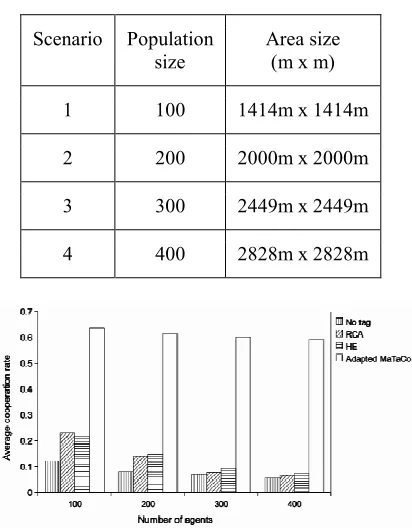
This experiment evaluates the impact of total number of agents on the average cooperation rate and the percentage of conditional cooperators. Table 4 lists the population size and corresponding area size settings used in four scenarios. Figure 7 and 8 show the average cooperation rate and the percentage of conditional cooperators at the end of simulation, respectively, for a population size of 100, 200, 300, and 400 agents. The simulation area size is changed accordingly to keep the population density fixed at 20000m2/agent (which is as same as the population density for 50 agents in an 1000m x 1000m area). For instance, a population of 400 agents with a density of 20000m2/agent requires an area of 8000000m2 which equals to approximately 2828m by 2828m square area. The aim of this experiment is to evaluate the approaches in large population. However, due to limitations of the machine used in terms of its processing capacity, this experiment could only support up to a maximum of 400 agents without consuming more time than was available.
It is observed that in each population size, the adapted MaTaCo increases the percentage of conditional cooperators. Hence, the average cooperation rate of the population increases. Both the average cooperation rate and the conditional cooperators percentage of the adapted MaTaCo do not decrease significantly as the population grows. This is because of the fact that the maximum speed is fixed at 10 m/s in each case, thus the probability of an agent finding other agents with similar tags does not change significantly between the cases.
[image:8.612.95.309.450.700.2]Scenario Population size
Area size (m x m)
1 100 1414m x 1414m
2 200 2000m x 2000m
3 300 2449m x 2449m
[image:9.612.94.300.98.362.2]4 400 2828m x 2828m
[image:9.612.317.523.378.684.2]Figure 7 Average Cooperation Rate With Respect To Number Of Agents
Figure 8 Percentage Of Conditional Cooperators At The End Of Simulation
3.10 Impact of Population Density
This experiment evaluates the average
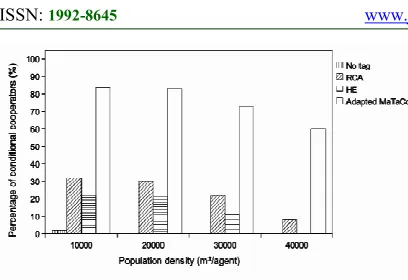
cooperation rate and the percentage of conditional cooperators, when population density varies. Table 5 lists the population density and corresponding area size settings used in four scenarios. Figure 9 and 10 show the average cooperation rate and the percentage of conditional cooperators at the end of simulation, respectively, for a population density of
10000, 20000, 30000, and 40000 m2/agent. The
values were chosen such that they do not exceed the view area of an agent. The view area is defined by
πr2 where r is the agent’s view radius. As each
agent’s view radius is defined as 250m throughout the simulation, therefore the view area of each
agent is approximately 196350m2 of circle area
which is always larger than the chosen population density values. This is important in order to keep the degree of population partitioning as low as possible, so that it would not affect the evaluation. The simulation area size is changed accordingly to keep the population size fixed at 50 agents. For instance, a population of 50 agents with a density of
10000m2/agent requires an area of 500000m2 which
equals to approximately 707m by 707m square area.
It is observed that both the rate and the percentage decrease as network density decreases. This is due to the fact that each agent’s view radius is limited to 250 m. Thus, as the area size increases which in turn decreases the network density, the probability of an agent finding neighbors decreases as each agent has a larger area to move around. With a decreasing probability of an agent finding neighbors, the probabilities of an agent finding other agents with similar tags and an agent has a neighbor to compare its payoff with also decrease.
Table 5: Population Density Setting
Scenario Population density
(m2/agent)
Area size (m x m)
1 10000 707m x
707m
2 20000 1000m x
1000m
3 30000 1225m x
1225m
4 40000 1414m x
1414m
[image:9.612.93.301.398.511.2]Figure 10 Percentage Of Conditional CooperatorsAt The End Of Simulation With Respect To Population
Density
4. CONCLUSION
We have presented the development of TACME, a mobile environment model for tag-based cooperation. The agent-tag-based modeling technique and tool used for TACME development were discussed. In this model, there was no radio communication involved. Therefore, the MaTaCo approach was adapted to use distances between agents for measuring tags similarity, instead of
using received power levels, RxPr as in the original
MaTaCo approach. The relationship between the distance between two agents and the received power level was derived from Friis’ free space transmission formula. Agents in TACME played PD games between them as TACME generalized a packet forwarding session in a MANET as a PD game.
We also presented the evaluation of the adapted MaTaCo in TACME, in comparison to the No-tag, RCA and HE approaches. A set of experiments that assess the performance of the adapted MaTaCo in terms of promoting higher cooperation than the baselines under varying conditions, was outlined. Overall, the adapted MaTaCo outperformed the baselines under all tested conditions. The adapted MaTaCo increased the average cooperation rate and the percentage of conditional cooperators under varying number of selfish agents, speed of agents, population size and population density. The baselines, on the other hand, decreased the rate and the percentage under the varying conditions. This shows that by enabling the nodes to be aware of neighboring nodes’ mobility and location, as implemented in our proposed algorithm, they can increase the cooperation rate between them.
ACKNOWLEDGMENT
This research was funded by the Universiti Kebangsaan Malaysia under Grant No. GGPM- 2015-005.
REFERENCES:
[1]N. E. Othman, S. Weber & R. Hassan: “A study on cooperation enforcement between nodes in
mobile ad hoc networks”, Journal of
Theoretical and Applied Information
Technology. 56(2), pp. 193-208, 2013.
[2]N. E. Othman & R. Hassan: “The design of mobility-aware tag-based cooperation for
mobile ad hoc networks”, International
Journal of Applied Engineering
Research. 11(6), pp. 4634-4639, 2016. [3]E. Bonabeau: “Agent-based modeling: methods
and techniques for simulating human
systems”, Proceedings of the National
Academy of Sciences of the United States of
America, pp. 7280—7287, 2002.
[4]C. M. Macal, M. J. North: “Tutorial on
agent-based modeling and simulation”, Proceedings
Of The IEEE 2005 Winter Simulation
Conference (WSC 2005), 2005.
[5]M. Wooldridge, N. R. Jennings: “Intelligent
agents: Theory and practice”, The Knowledge
Engineering Review, pp. 115—152, 1995.
[6]A. J. Heppenstall, A. J. Evans, M. H. Birkin: “A hybrid multi-agent/spatial interaction model
system for petrol price setting”, Transactions
in GIS, pp. 35—51, 2005.
[7]D. C. Parker, S. M. Manson, M. A. Janssen, M. J. Hoffmann, P. Deadman: “Multiagent systems for the simulation of land-use and
land-cover change: a review”, Annals of the
Association of American Geographers, pp.
314—337, 2003.
[8]H. Parry, A. Evans, D. Morgan: “Aphid
population dynamics in agricultural
landscapes: an agent-based simulation model”,
Ecological Modelling, pp. 451—463, 2006.
[9]A. Turner, A. Penn: “Encoding natural movement as an agent-based system: an investigation into human pedestrian behaviour
in the built environment”, Environment and
Planning B, pp. 473—490, 2002.
[10]C. Jacob, J. Litorco, L. Lee: “Immunity through swarms: agent-based simulations of the human
immune system”, Lecture Notes in Computer
[image:10.612.91.295.71.211.2][11]B. W. Miller, C. H. Hwang, K. Torkkola, N. Massey: “An architecture for an intelligent
driver support system”, IEEE Intelligent
Vehicles Symposium (IV 2003), pp. 639—644,
2003.
[12]M. T. Parker: “What is ascape and why should
you care?”, Journal of Artificial Societies and
Social Simulation, 2001. URL
http://jasss.soc.surrey.ac.uk/4/1/5.html. [13]M. E. Inchiosa, M. T. Parker: “Overcoming
design and development challenges in
agent-based modeling using ascape”, Proceedings of
the National Academy of Sciences of the United States of America, pp. 7304—7308, 2002.
[14]S. Luke, C. C. Revilla, L. Panait, K. Sullivan, G. Balan: “MASON: a multi-agent simulation
environment”, Simulation: Transactions of the
Society for Modeling and Simulation
International, pp. 517—527, 2005.
[15]N. Minar, R. Burkhart, C. Langton, M.
Askenazi: The swarm simulation system: a
toolkit for building multi-agent simulations, 1996.
[16]M. J. North, T. R. Howe, N. T. Collier, J. R.
Vos: A declarative model assembly
infrastructure for verification and validation in Advancing Social Simulation: The First World Congress (Takahashi, S. and Sallach, D.L. and Rouchier, J., ed.). Springer, 2007.
[17]Rimon Barr: JiST / SWANS - Java in Simulation
Time / Scalable Wireless Ad hoc Network
Simulator. 2005. URL
http://jist.ece.cornell.edu/sw.html.
[18]N. Aschenbruck, R. Ernst, E. Gerhards-Padilla, M. Schwamborn: “BonnMotion - a mobility scenario generation and analysis tool”, Proceedings of the 3rd International ICST
Conference on Simulation Tools and
Techniques (SIMUTools 2010), pp. 1—10,
2010.
[19]H. T. Friis: “A note on a simple transmission
formula”, Proceedings of the Institute of Radio
Engineers, pp. 254—256, 1946.
[20]T. Camp, J. Boleng, V. Davies: “A survey of mobility models for ad hoc network research”,
Wireless Communication and Mobile
Computing: Special issue on Mobile Ad Hoc
Networking: Research, Trends and
Applications, pp. 483—502, 2002.
[21]M. J. Osborne, A. Rubinstein: A course in game
theory. MIT Press, 1997.
[22]R. L. Riolo, M. D. Cohen, R. Axelrod:
“Evolution of cooperation without
reciprocity”, Nature, pp. 441—443, 2001.
[23]D. Hales, B. Edmonds: “Applying a socially
inspired technique (tags) to improve
cooperation in P2P networks”, IEEE
Transactions on Systems, Man, and
Cybernetics, pp. 385—395, 2005.
[24]Sonja Buchegger, Jean-Yves Le Boudec: “Performance analysis of the CONFIDANT protocol (cooperation of nodes: fairness in
dynamic ad-hoc networks)”, Proceedings of
the 3rd ACM International Symposium on Mobile Ad hoc Networking and Computing