Peters, Carsten and Kantaris, X. and Barnes, Jacqueline and Sutcliffe, A.
(2005) Parental attitudes toward disclosure of the mode of conception to their
child conceived by in vitro fertilization. Fertility and Sterility 83 (4), pp.
914-919. ISSN 0015-0282.
Downloaded from:
Usage Guidelines:
Please refer to usage guidelines at or alternatively
Birkbeck ePrints: an open access repository of the
research output of Birkbeck College
http://eprints.bbk.ac.uk
Peters, C.; Kantaris, X.; Barnes, J. and Sutcliffe, A.
(2005). Parental attitudes toward disclosure of the mode of
conception to their child conceived by in vitro fertilization.
Fertility and Sterility
83 (4) 914-919.
This is an author-produced version of a paper published in Fertility and Sterility (ISSN 0015-0282). This version has been peer-reviewed but does not include the final publisher proof corrections, published layout or
pagination.
All articles available through Birkbeck ePrints are protected by intellectual property law, including copyright law. Any use made of the contents should comply with the relevant law.
Citation for this version:
Peters, C.; Kantaris, X.; Barnes, J. and Sutcliffe, A. (2005). Parental attitudes toward disclosure of the mode of conception to their child conceived by in vitro fertilization. London: Birkbeck ePrints. Available at:
http://eprints.bbk.ac.uk/archive/00000331
Citation for the publisher’s version:
Peters, C.; Kantaris, X.; Barnes, J. and Sutcliffe, A. (2005). Parental attitudes toward disclosure of the mode of conception to their child conceived by in vitro fertilization. Fertility and Sterility 83 (4) 914-919.
http://eprints.bbk.ac.uk
Parental attitudes towards disclosure of the mode of conception to their child conceived by in-vitro fertilisation
Catherine Peters, MRCPCHa Xenya Kantaris, MSca Jacqueline Barnes, PhD b Alastair Sutcliffe, MDa
Where work was done:
Department of Community Child Health, Royal Free and University College Medical School, Rowland Hill Street, London, NW3 2PF, UK
Financial support: Support has been received from Ferring Limited, UK and IBSA Limited, Switzerland for administrative costs in our ongoing work.
Department affiliations: aDepartment of Community Child Health, Royal Free and University College Medical School, Rowland Hill Street, London, NW3 2PF, UK; bInstitute for the Study of Children, Families and Social Issues, Birkbeck, University of London, UK
Reprint requests: Reprint requests: Alastair Sutcliffe aDepartment of Community Child Health, Royal Free and University College Medical School, Rowland Hill Street, London, NW3 2PF, UK (fax: 0207 e-mail: [email protected])
Capsule of abstract
In a survey of parents of IVF children, the majority wished to tell their child at some point but were unsure about the most appropriate timing and method of disclosure.
Complete abstract
OBJECTIVES: To survey the level of disclosure of conception method within families of children conceived using conventional IVF or ICSI and to examine the factors that may influence parental attitudes and plans for disclosure.
DESIGN: An in-depth questionnaire
SETTING: Participants recruited through UK fertility clinics
PATIENTS: Parents of IVF/ICSI children aged 5-6 years (n=181, 51%)
INTERVENTION: Mothers and fathers of IVF/ICSI children were sent questionnaires to complete and return in a reply paid envelope
MAIN OUTCOME MEASURES: Completion of the questionnaire
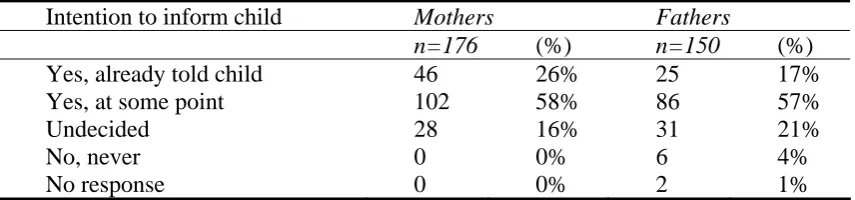
RESULTS: Most parents had told somebody about their child’s method of conception, mostly close friends and family. Fewer (26% mothers/17% fathers) had already discussed the child’s mode of conception with their child. 58% mothers/57% fathers intended to tell their child at some point. 16% mothers/21% fathers were undecided. 4% fathers never wanted to discuss the subject with their child. Children were more likely to be told if conception was ICSI, rather than conventional IVF, and if an only child. 29% undecided fathers and 36% undecided mothers stated that they would tell their child if appropriate child-friendly explanatory literature was available. CONCLUSIONS: The majority of parents wish to tell their child at some point but are unsure about the most appropriate timing and method of disclosure. Fertility clinics may have a role in providing the necessary support. Child-friendly literature may be helpful.
INTRODUCTION
The development of assisted reproductive technologies over the past 25 years has allowed many otherwise infertile couples to become parents to genetically related children. The level of disclosure within families about the child’s method of conception may vary according to social, cultural and personal parental beliefs. Only a few studies have attempted to examine the parental attitudes towards disclosing methods of assisted conception and factors that may influence these attitudes. A consistent finding was that the majority of parents with children under 10 years of age conceived using in-vitro fertilisation (IVF) had not revealed the method of conception (1-6). However, two studies found that over half the parents did intend to tell their child at some point (1,2).
The relationship between revelation of mode of conception and child behaviour is inconclusive. One study found that parents who had informed their child reported slightly higher, although non-clinical, levels of internalizing child problem behaviour (anxiety, worry) compared to parents who had not informed their child (1). Fathers of informed children also reported higher overall problem behaviour scores. Another study found no significant relationship (6).
Further studies investigating the issue of disclosure have focused mainly on donor insemination (DI) families (7,8). This work found that DI children who knew their conception method had less frequent and less severe disputes with their mothers than those who had not been told (7). However, these studies may not be
representative of IVF families per se. The use of donor eggs or sperm and the subsequent lack of genetic link to one or other parent may lead to differences in parental expectations of the child’s and the extended family’s reactions.
Studies of adults, who were adopted as children, have shown that it is important that they are told of their adoption at an early age and provision of information about their genetic background helped in the development of a stable identity (9). Thus, informing children about their mode of conception at an earlier age may result in a more favourable outcome in terms of identity and emotional difficulties.
This study is the largest survey of parental attitudes towards the issue of disclosure of the method of conception of their genetically related IVF or the more recently introduced Intracytoplasmic sperm injection (ICSI) conceived child. The aim was to ascertain whether parents had told, or intended to tell, their child how they were conceived and what factors may influence this decision.
MATERIALS AND METHODS Subjects
Procedure
All 356 families were sent an explanatory letter and a questionnaire for each parent, with the request that parents did not confer. Reply paid envelopes were provided.
Materials
The survey questionnaire was designed by the authors. A number of points were investigated:
Whether parents had revealed their child’s method of conception to others and if so, to whom.
Whether parents had discussed the method of conception with their child. Whether parents had decided if they intended to tell their child how they were conceived.
If intending to tell, at what age did they wish to inform their child? If undecided whether to tell, what were their concerns?
If parents did not want to inform their child, why not?
Were parents able to find any literature, short films or any other material addressing the issue of telling children that they were conceived after assisted conception?
Did parents want literature to help them inform their child, and if so, what would be helpful to them?
For each question, a list of potential responses was provided. The parents could tick as many answers as were applicable. The survey domains were determined by literature reviews and the authors’ previous research which has involved many consultations with parents of assisted conception children. Face and content validity were determined by consultation with other experts in the field and some parents not involved in the study. While a complete pilot was not possible a small number of parents gave feedback on the questions allowing the authors to predict that there would be sufficient variability in responses.
Analysis
The association between factors and outcomes were tested using the chi-square test, whilst odds ratios were calculated directly from relevant 2x2 contingency tables. T-tests were used to compare the means of parental age in the responders and non-responders.
RESULTS Sample size
Questionnaires were returned by 51% (181/356) of families; 80% (145/181) with data from both parents, 17% (31/181) with data from the mother only and 3% (5/181) with data from the father only.
Non-responders
The response rate was as expected for this type of postal survey (11,12) using a single mail out. No socio-demographic differences between non-responders and responders could be found, including parental age, social class and educational level.
Revealing the child’s conception method to family, friends and others Most parents had told somebody about their child’s method of conception and they were most likely to have confided in close friends and family (Table I). More than half (56% mothers; 53% fathers) did not mind who knew while only 1% of mothers and 3% of fathers had told no-one.
Table I: Frequency of responses to question 1, “Who have you told about your
child’s methods of conception?”
Who have you told? Mothers Fathers
n=176 (%) n=150 (%)
My set of parents 149 (85%) 121 (81%)
Partner’s set of parents 135 (77%) 127 (85%)
Both sets of parents 133 (76%) 117 (78%)
My/our other children a 15 (16%) 15 (19%)
Close friends 152 (86%) 116 (77%)
Other family members 144 (82%) 120 (80%)
Professionals 59 (34%) 46 (31%)
We do not mind who knows 99 (56%) 80 (53%)
No-one 2 (1%) 5 (3%)
a
Answers to this question are restricted to those parents who report having more than one child
Parental couples did not always agree in their response. For the families with data from both parents, there were 10% (15/145) families in which the father did not mind who knew but the mother did, and a further 10% (15/145) families in which the mother did not mind who knew but the father did. In 3 families the father had told no-one but the mother had told close friends. There were no cases the mother had told no-one but the father had told someone.
Informing the child of their method of conception
Parental responses to the question of whether they had already told or had intention to tell their child how they were conceived are shown in Table II.
Table II: Intention of parents to inform child of their method of conception.
Intention to inform child Mothers Fathers
n=176 (%) n=150 (%)
Yes, already told child 46 26% 25 17%
Yes, at some point 102 58% 86 57%
Undecided 28 16% 31 21%
No, never 0 0% 6 4%
No response 0 0% 2 1%
mothers and 100% fathers also gave the age the child had been when told. The mean age for mothers was 3.7 years (standard deviation (s.d.) 1.1 years, range 1-6). The mean age for fathers was 3.5 years (s.d.1.3 years, range 1-5). For the 145 children where the data was available from both parents, 38 had been told about their method of conception. Of these children, 22 had been told by both parents, 3 had been told by father only and 13 by mother only.
Factors associated with parental disclosure to their child
Several factors were considered that may be related to a parent’s decision to inform their child of their method of conception.
Sex of child
Of the 46 mothers (out of 176) who had already informed their child, and the 25 fathers (out of 150) the sex of the child was not associated with the likelihood of parental disclosure. 24% (23/95) of boys had been told by their mother compared with 28% (23/81) of girls (odds ratio (OR) boy: girl 0.81; 95% Confidence Interval (CI) 0.41 to 1.58; p=0.53). There was no effect of child sex on paternal disclosure (OR boy: girl 1.07; 95% CI 0.53 to 2.30, p=0.88).
Method of Conception
More, 35% (33/95) ICSI conceived children were told about their conception by their mother compared with 16% (13/81) of IVF conceived children (OR ICSI: IVF 2.78; 95% CI 1.34 to 5.77; p = 0.006). There was no method of conception effect for paternal disclosures (OR ICSI: IVF 1.18; 95% CI 0.49 to 2.79, p = 0.71).
Presence of a sibling
Children were less likely to have been told by their mother if they had one or more siblings. 20% (18/91) of those having one or more siblings, compared with 33% (28/85), without a sibling (OR no sibling: at least one 1.99; 95% CI 1.00 to 3.96; p = 0.05). Again there was no effect on paternal disclosure (OR no siblings: at least one 1.28; 95% CI 0.63 to 2.61, p = 0.51).
Naturally Conceived Siblings vs. IVF Siblings
In cases where the IVF-conceived study child had one or more siblings, the mode of conception of these siblings (naturally conceived or IVF) was not associated with parental attitudes to disclosure. 78% mothers (35/45) who had at least one naturally conceived child said that they had or would tell their child about their method of conception. In contrast, 87% (40/46) mothers who had no naturally conceived children said that they had or would tell their child about their method of conception. This difference was not significant at the 5% level (OR=0.53; 95% CI 0.17 to 1.59). 72% fathers (31/43) who had at least one naturally conceived child said that they had or would tell their child about their method of conception. 81% (30/37) fathers who had no naturally conceived children said that they had or would tell their child about their method of conception. This difference was not significant at the 5% level (OR=0.60; 95% CI 0.21 to1.74).
Age of parent
0.94 (95% CI 0.87 to 1.02, p=0.13). For father’s age, odds ratio per year increase was 0.98 (95% CI 0.90 to 1.05, p=0.52).
Relationship between informing the child and informing other adults Telling others was associated with telling the child in question. Of the mothers who did not mind who knew about their method of conception, 94% (93/99) said they had or would tell their own child, compared with 71% (55/77) of the
remaining mothers (OR=6.2; 95% CI 2.4 to 16.2). Similarly, of the fathers who do not mind who knew, 89% (71/80) said they had or would tell their own child, compared with 59% (40/68) of the remaining fathers (OR=5.5; 95% CI 2.4 to 12.9). Only two mothers and five fathers had told no-one. It is therefore not possible to assess how likely these parents are to tell their own child relative to other parents.
Disclosure of the method of conception to their child was more likely if mothers had disclosed the mode of conception to their own friends (Chi 4.50, degrees of freedom (d.f.)=1, p<0.03), to members of their own extended family (beyond their own parents) (Chi 4.96, d.f.=1, p<0.03) and to a lesser extent if their partners had told their extended family (Chi 3.38, d.f.=1, p<0.07). Disclosure to children was unrelated to disclosure to the respondents own parents.
Disclosure in the future
a) Age at which parents intend to disclose conception method to their child Of the mothers who said they intended to tell the child (see Table II), 41% (42/102) specified an age (mean 8.6 years, s.d. 2.2). Of the fathers who said they intended to tell their child (see Table II), 48% (41/86) specified an age (mean 9.9 years, s.d. 2.7).
In the 21 families where both the mother and father said they intended to tell the child and both gave the age at which they intended to tell the child the correlation between the mother’s and father’s responses was 0.68. The age reported by the father was on average 0.76 years older than that reported by the mother, but this difference was not significant (p=0.28; 95% CI –0.7 years to 2.2 years).
b) Reasons given by parents who do not wish to disclose conception method to their child
No mother said that she would never tell her child but six fathers gave this response (Table II). Only one of the fathers, however, had told no-one at all. The partners of these men intended to tell their child at some point in three cases (age not stated) or were undecided.
Factors that influenced the men’s decisions to never tell were varied and included: • parental factors such as parents unable to agree on decision
• concern about their child’s reactions/feelings
• wider world concern, for instance that their child would reveal the method of conception to others or concern about child’s acceptance within the family’s culture (moral, ethical or religious background)
c) Reasons given by parents who are undecided whether to inform their child Factors given by the 21% of fathers and 16% of mothers who were undecided included: parental factors, child reactions/feelings and wider world Other factors included the wish to wait until sex education as a whole was discussed and
concern that the child was too young for the parents to have given serious thought about approaching the topic (Table III). Seven parents also commented that they felt the subject was not important or relevant to the child.
Table III: Reasons given for indecision about whether or not to inform child of mode of conception
Reasons for indecision Mothers Fathers
n=28 (%) n=31 (%)
Parental factors 16 57% 13 42%
Child reaction/feelings 15 54% 13 42%
Wider world 7 25% 6 19%
Child too young 21 75% 22 71%
Not discussed sex education 15 54% 10 32%
Not relevant / important 3 11% 4 14%
Parents who intended to tell their child in the future were asked if it would be helpful to have child-friendly literature to help explain the conception to the child. The majority (92% of mothers, 82% fathers) reported that they would find
literature helpful.
29% (9/31) undecided fathers and 36% (10/28) undecided mothers stated that they would tell their child if they had access to appropriate child friendly literature that explained the topic.
DISCUSSION
This study is the largest survey of parental attitudes towards informing their IVF or ICSI conceived child of their mode of conception. The study is strengthened by including only families where children were the genetic offspring of both parents and by providing separate responses from both parents.
The majority of parents who responded had already disclosed, or wished in the future to disclose, details about the conception method to their child. The same proportion of mothers and fathers planned to inform their child in the future, but fathers on average would tell their children slightly later, at about 10 years rather than 8-9 years for mothers. It is of note that, in a much smaller study of 8-9 year olds, the percentage of parents who were undecided, who intended to tell at some point and who had already told are very similar to this study. They also found that parents who had informed their child had done so between 4-8 years (1).
Children who had already been informed, by the age of 5, about their conception status were more likely to have been told by their mothers. However, the
represent an age at which the child fully understood the information. Further research with children could explore this.
Parental decisions about whether or not to inform their child may be influenced by their decision to reveal the method of conception to others. Parents who did not mind who knew the child’s conception status (56% mothers and 53% fathers) were more likely to have already informed or intend to inform their child. The remaining parents may therefore have been more selective in their choice of confidants.
This is illustrated by parental reports that issues outside the family (wider world) contributed to their decision. These parents expressed concern that their child would reveal the method of conception to others or concern about their child’s acceptance within the family’s culture (moral, ethical or religious background). It has been reported that some cultures outside the UK, for example in Eastern Europe, are more secretive about disclosing conception information and more uncertain about whether to inform their child (13).
Previous studies have suggested that parents may perceive or experience social stigma from questioning by family and friends about their child’s conception. In particular questioning about whether the child (and by inference the family) was “natural” or “normal” and resulting, in some cases, in moral judgments. Parents may also feel that their masculinity or femininity is brought into question when they conceive using assisted reproduction. Revealing the mode of conception to others may increase this type of unwanted questioning (14,15).
However, the majority of parents in this study who were concerned about wider world factors had told somebody and had not kept the child’s conception method completely secret. Secrecy has been shown to be detrimental to family
relationships, creating boundaries between those who do and do not know. Holders of family secrets may experience anxiety about the possibility of disclosure and find discussion of related topics uncomfortable. If the secret is subsequently disclosed, the previously unaware party may feel that their trust has been violated (16).
Almost half the parents (54% mothers and 42% fathers) also stated that they were concerned about their child’s response or concerned that child would feel different to siblings or peers. In addition, the presence of siblings was associated with less disclosure. Possibly parents are reluctant to highlight differences between
children. However, general parental fear that their child may be singled out if their mode of conception was known by others has been reported previously (3) and this concern was also reported by three of the six fathers in this study who did not wish ever to inform their child.
The reasons for this are unclear. Compared to conventional IVF, ICSI is a relatively new technique. Parents may be more anxious about the long term outcomes of this technique and may wish their child to be fully informed.
Undecided parents were most concerned that their child was too young. All the children of families in this survey were under the age of 6.5years. The parents were not asked if the current age of the child was relevant to their future decision about revealing mode of conception. It may be that parents wish to wait until their child has developed further and asks questions for him/herself. The majority of parents who stated that their child’s age was a factor also had other reasons for non-disclosure.
Some parents related the decision to tell their child to the timing of sex education. The discussion of sex education between parents and children has been shown to be difficult in cases of natural conception (1,19) and it may be that these
difficulties are compounded by the need to explain assisted conception. The optimal age to discuss sex educationis not established, but charities such as the UK family planning association (FPA) advocate approaching the subject from an early age (17). Many parents may rely on the educational system to teach their child this topic and in the UK the discussion of assisted reproduction is suggested in the UK national school curriculum for 11 year olds (18). This may teach children the basic facts, but the child will not discover how they were conceived from this source.
Many parents are unsure how to approach the subject of assisted reproduction with their child. Parents may not know where to turn for this advice. A previous study found that 24% of parents felt that their fertility clinic could have been more helpful regarding the issue of disclosure (2). This study found that 29% of
undecided fathers and 36% of undecided mothers said they would tell their child if they had access to appropriate child friendly literature that explained the topic. In addition, almost all those who intended to tell their child (82% of fathers and 92% mothers) said they would welcome appropriate child friendly literature.
The evidence gathered in adoption studies (9) is that informing children early in life of their origins contributes to the formation of successful identity and subsequent wellbeing. It is likely that informing children of their assisted
conception at a young age may also be advantageous. The simple intervention of provision of child friendly literature may therefore be helpful to many parents and beneficial in the long-term for their children.
In addition, fertility clinics may have a role in helping parents tackle this issue of disclosure by offering pre-treatment counselling that encourages parents to discuss the topic and perhaps providing practical support. History has a tendency to repeat itself and it may be that, as with adoption studies, surveys of the attitudes of IVF conceived adults in the future may be the most accurate method of establishing how and when the IVF conceived child should be told, and what they would benefit from knowing.
less likely to respond. Of those that did respond, parents may further bias the study if they confer or answer questions in a manner that they think the researchers would interpret as “correct” or “good” parenting rather than any strongly beheld beliefs. We also had a lower response rate from fathers so conclusions about their behaviour need to be more tentative that those regarding their partners.
However, this study emphasises the need to provide support to families of IVF and ICSI-conceived children. By examining factors that influence parental decisions about disclosure, the results can be used to give an indication to further parents about how others in their situation feel and can contribute towards helping fertility clinics to discuss these questions with future couples seeking assisted reproduction treatments
Acknowledgements. We would like to thank the families who participated in our ongoing study. Although this study did not involve UK Fertility clinics we are grateful for the previous support of these clinics in helping recruit the original families. Support has been received from Ferring Limited, UK and IBSA Limited, Switzerland for administrative costs in our ongoing work. We have produced a booklet designed to aid parents in explaining ICSI/IVF conception to their
Reference List
(1) Colpin H, Soenen S. Parenting and psychosocial development of IVF children: a follow-up study. Hum Reprod 2002; 17(4):1116-1123.
(2) Greenfeld DA, Ort SI, Greenfeld DG, Jones EE, Olive DL. Attitudes of IVF parents regarding the IVF experience and their children. J Assist Reprod Genet 1996; 13(3):266-274.
(3) McWhinnie A. Outcome for families created by assisted conception programmes. J Assist Reprod Genet 1996; 13(4):363-365.
(4) Olivennes F, Kerbrat V, Rufat P, Blanchet V, Fanchin R, Frydman R. Follow-up of a cohort of 422 children aged 6 to 13 years conceived by in vitro
fertilization. Fertil Steril 1997; 67(2):284-289.
(5) Braverman AM, Boxer AS, Corson SL, Coutifaris C, Hendrix A.
Characteristics and attitudes of parents of children born with the use of assisted reproductive technology. Fertil Steril 1998; 70(5):860-865.
(6) Brewaeys A, Golombok S, Naaktgeboren N, de Bruyn JK, Van Hall EV. Donor insemination: Dutch parents' opinions about confidentiality and donor anonymity and the emotional adjustment of their children. Hum Reprod 1997; 12(7):1591-1597.
(7) Golombok S, Brewaeys A, Cook R, Giavazzi MT, Guerra D, Mantovani A et al. The European study of assisted reproduction families: family functioning and child development. Hum Reprod 1996; 11(10):2324-2331.
(8) Golombok S, Brewaeys A, Giavazzi MT, Guerra D, MacCallum F, Rust J. The European study of assisted reproduction families: the transition to adolescence. Hum Reprod 2002; 17(3):830-840.
(9) Hoopes JL. Adoption and identity formation. In: Brodinsky DM, Scheter MD, editors. The Psychology of Adoption. Oxford: Oxford University Press, 1990: 144-166.
(10) Sutcliffe AG, Taylor B, Saunders K, Thornton S, Lieberman BA,
Grudzinskas JG. Outcome in the second year of life after in-vitro fertilisation by intracytoplasmic sperm injection: a UK case-control study. Lancet 2001;
357(9274):2080-2084.
(11) Cummings SM, Savitz LA, Konrad TR. Reported response rates to mailed physician questionnaires. Health Serv Res 2001; 35(6):1347-1355.
(12) Boreham R, Airey C, Erens B, Tobin R. NHS Patient Survey Programme: General Practice. 16-7-2003. UK Department of Health. Ref Type: Report
(13) Cook R, Vatev I, Michova Z, Golombok S. The European study of assisted reproduction families: a comparison of family functioning and child development between Eastern and Western Europe. J Psychosom Obstet Gynaecol 1997; 18(3):203-212.
(15) Nachtigall RD, Tschann JM, Quiroga SS, Pitcher L, Becker G. Stigma, disclosure, and family functioning among parents of children conceived through donor insemination. Fertil Steril 1997; 68(1):83-89.
(16) Karpel MA. Family secrets: I. Conceptual and ethical issues in the relational context. II. Ethical and practical considerations in therapeutic management. Fam Process 1980; 19(3):295-306.
(17) Sex education. Family Planning Association . 2003. Ref Type: Internet Communication. www.fpa.org.uk
(18) Science at key stage 3 (Year 7) Unit 7B: Reproduction . Qualifications and Curriculum Authority . 2003. Ref Type: Internet Communication.
www.standards.dfes.gov.uk
(19) Ravesloot, (1997) Sexuality in the Youth Period, Before and Now. Doctoral dissertation quoted in: Colpin, H. and Soenen, S. (2002) Parenting and