The London School of Economics and Political
Science
Distributed Development of Large-Scale
Distributed Systems: The Case of the Particle
Physics Grid
Avgousta Kyriakidou-Zacharoudiou
A thesis submitted to the Department of
Management, Information Systems and Innovation
Group, of the London School of Economics for the
degree of Doctor of Philosophy, London
DECLARATION
I certify that the thesis I have presented for examination for the PhD degree of the London School of Economics and Political Science is solely my own work other than where I have clearly indicated that it is the work of others (in which case the extent of any work carried out jointly by me and any other person is clearly identified in it).
The copyright of this thesis rests with the author. Quotation from it is permitted, provided that full acknowledgement is made. This thesis may not be reproduced without the prior written consent of the author.
ABSTRACT
Developing a Grid within High Energy Physics for the Large Hadron Collider particle
accelerator is characterised as a highly collaborative, distributed and dynamic systems
development effort. This research examines the way this distributed Grid is developed,
deployed and provided as a service to the thousands of physicists analysing data from the
Large Hadron Collider. The particle physics community has always been at the forefront of
computing with a tradition of working in large distributed collaborations, therefore providing
a “distinctive” case of distributed systems development practice. The focus of concern is the
collaborative systems development practices employed by particle physicists in their attempt
to develop a usable Grid.
The research aims to offer lessons and practical recommendations to those involved in
globally distributed systems development and to inform the information systems
development literature. Global software development presents unaddressed challenges to
organisations and it is argued that there is an urgent need for new systems development
practices and strategies to be created that can facilitate and embrace the rapid changes of the
environment and the complexities involved in such projects. The contribution of the study,
therefore, is a framework of guidance towards engendering what the author defines as
“Hybrid Experimental Agile Distributed Systems Development Communities” revealing a
set of dynamic collaborative practices for those organisational contexts engaged in
distributed systems development. The framework will allow them to reflect on their own
practice and perhaps foster a similarly dynamic flexible community in order to manage their
global software development effort.
The research is in the form of an interpretative qualitative exploratory case study, which
draws upon Activity Theory, and frames the Grid’s distributed development activity as a
complex overarching networked activity system influenced by the context, the community's
tools, rules, norms, culture, history, past experiences, shared visions and collaborative way
of working. Tensions and contradictions throughout the development of this Grid are
explored and surfaced, with the research focusing on how these are resolved in order for the
activity system to achieve stability. Such stability leads to the construction of new
knowledge and learning and the formation of new systems development practices. In
studying this, practices are considered as an emergent property linked to improvisation,
ACKNOWLEDGEMENTS
This thesis is dedicated to my beloved mum and dad. You brought me into this world, you have been there when I needed you most and you are everything one could ask for from their parents. I am really proud that you are my parents and I want everyone to know that. Mum, I love you and I want you to know that your sacrifices have not been in vain. Dad, we have been discussing my PhD from day 1. I will never forget how happy you were when I announced to you that some day I would become a “Dr.”. Now that this wonderful journey is coming closer to an end, your absence is even worse. You are not with us anymore and I would like to take this opportunity to tell you that you are the one who made this happen. You were always giving me the strength to carry on because you were a fighter. You are a true inspiration, you are one in a million and I was lucky enough to have you as my dad. I love you and I miss you and I hope that you are proud of me.
I could not have done this PhD without the love and support of my wonderful husband, Ioanni Zacharoudiou. You made this possible. Thank you for all the sleepless nights, thank you for the long and endless discussions about my work, thank you for looking after me, thank you for everything. I am also grateful to my sisters, Evi and Maria, who supported me, kept me happy and for not letting me lose my enthusiasm. Their patience, love and understanding have been invaluable. I would like to extend my thanks to all my family in Cyprus (and it is a big family!) and my in-laws, for their continuous encouragement and support whilst completing this dissertation and for not letting my priorities waver. Kypro, Evi, Denni, Nana and Avgousta, you are like brothers and sisters to me. I am blessed to have you in my life.
big thank you also to your dear wife Angela and my beautiful bridesmaid, your daughter, Hannah. I remember once you told me that you wanted this PhD to be a great thesis that you could show to your future PhD students with pride. I hope that, as your first PhD student, I have succeeded in this. I hope that this is a thesis that makes you and will always make you proud.
I also like to thank my second supervisor Dr. Tony Cornford for his precious advice during the early writings on this research. Dear Tony, you make people want to improve themselves. Thank you for your guidance and your confidence in my academic abilities. Special thanks also to Dr. Steve Smithson for reading a draft of this thesis and providing valuable comments as well as to Dr. Carsten Sørensen for his support. Also thank you to Dr. Jannis Kallinikos and Dr. Susan Scott who acted as my examiners in the MPhil upgrade process. Their constructive initial comments have helped shape this dissertation.
To all my friends and colleagues who I encountered at LSE, especially Maha Shaikh, Katerina Voutsina, Dionysis Demetis, Vasiliki Baka, Eleni Lioliou, Ioanna Chini and Yingqin Zheng, I thank you very much for your support and for the invaluable advice you have offered me. A special thanks to Ritsa Pitta, Isidora Kourti and Marios Tziannaros who have been great friends and have always been there for me.
TABLE OF CONTENTS
LIST OF FIGURES ... 11
LIST OF TABLES ... 12
1
INTRODUCTION – RESEARCH ISSUES ... 13
1.1 Problem domain and scope of the research ... 13
1.2 Research approach ... 15
1.3 Motivation of the research, contributions and relevance of the study ... 18
1.4 Structure of the thesis ... 22
2
LITERATURE REVIEW ... 26
2.1 Introduction ... 26
2.2 Part 1: Global – Virtual software development ... 27
2.2.1 Virtual teams in GSD: Characteristics, challenges, proposed solutions .. 30
2.2.2 Systems development practices and their suitability in GSD ... 39
2.2.3 Silver bullet to GSD ... 45
2.3 Part 2: Global virtual communities: Collaborative practice, shared identity and learning 48 2.4 Part 3: Introducing the Grid ... 58
2.5 Chapter summary ... 61
3
ACTIVITY THEORY AND GLOBAL SYSTEMS
DEVELOPMENT ... 63
3.1 Introduction ... 63
3.2 Overview of AT ... 66
3.2.1 Generations of research in AT ... 66
3.2.2 AT’s fundamental principles... 71
3.3 AT in IS research ... 74
3.4 The activity system in detail for this study ... 76
3.4.1 Elements of activity ... 78
3.5 Structure of an activity ... 81
3.6 Contradictions as conceptualizing breakdowns in collaborative activity ... 86
3.8 Chapter summary ... 92
4
RESEARCH METHODOLOGY ... 96
4.1 Introduction ... 96
4.2 Philosophy of research approach and justification for choice of the interpretative philosophy ... 96
4.3 Research design ... 103
4.3.1 Case study strategy ... 103
4.3.2 Research context ... 105
4.3.3 Data collection ... 108
4.3.4 Data sources ... 112
4.3.5 Approach to data interpretation and analysis ... 115
4.4 Chapter summary ... 117
5
DEVELOPING THE PARTICLE PHYSICS GRID ... 118
5.1 Introduction ... 118
5.2 CERN: Where innovations are born ... 118
5.3 The birth of a collider ... 119
5.4 Developing Grid computers ... 121
5.5 Building the LCG in context ... 123
5.6 Chapter summary ... 135
6
FINDINGS ... 136
6.1 Introduction ... 136
6.2 Forming virtual alliances to build the Grid ... 137
6.3 How this decentralised computing effort is organised and coordinated ... 141
6.3.1 Organic, flexible management structure with a strong shared vision .... 142
6.3.2 Mutation of roles ... 148
6.3.3 Strategic planning or “planning not to plan” and prepare for change? .. 149
6.3.4 Communication channels coordinating the work ... 152
6.3.5 Consensus based decision-making and problem-solving ... 157
6.4 Competition and funding pressures in the Grid’s development ... 159
6.5 Dealing with systems development ... 161
6.5.1 Improvisational evolutionary development ... 162
6.5.2 Competing technological solutions ... 165
6.5.3 Grid middleware development process ... 166
7
DISTRIBUTED SYSTEMS DEVELOPMENT ACTIVITY ... 183
7.1 The historically developed activity system ... 184
7.1.1 The overarching ‘distributed systems development’ activity system in detail ... 188
7.2 The structure of the overarching ‘distributed systems development’ activity system and the internal contradictions ... 203
7.2.1 Tensions and fragmentations unveiling systemic contradictions ... 203
7.3 Resolution of contradictions through expansive learning cycles ... 226
7.3.1 Divergent motives, interests and expectations: Contradiction resolution ... 226
7.3.2 Expansive learning cycles – Lessons learned ... 228
7.4 Chapter summary ... 240
8
DISCUSSION OF HYBRID EXPERIMENTAL AGILE
DISTRIBUTED SYSTEMS DEVELOPMENT
COMMUNITIES ... 242
8.1 HEAD_SDC: Structure, history/culture and process ... 243
8.1.1 Structure – Division of labour... 246
8.1.2 History/culture - Community ... 247
8.1.3 Process – Mediated tools ... 248
8.2 Developing a framework based on lessons learned from a ‘unique’ development context ... 251
8.3 Chapter summary ... 256
9
CONCLUSIONS AND FUTURE RESEARCH ... 258
9.1 Introduction ... 258
9.2 Overview of the thesis ... 258
9.3 Research questions and outcomes ... 260
9.4 Research contributions ... 263
9.4.1 Contribution to practice ... 264
9.4.2 Contribution to theory ... 266
9.5 Limitations of the research ... 268
9.6 Future research ... 270
9.7 Concluding remarks ... 272
10
REFERENCES ... 273
APPENDIX A ‒ COMPARISON OF SYSTEMS DEVELOPMENT
PRACTICES ... 300
APPENDIX B – TABLE OF RESEARCH ACTIVITY ... 304
APPENDIX C – INTERVIEW PROTOCOL ... 312
List of Figures
Figure 1.1 PhD roadmap 25
Figure 3.1 Vygotsky’s model of mediated act 67
Figure 3.2 Human activity system 69
Figure 3.3 Interacting activity systems as the minimal model for the third generation of AT
71
Figure 3.4 Second generation activity triangle model 76
Figure 3.5 The definitive hierarchy of Leont’ev 81
Figure 3.6 Multi-motivated activity model 84
Figure 3.7 Four levels of contradictions within the activity system 87
Figure 3.8 Expansive cycle of learning actions 89
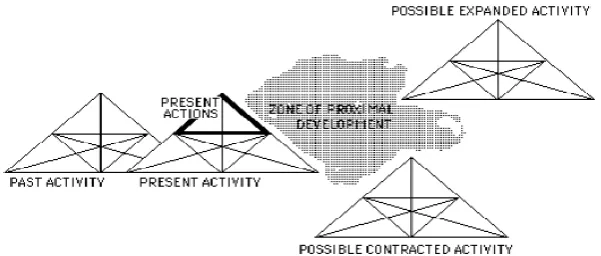
Figure 3.9 The zone of proximal development 91
Figure 3.10 The actions of the expansive learning cycle with types of contradictions
92
Figure 5.1 The LHC accelerator 119
Figure 5.2 The LHC underground ring 120
Figure 5.3 Grid middleware components 123
Figure 5.4 LCG’s tier architecture 125
Figure 5.5 CERN’s computing hall 125
Figure 5.6 GDC: Particle physicists and computer scientists, members of LCG, EGEE and GridPP, involved in the development of the Grid
128
Figure 5.7 Research focus - Grid middleware and applications development, deployment and user support of the GDC
128
Figure 5.8 Management structure of LCG 131
Figure 6.1 Grid middleware development process 168
Figure 6.2 Savannah bug report 173
Figure 7.1 The overarching ‘distributed systems development’ activity system of the GDC with the networked sub-activity systems
187
Figure 7.2 Details of the elements of the overarching ‘distributed systems development’ activity system of the GDC
202
Figure 7.3 Tertiary contradiction between the central and culturally more advanced activity
207
Figure 7.4 Poly-motivation within the central activity (adapted by (Kaptelinin and Nardi 2006))
Figure 7.5 Primary contradiction within the community element of the overarching ‘distributed systems development’ activity system
210
Figure 7.6 Primary contradiction within the division of labour element of the overarching ‘distributed systems development’ activity system
211
Figure 7.7 Primary contradiction within the tools element of the
overarching ‘distributed systems development’ activity system 213
Figure 7.8 Primary contradiction within the subject element of the
overarching ‘distributed systems development’ activity system 216
Figure 7.9 Secondary contradiction between the subject and tool elements of the overarching ‘distributed systems development’ activity system
218
Figure 7.10 Secondary contradiction between the subject and object
elements of the overarching ‘distributed systems development’ activity system
220
Figure 7.11 Secondary contradiction between the tools and object elements of the overarching ‘distributed systems development’ activity system
221
Figure 7.12 Primary contradiction within the subject element of the
overarching ‘distributed systems development’ activity system – Manifested because of a quaternary contradiction between the overarching activity system and the neighbouring ‘overall user activity system’
224
Figure 7.13 Contradictions within and between the elements of the central ‘distributed systems 'development’ activity system
225
Figure 7.14 Establishment of a development process: Expansive learning cycle with types of contradictions
231
Figure 7.15 Clusters of competence: Expansive learning cycle with types of contradictions
234
Figure 7.16 Cultivating power user communities: Expansive learning cycle with types of contradictions
237
Figure 7.17 Balancing experimentation with discipline: Expansive learning cycle with types of contradictions
239
Figure 8.1 HEAD_SDC’s structure, history/culture and process 250
List of Tables
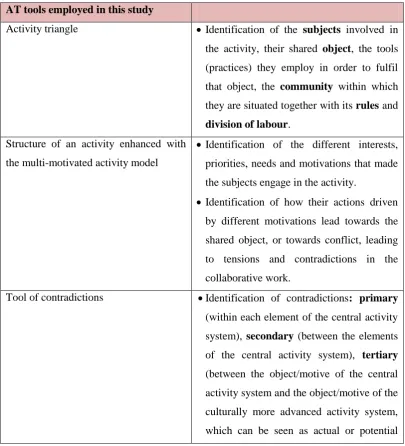
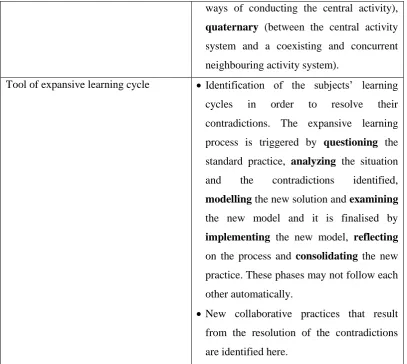
Table 3.1 Overview of AT tools employed in this research 94
Table 4.1 Summary of interviews conducted 110
Table 4.2 Details of research activities 115
Table 8.1 Framework for engendering HEAD_SDC: Lessons for future GSD projects
1
Introduction – Research issues
1.1 Problem domain and scope of the research
This research is a critical study of collaborative work practices within global systems development activities. It particularly examines how large-scale distributed systems are developed collaboratively in a globally distributed manner, through a case study of a Grid development project, the Large Hadron Collider computing Grid (LCG) project, in particle physics (PP). The aim of this thesis is to observe how the development of the Grid unfolds in a large, complex, distributed community and track events and activities over a period of time, aiming at understanding such events in their natural setting and capturing the subjective experiences of the community’s members during the development process. This research examines the development of the Grid, as an open-ended unfolding process. Clearly the technical tasks required in achieving this are significant; however this research’s interest lies in the collaborative processes and practices employed in developing such Grid technology as a socio-technical achievement, rather than as a purely technical artefact.
physicists from all around the world together to develop, deploy and maintain this Grid (Britton, Burke et al. 2006a).
The systems development setting studied here, the PP community, is a community with a tradition of solving their own technological problems. As such, they often find themselves in the roles of developers as well as users. This community is well-known for the development of other cutting edge distributed systems (notably the World Wide Web) and is itself highly distributed and virtual with distinctive culture and tradition (Knorr-Cetina 1999), so presenting a context where distinctive collaborative practices emerge. The more narrow area the research focuses upon is the development, deployment of Grid middleware and applications and user support.
This study particularly explores the collaborative systems development practices of the PP community in their attempt to develop a usable Grid and the collaboration formed around this development, with the aim to offer answers into the wider context of global distributed systems development. This collaborative development is explored through three distinctive perspectives: 1) structure and in particular how this whole effort is organised and managed as well as how competitive relationships are balanced, 2) history/culture and particularly how their distinctive and “exceptional” history and tradition influence and facilitate their current practice, and 3) process, focusing more on the processes and practices employed when developing and deploying Grid middleware components and applications to run on top of the middleware. In studying these, practices are considered as an emergent property linked to improvisation, bricolage (Ciborra 2002) and dynamic competences which unfold as large-scale projects evolve.
but a new generation of computing technology that may potentially have significant impact on scientific research, and perhaps foreshadow the “next generation Internet” (Carr 2005). Yet, developing and implementing such a complex information infrastructure requires collaboration among a range of dispersed groups, and flexibility and adaptability to volatile requirements (Berman, Geoffrey et al. 2003). Developing a Grid is indeed argued to be a significant systems development challenge, because it must be done as a distributed virtual collaborative effort. It involves coordinating the actions of a huge range of people of different culture, education and skill, all working within different institutions around the globe. Vital in this enterprise are the ability to share knowledge about the project, and to support innovating new technology and new work practices. In part this is achieved by careful attention to developing a strong sense of community among participants, and constructing a range of repositories of information about the project, the people, and the Grid itself.
The Grid is technically complex. Yet the complexity of the globally distributed systems development effort within the LCG project sometimes “exceeds” the Grid’s technical challenges. It is the mobilisation of resources, the creation of alliances, the drawing of boundaries, the “struggle” between order and chaos and experimentation and discipline, which constitute the fluidity and complexity in the emergence of the Grid infrastructure.
The following research questions are thus addressed in the context of the PP Grid development project providing lessons for the wider context of e-Science and global software development (GSD): (1) What is the nature of systems development for such a large-scale global project? (2) What practices emerge in response to the demands of such development? (3) How do these practices influence the development of large-scale and global systems? (4) What lessons are learned from the development of the PP Grid that can be translated into the wider field of GSD?
1.2 Research approach
UK Grid for particle physics (GridPP) project (a PP country-focused project contributing to the wider LCG). This study focuses uniquely on the systems development practices of particle physicists developing the Grid middleware. It particularly looks at the wider LCG project by encompassing elements from GridPP and from the Enabling Grids for e-Science (EGEE) project (an EU funded project jointly developing middleware with LCG) as contributors to LCG.
The researcher participated in all the activities and meetings of the Pegasus project, from its conception till its completion and played a key role in the project’s success. Being part of this project benefited the researcher greatly and made this study better as it provided easier and greater access to participants, financial independence and the ability to discuss the findings and analysis within the wider project and with a steering group who provided help and direction to the wider project. The researcher conducted the work in collaboration with the remaining team. The researcher’s input to the project is further discussed in the methodology chapter.
The research is in the form of an interpretative qualitative exploratory case study (Myers 1997) that addresses the research questions by focusing on 1) how collaboration occurs, 2) how new knowledge and expertise are created and shared, 3) the importance of trust and how competition is facilitated and 4) on the work practices and technologies that support this distributed collaborative endeavour. The case study strategy allows for a thorough understanding of the Grid distributed development context and offers deep insights into the complexities inherent in the development process. The central arguments of this thesis are thus derived from the comprehensive analysis of the data collected from the empirical case study.
development is understood as a series of contradictions between the elements of this overarching activity system, which are in a continuous process of getting resolved in order for the activity system to achieve stability and balance. Contradictions are considered to be the major source of dynamism and development in AT, since based on the emerging problems and conflicts, people have to re-consider their position and collectively re-construct their shared understanding, knowledge and practices (Bertelsen 2003). Tensions and frictions throughout the development of this Grid are thus explored and surfaced, focusing on how these are resolved in order for the overarching activity system to achieve stability, leading to the construction of new knowledge and learning and the formation of new systems development practices.
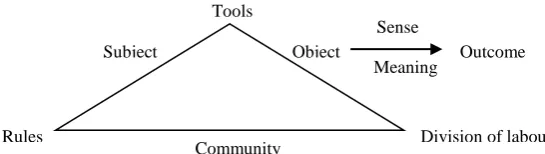
AT is considered a relevant theoretical framework to explain collaboration – and hence global systems development activity – as a complex work activity influenced by the context, the community, mediated artefacts, rules and division of labour of subjects undertaking this activity (Korpela, Mursu et al. 2002). It allows for an in-depth examination on how the Grid is collaboratively constructed in order to fulfil the objects of a global community and of the learning activities taking place throughout the process.
1.3 Motivation of the research, contributions and relevance of the study
Motivation
The work starts with the assumption that systems development beyond the smallest scale is inherently a collaborative activity (Whitehead 2007). With the current trend of globalisation where the information technology (IT) industry is becoming more and more globally interconnected (Sengupta, Chandra et al. 2006), the management, development and maintenance of software has increasingly become a political, multi-site, multi-cultural distributed undertaking, undertaken on a larger and more diffused scale as virtualised efforts distributed in time and space (Herbsleb, Paulish et al. 2005).
Today there are more software projects running in geographically distributed environments and the so-called GSD is becoming a norm in the software industry (Damian and Moitra 2006). Systems development now involves knowledge from multiple domains that a single developer (or organisation) does not possess. Collaboration then becomes a necessity because of the need to achieve levels of collective intelligence (Ye 2005). Organisations have to cope with the increasing internationalisation of business forcing collaboration and knowledge sharing simultaneously and thus there is now a need for new ways of thinking about how global collaborative development should be fostered and how knowledge should be shared in distributed groups (Gammelgaard 2010). It is not surprising that literature stresses that such collaborative and virtual systems development endeavours blur the boundaries between sectors and disciplines and have consequences for the development practices involved in the construction of systems (Agerfalk, Fitzgerald et al. 2009). With the globalisation of the development process (Sengupta, Chandra et al. 2006) and the new forms of open technologies such as Grids, the limitations of traditional systems development practices (and even contemporary agile practices) have become obvious (Fitzgerald 2000; Parnas 2006).
software industry with necessary techniques or tools to overcome the difficulties faced by global teams?” (Damian 2003). It is therefore argued that there is an urgent need for case studies which can facilitate a deep understanding of the current challenges and ones which can contribute solutions, effective strategies and practices, and lessons learned on how to address problems of technical, social and cultural nature in GSD (Smite, Wohlin et al. 2010).
GSD is argued to demand new, different development practices, since the nature of the problem and the environment are different (Damian and Moitra 2006). It is suggested that there is a need to develop alternative perspectives on distributed systems development, ones that put forward improvisation and emergent change as fundamental aspects of systems development in organisations (Bansler and Havn 2004). Herbsleb and Moitra (2001) indeed claim that there is still “significant understanding to be achieved, methods and techniques to be developed and practices to be evolved before this GSD phenomenon becomes a mature discipline and its benefits are fully understood”. Russo and Stolterman (2000) and Fitzgerald (2000) claim that new systems development practices, or guidelines for successful systems development, should be drawn from “best practice” development situations that prevail today. They further suggest, researchers should focus on examining systems development practice in real-world situations, and in real-world development projects.
This research is thus motivated by the debate around GSD and attempts to bridge this evident “gap” by providing suggestions, lessons learned and practical recommendations from the PP context that will fill in the urgent need for new and more efficient systems development practices. This research rejects the idea of “best-practice”, instead it explores a case that is interesting and unusual in the way they develop systems and therefore provides juxtaposition to more orthodox accounts with lessons emerging from reflection on both.
Contributions
revealing a set of dynamic collaborative practices relevant for those organisational contexts engaged in distributed systems development, which will allow them to reflect on their own practice and perhaps foster a similarly dynamic agile community in order to manage their GSD effort. HEAD_SDC, exhibit similar but also additional and “distinctive” characteristics to the ones already defined in traditional communities of practice (CoP) (Wenger 1998). Although CoP are spontaneously emerging groups (Wenger and Snyder 2000) and therefore it is difficult to structure their spontaneity and provide the enabling conditions – a vision, motivation, the systems and structures – to support their development and to sustain their activities, the community identified in this study has been developed and sustained through collaborative means of working by the whole PP collaboration; therefore, providing lessons based on what particle physicists believe can engender and maintain such a collaborative virtual community. This HEAD_SDC is identified as a new form of collaboration which is highly distributed, clustered, organic, collaborative and democratic, it is experimental and agile with tremendous computing expertise and not following pre-determined plans, methods and structures.
Relevance of the study
This study is based on the belief that lessons of this community’s distributed collaborative development of a Grid can provide insights for other fields with less experience of engaging with and developing large-scale technologies in a globally distributed way. This however, then poses the further challenge to assess to what extent the ways of working of this community, which are embedded in the “doing” of PP and within its complicated and unique context of massive physical apparatus, colossal data volumes and long traditions of large collaborative teams, can inform wider systems development efforts both within e-Science and beyond? If there are indeed lessons to be drawn from projects such as the LCG, it is here argued that it is necessary to look beyond the simple replication of a technological infrastructure within another domain. Instead, the Grid should be considered as a socio-technical information infrastructure such that the context within which LCG practices and accomplishments exist may be better understood. From this position and with a perspective that establishes a Grid as a reflection and construction of its context, valuable insights can be gained.
This dissertation thus differentiates itself from previous studies focused on GSD projects such as open source or outsourcing related projects, as it explores a “unique” and, as claimed by Chompalov, Genuth et al. (2002), an “exceptional”, collaborative, democratic and highly technologically competent distributed community in their attempt to develop a Grid to meet their LHC computing needs. The technology under study is obscure with distinctive characteristics and it is deployed under very specific circumstances such as the tight LHC deadline and the need to meet the particle physicists’ requirements and expectations, something which is expected to influence the systems development practices employed. While some of the PP collaborative practices reflect elements of those employed in open source and agile development, PP is a unique organisation exhibiting various distinctive characteristics that can offer lessons to GSD.
in 34 countries. Their Grid, which has been under development since 2001 is considered to be one of the world’s largest e-infrastructures (Britton, Burke et al. 2006b). Secondly, it is being developed within a community which has for many years worked as a globally distributed collaboration that thrives on democratic debates and discussions and has shown their ability to work pragmatically and creatively under extreme pressures and tight deadlines (Lloyd 2006).
Developing this Grid is a highly collaborative, distributed and dynamic systems development effort but one that also presents challenges in technical, organisational and social terms. It is indeed an example of large-scale systems development on a global scale and one that seems to demonstrate a spirit of agility, improvisation and emergent change. No prediction or prescription is intended. Rather, the findings of this thesis aim to provide guidance to other organisational contexts that attempt to perform distributed systems development of Grids and other technologies within their work.
1.4 Structure of the thesis
This thesis is structured as follows:
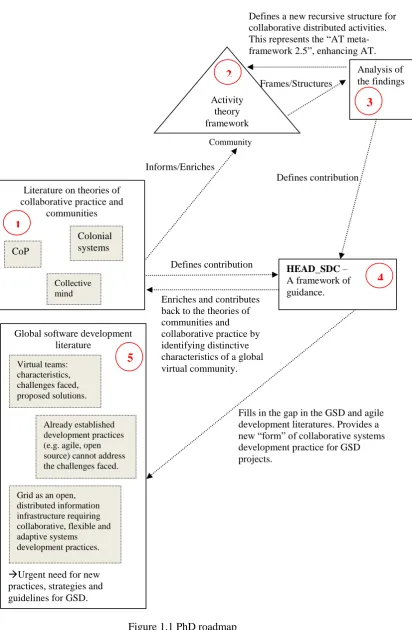
Chapter 2 builds the argument of the study by reviewing literature from fields relevant to distributed software development, which has studied aspects of such software processes before. Literature on theories of collaboration and communities (such as CoP, colonial systems, collective mind) is also reviewed in an attempt to enrich the community element of the AT framework employed and provide the basis for framing the contribution of the research. Finally, Grid literature is reviewed in order to define what the Grid is for this study. This literature is used to develop a coherent stance for the research.
Chapter 4 describes different traditions in research in order to situate this study within the field of interpretative IS research. The chosen case study approach is outlined and the way in which the research was conducted and data were analysed is demonstrated.
Chapter 5 describes the case – the wider organisational context within which the Grid “emerges”. The three main projects involved in the Grid’s development under study are presented and details on their structure, objectives and existing culture are discussed. This chapter complements Chapter 6, providing an overview of the different elements which when combined make up this case.
Chapter 6 provides a detailed presentation of the relevant data obtained from the empirical study of the Grid’s distributed systems development. The focus here is on how the Grid is developed collaboratively by a number of distributed actors. This chapter is split into two important parts. The first part provides details on how the collaboration around the development is structured, how the whole effort is organised, how knowledge is socialised and how the extensive communication flow helps coordinate the work. The second part of this chapter presents details on how the development work is performed, therefore, provides descriptions of the development, deployment and user support process.
Chapter 8 takes a step further to propose a framework for creating HEAD_SDC. In this chapter, the findings and analysis are extensively discussed shedding light and facilitating the development of the above framework. The framework’s ideas are examined and compared to the already existing literature on communities (discussed in Chapter 2). The relevance of this new framework – which is developed, based on the PP community’s lessons learned – to GSD is also portrayed. This framework is argued as a contribution to the discourse of GSD and agile development and the theories of collaboration and communities.
Chapter 9 concludes this dissertation. Firstly, a thesis synopsis is provided after which the outcomes of the research questions identified in the introduction chapter are briefly discussed. The major contribution of the research to both theory and practice is then presented followed by the limitations, challenges and ideas to stimulate further research in the areas covered by this study.
Defines a new recursive structure for collaborative distributed activities. This represents the “AT meta-framework 2.5”, enhancing AT.
Literature on theories of collaborative practice and
communities
Activity theory framework
Community
Global software development literature
Urgent need for new practices, strategies and guidelines for GSD.
[image:25.595.121.534.68.699.2]Analysis of the findings
Figure 1.1 PhD roadmap
Defines contribution Informs/Enriches Frames/Structures Defines contribution 1 CoP Colonial systems Collective mind 2 3
HEAD_SDC – A framework of guidance.
Fills in the gap in the GSD and agile development literatures. Provides a new “form” of collaborative systems development practice for GSD projects.
Enriches and contributes back to the theories of communities and collaborative practice by identifying distinctive characteristics of a global virtual community.
4
5
Already established development practices (e.g. agile, open source) cannot address the challenges faced. Virtual teams:
characteristics, challenges faced, proposed solutions.
2
Literature review
2.1 Introduction
This chapter presents a thorough review of the relevant literature in accordance to the objectives of this study. The chapter consists of three basic parts. Part 1 reviews literature that draws upon debates and literature from fields such as GSD, open source development and global outsourcing that are familiar with collaborative distributed software development processes and which previously have studied aspects, issues, practices and challenges of such software processes. The lack of evidence in the literature to address the challenges faced by GSD projects leads to a thorough discussion and review of relevant work on whether already proposed systems development practices, such as traditional methodologies, contemporary agile development approaches and open source approaches are appropriate to deal with these challenges. In light of this the perceived “gap” in the information systems development (ISD) and GSD literature is presented, urgently needing new and effective strategies and practices that can address problems of technical, social and cultural nature in GSD.
Part 2 of the chapter reviews literature on collaborative practice and communities and in particular it focuses on concepts such as CoP achieving shared identity and learning (Lave and Wenger 1991; Wenger 1998), Weick’s concept of collective mind (Weick and Roberts 1993) and Porra’s (1999) work on colonial systems. Such literature is reviewed in an attempt to enrich AT and particularly its concept of community, which does not reflect well the community being studied here. This enables a better analysis of the research findings. Such literature also helps define the contribution of this study, as the framework of guidance developed here draws upon and extends the concepts of CoP, colonial systems and collective mind in a global virtual development setting, thereby defining a new “distinctive” global hybrid systems development community.
The chapter is structured as follows: Section 2.2 sets out the scene for GSD focusing on the characteristics of such software processes, while Section 2.2.1 discusses virtual teams in GSD, perceived challenges and proposed solutions. Section 2.2.2 provides details on existing systems development practices (focusing on agile practices and open source development practices) that are perceived as the “silver bullet” to global systems development. Section 2.2.3 follows which identifies the “gap” in the literature and the urgent need for new development paradigms or guidelines that can inform future progress in distributed development after which the second part of the literature focusing on collective practice and communities is presented in Section 2.3. Section 2.4 presents details on the Grid and Section 2.5 summarises this chapter.
2.2 Part 1: Global – Virtual software development
ISD is at the core of the IS field (Fitzgerald, Russo et al. 2002). It is considered to be the fundamental process – a collaborative problem solving and intellectually complex activity (Vessey and Glass 1998) – carried out when engaging with technology to achieve a specific purpose in a specific context.
With the current trend of globalisation and the problem of turbulent business environments, ongoing innovations in information communication technologies (ICT) have made it possible to cooperate in a distributed fashion (Herbsleb, Paulish et al. 2005). The continuing advances and progress in ICT as well as in bandwidth and capacity and the use of advanced applications have turned the IT industry toward globally distributed software development in an attempt to find the silver bullet (Brooks 1987) of high-quality software delivered cheaply and quickly (Agerfalk and Fitzgerald 2006). From originally quite small co-located projects, enabled by technological advances, companies now embark on major complex software development projects running in geographically distributed environments (Oshri, Kotlarsky et al. 2008) and GSD is therefore “becoming a norm in the software industry” (Damian and Moitra 2006).
adaptable to the rapidly changing requirements and that is why communication, coordination and speed are all seen to be important aspects of the GSD process (Herbsleb, Mockus et al. 2001). A number of characteristics seem to define GSD projects with Smite and Borzovs (2006) suggesting the most important as being multi-sourcing, geographic distribution, temporal and socio-cultural diversity, linguistic and contextual diversity as well as political and legislative diversity.
It is argued that GSD is increasingly becoming common practice in the software industry, mostly because of its ability to develop software at remote sites, ignoring the geographical distance and benefit from access to a qualified resource pool and reduced development costs (Herbsleb 2007). One of the advantages of GSD is that it provides opportunities for developers in dispersed locations to communicate, collaborate as well as build and share knowledge repositories (Che and Zhao 2005). It is indeed claimed by Herbsleb and Moitra (2001) that a number of factors have accelerated this new trend with the most profound being: 1) the need to capitalise on the global resource pool to successfully and cost-competitively use scarce resources, wherever located; 2) the business advantage of proximity to the market, including knowledge of customers and local conditions 3) the quick formation of virtual teams to exploit market opportunities; 4) the severe pressure to improve time-to-market by using time-zone differences in “round-the-clock” development; and 5) the need for flexibility to capitalise on merger and acquisition opportunities wherever they present themselves. One-Ki, Probir et al. (2006) suggest that the open source development context is very similar to the GSD environment as it is characterised by a distributed environment, collaborative and rapid development among virtual teams and rapid evolution as the environment changes. Similarly, the globalisation’s effects on outsourcing of software production, have made outsourcing take up global dimensions and thereby become an international complex undertaking which requires a tremendous amount of support and interaction (Yalaho 2006).
Virtual alliances are defined as a network organisation consisting of independent enterprises (organisations, groups, individuals) that come together to explore an opportunity, business or market (Kasper-Fuehrer and Ashkanasy 2001). They can take various forms and structures with some being more permanent, interactive, knowledge intensive or complex than others (Panteli and Sockalingam 2005). Burn, Marschall et al. (2002)have created a virtual inter-organisational arrangement model which emphasises the strategic relationships between organisations including power, dominance and collaboration. Their model introduces three types of virtual alliances, the star alliance, the value alliance and finally the co-alliance, with the third model experiencing the highest levels of task conflicts as the nature of work is unstructured, but also experiencing a sense of mutuality and belonging which can lead to commitment and improve cooperation.
In management science, inter-organisational alliances have been investigated for a long time (Jha and Watson-Manheim 2007) and the term “Virtual Organisations” has been in common usage since at least 1992 (Davidow and Malone 1992; Jha and Watson-Manheim 2007).A “virtual organisation” (VO), it is claimed, is an extension of the traditional physical and structural bounded groups that are enabled and cooperate through technological advances, which revolutionise communication between them by establishing linkages for shared knowledge (Panteli and Chiasson 2008). Schultze and Orlikowski (2001) explain that “global electronic workspaces or information devices…together make up the unseen and sprawling empires of VOs”, with Panteli and Chiasson (2008) arguing that the advancement of ICT has been related not only to the emergence of virtual society but also to the development of the “virtual empire”, which is supposed to have an enormous impact on how people work, communicate and share knowledge. The location of work and our co-workers is now considered irrelevant. It is not surprising therefore that virtuality has been linked with globalisation that is about the “death of distance”. However, as Van Binsbergen (1998) puts it: “globalisation is not about the absence or dissolution of boundaries, but about…the opening up of new spaces and new times within new boundaries that we hitherto unconceivable”.
dependence, dynamic structural arrangements and national diversity. While there is a diverse set of meanings attached to virtuality, authors agree that being so complex and dynamic in nature, virtuality requires collective and collaborative efforts in order to better appreciate the broader, social, cultural, geographical and technological characteristics that surround it (Webster 2005).
Having defined what GSD and VOs mean to this study, the section below provides a review of the literature on virtual teams, their unique characteristics, the various challenges they face as a part of GSD projects as well as the already proposed suggestions to resolve such challenges. Such topics are reviewed in an attempt to inform this study and identify any relevant “gaps” in the literature.
2.2.1 Virtual teams in GSD: Characteristics, challenges, proposed solutions
Characteristics
through digital technologies between team members (Griffith, Sawyer et al. 2003). For a team to be hybrid, the presence of non-digital and digital technologies as well as the presence of face-to-face interaction needs to exist (ibid). Finally, the absence of digital technologies in communication and interaction is a key factor for making the team traditional. For the purpose of this research, virtual teams are seen as hybrid in order to inform the virtual community identified in this study, which has facets of a hybrid community thus portraying similar characteristics. However, this study looks beyond this concept as the identified virtual community also exhibits characteristics of CoP and colonial systems further discussed in Part 2 of this chapter.
Global virtual teams can rapidly form, reorganise, and dissolve when the needs of a dynamic marketplace change, and consist of individuals with differing competencies who are located across time, space and cultures (ibid). They represent a new organisational form that has emerged in conjunction with the globalisation of the socioeconomic and development process (Oshri, Van Fenema et al. 2008).
virtualised work environments. Recent research also suggests integrating collaborative technologies into integrated development environments in order to offer solutions that deal with breakdowns in communication among developers in virtual software teams (Zhua, Gonga et al. 2007).
Clearly, virtual teams are neither effective simply because of technology nor as a result of organisations wanting to extend their boundaries, but also and most importantly because individuals are able to trust and thus interact and work together in these electronic and non- traditional environments (Panteli and Chiasson 2008a).
Challenges
The substantial area of enquiry into remote collaborations has been the subject of a range of research strands over the years with some of the key issues been nicely summarised by Olson and Olson (2000) in their paper “Distance Matters”. They argue that distance does matter, it is “not only alive and well, it is in several essential respects immortal” (Olson and Olson 2000). Although distributed systems development with global virtual teams is considered to be a new paradigm in developing large-scale systems (Damian and Moitra 2006), there are still challenges and complexities involved in managing the development, coordinating dispersed team members, sharing knowledge, etc. that need to be addressed for having successful GSD (Herbsleb and Moitra 2001).
products leads to restricted or filtered communication, often seriously impairing this critical channel (Yalaho, Chunling et al. 2004).
Other studies show that distributed work usually worsens the chance for misunderstanding (Van Fenema 2002), there is a lack of trust (Panteli and Sockalingam 2005), asymmetrical distribution of information and knowledge among distributed sites (Carmel 1999; Panteli and Sockalingam 2005) and difficulty in collaborating due to different skills and training as well as mismatches in technologies. Strategic issues, such as deciding how to divide up the work, as well as technical issues such as incompatible data formats and different versions of the same tools, are also argued by Herbsleb and Moitra (2001) to be adding a further barrier to GSD.
GSD is situated within a complex, multi-leveled, multi-site socio-cultural context and it is argued that the environment of global virtual teams is not independent of the local setting and the cultural context (Sarker and Sahay 2004). Huang and Trauth (2007) have identified a number of key challenges in GSD with the most predominant indeed being the cultural diversity and cross-cultural management with Tanner (2009) similarly supporting that communication and culture are key issues that need to be addressed. Oshri, Van Fenema et al. (2008) similarly argue that virtual teams face major challenges in transferring knowledge across remote sites because of cultural differences that may include different languages and national traditions, communication habits, implicit assumptions as well as different values and norms of behaviour. DeSouza and Evaristo (2004) further suggest that dispersed members often adopt unique local routines for working, training and learning which create difficulties in standardising the work practices and might hinder the development of shared understanding and knowledge across the VO. Differences in skills, expertise, technical infrastructure, development tools and methodologies further raise the barriers for knowledge transfer between distributed sites (DeSouza 2003).
transfer of contextual and embedded knowledge (Oshri, Van Fenema et al. 2008). Such challenges exist mostly because distributed teams often experience changes in membership and their distribution decreases communication and increases the possibility for conflicts, misunderstanding and breakdowns (Armstrong and Cole 1995). While in co-located software development teams, joint training and face-to-face meetings facilitate the development of shared understanding and of the feeling of belonging to a group, in GSD this presents a problem (ibid).
Proposed solutions to GSD challenges
A number of studies have sought to propose solutions for overcoming the perceived challenges of GSD. Studies have suggested a clear division of labour and tasks between the dispersed sites (Battin, Crocker et al. 2001), inter-site coordination through division of labour which minimises cross-site communication and synchronisation (Mockus and Weiss 2001) as well as the use of technologies that support collaboration in a distributed environment (Cheng, DeSouza et al. 2004). On the other hand, Lee-Kelley, Crossman et al. (2004) have stressed that better performance in virtual teams is achieved through face-to-face meetings as a mechanism for team development and group identity. Qureshi and Zigurs (2001) similarly, play down the role of sophisticated technologies for successful virtualisation and emphasise the need for occasional face-to-face meetings for durable online collaboration. Robey, Khoo et al. (2000) also recommend that face-to-face meetings establish a greater social connection among members with Maznevski and Chudoba (2000) however claiming that the frequency of face-to-face meetings can gradually be reduced with the emergence of task clarity.
combined individual memory systems with communications/transactions between individuals, may enhance specialisation and division of labour and therefore minimise the constraints of sharing knowledge in distributed work, while increasing the awareness of who knows what and improve team performance. Kotlarsky, Van Fenema et al. (2008) however, take a different approach to this and stress the importance of coordination mechanisms, such as organisation design mechanism, work-based mechanisms, technology-based mechanisms and social mechanisms and technologies in eliminating the challenges of distributed work, especially those attributed to knowledge sharing and social aspects of global projects. While coordination mechanisms for managing knowledge process are important, Oshri, Kotlarsky et al. (2008b) argue that “successful software development efforts depend on timely and accurate coordination of expertise”. They propose a hybrid approach in managing and sharing of expertise which encourages the exploitation of expertise within globally distributed projects and yet explores the development and integration of expertise from external sources of knowledge.
On a similar perspective, a new stream of literature attempting to provide strategies for successful GSD suggests among others a clear distribution rationale, a sense of teamness, temporary co-location, instant feedback, informing and monitoring practices, appropriate training, human communication and effective tool bases as key factors enabling and facilitating successful global systems development (Paasivaara and Lassenius 2003; Prikladnicki, Audy et al. 2003; Paasivaara and Lassenius 2004; Lings, Lundell et al. 2006; Gratton and Erickson 2007). Olson, Zimmerman et al. (2008) also propose five major clusters of components that are seen as important to the success of global collaborations including the nature of work, the amount of common ground among participants, their readiness to collaborate, their management style and leadership and technology readiness.
Successful collaboration, socialization and the formation of trust in GSD
There is not a clear pattern for creating successful collaborations in GSD in the literature. However, it is possible to distinguish a range of conditions that improve the likelihood of success. Mattessich, Murray-Close et al. (2001) point out that some of the factors necessary for successful GSD collaborations are mutual understanding and respect, informal and personal relationships, open and frequent communication, shared vision, concrete and achievable goals, flexibility and adaptability, and a favourable political and social climate. Cohen and Bailey (1997) particularly stress that shared expectations of work practices, patterns of interactions and communication as well as on how technologies should be used are especially critical in the virtual environment where use of media is integral in accomplishing work activities. Qureshi and Zigurs (2001) on the other hand argue that management motivation has a direct effect on virtual collaboration, rather than technologies which should be seen as devises and not drivers of the collaboration in a GSD project.
Through socialisation, the norms, identity and cohesion between team members develop, enabling them to effectively communicate and perform. In distributed contexts, socialisation can be enhanced through technology (Ahuja and Galvin 2003), however, as argued by Oshri, Kotlarsky et al. (2008), its creation and maintenance may require distributed teams to reacquire norms and re-socialise as the project progresses. Indeed, evidence from numerous studies seem to indicate that the creation of commitment and of relationships enabled by periodic face-to-face meetings and socialisation, form an important ingredient for the durability of virtual team-working (Nandhakumar and Baskerville 2006).
Another key aspect enabling successful collaboration in GSD is argued to be the creation of trust (Javenpaa and Leidner 1999). Socialisation and effective knowledge sharing have indeed been proved to facilitate the creation of a trustworthy environment (Brede-Moe and Šmite 2008). Trust has been found to be positively related to global teams’ performance but in global environments it develops based on more “identifiable actions such as timely information sharing, appropriate responses to electronic communications, and keeping commitments to virtual team-mates” rather than based on social and emotional attachments (Furst, Reeves et al. 2004).
Therefore, other social factors or tactics need to be taken into account and enlisted in their place for having successful distributed collaborative relationships. Tactics here are defined as “attempts to influence other (e.g. expert human resources) to feel, think or behave in a desired fashion” (Weems-Landingham 2008). Tactics that facilitate the development and utilisation of positive instrumental relationships ‒ relationships that are not grounded in the physical but in the psychological proximity – should therefore be evoked, as they promote the strongest bonds between team members.
Establishing team identity/organisational identification for example has been argued to increase affiliation and membership since a sense of belonging to the organisation is created which links distributed members together (Yan 2008). Team identity is defined as the acceptance of interdependent goals and collective commitment and is seen to moderate the often difficult social relations in VOs such as the fragile trust, the easy occurrence of conflicts and the inappropriate attribution as well as to reduce uncertainty and complexity (Hinds and Mortensen 2005; Yan 2008). Although identity is seen as important for having successful global collaborations, tactics that promote such team identity in distributed contexts have not yet been established through systematic research (Weems-Landingham 2008). It is therefore argued that additional research must be carried out to determine tactics which for example promote trust, team identity, etc. that can enhance the virtual team members’ abilities to collaborate effectively in global contexts (ibid).
The section below discusses a number of system development approaches that have been suggested as appropriate solutions to the challenges of GSD, nevertheless their appropriateness is still to be examined.
2.2.2 Systems development practices and their suitability in GSD
It is claimed that the ISD context with most systems development methodologies, no longer makes sense (Fitzgerald 2000). Today’s dynamic environment has given rise to organisations that continuously adapt their strategies, structures and policies to suit this new global environment (Nerur, Mahapatra et al. 2005). However, the traditional plan-driven methodologies lack the flexibility to dynamically adjust the development process. Traditional methodologies are now being questioned because they are rooted in practices and concepts that were relevant to completely different “organisational and technical realities” (Fitzgerald 1994). The first methodologies were initially designed to support the early ISD which was mostly about in-house development of isolated systems from scratch (Avison and Fitzgerald 2003b) and were based on assumptions that IS are closed, stand-alone systems developed within a hierarchical structure and used within closed organisational limits. Nonetheless, the challenges of today’s distributed environment, call for new ISD paradigms and practices that are sufficiently “light”, recognise the particular character of work in such turbulent environments and can facilitate continuous development, wholeness, integration of different and complex parts, alignment of IS with business objectives and friendliness towards the various actors involved (Rupino da Cuhna and Dias de Figueiredo 2001).
the one hand, agile software development has emerged as a fast-paced, nimble means of developing software for customers; while on the other hand, there has been an increased adoption of open source software (OSS) development, in the hope of maximising reuse and reducing costs (ibid). These two paradigms offer important knowledge for this study as they reflect a new collaborative form of systems development. It is therefore important to understand them as this study reflects elements of them. The two paradigms are described below.
Agile approaches
Agile methods are a relatively recent phenomenon, most famously formally advocated in “the agile manifesto” (Fowler and Highsmith 2001), proposing four major principles: 1) individuals and interactions over processes and tools; 2) working software over comprehensive documentation; 3) customer collaboration over contract negotiation; and 4) responding to change over following a plan. The modern definition of agile software development evolved in the mid-1990s as a reaction against the heavyweight methods, which are characterised by a heavily regulated, regimented, micro-managed use of the waterfall model of development. Methods and processes originating from the waterfall model’s use are seen as bureaucratic, slow, demanding and inconsistent with the ways that software developers actually perform effective work (Fitzgerald 2000). Agile methods are sometimes characterised as being at the opposite end of the spectrum from plan-driven or disciplined methods. However, this distinction is quite misleading since it implies that agile methods are unplanned or undisciplined. A more accurate distinction is that methods exist on a continuum form adaptive to predictive and that agile methods lie on the adaptive site (Boehm and Turner 2004).
culture which embraces agility, and that it is the people, not the methods, which generate agility (Adolph 2006).
Agility is defined as “the quality of being quick-moving and nimble” (Lyytinen and Rose 2006), meanwhile it requires discipline and skill. In software development therefore, agility can be defined as “the ability of developers to sense and respond to new technical and business opportunities in order to stay innovative and competitive in a turbulent business environment” (ibid) or as One-Ki, Probir et al. (2006) argue, ISD agility represents the ability of systems development practices to rapidly adapt to the changing business requirements and environment. Unlike traditional development practices, agile approaches deal with unpredictability by relying on people and their creativity and competence rather than on processes (Highsmith and Cockburn 2001) and are adaptable to project specific circumstances, such as the experience of the team, customers’ demands, etc. (Bajec, Krisper et al. 2004). Implied in agile methods therefore is the idea of improvisation (Bansler and Havn 2004). Agile practices view people differently than traditional practices. “While
rigorous practices are designed to standardise people to the organisation, agile practices are designed to capitalise on each individual and each team’s unique strengths” (Cockburn and Highsmith 2001).
by self-organisation and intense collaboration within and across organisational boundaries. Self-organisation does not denote leaderless teams; rather these are teams which can organise again and again to meet challenges as they arise (Cockburn and Highsmith 2001). Agility therefore, requires that such teams should have a common focus, mutual trust and respect, a collaborative but speedy decision-making process and the ability to deal with ambiguity (ibid).
The concept of agile software development has become more or less synonymous with short-cycle time development (Baskerville and Pries-Heje 2004) and amethodical development (Truex, Baskerville et al. 2000) where the system evolves continuously and the development never reaches completion but continues as the system grows, evolves and changes. Truex, Baskerville et al. (2000) suggest that the amethodical view appreciates innovation and organisational change that leads to adaptation, experimentation, as well as to accidents and opportunism. They argue that organisational contexts should be understood as emergent, so requiring an ISD approach that is adaptable and flexible. Consistent to these concepts, Baskerville and Pries-Heje (2004) package agile methods as “short cycle time systems development” practices focusing on completion speed, release orientated parallel prototyping, architecture, negotiable quality and an ideal workforce. This package is consistent with amethodical development concepts that support emergent systems and thereby organisational emergence (ibid).
Open source software development
Open source software development (OSSD) is also often characterised as amethodical, evolving endlessly through a series of rapid releases, each developed by separate teams using disparate methods (Jorgensen 2001). The OSSD approach is argued to represent a significant alternative to modern software engineering techniques for developing large-scale software (Scacchi 2002). One of the most important features of OSSD is the formation and enactment of complex software development processes performed by loosely coupled coordinated developers and contributors that may be globally dispersed (Scacchi, Feller et al. 2006).
community of both users and developers can improve the functionality and quality of the software (Goldman and Gabriel 2005). OSSD projects are “self-organised, employ extremely rapid code evolution, massive peer code review, and rapid releases of prototype code” (Madey, Freeh et al. 2002). OSSD is considered to be a prototypical example of a decentralised self-organising process in that there is no central control or planning and it challenges traditional economic assumptions and the principles of conventional software engineering and project management. Furthermore, it is argued that engaging in an OSSD project requires understanding of the community, its culture and customs, its tools, and its way of working (Feller and Fitzgerald 2000), as community building, alliance formation and participatory contribution are essential activities in the OSSD projects to persist without central corporate authority (Scacchi, Feller et al. 2006).
OSSD projects are argued to enact Internet time development practices, which focus on iterative development, incremental releases that are driven by feedback from users as a way to determine requirements and prioritise incremental functionality, as well as on daily system builds (Scacchi 2002). Peer reviews of the source code are developed and usually major releases undergo more review compared to the daily build releases. OSSD indeed encourages software reuse and resource sharing as well as ongoing evolution of tools and applications through re-invention as a basis for continuous improvement (Scacchi 2004a). It is claimed that such projects are oriented to community and agility rather than relying on formal project management and traditional software engineering techniques that may increase bureaucracy (ibid). Indeed, individual contributors share equal power that they gain by their successful sustained contributions over time. Interestingly, One-Ki, Probir et al. (2006) suggest that agile practices are closely aligne