2017 2nd International Conference on Artificial Intelligence: Techniques and Applications (AITA 2017) ISBN: 978-1-60595-491-2
AAP: An Adaptive Image Segmentation Algorithm
Based on AP Clustering
He-qun
QIANG
1,2,4,
Sheng-rong
GONG
2and Chun-hua
QIAN
1,3,*1
Department of Computer Science, Suzhou Polytechnic Institute of Agriculture, Suzhou, China
2
Department of Computer Science & Technology, Soochow University, Suzhou, China
3
Department of Forestry Resource Management, Nanjing Forestry University, Nanjing, China
4
Department of Computer Science, The University of Texas at Dallas, Richardson, Texas, USA
*Corresponding author
Keywords: Image segmentation, Affinity propagation clustering, K-Means, FCM.
Abstract. Pre-specified number of categories, the initial classification center is one of the issues cannot be avoided to clustering-based image segmentation algorithm. In view of this, this paper presents Adaptive Affinity Propagation (AAP) clustering image segmentation algorithm. It adaptively calculates preference in Affinity Propagation clustering using the integral characteristic of image and applies this method to image segmentation. The results of experiments demonstrated that the new method segments image more accurate than classical K-Means and FCM clustering method.
Introduction
Image segmentation algorithm based on clustering is a kind of algorithm which is very important and used widely in the research field of image segmentation. It is suitable for all kinds of images such as gray image, color image, texture image and so on.
Based on the analysis of the existing classical image segmentation clustering algorithm: K-Means and Fuzzy C Means(FCM), we propose a adaptive image segmentation algorithm based on AP clustering(AAP). This new algorithm calculate the preference parameter adaptively, achieves good exprimental results compared to the K-Means and FCM.
Section 2 contains the analysis of classical image segmentation clustering algorithms. In section 3, we propose a new image segmentation algorithm AAP. In section 4, we give the experimental results compare to K-Means and FCM.
Analysis of Classical Image Segmentation Clustering Algorithms
During recent years, the most widely used algorithm is K-Means and FCM. These two Clustering algorithms aviod the problem of setting a threshold because it is unsupervised, and solve the multi branch segmentation problem which is tough to segmentation with threshold. It is automatic and effectual for the images with uncertainty and ambiguity.
But there are still some shortcomings in K-Means and FCM: (1) To determine the number of clusters
We must assign the number of clusters before running the algorithms, it is unsuitable in practical applications especially in automation system. Also, the number of clusters is hard to determine. Rosenbergerp[1] use iterative algorithm to solve the problem, but it is still unreasonable because of the high computation complexity.
(2) To determine the initial cluster center and initial membership degree matrix
(3) ignore the spatial structure information
Another shortcoming of K-Means and FCM is that they only considering the color feature or gray feature, ignore the inherent rich Spatial structure information of images. So the segmented region often discontinuous, the pixel belongs to the same region unconnected and can not acquire a meaningful segmentation result.
Adaptive Affinity Propagation Clustering Algorithm (AAP)
Many researchers improve the traditional clustering algorithm and propose many new algorithms during recent years. Affinity propagation clustering(AP) is an excellent algorithm proposed by Brendan J. Frey[2]. For the fixed preference parameter problem in AP, we propose the adaptive affinity propagation clustering algorithm(AAP) which calculate it adaptively.
The core step of AP is the process of alternating renew tow parameters, shown as Eq.1 to Eq.4:
)} , ( ) , ( { max ) , ( ) , ( .
. a i k s i k
k i s k i r k k t s k ′ + ′ − ← ≠ ′
′ (1)
If i≠k,
′ + ←
∑
∉ ′ ′.. {, } ) ( ( , )} , 0 max{ ) , ( , 0 min ) , ( k i i t s i t k i r k k r k ia (2)
∑
≠ ′ ′ ′ = k i t s i k i r k k a . . )} , ( , 0 max{ ) ,( (3)
Put a(i,k) on both sides of Eq.1, we can get Eq.4
)} , ( ) , ( { max ) , ( ) , ( ) , ( ) , ( . . k i s k i a k i a k i s k i a k i r k k t s k ′ + ′ − + ← + ≠ ′
′ (4)
According to the mean of pixels and the disperse level, we design the method for caculating the preference parameter adaptively, shown as Eq.5 to Eq.8:
≤ − + − > − − − = ) | (| | | | | | | ) | (| )) min( ) (max( | | | | σ σ σ σ σ m if m m m m if s s m m p (5)
∑∑
= ==
N i N jj
i
s
m
1 1)
,
(
(6)
∑ ∑
−
= = = N i N jm
j
i
s
N
N
1 12
)
)
,
(
(
*
1
2 1σ (7)
s is the similarity matrix, N is the number of feature vectors, max(s), min(s) is the functions to calculate the minimum value and maximum value.
We use color and texture features of blocks to clustering segmentation, patition the image Q(W×N ) into Fixed size blocks
mn
b (w×h), where m≤
W/w
, n≤
H/h
, extract feature vectors of every blocks and acquire the feature vector set V. We use 4×4 blocks in this paper.histogram(WEHmn(i),i=1,...,16.) as texture vector. Finally, calculate the combination features vector
according Eq.8
=
)
16
(
),....,
1
(
,
_
,...,
_
25 10
9 9
1 1
mn mn
mn mn
mn
WEH
w
WEH
w
color
Vec
w
color
Vec
w
Vec
(8)Where
i
w is the weight of each component in the feature vector.
The AAP algorithm steps are shown as follows: Step 1: initialze, give an input image Q to segment
Step 2: patition the image Q(W×N) into fixed size blocks bmn(w×h)
Step 3: extract the color-texture feature vector mn
Vec
of every blocksStep 4: Adaptive clustering segmentation according to Eq.5 to Eq.7 Step 5: output the segmentation result
Experimental Results and Conclusion
We do tow kinds of experiment in this paper. The experimental environment of computer hardware: CPU Pentium4 3.0GHz, Memory 1GB.
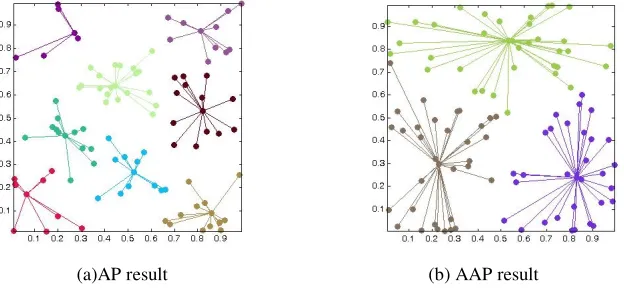
Firstly, we do clustering on two-dimensional point set. Figure 1(a) is the AP clustering result, the point set was divided into 8 regions, looks very messy, do not accord with people's intuitive sense. Figure 1(b) is our algorithm’s(AAP) result, the point set was divided into three regions, more consistent with the human sense, a more rational classification result.
[image:3.612.152.464.377.522.2](a)AP result (b) AAP result Figure 1. The clustering results of point set.
Secondly, we use AAP to do image segmentation expriment. The image databases are download from website of James Z. Wang[3]. It contains 1000 images including africans, beach, architecture, buses, baboons, elephants, flowers, horses, mountain, foods, total 10 categories and each category of 100 images.
(a) image of bus (b) K-Means (c) FCM (d) AAP Figure 2. The segmentation results of bus image.
[image:4.612.209.399.351.503.2](a) image of baboon (b) K-Means (c) FCM (d) AAP Figure 3. the segmentation results of baboon image.
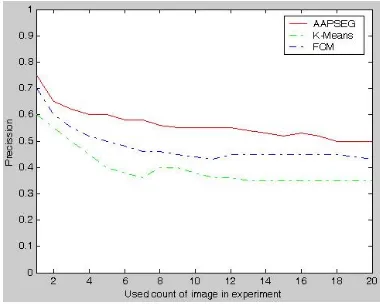
Figure 4 shows efficiency result of image segmentation based on K-Means, FCM and AAP. The result indicated that AAP is more robust than K-Means and FCM clustering algorithm for image segmentation.
Figure 4. Compare efficiency of K-Means, FCM and AAP.
Acknowledgement
This paper was supported by technological innovation project of Suzhou science and Technology Bureau (SNG2017056, SNG2017058), the Scientific research fund for young teachers of Suzhou Polytechnic Institute of Agriculture (KYPY201702, PPN201511) , Qinglan Project of JPDE (Jiangsu Provincial Department of Education) and Jiangsu Overseas Research & Training Program for University Prominent Young & Middle-aged Teachers and Presidents.
References
[3] James. Z. Wang. http://wang.ist.psu.edu/IMAGE/.
[4] Singla Anshu, Patra Swarnajyoti. A fast automatic optimal threshold selection technique for image segmentation[J]. Signal Image and Video Processing, 2017, Vol. 11(2):243-250.
[5] Saladi, Saritha, Prabha Amutha. A Comprehensive Review: Segmentation of MRI Images-Brain Tumor. 2016, Vol. 26(4):295-304.