Journal of Electrical and Electronic Engineering
2015; 3(1): 1-5Published online January 19, 2015 (http://www.sciencepublishinggroup.com/j/jeee) doi: 10.11648/j.jeee.20150301.11
ISSN: 2329-1613 (Print); ISSN: 2329-1605 (Online)
Improved fuzzy c-means algorithm for image segmentation
Xuegang Hu
1, 2, Lei Li
11
College of Computer Science and Technology, Chongqing University of Posts and Telecommunications, Chongqing, China 2
Research Center of System Science, Chongqing University of Posts and Telecommunications, Chongqing, China
Email address:
[email protected] (Lei Li), [email protected] (Xuegang Hu)
To cite this article:
Xuegang Hu, Lei Li. Improved Fuzzy C-Means Algorithm for Image Segmentation. Journal of Electrical and Electronic Engineering. Vol. 3, No. 1, 2015, pp. 1-5. doi: 10.11648/j.jeee.20150301.11
Abstract:
In order to preserve more image details and enhance its robustness to noise for image segmentation, an improved fuzzy c-means algorithm (FCM) for image segmentation is presented by incorporating the local spatial information and gray level information in this paper. The modified membership function and clustering center function are more mathematically reasonable than those of the FLICM, so the iterative sequence can converge to a local minimum value of the improved objective function. The new fuzzy factor grants the algorithm a novel balance between robustness to noise and effectiveness of preserving the details. The revised algorithm flow has significantly accelerated the processing procedure. Through these improvements, the experiments on the artificial and real images show that the proposed algorithm is very effective.Keywords:
Clustering, Image Segmentation, Fuzzy C-Means, Local Minimum Value, Gray Level Information1. Introduction
Image segmentation plays an important role in a variety of applications such as machine vision, image analysis and image understanding, so it is a hot topic in image processing in recent years [1]. Currently, the methods of image segmentation are broadly divided into four categories: threshold, clustering, edge detection and region extraction. Among the clustering-based methods, the fuzzy c-means algorithm (FCM) is one of the most popular methods of image segmentation, which was firstly proposed by Dunn [2] and improved later by many other scholars [3]. But the classic FCM algorithm and its improved ones are not suitable for images corrupted by noise, outliers and other imaging artifacts [4].
In recent years, incorporating local spatial information and gray level information to compensate the drawback above mentioned is becoming more and more popular. By introducing local spatial information in the objective function of the FCM, Ahmed et al. proposed an improved FCM algorithm (FCM_S) [5]. The main advantage of this method is good performance of noise-immunity, but the disadvantage is summarized as follows: First, the method lacks sufficient robustness to noise. Second, it can’t present a non-Euclidean structure of the image data. Finally, it increases running time. Tolias et al. imposed space constraints on clustering results to modify the objective function of FCM and obtained some positive effects [6]. Pham introduced space term into the
objective function of the FCM and significantly improved its noise-immunity capability [7]. In order to improve the anti-noise performance, robustness and reduce the processing time, Chen and Zhang proposed FCM_S1 and FCM_S2 based on FCM_S [8]. But the disadvantage is summarized as follows: it firstly lacks some robustness to noise and image speckle, it then needs some parameters chosen empirically, so it limits its application. Finally, the processing time depends on the size of the segmented image. To solvethe above problems, Cai et al.
information, it ignores the relationship between the central pixel and its neighbor pixels. In 2013, Gong et al. further introduced weigh factors and nuclear distance parameters into its objective function and proposed the KWFLICM algorithm, this method have improved the segmentation results [13], but its processing time is significantly higher than that of the RFLICM.
To further improve the accuracy of image segmentation and reduce time consumption, using the new constraint factor instead of fuzzy constraint factor of the FLICM, we presented an improved fuzzy c-means algorithm for image segmentation. This algorithm enhances its robustness to noise and preserves more image details for image segmentation. Experimental results have showed that this method can quickly and accurately segment images such as synthetic and natural images, which has good anti-noise performance at the same time.
The rest of this paper is organized as follows. In Section2, the classical fuzzy c-means clustering algorithm is briefly described. The proposed algorithm and our motivation are introduced in Section 3. Experimental results have showed in Section 4.Conclusions will be drawn finally.
2. Fuzzy C-Means Algorithm
The FCM algorithm for image segmentation is a clustering algorithm based on the most optimal function, its objective function is as follows
2
1 1
( , )
= =
=
∑∑
N c mm ji i j
i j
J u d x v , (1)
where
{
1, 2, ,}
N D NX = x x ⋯ x ⊆R × is the dataset in the
images to be segmented. vj denotes the center value of cluster j. 2
( ,i j)
d x v stands for a distance measure between dataset xi
and cluster center vj. N is the number of gray levels of the
image. c is the number of clusters with 2≤c<N. The parameter
m determines the amount of fuzziness of the result classification between 1.5 and 2.5 [14], uji is the degree of
membership of xi in the jth cluster satisfying
{
}
1
1, 1, 2, ,
c ji j
u i N
=
= ∀ ∈
∑
⋯ . (2)To calculate the possible extremum according to (2), an Euler-Lagrange function is used as follows
2
( , ) 1
1 1 1
∑ ∑ ∑ = − + − = = =
N c m c
L u v u x v u
ji j ji i j i ji
i j j
λ ,
where λi is a parameter. And we can obtain the one order
partial derivative of uji and vj. According to (2), the values of
membership and cluster centers can be calculated as follows
( ) 2/ 1 1
1
m C i j jik i k
x
v
u
x
v
− ∗ =
−
=
−
∑
(3) and1 1
N N
m m
j ji i ji
i i
v
∗u x
u
= =
=
∑
∑
. (4)The classical FCM algorithm can acquire good segmentation effect, but it is very sensitive to noise. Therefore, many scholars are developing its anti-noise capability.
3. Fuzzy Local Information C- Means
Cluster Algorithm
Because the classical FCM algorithm only considers the gray value of pixels and doesn’t take into account the relationship between the center pixel and its neighbors. So it is not suitable for images corrupted by noise. The FLICM algorithm takes advantage of neighborhood information, which has some anti-noise performance. It not only reduces the accuracy of the FCM algorithm, but also exists some mathematically unreasonable functions. Motived by these considerations, we propose a modified method by reducing fuzzy constraint factor values of the FLICM to enhance the accuracy of image segmentation, so we can get a new balance between robustness to noise and effectiveness of preserving the details. The new algorithm’s objective function is defined as follows
(
)
( ) 2 1 2 1 1 1 1 1 = − − = ∈ ≠ = ∑ ∑ = = ∑ − + + ∑
∑
d pl jl l i x v d m mji il jl jp
l p N ip
p i
N c
J m
i j
u x v u e
d
δ , (5)
where d denotes the image dimension. dip is the spatial
Euclidean distance between pixels i and j. xpl is the
neighborhood information of data item xil. ujprepresents the
fuzzy membership of the jth pixel lying within a window around xil with respect to cluster j, Ni is the dataset of
neighbors falling into a window around xil. δ is a distance
variance that denotes the degree of aggregation around the cluster. Its definition shows as follows
(
)
1 2 2 1 1 1 N i i d d Nδ
= = − − ∑
.Where di= xil−x , it is the distance from data item xil to
the mean value of all pixels falling into the window. The mean distance of di is 1
N i i
d=
∑
=d N.To calculate the possible extremum according to (2), an Euler-Lagrange function is used as follows
(
)
2( , )
1 1 1
N C m d
L u v u x v
ji j ji il jl
i j l
= ∑ ∑ ∑ − +
= = =
Journal of Electrical and Electronic Engineering 2015; 3(1): 1-5 3
2
1 1
exp 1
1 1
, 1
− − + −
∑ ∑ = ∑
+
∈ ≠ ip =
C
m d
u x v u
l
jp pl jl i ji
d
p N p i j
i
λ
δ ,
we can obtain the one order partial derivative of uji and vj. Let
= 0 and, = 0 we have
2 1
0
m
ji i j i
ji
L
mu x v
u λ
−
∂ = − − =
∂
and
(
)
21 1
0 1
1
− −
∈ ≠
∂ = − + − =
∑
∂ = +
∑
p ji
x v m
jp p j
p N ip p i N
L um v x u x v e
ji j i
v i d
jl
δ
δ .
According to (2), the values of membership and cluster centers can be calculated as follows
2 1 *
2
1 1
1
m C
i j
ji
k m
i k
x v
u
x v
−
= −
− =
−
∑
(6)and
2
2 1
*
1
1 1 1
1 1 1
p l
i
p l
i
x v N
m m
ji i p jp
i p N ip
p i j
x v N
m m
ji jp
i p N ip
p i
u x x u e
d v
u u e
d
δ
δ
δ
δ
− −
= ∈
≠
− −
= ∈
≠
−
+
=
−
+
∑
∑
∑
∑
. (7)
Thus, the above algorithm is summarized as follows Step 1: Fix the number m, ε, and c.
Step 2: Initialize the clustering center and calculate the initial membership matrix as described in Eq. (3).
Step 3: Set the loop counter b=0.
Step 4: Calculate the membership matrix as described in Eq. (6).
Step 5: Update the clustering center as described in Eq. (7). Step 6: If max{Vnew-Vold}<ε then stop, otherwise, set b=b+1
and go tostep 4.
4. Experimental Results and Analysis
In this section, we compare the accuracy, the efficiency and the robustness to noise of our algorithm with the FLICM algorithm. In the experiments, the code of the FLICM was provided by the authors.
Fig. 1 shows a synthetic image Synthetic’s segmentation effect after mixed Speckle noise, the noise level is 15%. The size of Synthetic is 256*256 pixels. The gray level value of the left is 20, and the right is 120. We generally set the parameters to be =2c ,
5
=10
ε
−,m=1.7.
Although the two algorithms worked well in the segmentation experiment, we still found that there are more “glitches” in Fig. 1 (c) than that in Fig. 1 (d). According to Fig. 1, we know that our method achieves better performance
under Speckle noises than FLICM.
(a) (b)
(c) (d)
Fig. 1. Segmentation results on Synthetic image. (a) Original image, (b) the same image corrupted by the Speckle noise (0.15), (c) FLICM result, (d) our result.
(a) (b)
(c) (d)
(e) (f)
Fig. 2 presents a comparison of segmentation real image. In this experiment, the Cameraman divided into four categories-coats, trousers, So the parameters was set to be c=4, =10ε
In Fig. 2 (b), an obviously false segmentation found on the right side, which should be information misclassified to another clustering, such a mistake in Fig. 2 (c). On the other preserves more details than Fig. 2 (b) such as edge of face. Due to the noise, the effect on But Fig. 2 (f) shows that the result from our clearer edge and smoother regions while added noises. This experiment suggests that
algorithm can accurately segment images. Furthermore, good anti-noise performance at the same time.
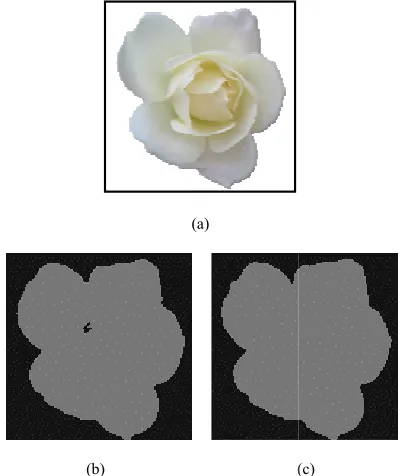
Fig. 3 presents a comparison of segmentation nature image. In this experiment, the Flower divided into two categories-flower and background. parameters was set to be
c
=2
,ε=10−5 and(a)
(b) (c)
Fig. 3. Segmentation results on Flower image. (a) Original result, (c) our result.
In Fig. 3 (b), an obvious area is divided belonging to the flower area. But Fig. 3 (c) generated. So our algorithm achieves better effect than the FLICM.
Furthermore, Fig. 4 shows some segmentation real images. The left column shows the while the right column shows the segmentation obtained by the proposed algorithm.
Celik et al. found thatthe iterative sequen can’t mathematically achieve to converge because of the improper membership function center function [11], although it achieve result. In this paper, we have modified those mathematical means. This is the main
segmentation results on a Cameraman image was trousers, skin and others.
5
=10− and m=1.7. segmentation area can be
a part of the sky clustering, and there is no other hand, Fig. 2 (c) as the hand and the on Fig. 2 (e) is poor. our method has much while clearing almost that our proposed Furthermore, it has time.
segmentation results on a Flower image was background. So the
d
m
=1.7
.(b) (c)
Original image, (b) FLICM
to the wrong area (c) avoids this error better segmentation
segmentation results on the original images, segmentation results which
sequence of the FLICM converge to a local minim function and clustering achieve good clustering those functions by reason why the
proposed algorithm achieves better the FLICM.
Fig. 4. Segmentation results on real
Finally, Table 1 shows the comparison on different size images using
algorithm. In this experiments, parameters to be
c
=
3
max
Iter
=
300
.Table 1. Running Time (in sec
200*200 300*300
FLICM 23.5 27.6
Our method 12.6 13.4
All experiments performed on Dual Core Processor 5400+ (2.8 Windows 7 Ultimate using MATLAB running time is shown above,
better segmentation effect than
real images by the proposed algorithm
comparison of the running time the FLICM and our proposed experiments, we generally set the
, 3
10
ε
= −,
m
=
2
andseconds) of the Two Algorithms
300*300 600*600 1024*1024
155.8 592.1
84.1 164.9
Journal of Electrical and Electronic Engineering 2015; 3(1): 1-5 5
than FLICM, especially, when the size of image is 1024*1024 pixels, the consumption time is only 27% of that of FLICM computed. This must owe to the novel algorithm flow. We initialize the membership matrix using Eq. (3) instead of initializing randomly it, so the value of initial membership matrix is more approximate to the final value. This modification has greatly decreased the iterative numbers.
5. Conclusions
In this paper, an improved algorithm based on FCM is proposed by modifying the fuzzy factor FLICM used. Through this way, we get a novel balance between robustness to noise and effectiveness of preserving the details. The results reported in this paper show that our method is effective to synthetic images, real images and nature images. The experiment results suggest that the proposed algorithm obviously improves the performance of image segmentation, which has good anti-noise performance at the same time.
So the major advantages of the proposed algorithm over the FLICM are summarized as follows:
Its computational time is less; It preserves more image details;
Its iterative functions are more mathematically reasonable.
Acknowledgements
The author would like to thank Dr. Krinidis for providing FLICM source codes for comparison, and the anonymous reviewers for their constructive comments.
References
[1] X. Muñoz, J. Freixenet, X. Cufı, et al, “Strategies for image segmentation combining region and boundary information,” Pattern recognition letters vol. 24, no. 1, pp. 375-392. [2] J. Dunn, “A fuzzy relative of the ISO-DATA process and its use
in detecting compact well separated clusters,” J. Cybern., vol. 3, no. 3, pp. 32-57, 1974.
[3] J. Bezdek, “Pattern recognition with fuzzy objective function algorithms,” New York: Plenum, 1981.
[4] Y. Liu, X. Wang, H. Yu, W. Zhang, “Brain tumor segmentation based on morphological multiscale modification and fuzzy c-means clustering,” Journal of Computer Applications, vol. 34, no. 9, pp. 2711-2715, 2014.
[5] M. Ahmed, S. Yamany, N. Mohamed, et al, “A modified fuzzy c-means algorithm for bias field estimation and segmentation of MRI data,” IEEE Trans. Med. Imag., vol. 21, no. 3, pp. 193-199, 2002.
[6] Y. Tolias and S. Panas, “Image segmentation by a fuzzy clustering algorithm using adaptive spatially constrained membership functions,” IEEE Trans. Syst., Man, Cybern., vol. 28, no. 3, pp. 359-369, Mar. 1998.
[7] D. Pham, “Fuzzy clustering with spatial constraints,” in Proc. Int. Conf. Image Processing. New Work, 2002, vol. Ⅱ, pp. 65-68.
[8] S. Chen, D. Zhang, “Robust image segmentation using FCM with spatial constraints based on new kernel-induced distance measure,” IEEE Trans. Syst., Man, Cybern., vol. 34, pp. 1907-1916, 2004.
[9] W. Cai, S. Chen, D. Zhang, “Fast and robust fuzzy c-means clustering algorithms incorporating local information for image segmentation,” Pattern Recognition, vol. 40, no. 3, pp. 825-838, Mar. 2007.
[10] S. Krinidis and V. Chatzis, “A robust fuzzy local information C-means clustering algorithm,” IEEE Trans. Image Process., vol. 19, no. 5, pp. 1328-1337, May 2010.
[11] T. Celik and H. Lee, “Comments on “A Robust Fuzzy Local Information C-Means Clustering Algorithm”,” IEEE Trans. Image Process, vol. 22, no. 3, pp. 1258-1261, 2013.
[12] M. Gong, Z. Zhou, J. Ma, “Change detection in synthetic aperture radar images based on image fusion and fuzzy clustering,” IEEE Trans. Image Process, vol. 21, no. 4, pp. 2141-2151, 2012.
[13] M. Gong, Y. Liang, J. Shi, et al, “Fuzzy c-means clustering with local information and kernel metric for image segmentation,” IEEE Trans. Image Process, vol. 22, no. 2, pp. 573-584, 2013.