2017 International Conference on Electronic and Information Technology (ICEIT 2017) ISBN: 978-1-60595-526-1
A Plural CDMA System with Zero Correlation Zone Codes in
Emergency Communication
Jin-cheng HUANG
1,a,*, Ya-heng ZHANG
1, Rui CAO
1, Gang ZHOU
1,
Yuan MA
1and Ze-ming DONG
21
Department of Information Engineering, Yancheng Institute of Technology, No.1 Middle Xiwang Avenue, Yancheng, Jiangsu Province 224051, P.R.China
2
Yamaguchi University, 2-16-1 Tokiwadai, Ube, Yamaguchi, 755-8611, Japan
a
*Corresponding author
Keywords: Emergency communication, ZCZ codes, CDMA.
Abstract. This paper proposes a plural ZCZ-CDMA system with binary frequency keying modulation. It is shown that this system achieves more advantageous bit error rate characteristics over Rayleigh fading channels than those of ASK or BPSK modulation scheme and have more advantageous for comprehensive spectral efficiency than BFSK modulation scheme. From the viewpoints of further improving their error rate performance over Rayleigh fading channel, this research on BFSK is conducted while introducing new techniques such as use of fading-independency between two keying frequencies to which a pair of balanced ZCZ sequences is allocated, and use of combining techniques with two demodulated outputs obtained by the two ZCZ sequences. Performance formulation and simulation on the proposed system are conducted under the comparison with the other ZCZ-CDMA systems or CDMA systems using the other codes. It will be proved that considerable improvement is achieved with the proposed system.
Introduction
Emergency communication technologies which bear construction of Ubiquitous Networking have been developed and applied in various application fields [1]. Wi-Fi, Zigbee, Bluetooth, ultra-wideband (UWB) are popular wireless standards for short-range communications [2]. Wi-Fi links two or more devices such as PC and PDA providing a connection through an access point to the Internet. Zigbee flexibly constructs a wireless sensor network among fixed communication devices. Bluetooth and UWB are respectively used for communication of sound and text data between electronics equipment such as mobile phone, PHS, and PDA, and for the high-speed transmission of the mass data such as images in a short distance within 10m.
There are potential technical features in CDMA systems using Zero Correlation Zone (ZCZ) codes called ZCZ-CDMA systems, possesses excellent properties, such as co-channel interference free operation with quasi-synchronous reception, synchronization capability with fast frame acquisition, and simplified hardware design. These includes ZCZ-CDMA systems with ASK modulation and BPSK, which called ASK-ZCZ-CDMA and BPSK-ZCZ-CDMA, respectively [4].
This paper propose a plural ZCZ-CDMA system with binary frequency shift keying (BFSK) modulation called plural BFSK-ZCZ-CDMA that one bit information is included in both of two carrier frequencies. It will be proved that considerable improvement is achieved with the proposed system.
ZCZ Codes
In this section, the practicable ZCZ codes for each modulation scheme are described together [5]. Let A be a set of bi-phase sequences with length N and the family size M, defined by − ∈ … … = =
−), {1, 1}.
, , , , , ( }, , , , , { 1 1 0 2 1 k i k N k i k k k M k a a a a a a a a a a A (1) The periodic correction function between sequences akandamat shifts τ is defined by
∑
− = + = 1 0 mod ) ( ) ( N i m N i k i aa a a
Rk m τ τ
. (2) If periodic auto/cross-correlation functions for the set satisfy the following conditions at both sides of the zero-shift, that is
≤ ≤ = ≠ = = = , | | 1 0 , 0 , 0 , 0 , ) ( cz a a Z m k m k N
Rk m
τ τ τ τ
(3) the set is called a ZCZ set.
ZCZ sets are families of sequences, whose periodic auto/cross-correlation functions have zero correlation zones at both sides of the zero-shift and a ZCZ set can be defined byA(N,M,Z). From the discussion of orthogonal nature, it can be easily shown that binary ZCZ sets are bounded by
1 + ≤ cz Z N M
. (4) When Zcz=1, this expression may achieve the upper bound only.
Let Aˆ be a set of K (K<M) pairs of sequences with length N, ( k
aˆ
,bˆk), where Aˆ defined by
{
(ˆ,ˆ),(ˆ,ˆ), ,(ˆ,ˆ), (ˆ ,ˆ)}
ˆ 1 1 2 2 k k K K
b a b a b a b a A=
, (5)
where k
aˆ denotes a balanced bi-phase sequence with ˆ ∈{1,−1}
k i
a
and
∑
−
= =
1 0 ˆ 0
N i k i a and k i bˆ a
2 1 ˆ ˆ }, 1 , 0 { ˆ ), ˆ , , ˆ , ˆ ( ˆ 1 1 0 + = ∈ … = − k i k i k i k N k k k a b b b b b b
, (6) and the periodic correction function between sequences aˆkand m
bˆ at shifts τ satisfies the following conditions: ≤ ≤ = ≠ = = = . | | 1 0 , 0 , 0 , 0 , 2 / ) ( ˆ ˆ cz b a Z m k m k N R m k τ τ τ τ (7) The set A is a ZCZ codes set for BPSK and Aˆ is a ZCZ codes set for ASK and BFSK. In this section, the well-known ZCZ set (2n1,2n,1)
A + is described. In the case of this set, in order to maximize the number of users, a value of Zcz=1 is enough for middle-low speed Wireless communications. Hadamard matrices with Sylvester's construction are defined by
] 1 [ , 0 1 1 1 1 = − = − − − − H H H H H H m m m m m
, (8) and the length of the matrices is2m×2m.
It follows the definition that a Hadamard matrix Hm of order
m
2 satisfies
m m m T
mH E
H =2 and
m
E is an identity matrix. ZCZ setA(2n+1,2n,1)can be expressed by
− − = − − − 1 0 1 1 0 1 1 , 1 1 2 3 2 1 1 n n H H a a a a n
. (9) ZCZ set ˆ(2n+1,2n − 2,1)
A is a matrix that removes the first and second rows
fromA(2n+1,2n,1).
Model of Plural CDMA System
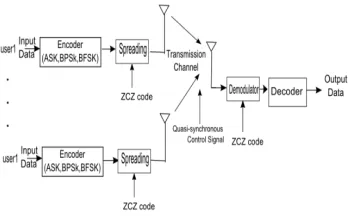
This section introduces a basic model of ZCZ-CDMA systems [6], which may be applied to quasi-synchronous systems. In these quasi-synchronous systems, the asynchronous mode is applied when there is a need to maintain the relative synchronicity in the time delay between the signals of different users with Zcz. Fig. 1shows a block diagram of ZCZ-CDMA systems. At a transmitter, an extended ZCZ sequence a~ or k b~kwith length N + 2Zcz which is made by adding respective guard
sequences to the both side of core-sequence k
aˆ in A of Eq. 1 or k
bˆ in Aˆ of Eq. 5 is
prepared as follows,
(
k)
Z k k N k i k k k N k Z N k k Z k k N k i k k k N k Z N k cz cz cz cz b b b b b b b b b a a a a a a a a a 1 0 1 1 0 1 1 0 1 1 0 1 , , , , , , , , , , , ~ , , , , , , , , , , , ~ − − − − − − − − … … … … = … … … … =
less than or equal to Zcz. In this paper, in order to maximize the number of users, a value of Zcz= 1 is chosen that is sufficient to guard such delayed waves as to take place in short-range wireless communications.
Each transmitter simultaneously sends the spread data symbol at a timing designated by a timing control signal supplied by a control station. A receiver receives a faded signal consisting of symbols sent by K users with additive white Gaussian noise. A soft output to be used for detecting the data is obtained by taking correlation between the received signal and a desired user sequence akor aˆ . The receiver may use the timing k
[image:4.612.216.390.198.306.2]control signal to detect data frame synchronization quickly.
Figure 1. A block diagram of ZCZ-CDMA systems.
Since BFSK uses ZCZ code with half a code-length as compared to that of BPSK or ASK, the number of available BFSK users who enjoy interference-free operation must be a half as many as that for BPSK or ASK systems. One can understand it by referring to the family size given by Eq. 4 Therefore, the overall spectral efficiency of BFSK is forced to reduce to an about half as compared to that of BPSK or ASK.
Figure 2. Frequency spectra of plural CDMA system.
For an object of designing a low transmit-power system, BFSK provides a useful solution for a case of not making much of the whole spectral efficiency. As another way, consider accommodating m*K users with m BFSK-ZCZ-CDMA, which use 2*m
keying frequencies fi (i = 1, 2, 3, ..., 2m). In the case of m = 2, a frequency arrangement can be designed such that one system uses f1, f2; the other system uses f1, f3 in an interleaved fashion, resulting in larger frequency difference between two spread components.
This design method may be achieved by selecting parameters such as code length, according to the user population while occupying the same bandwidth.
[image:4.612.202.408.422.498.2]Simulation
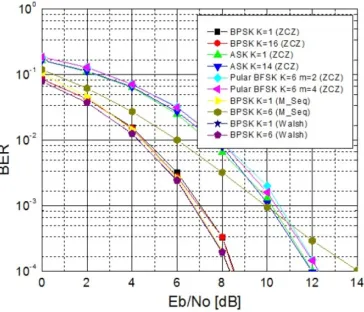
[image:5.612.216.398.219.375.2]Simulation of BER Performance is conducted, not only CDMA systems with ZCZ codes, but also CDMA systems using Walsh code (Walsh-CDMA) and M-sequence (M-CDMA), respectively. For a fair comparison, respective symbols made of M sequence or Walsh code are composed of such extended sequences with guard chips as those used for symbols of ZCZ-CDMA systems. The system parameters are shown in Table 1 where all the systems operate on a condition that the carrier is synchronized and the symbol timing is quasi-synchronized or synchronized. The Family size of M sequence is here counted so as to include an original sequence and all of the shifted sequences which are made by shifting the original sequence by two chips in turn.
Figure 3. BER performance over AWGN channel.
The BER characteristics over AWGN channel are shown in Fig. 3. It is observed that the BER characteristics of Plural BFSK-ZCZ-CDMA are slightly worse than that of ASK-ZCZ-CDMA and almost the same as those of BPSK-ZCZ-CDMA or Walsh-CDMA. ZCZ-CDMA and Walsh-CDMA achieve almost interference-free operation, even if the number of users K or m*K increases. However, the M-CDMA
[image:5.612.215.388.485.645.2]is affected by co-channel interference.
Figure 4. BER performance over AWGN channel.
look similar, while those of BPSK-ZCZ-CDMA appear much better due to the antipodal modulation than those of plural BFSK-ZCZCDMA or ASK-ZCZ-CDMA, and all of their characteristics are not affected by Rayleigh fading with 2-path channels, more advantageous BER characteristics of plural BFSK-ZCZ-CDMA are observed than those of BPSK-ZCZ-CDMA. One can find that MRC provides much better BER performance than that SC. Since combining technique can be effectively applied to plural BFSK and the frequency diversity effect is enhanced.
The bit rate of plural BFSK-ZCZ-CDMA is slightly lower than that of BPSK-ZCZ-CDMA and ASK-ZCZ-CDMA, because spread symbol of BFSK is two chips longer than that of BPSK-ZCZ-CDMA or ASK-ZCZ-CDMA. However, this slightly less value can be ignored by an example. In order to get a BER of 10-3, BPSK requires Eb=No of 20.5 dB; in contrast, plural BFSK with SC and MRC requires 16 and 14 dB, respectively. It is shown that such a large amount of transmit power as 4.5 or 6.5 dB can be saved.
Summary
Plural CDMA systems which achieve more advantageous bit error rate characteristics over Rayleigh fading channels than those of ASK or BPSK modulation scheme and have more advantageous for comprehensive spectral efficiency than BFSK modulation scheme are here proposed, and the Bit Error Rate performance is analyzed together with BPSK-ZCZ-CDMA and ASK-ZCZ-CDMA systems. BFSK modulation indicates much more robust anti-fading performance when mutually independent fading distributions on two adjacent carrier frequencies can be observed.
Acknowledgement
This work was supported by the Scientific Research Foundation of Jiang Su Industry-University-Research Collaboration under the Grant No. BY2016065-02 and the Project Sponsored by the Scientific Research Foundation for the Returned Overseas Chinese Scholars, State Education Ministry under the Grant No.14KJB430023.
References
[1] K. Karamitsios, T. Orphanoudakis, Efficient IoT Data Aggregation for Connected Health Applications, ISCC 2017, pp. 1182-1185.
[2] Alan. B, Short-Range Wireless Communication: Fundamentals of RF System Design and Application, 2nd dd., Newnes, 2003.
[3] P. Z. Fan, L. Hao, Generalized Orthogonal Sequences and Their Applications in Synchronous CDMA Systems, IIEICE Trans. Fundamentals, E83-A, No.11 (2000) 2054-2069.
[4] S. Matsufuji, T. Matsumoto, T. Hayashida, T. Hayashi, N. Kuroyanagi, P. Z. Fan, On a ZCZ Code Including a Sequence Used for a Synchronization Symbol,IEICE Trans. Fundamentals, E93-A, No. 11 (2010) 2286-2290.