Load Flow Analysis Framework for Active Distribution
Networks Based on Smart Meter Reading System
Merkebu Zenebe Degefa, Robert John Millar, Matti Koivisto, Muhammad Humayun, Matti Lehtonen Department of Electrical Engineering, Aalto University, Espoo, Finland
Email: [email protected];[email protected]; [email protected]; [email protected]; [email protected]
Received June 16, 2013; revised July 13, 2013; accepted July 20,2013
Copyright © 2013 Merkebu Zenebe Degefa et al. This is an open access article distributed under the Creative Commons Attribution License, which permits unrestricted use, distribution, and reproduction in any medium, provided the original work is properly cited.
ABSTRACT
With the expansion of distributed generation systems and demand response programs, the need to fully utilize distribu- tion system capacity has increased. In addition, the potential bidirectional flow of power on distribution networks de- mands voltage visibility and control at all voltage levels. Distribution system state estimations, however, have tradition- ally been less prioritized due to the lack of enough measurement points while being the major role player in knowing the real-time system states of active distribution networks. The advent of smart meters at LV loads, on the other hand, is giving relief to this shortcoming. This study explores the potential of bottom up load flow analysis based on customer level Automatic Meter Reading (AMRs) to compute short time forecasts of demands and distribution network system states. A state estimation frame-work, which makes use of available AMR data, is proposed and discussed.
Keywords: Active Network; Demand Response; Dynamic Rating; Load Forecast; Load Modeling; Smart Meter; State Estimation
1. Introduction
Distribution system state estimation provides the real- time system states to a Distribution Management System (DMS) enabling operators to monitor and control the operation of the distribution system. With the transfor- mation of distribution networks from passive networks to active networks, following widespread installations of Distributed Generation (DG) and Smart Metering (SM) technologies, the state estimation tool is becoming a core component. In fact, this tool has been used widely and for a long time with transmission systems. The utilization of the tool in distribution systems has been lagging due to two reasons: the first was the absence of widespread measurement, in distribution networks and the second is the low need for active management of the distribution network. Nowadays, however, smart meters are being installed down to the customer level opening up the net- work for more visibility. Nowadays, for effective DG and demand response applications, knowledge and regu- lation of voltage levels at every node of the active net- works is becoming crucial [1-3]. In addition, state esti- mation has a central benefit in enabling the full utiliza- tion of distribution system capacity [4].
A load modeling procedure is a requirement of any
distribution circuit state estimator. Load modeling tech- niques provide real-time estimates of customer load de- mands.
There has also been the emergence of innovative ideas from power load serving entities to increase efficiency, utilize assets to their utmost, and provide targeted cus- tomer services. The consequent impacts on feeder level load profile and diversity, however, are not known yet. The question of how far the peak load can be brought down still needs addressing. Therefore, the empirically driven, non-interactive load models need to give way to sophisticated models that simulate the independent be- havior of those components that contribute to the feeder load shape [5].
With the expansion of ICT infrastructure and the ad- vent of smart meters, network information such as con- nectivity and measurement data are assumed to be read- ily available in real time. Therefore, a load flow analysis can effectively utilize both the component based and measurement based load modeling outputs as shown in
Figure 1.
compared. This paper formulates and proposes a distri- bution system load modeling framework based on AMR metered consumption data. The potential of detailed cus- tomer level load modeling built up from component modeling is discussed.
This paper presents observations from the application of the three building blocks of an active distribution network state estimation framework as shown in Figure 1. Section 2 presents the load modeling techniques and their relevance in today’s active distribution network. Section 3 presents the test network used in this study, which has the topology and configuration of a typical Finnish sub-urban distribution network. The ARX model- based one day ahead load forecasting is explained in Section 4. Section 5 formulates and applies a simple AMR metering based load flow analysis technique and the last section will conclude the findings.
2. Load Modeling
In practice, domestic smart meters do not transmit data immediately after measurement or on an hourly basis, at least at the time of this study. State estimation is there- fore most likely to depend on the previous day’s meas- urement, requiring the application of very short time load forecasting, especially for the next day. Before perform- ing a load flow analysis or any sort of load estimation and forecasting, one has to model the consumer load. The term “load model” is, however, used both for component based and measurement based load models of the distri- bution system. Before continuing, we would like to clar- ify these definitions.
2.1. Component Based Load Modeling
This models customer loads as different component based load types explaining the relationship between the
Measurement based modelling Measurement
database
Customer type
Load flow analysis
Customer connectivity Component
based load modeling
Pt-1, Qt-1
Pt, Qt n
Pt,n, Qt,n Vn, dn Z%, I%, P%
AMR
Figure 1. A state estimation framework for an active dis- tribution network.
power, voltage and current [6,7]. It is usually referred to as a ZIP model, with constant Impedance (Z), Current (I) or Power (P). This modeling technique is explained and formulated in Table 1. In fact, the ZIP model may also be expanded by adding an exponential load type, where the load power varies with the voltage magnitude in an exponential relationship. The general voltage-load cur- rent characteristic is plotted in Figure 2.
[image:2.595.308.539.279.719.2]According to [7], residential areas have a ratio of con- stant power/constant impedance of 70/30 in strong sum- mer peaking and 30/70 in winter peaking days. In the coming sections the component based modeling used in the load flow analysis is presented. Section 3 presents the component load model of a typical Finnish household.
Table 1. Component based load modeling [6].
2 1.3
1 2 3
o o
PP a a Va V a V 8
2 1.38
1 2 3
o o
QQ b bVb V b V
1 2 3 1 2 3 1
o o
a a a a b b b b
Type Explanation Example loads
Constant Impedance (constant Z)
The load power varies with the square of the voltage magnitude
o a ,bo
Electric heating Incandescent lighting
Resistive water heater Stovetop Oven cooking
Constant current (constant I)
The load power varies with the voltage magnitude
only
2
a ,b2
Fluorescent lighting Welding units
Smelting Electroplating
processes
Constant power (constant P and Q)
The load power doesn’t vary with
the voltage magnitude. Voltage *
current = const 2
a ,b2
Electric motors Regulated power
[image:2.595.58.285.530.707.2]supplies
2.2. Measurement Based Load Modeling
This establishes a relationship between certain inde- pendent variables such as weather conditions, the day type and the total load. It aims to extract regression coef- ficients from static past data for possible future forecast- ing. These models could also incorporate dynamic be- havior such as in ARMAX (Auto Regressive Moving Average and Explanatory variable (X)). The multiple regressions in (1) explain the formulation of such mod- eling [8].
t t t
S c x t (1)
where
t
t sampling time,
S measured system load data,
t
x vector of adapted variables such as time, tempera- ture, light intensity, wind speed, humidity, day type (workday, weekend), etc.,
t
c regression coefficients, and
t
model error at time t.
Households belonging to the direct electric heating group, for instance, will have different regression coeffi- cients to those belonging to the district heating group. The target of this load modeling type is estimating un- measured load points based on statistical information and other variable measurements, or forecasting future load. A pure time series model with no additional explanatory variables is proposed in [9], as shown in (2).
before before
1,today
,today ,day
1,day
i i
i kWh
kWh kWh
kWh
i (2)
The model in (2) requires the past hour consumption of customer i. Smart meters, however, collect electricity consumption data at half hour or one hour intervals and this metering data will be sent to the utility the following day. The model proposed in [9] would not be practical in today’s infrastructure. With one day data delay other time series models such as Autoregressive Moving-Av- erage (ARMA) and Autoregressive Integrated Moving- Average (ARIMA) will also fail to keep up with the dy- namism of the load [8]. These models start to lose their relevance as they tend to depend on their own previous hour estimations. We applied the ARX (Auto Regressive with eXogeneous input) model, which utilizes previous day AMR metered consumption data as well as same day explanatory variables such as temperature, day structure, humidity, etc. Section 4 presents the detailed formulation of the ARX model.
2.3. The State Estimation Framework
The state estimation framework presented in Figure1
consists of three fundamental functions: the measurement based modeling, the component based modeling and the
load flow analysis. The measurement based modeling explained in Section 2.2 provides real time or near future forecasts of the loading situation while the component based modeling in Section 2.1 is used to undertake an effective and detailed load flow analysis by translating nodal power demand to voltage magnitude and phase (see Figure 1). Not being limited to hourly metered household consumption the framework in Figure 1 pro- poses a more detailed load flow analysis based on com- ponent level consumptions. The load-voltage characteris- tics will be comprehensive in including the special char- acteristics of certain load types with voltage; besides, the disaggregated load is essential for real-time and proactive demand response programs [10].
Load disaggregation is also needed for component based modeling. However, since the resolution of AMR metering is usually 15 minutes or above, the use of load disaggregation techniques through feature recognition (Non-Intrusive Load Monitoring systems) are not practi- cal options. Statistical load analysis techniques such as Conditional Demand Analysis (CDA), on the other hand, can be used to disaggregate measurements at connection boxes to individual appliances as long as a detailed ap- pliance survey is undertaken in the area, at least for sam- ple households [11]. Using the CDA technique the household hourly metered kWh can be disaggregated into major appliance consumptions, which can consequently be grouped under the ZIP classification of loads shown in
Table 1.
In this study we do not include component based mod- eling from the disaggregation results of the CDA tech- nique applied to certain Finnish households. Nevertheless, measurement based modeling is applied and explained in section 4.The load flow analysis without the inclusion of component level disaggregation is presented in section 5. We believe, in this study, the introduction of a frame- work for load flow analysis and the presentation of illus- trative applications will at least indicate the possibilities.
3. Test Network
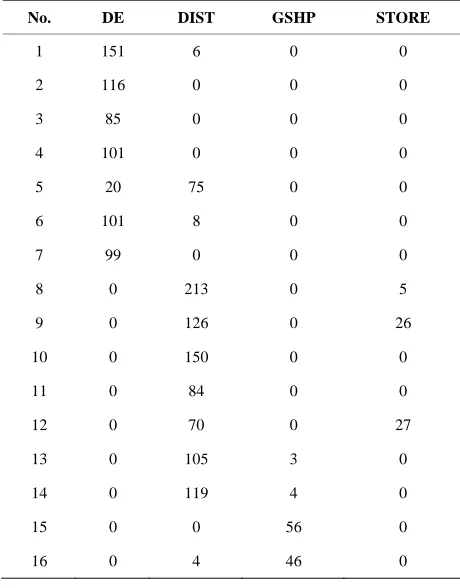
The test network used in this study was laid out by a network planning algorithm capable of producing opti- mized Greenfield networks or expansion and upgrade plans that utilize existing network. A fully radially oper- ated network without distributed generation is used. However, the motivation of this study, as stated in Sec- tion 1, is to utilize load flow analysis techniques and AMR metering data for active distribution network management. The profile of households type connected to the test network is shown in Table 2 and Figure 3 lays out the positions of the household as well as the west side network.
Table 2. Distribution of LV customers of the four heating types under the sixteen secondary substations.
No. DE DIST GSHP STORE
1 151 6 0 0
2 116 0 0 0
3 85 0 0 0
4 101 0 0 0
5 20 75 0 0
6 101 8 0 0
7 99 0 0 0
8 0 213 0 5
9 0 126 0 26
10 0 150 0 0
11 0 84 0 0
12 0 70 0 27
13 0 105 3 0
14 0 119 4 0
15 0 0 56 0
[image:4.595.57.286.429.549.2]16 0 4 46 0
Table 3. Greenfield radial distribution network data.
1 Primary Substation (40 MVA, 110/20 kV)
16 secondary substations (1.6 MVA, 20/0.4 kV)
Heating type No.
Direct Electric (DE) 673
District heating (DIST) 960
Ground Source HP (GSHP) 109 1800 Households
Electric storageheating (STORE) 58
These households are geographically distributed to build the simulated MV/LV network following geographical boundaries, street grids and the availability of, for exam- ple, district heating, as shown in Figure 3(a). On the other hand, we have actual hourly metered consumptions of one year between 2008 and 2009 for the same number of households and heating type profile. For both load forecasting and load flow analysis the actual one year hourly consumptions are randomly assigned to the indi- vidual households connected to the simulated network (see Figure 3(b)).
4. One Day Ahead Load Forecasting
The day ahead load forecasting is based on a simple
autoregressive model supported by exogenous variables; it is also called the ARX model. The model has lagging hourly consumption information from the same hour in the previous week and the previous day same hour load, since available measurements are only from the previous day’s metering. The effects of the previous two hours’ temperatures together with real time temperature are in- cluded in the explanatory variable. The day structure effect is included through weekday and weekend dummy variables, as shown in (3).
1 24 2 168 3 4 1
5 2 6 7 8
t t t t t
t d
Y c Y Y T T
T DL WD WE
t
(3)
where: :
t Y
:
T
kWh consumption at hour t
t DL
Temperature at hour t (˚C) :
d Day length to represent the light amount of day d
: Weekday dummy variables (0 or 1)
WD
:
WE Weekend dummy variables (0 or 1)
c: Constant :
t
White noise
The ARX based one day ahead load forecasting is car- ried out at three points in the network. The parameters
1, 2, 3, 8
are estimated using an Ordinary Least Squares (OLS) estimator. The results are plotted in Fig- ure 4 and the corresponding Root Mean Square Errors (RMSE) and Mean Absolute Percentage Errors (MAPE) are given for comparison in Table 4.
Case 1:
Forecasting individual customers: Each and every household is modeled individually and a one day ahead forecast is carried out. The consumptions are then aggregated hierarchically at their feeding secondary substation and then the primary substation.
Case 2:
Forecasting at secondary substations: Consumptions of individual households connected to a secondary substation are aggregated before application of the forecasting technique.
Case 3:
Forecasting at the primary substation: All consump- tions under the primary substation are aggregated and the aggregated load is modeled and forecasted for the next day.
Table 4. RMSE and MAPE comparisons.
RMSE (kWh) MAPE (%)
Feeder 0 0
Case 1 196.61 9.27
Case 2 160.06 6.88
[image:4.595.309.537.649.735.2](a)
[image:5.595.100.494.84.433.2](b)
Figure 3. The Greenfield test network. (a) Showing the distribution of household types, MV/LV and HV/MV substations; (b) WEST side network.
6005 6010 6015 6020
1800 2000 2200 2400 2600 2800 3000 3200
Hour of the year
kW
h co
ns
umpt
io
n
Consumption at Primary Substation Forcasting Individual customer
Actual Consumption Forcasting at Prim Subs Forcasting at Sec Subs
Figure 4. kWh at primary substation connecting 1800 households in Figure 3.
The error is expected to be greater with the attempt to model individual customer level electric loads as these loads do not follow any known distribution function [12]. There is, therefore, a trade-off between the interest in a customer level detailed load flow analysis and obtaining a model with an acceptable error margin. Nevertheless, the results in our study suggest that individual customer level modeling can be attained with a low error differ-
ence compared to the secondary substation or primary substation level load modeling (see Table 5 and Figure 4). However, the modeling technique needs to be robust and capable of providing error margins. It has to take into consideration coincidence and correlation factors among individual customers.
5. Load Flow Analysis Based on Customer
Level Load Measurement
Bidirectional load flow and the integration of DG are the driving forces behind the interest in customer connection point voltage levels in real time. The load flow analysis we implemented uses a simple Backward/Forward sweep technique as formulated in Equations (4) to (7). Due to the different voltage levels a per-unit analysis is used.
2node node * brh * brh
S S PMD I Z . (4)
*node node
brh
I S V
(5)*
brh brh brh
[image:5.595.62.283.485.598.2]node 1 * brh
V PM V (7)
where:
node
PM: is the node path matrix from the primary substa- tion to every node
:
S is P jQ in kWh at a node
D: is a diagonal matrix of equal size to PM
:
brh
I current flowing on the branch between two nodes (A)
:
brh
Z is the impedance of a branch between two nodes R jX (ohms)
:
brh
V Voltage phasor difference over a branch be- tween two nodes
node: V
.*
voltage level at a node
Matrix element-by-element multiplication
Including the secondary substations there are 1816 node points in the test network where the voltage magni- tude and angle are evaluated.
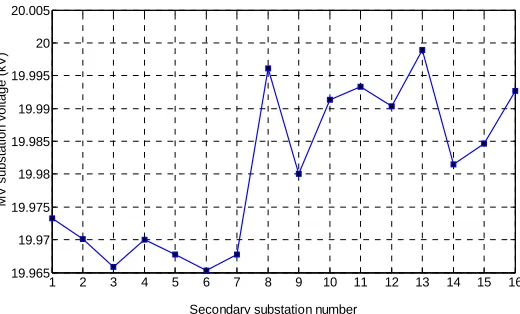
[image:6.595.54.485.398.705.2]Results in Figures 5-7 show the hourly voltage pro- files of the distribution network up to the LV customer level node. In this load flow analysis no voltage regula- tion is involved and the results show a cyclic voltage profile following the trend of the power itself. With this
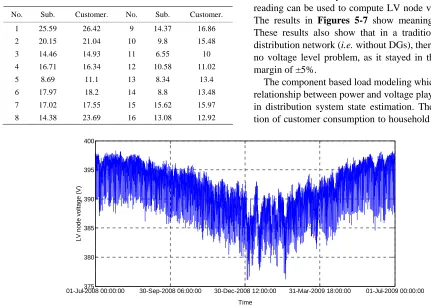
Table 5. RMSE (kWh)comparisons between individual cus- tomer forecasts and secondary substation forecasts for the 16 substations.
No. Sub. Customer. No. Sub. Customer. 1 25.59 26.42 9 14.37 16.86 2 20.15 21.04 10 9.8 15.48 3 14.46 14.93 11 6.55 10 4 16.71 16.34 12 10.58 11.02 5 8.69 11.1 13 8.34 13.4 6 17.97 18.2 14 8.8 13.48 7 17.02 17.55 15 15.62 15.97 8 14.38 23.69 16 13.08 12.92
resolution, the impact of intermittent energy sources such as solar panels can be studied more clearly. As the sub- station voltage profile in Figure 8 shows, load forecasts of individual customers can be also used to forecast voltage profiles one day ahead. It gets more interesting when forecasts of wind and sun radiation are included together with individual load forecasts to give real-time and one day ahead visibility of the network state.
6. Conclusions and Discussions
Indeed load forecasting at secondary substations experi- ences lower error than customer level forecasting, as shown in Tables 4 and 5. The quest for customer level voltage visibility, however, requires the redistribution of substation level forecasted load to individual households using statistical information. Referring to the results shown in Tables 4 and 5, it is encouraging that there is little difference in the errors committed when load fore- casting is performed at customer points and at secondary substations. The RMSE of voltage forecast using cus- tomer forecasted loads was about 0.004 pu and the MAPE is less than 1% (see Figure 8). Therefore cus- tomer level load forecasting can be used to conduct load flow analysis giving forecasted customer level voltages.
A load flow analysis based on customer point meter reading can be used to compute LV node voltage levels. The results in Figures 5-7 show meaningful voltages. These results also show that in a traditional suburban distribution network (i.e. without DGs), there seems to be no voltage level problem, as it stayed in the acceptable margin of ±5%.
The component based load modeling which defines the relationship between power and voltage plays a great role in distribution system state estimation. The disaggrega- tion of customer consumption to household appliances is
01-Jul-2008 00:00:00375 30-Sep-2008 06:00:00 30-Dec-2008 12:00:00 31-Mar-2009 18:00:00 01-Jul-2009 00:00:00 380
385 390 395 400
Time
LV
no
de v
ol
tage
(V
)
1 2 3 4 5 6 7 8 9 10 11 12 13 14 15 16 19.965
19.97 19.975 19.98 19.985 19.99 19.995 20 20.005
Secondary substation number
MV
s
ubs
tat
ion
v
o
lt
age
(k
V
)
Figure 6. Secondary substation voltages at the hour of the year where the highest voltage drop is experienced at the LV node in Figure 5. (i.e. 01-Jan-2009 23:00:00-00:00:00).
1 2 3 4 5 6 7 8 9 10 11 12 13 14 15 16 17 18 19 20 21 22 23 24 25 26 0.991
0.992 0.993 0.994 0.995 0.996 0.997 0.998 0.999 1 1.001
Node points
V
o
lt
a
ge (
p
u)
[image:7.595.166.426.84.241.2](5-26) LV nodes Vbase = 400V (1-4) Secondary substations Vbase = 20 kV
Figure 7. Voltage profile of nodes along the longest path in the network for their mean hourly consumption. On the path there are four secondary substations and 22 LV customers.
08-Jul-2008 22:00:000.997 11-Jul-2008 22:00:00 14-Jul-2008 22:00:00 17-Jul-2008 22:00:00 0.9975
0.998 0.9985 0.999 0.9995
Time
V
ol
at
g
e
lev
el
(
pu
, V
bas
e 20 k
V
)
[image:7.595.155.439.285.439.2]based on real customer measurement based on forecasted custumer load
Figure 8. Average voltage profile of the 16 secondary substations for 10 days using real AMR measurement and forecasted- customer load (Case 1 in Section 4).
the prerequisite for component modeling. Through load disaggregation and component based modeling, the im- pact of active demand response programs on distribution networks can be viewed more clearly.
In our following research plan, the current network will be expanded to include DGs. Component based modeling will be included in the load flow analysis
where the impact of real time demand response programs on the active distribution network will be investigated.
7. Acknowledgements
program through the SAGA project.
REFERENCES
[1] K. Samarakoon, J. Wu, J. Ekanayake and N. Jenkins, “Use of Delayed Smart Meter Measurements for Distri- bution State Estimation,” 2011 IEEE Power and Energy Society General Meeting, San Diego, 24-29 July 2011, pp. 1-6.
[2] A. Abdel-Majeed and M. Braun, “Low Voltage System State Estimation Using Smart Meters,” 47th International Universities Power Engineering Conference (UPEC), London, 4-7 September 2012, pp. 1-6.
[3] P. A. Pegoraro, J. Tang, J. Liu, F. Ponci, A. Monti and C. Muscas, “PMU and Smart Metering Deployment for State Estimation in Active Distribution Grids,” 2nd IEEE EN- ERGYCON Conference & Exhibition, Florence, 9-12 Sep- tember 2012, pp. 873-878.
[4] M. Lehtonen, M. Jalonen, A. Matsinen, J. Kuru and V. Haapamäki, “A Novel State Estimation Model for Distri- bution System,” 14th Power Systems Computation Con- ference PSCC, Sevilla, 24-28 June 2002, pp. 1-5.
[5] R. T. Guttromson, D. P. Chassin and S. E. Widergren, “Residential Energy Resource Models for Distribution Feeder Simulation,” IEEE Power Engineering Society General Meeting, Toronto, 13-17 July 2003, pp. 108-113. [6] K. P. Schneider and J. C. Fuller, “Detailed End Use Load
Modeling for Distribution System Analyses,” 2010 IEEE
Power and Energy Society General Meeting, Minneapolis, 25-29 July 2010, pp. 1-7.
[7] H. L. Willis, “Power Distribution Planning Reference Book,” Marcel Dekker, Inc., New York, 1997.
[8] H. K. Alfares and M. Nazeeruddin, “Electric Load Fore- casting: Literature Survey and Classification of Meth- ods,” International Journal of Systems Science, Vol. 33, No. 1, 2002, pp. 23-34.
[9] H. Wang and N. Schulz, “A Load Modeling Algorithm for Distribution System State Estimation,” IEEE/PES Transmission and Distribution Conference and Exposi- tion Volume 1, Atlanta, 28 October-2 November 2001, pp. 102-105.
[10] R. F. Arritt, R. C. Dugan, R. W. Uluski and T. F. Weaver, “Investigating Load Estimation Methods with the Use of AMI Metering for Distribution System Analysis,” 2012
IEEE Rural Electric Power Conference (REPC), Mil- waukee, 15-17 April 2012, pp. B3-1-B3-9.
[11] L. G. Swan and V. I. Ugursal, “Modeling of End-Use Energy Consumption in the Residential Sector: A Review of Modeling Techniques,” Elsevier, Renewable and Sus- tainable Energy Reviews, Vol.13, No. 8, 2009, pp. 1819- 1835. http://dx.doi.org/10.1016/j.rser.2008.09.033 [12] A. Seppala, “Statistical Distribution of Customer Load
![Table 1. Component based load modeling [6].](https://thumb-us.123doks.com/thumbv2/123dok_us/7861059.737017/2.595.308.539.279.719/table-component-based-load-modeling.webp)