http://www.scirp.org/journal/am ISSN Online: 2152-7393 ISSN Print: 2152-7385
Lyapunov Stability Analysis of Certain Third
Order Nonlinear Differential Equations
R. N. Okereke
Department of Mathematics, Michael Okpara University of Agriculture, Umudike, Nigeria
Abstract
This paper is concerned with the stability analysis of nonlinear third order ordinary differential equations of the form x+ax+g x
( )
+cx=0. We construct a suitableLyapunov function for this purpose and show that it guarantees asymptotic stability. Our approach is to first consider the linear version of the above ODE, by taking
( )
g x =bx and study its Lyapunov stability. Exploiting the similarities between
li-near and nonlili-near ODE, we construct a Lyapunov function for the stability analysis of the given nonlinear differential equation.
Keywords
Nonlinear ODE, Energy, Lyapunov Function, Assymptotic Stability
1. Introduction
In 1892, Lyapunov [1] proposed a fundamental method for studying the problem of stability by constructing functions known as Lyapunov functions. This function is often represented as V t x
( )
, defined in some region or the whole state phase that containsthe unperturbed solution x = 0 for all t > 0 and which together with its derivative
( )
,V t x satisfy some sign definiteness. The following definitions of stability were given
by Lyapunov.
1.1. Definition (Lyapunov) Consider the system
( )
, ,( )
0 0x= f t x x t =x (1)
where x denotes an n-dimensional vector and f t x
( )
, ( f I: ×n→n,I =[
0,∞)
) iscontinuous. Let x t x t
(
; 0, 0)
be a solution of the Equation (1) through(
x t
0,
0)
thenHow to cite this paper: Okereke, R.N. (2016) Lyapunov Stability Analysis of Cer-tain Third Order Nonlinear Differential Equations. Applied Mathematics, 7, 1971- 1977.
http://dx.doi.org/10.4236/am.2016.716161
Received: July 7, 2016 Accepted: October 22, 2016 Published: October 25, 2016
Copyright © 2016 by author and Scientific Research Publishing Inc. This work is licensed under the Creative Commons Attribution International License (CC BY 4.0).
http://creativecommons.org/licenses/by/4.0/
the trivial solution x x t
(
0, 0)
=0 of the system (1) is said to be stable at t=t0, pro-vided that for arbitrary positive ε >0, there exist a δ δ ε=(
,t0)
such that whenever0
x <δ , the inequality x t x t
(
; 0,0)
<ε is satisfied for all t≥t0. 1.2. Definition (Lyapunov)The trivial solution x t x t
(
; 0,0)
of the system (1) is said to be asymptotically stable if it is stable, and for each t0>0, there is an η>0 such that x0 <η implies(
; 0,0)
0x t x t → as t→ ∞. If in addition all solutions tend to zero, then the trivial
solution is asymptotically stable in the large.
1.3. Lyapunov’s Theorem on Stability (Lyapunov)
Suppose there is a function V which is positive definite along every trajectory of (1), and is such that the total derivative V is semi definite of opposite sign (or identically
zero) along the trajectory of (1). Then the perturbed motion is stable. If a function V exists with these properties and admits an infinitely small upper bound, and if V is
definite (with sign opposite of V), it can be shown further that every perturbed trajec-tory which is sufficiently close to the unperturbed motion x=0 approaches the latter
asymptotically.
1.4. Remark
1) The basis of Lyapunov theory in simple terms is that; if the total energy is dissi-pated, then the system must be stable.
2) The main advantage of this approach is that; by looking at how an energy-like function V (Lyapunov function) changes over time, we might conclude that a system is stable or asymptotically stable without solving the differential equation.
3) The disadvantage of this approach is that; finding a Lyapunov function may not be so easy! [2].
1.5. Motivation
1) Eigenvalue analysis concept does not hold good for nonlinear systems [1][3]. 2) Nonlinear systems can have multiple equilibrium points and limit cycles [4]. 3) Stability behaviour of nonlinear systems need not always be global (unlike linear systems) [5][6].
1.6. How Energy Is Associated with Dynamical Systems
We illustrate here how we can derive the Hamiltonian for a dynamical system of the form
( )
0x+ f x =
(2) The Hamiltonian of a system is the sum of its kinetic (T) and potential energies (V), i.e.
Given Equation (2), multiply by x to get;
( )
0xx +xf x = (4)
We observe that;
( )
2( )
2d 1 d
2
dt x = xx⇒xx=2 dt x
Hence substituting in (4) we get;
( )
2( )
1 d
0 2 dt x +xf x =
Integrating with respect to t,
( )
2( )
1 d d
d d constant
2 d d
x x t f x t t + t =
∫
∫
( )
2
1
d constant
2x f x x
⇒ +
∫
=The required Hamiltonian is;
( )
2
1
d 2
H= x +
∫
f x x (5)1.7. Remark
1) Any dynamical system of the form x+ f x
( )
=0 is conservative [7], i.e. the totalenergy of the system is conserved, and this implies that there exists a function H such that d 0
d
H
t = , where H is the Hamiltonian of the system.
2) The function 1 2
( )
d 2
H= x +
∫
f x t is often used as a Lyapunov function candi-date in the stability analysis of many conservative systems.
3) A concrete example of a conservative system is the simple pendulum [8].
1.8. Stability Definitions
We consider nonlinear time-invariant system x= f x
( )
, : n nf → a point
n e
x ∈ is an equilibrium point of the system if f x
( )
e =0. We remark that xe is an equilibrium point if and only if x t( )
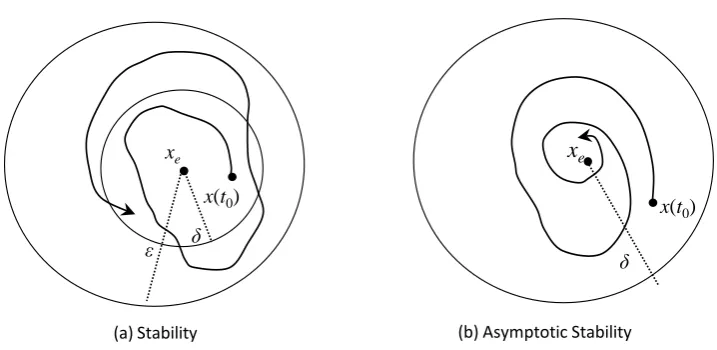
=xe is a trajectory. Figure 1 illustrates schemati-cally the concept of stability and asymptotic stability with respect to an equilibriumpoint n
e
x ∈ . Their definitions follow.
1.9. Definition
An equilibrium solution x=xe of x= f x
( )
is said to be:1) stable if, given any ε >0 and any t0≥0, there exists a δ δ ε=
(
,t0)
such that( )
0 e( )
e , 0 0x t −x < ⇒δ x t −x <ε ∀ ≥ ≥t t
2) uniformly stable if, for every ε >0, there exits δ δ ε=
( )
, independent of t0,Figure 1. Stability of equilibria.
4) asymptotically stable if there exists a δ >0 such that
( )
0 e lim( )
e tx t x δ x t x
→∞
− < ⇒ =
5) The system is globally asymptotically stable (G.A.S.) if for every trajectory x t
( )
and x t
( )
→xe as t→ ∞ (implies xe is the unique equilibrium point).6) The system is locally asymptotically stable (L.A.S.) near or at xe if there is an
0
R> s.t. x t
( )
0 −xe ≤ ⇒R x t( )
→xe as t→ ∞.2. Construction of Lyapunov Function for Third Order Linear ODE
Ogundare [9] constructed a Lyapunov function for a second order linear system of or-dinary differential equation using a quadratic form. We shall adapt his method with slightly more simplified assumptions to construct a Lyapunov function for a third order linear ODE of the form0 x+ax+bx+cx=
(6) which is equivalent to the system
x y y z
z az by cx
= =
= − − −
(7)
where a, b, c are all positive constants. The required quadratic form in this case is given as
2 2 2
2V = Ax +By +Cz +2Dxy+2Exz+2Fyz (8)
where A, B, C, D, E, and F are constants to be determined. Differentiating Equation (8) with respect to the system (7) we have
(
)
(
)
(
)
2V=2Axx+2Byy+2Czz+2D xy +xy +2E xz +xz +2F yz +yz .
(
)
(
)
(
)
2
2
V Axy Byz Cz az by cx Dy Dxz Eyz
Ex az by cx Fz Fy az by cx
= + + − − − + + +
+ − − − + + − − −
(a) Stability (b) Asymptotic Stability
xe
x
eε
x(t0) x(t 0)
(
)
(
)
(
)
(
)
(
)
2 2
2 2 2
2 2 2
.
V Axy Byz Caz Cbyz Ccxz Dy Dxz Eyz
Eaxz Ebxy Ecx Fz Fayz Fby Fcxy
Ecx Fb D y Ca F z Eb Fc A xy
Cc Ea D xz Cb Fa B E yz
= + − − − + + + − − − + − − − = − − − − − − + − − + − − + − − (9)
Setting the coefficients of 2 2
, , , ,
xy xz yz x z to be zero and coefficient of 2
y greater
than zero in Equation (9), we obtain
0 0 0 0 0 0 Ec Fb D Ca F
Eb Fc A
Cc Ea D
Cc Fa B E
=
− > − = + − = + − = + − − = (10)
Solving the system we have,
(
)
(
)
2 0 0 E F Ca D Cc A Cac B C b aab c C
= = = = = +
− >
(11)
By setting C = 1, we obtain
(
2)
1
0
A ac
B b a
C D c E F a = = + = = = = (12)
with
(
ab−c)
>0, these values of the constants guarantee the positive definiteness of Vand negative definiteness of its derivative. So, substituting (12) into Equation (8), gives
(
)
(
) (
)
(
)
2 2 2 2
2 2 2 2 2
2 2
1 1 2
2 2 2
2 2
V acx b a y z cxy ayz acx by cxy a y ayz z ac x a y− b ca− y z ay
= + + + + +
= + + + + +
= + + − + +
(13)
We now find the time derivative of V:
(
2)
2V=2acxx+2 b+a yy+2zz+2cxy +2cxy+2ayz +2ayz
(
)
(
)
(
)
(
)
(
)
2 2 2
2 2 2 2 2 2
2 2 2 2
V acxy b a yz z az by cx cy cxz az ay az by cx acxy byz a yz az byz cxz cy cxz az a yz aby acxy cy aby c ab y ab c y
= + + + − − − + + + + − − −
= + + − − − + + + − − −
= − = − = − −
Equation (13) is positive definite with
(
ab−c)
>0, and (14) negative definite,therefore, satisfies Lyapunov stability criteria.
2.1. Construction of Lyapunov Function for Third Order Nonlinear ODE Exploiting the similarities between linear and nonlinear systems, we shall construct a Lyapunov function for the stability of third order nonlinear differential equation of the form;
( )
0x+ax+g x +cx=
(15) Equation (15) is equivalent to the system
( )
x y
y z
z az g y cx
= = = − − − (16)
Taking into account the similarities between the linear and the nonlinear systems, we can see a close comparison with Equations (16) and (7), that by has been replaced by
( )
g y or 2
( )
02 d
y
by =
∫
g y y, where( )
( )
0 d
y
G y =
∫
g y y.We use Equation (13) as our trial Lyapunov function, given by
(
1)
2(
)
2( )
1 22V =ac x+a y− + z+ay +2G y −ca y− (17)
We also assume that
( )
( )
(
)
( )
20 0,g y 0, 0, 2
g b ab c G y by y
= ≥ > − > ≥ .
This implies that
(
)
(
)
( )
(
)
(
)
(
)
(
)
(
)
2 2
1 1 2
2 2
1 2 1 2
2 2
1 1 2
2V ac x a y z ay 2G y ca y
ac x a y z ay by ca y
ac x a y z ay b ca y
− − − − − − = + + + + − ≥ + + + + − ≥ + + + + − (18)
Since
(
ab−c)
>0, we have that(
1)
2(
)
2(
1)
20
ac x+a y− + z+ay + b−ca− y > ,
Hence V is positive definite.
Also, the time derivative of V along the solution path of (16)
(
1)(
1)
(
)(
)
(
1)
2V=2ac x+a y− x+a y− +2 z+ay z+ay +2 b−ca− yy
( )
1 1 2 2 1
V=ac xx +a xy− +a xy− +a yy− +zz+ayz +ayz+a yy+g y y−ca yy−
( )
(
)
( )
(
)
( )
( )
( )
( )
( )
( )
(
)
2 1 2
2 1
2 1 2 2
2 2 1
2 2 2 2 2
V acxy cxz cy ca yz z az g y cx az ay az g y cx a yz g y z ca yz acxy cxz cy ca yz az g y z cxz az
a yz ag y y acxy a yz g y z ca yz cy ag y y cy ab y y cy aby ab c y
Clearly V is negative definite and we have asymptotic stability.
Therefore, the Lyapunov function;
(
1)
2(
)
2( )
1 22V =ac x+a y− + z+ay +2G y −ca y− ,
is an appropriate Lyapunov function for the system (16).
2.2. Conclusion
We have seen that the Lyapunov function candidate constructed in this project is a good tool in the stability analysis of dynamical systems. Without the need to solve the systems of differential equations involved, we were able to obtain the qualitative beha-viour of the systems near their equilibrium points.
References
[1] Lyapunov, A.M. (1992) The General Problem of the Stability of Motion. Translated and edited by A. T. Fuller, Taylor & Franscis, London.
[2] Lassalle, J.P. (1960) Some Extentions of Liapunov’s Second Method, IRE Trans. CT-7 1960, 520-527.
[3] Cemil, T. (2007) Stability and Boundedness of Solutions of Nonlinear Differential Equa-tions of Third-Order with Delay. Electronic Journal.
[4] Henry, J.R. (2009) A Modern Introduction to Differential Equations. 2nd Edition, Elsevier Academic Press.
[5] Maliki, S.O. (2011) Analysis of Numerical and Exact Solutions of Certain SIR and SIS Epi-demic Models. Journal of Mathematical Modelling and Application, 1, 51-56.
[6] Maliki, S.O. and Nwoba, P.O. (2014) Stability Analysis of a System of Coupled Harmonic Oscillators. Pelagia Research Library Advances in Applied Science Research, 5, 195-203. [7] Maliki, S.O. and Okereke, R.N. (2016) A Note on Differential Equation with a Large
Para-meter. Applied Mathematics, 7, 183-192.http://dx.doi.org/10.4236/am.2016.73018 [8] Kreyszig, E. (2006) Advanced Engineering Mathematics. 9th Edition, John Wiley and Sons,
Hoboken.
Submit or recommend next manuscript to SCIRP and we will provide best service for you:
Accepting pre-submission inquiries through Email, Facebook, LinkedIn, Twitter, etc. A wide selection of journals (inclusive of 9 subjects, more than 200 journals)
Providing 24-hour high-quality service User-friendly online submission system Fair and swift peer-review system
Efficient typesetting and proofreading procedure
Display of the result of downloads and visits, as well as the number of cited articles Maximum dissemination of your research work