http://www.scirp.org/journal/ajor ISSN Online: 2160-8849
ISSN Print: 2160-8830
Explicit Exact Solution of Damage Probability for
Multiple Weapons against a Unitary Target
Hongyun Wang
1, Cardy Moten
2, Morris Driels
3, Don Grundel
4, Hong Zhou
5*1Department of Applied Mathematics and Statistics, University of California, Santa Cruz, CA, USA 2TRADOC Analysis Center, Naval Postgraduate School, Monterey, CA, USA
3MAE Department, Naval Postgraduate School, Monterey, CA, USA 4Armament Directorate, Eglin AFB, Valparaiso, FL, USA
5Department of Applied Mathematics, Naval Postgraduate School, Monterey, CA, USA
Abstract
We study the damage probability when M weapons are used against a unitary target. We use the Carleton damage function to model the distribution of damage probabil-ity caused by each weapon. The deviation of the impact point from the aimpoint is attributed to both the dependent error and independent errors. The dependent error is one random variable affecting M weapons the same way while independent errors are associated with individual weapons and are independent of each other. We con-sider the case where the dependent error is significant, non-negligible relative to in-dependent errors. We first derive an explicit exact solution for the damage probabil-ity caused by M weapons for any M. Based on the exact solution, we find the optimal aimpoint distribution of M weapons to maximize the damage probability in several cases where the aimpoint distribution is constrained geometrically with a few free parameters, including uniform distributions around a circle or around an ellipse. Then, we perform unconstrained optimization to obtain the overall optimal aim-point distribution and the overall maximum damage probability, which is carried out for different values of M, up to 20 weapons. Finally, we derive a phenomenological approximate expression for the damage probability vs. M, the number of weapons, for the parameters studied here.
Keywords
Damage Probability, Carleton Damage Function, Multiple Weapons with Dependent Errors, Exact Solution, Optimal Distribution of Aimpoint
1. Introduction
The probability of killing or damaging a target depends heavily on how close a weapon How to cite this paper: Wang, H.Y.,
Mo-ten, C., Driels, M., Grundel, D. and Zhou, H. (2016) Explicit Exact Solution of Damage Probability for Multiple Weapons against a Unitary Target. American Journal of Opera-tions Research, 6, 450-467.
http://dx.doi.org/10.4236/ajor.2016.66042 Received: April 18, 2016
Accepted: November 13, 2016 Published: November 16, 2016 Copyright © 2016 by authors and Scientific Research Publishing Inc. This work is licensed under the Creative Commons Attribution International License (CC BY 4.0).
http://creativecommons.org/licenses/by/4.0/
is delivered to the target. This delivery accuracy of a weapon may be affected by many components. In general, the errors are usually divided into two main groups: the de-pendent error and indede-pendent errors. The dede-pendent error is related to the aiming er-ror that results from a miscalculation of latitude, longitude, distance, wind effect, or uncertainty in locating the target position. The dependent error results in the arma-ment impacting away from the desired target point and it affects all weapons the same way. The independent errors refer to ballistic dispersion errors, which may result from variations in bullet shape, variations in gun barrels, or variations in amount of explo-sive used inside each bullet [1].
Due to many uncertainties in the field of weapon effectiveness, Monte Carlo simula-tions have been widely employed to estimate the probability of target damage [2]. Even though Monte Carlo simulations can provide reasonable estimates, exact solutions are mathematically more attractive and practically more useful. The objectives of this paper are: i) to derive explicit exact solution for the damage probability caused by multiple weapons against a single target, ii) to use the exact solution to maximize the damage probability with respect to the aimpoint distribution of weapons, with or without geo-metric constraint(s) on the aimpoint distribution, and iii) to study the relation of dam-age probability to the number of weapons when the dependent error is significant. The results obtained here can be applied to indirect fire artillery, or GPS/INS-guided wea-pons.
The remainder of this paper will progress as follows. Section 2 provides the detailed mathematical formulation and explicit exact solution for the kill probability. Section 3 considers the performances of various aimpoint distributions. Finally, Section 4 presents conclusions and future work.
2. Mathematical Formulation
We consider a single point target in the two dimensional space. We establish the coor-dinate system such that the target is located at the origin point xtarget =
( )
0, 0 . We useM weapons with dependent and independent errors to fire on the target. Due to the presence of significant dependent error, if all M weapons are aimed at xtarget =
( )
0, 0 ,the M impact points may be uniformly shifted away from the target by a significant distance, resulting in a small damage probability. To make the damage probability less susceptible to the dependent error, we aim the M weapons at M different points distri-buted around the target. When the dependent error shifts some impact points away from the target, it simultaneously shifts the some other impact points toward the target. In this study all weapons are assumed to be perfectly reliable. Gross errors due to ano-malies such as catastrophic weapon system failure, adverse weapon separation effects, and GPS jamming are neglected.
Let
• rj = the aiming point of weapon j.
• Y = miss distance from the aimpoint due to the dependent error of M weapons,
• Xj = miss distance from the aimpoint due to the independent error of weapon j,
affecting only the impact point of weapon j individually. We assume that
{
Xj, j=1, 2,,M}
are independent of each other and independent of random va-riable Y .The impact point of weapon j is given by
j = + +j j
w r Y X
We model the dependent error Y as a normal random variable with zero mean:
2 1 2 2 0 0 ~ , 0 0 N σ σ Y
where
σ
1 andσ
2 are standard deviations, respectively, in the two coordinate tions, which give an indication of the spread of the dependent error in the two direc-tions. We model each independent error Xj as a normal random variable with zero mean: 2 1 2 2 0 0 ~ , 0 0 j d N d XFurther, we assume that the independent errors of individual weapons
{
Xj, j=1, 2,,M}
are independent of each other and are independent of the depen-dent error Y.We use the mathematical fact that the sum of two independent normal random va-riables is a normal random variable. Suppose
( )
2~ 0,
U N
σ
and V ~N( )
0,s2 . We have(
2 2)
~ 0,
Z ≡ +V U N s +
σ
(1) The probability density functions of U and V are given by
( )
2 221 exp 2 2π U u u ρ σ σ − =
( )
2 221 exp 2 2π V v v s s
ρ = −
In terms of the probability density functions, we write Equation (1) as
(
)
(
)
(
)
2 2 2 2 2 2 2 2 2 2 2 1 1exp exp d
2 2
2π 2π
1
exp for any
2 2π
z u u
u s s z z s s σ σ σ σ − − − − = + +
∫
Applying a change of variables
u
new= −
u
, denotingu
new still by u for simplicity and multiplying the equation by 2π 2s , we get
(
)
(
)
1
2 2 2 2
2
2 2 2 2 2 2 2
1
exp exp d exp for any
2 2π 2 2
z u u s z
u z
s
σ
σ
sσ
sσ
We rewrite the equation above in terms of expected values:
(
)
(
)
1
2 2 2
2
2 2 2 2 2
exp exp
2 2
U
z U s z
E
s s
σ
sσ
− + − = + +
(2)
Here the notation
E
U indicates the average with respect to random variable U while z and 2s
are fixed, not varying with U. Equation (2) is valid for any normal random variable( )
2~ 0,
U N
σ
, and for any z ands
2>
0
. In the analysis below, wewill use Equation (2) extensively.
We use the Carleton damage function to model the probability of killing by an indi-vidual weapon. Let w=
(
w( ) ( )
1 ,w 2)
be the impact point of a weapon where w( )
1and w
( )
2 describe the impact points in the range and deflection directions from thetarget. The probability of the target being killed by a weapon at impact point w is
modeled mathematically as
(
)
( )
2( )
22 2
1 2
Pr target being killed by one weapon at impact point )
1 2 exp exp 2 2 w w b b − − = w (3)
This is called the Carleton damage function or the diffuse Gaussian damage function [3]. The two parameters
b
1 andb
2 in the Carleton damage function (3) represent the effective weapon radii in the range and deflection directions, respectively. With the impact points of the M weapons given by wj = + +rj Y Xj, j=1, 2,,M , the proba-bility of the target located at the origin being killed by the M weapons is{
}
(
)
( )
( )
( )
( ) ( )( )
( )
1 2 2 2 2 21 1 2
2 2
2
1 all -combinations 1 1 2
, , , from 1,2, ,
Pr target being killed by weapons at impact points , 1, 2, ,
1 2
1 1 exp exp
2 2
1 2
1 exp exp
2 2 l l k j M j j j k M
k j j
k k l
j j j
M
M j M
w w b b w w b b = = = = − − = − − − − = − −
∏
∑
∑
∏
w ( )
( )( )
( )
( )
(
)
( )( )
( )
( )
(
)
( ) 1 1 1 2 1 2 2 21 , , 1 1
, , 2
2
1 2
, ,
1 1 1 1 exp
2
2 2 2 exp 2 l l k k l l k k M j j k
k j j l
F j j
k
j j
l
F j j
r Y X
b
r Y X
b = = = − + + = − − − + + ×
∑
∑ ∏
∏
(4)
We calculate the probability of the target being killed averaged over independent er-rors
{
Xj, j=1, 2,,N}
and averaged over the dependent error Y . For that purpose,we only need to calculate the average of each term inside the summation:
(
)
(
)
1 1, , k 2 1, , k
horizon-tal components and F2
(
j1,,jk)
involves only the vertical components of{ }
Xj and Y . Since the horizontal components and vertical components are independent ofeach other, we have
(
)
(
)
(
)
(
)
1 1 2 1
1 1 2 1
, , , , , , , ,
k k
k k
E F j j F j j
E F j j E F j j
× = ×
Since F1
(
j1,,jk)
and F2(
j1,,jk)
have exactly the same format, we only needto derive the analytical expression for one. For conciseness, we denote
( )
1l
j
r , Y
( )
1 ,and
( )
1l
j
X simply by
l
j
r , Y, and
l
j
X in the calculation of E F j 1
(
1,,jk)
. We first average F1(
j1,,jk)
over independent errors{
(
)
}
2 1
~ 0,
j
X N d .
{ }
(
)
{ }(
)
(
)
2
1 1 2
1 1
2
2
1 1
, , exp
2 exp 2 l l j j l l jl k j j k X X l k j j X l
r Y X E F j j E
b
r Y X E b = = − + + = − + + =
∏
∏
(5)Each term in the product is an average of the form on the left hand side of (2). Ap-plying Equation (2), we write each average as
(
)
(
)
(
)
1 2 2 2 2 12 2 2 2 2
1 1 1 1 1
exp exp
2 2
l l l
jl
j j j
X
r Y X b r Y
E
b b d b d
− + + − +
=
+ +
Substituting this result into Equation (5), we obtain
{ }
(
)
(
(
)
)
(
)
(
)
(
)
1 2 2 2 11 1 2 2 2 2
1 1 1 1 1
2
2 2
1 1
2 2 2 2
1 1 1 1
2 2
2 2
1 1
1
2 2 2 2
1 1 1 1
1
, , exp
2 exp 2 2 exp 2 l j l l l k j k X l k k j l k k k j j l l r Y b
E F j j
b d b d
r Y b
b d b d
Y Y r k r k b
b d b d k
b = = = = − + = + + − + = + + − + + = + + =
∏
∑
∑
∑
(
)
(
)
2 2 2 2 21 1 1
2 2 2 2 2 2
1 1 1 1 1 1
exp exp
2 2
l l l
k k k
k
j j j
l l l
r k r k Y r k
b d b d k b d k
= = = − − + + + +
∑
∑
∑
Next we average over the dependent error
( )
2 1~ 0,
(
)
(
(
)
)
(
(
)
)
2 2
1
2 2 2
1 1
1 1
2 2 2 2 2 2 2 2
1 1 1 1 1 1 1 1
exp exp 2 2 l l k k j j l l Y
Y r k b d k r k
E
b d k b d k σ b d k σ
= = − + + − = + + + + +
∑
∑
Thus, the overall average of F1
(
j1,,jk)
has the expression(
)
(
)
(
)
( )
( )
(
)
( )
(
)
(
)
12 2 2
2 2
1 1
1
1 1 2 2 2 2 2
1 1 1 1 1
2 2
2
1 1 1
2 2 2 2 2
1 1 1 1 1
, ,
1 1 1
exp
2 2
l l l
k
k
k k k
j j j
l l l
b d k
b
E F j j
b d b d k
r k r k r k
b d k b d k
σ σ = = = + = + + + − × − + + +
∑
∑
∑
(6)Similarly, the overall average of F2
(
j1,,jk)
has the expression(
)
(
)
(
)
( )
( )
(
)
( )
(
)
(
)
12 2 2
2 2
2 2
2
2 1 2 2 2 2 2
2 2 2 2 2
2 2
2
1 1 1
2 2 2 2 2
2 2 2 2 2
, ,
2 2 2
exp
2 2
l l l
k
k
k k k
j j j
l l l
b d k
b
E F j j
b d b d k
r k r k r k
b d k b d k
σ σ = = = + = + + + − × − + + +
∑
∑
∑
(7)The probability of target being killed, averaged over independent errors and depen-dent error, is called kill probability, and is denoted by pkill
(
M weapons)
. It has theexpression
(
)
( )
(1 )
(
)
(
)
kill 1 1 2 1
1 , ,
weapons 1 , , , ,
k M
k
k k
k j j
p M E F j j E F j j =
= −
∑
−∑
(8)
where E F j 1
(
1,,jk)
and E F 2(
j1,,jk)
are given in (6) and (7) above. To-gether, Equations (6)-(8), give us an explicit analytical expression for calculating the kill probability.After the completion of the above derivation, we discovered that similar approaches had been taken separately by von Neumann [4] and by Washburn [5].
3. Performances of Various Aimpoint Distributions
of Multiple Weapons against a Single Target
Now we apply the exact solution to examine the kill probability corresponding to vari-ous distributions of the aimpoints of M weapons.
2 2
1 2
2 2
1 2
exp d d 2π 2 2
L
x y
A x y b b
b b
∞ ∞ −∞ −∞
= − − =
∫ ∫
(9)The aspect ratio of the weapon radii of the Carleton damage function 1 2
b a
b
= is de-scribed by the empirical formula:
(
)
max 1 0.8 cos , 0.3
a= − θ (10) where
θ
is the impact angle.Once the lethal area
A
L and the aspect ratio a are given, one can calculate the wea-pon radii for the Carleton damage function (3) as follows:1
2π
L
a A
b = ×
(11)
1 2
b b
a
=
(12)
For all the cases considered in this paper, we choose 2
2270 ft
L
A = ,
θ
=
65
. Thisyields
b
1=
15.4640 ft
andb
2=
23.3628 ft
. Furthermore, we chooseσ σ
1=
2=
30
for the dependent error andd
1=
d
2=
5
for the independent errors.We first consider the case of M weapons with aimpoints uniformly distributed on a circle as formulated below
(
)
(
)
2π 1 2π 1
cos , sin
j
j j
r r
M M
θ θ
− −
= + +
r
where r is the radius and
θ
the phase off-set angle of the distribution. These are pa-rameters that we can tune to maximize the kill probability.For each value of M, we maximize the kill probability with respect to
( )
r,θ . Thisunconstrained nonlinear optimization can be achieved by using MATLAB built-in function fminsearch which is based on a direct search method of Lagarias et al. [6]. The results are listed in Table 1.
Note that the Carleton damage function we use is not isotropic. It has different effec-tive radii in the range and deflection directions. To accommodate this anisotropic property of the Carleton damage function, we consider the case of M weapons with aimpoints distributed on an ellipse as formulated below
(
)
(
)
2π 1 2π 1
cos , sin
j
j q j
q
M M
η φ φ
η
− −
= + +
r
where
η
is the aspect ratio of the ellipse. In the formulation above, we elongate one axis by η and simultaneously shrink the other axis by the same factor. In this way, the area of the ellipse is maintained at πq2, independent of the aspect ratioη
.Para-meter q has the meaning
(
) (
)
area of ellipse
major axis minor axis π
q= = ×
Table 1. The optimal distribution for M aimpoints when they are uniformly distributed around a circle and the corresponding probability of kill. Here r is the radius and θ is the phase off-set
an-gle.
M ropt θopt pkill
1 0 *** 0.27597
2 16.246 0 0.43690
3 22.960 π
6 0.53834
4 26.948 0 0.62291
5 29.192 π
10 0.68212
6 31.086 π
6 0.72869
7 32.529 π
14 0.76474
8 33.731 0 0.79360
9 34.747 π
18 0.81702
10 35.63 π
10 0.83635
11 36.409 π
22 0.85251
12 37.105 0 0.86617
The asterisks reflect that when r = 0, θ is not meaningful, meaning that θ is arbitrary and irrelevant.
major axis=q η
minor axis q
η
=
We should point out that parameter
φ
is not the polar angle of the aimpoint of weapon 1.φ
is the angular value used in the parametric equation of the ellipse to cal-culate the aimpoint of weapon 1.φ
is the phase angle before the major axis is elon-gated and before the minor axis is shrunk.For each value of M, we maximize the kill probability with respect to
(
q, ,φ η)
. Weobtain the results in Table 2.
In the above, we calculated the performance of placing the aimpoints of M weapons along a circle or an ellipse. We now examine the case of aiming one weapon at the cen-ter and aiming the rest
(
M−1)
weapons at positions distributed on an ellipse. Theaimpoints of M weapons are distributed as formulated below.
(
)
(
)
2π 1 2π 1
cos , sin , 1, 2, , 1
1 1
j
j q j
q j M
M M
η φ φ
η
− −
= + − + − = −
r
( )
0, 0M =
r
For each value of M, we maximize the kill probability with respect to
(
q, ,φ η)
. The optimal results are reported in Table 3.Table 2. The optimal distribution for M aimpoints when they are uniformly distributed around an ellipse and the corresponding probability of kill. Here
φ
is the off-set value in the parametric equation of the ellipse. The cases of M=1 and M =2 are not affected by aspect ratio.M (major axis)opt (minor axis)opt φopt pkill
1 0 0 *** 0.27597
2 16.246 16.246 0 0.43690
3 25.637 17.639 π
6 0.53989
4 29.621 23.068 0 0.62477
5 30.411 27.235 π
10 0.68264
6 32.859 28.548 π
6 0.72958
7 34.292 30.095 π
14 0.76560
8 35.848 30.967 0 0.79469
9 37.135 31.75 π
18 0.81829
10 38.342 32.349 π
10 0.83784
11 39.436 32.861 π
22 0.85420
12 40.457 33.29 0 0.86806
The asterisks reflect that when r = 0, θ is not meaningful, meaning that θ is arbitrary and irrelevant.
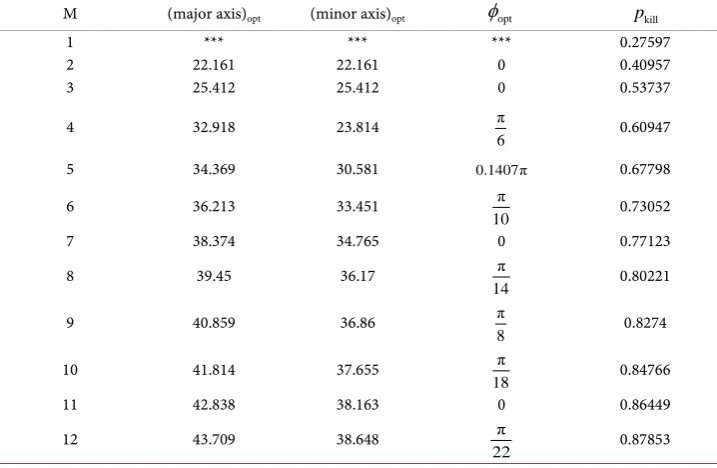
Table 3. The optimal distribution for M aimpoints when one of them is aimed at the origin while the rest of aimpoints are uniformly distributed around an ellipse, and the corresponding proba-bility of kill. Here
φ
is the off-set value in the parametric equation of the ellipse. For the cases of5
M≤ , the kill probability is not improved by moving one of the M aimpoints to the center. M (major axis)opt (minor axis)opt φopt pkill
1 *** *** *** 0.27597
2 22.161 22.161 0 0.40957
3 25.412 25.412 0 0.53737
4 32.918 23.814 π
6 0.60947
5 34.369 30.581 0.1407π 0.67798
6 36.213 33.451 π
10 0.73052
7 38.374 34.765 0 0.77123
8 39.45 36.17 π
14 0.80221
9 40.859 36.86 π
8 0.8274
10 41.814 37.655 π
18 0.84766
11 42.838 38.163 0 0.86449
12 43.709 38.648 π
22 0.87853
[image:9.595.194.553.446.680.2]on a circle or an ellipse. We represent the M aimpoints in polar coordinates.
(
rj,θ
j)
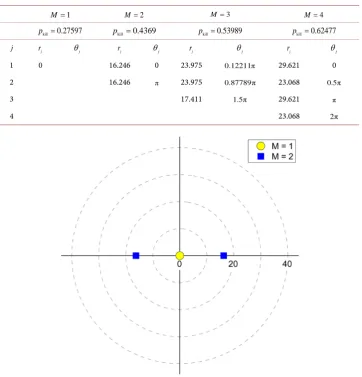
, j=1, 2,,MThe optimal solutions for M =1, M =2, M =3 and M =4 are listed in Table
4.
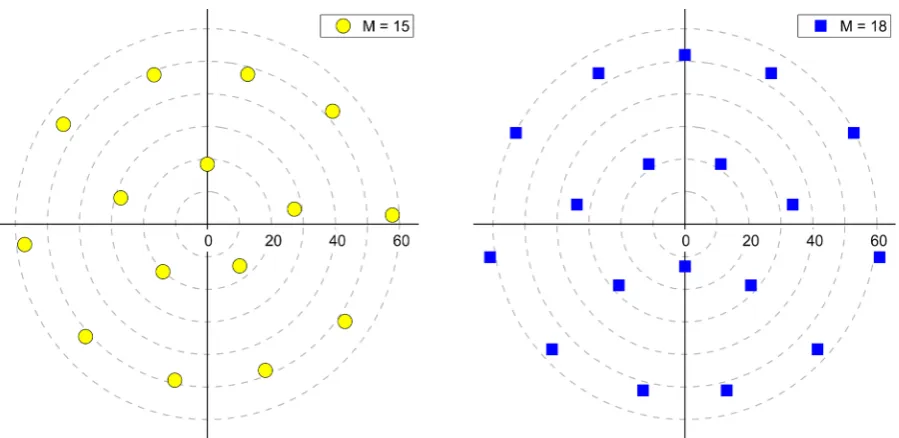
Figure 1 shows the optimal distributions of aimpoints for M =1 (yellow circles)
and M =2 (blue squares) while the optimal distributions for the cases of M =3
(yellow circles) and M =4 (blue squares) are displayed in Figure 2.
The optimal solutions for M =5, M =6, M =7 and M =8 are given in Table 5.
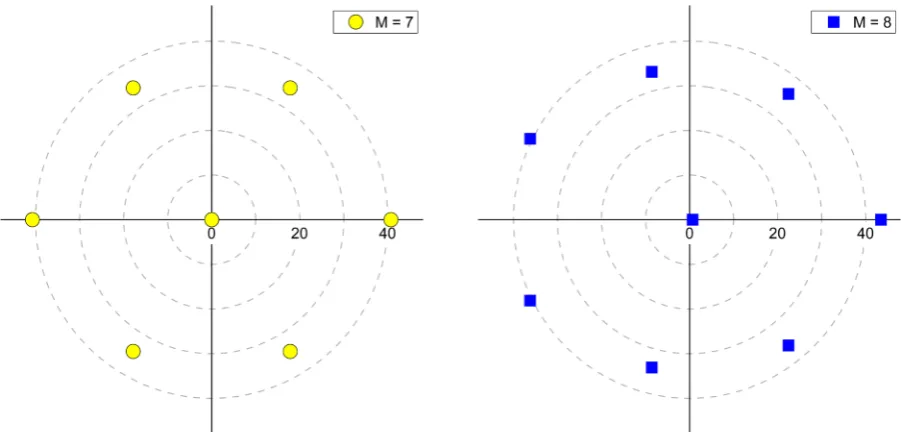
[image:10.595.193.556.301.679.2]Figure 3 illustrates the optimal distributions of aimpoints for M =5 (yellow cir-cles) and M =6 (blue squares); Figure 4 shows the optimal distributions of aimpoints for M =7 (yellow circles) and M =8 (blue squares).
Table 4. Optimal distributions of aimpoints and the corresponding probabilities of kill for
1
M= , M =2, M=3 and M =4. 1
M = M=2 M=3 M=4
kill 0.27597
p = pkill=0.4369 pkill=0.53989 pkill=0.62477
j rj θj rj θj rj θj rj θj
1 0 16.246 0 23.975 0.12211π 29.621 0
2 16.246 π 23.975 0.87789π 23.068 0.5π
3 17.411 1.5π 29.621 π
4 23.068 2π
Figure 1. Optimal distributions of aimpoints for M=1 (yellow circles) and M =2 (blue
Figure 2. Optimal distributions of aimpoints for M=3 (yellow circles) and M =4 (blue
[image:11.595.193.555.367.556.2]squares).
Table 5. Optimal distributions of aimpoints and the corresponding probabilities of kill for
5
M= , M =6, M=7 and M=8.
5
M= M=6 M=7 M=8
kill 0.68505
p = pkill=0.73391 pkill=0.77218 pkill=0.80341
j rj θj rj θj rj θj rj θj
1 33.839 0.08879π 38.334 0 40.69 0 43.43 0 2 24.734 0.5π 27.589 0.33554π 34.456 0.32695π 36.016 0.28566π
3 33.839 0.91121π 27.589 0.66446π 34.456 0.67305π 34.191 0.5809π
4 26.353 1.3057π 38.334 π 40.69 π 40.507 0.85228π
5 26.353 1.6943π 27.589 1.3355π 34.456 1.327π 40.507 1.1477π
6 27.589 1.6645π 34.456 1.673π 34.191 1.4191π
7 0 36.016 1.7143π
8 0.6587 0
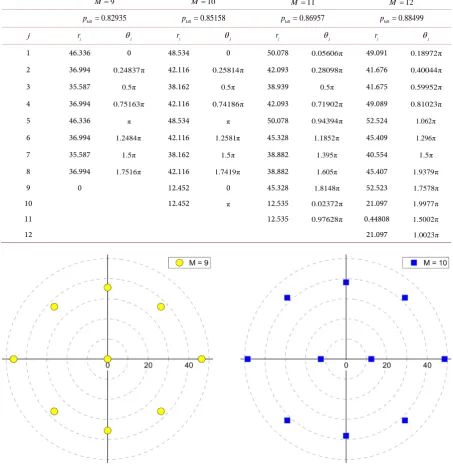
The optimal solutions for M =9, M =10, M =11 and M =12 are listed in
Ta-ble 6.
Figure 5 displays the optimal distributions of aimpoints for M =9 (yellow circles) and M =10 (blue squares); the optimal distributions for M =11 (yellow circles) and
12
M = (blue squares) are plotted in Figure 6.
Next, we study the optimal kill probability as a function of M. Let pkill
( )
M denotethe kill probability corresponding to the optimal distribution of aimpoints for the case of M weapons. As M increases, the survival probability of the target,
(
1−pkill( )
M)
,decreases. In the absence of dependent error and when the aimpoints are all fixed at one point, the outcome of each weapon affected by its independent error is statistically independent of the outcome of other weapons affected by their own independent errors. In this situation, the probability of surviving M weapons is simply the M-th power of the probability of surviving one weapon: 1 kill
( )
(
1 kill( )
1)
M
p M p
[image:12.595.270.481.215.428.2]− = − . In other words, in the absence of dependent error, the log survival probability is a linear function of M.
Figure 3. Optimal distributions of aimpoints for M=5 (yellow circles) and M =6 (blue
squares).
[image:12.595.102.553.469.685.2]Table 6. Optimal distributions of aimpoints and the corresponding probabilities of kill for M=9, M=10, M =11
and M=12.
9
M= M=10 M=11 M=12
kill 0.82935
p = pkill=0.85158 pkill=0.86957 pkill=0.88499
j rj θj rj θj rj θj rj θj
1 46.336 0 48.534 0 50.078 0.05606π 49.091 0.18972π
2 36.994 0.24837π 42.116 0.25814π 42.093 0.28098π 41.676 0.40044π
3 35.587 0.5π 38.162 0.5π 38.939 0.5π 41.675 0.59952π
4 36.994 0.75163π 42.116 0.74186π 42.093 0.71902π 49.089 0.81023π
5 46.336 π 48.534 π 50.078 0.94394π 52.524 1.062π
6 36.994 1.2484π 42.116 1.2581π 45.328 1.1852π 45.409 1.296π
7 35.587 1.5π 38.162 1.5π 38.882 1.395π 40.554 1.5π
8 36.994 1.7516π 42.116 1.7419π 38.882 1.605π 45.407 1.9379π
9 0 12.452 0 45.328 1.8148π 52.523 1.7578π
10 12.452 π 12.535 0.02372π 21.097 1.9977π
11 12.535 0.97628π 0.44808 1.5002π
12 21.097 1.0023π
Figure 5. Optimal distributions of aimpoints for M=9 (yellow circles) and M=10 (blue squares).
( )
(
kill)
(
kill( )
)
log 1−p M =Mlog 1−p 1
[image:13.595.101.555.110.577.2]the origin. The averages of F1
(
j1,,jk)
and F2(
j1,,jk)
are calculated fromEqu-ations (6) and (7) as
(
)
(
(
)
)
1
2 2 2
2 2
1 1
1
1 1 2 2 2 2 2
1 1 1 1 1
, ,
k
k
b d k
b
E F j j
b d b d k σ
+
=
+ + +
(
)
(
(
)
)
1
2 2 2
2 2
2 2
2
2 1 2 2 2 2 2
2 2 2 2 2
, ,
k
k
b d k
b
E F j j
b d b d k σ
+
=
+ + +
[image:14.595.107.552.104.455.2]The kill probability is
Figure 6. Optimal distributions of aimpoints for M =11 (yellow circles) and M =12 (blue squares).
[image:14.595.105.555.469.688.2]( )
( )
( )
(
)
(
)
( )
(
)(
)
1
kill 1 1 2 1
1 , ,
2 2 2 2
1 2 1 1 2 2
2 2 2 2 2 2
2 2 2 2
1 1 1 1 2 2 2
1 1 2 2
1 , , , ,
1 k M
k
k k
k j j
k
M k
k
p M E F j j E F j j
M b b b d b d
k b d b d b d kσ b d kσ = = = − − + + = − − + + + + + +
∑
∑
∑
In the absence of dependent error, we have
σ σ
1=
2=
0
, and the kill probability is( )
(
1 2)(
)
kill
2 2 2 2
1 1 2 2
1 1
M
b b p M
b d b d
− = −
+ +
In the presence of dependent error, to simplify the analysis, we assume that the
in-dependent errors are zero
(
d1=d2=0)
and assume that2 2 2 1 2 2 2 1 2 b b
σ
=σ
≡ω
. The kill probability becomes
( )
( )
kill 2
1
1
1 1 1
1 M k k M p M
k k
ω
=
− = + − +
∑
For the first few values of M, we obtain
( )
2kill 2 1 1 1 p
ω
ω
− = +( )
2 2kill 2 2
2 1 2
1 1 2
p ω ω
ω ω
− =
+ +
( )
2 2 2kill 2 2 2
2 3 1 3
1 1 2 1 3
p ω ω ω
ω ω ω
− =
+ + +
Using mathematical induction, we can prove that
( )
2kill 2 1 1 1 M k k p M k ω ω = − = +
∏
Clearly, when all M weapons are aimed at the same positon, 1−pkill
( )
M decays lessthan geometrically with M.
With the optimal distribution of aimpoints for M weapons, we may expect that
( )
kill
1−p M decays faster than in the case of aiming all M weapons at the same posi-tion. Indeed, as demonstrated in the left panel of Figure 8, when the M weapons are aimed according to the optimal distribution of aimpoints, 1−pkill
( )
M decays muchfaster than in the case of aiming all M weapons at
( )
0,0 . The right panel of Figure 8shows the enhancement in the decay of survival probability
(
1−pkill( )
M)
attributedto the optimal distribution of aimpoints. Specifically, in the right panel of Figure 8, we plot the quantity below as a function of M
( )
{ }
{ }
all aimed at 0,0 kill
optimal aim positions kill 1 1 p p − −
probabili-ty, log 1
(
−pkill( )
M)
, does not decrease linearly with respect to M in the presence ofdependent error. In the left panel of Figure 9, we plot log 1
(
−pkill)
vs. M. It is clearthat in the presence of dependent error, the survival probability decreases slower than the geometric decay.
After excluding the geometric decay, we explore the possibility of a power law decay for the survival probability. Specifically we examine whether or not the survival proba-bility obeys the power law 1 pkill
( )
M Mβ
α −
− = . If the survival probability follows this power law relation, then the plot of log 1
(
−pkill)
vs. log( )
M would be a linearfunc-tion
(
kill)
( )
( )
log 1−p =log α −βlog M
[image:16.595.48.557.258.444.2]In the right panel of Figure 9, we plot log 1
(
−pkill)
vs. log( )
M . The plot demon-Figure 8. Left panel: Comparison in the decay of survival probability
(
1−pkill)
, of the case of aiming all M weapons at( )
0,0 vs. the case of using optimal distribution of aimpoints. Right panel: Enhancement in the decay of survival probability(
1−pkill)
attributed to optimizing the distribution of M aimpoints. [image:16.595.51.559.505.687.2]Figure 10. Left panel: plot of log− log 1
(
−pkill)
vs. log( )
M . Right panel: plot of pkill vs. M.strates clearly that the survival probability does not follow a power law decay.
To find a phenomenological fitting to the decay of survival probability as a function of M, we consider the form of 1 pkill
( )
M exp(
M)
β
α
− = − . If the survival probability approximately satisfies this relation, then the plot of log−log 1
(
−pkill)
vs. log( )
Mwould approximately follow a straight line.
(
kill)
( )
( )
log−log 1−p =log
α
+β
log MIn the left panel of Figure 10, we plot log−log 1
(
−pkill)
vs. log( )
M . The plot isvery close to a straight line. In the right panel of Figure 10, we plot
p
kill vs. M and the fitting function(
0.73)
1 exp− −0.35M . For the set of parameter values used, phenome-nologically we have the approximation:
(
0.73)
kill 1 exp 0.35
p ≈ − − M
4. Conclusion
We have considered the damage probability caused by multiple weapons against a sin-gle target. Explicit exact solution was derived for the damage probability in the case of
Disclaimer
H. Zhou would like to thank TRAC-M for supporting this work. The views expressed in this document are those of the authors and do not reflect the official policy or position of the Department of Defense or the U.S. Government.
References
[1] Driels, M. (2014) Weaponeering: Conventional Weapon System Effectiveness. 2nd Edition, American Institute of Aeronautics and Astronautics (AIAA) Education Series, Reston. [2] Chusilp, P., Charubhun, W. and Koanantachai, P. (2014) Monte Carlo Simulations of
Weapon Effectiveness Using Pk Matrix and Carleton Damage Function. International Journal of Applied Physics and Mathematics, 4, 280-285.
http://dx.doi.org/10.7763/IJAPM.2014.V4.299
[3] Washburn, A. and Kress, M. (2009) Combat Modeling. Springer, Dordrecht and New York.
http://dx.doi.org/10.1007/978-1-4419-0790-5
[4] von Neumann, J. (1941) Optimimum Aiming at an Imperfectly Located Target, Appendix to Optimum Spacing of Bombs or Shots in the Presence of Systematic Errors. Ballistic Re-search Laboratory, Report 241.
[5] Washburn, A. (2003) Diffuse Gaussian Multiple-Shot Patterns. Military Operations Re-search, 8, 59-64.http://dx.doi.org/10.5711/morj.8.3.59
[6] Lagarias, J.C., Reeds, J.A., Wright, M.H. and Wright, P.E. (1998) Convergence Properties of the Nelder-Mead Simplex Method in Low Dimensions. SIAM Journal of Optimization, 9, 112-147.http://dx.doi.org/10.1137/S1052623496303470
Submit or recommend next manuscript to SCIRP and we will provide best service for you:
Accepting pre-submission inquiries through Email, Facebook, LinkedIn, Twitter, etc. A wide selection of journals (inclusive of 9 subjects, more than 200 journals)
Providing 24-hour high-quality service User-friendly online submission system Fair and swift peer-review system
Efficient typesetting and proofreading procedure
Display of the result of downloads and visits, as well as the number of cited articles Maximum dissemination of your research work
Submit your manuscript at: http://papersubmission.scirp.org/