Applied Linguistics and English as a Second
Language Dissertations Department of Applied Linguistics and English as a Second Language Summer 6-28-2012
Learner-Learner Interaction: An Exploration of the Mediating
Learner-Learner Interaction: An Exploration of the Mediating
Functions of Multilingual Learners’ Languages in an L3 Foreign
Functions of Multilingual Learners’ Languages in an L3 Foreign
Language Classroom
Language Classroom
Caroline A. Payant
Georgia State University
Follow this and additional works at: https://scholarworks.gsu.edu/alesl_diss
Recommended Citation Recommended Citation
Payant, Caroline A., "Learner-Learner Interaction: An Exploration of the Mediating Functions of Multilingual Learners’ Languages in an L3 Foreign Language Classroom." Dissertation, Georgia State University, 2012. https://scholarworks.gsu.edu/alesl_diss/23
FUNCTIONS OF MULTILINGUAL LEARNERS’ LANGUAGES IN AN L3 FOREIGN
LANGUAGE CLASSROOM
by
CAROLINE PAYANT
Under the Direction of YouJin Kim and Diane Belcher
ABSTRACT
Since the mid 90s, an increasing number of researchers have adopted a sociocultural theory
(SCT) of mind to investigate the social and cognitive functions of language during
learner-learner interaction (Lantolf & Thorne, 2007). Researchers from an SCT perspective have
identified that first languages (L1s) serve important cognitive functions (Alegría de la Colina &
García Mayo, 2009; Storch & Aldosari, 2010). Swain and colleagues (Swain, 1995; Swain &
Lapkin, 1995, 1998) have also illustrated that languaging, a form of verbalization, facilitates the
completion of complex linguistic tasks which leads to second language (L2) development
(Swain, Brooks, & Tocalli-Beller, 2002). Moreover, researchers have found that task type
(Hammarberg, 2010), researchers need to expand the scope of the research to include the role(s)
of native and nonnative languages on third language (L3) development. Thus, the purpose of the
current multiple case study was to investigate the specific mediating functions of multilingual
learners’ languages during four types of collaborative tasks and to explore the relationship
between languaging and L3 development. A 16-week classroom-based study was conducted in a
university French as a foreign language classroom in Mexico with four focal participants. The
language produced during learner-learner interaction was examined using three types of analysis:
(1) each turn was coded for language and for their specific functions; (2) each Language-Related
Episode (LRE) was coded for type and for resolution; and (3) accuracy on individual tailor-made
posttest items. Findings uncovered a complex picture of task type effects on the specific
mediating functions of language as well as complementary functions of L1 and L3 mediation.
Results from the analysis of LREs show that task type impacts the occurrence and resolution of
LREs. Accuracy scores from the posttests suggest that L1 and L3 mediation promotes L3
development. Findings are in line with the focal participants’ beliefs. The findings that languages
serve various social and cognitive functions during task completion are discussed in light of
current ideas from an SCT perspective.
FUNCTIONS OF MULTILINGUAL LEARNERS’ LANGUAGES IN AN L3 FOREIGN
LANGUAGE CLASSROOM
by
CAROLINE PAYANT
A Dissertation Submitted in Partial Fulfillment of the Requirements for the Degree of
Doctor of Philosophy
in the College of Arts and Sciences
Georgia State University
Copyright by Caroline Anne Payant
FUNCTIONS OF MULTILINGUAL LEARNERS’ LANGUAGES IN AN L3 FOREIGN
LANGUAGE CLASSROOM
by
CAROLINE PAYANT
Committee Chair: YouJin Kim
Diane Belcher
Committee: Stephanie Lindemann
John Murphy
Electronic Version Approved:
Office of Graduate Studies
College of Arts and Sciences
Georgia State University
DEDICATION
To Monique, Louis, Isabelle, Benoit, David, and Jesús for their love and support
ACKNOWLEDGEMENTS
I would like to thank YouJin Kim. You believed in me, trusted me, and offered me
support and guidance throughout my journey as a PhD student. You always took the time to
share ideas and insights which have helped me grow professionally and personally. I will forever
be grateful. I would like to thank Dr. Belcher for supporting my research interests and ideas since
I first arrived at GSU. You have been very supportive and inspiring during course work, during
my comprehensive examinations, and during the dissertation process. I would also like to thank
Stephanie. You were always available to meet with me and listen to my ideas. You have
supported me in many ways during the entire duration of the program. Thank you. I would also
like to thank Dr. Murphy. Taking courses with you has impacted my teaching practices and
beliefs and has inspired me to be curious about language learning and language teaching. Thank
you.
Je voudrais remercier Monique et Louis Payant. Merci de votre amour, patience, et
encouragement lors de cette aventure. Je voudrais également remercier ma grande sœur et mes
frères. Je vous adore et même si on est loin, on sera toujours très proche. Quisiera darle las
gracias a Jesús Ramírez por haberme apoyado a lo largo de este proceso.
I would also like to thank all my friends and colleagues at GSU. I would like to thank
Joe, Pam, and Lauren. You were there for me since my first day at GSU. Without you, I would
not be here today. I would also like to thank my dear friends, classmates, colleagues, and
mentors. Thank you Jason, Debra, Louise, Cheryl, Eliana, Liang, Kate, Gayle, John, Jack,
Daphne, Cassie, Kim, Amanda, Dara, Viviana, Iryna, Cheong Min, Amanda, Audrey, WeiWei,
My journey at GSU would not have been possible without the help and support from
friends and faculty in Mexico. I would like to thank Connie, Chris, Patrick, Gerardo, Ashley,
Brita, and all my students who volunteered their time and shared their ideas and beliefs with me.
Thank you to all my dear friends in Canada, in Mexico, and in the U.S. The person I am
TABLE OF CONTENTS
ACKNOWLEDGEMENTS ... v
LIST OF TABLES ... xii
LIST OF FIGURES ... xv
1 INTRODUCTION ... 1
1.1 Sociocultural Theory and language mediation ... 1
1.2 Third and additional language development ... 5
1.3 Motivation for the study ... 6
1.4 Present study ... 8
1.4.1 Organization of the study ... 9
2 LITERATURE REVIEW ... 11
2.1 Fundamental concepts of Sociocultural Theory ... 11
2.1.1 Mediation ... 15
2.1.2 Zone of proximal development... 16
2.2 Multilingualism and L3 development ... 19
2.3 Tasks in language development ... 29
2.4 SCT and pedagogical tasks ... 32
2.4.1 L1 mediation ... 33
2.4.3 Combined effects: Task-type and proficiency ... 37
2.5 Languaging ... 40
2.5.1 Languaging: Language-related episodes ... 42
2.5.2 Languaging: Laboratory settings ... 44
2.5.3 Languaging: Classroom-based setting ... 45
2.5.4 Proficiency effects on languaging during task performance ... 46
2.5.5 Languaging and language development ... 47
2.5.6 Pair dynamic and languaging ... 49
2.6 Learner’s beliefs about L1 use ... 50
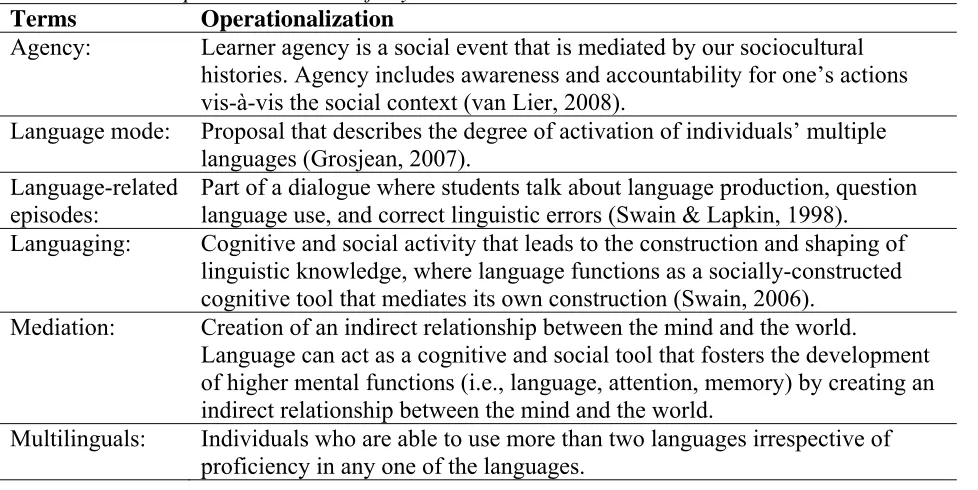
2.7 Operationalization of key terms ... 52
2.8 Research gap and questions ... 53
3 METHODOLOGY ... 55
3.1 Present study ... 55
3.1.1 Setting ... 55
3.1.2 Participants ... 57
3.1.3 Researcher-teacher roles ... 62
3.2 Procedure and materials ... 65
3.2.1 Pedagogical tasks ... 68
3.2.2 Posttests ... 75
3.2.4 Language proficiency test ... 79
3.2.5 Interviews ... 82
3.2.6 Language background questionnaire ... 83
3.2.7 Research journal ... 83
3.3 Data coding ... 83
3.3.1 Mediating functions ... 84
3.3.2 Languaging ... 90
3.3.3 L3 development ... 94
3.3.4 Interview data ... 95
3.4 Summary of methodology ... 95
4 RESULTS ... 97
4.1 Prelude: Overview of task implementation ... 97
4.2 Language mediation and collaborative tasks... 100
4.2.1 Cross-case analysis of L1, L2, and L3 use ... 101
4.2.2 Patterns of L1, L2, and L3 use during pedagogical tasks ... 105
4.2.3 Patterns of L2 mediation... 138
4.2.4 Concluding synopsis of general and specific functions of L1, L2, and L3 .. 139
4.3 Languaging ... 140
4.3.1 Languaging: Summary and cross-case analysis ... 140
4.4 L3 development ... 164
4.4.1 David: L3 development ... 164
4.4.2 Felip: L3 development ... 168
4.4.3 Marta: L3 development ... 171
4.4.4 Paco: L3 development ... 173
5 RESULTS: EXPLORING LEARNER BELIEFS ... 177
5.1 Exploring learner beliefs ... 178
5.2 Learners’ beliefs about language mediation ... 178
5.3 Functions of language mediation ... 185
5.3.1 Vocabulary support... 185
5.3.2 Discovering the grammar ... 189
5.3.3 Task requirements... 194
5.3.4 Social functions ... 195
5.3.5 Generating ideas ... 197
6 DISCUSSION AND CONCLUSION ... 199
6.1 Summary of the research ... 199
6.2 Research question 1 ... 200
6.2.1 General patterns of language mediation ... 201
6.2.2 Specific mediating functions ... 209
6.4 Research question 3 ... 226
6.5 Research question 4 ... 233
6.6 Implications and future directions... 236
6.6.1 Theoretical implications ... 236
6.6.2 Pedagogical implications ... 240
6.7 Limitations and future research ... 243
6.8 Final thoughts ... 247
REFERENCES ... 250
APPENDICES ... 270
Appendix A: Consent forms ... 270
Appendix B: Pedagogical tasks ... 273
Appendix C: French oral and written proficiency examinations ... 295
Appendix D: English oral and written proficiency examinations... 298
Appendix E: Interview protocol... 299
LIST OF TABLES
Table 1: Operationalization of key terms ... 52
Table 2. Overview of curriculum: Communicative, linguistic, and cultural goals ... 57
Table 3: Introduction of focal participants ... 58
Table 4: Timeline ... 67
Table 5: Task features ... 74
Table 6: Theme correspondences between posttests and pedagogical tasks ... 78
Table 7: Grammar deliberation codes ... 86
Table 8: Vocabulary deliberation codes ... 86
Table 9: Noticing/comparing ... 88
Table 10: Examples of task management ... 89
Table 11: Time and number of turns during task performance ... 99
Table 12: Time and number of turns (continued) ... 100
Table 13: General patterns of L1, L2, and L3 mediation ... 102
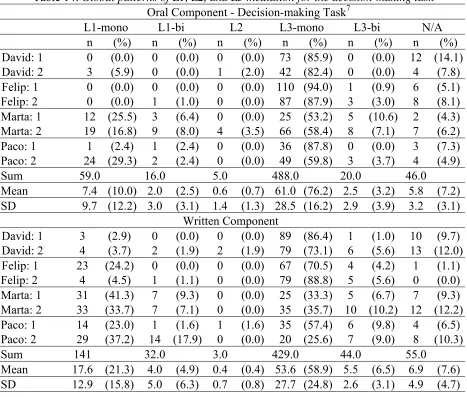
Table 14: Global patterns of L1, L2, and L3 mediation for the decision-making task ... 107
Table 15: Specific L1/L3 mediating functions for the decision-making task – David .... 108
Table 16: Specific L1/L3 mediating functions for the decision-making task – Felip ... 110
Table 17: Specific L1/L3 mediating functions for the decision-making task – Marta .... 111
Table 18: Specific L1/L3 mediating functions for the decision-making task – Paco ... 113
Table 19: Global patterns of L1, L2, and L3 mediation for the story completion task... 116
Table 20: Specific L1/L3 mediating functions for the story completion task – David .... 117
Table 21: Specific L1/L3 mediating functions for the story completion task – Felip ... 118
Table 23: Specific L1/L3 mediating functions for the story completion task – Paco ... 121
Table 24: Global patterns of L1, L2, and L3 mediation for the text reconstruction task 124 Table 25: Specific L1/L3 mediating functions for the text reconstruction task – David . 125 Table 26: Specific L1/L3 mediating functions for the text reconstruction task – Felip .. 127
Table 27: Specific L1/L3 mediating functions for the text reconstruction task – Marta 128 Table 28: Specific L1/L3 mediating functions for the text reconstruction task – Paco .. 130
Table 29: Global patterns of L1, L2, and L3 mediation for the dictogloss task ... 133
Table 30: Specific L1/L3 mediating functions for the dictogloss task – David ... 134
Table 31: Specific L1/L3 mediating functions for the dictogloss task – Felip ... 135
Table 32: Specific L1/L3 mediating functions for the dictogloss task – Marta ... 136
Table 33: Specific L1/L3 mediating functions for the dictogloss task – Paco ... 137
Table 34: Global Patterns of LREs for the focal participants ... 141
Table 35: Global Patterns of Resolution ... 144
Table 36: Percentages of correctly resolved lexis-based and form-based LREs ... 145
Table 37: Occurrences of LREs during decision-making task ... 148
Table 38: Patterns of resolution of LREs during the decision-making task ... 150
Table 39: Occurrences of LREs: Story completion ... 152
Table 40: Patterns of resolution during story completion task ... 155
Table 41: Occurrences of LREs: Text reconstruction ... 156
Table 42: Resolution during text reconstruction task ... 158
Table 43: Occurrences of LREs: Dictogloss task ... 159
Table 44: Patterns of resolution during dictogloss task ... 162
Table 46: Posttest scores: Correct responses ... 166
Table 47: Felip and L3 development ... 169
Table 48: Posttest scores: Correct responses ... 170
Table 49: Marta and L3 development ... 172
Table 50: Posttest scores: Correct responses ... 173
Table 51: Paco and L3 development ... 174
LIST OF FIGURES
Figure 1: Visual representation of the language mode continuum ... 25
Figure 2: Trilingual language mode ... 26
1 INTRODUCTION
1.1 Sociocultural theory and language mediation
A shared sentiment among many language teachers, teacher educators, and learners is
that the use of the first language (L1) in second language (L2) classrooms should be minimal, if
not avoided. Tracing the origins of this belief to the late nineteenth century, Cook (2001)
maintains that currently many educators take the position that L1 use should be minimized and –
in extreme cases – banned from the classroom. This claim is supported by the tenets of different
approaches to language teaching, including the Direct Method and the Audiolingual Method.
Yet, the limited or negative pedagogical value of L1 use in foreign language (FL) contexts may
not be empirically grounded. Research within a sociocultural theory (SCT) framework provides
increasing evidence that language functions as a symbolic tool that mediates our relationships
with the world and facilitates the development of higher mental functions (Lantolf, 2006, 2000c;
Swain & Lapkin, 2000).
The study of language development from an SCT perspective is based upon the work of
Lev Vygotsky, a Russian psychologist, who viewed learning as a socially situated and informed
activity. Vygotsky (1978, 1981) proposed the genetic law of cultural development to account for
cognitive and linguistic development in children. The genetic law of development stipulates that
internal mental functions such as memory and attention are preceded by an external stage that
unfolds in the social realm. Thus, according to Vygotsky:
From this perspective, speaking is intrinsically connected to thinking such that higher mental
functions are mediated by cultural and symbolic tools. Wertsch (1991), expanding on the work of
Vygotsky, maintains that to study the development of higher forms of thinking in isolation or in
a cultural, institutional, and historical vacuum has provided us with a fragmented understanding
of human cognition and argues that “attempts to understand the nature of mental processes by
analyzing only the static products of development will often be misleading” (p. 20).
The practice of studying fragmented pieces of a whole has been the dominant trend in the
field of traditional second language acquisition (SLA). SLA researchers have examined the role
of input, interaction, and output on language acquisition where negotiation of input has been the
locus of study (Gass & Mackey, 2006a, 2007b; Long, 1981, 1983). While SLA research has
focused on cognitive mechanisms underlying language acquisition processes, current views in
SLA are starting to recognize the importance of examining the sociocultural contexts where
language development occurs (Atkinson, 2011; Gass & Mackey, 2006b). These efforts can
provide us with a more accurate representation of the interconnectedness of thinking and
speaking that underlies human cognition. Despite these emerging directions and attempts to
bridge the gaps between cognitive and social factors, the field of SLA continues to have a strong
cognitive orientation.
Since the mid 90’s, Vygotskian ideas and concepts of cognitive development have been
applied to the study of L2 development. Building on the idea that higher mental functions first
appear on the social plane and are subsequently internalized, L2 researchers have begun to
examine the social and cognitive functions that language serves during interaction in order to
understand mental functioning and development in progress, that is, a process-oriented view of
(e.g. private speech) and with our peers. In brief, the study of situated learning provides us with a
holistic view of human cognition where language is a pervasive symbolic tool for learning.
Research has shown that L2 learners have at their disposal several symbolic tools: native
language (L1), the L2, private speech, and gestures (Lantolf, 2005, 2011). With these tools,
individuals form an indirect relationship, a mediated relationship, that allows the planning of
mental and material activities. In language teaching pedagogy, a popular belief is that L1 use
should be minimized (see e.g., Auerbach, 1993; Cook, 2001). However, from an SCT
perspective, L1s can provide a useful, if not necessary, scaffold for language learners. Current
literature reporting on the mediating functions of the L1 and the L2 during speaking and writing
activities is revisiting traditional conceptualizations of L1 use in language classrooms. One line
of work investigates the functions of L1 private speech, a form of externalized speech (Lantolf &
Thorne, 2006). The study of L1 private speech provides a window into developing mental
processes and empirical results suggest that language regulates mental activities (Appel &
Lantolf, 1994; Brooks & Donato, 1994; DiCamilla & Antón, 2004; Frawley & Lantolf, 1985;
McCafferty, 1994a, 1994b). A second area focuses on language produced during learner-learner
interactions and during student-teacher interactions while participating in L2 pedagogical tasks.
Tasks, in this context, are holistic activities that promote language development as a result of
language production (Samuda & Bygate, 2008). During the completion of tasks, learners discuss
task-related aspects, generate ideas, deliberate about grammar and vocabulary, and externalize
feelings and frustrations through the L1 (Alegría de la Colina & García Mayo, 2009; Antón &
DiCamilla, 1998; Swain & Lapkin, 2000). Results also suggest that L1 mediation during
learner-learner interaction is impacted by task type and learner-learner proficiency in the L2 (Storch & Aldosari,
While a number of researchers have reported on L1 mediation during learner-learner
interaction, Swain and Lapkin (1995, 1998, 2001) have investigated the dual functions of
language (i.e., social and cognitive) that unfold during interaction as learners complete a series of
tasks. They examined instances where learners use language to identify a gap in their linguistic
knowledge and to question their language production and use. Swain (2006) coined the term
languaging to capture the dual functions of language during moments of knowledge building.
Researchers have operationalized languaging as language-related episodes (LREs) and research
reporting on LREs shows that the process of using language to reflect on language facilitates the
completion of complex linguistic tasks (Swain & Lapkin, 1995, 1998) and fosters the
co-construction of linguistic knowledge (Swain & Lapkin, 2002). Previous studies have identified
various task-related and learner-related factors which affect LREs, including: (1) task type
(Swain & Lapkin, 2001); (2) pair dynamics (Kim & McDonough, 2011; Storch, 2001, 2002a,
2002b); and (3) language proficiency (Kim & McDonough, 2008; J. Williams, 1999, 2001).
Moreover, socioculturally informed empirical research has established a link between languaging
and L2 development (Swain & Lapkin, 1998, 2001). With the claim that languaging leads to L2
development, a select number of studies have investigated task-related and participant-related
variables that impact the outcome of languaging on L2 development (Kim & McDonough, 2008;
Kim & McDonough, 2011; Leeser, 2004; McDonough & Sunitham, 2009; Suzuki & Itagaki,
2009; Swain, Lapkin, Knouzi, Suzuki, & Brooks, 2009; Watanabe & Swain, 2007, 2008).
Although there is evidence of the pervasiveness of language as a symbolic tool, additional work
in this area is warranted, especially with learners of third languages (L3s).
Learner-learner interaction during L2 tasks provides opportunities for learners to engage
development). To further understand the functions of native language mediation in
classroom-based settings, drawing on learner beliefs is highly relevant. Although there appears to be some
consensus that L1 mediation can provide some benefits from the learners’ perspective (Mora
Pablo, Lengeling, Zenil, Crawford, & Goodwin, 2011; Rolin-Ianziti & Varshney, 2008), the
specific functions that their languages serve during the interaction remains underexplored. Thus,
one-on-one interviews stand to inform our still limited understanding of the role of language
mediation that occurs during learner-learner interaction.
1.2 Third and additional language development
With a population approaching 7 billion people (Index Mundi, 2012) and with more than
6,900 living languages (Ethnologue, 2012), bilingualism and multilingualism are more common
in the world today than monolingualism (Grosjean, 2008; Hammarberg, 2010; Wei, 2008).
Despite these facts, current theory and empirical research in SLA tend to ignore the uniqueness
underlying the development of multilingual competencies, which characterizes more than half of
the world’s population. A partial explanation for the dearth of empirical works on
multilingualism lies in the conceptualization of the goals and aims of SLA research. In their
introductory textbook, Gass and Selinker (2008) define SLA as follows:
SLA refers to the process of learning another language after the native language has been learned. Sometimes the term refers to the learning of a third or fourth language. The important aspect is that SLA refers to the learning of a nonnative language after the learning of the native learning. The second language is commonly referred to as the L2. As with the phrase “Second language,” L2 can refer to any language learned after learning the L1, regardless of whether it is the second, third, fourth, of fifth language (p.7)
Similar definitions abound in introductory textbooks, glosses, and references books (see also
Block, 2003 for a discussion; Lightbown & Spada, 2006; Mitchell & Myles, 2004; Ortega,
different processes than the acquisition of an L2, a belief is that the process of acquiring an L2 or
an L3 is similar. This claim may be erroneous and the adoption of a reductionist view may not
bring to the surface the unique processes at work while acquiring L3s (De Angelis, 2007; De
Angelis & Dewaele, 2009, 2011; Hammarberg, 2010).
Research in the field of third and additional language acquisition (TALA), primarily
originating in Europe, is beginning to emerge. Despite the recency of research on L3
development, a growing body of work shows that the underlying mechanisms of L2 and L3
acquisition differ (see Cenoz & Jessner, 2009; De Angelis, 2007 for a review). Research findings
show that multilingual learners have access to additional learning and metacognitive strategies
(Cummins, 2007; Herdina & Jessner, 2002; Mißler, 2000) and that they benefit from heightened
linguistic awareness (Herdina & Jessner, 2002; Jessner, 1999, 2005, 2006). These claims,
however, have been examined primarily in Europe. Given that the study of multilingual learners
is beset by a number of factors such as age of acquisition, language typology, simultaneous and
consecutive acquisition, recency of exposure and acquisition, and crosslinguistic interaction
(Aronin & Hufeisen, 2009; De Angelis, 2007; De Angelis & Dewaele, 2011; Jessner, 2006),
expanding the scope of research to different parts of the world is critical. Thus, to reach a deeper
appreciation of L3 development, empirical studies should embrace the dynamic and complex
processes at work with L3 learners in a variety of contexts.
1.3 Motivation for the study
Learning an L3, similar to learning an L2, is a complex, dynamic, and long-term
endeavor. Due to globalization, increased mobility, and the teaching of English as a Lingua
Franca, multilingualism is becoming the norm in a number of contexts worldwide (Jessner,
cognitive phenomenon that is in fact real and pervasive. Moreover, given that SLA research has
been investigating isolated pieces of the whole process, it is imperative to embrace an
epistemology that accounts for the interconnectedness of social and cognitive factors. SCT, a
theory of mediated mental development, views language and communication events as catalysts
for the development of higher mental functions. Given the close relationship between cognition
and social activities, adopting a Vygotskian perspective for the study of L3 development as a
result of participating in various types of pedagogical tasks could expand our understanding of
the role of language mediation in the development of an additional language.
To date, research from an SCT perspective has focused primarily on uncovering the
functions of an L1 in the development of an L2, and only a select number of studies have
examined the functions of an L2 on the development of an L3. Limiting the scope of research to
the relationship between L1s and L2s is problematic on a practical and theoretical basis. In terms
of practical concerns, multilingualism is the norm in the world and thus multilingual learners
outnumber L2 learners and it is imperative that we better understand the processes of L3
development. In terms of theoretical concerns, theories of language development should address
the unique cognitive and social dimensions of L3 development.
Pedagogical tasks are used by teachers and researchers alike in order to promote language
development and to investigate the cognitive and social processes that are at work. From an SCT
perspective, a small number of researchers have examined the impact of pedagogical tasks on
L1, L2, and L3 mediation and on the specific functions that these languages serve to support the
development of higher mental functions. To date, research findings remain inconclusive and
pedagogies in all pedagogical contexts, it is critical that we understand what unfolds between
learners of an L3 during a series of pedagogical tasks in authentic FL classrooms.
During the completion of pedagogical tasks, learners discuss lexical and grammatical
gaps (e.g., lexis-based LREs and form-based LREs). The opportunity to participate in sustained
conversation and to question language is critical for language development. Using LREs as a
construct, a number of studies have shown a complex interaction between task type, the
production and resolution of LREs, and language patterns. Similarly, LREs produced during
task-based interaction have been shown to lead to language development; however, the
relationship between LREs and L3s has yet to be investigated. Therefore, at this junction,
researchers should continue to examine the social and cognitive functions of language during
languaging between learners and extend the work to learners of L3s in intact classrooms.
Finally, obtaining both an emic and an etic perspective on language development is
critical. Thus, learners’ beliefs and interpretations of language mediation and pedagogical tasks
need be taken into consideration when examining the processes of L3 development. In light of
the aforementioned gaps, the present study investigated the mediating functions of multilingual
learners’ languages in an L3 FL classroom.
1.4 Present study
The present multiple case study was conducted with bilingual Spanish (L1) – English
(L2) learners of French as an L3 in an intact FL classroom and was guided by four overarching
and interconnected goals. First, the study explored the mediating functions that the L1 and the L2
of four focal participants served while participating in a series of pedagogical tasks in an L3
classroom-based context. This analysis provides rich and descriptive accounts of language
one particular context. Second, the study investigated languaging (i.e., LREs) during a series of
pedagogical tasks that included different task features to examine task type effects on language
patterns and on the occurrence and resolution of LREs. Third, the present investigation examined
if and when the production of LREs in this context leads to L3 development. Finally, to provide
a holistic interpretation of the social and cognitive processes at work during the completion of
collaborative tasks, the study included the focal participants’ perspectives concerning language
mediation. Also, to gain an emic perspective of the classroom activities that unfolded during a
semester-long task-supported language classroom, I served a dual function: I was both the
teacher and the researcher. The research was thus guided by the following four research
questions:
RQ 1: What mediating functions do language(s) serve during four types of collaborative tasks,
over time in an L3 classroom?
RQ 2: How does task type impact the occurrence and resolution of LREs in the L1, L2, and L3
by individual learners?
RQ 3: How do LREs lead to L3 development?
RQ 4: What are learners’ beliefs about using their languages during collaborative tasks?
1.4.1 Organization of the study
In Chapter 2, I provide a comprehensive review of the literature. The review begins with
the theoretical underpinning of SCT and discusses, in detail, two core concepts of SCT: language
mediation and the zone of proximal development (ZPD). The literature review then presents key
empirical advances on L3 development. Finally, the review continues with the literature
reporting on (1) L3 learners and multilingualism, (2) the role of language mediation, (3)
study approach that was adopted. From there, I provide a detailed description of the setting and I
introduce the four focal participants. Chapter 3 concludes with a detailed description of the data
collection procedures and the materials that were developed. Chapter 4 and Chapter 5 present the
results in light of the four research questions. Chapter 4 answers research questions 1-3; it
provides a cross-case analysis and it is followed by detailed accounts of each focal participant’s
performance during the completion of four types of collaborative tasks. Chapter 5 answers
research question 4. It presents the findings regarding the focal participants’ beliefs about L1 and
L2 mediation in the classroom. In Chapter 6, I discuss the findings for each research question in
light of previous studies. I conclude the chapter by considering the theoretical and pedagogical
implications drawn from the study, addressing the limitations of the present study, and proposing
2 LITERATURE REVIEW
2.1 Fundamental concepts of sociocultural theory
Exploring cognitive processes underlying L2 development has been one of the core areas
of study in SLA, with researchers investigating the role of input, interaction, and output on
language development (Gass & Mackey, 2006a). However, critics argue that SLA researchers
place too much emphasis on internal learner capacities and tend to ignore critical social, cultural,
and affective factors that may impact interaction and, consequently, the development of
additional languages (Block, 2003; Lantolf, 1996). In response, a number of researchers have
begun using an SCT framework developed by Vygotsky. Vygotsky proposed SCT to study the
development of cognition in children. SCT seeks to connect individuals’ cognitive development
to the sociocultural settings in which they function (Vygotsky, 1978). Wertsch (1991) identified
three major recurring themes in Vygotsky’s work: (1) the use of a genetic analysis to study
higher mental functions, (2) the role of social dimensions in the development of higher forms of
thinking, and (3) the claim that thoughts and actions are mediated by symbolic and physical
tools.
In order to study the fluid nature of the development of human cognition, Vygotsky relied
on genetic analysis which is comprised of four genetic domains: (1) the phylogenetic domain, (2)
the sociocultural history domain, (3) the ontogenetic domain, and (4) the microgenetic domain
(Vygotsky, 1981). Vygotsky saw how the study of these interrelated genetic domains could
provide us with a holistic understanding of developmental processes underlying human
cognition. The first of these, research within the phylogenetic domain, consists of comparing
limited to their physical realities, humans rely on physical and symbolic tools, especially
language, to engage in problem solving activities. The use of these tools is what enables humans
to mediate and alter their socially organized activities and think beyond the confines of the
present context. According to Vygotsky, the use of mediational tools is what distinguishes
humans from apes. The second, the sociocultural history domain, accounts for the distinctions
between biological transformations and historical transformations. Historical processes are thus
responsible for cultural development. According to Vygotsky (1930, as cited in Wertsch, 1985)
“the process of the historical development of human behavior and the process of its biological
evolution do not coincide; one is not a continuation of the other. Rather, each of these processes
is governed by its own laws” (p. 31). In other words, while changes in biological functions
govern development in the phylogenetic domain, the emergence and change of psychological
tools govern the development within the sociocultural history domain (Wertsch, 1985). Tools
become less dependent on the original spatiotemporal context. The third domain is the
ontogenetic domain. Vygotsky (1978) argues that development involves two interconnected lines
of development: the natural line of biological development, closely aligned with elementary
mental functions, and the social or cultural line (i.e., higher mental functions). Development in
the ontogenetic domain is the result of the integration of both biological and cultural
development: children are first guided by biological constraints and are quickly influenced by
their cultural environment. According to Vygotsky, the locus of control is, at first, external (i.e.,
it resides in our social environment). However, development in the ontogenetic domain marks a
change such that outside influences become internalized and thus alter higher forms of thinking.
In order to provide a unique explanatory framework of human development, it is necessary that
domain, is where one can study the short-term formation of psychological processes. In this
domain, development can occur during brief instances: “the development in question can be
limited to only a few seconds, or even fractions of seconds” (Vygotsky, 1978, p. 61). Therefore,
to study and understand the cognitive processes underlying the development of higher forms of
thinking, researchers should consider development that occurs during a single training phase of
an experimental task. Another important aspect is that development within the microgenetic
domain is not stable or predictable and development is viewed “as fundamental qualitative
transformation or ‘revolutions’ associated with changes in the psychological tools” (Wertsch,
1985, p. 81). Although the four domains form an integrated system (Wertsch & Tulviste, 1992),
Vygotsky and many of his followers conducted most of their work in the ontogenetic domain
because it is only possible to observe the entirety of development in this domain (Wertsch, 1985,
1991).
Today, Vygotskian principles are being applied to the study of L2 development (Block,
2003; Lantolf, 2006, 2000c; Ohta, 2000; Swain, 2000; Swain, Kinnear, & Steinman, 2011).
When investigating the process of L2 learning, the ontogenetic and microgenetic domains highly
inform our understanding of the developmental processes. Although researchers may attempt to
study development in a single domain, Lantolf and Thorne (2006) caution researchers that “in
studying the development of particular linguistic processes, for instance, at the microgenetic
level, we must recognize that this is likely to have consequences for the continued ontogenetic
development of the person” (p. 57). This perspective offers a more holistic understanding of L2
development. The present study will look for evidence of development that takes place within
The second theme in Vygotskian approaches to the study of the mind is the role of social
dimensions in the development of higher forms of thinking. The basic principle is that the
development of human cognition can only be understood by considering the social environment.
Activities that unfold in the social realm impact our unique mental functions. This notion was
captured by the following statement:
[a]ny function in the child’s cultural development appears twice, or on two planes. First it appears on the social plane, and then on the psychological plane. First it appears between people as an interpsychological category, and then within the child as an intrapsychological category. This is equally true with regard to voluntary attention, logical memory, the formation of concepts, and the development of volition… [I]t goes without saying that internalization transforms the process itself and changes its structure and functions. Social relations or relations among people genetically underlie all higher functions and their relationships (Vygotsky, 1978, p. 57).
From this perspective, the social environment is intrinsically connected to thinking and this
development occurs within the zone of proximal development (ZPD), a concept that will be
discussed in detail below.
The third theme, and one of the core concepts of an SCT of mind, is mediation. Vygotsky
(1978) explains that the development of higher forms of thinking is mediated by culturally and
socially constructed artifacts. Higher mental functions include memory, attention, rational
thinking, emotion, and learning and development (Lantolf & Thorne, 2006). Artifacts are either
material or conceptual. The former includes physical tools developed by humans and the latter,
also termed symbolic tools, includes spoken and written language and gestures. Physical tools
are externally oriented to exert control over the environment whereas symbolic tools are
2.1.1 Mediation
From an SCT perspective, researchers explore how language permits humans to create an
indirect relationship, or a mediated relationship, between the mind and the world. During social
and communicative events, language can serve interpersonal functions and intrapersonal
functions: through language, humans establish social contact and engage in social interactions
with others and with the self (Lantolf & Pavlenko, 1995). Intrapersonal functions take the form
of egocentric speech or inner speech. Egocentric speech is a precursor to inner speech and occurs
in social forms thereby providing a window into the development of higher mental functions.
Inner speech enables humans to plan and regulate their activity (Wertsch, 1985) and is the final
phase in the development of higher mental forms of thinking. Over time, egocentric speech
becomes internalized indicating self-regulation and control over mental activities.
As it relates to L2 development, learners use language as a social and cognitive tool to
mediate the language learning process (Antón & DiCamilla, 1998; Brooks & Donato, 1994;
Lantolf, 2000a, 2000b, 2004, 2011; Swain, 1995; Swain & Lapkin, 1998, 2000). To date, the
mediating functions of language have been the subject of inquiry in different contexts (e.g., L2
and FL contexts) and research settings (e.g., laboratory-based and classroom-based settings). To
investigate the specific functions of language, research has relied on various tasks, such as
collaborative tasks (e.g., story completion tasks, dictogloss tasks), individual writing tasks,
problem-solving tasks, and introspective methods (e.g., think-aloud protocol). Findings show
that language serves interpersonal functions which help learners gain control over the task and
their mental activities thereby making the activity more manageable (Brooks & Donato, 1994;
DiCamilla & Antón, 2004; Villamil & de Guerrero, 1996). Language also serves intrapersonal
L2 literature, is comparable to egocentric speech and is defined as a “form of externalized speech
deployed by adults to regulate their own mental (and possibly physical) activity” (Lantolf &
Thorne, 2006, p. 75). Several researchers investigate the mediating functions of private speech
(Antón & DiCamilla, 1998; Brooks & Donato, 1994; Centeno-Cortés & Jiménez Jiménez, 2004;
DiCamilla & Antón, 2004; Frawley & Lantolf, 1985; Ohta, 2001). Research shows that when
faced with cognitively challenging tasks, adults externalize their speech which helps them gain
control over the activity. It can thus be said that language used on both interpersonal and
intrapersonal planes plays a central role in the development of higher mental functions.
The development of human cognition is also marked by qualitative changes in the ability
to self-regulate our thoughts and actions. Wertsch (1979, as cited in McCafferty, 1994a)
maintains that self-regulation is preceded by two intermediary stages: object-regulation and
other-regulation. In the early stages of child cognitive development, thoughts and actions are
regulated by physical artifacts found in their surroundings. During this stage, children rely on the
use of objects to assist mental functions. The second stage, other-regulation, behaviors are
shaped by explicit and implicit help from a more capable peer. Once a child has control over
her/his thoughts and actions, the child is able to complete an activity independently.
Self-regulation is what enables children to plan and organize their actions and thoughts. The concept
of regulation has also been applied to the study of language development (McCafferty, 1994b).
Another key concept of SCT concerning cognitive development is the ZPD which is discussed in
the following section.
2.1.2 Zone of proximal development
According to SCT, social forms of mediation occur within the learners’ ZPD. The ZPD is
problem solving and the level of potential development as determined though problem solving
under adult guidance or in collaboration with more capable peers” (Vygotsky, 1978, p. 86).
Vygotsky makes a distinction between two levels of development, the child’s actual level of
development and the child’s potential level of development. He explains that knowing what a
child is able to do under the guidance of a more knowledgeable peer is more informative of their
developing mental abilities than knowing what they are able to do independently. He also claims
that the child’s mental activities are distributed between the child and the adult (or expert).
Therefore the ZPD is determined or negotiated between two individuals (Wertsch, 1985) as it
unfolds during interaction.
The ZPD is a useful construct to explore how learning occurs during interaction. Ohta
(1995) defines the ZPD for L2 development as “the difference between the L2 learner’s
developmental level as determined by independent language use, and the higher level of potential
development as determined by how language is used in collaboration with a more capable
interlocutor” (p. 96). In earlier work, the capable interlocutor was the adult, researcher, or
teacher (Aljaafreh & Lantolf, 1994; Lantolf & Aljaafreh, 1995). However, it has been argued that
during learner-learner interaction, one learner can offer help to a less knowledgeable peer,
providing the less knowledgeable peer opportunities to participate in the interaction and engage
in knowledge-building (Ohta, 1995, 2001). Moreover, within a single context or activity, the
learner’s role can shift between the less and more knowledgeable peer (Donato, 1994; Guk &
Kellogg, 2007; Ohta, 2001). Learning then does not occur as a result of participating in
collaborative activities; learning occurs within the ZPD between learners who collaborate and
co-construct knowledge where the learners are sometimes the expert and sometimes the novice
sum, learning within the ZPD is a potentially shifting and complex interpersonal process, one
which requires further empirical attention.
To study L2 development, the SCT framework takes into account a more comprehensive
and complex set of factors which shape and influence the creation of the ZPD. These factors
include the learners and their social and cultural histories, their individual goals, their symbolic
and physical tools, their peers, and their teachers (Aljaafreh & Lantolf, 1994). As an analytical
tool, the ZPD can be used to examine what learners are able to do with language individually and
in collaboration with their partner. Moreover, researchers can examine the dynamic and irregular
nature of language development within the microgenetic domain as it enables researchers to
explore how knowledge is constructed by the learners in each interactional turn. In sum,
collaborative activities that provide learners with opportunities to transform their higher mental
functions are therefore critical for L2 researchers who explore how learners pool their resources
to create knowledge within their ZPD.
The SCT theoretical perspective that frames language as a cognitive tool is steadily
gaining more attention. To date, empirical studies have been conducted with learners of an L2 in
a number of contexts including the French immersion setting, the FL context, and the ESL
context. Due to globalization, increased mobility, and the teaching of English as a Lingua
Franca, multilingualism is the norm in the world today (De Angelis, 2007; Grosjean, 2008;
Hammarberg, 2010; Jessner, 2006; Sollors, 2009). Yet, few studies have explored L3
development from this perspective. The roles and mediating functions of learners’ multiple
languages remain an elusive area of inquiry. As a result, it is critical that we broaden the scope of
cognitive and social functions of multilingual learner’s languages in the development of higher
mental functions.
2.2 Multilingualism and L3 development
Research on multilingualism and L3 development is still in its infancy in comparison to
the study of L2 development. Unlike SLA researchers who maintain that the acquisition of a
language beyond the L2 engenders similar mechanisms as the acquisition of an L2 (Gass &
Mackey, 2006a, 2007b; Gass & Selinker, 2008; Long, 1981, 1983), researchers investigating the
acquisition of L3s and additional languages argue that the processes underlying L3 development
are more complex than L2 development due to the greater number of factors at play (Aronin &
Hufeisen, 2009; De Angelis, 2007; De Angelis & Dewaele, 2011; Jessner, 2006). To
contextualize and understand recent findings in the field of L3 development, a necessary first
step is to provide a definition of key terms.
De Angelis (2007) identified four terms that are used to refer to the field of study: (1)
Multiple Language Acquisition, (2) Multilingual Acquisition, (3) Third Language Acquisition,
and (4) Third or Additional Language Acquisition (TALA). She argues that each of these terms
have some shortcomings. For example, the first of these, Multiple Language Acquisition,
suggests the simultaneous acquisition of languages rather than the acquisition of different
languages over time; the term Multilingual Acquisition creates a disconnect with SLA and SLA
research; the term Third Language Acquisition is symptomatic of the term SLA which highlights
the study of the third language only thus ignoring the study of additional languages. She explains
that to more accurately represent the field of study, she prefers the term TALA. The term TALA
languages that were learned beyond the L2. Following De Angelis (2007), when alluding to the
field of inquiry, I will use the term TALA.
A second consideration is the appropriate term to describe individual learners. Currently,
a distinction between bilinguals and multilinguals is not always clear (De Angelis, 2007; Kemp,
2009). For example, Grosjean (2010) defines bilinguals as “those who use two or more
languages (or dialects) in their everyday lives” (p. 4). In turn, Saville-Troike (2012) defines
multilinguals as individuals who are able to use two or more languages (p. 8). To capture the
idea that L3 development may be different from L2 development, a better description of
bilingual and multilingual learners is warranted. In the present study, multilinguals are
individuals who are able to use more than two languages. In other words, multilinguals are,
minimally, learning an L3.
Finally, there are some inconsistencies in terms describing the language that is being
learned. In the field of SLA, researchers refer to the first second language as the L2 and refer to
multiple languages learned after the L2 as L2s. This only captures a distinction between the L1
and the L2(s). Following Williams and Hammarberg (1998), in the present study, the L1 is the
native language and the L3 is the target language. All other languages are labeled L2s. While this
may obscure differences between learners who, in sequential order, are learning an L5 (e.g.,
David), it does capture the idea that each learner has had some experiences acquiring a language
beyond the L2. Thus, to recapitulate, the present study is rooted in the field of TALA and is
concerned with multilinguals learning an L3.
TALA research is beset by a number of factors. Next, I discuss three of the main factors:
(1) order of acquisition, (2) contexts of acquisition, and (3) typological similarities of languages.
For instance, in learning an L2, there are only two possible sequences of acquisition: sequential
acquisition (L1→L2) and simultaneous acquisition (L1 + L2). On the other hand, with learners
of an L3, there are four possible sequences of language development: (1) consecutive acquisition
(L1→L2→L3), (2) simultaneous acquisition of three languages (L1+L2+L3), (3) simultaneous
acquisition of two languages after the L1 (L1→L2+L3), and (4) simultaneous acquisition of two
languages before the L3 (L1+L2→L3). Cenoz (2000) explains that given these diverse
trajectories, the study of L3 development may be even more complex than the study of L2
development. The study of L3 development is further complicated when considering
interruptions in the study of one of the languages. Learners of an L3 may find themselves only
using a subset of their languages at any given time and may experience attrition in one or more
of their languages.
In addition to the order of acquisition, the contexts where languages are acquired present
some additional challenges to the study of L3 development. In a first instance, similar to L2
learners, the quantity of exposure to the target language varies in each situation. For example,
naturalistic settings may provide more exposure to the target language than classroom-based
settings, especially in FL contexts; however, in the case of multilingualism, the amount of
exposure to the native and the non-native languages is even more diverse. In addition to the
exposure resulting from contexts, the possible combinations of formal instruction in
classroom-based contexts and naturalistic contexts are greater. As such, when studying L3 development,
multiple situational and social factors may impact our understanding of the processes at play.
A third factor that impacts the development and the study of L3 development is language
typology. Languages that are typologically similar share phonological, morphological, and/or
only two languages; however, in L3 development, the typological distance of both the native and
the nonnative languages should be taken into account. For instance, in this study, the typological
distance between Spanish and French is smaller than the distance between English and French.
These relative distances between the L1 and the L2 may impact how languages are processed
and these distances need to be considered in light of the target language. In sum, the order of
acquisition, the contexts of acquisition, and the typological distance between languages are
important factors to consider in the study of multilingualism.
Similar to the field of SLA, the theoretical frameworks that inform the majority of L3
research adopts a cognitive approach. The areas that have received more attention include
cross-linguistic influences (CLI), metacross-linguistic awareness, and the multilingual lexicon (Cenoz, 2001;
De Angelis & Dewaele, 2009). While these three areas contribute important information, in what
follows I provide an overview of the key findings from the first two areas of research: CLI and
metalinguistic awareness.
The first of these, the study of CLI, began to emerge in the 1970s and saw rapid growth
in the 1980s. The term CLI, proposed by Sharwood Smith and Kellerman (1986), includes the
study of language transfer, interference effects between languages, borrowing, and avoidance
(Cenoz, 2001). While SLA research on CLI is chiefly concerned with the transfer of L1
knowledge onto an L2, L3 research examines the transfer of native and nonnative languages on
L3 development.
Several factors appear to impact the quantity of CLI on the development of L3s. For
instance, CLI is impacted by (1) language distance and typology, (2) context of exposure, (3)
proficiency in the nonnative languages (and in some cases in the L1), (4) recency of use, and (5)
examined in the areas of pronunciation, lexis, morphology and syntax (see e.g., Cenoz, Hufeisen,
& Jessner, 2001). Research findings on CLI are complex and remain inconclusive.
A number of studies show that CLI is more likely to occur between typologically similar
languages (Cenoz, 2001; Cheug, Matthews, & Lan Tsang, 2011; De Angelis, 2005; Fouser,
2001; Sanchez, 2011). However, there is evidence that CLI comes from more distant languages,
regardless of the native/nonnative status (Bono, 2007, 2011; Gibson, Hufeisen, & Libben, 2001).
For instance, Bono (2011) examined lexical transfer with speakers of French (L1) and English
(L2) learning Spanish (L3) and found that learners often activate L2 lexical equivalents during
informal conversations. Gibson, Hufeisen, and Libben (2001) examined whether typologically
related L1s would facilitate or hinder the production of German (L3) prepositional verbs. In their
study, they did not find any significant differences: Russian L1 learners and Chinese L1 learners
performed equally well. Two influential perspectives have been proposed that could explain CLI:
the psychotypological perspective and the ‘L2 Factor’ perspective.
The study of language typology is concerned with identifying structural similarities and
differences between languages. While learners may in fact rely on a language that is
typologically more similar, the perceived distance between languages may also impact CLI.
Kellerman (1983) proposed the term psychotypology to refer to the language that is perceived as
typologically closer to the target language. According to the psychotypological perspective,
learners of L3s will turn to the language that they perceive as being closer to the target language:
this could be either Language A or Language B. In the present context, Spanish L1 learners may
perceive French (Language A) to be more similar to Spanish than English (Language B).
The second perspective, ‘L2 Factor’, examines the status of the L2. Leung (2007)
The ‘second language (L2) factor’ in L3 acquisition refers to the general tendency to transfer (representations) from L2(s) rather than L1. In online processing/ performance terms, ‘L2 status’ is usually used to expresses the idea of general tendency to activate L2(s) rather than L1 (p.102).
Hammarberg (2001) and Williams and Hammarberg (1998) were the first to consider
CLI from both native and nonnative languages. They hypothesized that learners may rely on
their L2 to learn an L3 because the L2 and the L3 both share the status of a FL (1998).
Hammarberg (2001) put forth two possible explanations for the ‘L2 Factor’. In a first instance,
learners may be aware of the different mechanisms underlying the acquisition of an L3 and may
reactivate L2 mechanisms that facilitated the acquisition of the L2. A second explanation is that
learners may subconsciously suppress the L1 given that it is non-foreign. As a result, L2
strategies become more relevant to the acquisition of the L3.
While language (psycho)typology may offer some explanations to account for CLI,
others maintain that the context in which speakers use and learn additional languages may also
account for CLI. Grosjean argues that (1998, 2007, 2008) the interlocutors, the setting, and the
topic in each context impacts the degree of activation of the different languages: what is known
as the language mode. The language mode originally focused on bilinguals. In order to expand
on the language mode, it is useful to consider two dominant views of bilingualism: the
monolingual view of bilingualism (i.e., the fractional view of bilingualism) and the bilingual
view of bilingualism (i.e., the holistic view). The monolingual view assumes that bilinguals have
two independent language systems and sets of competencies. According to this view, a bilingual
is the equivalent to the sum of two monolinguals. Bilinguals are evaluated in light of
monolingual-like command of their languages and thus reflect a monolingual bias (Block, 2003;
competent users of a complete system that is qualitatively different. Bilinguals rely on different
languages for different purposes in order to satisfy the needs of different domains and contexts
(Grosjean, 2007, 2008).
The relationship between the activation of two languages is visually represented in Figure
1 (Grosjean, 2008). Language A (depicted by the dark square) is the base language and is highly
activated. Language B is depicted by the three hypothetical positions on the vertical axis. At
position 1, the bilingual is said to be in monolingual mode such that Language B is only slightly
activated. Conversely, at Position 3, the speaker is said to be in bilingual mode such that both
Language A and B are highly activated. Movement along the monolingual-bilingual continuum
is idiosyncratic: some learners could subconsciously position themselves on the monolingual
mode whereas others will be on the other end of the continuum.
Figure 1: Visual representation of the language mode continuum
In the present study, the degree of activation of the L1 and the L2 may depend on the
interlocutors, the formal classroom contexts, the pedagogical tasks, and perhaps the research
factor. The participants in the study all shared the same L1; however, the interlocutors’
their behaviors. Also, the context could impact the CLI: in this particular context, learners are
learning an L3. The L2 may therefore be less activated than in other contexts. Finally, research
factors are also hypothesized to impact the degree of activation. Learners are completing a series
of pedagogical tasks that are devised to prompt the activation of their L3. Thus, it is reasonable
to anticipate that French, the target language, is more highly activated than the L1 or the L2.
Grosjean (2008) hypothesizes about the relationship between three languages. He
proposes an extension of the language mode to multilingualism. He proposes that trilingual
speakers can be on the monolingual mode, bilingual mode, and/or trilingual mode, as captured
by Figure 2. As depicted in the model, when a speaker is in a monolingual mode, only one
language is activated. This is depicted by the dark square. The other two languages, said to be
de-activated, are represented by the thin dark lines. This situation could arise when a trilingual
speaker is in a context where everyone shares the same L1 or in the presence of a monolingual
speaker. In the bilingual mode, two languages are activated (depicted by the dark square and the
square with dark lines). This situation could arise with a trilingual speaker interacting with
bilinguals or in situations where there are two monolinguals from different backgrounds. Finally,
the trilingual mode is when a learner has all three languages activated to different degrees. For
the present study, the learners could potentially be in the trilingual language mode because they
all share the same languages.
Monolingual mode Language A Language B
Language C
Bilingual mode Language A Language B
Language C
Trilingual mode Language A Language B
Similar to the bilingual language mode, activation is contingent upon several factors and
is not uniform or universal. In review, several factors appear to impact CLI including
psycho(typological) distance, ‘L2 Factor’, and the context of use. Although the aim of the
present study is not to examine CLI of the L1 and L2 on L3 acquisition, the psychotypological
perspective and the ‘L2 Factor’ perspective may offer some insights into the quantity of Spanish,
English, and French that is used in a formal classroom setting. In order to provide a more holistic
understanding of the roles of language mediation in L3 development, factors that impact the
degree of L1 and L2 activation, such as the formal language classroom context, should also be
acknowledged.
A second area of study that has emerged in the field of L3 development is metalinguistic
awareness. Building on the notion that learning an L2 is cognitively different from learning an
L3, Hammarberg (2010) maintains that L2 knowledge enriches the process of learning an L3
because learners can draw on metalinguistic knowledge derived from previous language learning
experiences. Although metalinguistic awareness has been operationalized differently and
inconsistently in the field, in the present study, metalinguistic awareness is operationalized as an
“ability to focus attention on language as an object in itself or think abstractly about language,
and, consequently, to play with or manipulate language” (Jessner, 2006, p. 42).
The notion that L3 learners have heightened metalinguistic awareness is motivated by the
finding that bilinguals display greater awareness about language than monolingual learners (De
Angelis, 2007; Fouser, 2001; Herdina & Jessner, 2002; Jessner, 1999, 2005; Lasagabaster, 2001;
Thomas, 1988). The idea that multilingual learners are in an advantageous position is influenced
by the work of Cummins (1976, 1979). He proposed two hypotheses to explain the impact of L1
Threshold Hypothesis. The first of these, the Developmental Interdependence Hypothesis, is
built on the notion that the knowledge of the L1, irrespective of attained proficiency in the L1,
can be transferred towards L2 development. The second, the Threshold Hypothesis, is built on
the assumption that there are two thresholds that will impact cognitive development and
consequently language development. This hypothesis holds that learners must attain a certain
level of proficiency in the L1 for there not to be any negative impact on the language acquisition
and learners must reach a second threshold to experience beneficial impacts on language
development.
These proposals were later extended to study of L3s. Lasagabaster (2001), drawing on the
Developmental Interdependence Hypothesis, maintains that learners of an L3, regardless of
proficiency levels in the L1 and in the L2, could experience positive CLI. Thus, learners of an L3
can draw on knowledge of native and nonnative languages. According to the Threshold
Hypothesis, Lasagabaster explains that the first threshold is less relevant but that to experience
some benefits, a certain proficiency in the L2 should be attained.
In review, the study of L3 development shows that there are several factors that impact
CLI and the activation of the L1 and the L2. Also, research shows that multilingual learners may
have a more elaborate understanding of language structures and use given their heightened
metalinguistic awareness. Yet, the majority of the studies have approached the study of L3
development from a cognitive perspective and the study of L3 development from an SCT
perspective remains underexplored. Given the recent advances in the field of SLA (i.e.,
integration of concepts and ideas from an SCT perspective (Gass & Mackey, 2006b)), I would
the role of the L1 in L2 development, it would seem reasonable to find evidence of native and
nonnative mediation in L3 development.
2.3 Tasks in language development
To review, I have introduced the theoretical framework that has informed the present
study: SCT of mind. From this perspective, one of the goals is to examine the mediational means
deployed by individuals during language-related activities. I then presented current advances in
TALA and identified an important gap: the exploration of L3 development from an SCT
perspective. One important empirical question is, what symbolic tools do multilinguals rely on to
mediate the development of higher mental functions? In the present study, I investigated the
roles and functions of native and nonnative languages and examined the impact of pedagogical
tasks. In the field of SLA, there is growing consensus that pedagogical tasks provide learners a
context for using language which could impact language development. Next, I introduce the
construct of pedagogical tasks and major areas of study.
Since the mid 1980s, a number of definitions of tasks have become available. One
influential definition, proposed by Ellis (2003), is:
A task is a workplan that requires learners to process language pragmatically in order to achieve an outcome that can be evaluated in terms of whether the correct or appropriate propositional content has been conveyed. To this end, it requires them to give primary attention to meaning and to make use of their own linguistic resources, although the design of the task may predispose them to choose
particular forms. A task is intended to result in language use that bears a
resemblance, direct or indirect, to the way language is used in the real world. Like other language activities, a task can engage production or reception, and oral or written skills, and also various cognitive processes (p.16)
Samuda and Bygate (2008) discuss some of the limitations of this definition which are
relevant to the present study. They maintain that the analogy of tasks as a workplan considers the