ScholarWorks @ Georgia State University
ScholarWorks @ Georgia State University
Communication Dissertations Department of Communication
Spring 5-2011
Facebook Friendships between College/University Instructors and
Facebook Friendships between College/University Instructors and
Students: Deciding Whether or Not to Allow Students as Friends,
Students: Deciding Whether or Not to Allow Students as Friends,
Communicating with Students, and the Individual Differences that
Communicating with Students, and the Individual Differences that
Influence Instructors' Impression Management on Facebook
Influence Instructors' Impression Management on Facebook
Melissa S. Plew
Georgia State University
Follow this and additional works at: https://scholarworks.gsu.edu/communication_diss
Part of the Communication Commons
Recommended Citation Recommended Citation
Plew, Melissa S., "Facebook Friendships between College/University Instructors and Students: Deciding Whether or Not to Allow Students as Friends, Communicating with Students, and the Individual
Differences that Influence Instructors' Impression Management on Facebook." Dissertation, Georgia State University, 2011.
https://scholarworks.gsu.edu/communication_diss/26
This Dissertation is brought to you for free and open access by the Department of Communication at ScholarWorks @ Georgia State University. It has been accepted for inclusion in Communication Dissertations by an authorized administrator of ScholarWorks @ Georgia State University. For more information, please contact
FACEBOOK FRIENDSHIPS BETWEEN COLLEGE/UNIVERSITY INSTRUCTORS AND
STUDENTS: DECIDING WHETHER OR NOT TO ALLOW STUDENTS AS FRIENDS,
COMMUNICATING WITH STUDENTS, AND THE INDIVIDUAL DIFFERENCES THAT
INFLUENCE INSTRUCTORS‟ IMPRESSION MANAGEMENT ON FACEBOOK
by
MELISSA S. PLEW
Under the Direction of Dr. Cynthia Hoffner and Dr. Jaye Atkinson
ABSTRACT
This research examined Facebook friendships between college/university instructors and
students. Based on the development of instructor-student dual relationships, this study described
instructors‟ Facebook use with students. This included explanations for allowing/not allowing
students, communication with students, and ethical concerns. Rooted in the theories of
impression management, self-monitoring and role conflict, plus the concept of ambient
awareness, hypotheses predicted relationships between instructors‟ individual differences and
Facebook use: (1) monitoring would be positively related to role conflict; and (2)
self-monitoring, (3) role conflict, and (4) ambient awareness would be positively related to
instructors‟ self-presentation, impression management behaviors, and privacy management.
Emails were sent to faculty at 270 colleges/universities throughout the U.S. and 331 instructors
revealed that instructors allowed students as friends to communicate, to facilitate learning about
each other, and because it was difficult to decline requests. Some instructors did not allow
certain students (e.g., problematic students, undergraduates). They communicated by
commenting on and liking posts on students‟ pages, and had ethical concerns about negative
consequences. Open-ended answers revealed that instructors did not allow students as friends to
maintain the professional divide and avoid favoritism, which explained their ethical concerns.
Hierarchical regression analyses tested the predicted relationships. Results revealed that
self-monitoring approached significance as having a positive relationship with role conflict and a
negative relationship with privacy management, but was not related to self-presentation or
impression management behaviors. Role conflict was not related to impression management.
Awareness of students was positively related to self-presentation and impression management
behaviors, but unexpectedly, perception of students‟ awareness of instructors was negatively
related to privacy management. A partial correlation analysis tested high/low self-monitors
separately and not only replicated the results, but also revealed that high self-monitors‟
perception of students‟ awareness was positively correlated with self-presentation and
impression management behaviors.
These findings indicate that ambient awareness is related to online communication and
should be studied further. This is especially intriguing since the two types of ambient awareness
related differently to the three types of impression management studied in this research.
FACEBOOK FRIENDSHIPS BETWEEN COLLEGE/UNIVERSITY INSTRUCTORS AND
STUDENTS: DECIDING WHETHER OR NOT TO ALLOW STUDENTS AS FRIENDS,
COMMUNICATING WITH STUDENTS, AND THE INDIVIDUAL DIFFERENCES THAT
INFLUENCE INSTRUCTORS‟ IMPRESSION MANAGEMENT ON FACEBOOK
by
MELISSA S. PLEW
A Dissertation Submitted in Partial Fulfillment of the Requirements for the Degree of
Doctor of Philosophy
in the College of Arts and Sciences
Georgia State University
Copyright by
Melissa S. Plew
FACEBOOK FRIENDSHIPS BETWEEN COLLEGE/UNIVERSITY INSTRUCTORS AND
STUDENTS: DECIDING WHETHER OR NOT TO ALLOW STUDENTS AS FRIENDS,
COMMUNICATING WITH STUDENTS, AND THE INDIVIDUAL DIFFERENCES THAT
INFLUENCE INSTRUCTORS‟ IMPRESSION MANAGEMENT ON FACEBOOK
by
MELISSA S. PLEW
Committee Chairs: Cynthia Hoffner
Jaye Atkinson
Committee: Greg Lisby
Kathryn Fuller-Seeley
Mary Shoffner
Electronic Version Approved:
Office of Graduate Studies
College of Arts and Sciences
Georgia State University
ACKNOWLEDGEMENTS
Earning a Ph.D. is a long and often difficult process, but I was lucky enough to have
many people who supported my goal of getting this degree. I am afraid I will miss someone if I
mention too many names, but please know that if you played any part in my life over the past
five years, you helped me get here and I thank you.
My friends deserve the first thank you because they were the ones constantly there for me
during this process. I want to especially thank Elizabeth Cohen and Melissa Miller, who were
awesome enough to help me code the open-ended data. I appreciate the time you both took from
your own work to do that. Add in Anita Atwell-Seate and you have three of the best academic
friends anyone could ask for. You were the ones who supported me when I was feeling
incompetent, frustrated and lost; but, you were also the ones who made sure I had fun along the
way!
My family deserves more thanks than I can ever give. You have always been there for
me and I could not have done this without you. It was your love and support that made me
realize I could do this. Dad, your never-ending encouragement and constant belief that I could
accomplish anything I set my mind to has helped me reach more goals than you‟ll ever know.
Mom, I miss you and know that you would be bragging to everyone you met that your daughter
has a Ph.D. Dan, I know you take credit for any intelligence I have, so thank you for that (and
for being a pretty cool brother). Thank you all for being my biggest cheerleaders.
I owe a deep debt of gratitude to my advisors, Drs. Cindy Hoffner and Jaye Atkinson.
Thank you both for the all the help and advice you have given me. The compliments on things I
did well encouraged me to keep going and the constructive criticism on the things I needed to
better researcher. I know these skills will help me in all my future academic endeavors. Thank
you both for the time and effort you took to make sure I was always doing my best work.
I also want to thank the rest of my committee for everything they have done to help me
finish this dissertation. Drs. Greg Lisby, Kathy Fuller-Seeley and Mary Shoffner - thank you for
the advice on how to make this a better project. Sometimes a fresh eye can make a world of
difference and I know your comments and suggestions helped me move forward with this
research. I appreciate your support during this process.
Drs. David Cheshier and Carol Winkler also deserve acknowledgement for the
opportunities and advice they provided during my time at Georgia State. I thank Dr. Cheshier
for giving me countless opportunities to add to my vita and for all the advice he gave when I
needed to figure out what to do next. I thank Dr. Winkler for giving me the opportunity to work
with her during this past semester. Not only was I able to work from home and devote more time
to writing my dissertation, but working on the data analysis helped me realize I really do know
what I am doing! Thank you both for being such adamant supporters of and advocates for the
students in the communication department.
Last, but by no means least; thank you, Daniel. I know you got the brunt of my stress
during this process, but you were also the one that kept me sane. Thank you for the
always-brewing coffee, the insistence that I was capable of doing this, and making me laugh when I
didn‟t think I could. Most importantly, thank you for loving me, even when I made it difficult to
TABLE OF CONTENTS
ACKNOWLEGEMENTS iv
LIST OF TABLES xiii
CHAPTER
1. INTRODUCTION 1
The Present Study 6
2. LITERATURE REVIEW 11
Foundational Background 11
Instructor-Student Relationships 11
Dual relationships 13
Ethical communication 16
Online Social Network Sites (SNSs) 24
Facebook 26
Instructor-student use of Facebook 30
Conceptual Background 33
Role Identity 33
Role identity on Facebook 37
Role conflict 38
Role conflict on Facebook 39
Self-Monitoring 41
Self-monitoring on Facebook 43
Impression Management 45
Posting as impression management on Facebook 47
Privacy as impression management 51
Privacy as impression management on Facebook 53
Ambient Awareness 57
The Present Study 61
Deciding Whether or Not to Allow Students as Facebook Friends 63
Why instructors allow students as Facebook friends 63
Why instructors do not allow some students as Facebook friends 66
Why instructors do not allow any students as Facebook friends 66
Ethical considerations when deciding whether or not to allow students as
Facebook friends 68
Description of Instructor Facebook Use with Students 69
Types of students allowed as Facebook friends 69
Communicating with students on Facebook 70
The Impact of Instructors’ Individual Differences on Facebook
Impression Management 73
Self-monitoring and role conflict 73
Self-monitoring and impression management 74
Role conflict and impression management 75
Ambient awareness and impression management 77
3. METHOD 80
Participants 80
Procedure 82
Measures 83
Reasons for allowing/not allowing students as Facebook friends 83
Ethical concerns considered when deciding whether or not to allow
students as Facebook friends 85
Types of students allowed as Facebook friends 86
Communicating with students on Facebook 86
Ethical concerns considered when deciding how to communicate with
students on Facebook 87
Self-monitoring 87
Role conflict 88
Ambient awareness 88
Impression management on Facebook 90
Measures of self-presentation 90
Impression management behaviors 90
Privacy management 91
Demographics 92
4. RESULTS 94
Descriptive Data for Instructors With and Without Students as Facebook
Friends 94
Making the Decision about Whether or Not to Allow Students as Facebook
Friends 97
Keeping in touch 98
Another form of communication 100
Learning about students 100
Having nothing to hide 100
Mentoring/advising/networking 101
Personal support 101
Student groups 102
Liking students 102
Shared interests 103
If the student wants to, why not? 103
Difficult to decline requests 103
Reasons for Not Allowing Some Students as Friends on Facebook 104
No relationship with the student 104
Problematic students 105
Need for trust 106
Students are still enrolled (specific course/university) 106
No undergraduate students 107
Separation of personal/private life
107
Not wanting to know about students’ lives 108
Students are not ‘friends’ 109
Having other ways to communicate 110
Reasons for Not Allowing Any Students as Friends on Facebook 110
Privacy 112
Not wanting to know about students’ lives 112
Students are not ‘friends’ 113
Professionalism/appropriateness 113
Having other ways to communicate 114
Fear of favoritism 114
Ethical Concerns when Deciding Whether or Not to Allow Students as
Facebook Friends 115
Ethical concerns for instructors who have students as friends on
Facebook 115
Ethical concerns for instructors who do not have students as
friends on Facebook
117
Comparing the ethical concerns of instructors with and without students
as Facebook friends 118
Description of Instructor Facebook Use with Students 119
Types of Students Instructors Have as Facebook Friends 119
Undergraduate students 120
Master’s students 121
Doctoral students 122
Communication with Students on Facebook 123
Ethical concerns when deciding how to communicate with students on
Facebook 124
The Influence of Self-Monitoring on Role Conflict 128
Influence of Role Conflict, Self-Monitoring, and Ambient Awareness on
Impression Management 131
Influence of control variables 132
Influence of self-monitoring on impression management 132
Influence of role conflict on impression management 135
Influence of ambient awareness on impression management 136
What type of ambient awareness had more influence on impression
management? 136
Supplemental Analyses 137
5. DISCUSSION 139
Description of Instructors’ Use of Facebook with Students 141
Influence of Individual Differences on Instructors’ Facebook Use 147
Self-Monitoring 148
Role Conflict 151
Ambient Awareness 152
Theoretical Implications 158
Practical Implications 164
Limitations 169
Suggestions for Future Research 173
Conclusion 178
APPENDICES
Appendix A: RECRUITMENT EMAIL 203
Appendix B: INFORMED CONSENT FORM 204
Appendix C: SURVEY: COLLEGE/UNIVERSITY FACULTY USE OF
FACEBOOK 206
Appendix D: REMINDER EMAIL 223
Appendix E: WHY DO INSTRUCTORS FRIEND STUDENTS ON
FACEBOOK CODE BOOK 224
Appendix F: WHY DO INSTRUCTORS NOT FRIEND STUDENTS ON
FACEBOOK CODE BOOK 227
Appendix G: WHY DO INSTRUCTORS NOT FRIEND SOME STUDENTS ON
LIST OF TABLES
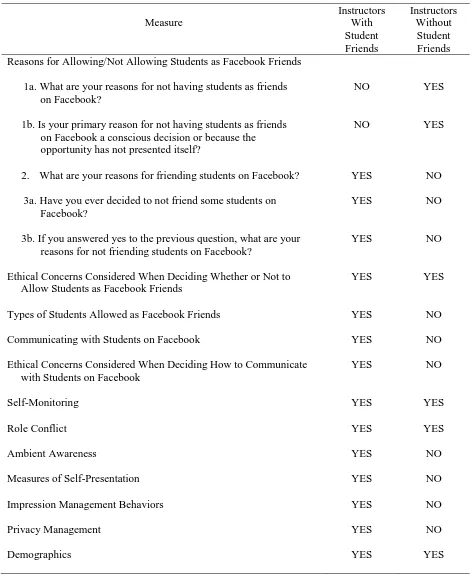
Table 1: Measures Completed by Instructors With/Without Students as
Facebook Friends 84
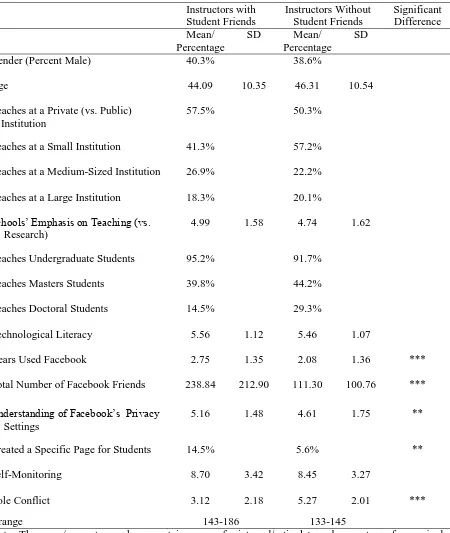
Table 2: Demographic Variables for Instructors With and Without Students as
Facebook Friends 95
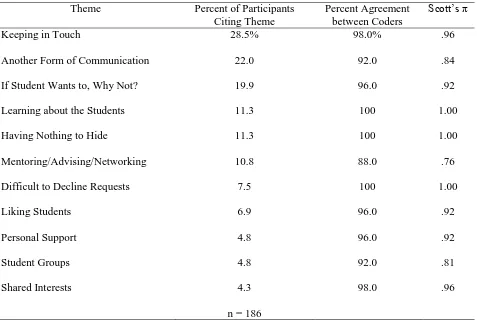
Table 3: Intercoder Reliability and Percent of Participants who Cited the Emergent
Themes Explaining Why Students are Allowed as Facebook Friends 99
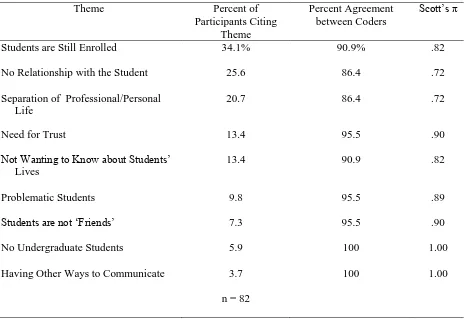
Table 4: Intercoder Reliability and Percent of Participants who Cited the Emergent
Themes Explaining Why Some Students are Not Allowed as Facebook
Friends 105
Table 5: Intercoder Reliability and Percent of Participants who Cited the Emergent
Themes Explaining Why No Students are Allowed as Facebook Friends 111
Table 6: Means, Standard Deviations, and Percent Agreements for Ethical Concerns
Instructors Consider when Deciding Whether to Friend Students on
Facebook 116
Table 7: Frequencies and Percentages of Instructors who Accepted and Sent
Facebook Friend Requests 120
Table 8: Frequencies and Percentages of the Types of Undergraduate Students
Instructors Have as Friends on Facebook 121
Table 9: Frequencies and Percentages for the Types of Masters Students
Instructors Have as Friends on Facebook 122
Table 10: Frequencies and Percentages for the Types of Doctoral Students
Table 11: Percentages of Instructors who Have Allowed Students as Facebook
Friends who have used Specific Communication Behaviors with
Undergraduate/Graduate Students on Facebook 124
Table 12: Means, Standard Deviations and Percent Agreement for Ethical Concerns
Instructors who Have Allowed Students as Facebook Friends Consider
when Deciding How to Communicate with Students 125
Table 13: Means and Standard Deviations for Variables Used in the Regression
Analyses to Test the Influences of the Individual Differences of Instructors
who Have Allowed Students as Facebook Friends on their Impression
Management 127
Table 14: Zero-Order Correlations Between Variables Used in the Regression
Analyses for Instructors who Have Allowed Students as Facebook Friends 129
Table 15: Summary of Hierarchical Regression Predicting Role Conflict Among
Instructors who Have Allowed Students as Facebook Friends 131
Table 16: Summary of Hierarchical Regression Predicting Self-Presentation Among
Instructors Who Have Allowed Students as Facebook Friends 133
Table 17: Summary of Hierarchical Regression Predicting Use of Impression
Management Behaviors Among Instructors who Have Allowed Students as
Facebook Friends 134
Table 18: Summary of Hierarchical Regression Predicting Privacy Management
Chapter 1
INTRODUCTION
Ahmet Atay was a graduate teaching assistant in 2006 when he received his first
Facebook friend request from a student. He admitted that he accepted the request with
some reservations. I thought rejecting his Facebook friendship request would have easily changed or damaged the dynamic of our student-teacher relationship. He would have easily felt rejected because of my actions. Even though adding him as a friend challenged my ideas about teaching, new media technologies, and their role in
educational settings, I was also intrigued by this new aspect of human communication and relationships (Atay, 2009, p. 72).
Atay (2009) made a choice that many college/university instructors are facing. Should they
allow students as friends on Facebook? Some instructors think these relationships have positive
qualities; however, other instructors feel these interactions are a dangerous way to communicate
with students, as well as a new way to breed inappropriate relationships between instructors and
students (Simon, 2008). As a student, Theresa Turner (2010) was shocked the first time a
professor offered to friend his students on Facebook and now wonders what the rules are when
instructors and students are friends on these sites. While the concerns about the relationships
developed on these sites are valid, technology scholars seem to side with Atay (2009). Prensky
(2001) asserted that today‟s students are “. . . digital natives. Our students today are all „native
speakers‟ of the digital language of computers, video games and the Internet” (p. 1). He believes
that instructors, who he calls digital immigrants, need to assimilate into the digital age and
incorporate new technology into their classrooms and as a communication method. According to
Prensky (2001), digital natives were born after 1980, so it is possible that younger instructors are
part of the digital native group. However, since the oldest digital natives are 30 years old, it is
reasonable to believe that digital native instructors are in the minority. Richardson (2009) agreed
including online social network sites (SNSs) like Facebook, if taught. He thinks that instructors
have the responsibility to use technology with their students as a means of showing them the safe
way to incorporate the Internet into their lives.
Becoming friends with students on Facebook can also have a positive influence on
learning outcomes. The National Communication Association (2010) posted a press release that
encouraged students to friend their instructors. Based on research by Joseph Mazer, NCA argued
that students who are friends with instructors on Facebook can find similarities between
themselves and their instructors, which may help them feel more comfortable approaching the
instructors with questions and concerns. Instructors can also use Facebook to become closer to
their students and create a more positive learning environment. A national organization‟s
endorsement of instructor-student relationships moving to Facebook suggests that these
friendships may be becoming more accepted in academic circles.
Online social network sites are one of the newest Internet technologies most widely used
by adolescents and college students; and Facebook is the most popular of them all. As of
October 2010, Facebook had more than 500 million users (“Statistics,” 2010). In May 2010,
Facebook became the most visited website in the world, with more than 540 million unique
visitors and 570 billion views a month, reaching 35% of the Internet population (Ionescu, 2010).
Atal (2007) claimed that over half of the users on Facebook are over 35 years old, so this site is
not just for adolescents or young adults. In fact, according to a Facebook spokesperson,
approximately 297,000 members identify themselves as faculty or staff at a college or university
(Robyler, McDaniel, Webb, Herman & Witty, 2010). These numbers clearly indicate that
Facebook provides a popular way for people of all ages, including instructors, to communicate
The popularity of this online communication is not surprising. Computer-mediated
communication (CMC) is not new. In 1992, Walther defined CMC as “synchronous or
asynchronous electronic mail and computer conferencing, by which senders encode in text
messages that are relayed from senders‟ computers to receivers‟ [computers]” (p. 52). Parks and
Floyd (1996) revealed that individuals reported that they socialize, maintain relationships, play
games and receive social support through e-mail, suggesting that CMC provided a new avenue of
communicating with others. As the Internet developed new ways for individuals to meet and
communicate with others, relationships formed on channels other than e-mail. Peter, Valkenburg
and Schouten (2005) claimed that adolescents commonly form relationships through online chat
rooms and instant messaging. Walther and Parks (2002) discussed another opportunity for CMC
when they asserted that the Internet “must be judged as a fabulously successful medium for
social support” (p. 545). Online support venues provide emotional support for topics as benign
as shyness or as horrific as sexual abuse (Harris, 2006). These examples show that individuals
have been turning to the Internet to communicate with others in a variety of ways for a number
of years and online social network sites are just the newest platform for CMC.
Computer-mediated communication may occur between strangers, but in many cases, it
happens between individuals in existing relationships. Rabby and Walther (2003) maintained
that most individuals use CMC to supplement face-to-face communication with people they
already know. They made the claim that “CMC serves as a supplemental medium that allows
relational partners familiar to each other in a variety of contexts to stay in touch” (Rabby &
Walther, 2003, p. 153). This suggests that instructors and students can use CMC channels to
Mediated communication channels are not only useful for individual interpersonal
relationships, but for the relationships of communities as well. Wellman (2005) defined
community as “networks of interpersonal ties that provide sociability, support, information, a
sense of belonging and social identity” (p. 53) and claimed that communities are often using
CMC to stay in touch. Sociologists have discovered that thanks to technologies such as phones
and planes, a person‟s overall community can extend beyond the boundaries of a neighborhood,
which changed the definition of community from one concerned with space to one concerned
with social networks (Wellman, 1988a, 1988b). In other words, individuals no longer have to
rely on others in physical proximity for companionship, but can now find others with similar
interests or needs for communication. Wellman and Gulia (1999) asserted that “as social beings,
those who use the Net seek not only information but also companionship, social support and a
sense of belonging” (p. 173). In 1999, Wellman and Gulia listed the possible online
communities as email, bulletin boards, Multi-User Dungeons, newsgroups and Internet Relay
Chat. Now, online social networks have joined the list.
Thanks to these technologies, people can communicate with others without being in the
same physical space. This gives students more opportunities to communicate with their
instructors since they no longer have to talk to them before/after class or find them in their
offices. The academic and classroom communities can move online. While moving these
communities online may seem beneficial, instructors need to consider a number of issues before
allowing their students to become their friends on Facebook. Theresa Turner (2010) suggested
that
college student partaking in such activities, so why then must an instructor‟s life remain so hidden and controlled? They‟re human too and they deserve to enjoy the life for which they‟ve worked so hard. Regrettably, however, to cross such lines could diminish the principles of the teacher-student relationship, despite the fact that we live in a more modernized society (p. 18).
While Turner is still a college student, she gets to the heart of the matter. Instructors deserve to
post the photos and information they want on their own personal page; but, if they are going to
allow students as Facebook friends, they have to think about how that information impacts the
instructor-student relationship. Instructors must think about how they present themselves on
Facebook. Does their impression management of their personal identities on Facebook match
the identities they present as a college faculty member? Kitchener (1988) argued that when
students witness their instructors acting in ways that are inconsistent with their instructor identity
confusion can occur. This confusion can lead to unsatisfactory instructor-student relationships
and ultimately cause ethical problems.
The interactions between college instructors and students involve more than just teaching
and learning in the classroom. Rawlins (2000) suggested that teaching is relational and that
instructors have to care about their students, while still being aware that they cannot become too
intimate. This can become problematic when one realizes that many college instructors form
dual relationships with their students. These relationships involve engaging in interactions
beyond the professional instructor-student one (Bowman & Hatley, 1995). Today‟s students are
digital natives and often want to communicate with instructors beyond the traditional meetings
after class or during office hours. With the advent of new technologies students are increasingly
turning to e-mail, texting and instant messaging to contact instructors (Bloch, 2002; Hassini,
through Facebook is the next logical step and means that instructors have to be aware of their
online communication behaviors.
The Present Study
Facebook has become increasingly popular as it provides a convenient way for
individuals to communicate with others in their social networks. As digital natives are entering
the college classroom, instructors have to decide whether or not to use this site to communicate
with their students. As Simon (2008) indicated, some faculty members see these sites as a
positive way to interact with their students, while other faculty members view them as a breeding
ground for dangerous affiliations. While there may be negative aspects of communicating with
students on Facebook, Prensky (2001) and Richardson (2009) asserted that technology is an
important part of the lives of today‟s youth and instructors need to help their students learn how
to use it safely. Millions of people of all ages use Facebook (Atal, 2007; “Statistics,” 2010) and
students and instructors are becoming friends on the site (Atay, 2009; Robyler et al., 2010;
Simon, 2008; Turner, 2010). The National Communication Association (2010) even encourages
instructors and students to become Facebook friends. Since this site is fairly new, there is little
research looking at how college/university instructors use the site, especially with students. This
study seeks to address this gap in the literature.
The overall purpose of this research is two-fold. The first part of the study seeks to
create a descriptive picture of how college/university instructors avoid or create Facebook
relationships with students. This includes discovering the instructors‟ reasons for allowing or not
allowing students as Facebook friends, the types of students who are allowed as friends, how
instructors communicate with the students they have allowed as Facebook friends, and what
created by asking college/university instructors about their Facebook use. The options provided
to the instructors were based on the dual relationship literature (Bowman & Hatley, 1995; Ei &
Bowen, 2002; Holmes, Rupert, Ross, & Shapera, 1999; Kagel & Giebelhausen, 1994; Kitchener,
1988; Owen & Zwahr-Castro, 2007; Rupert & Holmes, 1997) and typical Facebook
communication behaviors (“Help Page,” 2010; “Privacy Policy,” 2010). The ethical guidelines
set forth in the dual relationship literature (Blevins-Knabe, 1992; Congress, 1996) were used to
reveal what concerns instructors considered when deciding whether or not to allow students as
friends on Facebook and deciding how to communicate with students once they were friends.
The second part of this study seeks to identify the variables that influence instructors‟
impression management behaviors on Facebook. Impression management is a key element of
Facebook use. Hewitt and Forte (2006) argued that “because social networking communities are
built to support presentation of self, identity management is likely to be a significant issue for
participants in communities whose membership crosses perceived social boundaries and
organizational power relationships” (n.p.). Instructors, like other users, are likely to feel the need
to present multiple impressions on the site. This has the potential to lead to greater use of
impression management on Facebook, making impression management an important feature of
Facebook use to study. All users make specific decisions about what to post and what not to post
to create a specific image of themselves on the page. As previously noted, instructors should
have the ability to share their lives on Facebook and present any image they wish, but when they
invite or accept invitations from students, the rules may change. Instructors can present
themselves through specific impression management behaviors or they can keep certain
their impressions on Facebook may be influenced by a number of factors, including role conflict,
self-monitoring, and ambient awareness.
First, individuals have multiple identities (Stryker, 1980) and when more than one
identity is required at any given time, confusion and conflict can occur. Miller and Arnold
(2001) argued that many people struggled with a conflict between personal and professional
identities when they created websites. These people often wanted to share their personal lives
with others, but were concerned about colleagues visiting the site, which caused them to
experience conflict. This same conflict may be present when instructors allow their students as
friends on Facebook. The instructors will probably want to be themselves and communicate in
ways that are consistent with their personal identities, but when students enter the picture, that
communication may no longer be appropriate and conflict can occur. This conflict may be
linked to one‟s level of self-monitoring, which Snyder (1979) defined as one‟s desire to regulate
his/her impression management behaviors in social situations. Meyer (2001) explained that high
self-monitors are likely to present what they consider to be the correct image for any particular
situation, while low self-monitors are likely to present what they consider to be their true
identities regardless of the context. High self-monitors might feel more role conflict because
they are aware of what behaviors are considered proper for each role and know that it is difficult
to communicate in ways that are considered suitable for everyone when more than one audience
is present. On the other hand, low self-monitors tend to use the same behaviors in any situation,
so they may not perceive as much role conflict as high self-monitors do.
While one‟s level of self-monitoring may influence they role conflict s/he feels on
Facebook, both of these variables may also impact how s/he decides to present him/herself on
presenting an image that is appropriate for all Facebook friends. Goffman (1959) argued that
when multiple audiences are present at the same time, individuals will attempt to communicate
in ways that are appropriate for all audiences, which suggests instructors may attempt to manage
their impressions so that they are appropriate for all the different types of friends on Facebook.
High self-monitors who are concerned with the ideal behaviors for any given situation might be
more aware of what type of communication is appropriate on Facebook to present the image
expected by specific audiences, including students. This may lead to more effort in managing
their impressions to communicate in ways that are considered ideal for all of their Facebook
friends. Low self-monitors tend to communicate in the same ways for all audiences, so they will
probably put less effort into specifically managing their impressions on Facebook.
Finally, the ambient awareness, or the ability to pick up on others‟ moods and thoughts
through the information posted to SNSs (Thompson, 2008), instructors feel on Facebook is likely
to influence their impression management. Goffman (1959) argued that “when an individual
appears in the presence of others, there will usually be some reason for him to mobilize his
activity so that it will convey an impression to others which it is in his interests to convey” (p. 4).
Therefore, when instructors are aware of students as an audience, they may be more likely to
communicate in ways they think are appropriate given the image they want to project to students.
To accomplish the two goals of this research, college/university instructors who use
Facebook were invited to complete an online survey. The responses provided by both instructors
who have allowed students as Facebook friends and those who have not allowed students were
analyzed to create the descriptive picture of instructor Facebook use and to determine the
This dissertation is organized as follows. Chapter two reviews the relevant literature for
this project. It begins with an explanation of two foundational background areas. The first area
is the student-instructor relationship, which includes a discussion of interpersonal ethics as they
relate to the decision making processes of becoming Facebook friends with students and
determining how to communicate with them. The second area is online social network sites,
including Facebook. The second part of chapter two describes the conceptual background of the
project, which includes the concepts of role identity and conflict, self-monitoring, impression
management and privacy, and ambient awareness. Chapter two ends with an explanation of the
current study, which presents the rationale for the research questions and hypotheses. Chapter
three describes the method used in this project. It explains the procedures used to recruit
participants and collect data, as well as details the measures used on the questionnaire. Chapter
four provides a description of the data analyses and reports the results of the study. Chapter five
discusses the conclusions and interpretations of the findings, provides theoretical and practical
implications of the findings, explains the limitations of the study, and suggests possibilities for
Chapter 2
LITERATURE REVIEW
This chapter provides a review of the literature concerning the key concepts of this
research. The first main section explores two foundational background areas. The first area is
the student-instructor relationship, including an exploration of the ethical considerations
associated with these relationships. The second area discusses online social network sites,
focusing primarily on Facebook. The second main section explains the conceptual background
of the project. The concepts include role identity and conflict; self-monitoring; impression
management, including how privacy is used to manage one‟s impressions; and ambient
awareness. Finally, the present research study is described.
Foundational Background
To gain insight into the possible Facebook friendships between college/university
instructors and students, it is necessary to understand two key foundational areas. First, the
instructor-student relationship needs to be addressed. While instructors can form relationships
with any student, much of the research on these associations used undergraduate students as
participants. It should be noted that relationships with graduate students may possess some of
the same qualities, but there may be differences that have not been articulated in the research.
The relationships instructors form with their students may impact how they communicate in
specific situations, such as on Facebook; therefore the second area examined is online social
network sites, detailing what they are and how they work.
Instructor-Student Relationships
Individuals tend to develop relationships with the people they come into contact with on a
based on this regular contact, they may actually form interpersonal relationships with students
because they know there is more to teaching than passing along knowledge. Rawlins (2000)
suggested that “teaching is a physical, visceral, intellectual, and emotional activity. It is also
inherently relational” (p. 5). While the relationship between instructor and student is obviously
important, it is also complicated. Rawlins (2000) asserted that instructors can “care deeply and
significantly about our students without desiring an exclusive intimate connection with them,
either as a close friendship that might imply unwarranted favoritism, or as a sexual relationship
that involves exploitation and abuse of power differences” (p. 6). Instructors have to find ways
to communicate with their students that show respect and caring, without crossing the line and
becoming too personal.
Two models of relational development exist for this student-instructor relationship.
DeVito (1986) asserted that instructors and students follow seven stages, including the first two
that encompass the expectations the student and instructor have of each other before they even
meet. Stages three and four involve the first contact and testing each other to determine the
actual expectations of the relationship. Intimacy, the fifth stage, involves a significant expansion
of breadth and depth in communication. The final two stages are the deterioration and
dissolution of the relationship as the course comes to an end. Cooper and Simonds (2003) used
Knapp and Vangelisti‟s (1992) stages of relational development to explain the four stages they
claimed students and instructors follow while developing relationships. The first two stages
involve the initiation of the relationship, as well as experimenting to determine the expectations
of the relationship. Intensifying, the third stage, happens when the breadth and depth of
communication increases. The final stage occurs at the end of the course when the relationship
class ends, Cooper and Simonds (2003) asserted that is possible for the instructor-student
relationship to continue after the course is over. Some students stay in contact with instructors
for various reasons, including taking other courses, being involved in extra-curricular activities,
and mentoring opportunities. In a college or university setting, the relationship with
undergraduate students is more likely to end, while the relationship with graduate students tends
to continue since these students work more closely with faculty members. Both DeVito (1986)
and Cooper and Simonds (2003) stated that the interpersonal relationship between the teacher
and students intensifies when the breadth and depth of communication increases. This indicates
that to build relationships, students and instructors must get to know each other in some fashion.
Both parties must be willing to interact with each other and share information that allows the
other to get to know them. This may happen in the classroom, or it may happen in other spaces.
When the relationship moves beyond mere teaching, a dual relationship is formed.
Dual relationships. People may think that the relationship between instructors and
students mainly takes place in the classroom; however, research has found that numerous
students and teachers have relationships outside the classroom. These dual relationships are
defined as “engaging in one or more types of relationships in addition to a professional
relationship with an individual at a given time” (Bowman & Hatley, 1995, p. 232). In the
academic world, this means that an instructor may have a relationship with a student that goes
beyond classroom teaching. Owen and Zwahr-Castro (2007) stated that boundaries in
professional relationships, such as instructors and students, dictate rules that establish the
professional role as the primary role and separate from all others. In other words, an instructor‟s
primary job is to teach students. The problem with this is that instructors are not just teachers.
lives: academic advisor, curriculum planner, research advisor, employer, therapist, and/or friend
(Congress, 1996; Holmes et al., 1999; Rupert & Holmes, 1997). While roles such as advisor,
curriculum planner, and research advisor are an important part of an instructor‟s job, they are
different than teaching a group of students in a classroom. In the classroom, the instructor plays
the same role for all students enrolled in the course. When the instructor moves from teacher to
another role, such as academic advisor, the role is only pertinent to specific students. While
discussing the possibility of dual roles compromising the primary role of teaching,
Blevins-Knabe (1992) asserted that there are a number of questions an instructor must ask him/herself.
First, the instructor must make sure there is no loss of objectivity. Second, the instructor must
make sure that evaluations of the student are not tainted due to the dual relationship. Finally, the
instructor must make sure the student is held to the same standards as other students.
Relationships that cross into friend territory provide the most potential for these negative
consequences, but roles such as academic/research/curriculum advisor can become problematic
as well. Without realizing it, instructors may favor their advisees or provide more course
opportunities for students they work with outside the classroom. Bowman and Hatley (1995)
argued that “other students may become jealous and resentful as they witness close
faculty-student relationships and perceive that mentored faculty-students receive preferential treatment” (p.
232). Congress (1996) added that instructors need to be aware of how students view their
relationships with other students. If some students feel slighted or that the student in a dual
relationship with an instructor is getting special treatment, the resentment and jealously may lead
to a feeling of discontent in the classroom. When looking at instructor-student relationships, the
instructor needs to realize that in most cases, teaching is the primary role and all others are
While a dual relationship can happen between any student and instructor, Baggio, Paget
and Chenoweth (1997) explained that graduate students offer a special case of dual relationships
because they are encouraged to interact with faculty outside the classroom at events such as
conferences and social events. Atay (2009) agreed by stating that “graduate students are
encouraged to build working and lasting academic relationships and friendships with their
mentors and academic advisors” (p. 72). These activities and relationships are meant to socialize
students into the discipline and are crucial to the students‟ professional development. Instructors
are expected to work with graduate students as mentors and spend more time with them outside
the classroom due to research projects and advising opportunities. Since graduate students may
work with faculty who are not their classroom instructors, these relationships become the
primary role and other relationships, such as employer or friend, become secondary.
Guidance for professors about dual relationships tends to focus on sexual relationships
(Congress, 1996; Ei & Bowen, 2002; Holmes et al., 1999; Kagle & Giebelhausen, 1994; Owen &
Zwahr-Castro, 2007). But nonsexual dual relationships are more common; and although they
can be rewarding, they do provide opportunities for problematic interactions. Since it appears
that the instructor-student relationship does not end at the classroom door or with academic
work, it is necessary to look at the consequences of these relationships.
The literature on dual relationships tends to focus on the risks and problems of these
additional interactions instead of the possible rewards. The risk discussed most often is that of
exploitation (Holmes et al., 1999; Jacobs, 1999; Kitchener, 1988; Owen & Zwahr-Castro, 2007).
Kagle and Giebelhausen (1994) stated that the influence an instructor has over a student carries
over into the dual relationship, whether it be advisor or friend. This influence may
professor to demanding extra hours of research. Kitchener (1988) also mentioned that social
roles, including that of instructor, have specific expectations. The student will expect the
professor to act in specific ways, usually in ways that reflect his/her role as instructor. When
those expectations are not met in other interactions, such as in social situations, confusion can
occur. Rupert and Holmes (1997) stated that multiple relationships can erode the professional
nature of the student/instructor relationship and lead to a compromise of objectivity, as also
noted by Blevins-Knabe (1992). The erosion of the professional relationship and the loss of
objectivity are just two consequences that might encourage instructors to consider the ethical
dimensions of their dual relationships with their students.
Ethical communication. Ethical interpersonal communication is important, but difficult
to define. In 1990, Deetz argued that in the Handbook of Interpersonal Communication, the
word ethical appeared twice and the word ethics was absent. This implies that the ethics of
interpersonal communication are seldom discussed. Harral (1979) posited that “the ethics of
interpersonal communication . . . have to do with our attitudes toward the other person in any
relationship. To accept the other person and the range of his/her choices and in so doing to
accept our own range of choices – that is the challenge of an interpersonal ethic” (p. 45). This
argument suggests that communicating ethically means simply accepting the other‟s
communication behaviors. However, Johannesen (2002) stated that
Potential ethical issues are inherent in any instance of communication between humans to the degree that the communication can be judged on a right-wrong dimension, that it involves possible significant influence on other humans, and that the communicator consciously chooses specific ends sought and communicative means to achieve those ends (p. 2).
This indicates that ethics are a part of any communicative act and that the specific behaviors
right or wrong. Jensen (1985) argued that communication cannot be judged on the binary
assumption of ethical or unethical, but rather each interaction should be judged on a continuum
ranging from highly ethical to highly unethical. This argument points to the idea that
interpersonal communication behaviors can be placed anywhere on the continuum depending on
the factors involved and how the individual feels about those factors. Jensen‟s (1985) assertion
may explain why Christians and Lambeth (1996) found that communication instructors introduce
possible ethical issues, but provide little guidance on how to identity, evaluate or respond to
them. Jensen (1985) also argued that communication ethics need to be based on as many sources
as possible including the (1) political perspective, (2) human-nature perspective, (3) dialogical
perspective, (4) situational perspective, (5) religious perspective, (6) utilitarian perspective, and
(7) the legal perspective. While these approaches may provide guidance to those trying to
communicate ethically, Deetz (1990) argued that it is nearly impossible to construct ethical
principles that are appropriate for all situations and contexts. He added that one of the
established ways of looking at communication ethics is through “situational or contextual
morality arising out of specific communities” (Deetz, 1990, p. 227). In other words, individuals
are going to decide for themselves what it means to communicate ethically depending on the
specific situation, which makes a standard ethical principle for interpersonal communication
difficult to discern. This may explain why there are differing views on the ethics of
instructor-student relationships.
People have varying viewpoints about the possible relationships that can develop
between instructors and students. Some believe that relationships that become more personal can
be appropriate while others feel that the relationship should stay professional (Simon, 2008).
different idea of what it means to have an ethical relationship, the best course of action is for the
instructor to analyze the relationship and its consequences. Congress (1996) set forth six
questions the instructor need to ask when engaging in a relationship outside the instructor/student
one. First, the instructor needs to determine the role being assumed in the dual relationship. Is
that role friend, advisor, therapist, or sexual partner? Each role has its own risks and rewards and
the instructor needs to be aware of those. Second, the instructor must be aware of the potential
for exploitation or harm. If there is the slightest possibility of hurting the student in any way, the
relationship should not continue. Third, the instructor needs to realize whether or not the
relationship takes undue advantage of his/her greater power in the relationship. Is the instructor
asking the student to do things that might make the student uncomfortable, but due to the power
differential feels unable to speak up? Fourth, the instructor must decide if the relationship has an
impact on other students. If other students feel slighted or that the student in the relationship is
getting special treatment, then there will be a feeling of discontent in the classroom. Fifth, it is
important to look at whether the relationship is with a current student or former student. Current
students pose a greater risk than do former students. Finally, instructors should think about how
other colleagues view the relationship. If others see the relationship as inappropriate, there might
be a problem.
These questions are valuable for instructors who may become friends with students on
Facebook. For instance, if the instructor only friends certain students, others may feel as if they
are not as important as the students who are friends. Also, friending former students may pose
fewer problems than friending students who are currently working with the instructor in a
relationship into personal territory can be a risky decision and instructors have to be aware of the
ethical consequences associated with it.
When asked, students have definite opinions of what types of relationships with their
instructors are appropriate versus inappropriate. Bowman and Hatley (1995) conducted
telephone interviews with graduate students enrolled in counselor preparation programs
accredited by the Council for the Accreditation of Counseling and Counseling Related
Educational Programs. The sample included 247 graduate students from every geographic
region of the United States and represented large and small training programs. Each student was
asked to rate specific situations as ethical or unethical. Participants heard seven specific
scenarios and then were asked if they found twenty-six specific behaviors from the scenarios to
be ethical or unethical (it was a forced choice between the two). Financial interactions were
considered appropriate only when the student was doing specific work for the money (e.g.,
research, babysitting). Direct lending was considered inappropriate by 77% of the participants.
Socializing at conferences with a mentor and working closely on research projects were
considered appropriate, while most felt it was inappropriate to share a hotel room (92%), perform
office duties (57%) and deny authorship to students who have contributed to a project (92%).
The study found that 80% of respondents felt that a professor and student describing themselves
primarily as friends was unethical, and more than half of respondents considered it unethical to
attend public events together (62%), share personal information (57%), host parties for students
(68%), gossip (98%), and become intoxicated with students (94%). It is important to note that
the students who responded to these scenarios were graduate students, which shows that students
who are expected to have outside relationships with their professors do not always feel
when it is considered professional and not personal. This suggests that graduate students may
not feel comfortable being friends with their instructors on Facebook. Being able to see their
instructors‟ personal information may make students uncomfortable. This relates back to
Congress‟ (1996) questions about dual relationships. Do students feel uncomfortable, but feel
unable to speak up due to the power differential? Instructors need to be mindful of their
students‟ feelings when thinking about friending them on Facebook. It is important to note that
since this research focused on graduate students in one particular type of program, it is difficult
to generalize the results to all graduate students; however, the fact that students from across the
country and enrolled in programs of different sizes were surveyed does give the results more
validity. The results may not be true for all graduate students, but they do provide information
important for instructors to consider.
While graduate students seem to be apprehensive about building outside relationships
with their instructors, undergraduate students appear to have a more favorable opinion of them.
Ei and Bowen (2002) surveyed undergraduate students and through a factor analysis found five
primary types of relationships between students and faculty. Sexual/romantic relationships were
considered the most inappropriate. Most participants reported feeling neutral to negative about
students and instructors doing favors for each other. Spending time alone with instructors was
rated as generally neutral, with a slight leaning toward a negative view. Participants were neutral
about forming business relationships with their instructors (e.g., babysitting, taking the student
on as a client). The most appropriate relationship appeared to be group interactions (meeting for
coffee/drinks, playing sports, having lunch) between students and instructors. It seems that
undergraduate students feel that a personal relationship can be appropriate, but only when others
the decision to friend students on Facebook a tough call. Are these relationships unethical
because they can be seen as one-on-one; or are they appropriate because Facebook constitutes a
group of friends and group activities are seen as acceptable? Once again, instructors need to be
mindful of their students‟ feelings when thinking about friending them on Facebook.
Instructors may be uncertain about what constitutes ethical behavior, but it should be
helpful to know that their concept of ethics often corresponds to the students‟ ideas.
Keith-Spiegel, Tabachnick and Allen (1993) found that instructors and students often have similar
ideas of what it means to be an ethical professor. Students were asked to rate the acceptability of
107 acts in which professors might engage (e.g., dating a student, asking a small favor of the
student, giving pop quizzes, accepting a student‟s invitation to a party) and a comparison of
students‟ ratings and the professors‟ self-ratings “suggest that students and professors are
generally similar in their views of what constitutes ethical and unethical conduct for professors”
(Keith-Spiegel et al., 1993, p. 149). Much of the literature on instructor ethics relates to teaching
issues (e.g., not giving unfair advantages to athletes, grading everyone fairly, not giving a hard
test early in the semester to encourage students to drop the course); ethical behavior in terms of
relationships between instructors and students is seldom addressed (Folse, 1991; Matthews,
1991; Scriven, 1982). In terms of friendly interpersonal relationships, there are no ethical codes
for academics, so instructors are on their own when deciding what type of relationships are
appropriate (Birch et al., 1999).
Instructors may have to come to their own conclusions when it comes to communicating
with their students, but there is research that can guide their decision-making progress. Birch et
al. (1999) surveyed faculty at the University of Montana and compiled a list of behaviors
in terms of perceived ethical appropriateness on a five-point scale (1 = unquestionably unethical;
5 = unquestionably ethical). The most unethical behaviors (80% of the faculty rated the items as
unquestionably unethical or not likely ethical) involve specific teaching practices (e.g., giving
lower grades to students who oppose the professor‟s views, lowering course demands for
minority students, relaxing rules so students will like the professor, and grading on an unfair
curve). Behaviors considered ethical (less than 30% of the faculty rated the items as
unquestionably unethical or not likely ethical) include going to a bar with students, accepting
students‟ invitations to parties, hugging students and beginning a relationship with students in the
professor‟s class that may continue after the course ends. Birch et al. (1999) do caution that the
results should “be viewed with care” as many of the participants commented on the difficulty of
deciding whether a situation was ethical without a specific context. Although this research lacks
context and includes only one university, thus limiting its generalizability, it provides an
interesting look at what faculty may find appropriate and inappropriate.
The previously discussed research suggests that dual relationships are not taboo. As
mentioned earlier, group activities, socializing at academic events and working on research are
considered ethical behaviors (Bowman & Hatley, 1995; Ei & Bowen, 2002). As long as the
professor is not alone with a particular student, relationships beyond instructor-student are
accepted. These behaviors indicate that friending students on Facebook would be an acceptable
relationship.
The dual relationship literature revealed that interpersonal relationships with students are
acceptable and anecdotal evidence indicated that instructors are moving these relationships to
Facebook; but, instructors may still have qualms about actually having this type of relationship
faculty at the college/university are doing. Bruhn, Zajac, Al-Kazemi and Prescott (2002)
asserted that ethical citizenship is crucial to the tenure of professors. This ethical citizenship is
defined as “a role in an organization that is shaped by the values, norms, traditions and culture of
the organization or broader community” (Bruhn et al., 2002, p. 466). In essence, each university
has its own norms and values, so each professor needs to act in ways that are in accordance with
what his/her university expects. Charnov (1987) argued that different institutions have different
ethical standards and Baum (1991) added that practicing good ethical citizenship is open to the
interpretation of the organization‟s culture. These arguments suggest that instructors should be
aware of what others at the institution or within the department consider appropriate. This is
crucial information since most universities have policies against romantic relationships between
faculty and students but are silent when it comes to friendly relationships. For instance, Georgia
State University (2008) said
The integrity of academic and work relationships is the foundation of the University‟s educational mission. These relationships vest considerable trust in persons with authority whether as mentor, educator, evaluator and/or administrator. The unequal institutional power inherent in University academic and work relationships heightens the vulnerability of those in subordinate positions . . . Consequently, people in positions of authority within the University community must be sensitive to the potential for conflict of interest as well as sexual harassment in amorous relationships with people over whom they have a professional power/status advantage (section N).
In other words, the university is concerned about romantic relationships, but makes no mention
of friendly interactions. While academia as a whole constitutes the broader community, the
American Association for University Professors (AAUP) does not get involved in individual
cases, so there are no standards set by the broader community (Bruhn et al., 2002). Professors
often have guidance about romantic relationships spelled out in their school‟s faculty handbook,
but are on their own when making the decision about whether or not to become friends with their
are important. The administration and faculty at each school may have different views on
outside relationships and it is suggested that instructors should abide by those (Baum, 1991;
Bruhn et al., 2002; Charnov, 1987).
Dual relationships can pose a number of ethical concerns, but Baggio et al. (1997)
asserted that “an ethical relationship with a student is one in which three conditions are met: (a)
educational standards are maintained, (b) educational experiences are provided for the student
and (c) exploitative practices are absent” (p. 187). It is possible to have a relationship outside of
the traditional instructor-student one, but the instructor needs to remain mindful of the
consequences, including exploitation due to the power difference between the student and
instructor. With the emergence of digital natives, instructors not only have to consider the
face-to-face dual relationships they may form, but also the relationships they may form through the
use of technology, such as Facebook, one of many available online social network sites.
Online Social Network Sites (SNSs)
boyd and Ellison (2007) defined online social network sites as “web-based services that
allow individuals to (1) construct a public or semi-public profile within a bounded system, (2)
articulate a list of other users with whom they share a connection, and (3) view and traverse their
list of connections and those made by others within the system” (p. 2). The people on the list of
users with whom the individuals share a connection are called friends. This is often a troubling
term because people have a preconceived notion of what a friend should be. boyd (2007)
asserted that individuals would normally only give the label of friend to people with whom they
have close ties, but on online social network sites, the term actually refers to any member of an
imaginary audience. This audience includes the people who users see as part of their world on