Surface Decontamination Studies of
137
Cs and
85
Sr
Using Polymer Gel
Pham Quynh Luong
1,*, Nguyen Van Chinh
1, Nguyen Dinh Lam
21Institute for Technology of Radioactive and Rare Elements (ITRRE), Vietnam 2Nuclear Research Institute (NRI), Vietnam Atomic Energy Institute (VINATOM), Vietnam
Copyright©2016 by authors, all rights reserved. Authors agree that this article remains permanently open access under the terms of the Creative Commons Attribution License 4.0 International License
Abstract
The polymer gel solution consist of water soluble polymer preferably polyvinyl alcohol (PVA), plasticizing agent (glycerine) and chelating agents (citric acid) can decontaminate efficiency of 137Csand 84Sr on thecontaminated surfaces . Decontamination efficiency obtained from 95- 99% on glass and stainless steel, ceramic and PVC plastic surfaces, which also depended on radioactivity and coating thickness. Optimization of film thickness is around 200 microns. Decontamination efficiency of Polymer gel were compared with DeconGel 1101 (product from USA) on surfaces. IR spectra studies indicated that Cs+ and Sr2+ ions interacted with PVA and
citric acid in Polymer gel through C=O group. Mechanisms of this decontamination process have revealed.
Keywords Strippable Coating, Polymer Coating,
Decontamination by Polymer1. Introduction
Radioisotopes are widely used in industry, agriculture, scientific researches and education, especially in nuclear industry. While handling or storing radioisotopes, surface of machines, tools, laboratory desks…may get contaminated with radioactive materials. If contaminated surfaces haven't decontaminated in time, the radioactive materials can transfer to the environment and staffs working around. Radioisotopes may be absorbed by the human body, caused internal doses and seriously affect human health. Normally, diluted acids or detergents could be used for surface decontamination, however these techniques have a disadvantage: it'll release large amount of secondary liquid radioactive waste, which needs complicated procedures to treat before storage and final disposal.
Using strippable polymer coating is thought to be an effective and simple technique to remove radioisotopes from contaminated surfaces. Polymer gel solutions are prepared by mixing a polymer or copolymer in suitable solvent with
decontaminating agent and additive, which is sprayed or brushed on the contaminated surfaces, after short time (24h) it is dried and formed a strippable strong thin film and easily peeled off from the contaminated surface with the radioactive isotopes. The secondary wastes from decontamination process exist in solid form, small volumes. It's also compressible and combustible. This enables the management of radioactive waste to be more effective and economy.
1.1. Experiments
1.1.1. Polymer Coating Preparation
In our experiments, 140 g PVA (14% wt) was dissolved in 770 g distilled water in a beaker of 1 litre capacity at 500 –
600C (to speed up dissolution of PVA), stir well by using
mechanical stirrer made from stainless steel until PVA completely dissolved and form white/ homogenous solution. After that, add 75 g (7.5% wt) glycerine, 5g citric acid in 10ml distilled water (0.5% wt) to the polymer solution, continue stir until it become sticky, gel-form solution and to stay for overnight at room temperature without stirring for deformed. The gel solution becomes colourless and transparent solution and is transferred in to a sealed clean polyethylene bottle for storage, (all reagents were laboratory reagent).
1.1.2. Influence of Various Agents to Decontamination Factor
The gel solution of PVA/H2O/glycerine is prepared as
above. Add 5g of each decontamination agent in each solution sample to form polymer gel containing various decontaminating agent as follow: ethylenediaminetetraacetic acid disodium salt (EDTA), diethylenetriaminepentaacetic acid (DTPA), oxalic acid, citric acid and PVA.1 ml solution of radioisotope 137Cs and 85Sr (activity 0.0377 mCi/ml and
0.0145 mCi/ml respectively) in the form of CsCl and SrCl2
solution (called 1 and 2 solution respectively) is spread on a (10 cm x 10 cm) plates of glass within a 20 cm2 circle, then
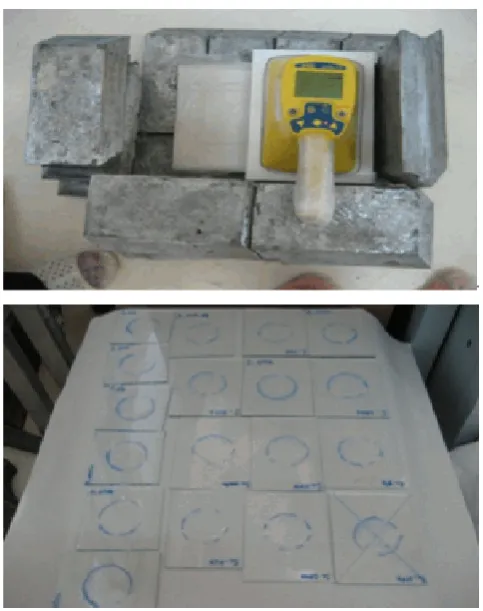
minutes). Activity on the surfaces was measured right after drying of the solution by MED-CoMo170 survey meter, then cover the contaminated areas with 2.0 g polymer gel, peel off the coating after drying (about 24 h) and measure activity again. Decontamination capability of polymer coating is represented by K(%) decontamination efficiency or DF decontamination factor and calculated by following formula [9]:
K (%) = [(Aj–Af)/Ai]*100 (1)
DF = Ai /Af (2)
Where: Ai is the surface radioactivity before
decontamination
[image:2.595.57.299.247.553.2]Af is the surface radioactivity after decontamination
Figure 1. MED - CoMo 170 survey meter and glass plates
1.1.3. Influence of Polymer Coating Thickness to Decontamination Factor
About 1 ml of 1 and 2 solutions was spread on stainless steel plates within a 20 cm2 circle, then dry out and cover
contaminated area with various amount of polymer gel: 0.7 g; 1.0 g; 2.0 g; 3.0 g, equivalent to various thickness: 90; 110; 220; 340 microns respectively (coating thickness is measured by spline micrometer). Decontamination factor (DF) related to each coating thickness is calculated by formula (2)
1.1.4. Influence of Activities to Decontamination Factor On the surface of 8 plates of glass, apply 0.5 ml; 1.0 ml; 1.5 ml; 2.0 ml of 1 and 2 solutions within a 20 cm2 circle, dry
out and cover about 2.0 g polymer gel. The polymer coating
is peeled off after drying. Activity before and after decontamination is measured by MED-CoMo170 survey meter. DF related to each activity is calculated by formula (2)
1.2. Decontamination Factor of Polymer Gel and Decongel 1101 on Various Surfaces
On the surface of glass, stainlesssteel, mild steel, ceramic, PVC plastic plates, apply 1.0 ml of 1 and 2 solutions within a 20 cm2 circle, dry out and cover contaminated area by 2.0 g
polymer gel and Decongel 1101 (supply by CBI Polymer US) separately. Decontamination factor related to Polymer gel and Decongel 1101 on each surface is calculated by formula (2)
1.3. Interaction of PVA and Polymer Gel (Gel) with Cesium and Strontium Ion
1.0 mg/ml SrCl2 and CsCl solution were prepared
separately. Apply 0.5 ml of these solutions on 50.0 mm diameter pieces of stainless steel. Dried out and covered it by PVA solution, Polymer gel separately. The coatings were peeled off after drying and were analyzed by XRF and FTIR (pellet compressed with KBr)
2. Results and Discussion
2.1. Influence of Various Agents to Decontamination Factor
Decontamination experiments of 2 isotopes 137Cs and 85Sr
indicated that polymer gel with decontaminating agents has much higher DF than those of single PVA gel but the DF of polymer gel with citric acid is highest compared to the DF of others because of this case citric acid not only acts as acid but also as a chelating agent. In this case, citric acid can form chelating complexes with Sr and Cs ions but Sr ion is much better. As the result, the DF of polymer gel with all the agents for 85Sr was higher than that for 137Cs. It is
possible that Sr2+ ion interacts with polymer gel
(decontaminating agents in polymer gel) better than Cs+ ions
does. The nature of this interaction is mixed chemistry and mechanics but the chemical interaction is much stronger than the mechanism. Fig.2
[image:2.595.323.540.603.731.2]2.2. Influence of Polymer Coating Thickness to Decontamination Factor
The results showed that DF of these isotopes also depends on thickness of coating. DF got highest value with thickness from 110 to 220 microns (equivalent to 0.8 – 1.0 l/m2
[image:3.595.58.299.205.323.2]surface). At 90 microns thickness, there's too little of gel, so coating film can't absorb all radioisotopes. At thickness of 340 microns, the coating is too thick so that can't dry out completely within 24 hours under the room temperature. Fig. 3
Figure 3. Influence of polymer coating thickness to decontamination factor
2.3. Influence of Activities to Decontamination Factor
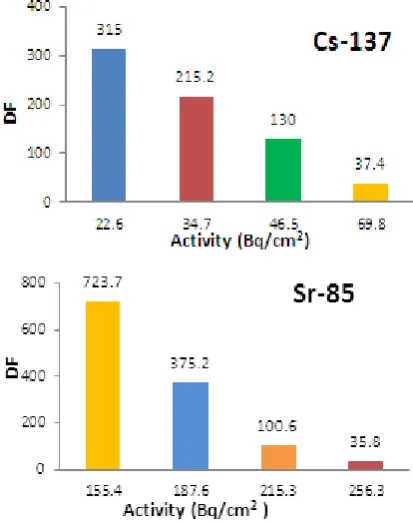
Experiments showed that in the range of studied activities, the higher activity of 137Cs and 85Sr, the lower
[image:3.595.312.552.448.616.2]decontamination factor we can obtained, because at high activity, the density of Cs and Sr ion is very high and they will compete with each other in interaction with decontaminating agent or they possible need more agents for this removal process completely.
Figure 4. Decontamination factor of polymer gel for various activities of 137Cs and 85Sr
Difference between DF of polymer gel for 137Csand 85Sr
depend on characteristic of each isotope and their interaction ability with agents in polymer gel, especially with citric acid. This result showed that decontamination factor depends on much of activity. The DF of 137Cs and 85Sr on the glass plate
are demonstrated in fig. 4.
3. Decontamination Factor of Polymer
Gel and DeconGel 1101 on Various
Surfaces
Decontamination factor of polymer gel for 137Cs and 85Sr
has great difference on various surfaces, for both of 137Cs
and 85Sr, the DF decreased in the order: glass > stainless
steel > ceramic > plastic > mild steel. The DF of mild steel is the lowest because this surface isn't smooth and radioactive solution can invade deeper inside material, out of reach of the polymer coating. On the other hand, Fe in mild steel can interact with acidic solution, produce a layer of FeCl3, that prevent polymer coating to access radioactive
isotopes and decrease effectiveness. Results in table 1 showed that DF great depends on porosity, smoothness of each surface. Decontamination efficiency (K%) reach 95 % value on all surfaces and 98% on glass and stainless steel. After decontamination, all activity of surfaces (Af) are
below 3.7 Bq/cm2, satisfy the regulations of IAEA for β and γ contaminated surface [7].
Table 1. Decontamination factor of polymer gel for 137Cs and 85Sron different surfaces.
Surface Radioisotope Ai
(Bq/cm2) (Bq/cmAf 2) DF (%) K
Glass
137Cs 22.6 0.07 315 99.7
85Sr 155.4 0.21 723.7 99.9
Stainless steel
137Cs 24.2 0.64 38.1 97.4
85Sr 70.3 0.36 196.6 99.5
Ceramic
137Cs 24.3 0.87 27.9 96.4
85Sr 77 0.78 98.3 99.0
PVC plastic
137Cs 22.5 0.84 26.8 96.3
85Sr 77.7 0.99 78.2 98.7
Mild steel
137Cs 27.9 1.31 21.3 95.3
85Sr 92.7 2.50 37.1 97.3
Results of experiment also showed that DF of DeconGel 1101 is higher than polymer gel on most of surfaces for both 137Cs and 85Sr but the difference isn't noticeable, fig. 5.
[image:3.595.73.280.471.733.2]both of two gels can remove medical radioisotopes such as
131I, 32P, 99mTc on the surfaces with decontamination
efficiency (K%) reached 99 % [8]. The DF of two polymer gels for 137Cs and 85Sr on various surfaces is demonstrated
in fig.5.
4. Interaction of PVA, Polymer Gel (gel)
with Cesium, Strontium Ions
4.1. FTIR Spectra of PVA, PVA- Cs and Gel, Gel-Cs
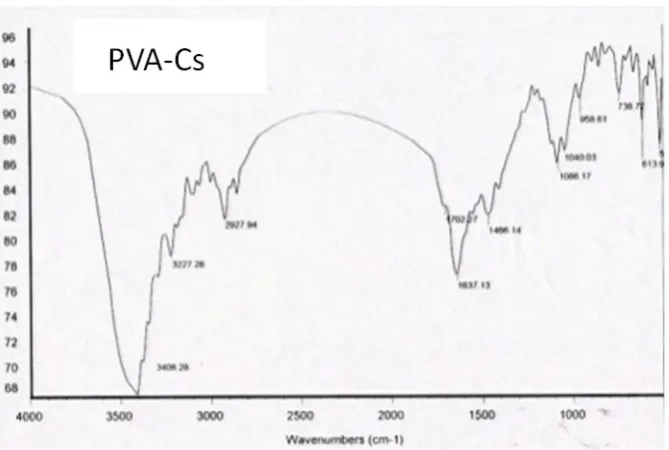
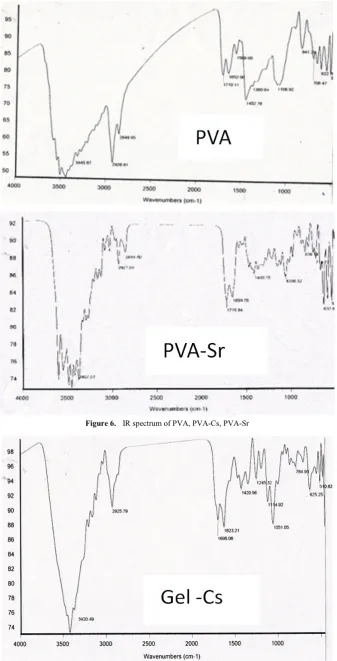
In figure 6 and 7, the stretching frequency of carbonyl group (C=O) of PVA, gel was compared with that of PVA-Cs, gel-Cs. There is a shift in wave number of (C=O) group: from 1710.11 and 1652.00 cm-1(PVA) to 1637.13
cm-1 (PVA-Cs) [6]. In the case of gel and gel-Cs, there is
also a shift from 1714.46 and 1636.14 cm-1(gel) to 1695.06
and 1623.21 cm-1(gel-Cs). The carbonyl group of gel
[image:4.595.138.473.440.665.2]contributed mainly from citric acid and in PVA from acetate groups which did not undergo hydrolysis in the production process of PVA from polyvinyl acetate [2]. It is indicating that there is interaction between cesium ion and carbonyl group (C=O) in PVA and polymer gel.
Figure 7. IR spectrum of gel, gel-Cs, gel-Sr.
5. Mechanism of Decontamination
Process by Polymer Gel
The solutions of SrCl2, CsCl are dissociated in to Cs+, Sr2+,
Cl-, Na+ ions. These ions stick to the surface or diffuse in to
studied specimen through small capillaries. The adhesion and diffusion abilities depend on characteristics, radium of each ion, the smoothness, porosity and size of capillaries. Citric acid is in polymer gel, that has three carboxyl groups, capable of forming chelate complex with metals, especially with Cs, Sr ions in following equation:
Cs+ + HL3-
→
CsHL2-Sr2+ + HL3-
→
SrHL-Stability constant (K) of CsHL2- and SrHL- complexes is
0.32 and 3.05 respectively at 250C [5]. It means that citric
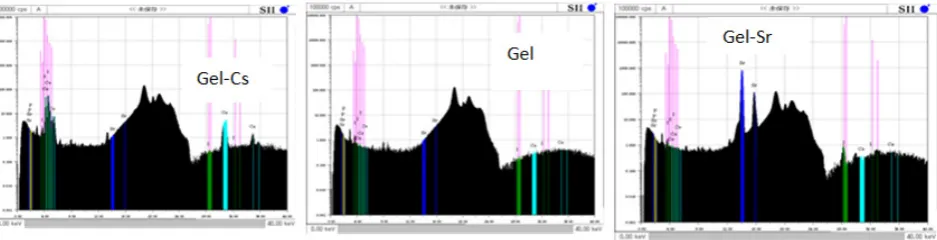
acid can forms chelating complex with Sr ion better than with Cs ion. This is the same the results obtained from decontamination process in 2.1. XRF spectra of Cs and Sr ions in membrane of polymer gel are in fig. 8. Hence, decontamination process of 137Cs and 85Sr by polymer gel is
Figure 8. XRF spectra of Cs and Sr in membrane of polymer gel, gel - Sr, gel-Cs
6. Conclusions
Polymer gel has ingredients as follows: 14% (wt) PVA, 7.5% (wt) glycerin, 0.5% (wt) citric acid in distilled water can be used for the effectively decontamination of 137Cs, 85Sr on various surfaces. Decontamination efficiency
obtained from 95- 99 %.
Decontamination factor depend on decontamination agent, thickness of polymer film, radioactivity and the characteristics of each surface. The amount of optimal polymer gel is about 0.8 – 1.0 ml/m2 surface, equivalent to
150 – 200 microns thickness of coating film.
DF of DeconGel 1101 is almost higher than that of Polymer gel on studied surfaces for 137Cs, 85Sr isotopes but
the difference isn't noticeable.
The secondary wastes from decontamination process exist in solid form, small volumes. It's also compressible and combustible. This enables the management of radioactive waste to be more effective and economical than other decontamination techniques.
We hope that this study to develop the low cost, high efficiency decontamination material that will able to apply in nuclear facilities, hospital to ensure absolute safety for people and environment of Viet Nam in the future.
REFERENCES
[1] S.V. Srao, K.B. Lai, “Surface decontamination studies using polyvinyl acetate based strippable polymer” Journal of radioactive analysis chemistry. May, 2003.
[2] N.S. LABIDI and A. DEBAILI, “Studies of The Mechanism of Polyvinyl Alcohol Adsorption on The Calcite/Water Interface in The Presence of Sodium Oleate”, Journal of Minerals & Materials Characterization & Engineering, Vol. 7, No.2, pp 147-161, 2008 jmmce.org Printed in the USA. [3] Gray HN, Jorgensen B, “Sensing Strippable Coating”, US.
Patent Application S-80, 449, 1995.
[4] US Nuclear Regulatory Commission, “Characterization of Radionuclide-Chelating Agent Complexes Found in Low-Lever l Radioactive Decontamination Waste”
[5] R. J. Serne, A. R. Felmy, K. J. Cantrell, K. M. Krupka, J. A. Campbell H. Bolton, Jr., J. K. Fredrickson, “ Characterization of Radionuclide-Chelating Agent Complexes Found in Low-Level Radioactive Decontamination Waste” US Nuclear Regulatory Commission. 1996. Appendix B, table B.5 [6] Handbook of Infrared and Raman Spectra of Inorganic -
Google Books.
[7] IAEA, Safety series No.48 -1979
[8] Pham Quynh Luong, Nguyen Van Chinh, Nguyen An Thai, Nguyen Dinh Lam, Vietnam Atomic Energy Institute (VINATOM) “The study of strippable polymer coating for surface decontamination of medical radioisotopes” The 3rd National Conference on Nuclear Science and Technology for Young Scientists Ha Noi, Oct, 2014.