skinned pear that originated in Japan in about 1895, seems t o be the most widely grown Asian pear in California and prob- ably was one of the first true Japanese varieties brought into the state. Another variety, Okusankichi, has been grown in the Loomis-Newcastle district of Placer County for many years, where it is known as the “late Japanese pear’’ or “October Japanese pear.” In Tulare C o u n t y , it is called “Nihon Nashi” (Japanese pear).
In the 1950s, the U. S. Plant Intro- duction Station a t Glenn Dale, Maryland, provided the authors with scion wood from a number of Asian pear varieties received from Japan, China, and Korea. These varieties have been maintained and propagated under continuing study in the University of California Department of Pomology orchards at Davis.
J a p a n e s e h orticulturists classify their pear varieties according t o skin color a n d russeting. Green-skinned varieties usually are free of russeting, and some t u r n y e l l o w upon ripening. Russet- skinned varieties have brown, yellowish- brown, or greenish-brown skin. Included in our study are the Japanese green- s k i n n e d varieties Kikusui, Nijisseiki (Twentieth Century), and Shinseiki, and russet-skinned varieties Chojuro and Okusankichi (Bansankichi). In addition, we have maintained two Chinese varieties, Tsu Li (Tzu Li) and Ya Li (Yarr Li). These have yellowish-green skin, but their pyriform shape distinguishes them from the roundish Japanese varieties. Although Tsu Li and Ya Li originated in China, they are also cultivated in Japan.
Japan had 46,930 acres of Asian pears in 1974. Chojuro and Nijisseiki (Twentieth Century) comprise approxi- mately 39 and 35 percent, respectively, of the acreage. At present California has only a few hundred acres of Asian pears in commercial orchards. Tulare County, with approximately 225 acres, is the leading producer of these pears. There are small acreages in Fresno, Placer, Sacra- mento, San Bernardino, Solano, and Yo10 counties. In general, California growers use the same cultural practices for Japa- nese and Chinese pear trees as for P. communis varieties.
Rootstocks
In Japan, Asian pear varieties are generally propagated on P. serotina (P. pyrifolia) seedlings. Tsu Li and Ya Li are commonly propagated in China on P. betulaefolia Bunge seedlings. In Cali-
fornia, most Asian pears have been propa- gated on P. communk seedlings, mainly Bartlett and Winter Nelis. Such trees have been fairly satisfactory in most areas of the state but tend t o lose vigor with maturity. When planted as one-year-old nursery trees, most varieties produce some fruits in their fourth year in the orchard.
Periodically during 1961 through 1969 at Davis, Asian varieties were top- grafted on young P. communk seedlings (Bartlett and Winter Nelis), and on P. betulaefolia seedlings. The resulting trees with P. betulaefolia roots are much larger and more vigorous than comparable trees with Bartlett and Winter Nelis seedling roots. Trees with P. betulaefolia roots came into bearing about one year later than those on P. communis roots, but once they started fruiting they had more and larger fruits.
Pollination
A l t h o u g h t h e J a p a n e s e pear varieties are partly self-fruitful, cross- pollination is generally required t o ensure commercial crops.
C h o j u r 0 , T w e n t i e t h Century, Kikusui, Shinseiki, and Okusankichi have overlapping bloom periods and produce a d e q u a t e amounts of viable pollen. Hence, with the possible exception of Twentieth Century and Kikusui, combi- nations of these varieties, interplanted in an orchard, should serve as satisfactory pollenizers for each other.
In tests a t Davis, Kikusui flowers gave good fruit-set (20 percent) when cross-pollinated with Twentieth Century pollen, but Twentieth Century flowers gave comparatively low fruit-set (3 per- cent) when cross-pollinated with Kikusui pollen. To be sure of effective cross- pollination, the orchardist who wants t o grow Twentieth Century and Kikusui should plant at least one other variety, such as Chojuro or Shinseiki, as a pollen- izer. Bartlett also overlaps the Japanese varieties in bloom period and is an effec- tive pollenizer for each of them.
The Chinese varieties Ya Li and Tsu
Li
are self-incompatible and thus need cross-pollination for satisfactory crops. Since they are intercompatible and bloom at approximately the same time, they should serve as good pollenizers for each other.Ya Li and Tsu Li are also inter- compatible with several of the Japanese varieties, but they usually reach full bloom before or at about the time the
Japanese varieties start t o bloom. Evi- dently the bloom periods of the two t y p e s over la p e n o u g h f o r c ross - pollination, however, because the Chinese varieties usually set good crops when interplanted with Shinseiki, Chojuro, and Twentieth Century.
Enough pollenizer trees and bees should be provided to ensure adequate fruit-set when adverse weather conditions occur during the bloom and fruit-setting period. We recommend planting every f o u r t h row to a pollenizer variety. However, if the number of pollenizers is to be kept t o a minimum, one tree t o eight, planted as every third tree in every third row, is suggested. During the blos- soming period, the grower should provide at least one strong colony of honey bees for each acre of trees to be cross- pollinated. Excessive fruit-set may be expected in years when weather condi- tions are ideal for flower development, bee activity, pollen tube growth, and fertilization. Fruit thinning will then be required for satisfactory fruit size.
Training and pruning
To yield good-sized fruits, Asian pear trees generally require somewhat more severe pruning than do Bartlett and other P. communis varieties, but other- wise, the Asian varieties may be satis- factorily trained and pruned by the same methods. Growth conditions and the characteristics of the different varieties help determine the type and degree of pruning in a given situation.
We have not tried t o develop the Asian pear varieties in hedgerows. How- ever, in some young Asian pear orchards in Tulare County, trees are planted 7 feet apart in rows 14 feet apart. Since the Japanese train their pear trees on hori- zontal trellises 5 to 6 feet high under the severe and stylistic “Tanazukuri” training system, we feel that the Asian varieties could be grown in hedgerows as success- fully as P. communis varieties.
Storage
Like peaches and apples, Asian pears attain their best eating quality when ripened on the tree. European pears are usually harvested when they are firm or hard ripe, held in cold storage for various periods, then allowed t o soften t o eating ripeness at nearly room temperature.
Text continued on page 12.
VARIETY CHARACTERISTICS:
(averages for three to five years at Davis, California)
SHlNSElKl
Early-mawring. I
Origin: Japan (1945);
seedling of
Nijisseiki x Chojuro. a <\
lledium size First bloom and vigor, 3118
spread i ng,
medium Full bloom: dense, 3/23
productive.
Harvest.
7,25 to
‘Q
8 / 1 5
P
Medium size First bloom: and vigor, 3/21
KlKUSUl
Mid-season variety. spreading,
Origin: Japan (1927); slightly Full bloom: seedling of drooping, 3/27 Taihaku x Nijisseiki. dense, very
productive. Harvest.
8/10 to
8/19
Medium size First bloom: and vigor, 3/18
medium
upright- Full bloom: sprradi ng, 3/25
dense,
-%:
A
8/10 toCHOJURO
f
4
Late-season variety. Origin: China; old variety.
through January.
Harvest through January.
Harvest through December.
Toms:
A W f p i v polnted Covyt-depression in wMch Elllptlcal-in Me form o l o b u l a f - n e o r l y r ~but not drawn out. stern is set and Joined to fruit of a flattened circle. or spherlcd. $l.RroundedbYoork.
axls.
Lgth: 57 mm Diam: 67 mm Wgt: 153 g Lgth: 58 mm Diam: 7 3 mm
Wgt: 185 g
Lgth: 55 mm
Diam: 66 mm
Wgt: 1 4 6 g
Lgth: 54 m m
Diam: 66 mm
Wgt: 150 g
Lgth: 8 6 mm
Diam: 9 3 mm
wgt: 390 g
Lgth: 82 m m
Diam: 70 m m
Wgt: 1 9 8 g
Lgth: 88 mm Diam: 75 mm Wgt: 242 g Uniform,
globular t o oblate in longitudinal section, circular in
transverse section.
Uniform,
oblate and lopsided in longitudinal section, angular in
transverse section.
Fairly uniform; round to oblate, often lopsided, in longitudinal section; circular in
transverse section.
Oblate and lopsided in longitudinal section, circular or
;lightly angular in transverse section.
h r b i n a t e o r ;lobular in
ongitudinal section, ircular to somewhat mgular in
xansverse section.
Fairly uniform; .urbinate t o globular- icute-pyriform in ongitudinal section, ,ften lopsided, ieck obscure in ,ome specimens; :ircular in .ransverse section.
Irariable; wate-pyriform in ongitudinal section, ieck obscure n some specimens; :ircular t o angular in xansverse section.
Length 19 mm; relatively straight; light green;
pubescent with raised, tan to brown,
oval o r oblong lenticels.
Length 31 mm; slightly curved; broader at cavity; light green; slightly pubescent with raised, ligh t-tan, elliptical lenticels.
Length 2 5 mm; slightly curved; light green;
pubescent with raised, tan, oval lenticels.
Length 2 8 mm; slightly curved; brown with greenish tint on exposed side, green on shaded side; lenticels very small, raised, light tan, elliptical.
Length 35 mm; relatively straight; green; lenticels raised, tan, circular
to elliptical.
Length 47 mm; curved; broader a t cavity; fleshy, often lipped; light brown, some with greenish tint; lenticels small,
el I i p tical,
slightly raised, sparsely scattered, tan.
Length 40 mm; broadened near cavity, may be lipped; slightly curved, often obliquely set; brown or brown with a greenish tint; lenticels raised, medium- sized, elliptical,
~r'Oblate-flattened at the Ovate-shaped llke I(
poles; axis Is shorter than tudlnal sectionof hen's
diameter. the brooder end basal.
Yellow; taste bland; medium tough and thick; surface fairly smooth, semiglossy; lenticels light brown, conspicuous, small to medium, slightly raised, hexagonal or roundish.
Yellowish green, usually faintly mottled with green; slightly bitter;
relatively tough and thick; surface dull, smooth except for lenticels;
lenticels conspicuous, medium sized, slightly raised,
hexagonal or roundish, tan.
Greenish yellow, mottled with green; taste bland; relatively thin and tender; surface smooth,
dull t o semiglossy; lenticels inconspicuous, small t o medium size, slightly raised, round or hexagonal, light tan.
Greenish brown t o brown; taste faintly astringent; relatively tough, medium thick; surface completely russeted, usually dull; lenticels conspicuous, medium size,
slightly raised, roundish or hexagonal, light tan.
Greenish tan to tan; taste somewhat bitter; tough, relatively thick; surface russeted, dull; lenticels conspicuous, large, raised,
round or hexagonal, light tan.
Light greenish-yellow; taste bland; moderately tough, medium thick; surface smooth, dull t o semiglossy, slightly waxy; lenticels conspicuous, small t o medium, slightly raised, numerous, pentagonal or hexagonal, tan; usually free of russet.
Light green t o yellowish green; taste slightly bitter; relatively tough and thick; surface sem iglossy
,
but lenticels make it look rough and dull;lenticels numerous, small to very large, raised,
tan.
I
roundish or polygonal, tan.I
White; sweet, mild; soluble solids 12.7%; aroma faint;
texture firm, crisp, juicy; more pulpy and coarse with more stone cells than Twentieth Century.
White; sweet, mild, trace
of tartness; soluble solids 14.4%; faint aroma peculiar to variety; texture firm,
tender, crisp, juicy; somewhat more pulpy and coarse with more stone cells than Twentieth Century.
White; sweet, mild, refresh- ing, slight tartness; core slightly acidic; soluble solids 12.3%; aroma slight; texture firm, tender, crisp, very juicy, somewhat coarse and pulpy (compared with Bartlett fruits), with a few stone cells.
White; mildly sweet, some- what bland, core somewhat sour; soluble solids 13.4%; distinctive, characteristic aroma; texture firm, crisp, somewhat coarse and pulpy, some stone cells; less
tender and juicy than the green-skin types.
Dull white;
slightly tart, refreshing; soluble solids 12.0%; aroma faint or lacking; texture firm, crisp, juicy, relatively few stone cells; more coarse and pulpy than Twentieth Century.
White; mildly sweet, trace of tartness; soluble solids 11.7%; fragrant aroma; texture tender, crisp, juicy, slightly pulpy and coarse, relatively few stone cells.
White with faint tint of yellow; sweet, trace of tartness, refreshingly mild; soluble solids 13.1%; aroma distinct and characteristic of the variety; texture firm,
tender, crisp, juicy, somewhat coarse and pulpy.
mgl- Pubescent-covered wlth Pyrlform-the classlcal Twl
egg, fine. short. Soft hairs. p e a r shape. a tc
Good t o excellent. Good to very good. Good to excellent. Good. Poor to fair. Good to excellent. Good. Mnateshaped llke
or inverted cone.
Measuring nitrogen
loss
e n i t r i f i c a t i o n is the biological
D
reduction of nitrate and nitrite t o volatile gases, usually nitrous oxide or molecular nitrogen, or both. Denitrifica- tion is accomplished by bacteria capable of using nitrate in place of oxygen. Under aerobic conditions the bacteria oxidize carbohydrates t o carbon dioxide and water. In the absence of oxygen these bacteria oxidize carbohydrates in nitrate respirat ion, yielding carbon dioxide, water, and the volatile gases, nitrous oxide and molecular nitrogen.The amount of denitrification is generally the unknown in attempts t o evaluate the fate of nitrogen fertilizers or wastes applied t o soils. Denitrification is usually calculated by difference from measurements of the other components of the nitrogen cycle, such as fertilizer addition, plant uptake, leaching, and residual soil nitrogen. The reliability of such denitrification values is at best no better than the reliability of the other measurements, with all errors accumu- lating in the difference value. It is not always easy to accurately measure leach- ing, plant uptake, and residual soil nitro- gen, especially in the field. In addition, determinating denitrification by differ- ence generally does not allow evaluation of rates or the dynamic nature of the denitrification process. There is also c o nsid e r a ble concern about possible nitrous oxide reaction with the ozone layer of the stratosphere. Thus, the amount of nitrous oxide gas resulting from denitrification is also an important environmental consideration.
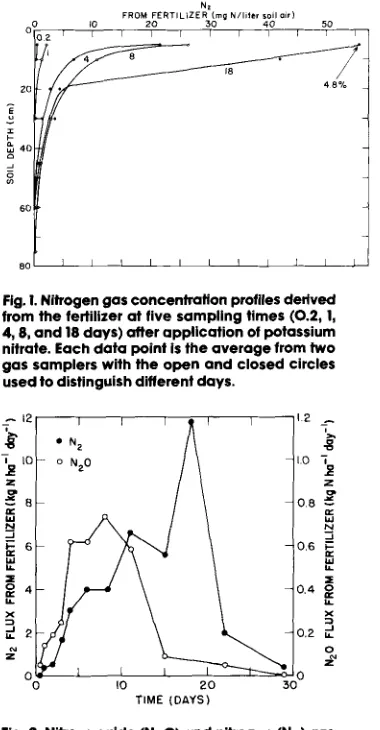
Field methods for measuring deni- trification other than by difference have required placing a sealed compartment over the soil surface and either trapping o r sampling the gases evolved. This method measures nitrous oxide evolution reasonably well. However, it is difficult t o determine how much nitrogen gas has evolved, because small increases above the ambient atmospheric concentration of 78 percent nitrogen cannot be measured. Research was conducted t o measure both nitrous oxide and nitrogen gas evolved from denitrification of fertilizer applied to a field soil under controlled conditions conducive to denitrification. In an open system, such as a field, some m eans must be used t o distinguish fertilizer-derived nitrogen gas from the nitrogen gas of the soil atmosphere. High
e n r i c h m e n t s of the stable isotope, nitrogen-15, were used to learn if the nitrogen gas component of the volatile d e n i t r i f i c a t i o n p r o d u c t s could be measured effectively in a field soil from the isotopic composition of the gas.
Measurement techniques
The field plot (4.6 x 6.1 meters), on Yo10 loam soil at Davis, California, was cropped with perennial ryegrass for more than a year before the experiment. The plot was kept constantly wet near saturation by rainfall or by a sprinkler system. The soil-water suction in the top locentimeters (cm) of soil was main- tained at approximately 0.2 centibar. In the center of the plot were placed tensi- ometers, soil solution samplers, neutron
N I
FROM FERTILIZER I m g N l I i I e r i o i l oirl
Fig. 1. Nitrogen gas concentration profiles derived
from the fertilizer at five sampling times (0.2, I,
4,8, and 18 days) alter application of potassium nitrate. Each data point is the average from two gas samplers with the open and closed circles used to distinguish different days.
0 10 20 30
TIME (DAYS)
Fig. 2. Nitrous oxide (N20) and nitrogen (N2) gas diffusing from the soil surface as a function of time after applying nitrate fertilizer. Note that the scale for N 2 0 is ten times smaller than for N2. Each data point is the average gas diffusion
(flux) determined from two gas samplers.
[image:5.612.398.588.333.698.2]