Journal of Chemical and Pharmaceutical Research, 2014, 6(2):353-358
Research Article
CODEN(USA) : JCPRC5
ISSN : 0975-7384
Dielectric and refractive index studies of phenols in carbon tetrachloride,
benzene and acetone through excess parameter
R. Anandhi and P. Krishnamurthi
Department of Physics, Varuvan Vadivelan Institute of Technology, Dharmapuri
_____________________________________________________________________________________________
ABSTRACT
The values of dielectric constant (ε), refractive index (n) and density (ρ) of the binary mixtures of phenol and p-chlorophenol with carbon tetrachloride, benzene and acetone have been measured experimentally at 301K. From these measurements evaluated the following parameter viz., polarization (P), molar refraction (R), molar volume (V), molar polarizability (α) also predict the following excess parameter like molar volume (VE), dielectric constant
(εE), molar refraction (RE) and polarization (PE). The results are discussed in terms of molecular interactions.
_____________________________________________________________________________________________
INTRODUCTION
Dielectric and refractive index measurements can be able to give the valuable information regarding the nature of molecular interactions of the pure liquids and liquid mixtures. [1-6] Several workers [7-13] study molecular interactions by using dielectric, ultrasonic and non spectroscopic technique. The present investigation, study the molecular interaction of the phenols with solvent (acetone , carbon tetrachloride and benzene) systems.
EXPERIMENTAL SECTION
The refractive indices of the solutions under investigations were determined using Abbe’s refractometer and density of the solution was measured using 5ml specific gravity bottle. The dielectric constants were measured from capacity measurement using dipole meter RL09 supplied by Toshniwal, India operated at 220 volts and working in the heterodyne principle with an oscilloscope null indication. It has a measuring frequency 300 KHz. The samples were placed in a cell containing a co-axial brass cylinder and the cell was immersed in water by means of precision thermostat with an accuracy of ±0.1°C supplied by Concord Instruments Pvt. Ltd., Chennai. The scale of the dipole meter is calibrated using the standard liquids of carbon tetrachloride, benzene, and acetone. The AR grade phenol, carbon tetrachloride, benzene and acetone were used without further purification. The temperatures of all the measurements were maintained at 301K using
RESULTS AND DISCUSSION
The dielectric constant (ε), refractive index (n) and density (ρ) of the binary mixtures of phenol with solvent (carbon tetrachloride (CC), benzene (BE) and acetone (AC) measured at 301 K are given in table 1 and 2. From these experimental values, evaluate the polarization (P), molar refraction (R), molar volume (V) and polarizability (
α) are using the following relations
Polarization of the binary mixtures
1 m
2
2
n
1 m
R
n
2
−
=
+ ρ
(2)The molar volume can be calculated from the equation
m
ρ
(3)Where m and ρ are the molecular weight and density of binary mixtures and the effective molecular weight
m= x1m1+ x2m2 (4)
The dipole moment induced by the electric field can be calculated from the optical refractive index of a material. The refractive index is related to the polarizability of molecules by Lorentz- Lorentz formula (7)
3
NR
4
α = π
(5)Where N is the Avogadro number and R is the molar refraction.
The calculated values of polarization (P) , molar polarization (R), molar volume (V) and polarizability (
α
) are given in table 3 and 4.The excess parameter for binary liquid mixtures are the measure of deviation from ideal behavior of the mixtures are found to be more sensitive tool towards the molecular interaction in the liquid mixtures. The values of excess refractive index (nE) , molar refraction (RE), molar polarization (PE) and molar volume (VE) were determined using the equation
AE= A- (X1A1+ X2A2) (6)
Where AE istherepresents the any excess parameter and A refer to above mentioned quantities. The subscripts 1 and 2 in above equations are respectively for component 1 and 2. X1 and X2 are mole fraction of pure liquids 1, 2
respectively.
The excess dielectric permittivity were evaluated using the relation
2 2 2
1 1 2 2 E
( n ) (( n ) ( n )
ε = ε − − ε − + ε − (7)
Where ε1 , ε2, and ε are the permittivity of the component 1,2 and binary mixtures, n1 ,n2, n are refractive indices
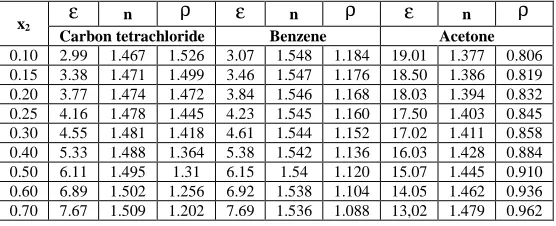
[image:2.595.168.446.614.727.2]of the component 1,2 and binary mixtures respectively. The deviation parameter contains the structural information due to interaction between 1 and 2. If εE is zero over the all concentration, this represents there is no interaction between 1 and 2 liquids. The excess parameter plotted with mole fraction as shown in fig. 1 to 5. The deviations of this parameter are shown in fig. 1, it is observed that static dielectric constant deviations (ε) were found to be positive and negative this indicates the intermolecular interaction takes place in mixtures.
Table 1: The values of dielectric constant (ε) , refractive index (n) and density (ρ) of the phenol with solvent systems
x2 ε
n ρ ε n ρ ε n ρ Carbon tetrachloride Benzene Acetone
Table 2: The values of dielectric constant (ε) , refractive index (n) and density (ρ) of the p-chlorophenol with solvent systems
x2 ε
n ρ ε n ρ ε n ρ Carbon tetrachloride Benzene Acetone
0.10 2.83 1.464 1.509 2.87 1.545 1.167 18.68 1.380 0.826 0.15 3.13 1.466 1.474 3.16 1.543 1.151 18.02 1.390 0.849 0.20 3.43 1.468 1.438 3.44 1.540 1.134 17.36 1.400 0.872 0.25 3.74 1.470 1.403 3.73 1.538 1.118 16.70 1.410 0.895 0.30 4.04 1.472 1.367 4.01 1.535 1.101 16.04 1.420 0.918 0.40 4.65 1.476 1.296 4.58 1.530 1.068 14.72 1.440 0.964 0.50 5.26 1.480 1.225 5.15 1.525 1.035 13.40 1.460 1.010 0.60 5.87 1.484 1.154 5.72 1.520 1.002 12.08 1.480 1.056 0.70 6.48 1.488 1.083 6.29 1.515 0.969 10.76 1.500 1.102
Table 3: The values of molar volume (V), molar refraction (R), polarization (P), polarizability (αx10-25) of the phenol with solvent
systems
x2
V R P α V R P α V R P α Carbon tetrachloride Benzene Acetone
0.1 124.87 34.46 47.25 7.19 67.32 21.38 27.49 4.46 76.53 17.6 65.6 3.67 0.15 123.18 34.12 51.15 7.12 68.46 21.71 30.81 4.53 77.51 18.19 66.17 3.79 0.2 121.47 33.77 54.41 7.04 69.61 22.04 33.85 4.6 78.47 18.77 66.7 3.91 0.25 119.73 33.41 57.14 6.97 70.78 22.38 36.67 4.67 79.39 19.35 67.18 4.04 0.3 117.97 33.04 59.4 6.89 71.97 22.72 39.31 4.74 80.29 19.94 67.61 4.16 0.4 114.38 32.26 62.79 6.73 74.39 23.41 44.15 4.88 82 21.1 68.34 4.4 0.5 110.68 31.44 64.94 6.56 76.88 24.12 48.58 5.03 83.62 22.26 68.86 4.64 0.6 106.88 30.58 66.12 6.38 79.45 24.85 52.73 5.18 85.15 23.41 69.18 4.88 0.7 102.96 29.66 66.52 6.19 82.09 25.6 56.67 5.34 86.59 24.55 69.27 5.12
Table 4: The values of molar volume (V), molar refraction (R), polarization (P), polarizability (αx10-25) of the phenol with solvent
systems
x2
V R P α V R P α V R P α Carbon tetrachloride Benzene Acetone
0.1 100.26 27.67 37.94 5.77 71.26 22.53 27.36 4.7 43.16 11.91 16.33 2.48 0.15 101.82 28.2 42.28 5.88 74.47 23.46 31.13 4.89 46.59 12.9 19.35 2.69 0.2 103.45 28.76 46.34 6.00 77.78 24.4 34.89 5.09 50.19 13.95 22.48 2.91 0.25 105.17 29.34 50.19 6.12 81.18 25.37 38.64 5.29 53.98 15.06 25.76 3.14 0.3 106.98 29.96 53.87 6.25 84.69 26.37 42.42 5.5 57.95 16.23 29.18 3.38 0.4 110.89 31.28 60.87 6.52 92.03 28.43 50.07 5.93 66.57 18.78 36.54 3.92 0.5 115.26 32.74 67.62 6.83 99.84 30.6 57.95 6.38 76.18 21.64 44.7 4.51 0.6 120.16 34.38 74.34 7.17 108.16 32.88 66.13 6.86 86.97 24.88 53.81 5.19 0.7 125.7 36.22 81.21 7.55 117.05 35.3 74.69 7.36 99.18 28.58 64.08 5.96
From table 1 and 2, it can be seen that with an increasing concentration of phenol and p-chlorophenol, the static dielectric constant values are increases for carbon tetrachloride and benzene and decreases for acetone. In the systems phenol with acetone, the values of static dielectric constant are decreased with increase in concentration. This type of results contribution of acetone has large permanent dipole moments also have large static dielectric constant, because the dielectric polarization depends primarily on the ability of their dipoles to reorient in an applied electrical field.
As the concentration of phenol increases in the solution of carbon tetrachloride and benzene, the alignment of dipoles along the field also increases due to this effect static dielectric constant increases. The increase in concentration, the alignments of dipoles along the field also decrease. This caused gradually increase in static dielectric constant. This may be possible due to increase the molar volume also increases in the effective length of the dipole caused by the concentration increases.
The density of the solution decreases for the binary mixtures of phenol+ carbon tetrachloride , phenol + benzene , p-chlorophenol + carbon tetrachloride, and p-chlorophenol+ benzene indicates that may be molar volume of binary solution decreases because influence of hydrogen bonding with carbon tetrachloride and benzene molecules and increases for the binary mixtures of phenol+ acetone, p-chlorophenol + acetone , indicates that may be molar volume of binary solution decreases because influence of weak interaction between acetone molecules. The density values of solution depending on the density of pure components.
Refractive index values of the binary mixtures increases for phenol + carbon tetrachloride, phenol + acetone, p-chlorophenol + carbon tetrachloride and p-p-chlorophenol + acetone because electronic polarization increases reverse trend for phenol + benzene and p-chlorophenol + benzene because electronic polarization decreases.
Generally, the polarizability α consists of two contributions, the first one measuring the ability with which the molecules will be deformed by an electric field, and other due to the orientation of the molecules dipoles under the action of this field . The more important are the orientation effects. Since we measured the refractive index in the optical region, the polarizability should not include orientation effects. The evaluated polarizability value are reported in table 3 and table 4. The Rm values obtained for the binary mixtures of phenol and p-chlorophenol with solvent (carbon tetrachloride , benzene , acetone ) solution lies in range. From table 3 and table 4 reproduces the experimental trend of Rm versus mole fraction of phenol and p-chlorophenol solution. The mean molar
polarizability values are tabulated in table 3 and 4. From table it is observed that, the contribution of electronic polarizability small.
Molar volume decreases for the binary mixtures of phenol + carbon tetrachloride, it is indicate that the weak interactions taking place and increases for the phenol + benzene, phenol+acetone, p-chlorophenol +carbon tetrachloride, p-chlorophenol + benzene and p-chlorophenol + acetone, it may arise the solute – solvent interactions. Similar variation observed for the molar refraction of the binary mixtures.
The polarization values decreases for the phenol + benzene , phenol + acetone, p-chlorophenol + carbon tetrachloride , p-chlorophenol+ benzene , p-chlorophenol + acetone and decreases for phenol + carbon tetrachloride. This is support to the exiting solute-solvent interactions.
Information related to solute-solvent interaction may be obtained by deviation from equation and from figure1. Shows the static dielectric constants are dependence on phenol and p-chlorophenol mole fraction (x) in the solutions of carbon tetrachloride, benzene and acetone at 301K. This dependence is strongly nonlinear, and results seem to be good example for illustration of a possible error extension in the estimation of the static dielectric constants of liquid mixtures, assuming the static dielectric constants of the pure liquids.
The deviations of εEare shown in fig. 1 and fig. 2. From the fig. 1 and fig. 2, it is observed that static dielectric constant deviations (εE) were found to be positive and negative this indicates the intermolecular interaction takes place in mixtures.
[image:4.595.85.537.453.606.2].
Fig. 1 phenol with solvent system Fig. 2 p-chlorophenol with solvent system
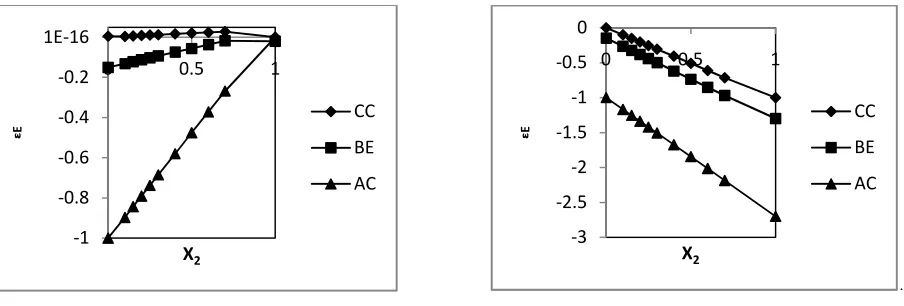
The nE not equal to zero values are generally observed for the systems where dispersion or weak dipole-dipole forces are primarily responsible for the interaction between the component molecules. In the systems under study, phenol, p-chlorophenol and acetone molecules are highly polar and carbon tetrachloride and benzene molecules are non-polar having electrons. On mixing, a phenol and p-chlorophenol molecule would induce a small dipole moment in the solvent molecule, which might lead to weak dipole-induced dipole interaction between the component molecules, in addition to donor- acceptor interaction between electrons solvent and highly polar OH group of phenol and p-chlorophenol resulting in negative values. Negative deviation in nE values may also be observed due to the difference in the molecular size of the component molecules, as in the present mixtures. The magnitude of negative nE values (Fig. 2 & 3) follows the sequence: carbon tetrachloride > benzene > acetone.
-1 -0.8 -0.6 -0.4 -0.2 1E-16
0 0.5 1
ᵋ
E
X2
CC
BE
AC
-3 -2.5 -2 -1.5 -1 -0.5 0
0 0.5 1
ᵋ
E
X2
CC
BE
[image:4.595.320.536.456.602.2].
Fig. 3 phenol with solvent system Fig. 4 p-chlorophenol with solvent system
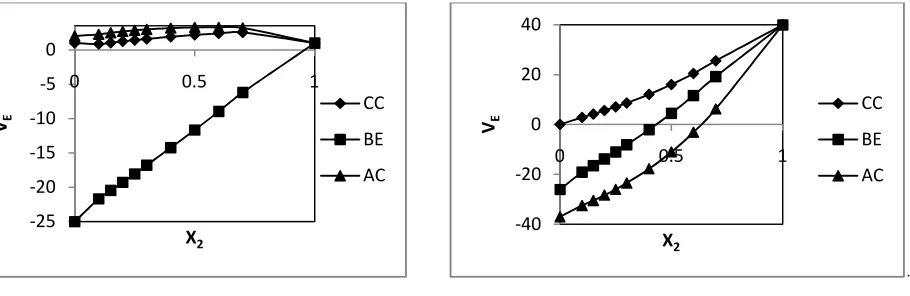
This is also the sequence in the difference in molar volumes of phenol and p-chlorophenol with carbon tetrachloride, benzene and acetone in the present study. For all the mixtures, the values become positive phenol with carbon tetrachloride and acetone and negative for phenol with benzene as shown in fig.5 and 6 also similar trend of p-chlorophenol with carbon tetrachloride, benzene, and acetone.
[image:5.595.83.538.311.459.2].
Fig. 5 phenol with solvent system Fig. 6 p-chlorophenol with solvent system
The deviation in VE suggests that the position of chlorine on the aromatic ring influences the VE values in these mixtures. We thus conclude that the magnitude of VE, for the present systems, depends on chlorine, carbonyl, and hydroxyl functional group.
.
Fig. 7 phenol with solvent system Fig. 8 p-chlorophenol with solvent system
The deviations in molar refraction (RE) are shown in Fig. 7 and fig. 8, all the three binary mixtures are negative for phenol +benzene and positive for phenol + carbon tetrachloride, phenol +acetone. Negative for lower concentration and positive for higher concentration in p-chlorophenol as one of the component of the solvents. The magnitude of
-0.02 -0.01 0 0.01 0.02 0.03 0.04 0.05 0.06 0 0.5 n E X2 CC BE AC -0.08 -0.06 -0.04 -0.02 0 0.02 0.04 0.06
0 0.5 1
n E X2 CC BE AC -25 -20 -15 -10 -5 0
0 0.5 1
VE X2 CC BE AC -40 -20 0 20 40
0 0.5 1
VE X2 CC BE AC -6 -5 -4 -3 -2 -1 0 1
0 0.5 1
R E X2 CC BE AC -6.5 -1.5 3.5 8.5
0 0.5 1
[image:5.595.79.540.522.691.2]suggest weak interactions and positive for strong interaction between the component molecules in the mixture. Thus, the observed trends in RE values with composition support the trends shown by nE for the mixtures under study.
[image:6.595.83.530.104.261.2].
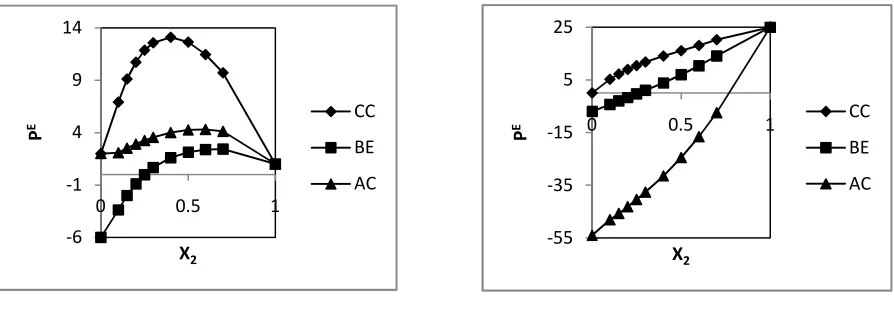
Fig. 9 phenol with solvent system Fig. 10 p-chlorophenol with solvent system
The deviations of PE are shown in fig. 9 and fig. 10, it is observed that excess polarization deviations (εE) were found to be positive and negative this indicates the intermolecular interaction takes place in mixtures. Deviation is positive strong interaction between the component systems and negative deviations weak interaction between the component systems.
CONCLUSION
The excess parameter like molar volume refractive index, polarization, molar refraction, dielectric permittivity shows deviation is positive strong interaction between the component systems and negative deviations weak interaction between the component systems. The value of refractive index , polarization dielectric constant , molar refraction increases for carbon tetrachloride , benzene and decreases for acetone which exhibit weak for carbon tetrachloride , benzene also strong interaction for acetone.
From the trends and behaviour of the evaluated excess values of binary mixtures of phenol and p-chlorophenol with carbon tetrachloride, benzene and acetone at 303 K, which may eventually concluded as exist a molecular interaction between the phenols and acetone is through hydrogen bonding and carbon tetrachloride and benze through dipole-dipole interactions. The strength of the molecular interactions gets weakened on further addition of carbon tetrachloride and benzene. Weak dipolar and cohesive forces are exist in the present systems of liquid mixture also solute- solute interactions component.
REFERENCES
[1]P Krishnamurthi ; S Balamuralikrishnan. J. Con. Eng. Tech. Sci. 2009, 1, 23-26. [2]P Krishnamurthi ; S Balamuralikrishnan. Asian J Chem, 2010, 222(7), 5144-5148. [3]P Krishnamurthi; T Vasavi. I. J. pharm. and Bio Res., 2013, 4(1), 126-131.
[4]P Krishnamurthi; P A Thenmozhi. J. Chem. and Pharm. Res., 2012, 4(11),4677 – 4681. [5]P Krishnamurthi; P A Thenmozhi. J. Chem. and Pharm. Res., 2012, 4(11), 4671 – 4676. [6]M Meenachi ; P.Krishnamurthi . I. J. pharm. and Bio Res., 2012, 3(4), 1719-1723. [7]I Farid ; El Dossoki, Journal of the Chinese Chemical Society, 2007, 54, 1129-1137.
[8]Alka Tadkalkar; Pravina pawar; and Govind K. Bichile; J of Chem Pharm res, 2011, 3(3), 165 – 168. [9] AJ Clement Lourduraj; and I Johnson . J.pure Appl.Ultrasonics., 2008, 30, 69-73.
[10]N Prasad; O Prakash; S Singh; and S Prakash. Ultrasonics, 1978, 16(2), 77.
[11]Amalendu Pal; Harshkumar; BK Arbad; and AB Tekale; Indian J Pure Appl. Phys., 2003, 41, 113. [12]GV Rama Rao;Viswanatha sarma; and C Rambabu. Indian J Che., 2004, 43(A), 752.
[13]A Ali, K Tiwari; AK Nain; and V Chakravortty. Indian J Phys., 2000, 74 B(5), 351.
-6 -1 4 9 14
0 0.5 1
P
E
X2
CC
BE
AC
-55 -35 -15 5 25
0 0.5 1
P
E
X2
CC
BE