58
A Study of Factors Which Determine The
Supply of Pigs
By R. O'CONNOR, M.AGR.SC, PH.D.
[Read before the Society on December 18th 1953)
THEORETICAL BACKGROUND AND REVIEW OF LITERATURE
In a free economy, where prices and production are not controlled, pig numbers move ia characteristic cycles, each cycle averaging about four years in length. These pig cycles are the resultant of many phy-sical and economic forces, and the whole pattern of production and prices has been given a generalised explanation which is referred to in the United States as the " Cobweb Theorem."1 This theorem is
explained by Shepherd2 as follows :
An unfavourable season will reduce the supply of pig food and, consequently, its market price will increase. Ordinarily, this will cause farmers to raise fewer pigs. When these reduced pig numbers reach the market, the price of pigs will go up. This rise in pig prices induces farmers to raise extra pigs but when this large supply of pigs reaches the market it depresses the price of pigs again. This in turn leads farmers to produce fewer pigs, and so on. The price and production tend to swing round and round an equilibrium point rather than settle at it.
The Cobweb Theorem, as developed above, explains two-year cycles in production and prices. It does not fully explain the longer cycles, however, and so we must conclude that there are other determinants of the cycle as well as supply of food and price of pigs. Henry A. Wallace3 in 1920, using statistical analysis, was apparently the first
to develop the new well-known American Hog Corn Ratio.4 He showed
the significance of the relation of corn prices to future pig prices, and made multiple correlation studies of the relation of supplies and busi-ness activity to pig prices.
Ezekiel and Haas5 in 1927 in a study of the factors affecting the
price of pigs showed a pig price cycle as well as a pig number cycle and concluded that the price cycle was due to a tendency by pig pro-ducers to overshoot the mark in increasing production when the relation of pig prices to corn prices was favourable, and to reduce too much when it was unfavourable. Wells6 in 1933 examined the
1 Ezekiel Mordecai. " The Cobweb Theorem," U.S. Quarterly Jol. of Econ.,
Feb. 11, 1938.
2 Shepherd, G. Agric. Price Analysis, 3rd Ed. Ames, Iowa, 1950, pp. 31, 32. 3 Wallace, Henry A. Agric. Prices, Des Moines, Iowa, U.S.A., 1920.
4 Hog Corn Ratio is the ratio between the price of 100 lbs. of Pork and the
price of 1 Bushel (56 lbs.) of Corn (Maize).
5 Ezekiel, M., and Haas, G. C. Factors affecting the price of Hogs. U.S.D.A.
Bulletin, No. 1440, Washington D.C., 1927.
6 Wells, O. V. " Farmers Response to Price in Hog Production and Marketing."
various factors which influence farmers in their decision to produce pigs and found that the Hog/Corn ratio was the price factor to which the American farmer was most responsive. He went on to say that if the collective national response was being considered, the three general price influences that tended to modify the farmers' initial corn hog responses were hog prices, the general level of other live-stock prices, and commercial feed prices. He also stated that the most important non-price influences to be considered were spring weather and disease. Wells analysed his data by a simple method of graphic association or correlation, but he did not attempt the derivation of an exact mathematical supply curve.
Hanau1 in 1927 showed that European farmers responded to the same
influences as the Americans in their pig production decisions and listed (a) the ratio of pig prices to the price of a unit of pig feed, (b) the price of a unit of pig feed and (c) the rate and direction of the change in the number of sows, as being the most important deter-minants of pig numbers. He also showed that with regard to (a), when the ratio was favourable large supplies of pigs were available 18 months later and prices fell. Finally, he combined the above fac-tors into a price-fore casting formula which gave price estimates re-markably close to the actual.
Schrader2 in a recent study (March 1953) examined the factors
affecting pig production in Canada. Variations in pig slaughter were studied in connection with six factors representing pig and barley prices, feed supplies and farm cash income. He found that variations in these six factors were associated with 92% of the variations in annual pig slaughterings from 1927 to 1951. Percentage changes in the variables from year to year were used to derive a logarithmic supply function.
PIG STUDIES IN IRELAND
In an important article in the Irish Trade Journal in December 1925 it was shown that pig numbers in Ireland followed the same general pattern as those in other countries. A heavy potato crop in any year was generally followed by a heavy pig crop the following year, while a high pig price in any year was usually followed by an increase in pig numbers the year after also. The article says that in no less than 23 out of 31 years from 1881 to 1913, a rise or fall in pork prices in any 12 months was followed by a rise or fall respectively in the number of pigs in the following 12 months. In 6 out of the remaining 8 years the changes were brought about by exceptionally large or small potato crops. Although pork rose in price in Ireland from 1896 to 1897, pig numbers fell from 1897 to 1898 because the average yield of potatoes fell from 66 cwts. in 1896 to 44 cwt^.—an extremely bad crop—in 1897. The potato crop in 1870, the highest in 6 years, was followed in 1871 by one of the best pig years on record, and the bad potato crop in 1872 was followed by decreased supplies of pigs in 1873.
1 Hanau, Arthur Die Prognose der Scheweinepreise, Berlin, 1927. Quoted in
Irish Trade Jol. and Stat. Bui., August, 1928, p. 137.
2 Schrader, F. M. "Factors affecting Hog Production," Canada Dept. of
Staehle1 in 1951 confirmed the above findings and with the aid of
a scatter diagram showed that in the years 1847 to 1913 there was a high correlation between young pigs under 6 months old counted in each year and the ratio of the price of pork to that of potatoes two years earlier.
In his now historic paper read before the Statistical and Social Inquiry Society in 1925, Barrington2 showed an important
relation-ship between pork and young pig prices. He presented a diagram to demonstrate that a given percentage change upwards or down-wards in the price of pork was accompanied or followed immediately by a greater percentage change in the same direction in the price of young pigs, and stressed the importance of such prices as a deter-minant of pig numbers at future dates.
Though there have been numerous other studies of the pig industry in this country, all are more or less of a descriptive nature and, except to a limited extent, their purpose has not been an analytic examina-tion of the factors influencing the supply of pigs. Two early studies are, however, worthy of mention, though they do not purport to study specifically pig supplies. These are the Tariff Commission Report No. 143 and the Report of the Pig Industries Tribunal.4 Both these
reports give intimate descriptions of the different aspects of the Pig Industry in this country and bring our knowledge on these subjects up to the dates of their publication. The writer is greatly indebted to these two reports for his background of knowledge on the whole Pig Industry in this country.
SCOPE AND METHOD OF THIS STUDY.
Prior to World War II total pig numbers in the State5 on June 1st
each year were in the region of 1,000,000. A drastic reduction occurred during the war years, and up to the end of 1952 numbers had not returned to anything like the pre-war figure. The present study is, among other things, an attempt to find a rational explanation for this state of affairs.
The object was to examine critically the Pig Industry in the inter-war years ; to study the various factors influencing farmers in their production decisions, and to see if the inter-war relationships were operative in the post-war period.
The Industry during the war period was not studied, since it was felt that the whole economic structure was upset during that time, and meaningful results would not be obtained.
It was thought that it might be possible to derive a statistical supply curve for pigs in this country, but not much hope of success in this direction was entertained, as supply curves are much more difficult to derive than demand curves.
1 Staehle Dr. Hans. Statistical Notes on the Economic Hist, of Irish Agric,
1847-1913. Jol. Stat. and Soc. Inquiry Soc. of Ireland Vol. XVIII 1950-51.
2 Barrington Thos. A review of Irish Agric. Prices Proc. Stat. and Soc.
Inquiry Soc. of Ireland, 1925-26. pp. 264-266.
3 Tariff Commission Report No. 14. Dublin Stationery Office 1932. 4 Pig Industries Tribunal Report. Dublin Stationery Office 1933.
5 The State here refers to Ireland (excluding six North-eastern Counties). The
In the course of the Study, the following factors were examined : 1. Pig numbers.
2. Price of Pigs.
3. Price of Pigs relative to other agricultural produce. 4. Quantity of food available.
5. Price of Pig Food. 6. Pig Food price ratio and 7. Price of young Pigs.
The influence of disease, though it may be considered of some import-ance, was not considered, since there were no complete figures avail-able on the matter.
It was hypothecated that pig numbers in any one period were the resultant of rational decisions made previously by farmers, and that in making their decisions producers were influenced to an important degree by all or most of the other variables listed above. Each of these factors was then considered as follows :
PIG NUMBERS
Pig numbers on the 1st of June each year, as given in the Statis-tical Abstract, are an imperfect measure of pigs produced. Due to the fact that pigs mature in about 7 months from birth, most pigs born between June and November will be slaughtered before the next census and will not appear in the statistics at all. Pigs slaugh-tered in the country and live pigs exported are, therefore, a more per-fect measure of pig production than pig numbers appearing in the census, and it was decided to study these. As the study was orientated with a possible view to exact statistical examination afterwards, quarterly observations were made so as to give as many degrees of freedom as possible.
Monthly figures for pigs slaughtered in factories and for export are available for the Twenty-Six Counties since January, 1924.1 For pigs
killed on farms, only yearly estimates are available, and these are excluded for the following reasons—
The estimates give no break down of farm killings for separate quarters, although one might validly conclude that the bulk of the killings took place between October 1st and May 1st. Regardless of prices, certain farmers will kill a pig or two each year. Strictly speak-ing, therefore, pigs killed on farms do not enter into the economic system at all, and it was mainly for this reason that they were left out of the reckoning.
Between 1924 and 1934 inclusive, an average of about 60,000 store pigs and bonhams2 was exported each year to Northern Ireland and
Great Britain. After 1934, these exports declined to an average of about 10,000 per annum. These exports complicate the pattern con-siderably, and it was not easy to decide whether to include or exclude them. The exported pigs were bred in the State and were thus the resultant of a decision making process. They were not, however, fattened in the State, and therefore could not be considered along with fat pigs. It was eventually decided to deal only with fat pigs and porkers and to exclude exported store pigs and bonhams.
1For details of sources see Appendix 1.
During the inter-war years an average of about 67,000 pigs per annum was killed by Irish pork butchers. Only annual estimates are available for these killings and there was little information avail-able as to their seasonality. Tt was felt, however, that these pigs should be included and, accordingly, one-fourth of the annual num-bers was apportioned to each quarter.
In Table I, Appendix II, is given a breakdown of the total number of Bacon Pigs and porkers marketed per annum, while in Table II the total marketings per quarter are given. In Figure I the data from Table II are graphed against time to show that from 1925 until about the middle of 1937 the cyclical pattern of pig numbers is very pro-nounced and the length of a cycle from peak to peak or from trough to trough is about 4.years. That farmers increase production more slowly than they decrease it is shown by the slopes of the curve. The gradient from a trough to a peak is not as steep as the slope from a peak to a trough.
Though imports of pig meat and sausages into the Twenty-six Counties have been subject to a limited customs duty since the 31st December 1931 and to a more comprehensive duty since the 25th July, 1932, this departure from free trade did not seem to upset the pig cycle materially. Figure I shows that from 1932 to 1937 there was one complete cycle. The customs duty imposed by the British Government on imports of Irish bacon in July, 1932, did not seem to affect the cycle very much either. Nevertheless, there was a change in the 'thirties.
A close examination of Figure I shows that the cycle from 1932 to 1937 is about one year longer than the earlier ones. The cycles in the 'twenties took place at intervals of about 4 years, that in the thirties took five years to complete.
From the middle of 1937 onwards, a readily apparent change takes place in the cyclical pattern. Pig numbers each quarter become more uniform and the typical movements have almost disappeared. This is a very interesting change and appears to be closely related to the establishment of the Pigs' Marketing Board, which was established in 1935. This Board fixed its first price of pigs in October of that year. From this until 1943, the price which curers paid for pigs was regulated either by this Board or by the Pigs and Bacon Commission which replaced it in 1940. As a result of price fixation, fluctuations in price were almost eliminated (see Fig. I) and, after an interval of about 18 months, fluctuations in pig numbers began to disappear also, as is shown. There may, of course, be other reasons for this change in the pattern of pig production at this time but the most apparent is the influence of the stabilisation of prices.
Dividing the inter-war pig series into two periods corresponding to free and controlled prices, we find that the average number of bacon pigs and porkers marketed per quarter from the first quarter of 1924 to the fourth quarter of 1936 inclusive was about 324,000. From the first quarter of 1937 to the end of 1939, the average quarterly
g arketings were about 297,000.
PRICES OF PIGS
prices are given in Appendix I. The prices of pigs given in Appendix II are weighted averages of the prices of bacon pigs and porkers since prices of these two classes of pigs are given separately in most of the sources consulted.
The separate prices were weighted by the numbers of bacon pigs and porkers sold and made into a weighted average of pig prices. This weighted average is almost identical with the prices of bacon pigs since, in the first place, there was not a wide difference in the two prices averaged and, in the second, the proportion of bacon pigs sold was very much greater than the proportion of porkers.
Since prices of any commodity are relative to those of other com-modities, the actual pig prices tell very little on their own. It was therefore decided to deflate these prices by the general index of agri-cultural prices, which series is in existence since January 1922, with 1911-13 as base period. Thus, the deflated prices are a combination of two variables which show the course of pig prices relative to that of all agricultural produce and represent the trend of pig prices in relation to all prices which farmers receive. This deflated price series is also given in Table III.
The deflated prices of pigs are plotted in Figure I along with pig numbers to show the relationship between these two variables. That there is a close relationship between prices and numbers is readily apparent in the earlier years. The peak of a price cycle is followed by the peak of a pig cycle in 18 to 21 months, while the troughs are similarly spread. By moving forward the price series about 18 months it almost coincides cycle for cycle with the pig number series up to about 1932. From 1932 to 1937 the relationship is not so close, since the pig cycle is longer than the price cycle.
To test the relationship between the two series, the co-efficients of correlation between pig numbers and lagged pig prices were cal-culated by the product moment method. Pig numbers were taken from the 1st quarter of 1924 to the 3rd quarter of 1936, and these were correlated with prices lagged by 15, 18 and 21 months respec-tively. The best lag was found to be 18 months and the approximate correlation co-efficient between pig numbers and prices at this lag was -69.1 It would seem, therefore, that prior to price fixation in
1935, prices were an important determinant of pig numbers. After 1935 we must conclude that they are also important, but the graphic relationship is not so obvious. As explained previously, price fixation, had the effect of eliminating the price cycle and this in turn seems to have contributed appreciably towards the disappearance of the pig cycle.
The average deflated price of pigs from the third quarter of 1922 to the 2nd quarter of 1935 was 58-0/- per cwt. d.wt. The deflated price from the third quarter of 1935 to the 2nd quarter of 1938 was 62-5J- per cwt. d.w.
QUANTITY OF FOOD AVAILABLE AND PRICE OF FOOD
Earlier it has been shown that the quantity of potatoes available in any one year greatly influences the number of pigs marketed in
1 According to a method suggested by Dr. R. C. Geary this coefficient is
the following year. The supply of Creamery separated milk has protr ably the same effect as was pointed out in the Tariff Commission Report.1
When statistical calculations are contemplated, difficulties arise with both the supply of potatoes and of skim milk. The potato crop is an annual item and can only be correlated with annual pig numbers, not with quarterly figures. Quarterly figures are not available for separated milk either, and so, the amount of this commodity cannot be correlated with quarterly pig numbers.
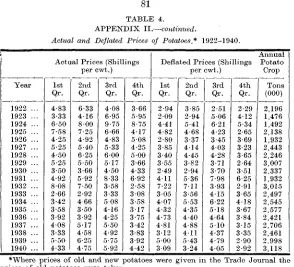
Though only a small proportion of the potato crop comes on the market, nevertheless price is an important barometer of the potato crop. When the crop is poor prices are generally high, when good, prices are low. It was thus decided to plot quarterly prices of potatoes along with pig numbers to see if any relationship existed between them. This has been done in Figure II, after deflation of potato prices by the general agricultural price index.
Separated milk did not come on the market in the years in question and therefore had no price. Because of this, there was no way of correlating it with quarterly pig numbers.
In the years under review, Indian meal (maize meal) was the most important cereal used in the feeding of pigs in this country. Adequate quantities of this food were available and it was rationed only by price. During the war, when supplies of maize became scarce, pig numbers dropped rapidly. We can therefore conclude that maize, especially in the mid-war years, was an important determinant of pig numbers.
Actual and deflated prices of Indian meal are given in Table V. In Fig. I I the deflated series has been plotted along with potato prices and pig numbers.
As can be seen from Figure II, there is not a very definite relation-ship between pig numbers and the deflated price of Indian meal over the whole of the range shown. Prior to 1932 there is an inverse corre-lation between the two series. From 1932 to 1936 there seems to be no relationship between them, but from 1936 to 1940 high priced Indian meal again seems to be related to low pig numbers. Over the whole range, however, the co-efficient of correlation between pig numbers and deflated price of Indian meal is not significant.
The relationship between potato prices and pig numbers is fairly well pronounced. Small pig crops in 1925, 1929-30 and 1932-33 are associated with dear potatoes 18 to 24 months before. Large pig crops in 1928, 1931 and 1936 can be related to cheap potatoes at an earlier period also, but the lags in this case would appear to be longer than the others.
The pattern of these series would suggest that a poor potato crop causes farmers to go out of pig production rapidly (a thing very easily done) whereas a good crop does not get them into production nearly so rapidly. It would seem that the lags at peaks and troughs are not the same, a fact which introduces difficulties into the statisical calculations.
PIG FOOD PRICE RATIO
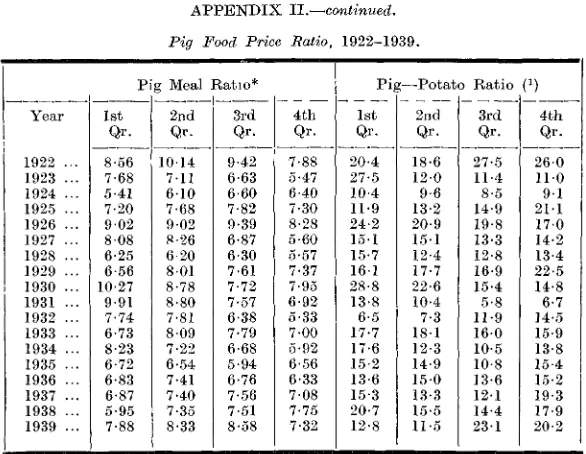
The following ratios were calculated :—
i. PigjMeal Ratio. This is the ratio between the price of 1 cwt. of pork and the price of 1 cwt. of Indian meal. It is obtained by dividing the latter price into the corres-ponding price for the former.
ii. PigJPotato Ratio. This is the ratio between the price of 1 cwt. of pork and 1 cwt. of potatoes.
Both these series of ratios are given in Table VI. Professor Johnston in his recent book1 has constructed a pig/food price ratio based on
half bran and half Indian meal, but since the price of bran does not differ very much from the price of Indian meal there is little difference between this ratio and the pig/Indian meal ratio.
Regarding pig/food ratios in general, it may be said that the num-erator of all such ratios is the price of pigs, a figure which is highly correlated with pig numbers. Consequently, any reasonable pig/food ratio constructed will be correlated with pig numbers also, since there has not been any great variation in the price of pig food generally in the years in question.
It is interesting to note that during the period 1922 to 1939 inclu-sive, the pig/meal ratio varied from 5*3 to 10*3, the average for the period being 7*4. The pig/potato ratio for the same period averaged 15-4, the highest being 28-8 in the first quarter of 1930, while the low-est was 5-8 in the third quarter of 1931.
The longtime American hog corn ratio is about 12 *02 which is the
ratio between the price of 100 lbs. of pork and 1 bushel (56 lbs.) of maize. Converted into our units of 112 lbs. pork and 112 lbs. maize, the average American ratio of 12-0 becomes 6'12.
PRICE OF YOUNG PIGS
Barrington3 had shown that in the years prior to 1925 pig and
bonham prices had moved up and down together in characteristic fashion. Comparing these two price series since 1925 we find that the pattern is unaltered. A rise in the price of pigs is followed almost immediately by a greater relative rise in the price of young pigs, and vice versa.
In a closed economy, the price of bonhams is determined by the price of fat pigs. Farmers receiving good prices for their fat pigs are prepared to pay high prices for young pigs to fatten and vice versa. Ours, however, is not a completely closed economy, and it was felt that an outside demand for young pigs would innate the price of these animals somewhat, even though pig prices at home were low. As mentioned previously, about 60,000 store pigs and bonhams were exported annually up to 1934, and even since then it has often been said that smuggling over the Border went on from time to time on a
1 Johnston Prof. J. Irish Agriculture in Transition. Dublin 1951 pp. 68-71. 2 Feed Statistics. U.S.D.A. Washington, D.C.
3 Barrington Thomas. A review of Irish Agricultural Prices. Jol. Stat. and
fairly large scale. The writer felt, therefore, that there may have been a negative correlation between pig numbers in any period and the price of bonhams six months earlier. The hypothesis was that an outside demand would increase the price of young pigs above the home economic price. This would cause farmers to sell more young pigs than they normally would. These young pigs would leave the State and would be reflected in a decreased supply of fat pigs reaching the market six months later.
To test this hypothesis, bonham prices lagged by six months were correlated with pig numbers marketed. A correlation co-efficient of -0*13 was obtained, but since this co-efficient was not significantly different from zero at the 5% level, the hypothesis had to be rejected. Actual and deflated bonham prices from 1922 to 1939 are given in Table VII.
STATISTICAL ANALYSIS
Having examined superficially the different factors which might be expected to influence pig producers in the inter-war years the derivation of a statistical supply curve was attempted. It was decided to derive such curve for the period of free prices only, since graphed data for the period of controlled prices did not look very promising for this purpose. Accordingly, quarterly pig numbers were used from the 1st quarter of 1924 to the 4th quarter of 1936 (52 observations) and the other variables suitably lagged were chosen to agree with these observations.
The variables used were as follows :
Dependent Variable—^o. of bacon pigs and porkers (in thousands) marketed per quarter.
Independent Variables—Deflated pig prices lagged 18 months. Deflated prices of potatoes lagged 21 months. Deflated prices of Indian meal lagged 18 months.
The lags used had given the highest correlation with the dependent variable when various lags were tried. These lags can also be justified on logical grounds. Even if farmers responded immediately to price increases, fat pigs could not reach the market before 11 months. (4 months gestation and 7 months feeding). Such a situation would mean that female pigs were at hand and ready to be turned into sows at a moment's notice. This is not so. A farmer deciding to keep an extra sow generally has to allow a bonham to reach the correct age for mating, thus stretching the time of response by a further five or six months. Further, as is well known, farmers do not respond immediately to price increases, so that 18 months is about the mini-mum period which can elapse before extra pigs reach the market.
Ezekiel1 has found that the American farmers' response to the
Hog corn ratio takes about 18 months to come into effect also. What is true of the lag with pig prices is also true of Indian meal, but pot-atoes are in a different position. Throughout the country generally the potato market does not really begin until after Christmas, so that
1 Ezekiel M. and Haas, G. C. Factors affecting the price of Hogs. U.S.D.A.
prices early in the season are not the lever which they are later. Con-sequently, it is to be expected that the lag for potato prices will be longer than the lags for either pigs or Indian meal.
STATISTICAL METHODS
In the derivation of supply curves it is not easy to decide which statistical method is the most appropriate. Little has been published on the subject of supply curves, and the literature is therefore not very helpful. Another difficulty associated with this type of study is the drawback which is inherent in all time series analysis, namely, that of serial and auto correlation. Though a number of methods are available for reducing the mutual dependence of successive obser-vations no entirely satisfactory method has yet been devised. Not alone this, but the choice between models is very difficult. According to Tintner1, p. 187 "There is as yet no valid procedure for the choice
between different theories or hypotheses."
In such circumstances the research worker has to experiment with a number of methods until one is found which gives reasonably good results. There is no one method which can be used to the exclusion of all others. Most of the modern econometric methods for dealing with time series are based on the assumption that each observation in the series consists of two parts, a systematic part and a random or error part. (Geary, 1948,2 Tintner 1950.3) The method of analysis
used will depend on the assumptions made concerning the systematic parts. If it is assumed that these parts are functions of time then the objective is to eliminate the systematic parts and to use methods of correlation analysis on the random or error parts. If the systematic parts are not assumed to be functions of time, then other methods of analysis are appropriate.
Method I.
In the present case it was assumed that the systematic parts were time functions and that they could be estimated by a finite number of orthogonal polynomials. Accordingly a fifth degree polynomial was fitted to each of the variables by the method of orthogonal poly-nomials. The fitting is facilitated by the fact that the polynomial values for different Ns are tabulated.4
The estimates obtained by fitting the fifth degree polynomial were then subtracted, item by item, from the original series and the resid-uals obtained were correlated with each other by the method of least squares, a linear regression equation being obtained.
Pig numbers were estimated by this equation, but inspection of the estimates showed that they were a poor representation of the actual. This method was not considered any further and there is therefore no need to discuss the assumptions on which it is based.
1 Tintner, Gerhard. Econometrics, New York, 1952.
2 Geary, R. C. Studies in relations between Economic Time Series. Jol.
Royal Stat. Soc. Series B. (Methodological), Vol. X, No. 1. 1948.
3 Tintner, Gerhard. A Test for Linear Relations between weighted regression
Co-efficients. Jol. of Royal Stat. Soc. Series B. (Methodological), Vol. XII, No. 2, 1950.
4 Anderson, R. L., and Houseman, E. E. Tables of Orthogonal Polynomial
68 Method II.
Having failed to derive a satisfactory formula by the first method, a linear equation was obtained by the old classical method of least squares. In this case time measured from 0 to 51 was included as another independent variable. The following linear equation was obtained, using the Doolittle Method of solution.
Y=42-4054+l-54858X1 + 5-99453X2 — 6-61616X3 — 9-89871X4
Y=pig numbers in thousands, Xx =time in quarters the first
quarter being taken as 0, the last as 51, X2, X3 and X4 are
the deflated prices of pigs, potatoes and Indian meal respect-ively.
Pig numbers were then estimated, using this equation and the esti-mated and actual series are plotted together in Figure III. As can be seen, the estimates are a close representation of the actual except for a few off periods between 1928 and 1932. Indeed, it is unlikely that a better fit could be obtained with these variables using any other method.
When the estimates were extrapolated beyond their range, as shown also, the fit obtained was not very good. This furnishes further evid-ence, if such evidence were needed, that a change took place in the economic structure with the introduction of controlled prices.
The uncorrected co-efficient of Multiple Determination R2 was
found to be 0*55863. Correcting this by the usual method gave the corrected co-efficient R2 as 0-52107. This figure seems low in view
of the good fit obtained by the graphic method, but it is quite poss-ible that the few seemingly freakish peaks in the cycle may be responsible for the rather low co-efficient of multiple determination.
The square root of R2 which is the co-efficient of Multiple
Correlat-ion was found to be *748. Had the usual conditCorrelat-ions regarding random sampling and independence of observations been fulfilled, this co-efficient would be highly significant. In the present case we can only say that it is probably significant.
ACTUAL PRICES VERSUS DEFLATED
In an attempt to find a formula which gave a better " fit " than the previous one, a linear equation was calculated, using actual rather than deflated prices. The following formula was obtained :
where X1=416-55+5-36Xa-l-08X8-3-14X4-3-64X5,
X1=number of bacon pigs and porkers marketed per
quarter, X2=actual price pigs (shllgs. per cwt. d.w.) 18 months lag,
X3=price of potatoes, (shllgs. per cwt.) 21 months lag, X4—price of I.
meal (shllgs. per cwt.) 18 months lag, X5=general agricultural price
index, 18 months lag.
R2=0-56 : R=0-75 : N=52 : M=5.
&9=5-36±0-86 t=6-22
&3=—1-08±5-75 t=O-ld
64—3-14+7-11 *=0-44
b5=—3-54+0-87 *=4-08
Regarding significance we can say that if the necessary conditions pertaining to random sampling and independence of observations are fulfilled, R,&2 and b5 are highly significant whereas b3 and bA are not significant. The significance of b5 is very interesting since it im-plies that in the period concerned, pig numbers were inversely related to the general agricultural price index. In other words, high agricul-tural prices generally tend to be associated with low pig numbers. This would imply that when agricultural prices are low farmers are forced to keep pigs if the necessary income is to be obtained, whereas, when general agricultural prices are high, there is no need to go in for what they may consider laborious pig production.
The non-significance of potato and maize meal prices is also very interesting. It means that potato prices are not really a determinant of pig numbers. This is not unexpected, since only a small proportion of the potato crop ever reaches the market. It is the physical volume of potatoes produced each year which really matters and it seems that quarterly prices do not adequately represent the volume.
The non-significance of Indian meal prices can only be interpreted to mean that in the period concerned factors other than this caused farmers to expand production and the meal was purchased regardless of price to supplement the home produced foods. Without the meal, pigs could not be produced, but changes in its price in the years con-cerned do not seem to have been important.
CORRELATION OF PERCENTAGE CHANGES
Finally, with the sole object of including the annual potato crop as an independent variable, a further equation was calculated, this time annual data being used. In this case percentage changes in pig numbers were used and these were correlated with percentage changes in the independent variables. Logarithmic regression functions were used in this analysis, giving the following equation, which is linear in the logarithms :—
Log X ^ L o g 1-5108+0-6239 Log X2+0-2126 Log X3—0-5906 Log X4,
Where Xx=annual number of bacon pigs and porkers marketed as
a percentage of previous year (1924—38), X2=actual price of bacon
pigs (shllgs. per cwt. d.w.) as percentage of previous year (2yrs. lag), X3=annual potato crop (thous. tons) as percentage of previous year
(2 yrs. lag), X4=general index of agricultural prices as percentage
of previous year (1 yr. lag).
Changes in maize meal prices were also included in this equation, but this variable had to be deleted as it appeared with a wrong sign. In this case, the best lags were previously calculated by simple correlation methods, therefore, ordinary tests of significance are not valid.
R2 = -752 with n = 1 3 and m = 4 .
R =-867 (significant)
62=0-6239±0-1863, £2=3-35 (significant)
&3=0-2126=t0-1329, *8=l-60 (not significant.)
&4=0-5906±0-4176, *4=1-41
The adjusted co-efficient of multiple determination R2 equals *67.
This means that 67% of the variance in the dependent variable (per-centage change in pig numbers) is explained by the independent variables.
In this type of function the regression co-efficients are the elastic-ities of the dependent variable with respect to the independent vari-ables. (Allen.1) These elasticities may be interpreted as follows, if we
make the usual allowance for " ceteris paribus." During the fourteen years period examined, a 6% change in pig numbers (expressed as a percentage of the previous year) resulted from a 10% change in the same direction in lagged pig prices expressed as a percentage of the previous year (2 year lag).
A 10% increase in the potato crop expressed as a percentage of the previous year was responsible 2 years later for a 2% increase in pig numbers expressed as a percentage of the previous year.
A 10% increase in the general index of agricultural prices expressed as a percentage of the previous year was followed in 1 year by almost a 6% decrease in the number of pigs sold (these also expressed as a percentage of the previous year).
Percentage changes in pig numbers estimated from this equation have been plotted in Figure IV along with the actual figures, and the estimates have been extrapolated beyond their range into the period of fixed prices before the war and for the three years 1949-50, 1950-51 and 1951-52. As can be seen, the equation is not very suit-able for extrapolation purposes.
In Table IX Appendix II, the data from which this equation has been calculated is given together with the estimates of percentage changes in pig numbers calculated from the equation.
POST WAR PERIOD
As mentioned previously, imports of maize meal disappeared dur-ing the war years, and we can assume that supplies of food were not adequate for large pig numbers during that period. It was not until 1946 that supplies began to trickle back again, and it was only in 1948 that any reasonable supplies were imported. The following figures show annual maize imports since 1946 :—
1946 2,147,000 cwts. 1947 1,508,000 ,, 1948 ,4,505,000 ,, 1949 5,814,000 „ 1950 6,970,000 „ 1951 3,998,000 „ 1952 2,863,000 „
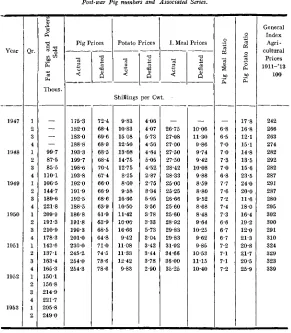
If we assume that a farmer wishing to feed pigs could only purchase sufficient feed for their requirements from 1948 onwards, then the period remaining is very short for any statistical examination of the data. A brief tabular and graphic analysis is therefore all that is attempted.1
COMPARISON OF PREWAR AND POSTWAR SERIES.
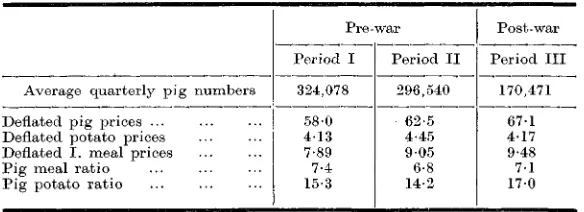
The various series for the post-war years are given in Table X (Appendix II). Averages for the more important of these series have been computed and these are compared with similar prewar averages in the following table. For prewar years two series corresponding to free and controlled prices are compared. For pig numbers the periods compared are
Period I. 1st quarter, 1924 to 4th quarter, 1936 Period II. 1st quarter, 1937 to 4th quarter, 1939 Period III. 1st quarter, 1949 to 1st quarter, 1952
[image:14.391.33.325.285.391.2]All prices and price ratio associated with pig numbers are lagged by 18 months, with the exception of potato prices and the pig potato ratio which are lagged by 21 months.
TABLE I.
Pre-war and Post-war Averages for Pig numbers and other related series.
Average quarterly pig numbers Deflated pig prices ...
Deflated potato prices Deflated I. meal prices Pig meal ratio Pig potato ratio
Pre-war Period I
324,078 58-0 4 1 3 7-89 7-4 15-3
Period I I 296,540
62-5 4-45 9-05 6-8 14-2
Post-war Period I I I
170,471 67-1 417 9-48 7 1 17-0
Prices of pigs, potatoes and Indian meal in shillings per cwt.
This table shows that in the early post war years there had been no general deterioration in the different price factors which might be expected to influence the number of pigs. With the exception of the deflated price of Indian meal other prices and price ratios were more favourable than in prewar years. In spite of this, pig numbers up to the first quarter of 1952 were only about half prewar figures. There must therefore be other factors in operation in the early postwar period which were not manifest in the prewar analysis. One such factor no doubt has been the change in the labour force in agriculture. In the interwar years there was abundant labour on our farms and for that reason labour was at no time a limiting factor. This may not be the case now. The male agricultural labour force has declined by about 25% from 1936 to 1953 and as female family workers have also left the farms in large numbers the reduction
in workers on the land has no doubt had its effect on pig numbers. As carried out in this country up to quite recently pig feeding was a laborious and time consuming operation. Pigs were associated with the production of a large potato crop which had to be stored, prevented from sprouting and in most cases, cooked on the kitchen fire. The cooking and feeding operations were usually done by the female members of the family, while the male workers produced the potatoes and supplied large quantities of peat for the fires.
These traditional methods called for a large labour force and hard work from both males and females. Nowadays the big labour force is not available and consequently there was bound to be a drop in production until adjustments were made to meet the new situation. Within the last year or so these adjustments have come in fairly rapidly but in the early post war years, modern labour saving devices in pig production such as self feeding, steam cooking of potatoes, the feeding of raw grain and roots were not introduced as rapidly as labour left the land.
Another factor which is quite likely to have retarded pig production somewhat in post war years was the risk element. Pig production is always considered a relatively hazardous enterprise. Under the best of conditions the breeding of a large number of young animals is fraught with a certain amount of danger, but in the post war period the fattening of pigs became exceedingly risky also. The disease Pig Odeoma which almost reached epidemic proportions a few years ago no doubt has had an important effect on pig numbers. Many farmers who lost pigs as result of this disease were slow to go back into production again, and with high prices available for other farm produce the need to take risks with pigs was not so great. Geary1
has estimated an increase of 70% in agricultural real income per person since 1938 and it is quite possible that many farmers, in the early post war years particularly, considered their incomes sufficiently high without having to go in for what they considered laborious and risky pig production.
PRESENT TRENDS IN PIG PRODUCTION.
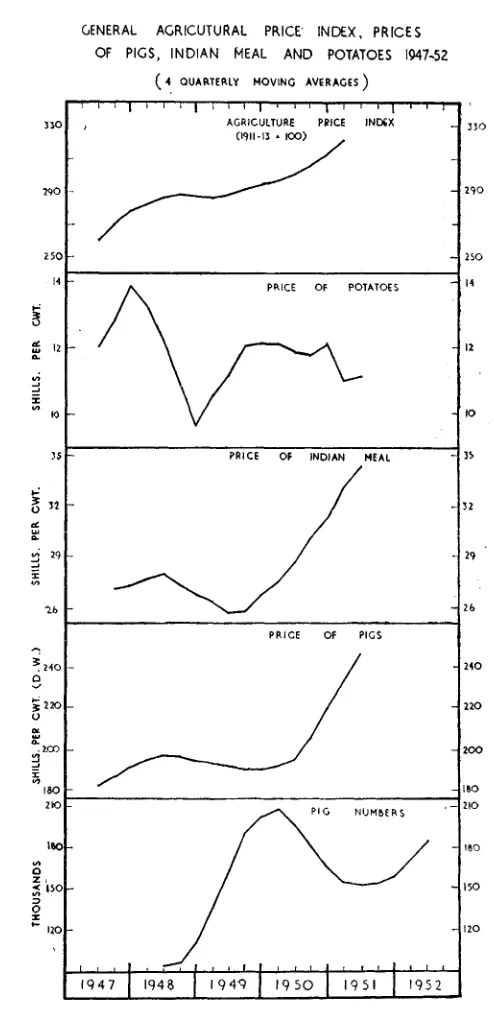
Graphs of the more important post war series are given in Figure V and we can see that some well defined trends are already appearing. The first noticeable post war increase in pig numbers begins to appear about the end of 1948 and by the end of 1949 and early 1950 over 200,000 pigs are being marketed per quarter. After this, a decline takes place to an average of about 150,000 per quarter in 1951 and early 1952. At the present time, pig numbers are again increasing. In the last quarter of 1952, over 220,000 pigs per quarter were marketed and since Figure V was prepared the quarterly sales to factories have increased to over 240,000 for the second quarter of 1953. It is quite likely that this upward trend will be maintained for some time to come also as the June 1953 census of livestock shows an increase in sows of almost 14,000 over the figure for the previous year.
Figure V shows that in the early post war years there seems to
1 Geary, R. C. Irish Economic Development since the Treaty. Studies, Vol. XL.
be little association between any of the price series and pig numbers, with the possible exception of the price of potatoes. It would appear that low priced potatoes in 1948, due to a very large crop that year, was responsible for the increase which took place in pig numbers in 1950.
At present it seems that we are again returning to prewar conditions as there seems to be a definite connection between the increase in pig prices which took place in 1950 and '51 and increasing pig numbers in 1952. As high pig prices have been maintained through 1952, the present large pig population is no doubt associated with these high prices also.
As in the prewar period, the price of Indian meal does not seem to be a strong determinant of pig numbers now.
There is little association between the general index of agricultural prices and pig numbers within this short period, but since the 1948-52 average is almost three times that of 1937-39 it is not unreasonable to conclude that low pig numbers in the early post war years were associated with high agricultural prices generally. The relationship between the index of general agricultural prices and pig numbers would however appear to be of a curvilinear nature. In effect, this means that there is a,n inverse relationship between the two series up to a certain point, but beyond this point the relationship is probably reversed. This hypothesis is reasonable from the point of view of economic theory and seems to be well justified in the present case. Cattle prices are now so high that the risk element in cattle invest-ments is becoming more and more important. Indeed, many farmers may now consider cattle much more risky than pigs and are con-sequently swinging over to the latter with a view to spreading the risk element somewhat. The adoption of modern techniques mentioned previously makes such a change not very drastic. The drudgery in pig rearing is disappearing.
There is one other important factor which was not present in prewar or in the early post war years but which now must be con-sidered in any analysis of pig supplies. This is the widespread cultivation in this country of high yielding varieties of feeding barley. Official statistics do not give any breakdown as between malting and feeding barley, but within the last few years a substantial area of the latter type has been harvested. This means that there is now available, in addition to potatoes and fodder beat, a home grown cereal ideally suited to the feeding of pigs.
Table II shows the annual post war production of pigs, potatoes and barley, and gives a picture of the available home grown pig food since 1946. No figures are available for fodder beet, but the amount of this crop grown is not as yet very great.
TABLE II.
Annual production of pigs, potatoes and barley, 1946-1952.
Year
1946 1947 1948 1949 1950 1951 1952
Bacon pigs and porkers sold
(000)s . 382-9 662-6 790-4 609-2 743-6
Annual potato crop.(000) tons
3,227 2,600 3,275 2,692 2,874 2,766 2,676
Annual barley crop (000) cwt.
2,420 1,766 2,013 3,188 2,379 3,511 4,980
CONCLUSIONS.
As a result of this study, the following observations appear justified :—
(1) The most important determinant of pig numbers is the amount of food available. In the absence of abundant supplies of maize meal, pigs almost disappeared during the war.
(2) In our economy the price of maize meal does not seem to be at all as important as one might expect. Over the whole period from 1924 to 1940 there was no significant correlation between the price of Indian meal and the number of pigs produced one to two years later. It seems that in this period the meal was purchased regardless of price to balance home-produced potatoes and milk.
(3) The size of the potato crop has a strong effect on pig numbers. A large potato crop any year is followed in about two years by an increase in pig numbers, but this influence is modified from time to time by other factors such as the price of pigs and the general level of agricultural prices.
(4) Previous to the setting up of the Pigs Marketing Board, the price of pigs was very closely associated with pig numbers 18 months later. The well-defined pig cycles of the 'twenties and 'thirties were caused by and were them-selves the cause of the price cycle. The stabilisation of prices had the effect of eliminating the pig cycle, but an increase in fixed prices did not seem to have the effect of bringing forth increased pig numbers. Indeed, it may well be that price fluctuations are the very essence of pig production.
supplies of food available and the price of pigs relative to other livestock prices is considered favourable. (6) The recent very great increase in pig numbers is probably
due to relatively high pig prices for the past few years and to the very great increase in the amount of feeding barley produced in 1951 and 1952.
ACKNOWLEDGMENTS.
The writer gratefully acknowledges the assistance he has received from various people during the course of this study. Thanks are due to Professor George O'Brien, Professor of National Economics, U.C.D., under whose direction this work was carried out. Special thanks are due to Dr. R. C. Geary, Director of the Central Statistics Office, for making available all the necessary data on pig numbers and prices ; for his permission to work in the Library of the Central Statistics Office, and for his valuable advice and assistance on many technical problems which arose. Sincere thanks are also due to Professor M. D. McCarthy, Assistant Director of the Central Statistics Office, for his unstinted help and advice throughout the work. Finally I wish to acknowledge thanks to my wife without whose unfailing help this work would not have been completed.
ADDENDUM.
76
RELATION BETWEEN MOVING AVERACE OF PIC PRICES AND OF NUMBER OF PICS MARKETED
1925 1926 1927 1928 1929 1930 1931 1932 1933 1934 1935 1936 1937 1938 1939 1940 194)
RELATION BETWEEN MOVING AVERAGES OF PIC NUMBERS AND OF DEFLATED PRICES OF INDIAN MEAL A N D POTATOES (LAGGED)
r
/ \ JT \ Number of fat
\ / \
77
ACTUAL PIC NUMBERS AND PIC NUMBERS ESTIMATED FROM LINEAR REGRESSION KXWTION. * . (Y - 42 4O54 + 1-54858 X I + 5 99453 X 2 - 6-61616 X 3 -9 89871 X4)
1
A
' 7l\ i
-
Vu
n* *
\ i \
1 I A
\ A
l'\
'/ M
/ \7
\
v/
' V V
p i9 numben.pi 9 numbi
i \
V ^
V / \ / / \ / /\
v\/
-\ / -\ 1
\j VJ /
\ A M A / ^ Vj V ^
1925 1926 1927 1928 1929 19 JO 1931 1932 1933 1934 1935 1V38 1939 1940
PIC NUMBERS IN THE TWENTY-SIX COUNTIES AS PERCENTAGE Of PREVIOUS YEAR
78
F I G V
GENERAL AGRICUTURAL PRICE' INDEX, PRICES
OF PIGS, I N D I A N MEAL A N D POTATOES 1947-52
( 4 QUARTERLY MOVING AVERAGES)
1 l [ I ' ' ' I ' ' ' I ' ' ' I ' ' ' I ' ' '
, AGRICULTURE PRICE INDCX (1911-13 * IOO)
2 50
• 1 4
PRICE OF POTATOES
2 5O 14
PRICE OF INDIAN MEAL
5 220 O
PRICE OF PIGS
I8O 2kO
16O O
z < ISO z>
o
x *" I2O
PIG NUM&ERS
[image:21.391.78.325.60.569.2]APPENDIX I. Sources of Statistics.
Pig Statistics have been compiled from the following sources :
I. Irish Trade Journal and Statistical Bui. for Home Curings by Factories. II. " Monthly Trade Statistics" of Dept. of Industry and Commerce
for Imports and Exports.
III. Other Pig Disposals were obtained from Tariff Commission Report No. 14 (Stat. Office, 1932), from Report of Pig Industries Tribunal (Stat. Office, 1933), from the Census of Production Reports for the Bacon Curing Industry from 1926 onwards, and from working files on Agric. output and Trade kindly placed at the writer's disposal by the Director of the Central Statistics Office.
Sources of Prices.
Monthly prices of pigs, pig food and young pigs are given in the Irish Trade Journal and Statistical Bulletin from May, 1926 onwards. There is a gap in the Official Price Publications between the last issue of the " Monthly Statistical Statement," published in April, 1923, and the May, 1926 issue of the Trade Journal. The missing figures were obtained from (1) Barrington's paper " Review of Irish Agricultural Prices/' which gives prices of pork and young pigs for the missing years, and from (2) Manuscripts kindly made available by the Director of the Central Statistics Office.
TABLE I. APPENDIX II.
Annual Disposal of Pigs marketed in Twenty-six Counties, 1924-1940.
F A T PIGS AND PORKERS.
Year 1924 1925 1926 1927 1928 1929 1930 1931 1932 1933 1934 1935 1936 1937 1938 1939 1940 Bought for curing
b y . factories at home* 817-6 646-3 633-4 709-8 878-3 792-0 657-1 700-6 737-3 851-7 985-0 1,062-3 1,094-3 1,034-2 1,043-1 984-9 1,102-0 Bought by Irish Pork butchers
6 7 0 67-0 67-0 67-0 67-0 67-0 67-0 67-0 67-0 67-0 67-0 67-0 67-0 67-0 67-0 67-0 76-0
E x -ported
alive E x -ported
Dead (1)
Total F a t Pigs and Porkers Numbers (Thousands) 190-5 63-4 177-8 3190 281-6 250-7 331-3 398-7 216-5 54-0 67-8 108-8 100-5 36-5 37-3 56-0 49-8 163-5 98-0 128-7 2791 3410 245-9 2521 3710 263-5 200-7 168-0 187-0 152-9 71-3 48-5 45-6 29-4 1238-6 874-7 1,006-9 1,374-9 1,567-9 1,355-6 1,307-5 1,537-3 1,284-3 . j j ] ] 1,173-4 .,287-8 1,425-1 1,414-7 1,209-0 1,195-9 L,153-5 L,257-2 Exports Bonham Stores 36-9 3 4 0 51-8 66-2 3 3 0 56-5 77-3 77-7 86-7 89-3 6 6 1 17-8 16-7 5-9 8-4 7-5 3-9 Total (2) Pigs 1275-5 908-7 1,058-7 1,441-1 1,600-9 1,412-1 1,384-8 1,615-0 1,371-0 1,262-7 1,353-9 J . ] ] 1,442-9 1,431-4 1,214-9 L,204-3 ! 1,161-0 1 1,261-1 *Small numbers of pigs imported have been excluded from published figures for this item.
(1) Pork converted into pigs on the basis of 84 lbs. dead weight, for porkers exported into Britain and from figures published in Trade Journal for dead weight of Bacon Pigs cured in Northern Ireland.
TABLE I I . APPENDIX II—continued. Total Fat Pigs
Year 1924 1925 1926 1927 1928 1929 1930 1931 1932 1933 1934 1935 1936 1937 1938 1939 1940 1st Qr. 367-9 2241 199-5 292-9 396-0 3791 290-8 363-2 337-5 285-9 288-0 323-4 333-3 300-6 261-1 279-7 2751
and Porkers, Marketed ( iach quarter, 1924-1940.
Actual Numbers (Thousands) 2nd Qr. 267-4 188-5 194-6 268-8 3200 267-3 264-4 272-8 268-4 2321 254-2 294-4 312-7 263-9 249-2 252-2 265-3 3rd Qr. 250-1 204-4 263-7 3360 360-0 311-3 322-2 381-4 288-0 290-4 335-7 353-8 365-3 323-3 348-8 303 0 344-0 4th Qr. 353-4 257-7 349-2 477-2 491-8 398-0 430-1 519-9 390-4 3651 409-8 453-4 403-2 321-2 336-9 318-6 372-8 Total (2) for year 1,238-8 874-7 1,007-0 1,374-9 1,567-8 1,355-7 1,307-5 1,537-3 1,284-3 1,173-5 1,287-7 1,425-0 1,414-5 1,209-0 1,196-0 1,153-5 1,257-2 *Home killings not included
(2) These figures differ slightly from the same items in Table I due to rounding. TABLE I I I .
APPENDIX II—continued.
Average Quarterly Price of Fat Pigs and Porkers, 1922-1940.
Year 1922 1923 1924 1925 1926 1927 1928 1929 1930 1931 1932 1933 1934 1935 1936 1937 1938 1939 1940
Actual Price (Shillings per D.W 1st Qr. 98-5 91-5 67-6 90-0 1030 83-5 70-8 80-3 101-0 67-7 52-9
4 7 1
60-3 54-3 53-5 62-4 68-9 70-3 92-3 2nd Qr. 117-5 85-3 76-2 96-0 1030 83-3 77-5 97-5 82-7 61-5 54-7 54-6 57-2 52-3 58-7 69-0
7 1 0 7 2 1 7 2 1
3rd Qr. 112-3 79-5 82-5 99-0 95-5
7 1 0
76-8 87-5 69-5 47-9 42-5 53-2 53-4 45-0 58-0 69-9 70-7 70-8 97-7 cwt. 4th Qr. 95-2 65-6 80-0 87-8 86-3 60-3 66-8 82-4 64-2
4 6 1
37-3 49-0 49-3 48-7
5 7 1
66-5 68-4 79-3 87-3 Deflated price 1st Qr.
6 0 1
57-8 45-9 57-2 67-8 61-2 53-4 57-0
7 2 0
56-6 47-3
5 4 0
71-8 65-6 64-6 65-8 64-6 64-0 65-9 (Shillings per cwt. D.W.*)
2 n d Qr. 71-5 60-4 51-5 62-0 70-6 62-6 55-2 69-4 66-3 55-7 51-8 66-5 67-9 65-0
6 6 0 6 5 1
63-7 62-6 49-2 3rd Qr. 69-0 57-9 52-5 62-9 68-2 53-7 54-8 62-8 57-2 45-9
4 7 1
66-3 65-4 56-0 63-3 64-8 62-8 59-0 66-8
4 t h Qr. 59-6 45-4 48-9 55-8 62-6 45-9 48-7 59-4 52-9 41-6
4 2 1
TABLE 4. APPENDIX II.—continued.
Actual and Deflated Prices of Potatoes * 1922-1940.
i Year 1922 ... 1923 ... 1924 ... 1925 ... 1926 ... 1927 ... 1928 ... 1929 ... 1930 ... 1931 ... 1932 ... 1933 ... 1934 ... 1935 ... 1936 ... 1937 ... 1938 ... 1939 ... 1940 ... Actual Pric( 1st Or. 4-83 3-33 6-50 7-58 4-25 5-25 4-50 5-25 3-50 4-92 8-08 2-66 3-42 3-58 3-92 4-08 3-33 5-50 4-33 3S (Shillings per cwt.)
2 n d Qr. 6-33 4-16 8-00 7-25 4-92 5-40 6-25 5-50 3-66 5-92 7-50 2-92
4 6 6
3-50 3-92 5-17 4-58 6-25 4-75
3 r d Q r .
4-08 6-95 9-75 6-66 4-83 5-33 6-00 5-17 4-50 8-33 3-58 3-33 5'08 4-16 4-25 5-50 4-92 5-75 5-92
4 t h Qr. 3-66 5-95 8-75 4-17 5-08 4-25 5-00 3-66 4-33 6-92 2-58 3-08 3-58
3 1 7
3-75 3-42 3-83 3-92 4-42
Deflated Prices (Shillings
1st Q r .
2-94 2-09 4-41 4-82 2-80 3-85 3-40 3-55 2-49
4 1 1
7-22 3-05 4-07 4-32 4-73 4-81
3 1 2 5 0 0 3 0 9
p e r
2nd Q r .
3-85 2-94 5-41 4-68 3-37
4 1 4
4-45 3-82 2-94 5-36
7 1 1
3-56 5-53 4-35 4-40 4-88
4 1 1
5-43 3-24 cwt.) 3rd Qr. 2-51
5 0 6
6-21 4-23 3-45
4 0 3
4-28 3-71 3-70 7-98 3-93
4 1 5 622 5-18 4-64 5-10 4-37 4-79 4-05
4 t h Q r .
2-29
4 1 2
5-34 2-65 3-69 3-23 3-65 2-64 3-51 6-25 2-91 3-65 4-18 3-67 3-84
3 1 5
3-35 2-90 2-92 Annual Potato Crop Tons (000) 2,196 1,476 1,492 2,138 1,932 2,443 2,246 3,007 2,337 1,932 3,015 2,497 2,545 2,577 2,421 2,706 2,461 2,998 3,118 * Where prices of old and new potatoes were given in the Trade Journal the prices of old potatoes were taken.
TABLE 5. APPENDIX Il^continued.
Actual and Deflated Prices of Indian Meal, 1922-1940.
Year 1922 ... 1923 ... 1924 ... 1925 ... 1926 ... 1927 ... 1928 ... 1929 ... 1930 ... 1931 ... 1932 ... 1933 ... 1934 ... 1935 ... 1936 ... 1937 ... 1938 ... 1939 ... 940 ... Actual 1st Q r .
11-50 11-92 12-50* 12-50* 11-42 10-33 11-33 12-25 9-83 6-83 6-83 7-00 7-33 8-08 7-83 9-08 9-92 8-92 12-66
Prices (Shillings) per cwt.
2 n d Q r .
11-58 1200* 12-50* 12-50* 11-42 10-08 12-50 1217 9-42 7-00 7-00 6-75 7-92 8-00 7-92 9-33 9-66 8-66 14-58 3rd Qr. 11-92 12-00* 12-50* 12-66 1017 10-33 12-50 11-50 9-00 6-33 6-66 6-83 8-00 7-58 8-58 9-25 9-42 8-25 1400
4 t h Q r .
12-08 1200* 12-50* 1202 10-42 10-58 1200 1118 8-08 6-66 7-00 7-00 8-33 7-42 9-00 9-33 8-83 10-83 13-92
Deflated Prices (Shillings
1st Qr. 7-01 7-48 8-49 7-95 7-51 7-57 8-55 8-28
7 0 1
5-71 5-74 8-03 8-72 9-76 8-46 9-58 9-31 8-21
9 0 4
per cwt.)
2 n d Qr.
7-04 8-49 8-44 8-07
7 1 4
7-58 8-91 8-45 7-55 6-34 6-64 8-22 9-41 9-95 8-91 8-79 8-67 7-52 9-95 3rd Q r .
7-32 7-40 7-96 8-04 7-26 7-82 8-92 8-26 7-40 6-06 7-31 8-51 9-79 9-44 9-37 8-57 8-37 6-87 9-57
[image:24.394.50.340.28.577.2] [image:24.394.48.342.37.304.2]82
TABLE VI. APPENDIX II.—continued. Pig Food Price Patio, 1922-1939.
Year
I
1922 ... 1923 ... 1924 ... 1925 ... 1926 ... 1927 ... 1928 ... 1929 ... 1930 ... 1931 ... 1932 ... 1933 ... 1934 ... 1935 ... 1936 ... 1937 ... 1938 ... 1939 ...Pig Meal
-1st Q r .
8-56 7-68 5-41 7-20
9 0 2
8-08 6-25 6-56 10-27 9-91 7-74 6-73 8-23 6-72 6-83 6-87 5-95 7-88 2nd Qr. 1014
7 1 1 6 1 0
7-68 9-02 8-26 6-20 8-01 8-78 8-80 7-81 8-09 7-22 6-54 7-41 7-40 7-35 8-33 Ratio* 3rd Qr. 9-42 6-63 6-60 7-82 9-39 6-87 6-30 7-61 7-72 7-57 6-38 7-79 6-68 5-94 6-76 7-56 7-51 8-58 4th Q r .
7-88 5-47 6-40 7-30 8-28 5-60 5-57 7-37 7-95 6-92 5-33 7-00 5-92 6-56 6-33 7-08 7-75 7-32 Pig—Potato Ratio 1st Qr. 20-4 27-5 10-4 11-9 24-2
1 5 1
15-7
1 6 1
28-8 13-8 6-5 17-7 17-6 15-2 13-6 15-3 20-7 12-8 2nd Q r .
18-6 12-0
9-6
13-2 20-9
1 5 1
12-4 17-7 22-6 10-4 7-3 18-1 12-3 14-9 15-0 13-3 15-5 11-5 3rd Qr. 27-5 11-4 8-5 14-9 19-8 13-3 12-8 16-9 15-4 5-8 11-9 16-0 10-5 10-8 13-6
1 2 1
14-4
2 3 1
n
4 t h Q r .
26-0
1 1 0 9 1 2 1 1 1 7 0
14-2 13-4 22-5 14-8 6-7 14-5 15-9 13-8 15-4 15-2 19-3 17-9 20-2
*Got by dividing price of 1 cwt. of Pork by price of 1 cwfc. of Indian meal. (J) Got by dividing price of 1 cwt. of Pork by price of 1 cwt. of Potatoes.
TABLE VII.
APPENDIX II—-continued.
Actual and Deflated Bonham Prices, 1922-39 (Shillings each).
Year 1922 ... 1923 ... 1924 ... 1925 ... 1926 ... 1927 ... 1928 ... 1929 ... 1930 ... 1931 ... 1932 ... 1933 ... 1934 ... 1935 ... 1936 ... 1937 ... 1938 ... 1939 ... 1 1st Q r .
56-3 55-9 16-3 32-8 50-0 40-5 24-8 27-3
4 4 0
28-5 20-5 19-0 23-3 22-5 19-8 22-8 29-3 27-0 Actual
2 n d Qr. 61-8 51-9 24-9 39-0 54-0
3 4 0 2 4 0
32-8 40-3 23-5 16-5
2 1 0
19-5 18-0 17-3 22-3 26-8 26-3 Prices 3rd Q r .
68-0 31-5 28-2 45-3
5 1 0
27-0 23-5 35-8 36-8
2 0 0
18-3 19-8 19-5 17-5 19-0 26-0 28-8 31-8
4 t h Q r .
55-8 19-1 27-4
5 1 0
44-5 24-5 25-0 39-0 32-3 19-5 15-8 20-0 21-8 19-0
2 3 0
27-5 28-0 38-5
1st
Q r .
34-3
3 5 1 1 1 1
20-9 32-9 29-7 18-7 19-4 31-4 23-8 18-3 21-8 27-7 27-2 23-9
2 4 1
27-5 24-6
Deflatec
2nd Q r .
37-6 36-7 16-8 25-2
3 7 0
25-6 16-8 22-8 32-3 21-3 15-6 25-6 23-2 22-4 19-5
2 1 0 2 4 1
22-8
. Prices
3rd Q r .
41-8 22-9 18-0 28-8 36-2 20-4 16-8 25-7 30-3 19-2
2 0 1
24-7 23-9 21-8 20-7
2 4 1
25-6 26-5
4 t h Qr.
3 5 0
13-2 16-7 32-4 32-3 18-6 18-2
2 8 1
26-6 17-6 17-8 23-7 25-4
2 2 0
[image:25.391.53.345.349.567.2]TABLE VIII. APPENDIX II-~continued.
General Index of Agricultural Prices, 1922-1940. (Base 1911—'13 = 100)
Year 1922 1923 1924 1925 1926 1927 1928 1929 1930 1931 1932 1933 1934 1935 1936 1937 1938 1939 1940 1st Qr. 1641 159-3 147-3 157-3 152-0 136-4 132-5 140-8 140-3 119-7 111-9 87-2 84-0 82-8 82-8 94-8 106-6 109-8 1401 2nd Qr. 164-4 141-3 1481 154-9 145-9 1330 140-3 1440 124-7 110-4 105-5 82-1 84-2 80-4 88-9 106-0 111-4 1151 146-6 3rd Qr. 162-8 137-3 157-1 157-5 140-1 1321 140-2 139-3 121-6 104-4 9 1 1 80-3 81-7 80-3 91-6 107-9 112-5 120-1 146-3 4th Qr. 159-6 144-5 163-7 157-4 137-8 131-5 1371 138-8 121-3 110-7 88-6 84-4 85-7 86-3 97-6 108-5 114-4 1351 151-3
Monthly figures for this series are published in the Irish Trade Journal. The Quarterly figures given here are a simple average of the corresponding three monthly figures. Such a simple average is not entirely accurate but it is reasonable enough for the present purpose.
TABLE I X .
Time Series used in analysis of Percentage changes from year to year in Pig numbers. Year 1924-25 1925-26 1926-27 1927-28 1928-29 1929-30 1930-31 1931-32 1932-33 1933-34 1934-35 1935-36 1936-37 1937-38 1938-39 1939-40 1949-50 1950-51 ... 1951-52 76-53 96-60 124-74 100-21 76-35 98-91 117-93 89-82 69-01 88-30 108-55 106-89 91-71 114-46 118-07 103-71 107-9 98-09 102 1 X3 67-21 10110 143-3 90-36 126-4 91-94 133-9 77-72 82-67 15606 82-82 101-92 101-25 93-95 111-77 90-95 1260 82-2 106-8 11111 98-75 88-61 94-29 103-80 101-50 89-93 88-00 89-09 85-71 100-00 98-81 109-60 115-40 106-70 108-00 100-40 104-60 109-80 ] X , (actual) 70-62 11511 136-55 11404 86-46 96-45 117-57 83-54 91-36 109-75 110-70 99-27 85-46 98-92 96-45 109-00 119-3 77-10 122-80 xi (estima-ted) 77-75 99-45 136-90 102-10 87-42 97-29 126-30 9618 81-64 11210 101-70 106-00 90-55 99-26 1100 1011 110-6 92-85 97-81
j = Annual number of Bacon pigs and porkers expressed as percentage of previous year.
X2=Annual price Bacon pigs as percentage of previous year (2 years lag).
X3= Annual Potato Crop (tons) as a percentage - of previous year (2 years
lag).
X4 = General Agricultural Price index as percentage of previous year (1 year
TABLE X.
APPENDIX II—continued.
Post-war Pig numbers and Associated Series.
Year 1947 1048 1949 1950 1951 1952 1953 Qr-1 2 3 4 1 2 3 4 1 2 3 4 1 2 3 4 1 2 3 4 1 2 3 4 1 2
I
•a g s a r Sol d £ Fa t Thous. — — — 99-7 87-5 85-5 110-1 106-5 144-7 189-6 221-8 209-9 191-3 210-9 178-3 143-6 137-1 163-4 165-3 150-1 156-8 214-9 221-7 205-8 249-0 Pig Prices < 175-3 1820 183-0 188-8 193-3 199-7 198-6 193-8 192-0 191-9 192-5 188-5 186-8 191-8 199-3 201-0 2 3 0 0 245-2 254-0 254-3 0) •*-> OS & 72-4 68-4 69-6 68-9 68-5 68-4 70-4 67-4 66-0 66-9 68-6 63-9 61-9 63-9 68-5 64-8 7 1 0 74-5 78-6 78-6 Potato Prices 3 < Shillings 9-83 10-83 15 08 12-50 13-08 14-75 12-75 8-25 8-00 9-58 16-66 10-50 11-42 10-00 16-66 9-42 11-08 11-33 12-42 9-83 TS "rt &I. Meal Prices
_ a •3
1
per Cwt. 4-06 4 0 7 5-73 4-56 4-64 5-05 4-52 2-87 2-75 3-34 5-95 3-56 3-78 3-33 5-733 0 4
3-42 3-44 3-78 2-90 26-75 27-08 2 7 0 0 27-50 27-50 28-42 28-33 25-00 25-25 26-66 25-60 25-60 28-92 29-83 29-83 31-92 34-66 36-00 35-25 "2 CT5 & 10-06 11-30 9-86 9-74 9-42 10-08 9-88 8-59 8-80 9-52 8-68 8-48 9-64 10-25 9-62 9-85 10-53 11-15 10-40 ti o OS n bt) 6-8 6-5 7-0 7 0 7-3 7-0 6-8 7-7 7-6 7-2 7-4 7-3 6-6 6-7 6-7 7-2 7-1 7-1 7-2
1
"o .5? £ 17-8 16-8 12-1 1 5 1 14-8 13-5 15-6 23-5 2 4 0 2 0 0 11-6 1 8 0 16-4 19-2 12-0 21-3 20-8 21-7 20-5 25-9 General Index Agri-cultural Prices 1011 ' 1 ^100 242 266 263 274 282 292 282 287 291 287 280 295 302 300 291 310 324
3 2 9
323 339
To get this Index the new series now published in the Trade Journal was multiplied by 1-138.
DISCUSSION.
In proposing a vote of thanks, Mr. F. P. Hussey congratulated Dr. O'Connor on the skill with which the practical and mathematical approaches had been combined to result in a paper of which both the author and the Society could be proud.
good fit, despite dealing with a problem in which the farmer's subjective attitude is not the least important variable, though undoubtedly the most incalculable.
Dr. O'Connor had so carefully examined all aspects of his subject that little was left for a critic to query, but he was not entirely satisfied regarding the 18 months lag between pig numbers and potato crops. Within 18 months another potato year would have intervened. If a plentiful supply of, say, potatoes, enticed farmers into more active pig production, the extra pigs so produced would not be available soon enough to make use of the plentiful potato supply. If the demand for young pigs to consume this supply stimulated breeders to produce additional pigs by mating additional sows, these would only come on the market when the cheap food had gone. Yet the pig cycle was no new thing : it had existed since pigs were counted. In the middle years of the last century the cycle was one of 6 years : it is now one of 4 years.
If the price stimulus is answered in, say, 18 to 24 months and the rate of retreat from pig rearing is quicker than entry into it, there would appear to be an overlap of about 12 months within the 4-year cycle. Is this a measure of the farmer's failure to match demand with supply ?
Dr. O'Connor's figures of seasonal numbers and prices appear to show that fat pigs and porkers command the lowest price in the fourth quarter of the year, while their numbers generally seem to be lowest in the second quarter. Poverty of food supply in this quarter is an obvious explanation of the latter minimum, but the reason for the low price in the 4th quarter is not so clear.
Why variations in labour supply should have had such a serious effect on pig production is in no sense obvious. Most Irish pigs are produced on small farms where the numbers kept are also small. A large relative increase in numbers would not appear to call for a major increase in the labour force, while an 8% fall in labour available on Irish farms from 1936-'51 would seem scarcely sufficient to account for the decline in pig numbers.
On the statistical side of his paper, Dr. O'Connor deserved to be congratulated on his industry and thoroughness in exploring every possible source of variation. The amount of solid hard work in calculations alone deserved respect. Even the extrapolation had been worth doing, even though the author must have had little faith that post-war conditions would supply worth while results.
In all, Dr. O'Connor was to be congratulated on a very satisfactory study, worth doing and well done.
86
views on these matters of great interest, and he felt they would be of value recorded in the proceedings of the society.
Everybody accepted that at one period there was a fairly well defined pig cycle, but in the opinion of the speaker, the fairly stable conditions of the latter part of the last century and the beginning of the present, were necessary for the existence of such a cycle, and of the type of relationship that Dr. O'Connor was seeking. In fact, the clearest relationship established, as noted by Dr. O'Connor, was one between pig numbers and maize prices up to 1920, but not thereafter. Under modern conditions, adventitious circumstances, such as government action, or even the efficiency of border patrols, could quite definitely have a considerable effect on the fortunes of pig feeders, and consequently, on the numbers of pigs. The author had made several suggestions to explain the slow increase in numbers of pigs in the post-war period. Dr. Senior suggested that one important factor had not been included, and that was the scarcity of protein concentrates—-meat and bone meal, fish meal, vegetable protein and skim milk. In his opinion, during the past decade a significant proportion of pig-keepers had moved away from the old unscientific practice of attempting to fatten pigs largely on maize meal or on potatoes. In the post-war period, more and more pig-keepers realised that they had to balance the ration either by the use of skim milk on the farm, or through the purchase of compound pig meals. It was only during the last couple of years, that protein concentrates had become fairly freely available, and in his opinion, this was a factor contributing towards the slow increase in numbers during the post-war period.
Before concluding, Dr. Senior said he had one or two questions to ask. Firstly, what in the author's opinion was the statistical significance of the statement to the effect that pig numbers were inversely related to the general agricultural price index, and that high agricultural prices tended to be associated with low pig prices. Even if the correlation was statistically significant, Dr. Senior thought the conclusion would be in conflict with general experience. Similarly, he would like to ask where was the evidence in the paper to support the conclusion reached under item No. 5, of the conclusions that when cattle prices were high, farmers tended to reduce pig numbers. His third question was addressed rather to the statisticians present, with a view to seeking enlightenment on a point which he often found puzzling. Even if Dr. O'Connor found correlations of high statistical significance, must they accept that the relationship was one of cause and effect. For example, could not the increased interest of farmers in ymer barley be just as much the result of an anticipated increase in pig numbers, as the reverse, that is, that as Dr. O'Connor had suggested pig numbers increased because the acreage of ymer barley increased. In conclusion, he again wished to congratulate Dr. O'Connor on the tremendous amount of work which obviously had been put into the preparation of the paper.