MODELING THE KNOWLEDGE MANAGEMENT PROCESSES FOR PLANNING AND SCHEDULING OF CONSTRUCTION PROJECTS BASED ON
STATE-OF-THE-ART TECHNOLOGY
SITI FAZREENA IDAYU BINTI BAHTIAR
A thesis submitted in
fulfilment of the requirement for the award of the Master Science of Technology Management
Faculty of Technology Management, Business and Enterprenuership Universiti Tun Hussein Onn Malaysia
v
ABSTRACT
Construction management is an information intensive industry. In construction projects, knowledge is usually buried in unread reports and arcane filing systems, or lost because people move on, leads to wasted activity of reinventing the wheel and impaired project performance. The application of Knowledge Management (KM) has been identified to be lagging in the area of construction project. Previous
developments for KM in the construction industry are focused on traditional project management philosophy of focusing on tasks. Based on high focused research on construction management by Lean practitioners and researchers it is evident that breakthrough improvements in construction can be achieved by focusing on flows. This study focuses on modelling the technology enabled KM process using a re-engineered Last Planner System (LPS) that focuses on flows and Integrated Production Scheduler (IPS) process. Taking an action research approach, a case study was documented to map out the information flow and the KM mechanism. The KM process was modelled based on systematic cyclical observation and analysis. A questionnaire survey was carried out to understand the current practice of
information flow management and identify the KM mechanism as well. The result revealed that currently, the construction practitioners applied the traditional approach of project management practice and there are inefficiencies of the current practice. Questionnaire result also had identified KM mechanism that currently being practiced in Planning and Scheduling (P&S) activities. Hence, a proposed system was developed to enhance the current construction management process that performs the role of KM mechanism. At the end of this study, a working model for KM in P&S was developed. The initial feedback of system evaluation on
ABSTRAK
Pengurusan pembinaan merupakan industri yang mempunyai maklumat yang banyak dan teliti. Dalam sesuatu projek pembinaan, pengetahuan biasanya tersimpan rapi dalam timbunan sistem pemfailan tradisional atau hilang disebabkan organisasi sementara, menyebabkan pengulangan proses kerja yang mengakibatkan penurunan prestasi projek. Dalam bidang pengurusan projek, aplikasi Pengurusan Pengetahuan (PP) adalah sangat terhad. Kajian terdahulu berkaitan PP dalam industri pembinaan adalah berfokuskan pada konsep tradisional pengurusan projek yang menumpukan pada sesuatu aktiviti. Berdasarkan kajian terperinci oleh penyelidik ‘Lean’, telah terbukti peningkatan dalam pengurusan projek boleh dicapai dengan menumpukan pengurusan terhadap aliran maklumat atau pengetahuan. Untuk itu, kajian ini bertujuan memodelkan aplikasi teknologi bagi proses PP dengan menggunakan proses kejuruteraan semula yang mengambil kira konsep Integrated Production Scheduler (IPS) dan Last Planner System (LPS) yang menumpukan pada aliran. Menggunakan kaedah Action Research, satu kajian kes telah didokumenkan untuk memetakan aliran maklumat dan mengenalpasti mekanisma PP. Dengan ini, proses PP telah dimodelkan berasaskan kitaran pemerhatian dan analisis yang sistematik. Satu kaji selidik telah dijalankan untuk memahami praktis semasa bagi pengurusan aliran maklumat dan untuk mengenalpasti mekanisme PP. Keputusan kaji selidik mendapati, pihak pengurusan pembinaan masih menjalankan pendekatan tradisional dimana terdapat ketidakcekapan dalam praktis semasa. Dengan itu, kajian ini telah mencadangkan satu sistem untuk meningkatkan kecekapan praktis semasa dan turut dapat menjalankan mekanisma PP. Diakhir kajian ini, satu model kerja proses PP dalam aktiviti perancangan dan penjadualan telah dibangunkan. Maklumbalas awal penilaian sistem prototaip berkaitan kebolehfungsian dan keberkesanan dikumpul diakhir kajian ini dan akan digunakan untuk kajian seterusnya bagi menambah nilai kajian ini.
vii
COTETS
TITLE i
DECLARATIO ii
DEDICATIO iii
ACKOWLEDGEMET iv
ABSTRACT v
ABSTRAK vi
COTET vii
LIST OF TABLES xiv
LIST OF FIGURES xv
LIST OF ABBREVIATIO xvii
LIST OF APPEDICES xviii
CHAPTER 1 ITRODUCTIO 1
1.1 Introduction 1
1.2 Research Background 2
1.2.1 Knowledge Driven Economy 2 1.2.2 Nature of Construction Industry 3
1.2.2.1 Planning and Scheduling (P&S) Activities via Information and
Knowledge Management 5
1.2.3 Technology Advantage 7
1.3 Problem Statement 8
1.3.1 Reinventing the wheel in P&S activities 8 1.3.2 Inadequate Theories of P&S 9 1.3.3 Negligence on Technological Advantage 10
1.6 Research Methodology 12
1.6.1 Data Collection 13
1.6.2 Data Analysis 14
1.7 Significance of the Research 14 1.8 Thesis Writing Organization 15 1.8.1 Chapter 1: Introduction 16 1.8.2 Chapter 2: Knowledge Management 16 1.8.3 Chapter 3: Planning and Scheduling 16 1.8.4 Chapter 4: Research Methodology 16 1.8.5 Chapter 5: Findings and Discussion 17 1.8.6 Chapter 6: Conclusion and
Recommendation 18
1.9 Chapter Summary 18
CHAPTER 2 KOWLEDGE MAAGEMET 19
2.1 Introduction 19
2.1.1 Differentiating of Data, Information and
Knowledge 20
2.1.2 Defining Knowledge 21
2.2 Knowledge Management (KM) Processes 22
2.3 KM Process Elements 23
2.3.1 Knowledge Creation 24
2.3.2 Knowledge Storing 25
2.3.3 Knowledge Sharing 26
2.3.4 Knowledge Updating 26
2.4 KM Process Model 27
2.4.1 Knowledge Management VS Information
Management 29
2.5 KM in the Construction Industry Context 31
2.6 Knowledge Type 31
2.7 KM Mechanism in P&S 34
ix
CHAPTER 3 PLAIG AD SCHEDULIG OF
COSTRUCTIO PROJECT 36
3.1 Introduction 36
3.2 Review of Planners Scope of Work and Their
Traditional Tools 37
3.2.1 Information Flow 41
3.2.2 Communication Network in P&S 41 3.3 Planning and Scheduling Tools 43
3.3.1 Microsoft Project 44
3.3.2 Primavera 45
3.3.3 Procore 46
3.3.4 Project in Time (PiT) 47 3.4 State-of-The-Art Technology in P&S 48 3.4.1 Building Information Modelling (BIM) 49
3.4.1.1 Autodesk Revit 50
3.4.1.2 Bentley 52
3.4.1.3 NavisWork 52
3.4.2 Web 2.0 Approach 54
3.5 Barriers and Failures of Technology
Implementation 54
3.6 Related Solutions to Overcome the Barrier
Consideration in Developing KM P&S Prototype 56 3.6.1 Process Re-engineering – Lean Construction
Approach 56
3.6.2 Last Planner System 57
3.6.3 Master Scheduling 58
3.6.3.1 Phase Scheduling 58
3.6.3.2 Look-ahead Planning 58 3.6.3.3 Commitment Planning 59 3.6.4 Theory of Constraint (TOC) 59 3.6.4.1 Constraint Analysis 60 3.6.5 Transformation – Flow – Value (TFV) 60 3.6.6 Integrated Production Scheduler (IPS)
3.7.1 Construction Industry KM – Technology
Centric Approach 62
3.8 Research Gap 64
3.9 Chapter Summary 65
CHAPTER 4 RESEARCH METHODOLOGY 66
4.1 Introduction 66
4.2 Introduction to Research Methodology 66
4.3 Research Design 67
4.4 Qualitative Research Methodology 69
4.4.1 Literature Search 69
4.4.2 Semi-Structured Open Ended Interview 70 4.4.3 Action Research Approach 70
4.4.4 Case Study 71
4.4.4.1 Case Study Profile 72
4.5 Quantitative Research Method 74
4.5.1 Questionnaire Survey 74
4.5.1.1 Scale 74
4.5.1.2 Targeted Respondent and Sampling 75 4.5.1.3 Questionnaire Formulation 76
4.6 Prototype System Development 77
4.6.1 Ontology Development 78
4.6.2 Technical System Design 78 4.6.3 Business Process Analysis – System
Domain 79
4.6.4 Logical View System Design 81 4.6.5 System/Tool Architecture 82
4.6.6 Decomposition Diagram 82
4.6.7 Module and System Navigation 85 4.6.7.1 User Management Module 85 4.6.7.2 Planning and Scheduling
xi
4.6.7.3 Planning and Scheduling
General Module 86
4.6.7.4 Knowledge Extraction Module 86 4.6.7.5 Knowledge or Expert Search
Module 87
4.6.8 System Flow 87
4.6.8.1 P&SKM Flow Chart 87 4.6.9 System Development Requirement 91 4.6.9.1 Software Requirement 92 4.6.9.2 Hardware Requirements 92
4.6.10 System Design 93
4.6.10.1 Context Diagram 93
4.6.10.2 Data Flow Diagram 94
4.6.11 System Function 96
4.6.12 System Testing and Evaluation 98
4.7 Data Collection 99
4.8 Data Analysis 100
4.8.1 Qualitative Data Analysis 100
4.8.1.1 Stage 1 101
4.8.1.1 Stage 2 103
4.8.1.1 Stage 3 103
4.8.2 Quantitative Data Analysis 105
4.9 Chapter Summary 105
CHAPTER 5 RESEARCH FIDIGS AD DISCUSSIO 106
5.1 Introduction 106
5.2 Preliminary Data Findings 107
5.3 Case Study Findings 108
5.4 Questionnaire Data Findings 111 5.4.1 Findings of Section A: Demographic 111 5.4.2 Findings of Section B: Information
Flow Management 111
5.4.2.1 Section B1:Information Creation/
5.4.2.3 Section B3: Information Passing or
Searching 117
5.4.2.4 Section B4: Information Flow
Management (Effectiveness) 119 5.4.3 Findings of Section C: Knowledge
Management Mechanism 121
5.4.3.1 Section C1: Knowledge Creation
Mechanism 122
5.4.3.2 Section C2: Knowledge Storing
Mechanism 123
5.4.3.3 Section C3: Knowledge Sharing
Mechanism 125
5.4.3.4 Section C4: Knowledge Update
Mechanism 127
5.4.4 Findings of Section D: Technology Extent 129 5.4.4.1 Section D1: Technological Status
(Current) 130
5.4.4.2 Section D2: Organization
Commitment 132
5.5 System Evaluation 134
5.6 Chapter Summary 137
CHAPTER 6 RECOMMEDATIO AD COCLUSIO 138
6.1 Introduction 138
6.2 Research Summary 138
6.2.1 Objective 1: Current Practice of Planning and Scheduling Activities 139 6.2.2 Objective 2: Knowledge Management
Mechanism 139
6.2.3 Objective 3: Developing KM Working
Model 140
6.2.4 Objective 4: Developing KM Mechanism as
xiii
6.3 Contribution of Research Study 141 6.3.1 Contribution to the Academic 141 6.3.2 Contribution to the Industry 142
6.4 Study Limitations 142
6.5 Recommendation for Further Research 143 6.5.1 Recommendations for Researchers 143 6.5.2 Recommendations for Industry Practitioners 144
6.6 Concluding Remarks 145
References 147
Attachment 167
LIST OF TABLES
2.1 KM Processes (Ying et al., 2007) 23
2.2 KM Differences between IM and KM (Singh, 2007) 30
2.3 Knowledge Type 33
2.4 KM Mechanism 34
3.1 The TFV Theory of Production (Koskela, 2000) 60
3.2 Research Gap 64
4.1 Rating Scales (Cavana et al., 2004) 75
4.2 System Function 96
5.1 Findings of Section B1: Information Creation /
Documentation 112
5.2 Findings of Section B2: Information Indexing/Storing 115 5.3 Findings of Section B3: Information Passing/Searching 117 5.4 Findings of Section B4: Information Flow Management
(Effectiveness) 119
5.5 Findings of Section C1: Knowledge Creation Mechanism 122 5.6 Findings of Section C2: Knowledge Storing Mechanism 124 5.7 Findings of Section C3: Knowledge Sharing Mechanism 125 5.8 Findings of Section C4: Knowledge Update Mechanism 127 5.9 Findings of Section D1: Technological Status (Current) 130 5.10 Evaluation Results: Section A: Practicality and
Functionality 135
xv
LIST OF FIGURES
1.1 Action Research Model (Eden and Huxham, 1996) 12 2.1 Spiral View of SECI Model (Nonaka, 1995) 24 2.2 Overview of the Main KM Processes (Kucza, 2001) 28 2.3 KM Process in Construction Environment (Wenfa, 2008) 28
3.1 The planning Lifecycle (Halpin, 2005) 37
3.2 Anatomy of Failure (Basu, 2004) 39
3.3 Construction Bar Chart 40
3.4 Model of Centralised Network During Construction
Phase (Emmit and Gorse, 2003) 42
3.5 Comcon Network - Communication Network and Information Management (Chassiakos and
Sakellaropoulous, 2008) 43
3.6 Microsoft Project Screenshot 44
3.7 Primavera Screenshot 45
3.8 Procore Screenshot (Main Page) 46
3.9 Project in Time (PiT) Screenshot 47
3.10 4D Modeling Using BIM 50
3.11 Autodesk Revit Screenshot 51
3.12 Bentley Screenshot 52
3.13 Naviswork Software 53
3.14 Dynamic Knowledge Map Concept 63
3.15 Implementation Procedure of Risk Management into KM 63
4.1 Flow of Research Methodologies 68
4.2 Online Questionnaire Screenshots 76
4.3 Waterfall Model of System Development Life Cycle 77
4.4 Basic Ontology of the Prototype System 80
4.7 Initial System Flow 88
4.8 System Administrator Flow 88
4.9 Planners’ System Flow 90
4.10 General User (Last Planners) Flow Chart 91
4.11 Context Diagram 93
4.12 Data Flow Diagrams of P&SKM 95
4.13 Methods of Data Collection (Kumar, 2005) 100
4.14 Process of Drafting the Flow Mapping 102
4.15 Final Draft of Flow Mapping 104
5.1 Information Flow of Planning and Scheduling
Activities 109
5.2 Information Flow in P&S (Proposed) 110
5.3 Cost Element 1: Setting Up 132
5.4 Cost Element 2: Training Worker 133
xvii
LIST OF ABBREVIATIOS
3D - 3 Dimension 4D - 4 Dimension
AEC - Architecture Engineering and Construction AR - Action Research
BIM - Building Information Modeling CPM - Critical Path Method
DFD - Data Flow Diagram
IDEF - Integrated Definition for Function IE - Internet Explorer
IPS - Integrated Production Scheduler IS - Information System
IT - Information Technology KM - Knowledge Management LP - Last Planner
LPS - Last Planner System P&S - Planning and Scheduling
P&SKM Planning and Scheduling Knowledge Management System PPC - Plan Percent Complete
SDLC - System Development Life Cycle SA - System Administrator
LIST OF APPEDICES
A Attachment Letter 167
B1 Case Study Note 168
B2 Field Note 169
C Questionnaire Survey Set 170
D Server Application 176
E Evaluation Notes 177
CHAPTER 1
ITRODUCTIO
1.1 Introduction
Management is increasingly aware that knowledge resources are essential to the development of their organizations. Various writers have indicated that knowledge is an organization’s best sustainable source of competitive advantage (Issa and Haddad, 2007). Knowledge Management (KM) is central to this and is increasingly
recognised as an integral part of an organisation's strategy to improve business performance (Carillo et al., 2003). KM is becoming more important in construction industry than ever before since knowledge sharing and reusing can reduce project time and cost, improve quality, and provide a major source of competitive advantage for the construction participants. It is recognized that in the construction project, the project knowledge is lost dramatically between project phases, such as concept phase, design phase, construction phase and occupancy phase (Wenfa, 2008).
The knowledge gurus, Nonaka and Takeuchi (1995) define Knowledge Management (KM) as a capability of an organization to create new knowledge, disseminate it inside the organization and embody it in products, services and
systems. The general purpose of KM is to make knowledge usable for more than one individual, e.g. for an organisation as a whole; that is, to share it. According to Scarborough et al. (1999) KM is “any process or practice of creating, acquiring, capturing, sharing and using knowledge, wherever it resides to enhance learning and performance in organizations”. Generally speaking, this has to include the
Nicolas (2004) claims that KM is generally viewed as a systematic process for creating, acquiring, disseminating, leveraging and using knowledge to retain competitive advantage and to achieve organizational objectives. Whilst, Tserng and Lin (2004) view KM as a process that involves creating, securing, capturing, coordinating, combining, retrieving and distributing knowledge.
To fit with this research objectives, definitions from several existing work has been combined to create a working definition of KM specifically for this research purpose of modeling knowledge management process in the construction industry. As such, the KM can be viewed as a task of managing a systematic process of creating, securing, capturing, coordinating, combining, retrieving and distributing knowledge to retain competitive advantage and achieve the construction contracting organization’s objectives.
1.2 Research Background
This section discusses the research background that provides the context to this study and the justification for the research focus. There are three (3) sub-sections that provide the justification for undertaking KM research in the construction industry namely:- (i) Knowledge Driven Economy, (ii) Nature of Construction Industry, and (iii) Information Technology (IT) Advantage.
1.2.1 Knowledge Driven Economy
3
it has been described as lagging in terms of leveraging on technological advances. According to Houghton and Sheehan (2000), the rise in knowledge intensity of economic activities, and the increasing globalisation of economic affairs are two defining forces of the current knowledge economy. They also noted that, the issue of knowledge production, transmission and transfer are important facets of the
knowledge economy, and undoubtedly the knowledge economy involves rapid change, uncertainty and turbulence.
In Malaysia’s Knowledge-based (K-based) Economy Master Plan (2000), many definitions of K-based economy are provided, all revolving around the notion of an economy based on the production, distribution and utilisation of knowledge, which constitutes the primary engine of growth and wealth creation in the economy. Hence, in this economy status; knowledge, creativity and innovation play an ever-increasing and important role in generating and sustaining growth. In this sense, Asoh et al. (2002) point out that there is a tendency to define the new economy in terms of the new tools and technologies that permit us to manage data and
information faster and better than ever enabling us to discover if not create,
knowledge. During the early stages of the K-based economy, traditionally we have always been concerned with mainly managing data and information in order to improve organizational efficiency and effectiveness. However, today the Internet and related global networking technologies have enabled us to make data, information and even knowledge available to anyone at anytime.
1.2.2 ature of Construction Industry
The issue of Knowledge Management (KM) is relevant to all industries. However, the construction industry and its peculiarities provide a more challenging opportunity to develop clear understanding of the fundamentals and possible unique problems related to KM. Hence, the nature of construction industry had become a catalyst for this research as well as from an economic perspective the activities of the
(Raza Ali Khan, 2008). This industry has a broad definition and means differently to different people. The term construction is generally used to describe the activity of the creation of physical infrastructure, superstructure and related facilities (Fadhlin Abdullah, 2004). Whilst Egbu and Robinson (2005) note that construction is an industry that is not made by a single party, but being made up of different
organisations, consultants and professionals providing a range of services for clients, customers and the wider community.
It is noted by Zhu (2009), that the construction industry being a big and complex industry inevitably brings a bigger challenge to the aspect of knowledge management. Hence, traditionally, the precious knowledge and the experience management obtained was not valued or accumulated, causing the massive intelligence achievement not to be reused, but also not to become the competitive advantage of the organization. In view of this, Koskela et al. (2002), pointed out that the construction industry needs a rapid change of improving their business process by adapting new management theories in nurturing the KM practice inside the projects communities as well as promoting the use of technology in project
management. Koskela (2000) identified the construction industry to have three (3) peculiarities; on-site production, temporary organization and this is a major reason for the complex issues faced by the industry. Amongst the complex issues facing the industry, is that of communication and coordination of work that requires greater attention for research. KM has the potential to contribute not only to enhancing communication and coordination of work, more importantly providing the opportunity for enhancing productivity.
5
business process and this research clearly provides the confirmation that the focus on the Transformation-Flow-Value (TFV) approach at the same time allows knowledge to be managed more systematically.
This study however focuses its research lens only on the planning and scheduling activities of a construction project. As the construction industry is large and involves various disciplines who form a temporary organization, this research assumes that the ‘Planning and Scheduling’ department has the potential to be the focal point for information and KM mainly due to it being a core coordination task. Hence, it is appropriate to view construction planning and scheduling as a managerial process that is closely related to the aim of improving the holistic effectiveness of delivering construction projects on time, within budget/cost and expected quality.
1.2.2.1 Planning and Scheduling Activities via Information and Knowledge Management
Planning and scheduling activity is known for its focal point that touches all other processes in construction projects (Prince, 2007). This activity is one of the most important functions in a supply chain to achieve high quality products at lower cost, lower inventory and high level of performance. Solving the problem is essential for the generation of flexible process sequence with resource selection and for the decision of the operation schedules that can minimize makespan (Chiung et al., 2008).
These uncertainties have become a major concern for planning and scheduling, where every task is not certain until the accomplishment of it. These uncertainties can happen whether before, while or after the task is carried out. Even though it is the nature of construction industry, numerous researches have attempted to tackle this issue by proposing new construction methods and have yet to find appropriate solutions to address this in a structured, practical and cost effective manner. Ibrahim et al. (2010), emphasizes that this industry needs to prepare for paradigm shifts to improve its competitiveness that can be achieved by using good practices, advanced construction techniques and optimise resource utilization. Egbu and Botterill (2002) argued that KM is about mobilising the intangible assets of an organization, which are of greater significance in the context of organizational change than its tangible assets, such as Information Technology (IT).
They emphasize that IT should be understood less in its capacity to store explicit information and more in its potential to aid collaboration and co-operation between people. In considering the above arguments, however this research argues that the intended change requires a systemic focus that can only be delivered by re-engineering the process of P&S from the traditional transformation view to the Transformation-Flow-Value (TFV) view. In this research, through extensive literature review it was concluded that the Last Planner (LP) approach using the Integrated Project Scheduler (IPS) provided the basis for structuring information flow to enable reliable and efficient P&S. Hence, this research views the role of the Planner working for the main contractor as a key knowledge worker collaborating with fellow knowledge workers rather than just information suppliers and processors.
Systematic capture and coordination of knowledge makes it easier to disseminate and use knowledge that can improve interaction and iteration between knowledge workers. Through augmentation by appropriate technology, knowledge is effectively amplified from being tacit and individual into a form that is more widely used throughout the organisation on an ongoing basis. Although this research does not focus on tacit knowledge it is acknowledged as a form of knowledge that can be made explicit as described by Nonaka (1995).
7
increase the value of their services. Egbu et al. (2005), had identified various potential benefits of KM as follows:
•
• Improved ability to sustain competitive advantage;
• Immediate results in solving organisation-wide problems;
• Improved organisational productivity in delivering services to clients;
• Improvements in the quality of an organisation’s work force, through capacity building and upskilling;
• Formalised knowledge transfer system can be established (best practices, lessons learned).
• Improved capture and use of knowledge from outside the firm;
• Improved integration of knowledge within the firm;
• Better on-the-job training of employees;
• Fostering Innovation and services.
1.2.3 Technology Advantage
According to Carneiro (2000), ‘Knowledge’ and ‘Information Technology’ (IT) are critical success factors for strategic formulation. Along with economic globalization and science and technology’s rapid development, the scale of modern engineering construction projects are growing bigger, the project’s content is more and more complex and construction client’s request are more and more demanding (Zhu, 2009). From a strategic point of view, hence KM that is technology-enabled can provide the capacity to deal with growing challenges faced by the construction industry.
create artificial barriers that did not exist before. However, research focuses on developing a model for KM based on integrated system in which the system requirements will be identified.
Malaysia’s Construction Industry Master Plan (CIDB, 2007) also stresses that leveraging on information and communication technology in the construction industry as being one of the strategic thrust in order to achieve the vision and mission of the construction industry. From a national initiative perspective, there is strong support for leveraging on technology. The Malaysian Industrial Development Authority (MIDA, 2009) has identified the use of high technology as one of the characteristics that need to be fulfilled in order to be granted incentives for deduction in the computation of their income tax. Hence, with the use of advanced technology, the management function can be enhanced by additionally incorporating new
management theories in current practice and using technology as its enabler.
1.3 Problem Statement
The world is experiencing an era which has been termed the “knowledge age” or the “knowledge economy” (Sunassee, 2000). The importance of knowledge is seemed to be appreciated the extent to which it is being managed to generate value, however this is questionable, especially within the construction industry. The ability of current industry players to leverage on technology in the construction industry sector in order to enhance management functions is not encouraging. Below are the problem statements that are identified during the background study.
1.3.1 Reinventing the Wheel in Planning and Scheduling Activities
9
project duration and to make a reliable plan in order to avoid extra cost and project delay. Inefficiency does happen, and is not really being managed in which the need to value knowledge at this level is the key, so that the industry does not continuously reinvent the wheel which leads to time and cost wastage (Govender and Pottas, 2007). Often the focus on KM for planning and scheduling is overlooked.
Based on preliminary case study of this research, it is observed that, the construction practitioner is comfortable with the act of taking corrective action and reinventing the wheel in doing his job, this contributes to time and cost wastage. The acceptance of this phenomenon is evidenced by, the practice of project timeframe buffer that is intentionally fixed in for confronting the unexpected condition.
According to Mohamed and Anumba (2006), KM can help management to prevent repeating past errors; by capturing best practices, lessons learned, and especially, the solutions to problems that arise allow, similar situations in the future to be dealt with efficiently and effectively, which can also be applied to a planner or project manager in managing a construction project.
However, planners and project managers in construction contracting companies are often not allowed to prioritize and develop their own requirements and resources for KM as most other information intensive work organization often do. There is a tendency to use generic KM systems and applications that often are not synchronized with the existing flow of information on projects. Additionally, key construction processes such as planning and scheduling are very information
intensive and current systems tend to work on complex functionalities and operations that are cross-linked and hamper the ability to achieve effective knowledge
management as the scope is rather extensive.
1.3.2 Inadequate Theories of Planning and Scheduling
area in terms of: (i) unrealistic role of planning and poor short term planning, (ii) lack of systematic way of managing execution; and (iii) narrow view of control as measuring and taking corrective action rather than as a process of learning. Formosa et al. (1998) identified the main problems during the diagnosis stage of a project as:
• Development of the planning process on a very informal basis;
• Lack of accomplishment of the schedule;
• Schedule preparation based on the experience of the site engineer and not on the firm’s own data;
• Lack of a systematic short term plan;
• Lack of resource scheduling.
Recently, new theories and techniques have been introduced in order to enhance the process of planning and scheduling. It involves the enhancement of information flow, managing knowledge in collaborative environment and the Last Planner concept to support more reliable planning (Ballard, 1999).
1.3.3 egligence on Technological Advantage
Although Computer-Integrated Construction (CIC) paradigm has evolved as a tool of information technology (IT) integration in the construction industry, with the aim to effectively managing construction information (Sanvido, 1990). Construction industry is still seen by many as backward in deploying technology, not least information technology. Application of IT has been quite piecemeal and only very few contractors have a comprehensive and integrated information system for its core business (Mak, 2001). This has become a barrier to the industries to achieve a state where knowledge becomes a main competitive advantage asset.
11
the infrastructure support itself. Lots of attempt had been made by previous KM researchers, on using technology as an enabler to manage knowledge. These attempts mostly focus on the explicit type of knowledge and the tacit part of it is usually being neglected or overlooked as technology capabilities itself that has limited access to manage something inside the human minds. However, technologies present a number of potentials as a medium of communication, reducing time and distance constraint and, in addition, having the potential to add value to communications processes (Quintas, 2005). This ability can accelerate the KM process and its efficiencies can double up the management effectiveness by only taking advantage of the explicit knowledge.
1.4 Research Scope
This research is focused on G7 Class ‘A’ Malaysian construction firms who act as main contractors in construction projects. The area that was explored and tested is planning and scheduling of construction projects as it touches every task in a project and in every phase from project conceptual planning to completion. The targeted respondents were construction project planners and project managers who are crucial in the planning and scheduling of activities. The reason for choosing Class A
construction firms is because it is anticipated that they would require a more
systematic infrastructure for construction management that provides the opportunity for exploring the issues of knowledge management based on data provided by practitioners who are within a more information and knowledge intensive environment.
1.5 Research Objectives
construction industry on the management of information flow.
ii) To identify the mechanism for knowledge management that is currently being practiced within planning and scheduling activity of construction project organization.
iii) To develop a working model for knowledge management, incorporating state-of-the-art technology specific to the requirements of planning and scheduling activities of construction management.
iv) To develop knowledge management mechanism as a web-based-system for enabling collaborative construction project management with a focus on structuring the knowledge management process.
1.6 Research Methodology
An applied research approach was used in this study, as this study deals with ‘fuzzy’ issues, aimed at addressing the generation of a solution in a “messy” or uncontrolled environment (see Bickman and Rog, 1998) as is a predominant feature of
construction project environments. A well-known process for guiding applied research work is action research (Page and Mayer, 2000). As such action research methodology was used in carrying out this study. Figure 1.1 shows the simple action research model used in this study.
Figure 1.1: Action Research Model (Eden and Huxham, 1996)
In each phase or process in the model, other methodologies were incorporated, such as; case study methodology, qualitative research method, quantitative research
1. Diagnosis 2. Planning
[image:27.595.125.457.563.686.2]13
methodology and prototype system development in order to accomplish the objectives of this research.
1.6.1 Data Collection
The data collection activity started with data collection from secondary sources such as journals, books, reports etc. The data was studied and reviewed to find out
underlying theories previously proposed on the subject of KM, as well as being applied models for KM either being implemented or other relevant theories currently being proposed.
For the purpose of achieving objective one and two, an exploratory case study methodology was applied as initial steps in undertaking this study. According to Davey (1991), exploratory case study is normally undertaken before implementing a large-scale investigation as it helps identify questions, select measurement
constructs, develop measures and also safeguard investment in larger studies. However, in this study, the exploratory approach was combined with an attempt to conduct an in-depth study as a non-participant observation technique which was undertaken by the researcher. Additionally, a key practitioner-researcher provided further credibility to the data obtained from the case study.
The study was scoped only within the area of planning and scheduling. In order to obtain more specific data regarding the user requirements for having a web-based KM system, a questionnaire survey was undertaken to collect data from the practitioner-researcher, who is the contractor’s planner and project managers was undertaken. The quantitative approach was undertaken as it is possible to give precise and testable expression to qualitative ideas.
1.6.2 Data Analysis
Data gained from the case study is documented and presented, and important elements and points were considered in the development of the questionnaire based on the results of the literature review. The analysis of data is made using these approaches (Creswell, 2009 and Elliott, 2005):
i. Narrative approach
a. The description method was used for analysing the case study. b. A chronological process mapping will be done as a result of a case
study.
ii. A descriptive quantitative data analysis
a. To analyse the questionnaire survey and feedback from the KM system implementation.
b. For each question, a graph is generated and a simple description of every question is made (Babbie, 2010).
1.7 Significance of the Research
The description and representation of the current practice of information flow management for achieving the first research objective expose the disadvantages of poor management of information flow. The analysis acquired from this objective reveals how the information currently flows in and out of the planning and
scheduling activities specifically and flows within construction projects generally. According to Santos et al. (1998), when construction is viewed as a flow many factors that before were considered unimportant come to the surface and become very important to the effectiveness of production. By identifying these flows, it can enhance the current shortcomings that are being neglected inside the flow.
15
the knowledge that is input by these temporary specialists can become permanent corporate asset as they are paid to provide the specific information and knowledge regarding the project as part of their work coordination efforts KM system. Without proper management, the waste of knowledge flow within construction project scan be visualized as being directly proportional with also temporary specialists which also leave after the project. As the mechanism of KM is successfully identified and applied, the approach of making knowledge a permanent asset for the construction contracting organization will be much easier.
The working model of KM process that is to developed as an outcome of this research is based on reviewing and matching current available technology and ensuring that it is closely tied in with a real practice of Malaysia’s construction industry and not just ‘importing’ models from other industries. As the model is developed based on current technological status, the elements inside the model have been designed after every critical aspect had been considered, especially with regards to attempting to incorporate state-of-the-art technology. Based on this model, it is intended that technology aspect be regarded as an effective means for enhancing information and knowledge management. In addition by focusing on the work process in modelling the ICT-enabled KM, significant improvements in communication, reducing time and distance constraint can be achieved.
The web-based KM system is expected to improve decision making, improve strategic and reliable planning, provide a faster and more robust problem solving infrastructure and also to reduce cost of employee training. All these advantages are stated by Long et al. (2005) as benefits that can be attained by applying a KM system.
1.8 Thesis Writing Organization
1.8.1 Chapter 1: Introduction
In this chapter, the background of research title is elaborated and discussed. As the understanding of research background is cleared, the problem statement is identified from the gaps that exist in the Research background, research questions are
formulated and relevant research objectives are presented. The suitable methodology was selected in order to achieve the objectives.
1.8.2 Chapter 2: Knowledge Management
This chapter reviews the aspect of Knowledge Management (KM), to give a clear knowledge of relevant research regarding this research topic. It consists of
introduction to knowledge, understanding KM, previous work on KM, and current concepts, tools in handling KM issues.
1.8.3 Chapter 3: Planning and Scheduling
This chapter reviews the aspect of Planning and Scheduling (P&S) as it is crucial to understand the case to implement KM. It consists of; i) issues of P&S, ii) current technological status, iii) new management concept of P&S and iv) previous proposed application of KM in P&S. At the end of this chapter, a gap of previous research is discussed and the action plan to overcome the gap is described in Chapter 4.
1.8.4 Chapter 4: Research Methodology
17
development and finally using a descriptive quantitative research methodology. System and user requirements for web-based mechanism for KM using the case study approach is described and justified using a questionnaire analysis. Description of the conceptual KM model is presented and how it is used as a guide for
developing a prototype web-based mechanism of KM. The proposed web-based mechanism and its testing process based on using an action research approach is documented as a case study. The descriptive quantitative research process is
described as a means to acquire more reliable data to support the key components of the KM system.
Waterfall model of system development life cycle used in designing and developing a prototype system for this study is described. The logical and physical view of system development is provided to give a clearer view on how this
mechanism works. The database and knowledge base logical view is also provided. Also, the tools that are used in the system development as well as the launching process are described. The prototype system that was tested and evaluated are presented, whilst the analysis of the evaluation presented in the Findings and Discussions Chapter.
1.8.5 Chapter 5: Findings and Discussions
The description method of qualitative analysis in this study of current practice of KM is presents in this chapter as well as the conceptual working model that is tested using the action research approach. The analysis of case study and preliminary interview used in constructing the working model is presented.
1.8.6 Chapter 6: Conclusion and Recommendation
The developed prototype web-based mechanism of knowledge management and its findings are evaluated in the context of achieving the intended objectives.
Additionally, the limitations and usefulness of the KM system based on practitioner feedback is evaluated and concluded in terms of a brief comparison with current models and recommendations for future work are proposed. The focus of this chapter is to provide a conclusive comparative analysis and identify the possibility of
developing the system for the whole construction project.
1.9 Chapter Summary
The importance of Knowledge Management (KM) is now being realised and businesses are starting to formulate strategies to invest in systems that will enable them to manage their corporate knowledge. This is a relatively new concept for construction organisations, which have a fundamental need to manage knowledge as they move from one project to another, working with different partners and supply chains (Carillo et al., 2000).
CHAPTER 2
KOWLEDGE MAAGEMET
2.1 Introduction
Throughout the 1980s and 1990s a new range of business improvement philosophies, approaches and methodologies have been continuously developed. Knowledge Management (KM) started to emerge as an area of interest in academia and organisational practice. Literature reveals a rapidly increasing body of knowledge relating to KM which covers many different disciplines and areas of interest to academia and practitioners. This chapter presents the literature review on elements of the research which was carried out to provide the background knowledge related to the problem statement, determine the important areas requiring further research and to support as well as to structure the focus of this study in order to achieve the research objectives stated in Chapter 1. In this respect the existing work related to the research topic is discussed. Hence, this chapter on literature review chapter provides the basic knowledge associated with KM concept for project-based organisations, specifically that of construction. This research study additionally serves as a basis for further future work that needs to address the issue of organizational KM for construction contracting organizations.
innovation and competitive advantage.Knowledge is neither data nor information, and people speak of a ‘knowledgeable individual’ and mean someone with a thorough, informed and reliable grasp of subject, someone both educated and intelligent (Davenport and Prusak, 1998).
2.1.1 Differentiating of Data, Information and Knowledge
Some authors address the question of defining knowledge by distinguishing it among knowledge, information and data. Numerous previous researches have been
concerned with managing data and information in order to improve organizational efficiency and effectiveness (Asoh et al., 2002). The literature reveals an established hierarchical relationship among data, information and knowledge. Data can be defined easily as “raw” facts, strings of elementary symbols, such as digits or letters (Meadow, 2000). Data becomes “information” when it is put into some context, with respect to relevance and purpose but not specific skill or experience, as according to Drucker (2001), information means ‘data endowed with relevance and purpose’. Whilst, knowledge is stated by Wiig (1999) as “the data and information made meaningful through a set of beliefs about the causal relationships between actions and their probable consequences, gained through either inference or experience”.
Knowledge differs from information in that it is predictive and can be used to guide action while information merely is data in context which have the static
21
2.1.2 Defining Knowledge
In the domain of KM, multiple attempts to categorizes, classify and define knowledge and related terms have been undertaken in the past (Davenport and Prusak, 1998). Knowledge is defined by the Oxford English Dictionary (2009) as (i) expertise, and skills acquired by a person through experience or education; the theoretical or practical understanding of a subject, (ii) what is known in a particular field or in total; facts and information or (iii) awareness or familiarity gained by experience of a fact or situation. However, the definitions differ catering to the research objective. According to Mclnerney (2002), in the journal paper titled Knowledge management and the nature of knowledge, knowledge is referred to “as the awareness of what one knows through study, reasoning, experience or
association, or through various other types of learning”. Morrissey (2005) defines knowledge as something that can be thought of as “information combined with experience, context, interpretation, reflection and is highly contextual. It is a high-value form of information that is ready for application to decisions and actions within organizations”.
The examination of existing definition and classification of KM shows a wide spectrum of viewpoints. These ranges from the more mechanistic to more socially oriented. The mechanistic type assume an intellectual capital approach (knowledge is viewed as an asset) while the social type assumes a social constructionist approach where knowledge is constructed in the social relationship within organisations (McAdam and McCreedy, 1999).
refers to knowledge that can be codified easily and can be in readable form. According to Kucza (2001), tacit knowledge refers to knowledge that is gained through experience and cannot be codified in anyway. For the purpose of
undertaking the complex task of researching on knowledge management it is found necessary to use a simple and practical definition of knowledge. Hence, the meaning of knowledge with regards to this research context is information in the context of expertise or skills acquired through formal and informal learning (explicit) or experience (tacit) to accomplish a specific task or job.
2.2 Knowledge Management (KM) Processes
According to Asoh et al. (2002), “The concept of KM is nothing new. It has been practiced for a long time and mostly in an informal manner”. Corporations have always had some process to synthesize their experience and integrate it with knowledge acquired from outside sources.
Mohamed and Anumba (2006) emphasise that KM is not simply about extracting the knowledge held in an individual’s mind and converting it to an accessible electronic format, or disseminating and making available as an organization’s knowledge. It is about providing knowledge to facilitate
communication between individuals, teams and communities of specialists and thereby providing access to knowledge assets; individual experiences, lessons learnt, best practices etc. Stelth and Le Roy (2009) state that the main purpose of any KM strategy is to reduce errors, create less work, provides more independence in time and space for knowledge workers, generates fewer questions, produce better
23
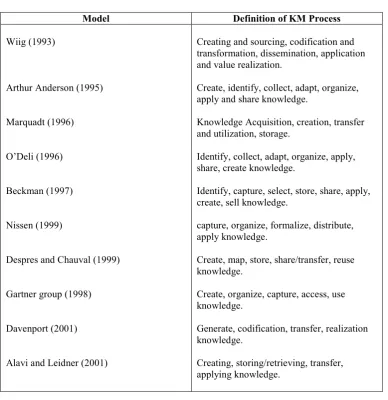
Table 2.1: KM Processes (Ying et al., 2011)
Model Definition of KM Process
Wiig (1993) Creating and sourcing, codification and transformation, dissemination, application and value realization.
Arthur Anderson (1995) Create, identify, collect, adapt, organize, apply and share knowledge.
Marquadt (1996) Knowledge Acquisition, creation, transfer and utilization, storage.
O’Deli (1996) Identify, collect, adapt, organize, apply, share, create knowledge.
Beckman (1997) Identify, capture, select, store, share, apply, create, sell knowledge.
Nissen (1999) capture, organize, formalize, distribute, apply knowledge.
Despres and Chauval (1999) Create, map, store, share/transfer, reuse knowledge.
Gartner group (1998) Create, organize, capture, access, use knowledge.
Davenport (2001) Generate, codification, transfer, realization knowledge.
Alavi and Leidner (2001) Creating, storing/retrieving, transfer, applying knowledge.
As such, KM involves series of systematic processes; and the review of the KM concept indicates that KM is an ongoing process in an organization which starts with acquiring relevant knowledge resources and continues through its proper utilization (Roknuzzaman et al., 2009).
2.3 KM Process Elements
knowledge creation, knowledge storing, knowledge sharing and knowledge update (Kucza, 2001; Yin et al., 2008; Scarborough, 1999; Nicholas, 2004) are the elements of KM processes identified from previous research on KM.
2.3.1 Knowledge Creation
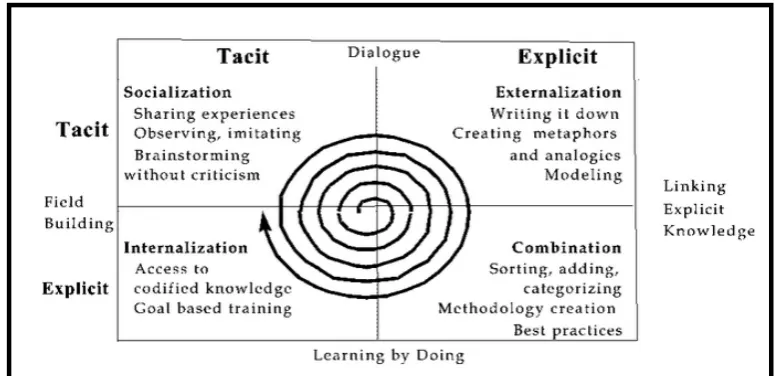
[image:39.595.121.510.411.599.2]Dave and Koskela (2009) state that the basis of knowledge creation in organization is continuous interaction among individuals and a continuous conversion from tacit into explicit knowledge (and vice-versa) by individuals, supported by the group. In representing the creation of knowledge, Nonaka’s and Takeuchi’s (1995) model of knowledge conversion named SECI has become a main reference in the area of KM. Figure 2.1 shows how the conversions of knowledge from tacit and explicit (and vice-versa) occur in each process.
Figure 2.1: Spiral View of SECI Model (Nonaka, 1995)
147
REFERECES
Ahuja, V. and Thiruvengadam, V. (2004). Project scheduling and monitoring: current research status. Construction Innovation, Vol. 4. pp 19-31.
Al-Hawamdeh, S. (2003). Knowledge Management.Oxford: Chandos Publishing.
Alavi, M. and Leidner, D. (2001). Knowledge management and knowledge management systems: conceptual foundations and research issues. MIS Quarterly, 25(1). pp. 107-36.
Arndt, T. and Guercio, A. (1992). Decomposition of data flow diagram. IEEE. D.O.I 1-8186-2830-8/92. pp 560-566
Asoh, D., Belardo, S. and Neilson, R. (2002). Knowledge management: Issues, challenges and opportunities for governments in the new economy.
Proceedings of the 35th Hawaii International Conference on System Sciences, IEEE.
Apostolou, D. and Mentzas, G. (1999). Case study managing corporate knowledge : A comparative analysis of experiences in consulting firms. Knowledge and Process Management, 6(3). pp 129-138.
Arndt, T. and Guercio, A. (1992). Decomposition of data flow diagram. IEEE. D.O.I 1-8186-2830-8/92. pp 560-566
Website: http://usa.autodesk.com/revit-structure/
Babbie, E. (2010). The Practice of Social Research. California, USA: Wadsworth, Cengage Learning.
Ballard, G. (1999). Improving work flow reliability. Proceedings of IGLC-7. Berkeley, USA: IGLC. pp. 275-286.
Ballard, G. and Howell, G. (2004). An update on Last Planner. Proceedings of 11th Annual Conference of IGLC. pp 13.
Basu, A. (2004). Creating The Framework For The Successful Use Of A Schedule In A Project. Retrieved on August 25, 2010.
Bankowski, H. (2007). Introduction to Information Systems, 1st Edition. Retrieved on July 8, 2010 from http://www.authorstream.com/Presentation/Davide-47906-
ch06-Introduction-Information-Systems-1st-Edition-Chapter-6-Outline-as-Education-ppt-powerpoint/
Berente, N., Vandenbosch, B. and Aubert, B. (2009). Information flows and business process integration. Business Process Management Journal, 15 (1). pp. 119-141.
Berg, B.L. (2007). Qualitative Research Methods for the Social Sciences. 7th Ed. Portland: Book News, Inc.
Betts, M. (1999). Strategic Management of IT. Blackwell Publishing.
Beveren, V.J. (2002). A model of knowledge acquisition that refocuses knowledge management. Journal of Knowledge Management, 6(1). pp 18-22.
149
Block, R. (1983). The Politics of Projects. Yourdon Press.
Bollinger, A.S. and Smith, R.D. (2001). Managing organizational knowledge as a strategic asset. Journal of Knowledge Management, 5(1). pp 8-18.
Bouthillier, F. and Shearer, K. (2002). Understanding knowledge management and information management: the need for an empirical perspective. Information Research. 8(1). Retrieved on August 19, 2010 from
http://InformationR.net/ir/8-1/paper141.html
Bradshaw, G.B. (2008). Establishing a first class project controls organization for managing large complex projects. AACE International Transactions. Retrieved on November 23, 2010 from
www.ptcinc.com/Content/Downloads/.../Bradshaw_George_AACE_
2008.pdf
Brandon, P., Betts, M. and Wamelink, H. (1998). Information technology support to construction design and production. Computers in Industry, 1(12). pp 1-12.
Caldwell, B. (1996). Client-server: can it be saved? Information Week, Vol 84. pp 36-44.
Carla, C.J.M. and Chong, J.C. (2010). Development and knowledge resources: a conceptual analysis. Journal of Knowledge Management, 14(5). pp 759-776.
Carillo, P.M., Robinson, H.S., Anumba, C.J. and Al-Ghassani, A.M. (2003). IMPaKT: A framework for linking knowledge management to business performance. Electronic Journal of Knowledge Management, 1(1). 1-12.
12 Online Learning: A Review of Open Access Literature. The International Review of Research in Open and Distance Learning (IRRODL), 10(1).
Chassiakos, A.P. and Sakellaropoulos, S.P. (2008). A web-based system for managing construction information. Journal of Advances in Engineering Software, Vol 39. pp 865-876.
Chen, J. and Tong, L. (2004). The knowledge management mechanism in CoPS Innovation. International Engineering Management Conference. pp 651-655.
Chiung, M., Young, H.L., Chan, S.J. and YoungSu, Y. (2008). Integrated process planning and scheduling in a supply chain. Computers & Industrial Engineering, Vol. 54. pp. 1048-1061.
Chua, D.K., Shen, L.J. and Bok, S.H. (1999). Integrated production scheduler for construction look-ahead planning. Proceedings of International Group for Lean Construction -7. Berkeley, California: USA. pp 287- 298.
Cohen, L., Manion, L. and Morrison, K. (2007). Research Methods in Education (6th Ed.). Routledge. Madison Avenue, NY.
Cole-Gomolski, B. (1999). Knowledge ‘czars’ fall from grace. Computerworld, 33(1). pp 1-13.
CIDB, Construction Industry Development Board (2007). Construction Industry Master Plan 2006-2015. Kuala Lumpur, Malaysia: CIDB.
Creswell, J.W. (2009). Research Design: Qualitative, Quantitative and Mixed Method Approaches. 3rd Ed. London: Sage Publication.
151
Davenport, T.H. and Prusak, L. (1998). Working Knowledge: How Organization Manage What They Know. Harvard Business School Press.
Davey, Lynn (1991). The application of case study evaluations. Practical
Assessment, Research & Evaluation, 2(9). Retrieved on September 29, 2010 from http://PAREonline.net/getvn.asp?v=2&n=9
Dawson, R. and Dawson, C. (1998). Practical proposals for managing uncertainty and risk in project planning. International Journal of Project Management, 16(5). pp 299-310.
Demirag, O., Johnson, A., Nazzal, D. and Yen-Tai, W. (2000). Integrated Definition (IDEF) Modeling Techniques. Retrieved on Jan 1, 2011 from
http://www.idef.com/idef3.html.
Dion, H.G., Alton, Y.C., Brendan, L. and Chei, S.L. (2007). Knowledge access, creation and transfer in e-government portals. Online Information Review, 32(3). pp 348-369.
Drucker, P. (2001). Management Challenges for the 21st Century. New York, NY: Harper Business Press.
Dul, J. and Hak, T. (2008). Case Study Methodology in Business Research. MA, USA: Elsevier Ltd.
Duncan, W. (1996). A guide to the project management body of knowledge. Sylva, NC:PMI Publications.
Eastman, C.M., Eastman, C., Teicholz, P. and Sacks, R. (2008). BIM Handbook: a guide to building information modelling for owners, managers, designers, engineers and contractors. Canada: John Wiley and Sons.
the scope for improving the quality and efficiency of UK construction. London: Crown. Retrieved from
http://www.constructingexcellence.org.uk/pdf/rethinking%20construction/ret
hinking_construction_report.pdf
Egbu, C. O. and Botteril, K. (2002). Information Technologies for Knowledge Management: Their Usage and Effectiveness. ITCon, Vol. 7. pp. 125-137.
Egbu, C. and Robinson, F. (2005). Construction as a Knowledge-Based Industry. In Anumba, C.J.,
Egbu, C.O. and Carillo, P. (Ed). Knowledge Management in Construction. Tpt terbit:Blackwell Publishing Ltd. pp 31-47.
Elliott, J. (2005). Using arratives in Social Research: Qualitatives and Quantitatives approaches. London: SAGE Publications Ltd. pp 5-10.
Emmit, S. and Gorse, C.A. (2003). Construction Communication. USA: Blackwell Publishing Ltd.
Fadhlin Abdullah. (2004). Construction industry & economic development: The Malaysian scene. Penerbit Universiti Teknologi Malaysia, Johor, Malaysia.
Fiona, F.N., Keng, S. and Yuhong, T. (2005). Knowledge Management mechanisms of financial service sites. Communications of the ACM, 6(48). pp 117-123.
Fischer, l. (2006). Workflow Handbook 2006. USA:Future Strategies Inc.
Formoso, C.T., Bernardes, M. and Oliveira, L.F. (1998). Developing a model for planning and controlling production in small sized building firms.
153
Fowler, P., Martin, I.G., Juristo, N., Levine, L. and Morant, J.L. (1997). An expert system in the domain of software technology transfer. Expert Systems with Applications, 12(3). pp 275-300.
Gahlot, P.S. and Dhir, B.M. (2007). Construction Planning and Management. India: New Age International (P) Limited.
Gehling, R., Turner, D. and Rutherford, B. (2007). Defining the proposed factors for small business online banking: Interviewing the IT professionals. Journal of Financial Services Marketing, 12(3), pp 189-196.
Gourlay, S. (2004). The SECI model of knowledge creation: some empirical shortcomings. Retrieved on Jan 23, 2010 from
http://eprints.kingston.ac.uk/2291/1/Gourlay%202004%20SECI.pdf
Goldratt, E.M. (1990). What is this thing called the theory of constraint? New York: The North River Press.
Govender, S.S. and Pottas, D. (2007). A model to assess the benefit value of
knowledge management in an IT service provider environment. Proceedings of SAICSIT. South Africa:ACM. pp. 36-45.
Greif, M. (1991). The Visual Factory. Cambridge: Productivity Press.
Gyampoh-Vidogah, R., Moreton, R. and Proverbs, D. (2002). Implementing information management in construction: establishing problems, concepts and practice. Construction Information, Vol 3. pp 157-173.
Halpin, D.W. (2005). Construction Management. New York, NY: Wiley.
o.4, pp. 519-530 Retrieved on May 19, 2009 from http://www.econlib.org/cgi-bin/printarticle.pl
Herrmann, T., Loser, K-U. and Jahnke, I. (2007). Solving problems in knowledge sharing with sociotechnical approaches. Learning Organization, 14(5), pp. 450-464.
Hung, Y.H., Chou, S.C.T., and Tzeng, G.H. (2007). Knowledge management strategic planning. IEEEXplore. Retrieved on September 9, 2010 from http://ieeexplore.ieee.org/Xplore/login.jsp?url=http://ieeexplore.ieee.org/iel5/
4296570/4296571/04296626.pdf%3Farnumber%3D4296626&authDecision=
-203
Hoadley, C.M. and Kilner, P.G. (2004). Using technology to transform communities of practice into knowledge-building communities. SIGGROUP Bulletin, 1(25). pp 31-40.
Houghton, J and Sheehan, P. (Ed.) (2000). A Primer on the Knowledge Economy. Victoria University, Australia: Centre for Strategic Economic Studies.
Hsieh, C. (2005). Four-dimensional computer-aided drafting-current status and potential business applications. Retrieved on October 29, 2010 from http://www.swdsi.org/swdsi2009/Papers/9K03.pdf
Huber, B. and Reiser, P. (2003). The marriage of CPM and Lean Construction. Retreived on June 29, 2009 from
cns.ou.edu/Bill/files/scheduling/CPM%20and%20Lean.pdf.
Innovaya. (2009). Innovaya: Helping build your vission. Retrieved Jan, 25, 2009 from Innovaya Website: http://www.innovaya.com.
155
Ibrahim, A.R., Roy. M.H., Ahmed, Z. and Imtiaz, G. (2010). An investigation of the status of the Malaysian construction industry. Benchmarking: An
International Journal. 2(17). 294-308.
Jaafar, M., Aziz, AR., Ramayah, T. and Saad, B. (2007). Integrating information technology in the construction industry: technology readiness assessment of Malaysian contractors. International Journal of Project Management, Vol 25. pp 115-120.
Jan, S. and Ho, S.P. (2006). Construction project buffer management in scheduling planning and control. Retrieved Oct, 10, 2009 from
http://www.slideshare.net/Samuel90/construction-project-buffer-management-in-scheduling-planning
JKR (2000). Facilities- SKALA. Retrieved on January 11, 2010 from http://www2.jkr.gov.my/v2/malay/Facilities/SKALA.htm
Jeong-Han, W., Clayton, M.J., Johnson, R.E., Flores, B.E. and Ellis, C. (2004). Dynamic knowledge map: reusing experts’ tacit knowledge in the AEC industry. Automation in Construction, Vol 13. pp 203-207.
Jonsson, P. and Mattsson, S. (2006). A longitudical study of material planning applications in manufacturing companies. International Journal of Operations & Production Management, 26(9). pp 971-995.
Kamara, J.M., Augenbroe, G., Anumba, C.J. and Carillo, P.M. (2002). Knowledge management in the architecture, engineering and construction industry. Construction Innovation, Vol. 2, pp. 53-67.
process redesign: applying a knowledge map to redesign a business process. Journal of Knowledge Management, 11(3), pp. 104-125.
Kempis, R. and Ringbeck, J. (1999). Do IT Smart: Seven Rules for Superior Information Technology Performance. New York, NY: Free Press.
Knight, A. and Ruddock, L. (2008). Advanced Research Methods in the Built Environment. West Sussex, UK: Blackwell Publishing Ltd.
Koskela, L. (1992). Application of the new production philosophy to construction: Technical Report. Retrieved on August 12, 2010 from
http://www.ce.berkeley.edu/~tommelein/Koskela-TR72.pdf
Koskela, L. (2000). An exploration towards a production theory and its application to construction. VTT Publication, Finland: Doctorate Thesis.
Koskela, L., Howell, G., Ballard, G., and Tommelein, I. (2002). The Foundations of Lean Construction. In Best, R and Valence, G.D. (Ed). Design and
Construction: Building in Value. Butterworth-Heinemann, Elsevier, Oxford, UK. pp 211-225.
Kucza, T. (2001). Knowledge Management Process Model. Finland: VTT Publications.
Kumar, R. (2005). Research Methodology: A Step-by-step Guide for Beginners. Thousand Oaks, California: Sage Publications Ltd.
Lerner, V.S. (2004). Systemic mechanism of organizing and assembling information. Kybernetes, 34(6). pp 834-856.
157
Lustri, D., Miura, I. and Takahashi, S. (2007). Knowledge management model: practical application for competency development. The Learning Organization, 14(2). pp 186-202.
Loria-arcila, J.H. and Vanegas, J.A. (2005). IT Support for Lean Construction: Issues affecting the flow in information during the design phase of affordable
housing developments. Proceedings IGLC-13. Sydney, Australia: IGLC. pp. 161-169.
Love, P.E.D. and Irani, Z. (2004). An exploratory study of information technology evaluation and benefits management practices of SMEs in the construction industry. Information and Management, Vol 42. pp 227-242.
Mak, S. (2001). A model of information management for construction using information technology. Automation in Construction, Vol. 10, pp. 257-263.
MIDA, Malaysian Industrial Development Authority. (2009). Incentives for Knowledge-based Activities. Retrieve on November 4, 2009 from
http://www.mida.gov.my/en_v2/index.php?page=knowledge-based-economy
Markus, M.L. (2001). Towards a theory of knowledge reuse: types of knowledge reuse situations and factors in reuse success. Journal of Management Information Systems. 1(18). pp 57-93.
Mathiassen, L. and Pedersen, K. (2005). The dynamics of knowledge in system development practice. Proceedings of the 38th Hawaiian International Conference on System Sciences.
interplay of problem solving and research in information systems action research projects. In Kock, N. (Ed.). Action Research: An Applied View of Emerging Concepts and Methods. Texas, USA: Springer Science. pp. 131 - 160.
Mclnerney, C. (2002). Knowledge Management and the dynamic nature of knowledge. Journal of American Society for Information Science and Technology. 12(53). 1009-1018.
Meadow, C.T., Boyce, B.R. and Kraft, D.H. (2000). Text Information Retrieval Systems (2nd edition). San Diego, CA: Academic Press.
Meredith, J.R. and Mantel, S.J. (2006). Project Management – A Managerial Approach (6th Ed). New York, NY: Wiley.
Miller, P. (2005). Web 2.0: Building the New Library. Ariadne, Vol 45.
Mohamed, S.F. and Anumba, C.J. (2006). Potential for improving site management practices through knowledge management. Construction Innovation, Vol.6. pp 232-249.
Morrissey, S. (2005). The Design and Implementation of Effective Knowledge Management Systems. Center for Technological Innovation of Wharton School: Master’s Thesis.
Mustafa, A. (2007). Rethinking IT in Construction and Engineering: Organisational Readiness.Madison Ave, New York: Taylor and Francis.
Narimah, K. (2007). Improving Materials Management on Construction Projects. Loughborough University: Ph.D Dissertation.