Implementation of RFID Technology for Real-Time
Materials Tracking Process in Construction Projects
Narimah Kasim
Faculty of Technology Management and Business Universiti Tun Hussein Onn Malaysia
Johor, Malaysia [email protected]
Alina Shamsuddin
Faculty of Technology Management and Business Universiti Tun Hussein Onn Malaysia
Johor, Malaysia [email protected]
Rozlin Zainal
Faculty of Technology Management and Business Universiti Tun Hussein Onn Malaysia
Johor, Malaysia [email protected]
Naadira Che Kamarudin
Faculty of Technology Management and Business Universiti Tun Hussein Onn Malaysia
Johor, Malaysia [email protected]
Abstract—The management of materials in construction projects is a key function that significantly contributes to the success of a project. Materials management is made problematic by materials shortages, delays in supply, price fluctuations, damage and wastage, and lack of storage space. Paper-based reports are mostly used to record and exchange information related to the materials component within a supply chain, which is problematic, error-prone, and inefficient. Generally, emerging technologies such as wireless system, bar-coding and RFID are not being adequately used to overcome human error and are not well integrated with project management systems to make the tracking and management of materials easier and faster. Thus, this study seeks to identify the potential employment of that technology focusing on RFID for materials management in construction projects. As a precursor to this work, a literature review on materials managementand exploring RFID technology potentially being employ in materials tracking was conducted. The findings reveal the needs for more sophisticated materials management solutions to improve on-site materials tracking and inventory management processes. The paper concludes by presenting a real-time materials tracking process with RFID employment to improve materials management in the construction site.
Keywords-construction projects; materials management; real-time; RFID; tracking
I. INTRODUCTION
Materials management is a vital function for improving productivity in construction projects. The management of materials should be considered at all the phases of the construction process and throughout the construction and production periods. This is because poor materials management can often affect the overall construction time, quality and budget. Reference [1] stated that it is important for planning and controlling of materials to ensure that the right quality and quantity of materials and installed equipment are
appropriately specified in a timely manner, obtained at a reasonable cost, and are available when needed. The scope of the research will focus on space constraints due to the logistics in construction sites and particularly in large and complex projects. Many construction projects apply manual methods, not only for the tracking of materials, but also for materials management as a whole and this involves paper-based techniques and is problematic with many human errors.
There are various advantages in the implementation of ICT in materials management, as ICT has the potential to significantly improve the management of materials on site. Reference [2] stated that, a range of opportunities for construction organisations to invest in advanced information technology and telecommunications systems. In other areas of business, such as publications, advertisement and manufacturing the growth of ICT has been very rapid. ICT applications in the construction industry are now commonplace for facilitating procurement, collaboration and knowledge management [3]. For example, product procurement has such features as direct and indirect purchasing, electronic payment, and material aggregation which can be supported by ICT. This can eliminate paper work, lower product and operational costs, and reduce cycle times. ICT is used in materials management for cost estimating through involving well known software such as Microsoft Excel [4]. However, there is not much use of modern ICT tools (e.g. wireless communications, bar-coding and RFID) to facilitate materials management processes in tracking materials quickly, accurately, and easily.
study of the use of bar-coding to provide instant and up-to-date information on quantities of materials exchanges between the storage keeper and the group leaders in term of the measurement of materials wastage [5]. Reference [6] have developed an automated schedule monitoring system to assist the managers to control the erection process for precast building construction by integrating bar-coding and Geographic Information System (GIS). In another study, was presented a data collection methodology that utilises both bar-coding and RFID technology to collect data (such as working hours and materials quantities) on construction sites and store the data in a central database for tracking project cost and schedule information [7].
All the above examples have shown the successful implementation of bar-coding in materials tracking processes. However, the use of the bar-coding system could involve many constraints such as it can easily be damaged, it cannot be read in direct sunlight, and it cannot withstand harsh conditions [8]. Thus, incorporate technologies such as RFID and wireless communications are expected to grow in usage to support materials management practices [9]. Recent study analyses the feasible utilisation of passive RFID technologies to automatically track the flow of structural steel components during shipping and receiving processes [10]. These technologies have been successfully used in other industry sectors such as manufacturing, retail, and transportation in improving logistics. There is potential to apply these in construction practices [3]. Therefore, the specific research is concerned with the potential employment of RFID technology in the resolution of the specific problem related to materials management on large and small construction projects.
II. MATERIALSMANAGEMENTIN CONSTRUCTIONPROJECTS
The construction industry is the most significant industry in the economy and the successful measure with completion within time, budget, accordance with specification and satisfaction of stakeholders [11]. Construction is the process of physically erecting the project and putting construction equipment, materials, supplies, supervision, and management necessary to accomplish the work [12]. Construction projects are complex, with many organisations involved such as clients or owners, architects, engineers, contractors, suppliers and vendors. This includes the heterogeneous and often complex process of producing unique, large and immovable products with a supply of the resources (money, equipment, material, and labour).
As projects grow in scale and complexity, materials management becomes more difficult, often requiring the use of appropriate tools and techniques to ensure, amongst other things, that materials are delivered on time, stock levels are well managed, the construction schedule is not compromised, and that wastage is minimised. Materials management is especially problematic for large and complex projects, where sophisticated tools and techniques are necessary. The
management of materials in complex construction projects needs adequate consideration due to the various elements involved and the importance of the project. Furthermore, the implementation of appropriate Information and Communication Technologies (ICT) could facilitate new management processes for complex projects. For example, the potential of emerging technologies such as wireless technologies and tagging technologies could have a strong impact on materials management processes in the future.
The improper handling and management of materials on construction sites has the potential to severely hamper project performance [13]. The result of improper handling and managing materials on site during construction process will influence the total project cost, time and the quality [14]. The costs of materials management may range from 30-80% of the total construction costs depending on the type of construction [15]. However, the total cost accounted 50-60% of construction projects is for construction materials and equipment [16]. Construction materials are major components on any project with value 50-60% [17]. Therefore, there is a need for efficient materials management in construction projects. This is because poor materials management will affect the overall construction time, quality and budget. Therefore, an effective materials management system is required in order to avoid problems, such as delays in a construction project.
Delays in materials supply have been found to be a major cause of time overruns [18]. Many factors accelerate the delay of project duration, however poor materials management can have a major effect on site activities. Reference [13] suggested that the main reasons for project delays on housing projects in Thailand were incomplete drawings, material management problems, organisation deficiencies, shortage of construction materials, and inefficiencies in site workers. Reference [18] also suggested that delays in materials supply was a major cause of time overrun. Thus, it would seem that materials delays are a major cause of delays in construction projects. There is also a need for an integrated material handling process from the design stage to the usage of materials. This could happen, with a good management system with the implementation of ICT in managing materials. Hence, a good materials management environment enables proper materials handling on construction sites.
III. IMPLEMENTATIONOFRFIDTECHNOLOGYIN CONSTRUCTIONPROJECTS
tracking, system or component build, waste reduction, and asset management. RFID technology is becoming cheaper and should offer construction new opportunities to improve maintenance of assets. It can provide potential savings (money and efficiency) through:
• productivity improvements;
• availability of ‘real time’ data capture; • job tracking;
• better quality control; • better stock control; • reduction in paperwork;
• reducing the incidents and associated cost of sending incorrect products to site;
• improvement in customer information; • web-enabled customer information system; • improved health and safety;
• allowing manufacturers to offer new value added maintenance services for their products.
Reference [20] stated that the RFID systems can also provide the industry with the potential to improve construction productivity, quality, safety, and economy, cutting labour and material costs and enhancing project schedules. According to Reference [21] mentioned that the use of RFID in the construction industry such as tracking and managing unique tagged materials through the supply chain and on the construction site. They also stated that examples of RFID applications in materials management are as follow:
• Inventory tracking: RFID systems can enable automatic, real-time, error-free tracking and inventory of unique materials through the supply chain from fabrication, transport, receipt, site storage, and issue to installation. For example, a pipe spool can be automatically identified as they are shipped and received and reduced error-prone in by current manually in identification, updating and immediately downloaded electronically into materials management systems without manual data entry.
• Streamlined materials tracking and expediting: an RFID-enabled process can deliver material status information earlier than the current manual processes, provide field planners with reliable advance information, and be able to optimise planning on schedule critical tasks or quickly find available work for crafts that might otherwise be temporarily under-utilised.
• Accurate material status and inventories: Provide accurate information about shipping, receiving, and inventory to avoid items missing, misplaces, or not received which can cause schedule disruption. This situation can easily be supported by using a hand-held reader, for example, to confirm possession of material that may have been placed or moved to an incorrect location within a yard.
Many research projects have been conducted for the past few years to explore the possibility of implementing RFID technology in the construction industry. These include:
• The implementation of RFID technology to monitor planning of the materials usage in a water supply project which suffers from poor materials management due to the complex operational environment [22];
• The application of RFID for tool tracking on construction job sites by developing a tool tracking and inventory system capable of storing operation and maintenance data [23];
• Integrating bar-coding and RFID to automate data collection from the construction site to track project cost and schedule information [7];
• Development of an automated model for materials management and control with the application of RFID technology [24];
• A model to track the progress of percentage completed in construction projects by the adoption of RFID and wireless technologies [25];
• Automating the task of tracking the delivery and receipt of fabricated pipe spools in industrial projects by using RFID technology to address some problems of current methods for tracking pipe spools through automation the current tracking process [26];
• The utilisation of RFID for tracking precast concrete components and their historical information from fabrication to post construction [27];
• Implementation of RFID in the construction process to provide a procedure for helping contractors and owners to determine the type of RFID configuration that best fits their applications [8]; and
• The development of a prototype system for identification and spatial tracking of structural steel members at the construction site [28].
IV. REQUIREMENTSFORREAL-TIMEMATERIALS TRACKING
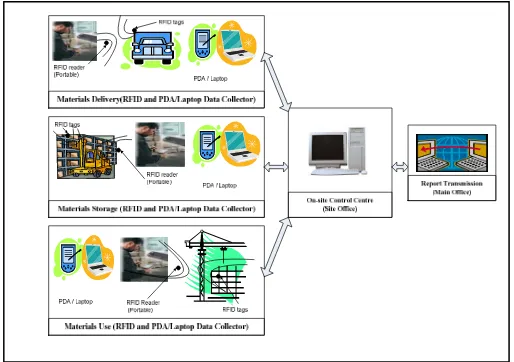
having been employed effectively. The development of the real-time materials tracking process is intended to improve materials tracking and overall process of materials management on the construction site. The proposed process consists of: (1) Materials Delivery; (2) Materials Storage; (3) Materials Use; (4) On-site Control Centre; and Report Transmission as depicted in Figure 1.
Figure 1. Components of Real-Time Materials Tracking
V. CONCLUSION
This paper has presented a review of materials management and employment of RFID technology in construction projects. It discussed the materials management on construction projects and potential to employ RFID in materials management practices. It clearly identified that these are important for effectively managing materials management in the construction project in order to provide better handling of construction materials to provide an overall performance of construction projects in term of time, budget (cost) and quality. The employment of RFID to support current practices of materials management in the construction site is considered improving for effective managing construction materials on site. In this paper, the emerging technologies such as RFID are discovered to be a potential for improving materials management especially for tracking of materials. The next stages of this research will examine the proposed real-time materials tracking process with employment of RFID in the construction industry.
VI. ACKNOWLEDGMENT
The author would like to thank Ministry of High Education (MOHE), Office of Research, Innovation,
Commercialisation and Consultancy (ORICC), UTHM, for
supporting this research under the Exploratory Research Grant Scheme (Vote No. 0884).
REFERENCES
[1] L.C. Bell, and G. Stukhart, “Attributes of Materials Management
Systems,” Journal of Construction Engineering and Management, vol. 112, no. 1, pp. 14-22, 1986.
[2] A. Griffith, P. Stephenson, and P. Watson, Management Systems for
Construction. Longman, England, 2000.
[3] BRE, Technology Review. Building Research Establishment Ltd., UK,
2005.
[4] M. Sun, and R. Howard, Understanding I.T. in Construction. Spoon
Press, London, 2004.
[5] Z. Chen, H. Li, and C.T.C. Wong, “An Application of Bar-code System
for Reducing Construction Wastes,” Automation in Construction, vol. 11, issue 5, pp. 521-533, 2002.
[6] M. Cheng, and J. Chen, “Integrating Barcode and GIS for Monitoring
Construction Progress,” Automation in Construction,vol. 11, no. 1, pp.
23-33, 2002.
[7] O. Moselhi, and S. El-Omari, “Integrating Bar Coding and RFID to
Automate Data Collection From Construction Sites,” Joint International Conference on Computing and Decision Making in Civil and Building
Engineering,June 14-16, 2006, Montreal, Canada, pp. 1734-1741, 2006.
[8] E.J. Jaselskis, and T. El-Misalami, “Implementing Radio Frequency
Identification in the Construction Process,” Journal of Construction Engineering and Management, vol.129, no.6, pp. 680-688, 2003.
[9] N.B. Kasim, C.J. Anumba, and A.R.J. Dainty, “Improving Materials
Management Practices On Fast-Track Construction Projects,” Proceedings, ARCOM Twenty First Annual Conferences, SOAS, London, 7-9 September, pp. 793-802, 2005a.
[10] D. Grau, L. Zeng, and Y. Xiao, “Automatically Tracking Engineered
[11] L.D. Nguyen, S.O. Ogunlana, and D.T.X. Lan, “A Study on Project Success Factors in Large Construction Projects in Vietnam,” Engineering Construction and Architectural Management, vol. 11, no. 6, pp. 404-413, 2004.
[12] R.H. Clough, G.A. Sears, and S.K. Sears, Construction Project
Management. John Wiley & Sons, USA, 2000.
[13] S.O. Ogunlana, K. Promkuntong, and V. Jearkjirm, “Construction
Delays in a Fast-growing Economy: Comparing Thailand with Other Economies,” International Journal of Project Management, vol. 14, no. 1, pp. 37-45, 1996.
[14] C.W.F. Che Wan Putra, A. Ahmad, M.Z. Abd Majid, and N. Kasim,
“Improving material scheduling for construction industry in Malaysia,” In Malaysian Science & Technology Congress 99, 6-8 Disember 1999, Johor Bahru, Malaysia, 1999.
[15] F.B. Muehlhausen, “Construction Sites Utilisation: Impact of Material
Movement and Storage on Productivity and Cost,” Logistics Information Management, vol. 14, no. 5/6, pp. 337-343, 1991.
[16] D.U. Kini, “Materials Management: The Key to Successful Project
Management,” Journal of Management in Engineering, ASCE, vol. 15, no. 1, pp. 30-34, 1999.
[17] G. Stukhart, Construction Materials Management. Marcel Dekker Inc.,
New York, 1995.
[18] P.K. Dey, “Managing Projects in Fast Track – A Case of Public Sector
Organisation in India,” International Journal of Public Sector Management, vol. 13, no. 7, pp. 588-609, 2000.
[19] Innovation & Research Focus (IRF), IT & Construction Process: Reports on Radio Frequency Identification (RFID). issue 67, pp.6., 2006.
[20] M. Schneider, Radio Frequency (RFID) Technology and its Application
in the Commercial Industry. Master’s of Science in Civil Engineering, University of Kentucky, 2003.
[21] C.R. Wood, and M.W. Alvarez, Emerging Construction Technologies A
FiatechTM Catalogue. FIATECHTM, 2005.
[22] Z. Ren, L. Sha, and T.M. Hassan, T.M., “RFID facilitated Construction
Material Management - A Case Study of Water Supply Project,” Proceedings of the 24th CIB W78 Conference Information Technology in Construction, Maribor, Slovenia, pp. 401 – 406, 2007.
[23] P.M. Goodrum, M.A. McLaren, and A. Durfee, “The Application of
Active Radio Frequency Identification Technology for Tool Tracking on Construction Job Sites,” Automation in Construction, vol. 15, no. 3, pp. 292-302, 2006.
[24] R. Navon, and O. Berkovich, “An Automated Model for Materials
Management and Control,” Construction Management and Economics, vol. 24, no. 6, pp. 635-646, 2006.
[25] A.A. Ghanem, Y.A. AbdelRazig, and S.M. Mahdi, “Evaluation of a
Real-Time Construction Project Progress Tracking, Sustainable Development through Culture and Innovation,” The Joint International Conference on Construction Culture, Innovation and Management (CCIM), 26-29 November, Dubai, pp.771-780, 2006.
[26] J. Song, C.T. Haas, C. Caldas, E. Ergen, and B. Akinci, “Automating the
task of tracking the delivery and receipt of fabricated pipe spools in industrial projects,” Automation in Construction, vol. 15, no. 2, pp. 166-177, 2005.
[27] B. Akinci, M. Patton, and E. Ergen, “Utilizing Radio Frequency
Identification on Precast Concrete Components-Supplier’s Perspective,” Proceedings. ISARC’02, IAARC, Washington, DC, pp. 381-386, 2002.
[28] K.M. Furlani, and L.E. Pfeffer, “Automated Tracking of Structural Steel
Members at the Construction Site,” ISARC 2000, 2000.
[29] N.B. Kasim, C.J. Anumba, and A.R.J. Dainty, “Materials Management
in Complex Projects: Case Studies,” Proceedings, International Conference on Construction & Real Estate Management, Penang, Malaysia, 12th – 13th December, pp. 232-238, 2005b
[30] O.O. Faniran, and G. Caban, “Minimizing Waste on Construction