Class
Attendance System using Active RFID:
A Review
FI<EE Compilation of Papers 2009
.
Abstract -The rapid growth of Information and Communication Technology field
has made medium of information retrieval more advanced and complex. As the RFID
has gained a lot of attention nowadays, the use of RFlDin a wide range application
has been successfully developed. Thus, this paper describes a brief introduction t o
application of attendance system and reviews some application of attendance
system and techniques of data retrieval such as smart card, biometrics, barcode and
RFID itself. This ongoing research would be applicable in collecting student
attendance in classroom using active RFID technology.
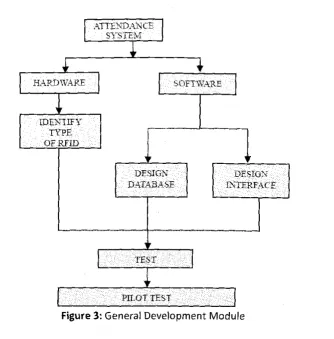
Figure 3: General Development Module
In this paper, a review on attendance system and some application of techniques such as biometric, barcode, smart card and RFID were discussed. The main aim of the review is to determine the suitability of choosing the right techniques as well as t o discover the benefit of applying RFID in attendance systems.
This research is funded by UTHM Short Term Grant 0595. 1 would like to thank to
Pusat Penyelidikan dan lnovasi, Universiti Tun Husscin Onn in supporting t h ~ s work.
[ I ] Sandip, L. (2006). "RFID Sourcebook." United Kingdom: International Business
Machines (IBM) Corporation.
[2] Shepard, S. (2005). "RFID Radio Frequency Identification." United State of America:
McGraw-Hill Companies Inc.
[31 Boatwright, M. and Xin Luo. (2007). What Do We Know About Biometrics
Authentication. Proceeding of the Fourth Annual Conference on Information Security Curriculum Development, Kennesaw. Georgia, USA. No. 13.
[4] Gil, Y., Ahn, D., Pan, S. and Chung, Y. (2003). Access Control System with High Level Security Using Fingerprints. Proceedings of the 32 Applied Imagery Pattern Recognition Workshop (AIPR'03). 15-17 October 2003. Washington DC, USA.
[5] Ratha,N. K., Chikkerur, S., Connell, J. H., and Bolle, R. M . (2007). Generating
Cancelable Fingerprint Templates, IEEE Transactions o n Pattern Analysis and Machine Intelligence. Vol. 29, No. 4, pp. 561-572.
[ ~ j ] Wu, Z. (2008). Biometrics Authentication System o n Open Network and Security Analysis. lnternational Symposium o n Electronic Commerce and Security 2008. Guangzhou, China. 3-5 August 2008. pp. 549- 553.
[7] Reillo, R.S. (2003). Smart Card Information and Operations Using Biometrics. IEEE
Aerospace and Electronic Systems Society (AESS) System Magazine. April 2003. Vol. 16, NO. 4, pp. 3-6.
[8] Simao, P., Fonseca, J. and Santos, V. (2008). Time Attendance System With
Multistation and Wireless Communications, IEEE lnternational Symposium on Consumer Electronics 2008. 14-16 April 2008. pp. 1-4.
191 Zhang, D., Kong, W. K., You, J. and Wong, M. (2003). Online Palmprint Identification.
IEEE Transactions o n Pattern Analysis and Machine Intelligence. Sept 2003. Vol. 25, No. 9, pp.1041-1050.
[ l o ] Gao, J.Z., Lekshmi Prakash and Rajini Jagatesan. (2007). Understanding 2D-Barcode
Technology and Applications in M-Commerce- Design and Implementation of a 2D Barcode Processing Solution. 31st Annual lnternational Computer Software and Applications Conference (COMPSAC 2007), Beijing. 23-27 July 2007. Vol 2, pp. 49-56.
[ l l ] Hebert, P.D.N., Stoeckle, M.Y., Zemlak, T.S. and Francis, C.M. (2004). Identification of
Birds through DNA Barcode. Public Library o f Science. Vol 2. Issue 10. pp. 1657-1663.
[12] Kato H. and Tan K.T. (2005). 2D Barcode for Mobile Phone. Second lnternational
Conference on Mobile Technology, Application and System. 15-17 November 2005. Japan. pp. 1-8.
[13] Susan, M . S., Mitchell, V. and Dudley, E. (2002). Using the Campus Web Site t o Traclc
Student Attendance. Proceedings of the 30th Annual ACM SIGUCCS Conference on User services. 20-23 November 2002. Rhode Island, USA. pp. 197-198.
[I41 Carr, M.R. (2002). Smart Card Technology with Case Studies. 36th Annual 2002
lnternational Carnahan Conference on Security Technology. 20-24 October 2002. Atlantic City NJ. pp. 158-159.
[IS] Hendry M . (1995). "Smart Card Security and Applications". Second Edition. London:
Artech House Publisher.
[I61 Sam, P. (2007). "The RFlD Case Study Book-RFID Application Stories From Around the
Globe". Abhisam software.
Won-Ju, Yoon., Sang-Hwa, Chung. and Seong-Joon Lee. (20081, lmplementation and Performance Evaluation of an Active RFID System for F a s t Tag Collection.
lnternational Symposium on Performance Evaluation of Computer and
Telecommunication Systems, Edinburgh, United Kingdom. Vol. 13. Issue 17. pp. 4107-4116.
M. K. Yeop Sabri., M. Z. A. Abdul Aziz., M . S. R. Mohd Shah and M . F. Abd Kadir. (2007). Smart Attendance System by Using RFID. Proceedings of Asia-Pacific Conference on Applied Electromagnetics 2007. Melaka, Malaysia. 4-6 December 2007. pp. 1-4.
Chen, W. D. and Chang, H. P. (2008). Using RFID Technology to Develop an Attendance System and Avoid Traffic Congestion around Kindergartens. First IEEE lnternational Conference on Ubi-Media Computing 2008, Lanzhou University, China.
3 1 July- 1 Aug 2008. pp. 568-572.
Kohei Mizuno and Masashi Shimizu. (2007). Transportation Quality Monitor Using Sensor Active RFID. Proceedings of the 2007 lnternational Symposium on Applications and the Internet Workshops (SAINTW'O7). pp. 19-22.
A. Qaiser and S. A. Khan. (2006). Automation of Time and Attendance using RFID Systems. Second lnternational Conference on Emerging Technologies. November 13- 14. Peshawar, Pakistan. pp. 60-63.
Ogata, H., Saito, N. A., Paredes, R. G.J., San Martin, G. A., and Yano, Y. (2008).
Supporting Classroom Activities with the BSUL. IEEE lnternational Workshop on Wireless and MobileTechnologies in Education. 28-30 Nov 2005. pp. 1-16.
M . F. Rahmat and Shu Khan, Lee. (2007). Development of a Modern Control System Analysis Package Using Visual Basic Programming. Elektrika Journal of Electrical Engineering. Vol. 9, No. 2, pp. 41-48.
Timothy, J. 0, and Linda, J. 0. (2004). "Microsoft Office Access 2003 Introductory
Edition". New York: McGraw-Hill Companies Inc.
Mohd Helmy Abd Wahab, Siti Zarina Mohd Muji and Fazliza Md. Nazir. (2007). Integrated Billing System through GSM Network. Proceedings of the lnternational Conference on Robotic, Vision, lnformation and Signal Processing. 28 -30 November 2007. Penang, Malaysia. pp. 54-57.
H. M . Deitel, D. J. Deitel and T. R. Nieto. (1999). "Visual Basic 6 How to Program." New Jersey: Prentice Hall.
S. Kadry and K. Smaili. (2007). A Design and Implementation of a Wireless Iris Recognition Attendance Management System. lnformation Technology and Control,
Kaunas, Technologija, 2007. Vol. 36, No. 3, pp. 323
-
329.Omar, S. and Djuhari, H. (2004). Multi-Purpose Student Card System Using Smart Card Technology. Proceedings of the Fifth lnternational Conference on lnformation
Technology Based Higher Education and Training. 3 1 May-2 June 2004. Australia. pp. 572-532.
[2g] Halawani, T. and Mohandes, M . (2003). Smart Card for Smart Campus KFUPM Case
Study. Proceedings o f t h e 2003 10th IEEE lnternational Conference on Electronics,
Circuits and Systems, 2003. 14-17 Dec 2003. Vol. 3, pp. 1252-1255.
1301 Mustafa Man and Kyng, L. Y. (2007). TITO: Utilizing MyKad Touch N Go Features for
Student Attendance System. First lnternational Malaysian Educational Technology Convention 2007. 2-5 November 2007. Johor Bahru, Malaysia. Vol. 1, No. 17, pp. 114-120.
(311 Herdawatie Abd Kadir, Siti Nurul Aqmariah M o h d Kanafiah and M o h d Helmy Abd
Wahab. (2008). Boarding School Students Monitoring System (E-ID) Using RFID. The Fourth lnternational Conference o n lnformation and Communication Technology and System. 5 August 2008. Surabaya, Indonesia. Vol. 1, No. 1, pp. 267-271.
[32] Joseph, 0. I. and Yusuf lsmail Nakhoda. (2008). Students Attendance by Using RFID
Informed Through SMS. The Fourth lnternational Conference on lnformation and Communication Technology and System. 5 August 2008. Surabaya, Indonesia. Vol. 1, NO. 1, pp. 189-194.