2019 International Conference on Computation and Information Sciences (ICCIS 2019) ISBN: 978-1-60595-644-2
Fixed Speed-increment Interception Orbit
Calculation Based on QPSO Algorithm
Guibo Zheng, Zongbo He, Zhiqiang Zhang and Jindong Li
ABSTRACT
Aiming at the problem of orbit interception under fixed speed increment condition, a method based on quantum-behaved particle swarm optimization (QPSO) algorithm for interception orbit parameters is proposed. This method quickly finds the rendezvous time that can achieve the target interception through the QPSO algorithm based on swarm intelligence, and avoids the problem of large computation and low efficiency caused by the enumeration method. The practical application of the orbit interception problem under an initial condition shows that the method can quickly determine the interception orbit parameters.
1. INTRODUCTION
In the orbit designing of more and more space missions, spacecraft rendezvous orbit design is more and more common, such as rendezvous and docking of space station, on-orbit service of cooperation target and interception of non-cooperative target. In the orbital design of the above space missions, common orbital transfer methods include double-pulse Hohmann orbit transfer and Lambert orbit transfer[1]. In some specific space application scenarios, the optimal interception orbit and the optimal interception time need to be calculated at the condition of the target spacecraft rendezvous with the sub-spacecraft thrown by interception spacecraft at a fixed point in a fixed speed increase, which is the inverse procedure of the traditional Lambert interception orbit calculation process. To complete the optimal
interception orbit calculation in this scenario, the common method needs to calculate the initial velocity required to achieve the rendezvous at different times by the Lambert method in a small step size until the difference satisfy the accuracy requirement between theoretically calculated speed increment and the specified speed increment. The defects with large calculation amount and long calculation time make it difficult to be applied in engineering.
The parameter optimization algorithm based on biological evolution has strong global optimization ability and adaptability, and the calculation is simple, so it is gradually applied to the parameter optimization of nonlinear problems. Among many optimization algorithms, the swarm intelligence algorithm, the particle swarm optimization (PSO) algorithm[2] has the advantages of simple calculation process and high efficiency, which is based on the study of artificial life and the foraging behavior of flocks and fish stocks. It is used in optimization calculations in various fields. Literature [3] improved the PSO algorithm for finding the maximum power point of the PV system; the literature [4] used the PSO algorithm for cloud computing tasks planning; the literature [5] used the particle swarm algorithm for capacitor optimal allocation strategy of the wind turbine distribution system, to reduce energy loss; literature [6] used simplified particle swarm optimization algorithm for optimal path planning of intelligent mobile robots; literature [7] adopted improved PSO algorithm for cooperative tracking optimization of near space spacecraft. The literature [8] used the quantum particle swarm algorithm for complex network clustering research.
Based on quantum particle swarm optimization (QPSO) algorithm, this paper proposes a fast optimization calculation method for spacecraft interception orbit under fixed speed increment condition, which converts complex time-consuming parameter trial calculation into parameter independent optimization process to shorten calculation time and improve calculation precision. On the basis of the algorithm designing, the interception orbit of the spacecraft with fixed growth rate of 1200m/s on two co-planar elliptical orbits is analyzed and calculated.
2. PARAMETER OPTIMIZATION METHOD BASED ON QPSO
The QPSO-based parameter optimization method is an improved algorithm of Particle Swarm Optimization (PSO) which is an evolutionary computational technique and first proposed by Eberhart and Kennedy in 1995[2]. Starting from a random solution, it finds the optimal solution by iteration, evaluates the quality of the solution by fitness, and searches for the globally optimal value by following the optimal value of current search. Its basic concept stems from the study of foraging behavior of birds.
well and considers the particle to have quantum behavior. Based on this model, Quantum-behaved Particle Swarm Optimization (QPSO) was proposed.
In the quantum space, the properties of the particles satisfying the aggregate state are completely different, and it can be searched in the whole feasible solution space. Therefore, the global search performance of the quantum PSO algorithm is far superior to the standard PSO algorithm. In quantum space, the velocity and position of a particle cannot be determined at the same time. Therefore, Sun et al.[9] describe the particle state by a wave function 𝛹(𝑥, 𝑡) whose physical meaning is that the square of the wave function is the probability density of the particle appearing at a certain point in space. And by solving the Schrodinger equation, the probability density function of the particle appearing at a certain point in space was gotten. The positional equation of the particle is then determined by Monte Carlo stochastic simulation.
In the QPSO algorithm, the particle's velocity and position information are attributed to one parameter. In order to ensure the convergence of the algorithm, each particle must converge to its p point, 𝑝 = (𝑝1, 𝑝2, … … , 𝑝𝑑) , which pd is the
value of the particle in the d-th dimension.
𝑝𝑑 = (𝜑1. 𝑝𝑖𝑑+ 𝜑2. 𝑝𝑔𝑑)/(𝜑1+ 𝜑2) (1)
Where φ1,φ2 is a random function between 0 and 1.
At the same time, a median optimal position is introduced into the particle swarm to calculate the variable L of the next iteration of the particle, which is defined as the average of the global extreme of all particles. The formula is as follows:
𝑚𝑏𝑒𝑠𝑡 =𝑁1∑𝑁 𝑃𝑖
𝑖=1 = 𝑁1∑𝑁𝑖=1𝑃𝑖1, … ,𝑁1∑𝑁𝑖=1𝑃𝑖𝑑 (2)
Where N is the number of particle groups and 𝑃𝑖 is the global extremum of particle i. Therefore, the formula for calculating the parameters L can be derived:
𝐿(𝑡 + 1) = 2 ∙ 𝛽 ∙ |𝑚𝑏𝑒𝑠𝑡 − 𝑥(𝑡)| (3)
Further, the evolution equation of the particle can be obtained as follows:
𝑥(𝑡 + 1) = 𝑝 ± 𝛽 ∙ |𝑚𝑏𝑒𝑠𝑡 − 𝑥(𝑡)| ∙ 𝑙𝑛 (1/𝑢) (4)
Among them, u=rand(0,1), where β is the coefficient creativity, adjusting its value can control the convergence speed of the algorithm. In general, the algorithm can achieve better results when β linearly decreasing from 1.0 to 0.5. Equations (1), (2), and (4) are the algorithm equations of QPSO.
𝛽 = (0.95 − 0.55) ∙ (𝑁 − 𝑡) 𝑁⁄ + 0.55 (5)
The research shows that the improved model parameter determination method based on quantum-behaved particle swarm optimization algorithm has higher speed and precision than the traditional model parameter determination method, and is gradually applied to the actual parameter optimization.
3. QPSO-BASED INTERCEPTION ORBIT CALCULATION METHOD
The application scenario of interception orbit calculation in this paper is as follows: the interception spacecraft throws a sub-spacecraft with fixed initial velocity and adjustable speed direction. Through the interception orbit design, the orbital intersection of the sub-spacecraft thrown by interception spacecraft and the target spacecraft is realized.
The specific implementation steps of interception orbit calculation based on QPSO algorithm are as follows:
(1) Determining the population size N and the particle dimension d, initializing the particle population individual position pid and the population optimal position
pgd;
(2) Using the particle swarm position pidas the rendezvous time t, calculating the
position of the target spacecraft after the elapse of time t;
(3) Using the particle swarm position pid as the rendezvous time t, and
calculating the velocity vector V1 required to achieve the rendezvous with the target spacecraft at the time t by the Lambert orbit calculation method;
(4) Taking the value of ‖𝑉1− 𝑉0‖ − ‖𝑉𝑚‖ as the fitness of the particle, where
𝑉0 is the initial vector of the interception spacecraft, and ‖𝑉𝑚‖ is the modulus of the speed increment of the sub-spacecraft thrown by the interception spacecraft ;
(5) Repeat (2)-(4) to calculate the fitness of each particle;
(6) According to its fitness, update the individual optimal position pid(i) and the
group optimal position pgd(i);
(7) Add or subtract with a certain probability according to formulas (2) to (5), update the position of each particle, and generate a new particle population;
(8) Determine whether the particle fitness satisfies the convergence condition or whether it reaches the maximum evolution algebra, and then exits, otherwise returns step (2).
4. INTERCEPTION ORBIT CALCULATION UNDER FIXED SPEED INCREMENT CONDITIONS
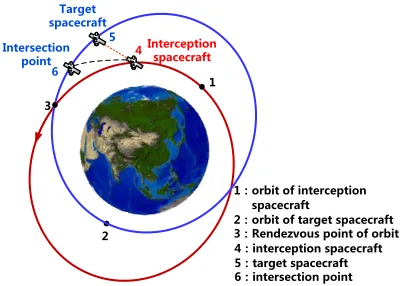
The initial state of interception orbit calculation under fixed speed increment condition is as follows: the target spacecraft and the interception spacecraft operate independently in two polar orbital elliptical orbits with the same orbital height and the same orbital plane, and the orbital inclination angle is 97.3°, and the argument of
perigee of the two orbits differ by 180°. The binary spacecraft relationship and interception diagram are shown in Fig 1. Track 1 is the initial orbit of the interception spacecraft, Track 2 is the initial orbit of the target spacecraft, 4 is the initial position of the interception spacecraft, 5 is the initial position of the target spacecraft, and the interception star throws the sub-spacecraft at 1200 m/s at position 4. After time tf, sub-spacecraft meet the target spacecraft at position 6.
Interception spacecraft
Target spacecraft
1
2 3
4
6 5 Intersection
point
1:orbit of interception spacecraft
[image:5.612.199.400.317.460.2]2:orbit of target spacecraft 3:Rendezvous point of orbit 4:interception spacecraft 5:target spacecraft 6:intersection point
Figure 1. Schematic diagram of spacecraft’s orbit distribution and interception.
The initial position and velocity vectors RV1 and RV2 of the interception spacecraft and the target spacecraft are: RV1=[-955.872535e3, 631.082894e3, 6686.454443e3, 7.792242e3, 2.227973e3, 0.948591e3]; RV2= [-957.921339e3, 634.428887e3, 6896.221789e3, 7.190404e3, 2.190739e3, 0.643301e3].
TABLE I. INITIAL PARAMETERS OF SPACECRAFT ORBITS.
Orbital elements α(km) e i(°) Ω(°) ω(°) f(°)
Interception
spacecraft 6979.1 0.02 97.3 196.3 0 81.6
Target spacecraft 6979.1 0.02 97.3 196.3 180 266.2
According to the QPSO-based fixed speed-increment interception orbit calculation method, the Matlab simulation program is written for analysis and calculation.
The initial parameters of the QPSO algorithm are set as follows: the fixed speed increment dV0 of the interception spacecraft throwing spacecraft is 1200 m/s, the number of particles is N=10, the particle dimension is d=1, the maximum number of iterations is 20,000, and the lower limit of the initial position of the particle is taken 0.1, the upper limit of the initial position of the particle is 20, the maximum position value of the particle is 40, and the optimal termination error condition is 1.0×10⁻⁶.
According to the above initial conditions, the optimization of the rendezvous time tf, the rendezvous time optimization path is shown in Fig. 2.
It can be seen from the optimization results that after 8 iterations, the fitness (the difference between the theoretical growth rate and the specified growth rate) converges from 108m/s to about 1m/s. After 62 iterations, the fitness reaches 6.57711×10⁻⁷m/ s, the calculation time used is 0.1s, and the optimal rendezvous time obtained is tf=19.906113s.
The calculation process for interception orbit is:
(1) Calculate the position vector of the target spacecraft after rendezvous time tf , and get p2'=[-814.577907e3, 677.887944e3, 6907.412031e3];
(2) Combine the interception spacecraft initial position vector
p1=[-955.872535e3,631.082894e3,6866.459444e3], and calculate the orbit transfer velocity vector V1 through p1, p2' and tf by the Lambert equation from p1, p2' and
tf, and get V1=[7087.404359, 2358.866154, 2137.890301];
(3) The initial position velocity vector RV1' of the interception orbit is formed by the interception spacecraft initial position vector p1 and the orbit velocity vector V1;
(4) The elements of intercepted orbits calculated by RV1' is α=7360.7km,
e=0.18, i=97.3°, Ω=196.3°, ω=1°, f=62.7°;
(5) The interception track can be obtained by calculating the position vector from t0 to tf from the elements of orbits.
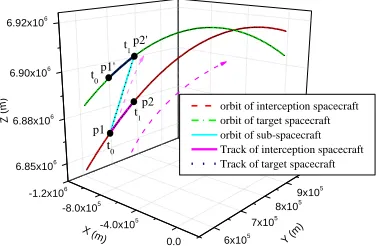
The change of the position vector of the interception spacecraft, the target spacecraft and the interceptor with time can be calculated by the Matlab program. The evolution and interception process of the two spacecraft position vector are shown in Fig. 3.
In Fig. 3, the p1 point is the initial position of the interception spacecraft, the p1'
point is the initial position of the target spacecraft, t0is the time zero point, t1 is the
𝑝1𝑝2′
⃑⃑⃑⃑⃑⃑⃑⃑⃑⃑⃑ is the trajectory of the interceptor and 𝑝1′𝑝2′⃑⃑⃑⃑⃑⃑⃑⃑⃑⃑⃑⃑⃑ is the trajectory of the target
spacecraft. To ensure accurate interception, the time of the target spacecraft from p1'
to p2' and the time of the interceptor from p1 to p2' must be equal to the intersection time tf (19.906113s).
0 10 20 30 40 50 60 70
0 20 40 60 80 100 120 Iteration times Fit ness ( m/s )
10 20 30 40 50
0.0 0.2 0.4 0.6 0.8 1.0 F it n e ss ( m /s ) Iteration times Partial enlargement -1.2x10⁶ -8.0x10⁵ -4.0x10⁵ 0.0 6.85x10⁶ 6.88x10⁶ 6.90x10⁶ 6.92x10⁶ 6x10⁵ 7x10⁵ 8x10⁵ 9x10⁵
orbit of interception spacecraft orbit of target spacecraft orbit of sub-spacecraft Track of interception spacecraft Track of target spacecraft
t0 p1' p2' p2 t 1 p1 t0 Z (m)
Y (m) X (m)
[image:7.612.310.499.149.272.2]t1
Figure 2. Rendezvous time optimization path. Figure 3. Intercepting process of spacecraft.
5. CONCLUSIONS
Aiming at the optimal interception orbit design problem under fixed speed-increasing constraints, a QPSO algorithm based on swarm intelligence is used to optimize the interception orbit parameters. The calculation results show that the QPSO algorithm can not only obtain the optimal interception parameters, but also has a high convergence speed and accuracy. It is a good parameter optimization method for nonlinear problems.
REFERENCES
1. Sang Yan, Zhou Jin. 2009. “An Approach of Accurate Impulse Transfer Based on Lambert Algorithm,” Journal of National University of Defense Technology, 2009 31(3):29-32.
2. Kennedy J. Eberhart R C. Particle Swarm optimization.1995. “Proceedings of IEEE International Conference on Neural Networks,”1995:1942-1948.
3. Tianmeng Wei, Dongliang Liu, Chuanfeng Zhang.2017. “An Improved Particle Swarm Optimization (PSO)-Based MPPT Strategy for PV System,” Proceedings of ICMITE 2017,
Cheng Du. 2017:1-5.
4. Qing Wang, Xueliang Fu, Gaifang Dong, et al. 2018. “Research on Particle Swarm Optimization Algorithm Based on Cloud Computing Task Scheduling,” Proceedings of the 2018 International
Conference on Physics, Computing and Mathematical Modeling, Shang Hai, 2018:278-284.
5. H.S. Ramadan, A.F. Bendary, S. Nagy. 2017. “Particle swarm optimization algorithm for capacitor allocation problem in distribution systems with wind turbine generators,” International
Journal of Electrical Power & Energy Systems, 2017, 84:143-152.
7. Fan Cheng-li, Fu Qiang, Qinghua Xing. 2017. “Cooperative tracking optimization of near space high-speed vehicle based on improved particle swarm optimization,” Systems Engineering and
Electronics, 2017 39(3):476-481.
8. Lingling Li, Licheng Jiao, Jiaqi Zhao, et al. 2017. “Quantum-behaved discrete multi-objective particle swarm optimization for complex network clustering,” Pattern Recognition. 2017, 63:1– 14.
9. Sun J, Feng B, Xu W, 2004. “Particle swarm optimization with particles having quantum behavior,” Proceedings of the 2004 Congress on Evolutionary Computation, New York, United