Munich Personal RePEc Archive
The Impact of Irregular Status on
Human Development Outcomes for
Migrants
Sabates-Wheeler, Rachel
Centre for Social Protection at the Institute of Development Studies
(IDS), Sussex
9 July 2009
Human Development
Research Paper
2009/26
The Impact of Irregular
Status on Human
Development Outcomes
for Migrants
United Nations Development Programme
Human Development Reports
Research Paper
July 2009
Human Development
Research Paper
2009/26
The Impact of Irregular
Status on Human
Development Outcomes
for Migrants
U
nited Nations Development Programme
Human Development Reports
Research Paper 2009/26
July 2009
The Impact of Irregular Status on Human
Development Outcomes for Migrants
Rachel Sabates-Wheeler
Rachel Sabates-Wheeler is a Research Fellow and a Director of the Centre for Social Protection at the Institute of Development Studies (IDS), Sussex. Email address: [email protected].
Abstract
The purpose of this paper is to explore how irregular status impacts a range of human development outcomes for labour migrants. The analysis indicates that for poorer labour migrants, irregular (or undocumented) migration provides a positive, private return to income and livelihood improvements for themselves and their families as compared to 1) no movement at all, and at times, 2) regular (or documented) migration. However, irregular status is associated with a range of forms of disadvantage and vulnerabilities that often compromise migrants’ rights, entitlements and the rate of return they achieve from the migration process. Migrants are as rational as other members of the population and, being aware of these vulnerabilities, many still choose to migrate. The larger hypothesis of this paper is that, as long as poverty drives migration, legal status will not be a priority for migrants. Migrants will be willing to endure short to medium term hardship and the undermining of a range of capabilities and rights (such as education, social assets, rights and personal welfare) to provide economic safety nets for their families and future improvements to their (and their families) livelihoods and wellbeing. As long as migrants on average achieve a positive increase in income and assets through the migration experience (which they do) they will sacrifice a whole range of freedoms and rights. It is therefore imperative that policy makers make active steps to protect migrants with regard to basic human rights and facilitate positive outcomes from their migration experiences. In particular, we urge southern governments to advocate for all their migrants abroad, regardless of legal status. If southern country governments accept the mainstream opinion that migration is good for development, and furthermore recognise that a substantial number, if not the majority, of their migrants are irregular, and continue sending remittances and investment, then governments should seek to protect their citizens aboard, facilitate safe remittances, and begin to stand firm in the face of pressure to control national borders.
Keywords: Irregular status, migration, vulnerability, poverty, protection.
1. Introduction
The potential for positive linkages between migration and development has been increasingly
recognised in recent years, with a spate of books, articles and international conferences focused
on this theme. In fact, there is a growing body of opinion that migration is good for
development. This theme has been taken forward in a ‘High Level Dialogue on Migration and
Development’ as part of the meeting of the UN General Assembly in 2006, as well as estimates
from the World Bank that an increase in temporary international mobility of the order of 3 per
cent of developed countries’ workforces could generate up to $356 bn in benefits annually, fairly
evenly distributed between rich and poor countries (World Bank 2006).
Yet in terms of international migration at least, the policy context for poor people to use
migration as a route out of poverty often remains limited. In particular, although there has been
an expansion of international migration into northern economies over the past decade, especially
to the United States and European countries with relatively high economic growth rates, these
countries have generally retained and sometimes strengthened relatively restrictive immigration
rules. As a result, legal migration routes have been opened primarily only to more educated
individuals and to special categories of migrants such as refugees (although recently there have
been some significant changes). In turn, a significant proportion of migrants have been pushed
towards more ‘irregular’ modes of entry into the North – as well as to some southern countries,
with the result that they enter sectors of the labour market where jobs are less secure, wages and
working conditions are generally poorer, and where there may be a constant threat of discovery
and deportation.1
The purpose of this paper is to explore how irregular status impacts a range of human
development outcomes for labour migrants.2 First, using primary data and secondary evidence we support the increasingly held view that it is inappropriate to use simple dichotomies when
1
Throughout this paper we use the terms irregular and undocumented interchangeably. However, strictly speaking, as will be discussed in section 2, undocumented is a special case of irregular.
2
describing migrant status for instance between irregular and regular migrants (also referred to as
legal/illegal; authorised/unauthorised; documented/undocumented). Instead we point out the
many shades of grey that exist according to a range of legal statuses. We then move on to
propose that, for the majority of labour migrants across the globe, poverty, the need to manage
risk and the motivation to improve livelihoods and capabilities, is the main migration driver. We
argue that poorer migrants are more likely to engage in irregular migration (with the incorrect
documentation or no documentation) than non-poor migrants due to reasons of necessity,
structural constraints that restricted access to legal routes of migration, and informational
barriers.
We then move to discuss the incentives for (non)compliance from a migrant perspective.
Evidence is drawn on to argue that, as far as direct economic benefits from migration are
concerned (such as, fulfilment of basic needs, increases in wealth and assets), legal status is not
causally related to a positive outcome. Sometimes regular status may actually work against a
positive outcome. However, we go on to focus on exploring the costs of being irregular in terms
of social, political and distributional indicators. Irregular status exacerbates migrant disadvantage
and vulnerability on a number of counts. As the poor are more likely to engage in irregular
migration, they face the double disadvantage of poverty-specific vulnerabilities as well as
irregular-migration vulnerabilities. Poorer migrants need to weigh up whether the poverty
alleviating and asset enhancing benefits from irregular migration compensate for a plethora of
possible disadvantages, such as: exploitation; deskilling; extortion; exclusion; insecurity;
discrimination; lack of rights; and lack of safety at work. We trace the impacts of irregular status
on a range of human development outcomes using secondary sources and primary survey
sources. In conclusion, we draw out implications of the work with a view to maximising the
benefits and minimising the risks of migration for irregular migrants.
Methodology and Datasets
The data used for primary analysis in this report comes from a number of quantitative specialised
migrant surveys and qualitative surveys conducted as part of the research project on Social
1. a survey of 201 Malawian return migrants from the UK
2. a survey of 150 Malawian return migrants from South Africa
3. a survey of 207 Ghanaians in Nigeria
4. a survey of 107 Ghanaians in the UK
5. a qualitative survey of 17 current Malawian migrants residing in Johannesburg
6. qualitative interviews with Ghanaians in the UK, Malawians in the UK and Ghanaian
returnees from Nigeria.
The surveys were conducted at various times between January 2007 and January 2008. They
collected information on a range of themes, including: decision to migrate; employment
trajectories during migration; legal status and change in status; access to formal and informal
social protection; poverty indicators; assets, remittances and associational membership. For the
purposes of this paper we draw selectively on data that provides insights into dimensions of legal
status, migrant characteristics and migration outcomes.
2. Characteristics of irregular migrants
Numbers
Accurate estimates of the flows and stocks of international migrants are extremely difficult to
obtain, especially in light of the following: 1) the majority of migration is short-term, circular
and/or seasonal (ie, under 12 months), whereas official estimates only include people living
abroad for over 12 months; 2) many countries do not have robust or reliable databases containing
migrant numbers; and 3) these numbers do not include flow estimates. It is likely, then, that the
number of international migrants is significantly, if not vastly, higher than this estimate.
If it is hard to obtain an accurate picture of regular migration stocks, how much more unreliable
are the attempts to estimate irregular migrant stocks and flows? Exact numbers of irregular
migrants are difficult to estimate for a number of reasons discussed below, but it is clear that
irregular migration occurs on a large scale — and is a global phenomenon. The Pew Hispanic
Center estimates that there are 11.5 to 12 million ‘unauthorised’ migrants in the US (Passel
2006) and, despite the attempts of European countries to limit immigration of ‘unskilled’
et al. 2007) — although the latter figure does include all irregular migrants. Estimates from the
UK stand anywhere between half a million and one million irregular migrants. Irregular
migrants are also common in migration contexts within the Global South. For example, there are
large flows of irregular migrants to South Africa from other countries in the Southern African
Development Community (Oliver 2008). Finger-in-the-wind estimates suggest that irregular
migrants comprise between 5-10 per cent of total migrant stock.
With respect to other OECD destinations estimates exist on the share of irregular migration.
UNESA (2005) estimates the Russian migrants stock at 12 million, the irregular migrants
comprising approximately 29 per cent. In 2008, the irregular stock stood at 3.5 million (Alexeev
2008). Thailand estimates for irregular stand at around 55 per cent. Estimates from 2005 put
South Africa’s irregular stock at 45% and in Kazakhstan estimates reach as high as 98%
(UNESA 2005).
Clearly, the above estimates must be considered with much caution, if considered at all. More so
than regular migrant stock estimates, irregular estimates suffer from a range of methodological
problems. For example, irregular migrants are not always recorded in macro-data instruments.
Estimates of undocumented migrants are often calculated using the ‘residual method’, which
involves subtracting the number of migrants in census data from the total number of known legal
migrants in the country. This technique is often imprecise, and in any case provides only a partial
window into the volume of irregular migration. Another popular way of measuring numbers of
irregular migrants is to look at apprehension rates of migrants at border points, under the
assumption that most migrants are apprehended. This method is unreliable as it is impossible to
tell the number of migrants apprehended as a proportion of the total number of migrants crossing
the border. Furthermore, evidence from the Mexican Migration Project (MMP) shows that
migrants who have been apprehended are more likely to attempt to re-migrate. With successive
attempts and with the aid of migration information networks, migrants become more skilled at
crossing the border without being apprehended (Donato et al. 1992).
A further significant barrier to conducting research on irregular migrants is the fact that it is often
forward for interview for fear of being reported to immigration-related authorities. Moreover,
those who do come forward may be a specific higher risk group, thus causing selection problems
for any survey design or analysis. If they do come forward they may chose to conceal
information concerning legal status, networks and employment, thus introducing bias into the
survey method. Ethnographic methods are one way to attempt to overcome these problems;
however this introduces large costs in terms of length of time in the field and a limited number of
respondents. Another, more appealing way to obtain ‘true’ information on migrants’ experience
is to interview returnees within their own countries. The sample may still be subject to the
problem of selection bias but problems of concealed information and misinformation are likely
to be minimised.
Status Blur
Many studies of migrants acknowledge the importance of migrants’ legal status in a country as a
possible determinant of employment decisions, sectors of employment, housing decisions and
social protection decisions (among other things). However, due to data constraints the majority
of studies are unable to interrogate these issues. If surveys do collect information on legality it is
typically in the form of a question, for example: ‘Are you legally entitled to remain in the
country?’ or ‘Do you have the formal documentation to allow you to legally stay in the country?’
While this line of questioning provides some basic information as to whether a migrant is legally
residing within a country, it sheds little light on other factors, such as whether their legal status
has been changing while at their destination or whether the migrant has strategically chosen to
become undocumented. Furthermore, the simplistic method of this kind of enquiry leads to false
dichotomous labelling where the tendency is to divide all international migrants into
documented/undocumented; legal/illegal; authorised/unauthorised; regular/irregular migrants.
These binaries obscure the empirical reality that the legal status of many international migrants
shifts during their time in host countries. For example, some migrants may enter countries
through legal channels and later become ‘undocumented’ by overstaying their visas, while others
may violate the terms of visitor visas by working without permission. Irregular migration refers
to a broader group of migrants than the ‘undocumented’ category allows for, encompassing any
migrants who enter countries illegally, failed asylum seekers, migrants who overstay their visas,
and those who have a legal right to remain but work illegally.
Carefully distinguishing between different categories - undocumented, documented with right to
remain and not work, and documented with right to work - allows us to explore in much more
detail the way in which migrants interact with local labour markets and the strategies they might
use to balance various types of legal status with employment opportunities and employment
status. Legality of employment has obvious implications for migrants’ access to social
provisioning, both through the employer and workplace as well as through claims made on the
state.
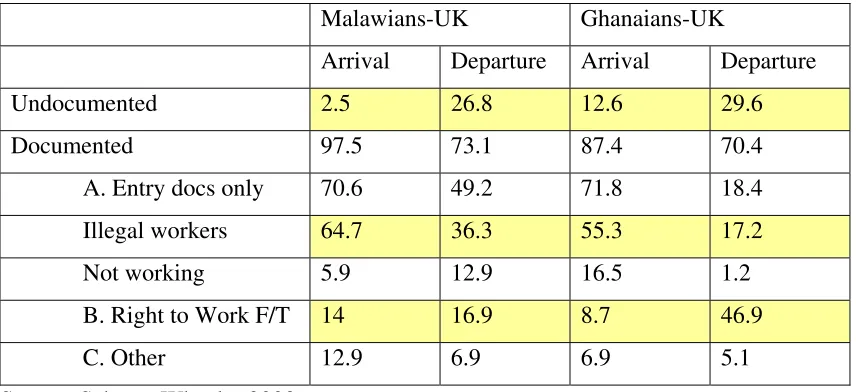
Table 1 below indicates the change in legal status of Malawian and Ghanaian survey respondents
at arrival in the UK and upon departure (source: Sabates-Wheeler 2008). As anticipated, only
2.5 per cent of Malawians and 12.6 per cent of Ghanaians arrived in the UK without any form of
documentation - in other words, completely illegally. Whereas, at the point of departure, 27 per
cent and 30 per cent were without any form of documentation to support their continued stay in
the UK. The majority of migrants claimed to have some form of documentation on arrival and
on departure.
The category of ‘legal’ or ‘documented’ is not a particularly useful one when interrogating
migrant labour patterns and employment rights. Disaggregating ‘legal’ into its constituent parts,
Table 1 shows that only 14 per cent of Malawian migrants and 8.7 per cent of Ghanaian migrants
had the ‘right to work’ upon arrival to the UK. A further 6 and 16 per cent respectively were not
working (in keeping with their legal status); however a massive 65 and 55 per cent of migrants in
the UK stated that while they had the legal entry requirements they were in fact working
illegally.
Over time we see that the number of legal-entry/illegal-workers reduces to approximately 36 per
cent and17 per cent respectively, however this is matched by a huge increase in undocumented
migrants. For the Ghanaians we also witness a large increase in the number of migrants who
is much more modest. Over time we see that some migrants are able to obtain the right to work,
whereas many others become completely undocumented by staying in the UK beyond the legally
[image:12.612.72.500.174.370.2]allowed time.
Table 1: Fluidity of legal status between arrival and departure
Malawians-UK Ghanaians-UK
Arrival Departure Arrival Departure
Undocumented 2.5 26.8 12.6 29.6
Documented 97.5 73.1 87.4 70.4
A. Entry docs only 70.6 49.2 71.8 18.4
Illegal workers 64.7 36.3 55.3 17.2
Not working 5.9 12.9 16.5 1.2
B. Right to Work F/T 14 16.9 8.7 46.9
C. Other 12.9 6.9 6.9 5.1
Source: Sabates-Wheeler 2008
The blurring of legal status is compounded by the hugely complex and intricate immigration
laws and regulation in many countries. For instance in the UK there are over 80 different types
of entry and immigration status.
Compliance framework
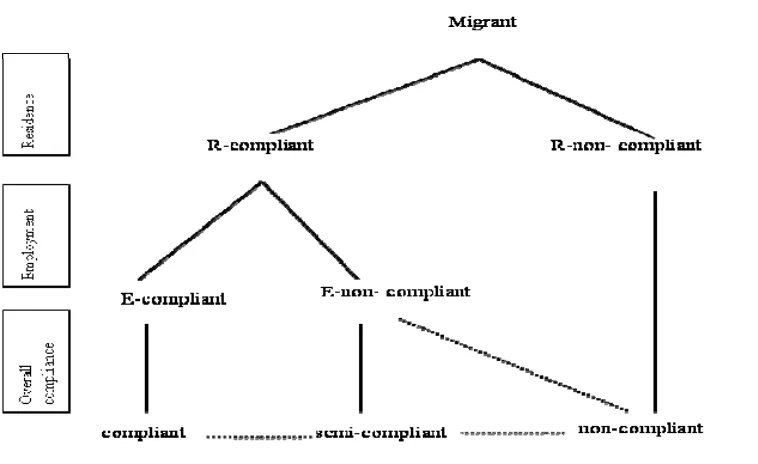
Ruhs and Anderson (2006) usefully provide a more nuanced way of categorising different types
of legal status. They distinguish between three levels of compliance: compliant migrants are legally resident and working in full compliance with the employment restrictions attached to
their immigration status; non-compliant migrants are those without the right to reside in the host country (i.e. those “illegally resident”); and semi-compliance indicates a situation where migrants are legally resident but working in violation of some or all of the employment
restrictions attached to their immigration status. (see figure 1 below). A migrant can enter a
country as resident compliant or resident non-compliant. If the latter, then the migrant is
of any kind. Alternatively the labour migrant may enter the country as resident-compliant and
employment-compliant, thus this person becomes classified as fully compliant.
The more complex and fuzzy category is that of compliance. The category of
semi-compliance – the “space between” strict legality and illegality – is extremely broad and captures
a wide range of violations of the conditions of employment attached to a migrant’s immigration
status, with varying degrees of severity. Consider the case of four student visa holders working
20, 21, 25 and 40 hours per week respectively in the UK. Clearly, there is a substantial
difference – in terms of the degree to which the employment restrictions attached to immigration
status are violated – between a student who works 21 hours per week and a student who works
40 hours per week. The discussion of where and how the line should be drawn between
semi-compliance and non-semi-compliance – or indeed between semi-compliance and semi-semi-compliance – can be
highly politicized and the decision might often rest on a personal judgement, with different
actors drawing the line in different places. This is an example of how illegality is “socially
[image:13.612.71.450.420.652.2]constructed”.
Figure 1: Compliance Framework
3. Incentives for less than full compliance
An important contribution of the compliance framework is that it draws attention to the agency
of migrants and their ability to strategise in relation to legal status. Often labour migrants choose
non-compliance and semi-compliance over compliance. This choice reflects the range of
constraints and vulnerabilities at home as well as the options at and of the destination. The
decision to migrate irregularly also determines the vulnerabilities and constraints, or
opportunities, that will face the migrant in the future.
Desire to alleviate poverty trumps compliance
The decision facing the majority of voluntary, relatively poor migrants is whether to stay put at
home, where they have full legal status, or whether to move, with the expectation of obtaining a
higher income abroad, where they might not enjoy full legal status and the range of capabilities
and rights it affords. However, we hypothesise that that this decision is made independent of
legal status. The main considerations that influence this decision are current and future family welfare as well as the ability to finance the trip. Recognising that expected income is a
determinant of migration (as in the Harris-Todaro model and others such as those of Kennan and
Walker), we argue that realised income, or poverty in the current period, is also a significant
determinant of migration. In other words, it is not just prior moves that influence subsequent
opportunities, but also prior opportunities influence moves which in turn influence future
opportunities. Thus we should recognise the importance of initial conditions, specifically
poverty, as a determinant to migration.
In keeping with Sabates-Wheeler et al. (2008), we forward that as long as people can cover the
minimum costs of a move, the ‘poverty threshold’ will determine migration choice. This
threshold is likely to be highly context specific; it could be defined in relation to an objective
measure such as income or, more likely, a comparative, relative or subjective benchmark.
Individuals who are poorer (in a multidimensional sense of the term) are more likely to migrate
as long as they see a payoff for doing so. Movement is influenced by their relative position with
respect to this threshold. For poorer households the incentive for non-compliance is
overwhelmed by a concern to secure welfare (reduce poverty) for the migrant and the family. In
poorer people are much more likely to engage in irregular migration due to: 1) binding poverty
constraints at origin and thus the lure of a better livelihood; 2) the high transaction costs of
obtaining legality (see below); and 3) structural constraints that restrict access to legal routes of
migration. The poorer migrants migrate out of necessity, thus the luxury of legal status
considerations are not a priority.
Poorer migrants prioritise family welfare, as indicated from qualitative work with 17 irregular
migrants living in two townships of Johannesburg.3 All respondents cited poverty as a reason for coming to South Africa, often encouraged by either family members or friends at home or in
South Africa. The majority of respondents did not want to stay in South Africa. Thus, for them,
migration is, in and of itself, a means of social protection for themselves and their families, both
in South Africa and in Malawi. All but one of the migrants interviewed had a clear objective to
their migration. Many times the objective was to fund a very specific investment, such as ‘to
build a roof on my house back in the village’, or ‘to cover the costs of secondary school for one
of my daughters’, or ‘to purchase a fishing net’ or ‘to buy a popcorn machine.’ These plans were
time bound and most of the migrants had performed calculations about the exact time it would
take (given their current salary) to fund the investment and return home.
Frans, a Malawian migrant in Jo’Burg tells of the poverty that caused him to migrate:
“I am 40-years-old and first came to South Africa in 1991. My cousin was working and
living in Johannesburg. I was doing small-scale farming in Malawi and not making much
of a living for the family. The soil was poor and fertiliser expensive, so I was only growing
enough for the family to eat – sometimes, we ran out before the next harvest. There was no
opportunity to find any work in Malawi. My cousin in Johannesburg said I should come to
Johannesburg and look for a job. He helped me find my first contract job here. But it
wasn’t enough. So, I looked for work by standing on the street corners and waiting for
employers to stop and offer work. I was picked up by a White man with a grass cutting
business who needed additional labour.”
3
The reason that livelihood concerns so often trump formal legal requirements for deciding
migrants is that migration itself represents a critical, possibly the most vital, form of insurance
and risk mitigation for the migrant and their family. Approximately 45 per cent of migrants
returning from the UK and South Africa accumulated physical assets in their home country as a
result of migration. However the nature of investments differ quite highly between migrants.
Figure 2 below shows that significantly more UK migrants invested in land back home (27 per
cent as compared to 8 per cent), whereas SA migrants invested significantly more in housing and
[image:16.612.76.437.301.551.2]small livestock.
Figure 2: The impact of migration on physical assets in home country (per centage saying yes)
0 5 10 15 20 25 30 35 40
Land Hous
ing
Bus ines
s
Bui lding
Agr.M ach
Large Live
stock
Sma ll live
stoc k
UK
SA
Source: Sabates-Wheeler 2008
Similar data from Ghanaians in Nigeria shows that the vast majority of respondents (81.7 per
cent) were able to use their migration to build securities for their future. The above data
converges to show that the majority of respondents are planning their future social security
Unregulated labour markets translate into higher income for irregular migrants
Evidence shows that irregular migrants can at times obtain a higher income than their regular
counterparts. For example, for Burmese in Thailand, irregular status is the way to ensure the
most income. Refugee status leads to no income at all, while registering with sending or
receiving governments means a significant portion of wages are lost to taxes and/or extortion.
Therefore, although in this case regularised workers remain in the same jobs as irregular ones, it
can be demonstrated that their income is negatively affected by legalisation. This is a dynamic
particular to labour markets where there is little enforcement of rights or social protection,
factors which provide economic incentives for regularisation in areas such as the US and Europe.
The IRC estimates that there are 2 million Burmese in Thailand, most of them undocumented
(IRC 2007). The ILO puts the figure at 1.8 million, but does not offer an estimate of the
proportion of irregular migrants.4 Most of these originally migrated to escape persecution at home. However, there is a strong incentive not to register with UNHCR for refugee status. Since
refugees are forbidden to work, and live in camps where the prohibition can be exercised, they
are only economically viable as undocumented workers. One Burmese interviewee said, ‘I didn’t
know what would be the use of being recognized [as a refugee by UNHCR] anyway.’
(Koetsawang 2001: 78).
Prohibitive transactions costs
To regularise their status with their own government, workers from Burma have to register with
the Burmese authorities before leaving the country. This subjects them to a 10 per cent tax on all
their income earned abroad. Meanwhile at the Thai end, the official worker registration system,
designed to legalise and keep track of undocumented workers, acts in various negative ways on
their chances of working their way out of poverty:
• When work permits were introduced in 1996, employers were responsible for registering
and acquiring work permits for their irregular workers. However they made foremen and
contractors administrative proxies, which resulted in the selling of work permits at
inflated prices (up to 4,500 baht instead of the official price of 2,500 baht) (Koetsawang
2001: 80). The average monthly wage in the Thai construction sector in 2006 was 4,706
4
baht, and in agriculture was 3,019 baht.5 The current exchange rate is 34 Baht to 1 US dollar.
• Registration confined the worker to one job in one place, but most migrants are in sectors where they need to remain mobile to work, e.g. construction, agriculture and fishing. The
other most common sector for Burmese migrants is domestic work (Koetsawang 2001:
81).
• Registration also involved regular reporting to the authorities by migrant workers. This led to police corruption: they would raid worksites, particularly in construction, looking
for those who had missed an appointment and extorting money from them. (Koetsawang
2001: 81)
• Workers could also be jailed for missing appointments, and had to pay (1,000 baht in the case quoted) to get out of jail (Koetsawang 2001: 82).
Overall, both legal migration procedures and regularisation act as a tax on workers, levied
through various formal and informal mechanisms of bureaucracy and corruption. The market
price of a work permit is approximately 8 per cent of the official annual income of an employee
in the construction sector, although evidence shows it is more likely double that of an
undocumented Burmese worker (Caouette and Pack 2002). A worker who is subjected to police
raids and imprisonment, which evidence shows are more likely to occur where migrant workers
are identified through registration procedures, can take another 5-10 per cent (at official
minimum wage) out of the yearly salary for each occurrence. Therefore a hypothetical worker
who manages to opt out of regularisation or registration of any kind could be expected to keep a
minimum of 20 per cent more of their salary than those who regularise.
Inappropriate Social Protection Provisions
Regular migrants from the South often contribute to social security programmes while working
abroad, but many have little to show for these contributions when they move on or return home.
This is particularly relevant in the case of public pensions or health insurance, to which some
migrants contribute significant sums of money while abroad. Limits to the ‘portability’ (or
transferability) of pensions gives some short-term migrants less incentive to work in jobs in the
5
formal sector, if this means contributing to social security schemes from which they will not
benefit. Moreover, a lack of portability may undermine return or circular migration, as migrants
who have spent a considerable amount of time in their host countries are likely to factor in the
loss of benefits if they return to their countries of origin. More drastically, many short term
migrants will prefer to opt out of the formal, legal system altogether as they wish to avoid tax
and social security payments. Furthermore, it is possible that the vulnerabilities that may attract
insurance in the Global North, such as pensions and life home insurance, may not be priorities
for poorer migrants from some countries in the South, where health insurance may be a priority.
Priorities for the future expressed by Malawian and Ghanaian migrants to the UK are shown in
table 2 below. The most significant investments for the future were savings, housing and land,
and small business. Very few migrants were contributing to private pensions or health in home
country or at destination. This is likely to reflect the preferences of migrants in general, their
relative lack of attachment to a host labour market and also their relative poverty status. The
tables illustrates that, overall, compliant migrants make more investments for the future, due in
large part to their higher levels of initial and current wealth. However, the social protection
priorities are similar across all categories of migrants: savings, investment in property and small
businesses. The different magnitudes and rankings across the migrant groups (Malawians and
Ghanaians) are likely to reflect the changing investment profiles of current versus returnee
migrants. That is, returnees are more likely to have investment in small businesses upon return
[image:19.612.71.511.565.716.2]as opposed to current migrants who have yet to repatriate their efforts in full and start businesses.
Table 2: Investments for the Future of South-South Labour Migrants in home locations, per cent
indicating ‘yes’
Ghanaians in Nigeria Malawian returnees from S.A.
compliant
Semi-compliant
Non-compliant
compliant
Semi-compliant
Non-compliant
Savings 60 53 48 53 23 22
Pensions
and health
14 5 8 0 0 1
and land
Small
business
20 24 16 47 30 45
Farming 3 2 0 41 9 6
Source: Sabates-Wheeler 2008
Limited private economic benefits to regular status
Wages
It is very surprising to note that recent, yet limited, evidence from both the USA and the UK
suggest that there are few, if any, private economic benefits to entering a country with regular
status. Benefits here are defined in terms of wage differentials or positive changes in income
over time. Evidence from the Mexican Migration Project indicates that a lack of documents has
no effect on US wages. Factors that do relate to immigrant wages include language, time in the
job, skill level and receiving-country social networks (Massey 1987). While Massey and
colleagues show that legality has no impact on wages, citizenship does (Massey et al. 2005).
More recent work by the main author, using data from Ghanaian and Malawian migrants in the
UK and Malawian migrants in South Africa, revealed a number of interesting findings regarding
the importance of legal status for the migration prospects of this particular group of migrants. In
the case of both UK and South Africa returnees, irregular status did not work against migrants in
terms of obtaining positive outcomes — which were defined as income change and occupational
mobility — from their migration, nor did it prevent them from obtaining a positive change in
their immigration status whilst abroad. Even more striking was the fact that characteristics such
as marital status, age, wealth and education had little effect on migrants’ success whilst abroad.
Indeed, length of stay and social protection, including asset-building and access to informal
social networks, were determined to be the most important aspects of migration success for the
migrants. It was these factors that largely determined whether temporary labour migration
allowed migrants to move out of poverty. Very importantly, the results are nuanced by the
destination of the migrant. For migrants in closer locations (South Africa) social networks were
if vital importance, whereas for migrants that travelled long distances, length of stay and
While regular migrants have, on average, higher incomes, the ability to obtain a positive
improvement in income is not affected by legal status. We find that for the majority of migrants,
experience improved income, even those with a negative change in legal status. However, if a
migrant retains continual right to work or a positive change in status, (s)he is more likely to have
an increase in income. So better legal status helps, but still the majority of migrants have an
increased income, even if they are undocumented. So illegality does not work against you, but
legality works for you (heightens a positive effect).
Destination Matters: duration and social networks
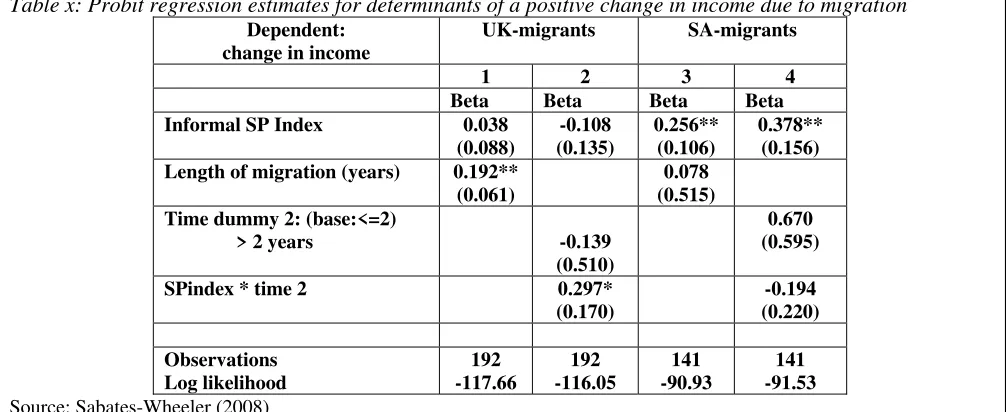
The table below provides the results of a probit regression estimation. The dependent variable takes the value of 1 for a positive change in income due to the migration experience, and 0 otherwise. This variable is not constructed from income, but from asking the respondent to evaluate their change in income due to the migration experience. We include a number of variables to measure these characteristics, such as age, education, prior income, prior occupation, however these are not presented here. Columns 1 and 3 show point estimates of a regression that includes an informal social protection index and length of stay as separate variables. As expected, we see that length of stay is crucially important for UK-migrants in achieving a positive change in income. For the average migrant, informal networks (SPIndex) are not significant. This result resonates with qualitative fieldwork carried out within the UK. Malawians within the UK are a very disparate group with thin associational life. The few interviews we were able to conduct indicated that UK Malawian migrants were highly suspicious of us and of each other. Even family members, who have overstayed, are unlikely to contact each other while in the UK. However for SA migrants, informal social protection turns out to be highly significant while length of stay is not significant.
[image:21.612.56.559.516.722.2]Columns 2 and 4 include an interaction term between time and informal social protection. The results for UK-migrants show that length of stay*SPindex is significant at the 10 per cent level. Length of stay as measured by ‘Time 2’ is no longer significant. This suggests that it is the interaction of time and informal social protection that allows migrants to achieve a positive result. In other words, long-stay migrants with relatively more networks achieve a better result than short-stay migrants with thin networks, controlling for time and social networks (if we specify the time dummy as one year or more then the result becomes significant at the 5 per cent level). We also ran a specification that included initial legal status as an independent variable. We found this variable to be insignificant in explaining increased income due to migration. The story is different for SA-migrants: the interaction term is not significant and the informal social protection index remains highly significant.
Table x: Probit regression estimates for determinants of a positive change in income due to migration
Dependent: change in income
UK-migrants SA-migrants
1 2 3 4
Beta Beta Beta Beta
Informal SP Index 0.038 (0.088) -0.108 (0.135) 0.256** (0.106) 0.378** (0.156) Length of migration (years) 0.192**
(0.061)
0.078 (0.515) Time dummy 2: (base:<=2)
> 2 years -0.139 (0.510)
0.670 (0.595)
SPindex * time 2 0.297* (0.170) -0.194 (0.220) Observations Log likelihood 192 -117.66 192 -116.05 141 -90.93 141 -91.53
Contracts and Employment-Related Social Protection
The research foregrounds the fact that international migrants often have a plethora of alternative
strategies to access international labour markets and to achieve positive outcomes from their
overseas migration. For example, many migrants without the right to work had secured formal
work contracts that were taxed (perhaps in the form of a hidden extortion). Similarly, ‘legal’
migrant workers took on jobs in the informal sector of host countries (see table 3 below). Table 3
below shows a substantial increase in formal legal contracts for migrants with the right to work
between first and last jobs (from 50 to 80 per cent). Interestingly, informal verbal contracts
decrease massively for undocumented migrants between first and last jobs, matched by a
substantial increase in formal legal contracts for undocumented migrants!! We also see that 66
per cent of migrants on entry visas but with work restrictions claim to have formal legal contracts
[image:22.612.69.508.361.516.2]in their last/current jobs!!
Table 3: Type of contract in first and last/current jobs in the UK by legal status
Non-compliant Semi-compliant Compliant
1st Last 1st Last 1st Last
Formal legal 23.8 41.2 40.2 66.4 50 80
Informal written 23.8 27.4 27.5 13.6 35 15
Informal verbal 52.4 19.6 27.9 15 12.5 0
Other 0 11.7 4.2 5 2.5 5
Total (no) 21 102 236 140 40 80 Source: Sabates-Wheeler 2008
the sample includes 157 Ghanaians who are currently, or returned from the UK and 201
Malawians returnees from the UK
Many legal migrants saw little point in contributing to formal social security benefits, and this
made working in the informal sector an attractive option for some migrants. Migrants’ access to
formal state services in their host countries varied.
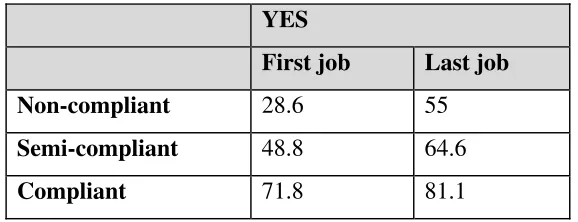
According to work status (defined by legal documents) only 12 per cent of migrants were
table below shows that from those 12 per cent only 71.8 per cent claimed to be entitled to
benefits in their first job. This increased to 81.1 per cent in last/current jobs. The majority of
other migrants are not entitled to benefits in their first jobs, however, in the ‘entry but illegal
worker’ category 48 per cent believe they are entitled to benefits in their first job. This rises to
64.6 per cent in last/current job. The increase in entitlement-belief is even more dramatic for the
undocumented category. Both of these latter categories are not entitled to any state-funded
benefits, therefore the conclusions that can be drawn here are that 1) migrants are ignorant of
their inability to access benefits, or/and 2) migrants are entitled to other employment related
[image:23.612.162.451.298.409.2]benefits that are not state-funded.
Table 4: Entitled to benefits in first and last/current jobs?
YES
First job Last job Non-compliant 28.6 55
Semi-compliant 48.8 64.6
Compliant 71.8 81.1 Source: Sabates-Wheeler 2008
Occupational mobility
Using data on Ghanaians and Malawians to the UK we find that migrants who were employed in
‘higher’ occupations prior to migration take a relatively bigger hit to occupational status on
arrival to the UK. Over 70 per cent of illegal and legal workers are downwardly mobile between
last job at origin and first job at destination. Looking at legal status at point of departure and
occupational mobility between first and last job, non-compliant and semi-compliant workers in
the UK are more likely to be downwardly mobile than those with the right to work (17 per cent
as opposed to 10 per cent for other groups) and those with the right to work are more likely than
other groups to be upwardly mobile (35 per cent and 27 per cent). However, across all groups
4. Relational and Distributional Disadvantage as a Result of Irregular Status
The above section outlines the limited (sometimes negative) impact that regular status has on
outcomes, specifically quantifiable economic outcomes such as income, occupational mobility,
and labour force engagement. That is, in regard to income and income improvement irregular
status does not appear to have significantly negative outcomes. In this section we look at other
aspects of human development, such as social welfare, security, dignity, associational
participation and inclusion, asking what are the impacts of irregular status on these outcomes?
Disadvantages or vulnerabilities specific to irregular status define and shape the parameters of
outcomes for migrants.6 Disadvantage can take three forms: individual, distributional, and relational. Individual forms of disadvantage may arise due to specific characteristics of the
individual, related to differences in innate ability, but also to some types of disability. We do not
deal with this type of disadvantage here. A relational form of disadvantage can be embedded in
socio-cultural relationships that reflect differences in the norms, values and customs which
constitute local constructions of ‘the migrant’, or other groups. These constructions are often
interwoven with culturally-held notions of legality, race or gender, which can constrain the
nature of a group’s participation in labour markets. That is, social constraints may militate
against their taking up of certain occupations. These socio-cultural constraints can lead
individuals and groups to be relatively excluded from access to public goods, such as health and
[image:24.612.72.512.549.689.2]education, and from civic engagement.
Table 5: Forms of Disadvantage and Structures of Opportunities for Irregular Migrants
STRUCTURES
OF
OPPORTUNITIES
FORMS OF DISADVANTAGE
Relational Distributional
Socio-cultural Socio-political Locational
6
Access and
distribution
Social exclusion
based on ethnicity
or irregular status;
isolation;
lack of access based
on discrimination;
exploitation;
unequal distribution
of resources;
lack of ‘legal’ status
leads to economic
exploitation
Eg. irregular
migrants in transit
are unable to access
services due to
‘remoteness’
Remote, rural
dwellers –lack
access to health and
education
Ghettoisation of different labour
groups and castes in
marginal places Representation marginalization; exclusion from participation in social life.
Exclusion of certain
groups more than
others (women, men; children, elderly); harassment. Lack of representation (irregular migrants); denied participation
in political life
Inability to access
institutions due to
high transactions costs Recognition cultural devaluation disadvantage; language and cultural barriers
lack of rights to
formal institutions
due to restrictive
legislation; more
prone to injustices;
discrimination and
disadvantage of
some groups to
education, social
services and
economic
opportunities
communities (eg,
urban informal
settlements).
A distributional form of disadvantage could be ‘locational’. For instance, a major factor causing
vulnerability for migrants is spatial dislocation associated with mobility. In transit, migrants
may be ‘remote’ in terms of geography and in terms of access to basic services such as health
and education. This is especially relevant for undocumented migrants as their status as it
precisely these migrants who will be travelling in clandestine form (often across inhospitable
terrain) which means they have no recourse to legal protection and health services. A large
number of irregular migrants are vulnerable to health problems because of inhospitable terrain on
transit and isolation. They are also vulnerable to exploitation and poverty due to their spatial
dis-location from economic and social opportunities. This latter point also holds for many migrants
at their destination, especially illegal migrants. Spatial dis-location and the remoteness of transit
migrations in particular, makes it very difficult for the government to provide formal social
protection schemes. It is more often the case that migrants use informal social protection
mechanisms to help manage risk during transit. Many migrants rely on informal social
protection mechanisms, such as migrant networks, to enable them to better manage the spatial
dislocation from source to destination. Spatial vulnerability also interacts with vulnerabilities
related to environmental hazards. For instance, the ghettoisation of migrants, particularly illegal
ones, who are typically located in marginal areas where distribution of all services is thin (think
of the migrant communities in the townships of Jo’Burg).
Socio-political constraints can constitute both relational and distributional forms of disadvantage.
They refer to the institutional constraints facing groups (such as children, migrants, women,
ethnic groups) and typically reflect the lack of political commitment from the destination
government/society to that group. This type of vulnerability is especially pronounced for illegal
migrants who by definition are excluded from participation in political life and from access to
this determinant of vulnerability often causes the illegal migrant to become further marginalized
over time, prone to exploitation and discrimination, leading to a spiral into poverty.
Table 5, above, illustrates how forms of disadvantage compromise structures of opportunities.
Access to various physical, financial, human, and political resources; representation in spaces
and places that enable people to improve their lives; and recognition – are vital to moving out of
dependency and marginalised lives.
The case of transit migrants with irregular status provides a useful way of concretising the
conceptual framework presented above. As described in the Box below, these migrants face the
full range of forms of disadvantage as well as restrictions on their opportunities. They have no
legal recognition, severely restricted access to provisions (nutritional and social), and no
opportunities to represent themselves due to a political strategy to keep them separate.
A category of irregular migrant (which often overlaps with transit migrants) that is extremely
vulnerable, is the ‘stranded migrant,’ R. Dowd (2008) provides a useful exploration into the
plight of these migrants: ‘migrants who leave their own country for reasons unrelated to refugee
status, but who become destitute and/or vulnerable to human rights abuses in the course of their
journey. With some possible exceptions, they are unable or unwilling to return to their country of
origin, are unable to regularize their status in the country where they are to be found, and do not
have access to legal migration opportunities that would enable them to move on to another state’
(pp. 2).
Migrants may become stranded due to lack of financial resources to move home; loss of theft of
documents; detention; and abandonment. These migrants are particularly vulnerable to human
rights violations and abuse. Amnesty International (2006) has commented that ‘[t]hose who lack
official status and the protection of the law are often denied the right to education, health and
housing services and are condemned to live and work in appalling and degrading conditions.’
Amnesty International states that when the ‘veil of invisibility’ that has kept stranded migrants
from the public eye is lifted, ‘we discover a group of particularly vulnerable migrants with a
between their country of origin and country of desired destination, and also in a protection gap
between the country in which they are situated, their country of origin and the international
protection regime’ (Dowd, 2008).
As argued above, on average poorer migrants are more likely to engage in irregular migration.
And irregular status implies much higher levels of vulnerability. Thus poverty and outcomes are
moderated by irregular status. Poorer migrants need to weigh up if increased income
compensates for a plethora of possible disadvantages such as: deskilling; extortion; exclusion;
insecurity; discrimination; lack of rights; lack of safety at work,etc. Below we draw on
qualitative interviews with Ghanaians and Malawians in the UK, Ghanaians returned from
Nigeria, and Malawians in South Africa, to highlight the forms of disadvantage that migrants
Transit migrants with irregular status
Since 2000 migration control in the Mediterranean has become a growing European priority, leading to groups of migrants becoming ‘stuck’ in countries bordering the EU due to its strong border controls. Collyer (2006) describes these groups as ‘small, highly vulnerable minorities’, whose situation is exacerbated where the countries in question (notably those bordering the EU, such as Morocco) have little experience of migration and few provisions to deal with those who become stuck within their borders. Collyer’s research identifies these migrants as undocumented, and the primary problems facing them as hunger, illness and racketeering from other migrants. Amongst those with injuries who sought healthcare from Medecins sans Frontieres (MSF 2005), 60% attributed their injuries to the Spanish or Moroccoan border guards. Transit migrants in Morocco were found to be mainly Congolese and Nigerians. Collyer’s study reports evidence that there are around 10,000 undocumented migrants in Morocco, and that the increased intensity of border controls has led to greater danger in being a transit migrant, and increased difficulty in surviving. The average length of stay of these migrants was found to be high, at 15.4 months.
A study of transit migrants in Libya (Hamood 2006) found that there were four distinct forms of ‘holding pattern’ for these groups: detention centres designed for short stay, those for long stay, open camp-villages which migrants could exit to work, and repatriation centres which
face along with the comprised opportunities open to them. Nonetheless, these people have
chosen to migrate despite the odds.
5. Impacts of Status Disadvantage on Human Development Outcomes
“Once you have a permit, you are free”.7
In section 3 above we reviewed the reasons why migrants may choose to become or remain
irregular. A number of advantages with regard to direct economic (income) benefits are
observed. However, the choice to remain irregular implies large opportunity costs in a range of
areas. Disadvantages associated with irregularity (as discussed in the conceptual section) impact
a whole range of human development outcomes. This section reviews a range of HD indictors
with respect to the impact from irregular status. We draw on a wide range of literature,
supplementing it with primary evidence from migrants themselves.
Income
Perhaps the primary way in which the problems of differences in legal status manifest
themselves is through the labour market and migrants’ economic opportunities. Workers’ rights
generally cannot be enforced for the undocumented, they cannot be accurately counted or
assessed, and are correspondingly more vulnerable to employer abuses that lead to reduced
earnings and ability to remit.
Many of these effects are likely to be indirect. Migrant workers who are brought by recruiters to
work in developed countries may be either legal or undocumented, but their rights are likely to
be constrained by a lack of networks and knowledge of the receiving country. This occurs
wherever recruited migrant labour exists in significant numbers. For the legal but bonded
migrant, dependence on a single employer/recruiter (which may be exacerbated for those present
on temporary worker visas which tie them to a single employer) leads to financial abuses such
as: fines for not fulfilling quotas; forced withdrawal of wages for payment of ‘debt’ for
equipment or travel; excessive interest repayment on debt; and non-payment or extremely low
payment of wages. Anderson and Rogaly (2005) term this ‘super-exploitation’. They note that
this problem is far worse for undocumented migrants since they are often smuggled and therefore
have to pay off fees when they work.
The right to change employers is important in mitigating wage disparities between legal and
undocumented workers. Even legal migrants in many countries do not have the right to change
jobs (Anderson et al. 2006). This type of restriction is generally focused on low-skilled workers,
as in Asia, where Taiwan, Thailand, Malaysia, Singapore, Japan and Korea have all passed laws
designed to restrict workers’ mobility and access to jobs. This leads to multiple inefficiencies:
workers cannot access jobs, are punished where they work without authorisation, and are
deported or imprisoned. Some states such as Malaysia allow freelance companies acting as
vigilantes to deport the undocumented (Xiang 2008), while others such as Korea impose fines on
apprehended irregular migrants before deporting them, and subsequently make them pay the
costs of deportation.
In these restrictive labour markets, there are also hidden penalties for remaining undocumented.
Domestic workers’ lack of legal status, for instance, gives their employers power to withhold
earnings and pay below minimum wage, and also means they cannot open a bank account to save
their money (Punpuing et al. 2005).
For those who do not overstay a visa or transfer from an authorised job to an unauthorised one,
becoming an undocumented migrant usually involves some form of smuggling. The cost of
unauthorised border-crossing often forms a heavy burden where the migrant would otherwise be
generating capital to benefit themselves or those left behind. There is an important difference
between the prepaid and postpaid smuggling fee in its impact on migrants and their households.
Van Liemt (2004) observes that ‘the probability of getting into debt to the trafficker is lower
Mexican Migration Project data (Massey 2005) records the price of being smuggled from
Mexico into the US as rising from $400 in 1993 to $1,200 by 1999, and today it is $3,000. In
2003 an illegal crossing by boat from Morocco to Spain cost approximately US$200 for minors,
US$500 to US$800 for Moroccans, and between US$800 and US$1,200 for sub-Saharan
Africans (Lahlou 2003). The SIMI survey respondents, from a mixture of North African and
Middle Eastern countries reported that, on average, migration cost their families 2 years of
earnings. In the US, irregular workers can recoup their smuggling costs relatively fast. Hanson
(2006) estimates that in 2000, a 23-27 year-old recent Mexican migrant with 5 to 8 years of
Bribery and Extortion
Irregular migrants, especially South-South migrants, are frequently required to pay substantial bribes to officials to allow them to remain in the destination. The story recounted by Frans, a Malawian irregular migrant in Jo’Burg, illustrates the institutionalised nature of this type of exploitation of migrants:
“I used the bus to travel to South Africa from Malawi. I did have a passport and a visitor’s visa for one month. I knew I would never get legal permission to work here. Like everybody else, I simply stayed on after my visa expired. I was arrested 3 times – the first time was in 1993 – for having an expired visa and no work permit. They sent me to Morningside Jail where I remained for 5 days. My brother-in-law bribed one of the guards with R700.00 to let me go. The other two times I was arrested, my brother-in-law did the same thing, although the price went up each time: the last time was in 1994 when he had to pay R850.00 to get me released.
It is common for Malawians (and all other foreigners in South Africa) to bribe officials for various things – it all depends on how much money you have. If, like me, you are not rich, you’ll only afford to pay small money to be released if you are caught. If you have enough money, you can pay an official to get you a South African ID (identity) book.
I used to visit Malawi during those years using my passport and expired visa. I simply paid the border official R50.00 to allow me to cross. I did that each time I travelled to Malawi. Many others were doing the same thing. Although R50.00 isn’t a lot, when you add all the fifties from all the people crossing with expired documents, those guards made a lot of money each day. We are not happy bribing officials, but if it is the only way of staying on and working, then we will have to do it. We all have to support our families, so we are prepared to do anything to remain here.”
schooling would make back his smuggling costs of $2,000 in 313 hours, or 7.8 weeks based on a
40-hour working week.
Meanwhile, Koser’s study of 50 labour migrants smuggled from Pakistan and Afghanistan to the
UK (2008) looks at comparative prices for being smuggled from the two countries, and their
effects on migrants’ level of debt and propensity to remit. The group was composed of mainly
male migrants travelling without families, half of them university educated. Fees ranged from
$20,000 (to the US and Canada) to $3,000 (overland to the EU). On average, it took these
migrants two years to pay off the smuggling fees with their remittances. However, after that,
remittances more than doubled their households’ income, leading to the conclusion that even
undocumented migrants who pay high fees to be smuggled still contribute to reducing poverty at
home.
Migrants also suffer economically from a lack of rights to financial services, since they cannot
start bank accounts without documentation about their legal status. Amuedo-Dorantes and
Bansak (2006), using data from the Mexican Migration Project, found that legal status was
related to whether or not Mexican migrants in the US were banked, and that in turn their access
to banks was related to the amount of capital they brought home with them upon return. Being
unbanked due to undocumented status has also been shown to hinder Burmese migrants in
Thailand from remitting (Koetsawang 2001).
Labour subcontracting is an important factor driving workers’ lack of rights with respect to
migration, whether documented or undocumented. It distorts the way that legal migrants enter
the labour market (concentrating them into specific jobs where abuses develop due to a lack of
enforcement); it leads to specific abuses such as low pay, substandard accommodation and
working conditions, and a dissociation by the overall employer with workers’ wellbeing. As the
research of Evans et al. (2005) shows, this problem is so great among legal workers that it
indicates an even greater problem for those without the basic protection of legal presence in the
country. Equally, these abuses can lead legal subcontracted workers to overstay, change
employers, or otherwise move out of their original position in the labour market into even more
As opposed to subcontracted authorised migrants, who will be in sectors such as
mining/agriculture/services, but are at least visible because they are on official visa programs,
the unauthorised will be recruited for the most extreme/least formal 3D jobs such as informal
construction and mining, prostitution, kitchen and marginal agricultural work. These latter
occupations are the hardest to make an impact on in terms of decent conditions in the first place.
It is thus, easier to exploit workers because they are less visible. Conditions of bonded labour are
most likely to go unremarked in these occupations as people pay off recruiters' fees.
Education
Inadequate access to education particularly impacts undocumented migrants, but can be an issue
for legal migrants as well. One fundamental issue for most migrants is learning the language of
their receiving country, but this is seldom funded adequately or realistically by governments
(MPI 2007). Moreover, new arrivals are often ghettoised, or at least segregated, in ways that
reduce their access to education.
The FIDH (2008) studied the conditions of documented and undocumented migrants in South
Africa during 2007. It concluded that both groups faced serious problems in accessing education
for their children. In the case of documented migrants this was because the authorities tended to
claim that they had insufficient documentation to enrol their children. The report found that
although this group should have had recourse to legal means of enforcing their right to an
education for their children, they were not aware or able to access the information or the help of
the relevant authorities. Both problems were even worse for the undocumented, who had no
proof of residency at all and therefore could not access education for their families, nor did they
have the right to appeal.
Rossi (2008) found that children migrating with their parents to richer countries within the
developing world were likely to have better access to education. However, these may not do well
in comparison with their native counterparts: evidence from industrialised receiving countries
shows that migrant children are among the lowest-scoring in their age groups on standardised
tests. Statistics are not yet collected for non-OECD countries, however. According to the same
with parents who are on temporary worker visas, i.e. those whose only legal status is by
association and in any case is tenuous; and by those who migrate alone (and therefore
undocumented). These children were unlikely to be able to access education at all, due to ‘social
and cultural isolation, strenuous and hazardous work, extreme poverty, poor health conditions
and language barriers’ (ibid.)
Legal migrants (who are not refugees) in the primary migrant-receiving states of the USA do not
benefit from any targeted funding to help them learn English, and legally resident migrant
children often receive substandard education because of ethnic segregation that groups together
newcomers in schools that receive no extra funding for their language-learning (MPI 2007). In
the UK, there is some evidence that those who migrate for education may be exploited by
receiving-country colleges, which are able to charge higher fees for foreign students. These
institutions often recruit intensively without providing adequate information for foreign students,
putting them in a situation where they are responsible for their own compliance with the rules but
lack the information to preserve their status (Taylor 2009).
The undocumented are highly impacted by inadequate or discriminatory educational provision
because they are predominantly young. For example, the undocumented population
(predominantly low-income Latinos) in the US historically has an extremely low school
completion rate: according to the 2000 Census, only 40 per cent of undocumented Latino males
between 18 and 24 who arrived in the United States before the age of 16 had completed high
school or obtained a GED (an equivalent qualification).
The World Development Report (World Bank 2007) shows that 50-90 per cent of youth report
that they would like to migrate, mainly temporarily. A third of the migrant flow from developing
countries are aged 12 to 24. Young undocumented migrants suffer problems when they reach the
end of the period in which schooling is legally mandated and therefore free. For example, in the
US in 2006 there were an estimated 1,075,000 unauthorised youth aged between 5 and 24
(Batalova and Fix 2006) for whom legal status presented a serious challenge to their ability to
access education. Although federal law mandates that these migrants receive free schooling up to