Munich Personal RePEc Archive
An Analysis on Technical Efficiency in
Post-reform China
Zhou, Xianbo and Li, Kui-Wai and Li, Qin
2010
Online at
https://mpra.ub.uni-muenchen.de/41034/
China Economic Review
, 22 (3) September, 2011: 357-372
An Analysis on Technical Efficiency in Post-reform China
Xianbo Zhoua,Kui-Wai Lib†and Qin Lia
a
Lingnan College, Sun Yat-Sen University, China
b
Department of Economics and Finance, City University of Hong Kong
Abstract:
This paper employs a fully nonparametric stochastic frontier model with time and
individual effects to study technical efficiency in China’s post-reform economy. The
panel data cover China’s thirty provinces for the period of 1985-2008. The empirical
results show that the average output elasticity of labor is larger than the other two inputs of capital and human capital. Based on the specified inefficiency Tobit model, the factor analysis on technical efficiency shows that the time effects of technical efficiency in
China’s post-reform economy are significantly contingent on the factors. There exists
significant regional differences in technical efficiency in China’s economic development,
and a number of policy implications can be drawn.
Key words: Fully nonparametric stochastic frontier; time effects and individual effects; time variant; technical efficiency; Tobit model.
JEL Classifications: C52, D24, O47 _____
† Corresponding author: Kui-Wai Li, City University of Hong Kong, Tel.: 852 34428805;
Fax.: 852 34420195; E-mail: [email protected].
Acknowledgement: The authors are indebted to the invaluable comments from the referees and would like to express their gratitude for the various research funding
supports. Zhou’s research was supported by the National Natural Science Foundation of
China (Grant 70971143), and Li’s research funding was supported by the City
University of Hong Kong under two Strategic Research Grants (Numbers 7001907 and
7002175).Research assistance from Liang Wang, Helen H. K. Lam, Pang Yu and Lan
1. Introduction
The discussion on the sustainability of economic growth in China’s post-reform
economy has led to studies on China’s productivity, using either growth accounting or
stochastic frontier analysis (SFA) (Chen et al., 2009; Chen et al., 2008; Wu, 2000, 2003,
2004; Hu and Khan, 1997; Woo, 1998; Mao and Koo, 1997; Borenstein and Ostry, 1996;
Yang and Lahr, 2010). For example, the studies by Chow and Li (2002) and Li (2003)
used investment figures to construct capital stock to estimate China’s national total
factor productivity (TFP) growth rates have been extended by Liu and Li (2006) and Li
(2009) who incorporated the human capital variable and alternative investment data to
examine both national and provincial TFP growth rates. Similar studies by Wang and
Yao (2003) have examined the sources of China’s economic growth, while Swamy
(2003), Motohashi (2007) and Bosworth and Collins (2008) have compared China’s
TFP with other world economies.
In studying the technical change in the United States, Solow (1957) differentiated
the movement along the production function caused by input growth from shift in the
production function caused by technical progress. Both Bauer (1990) and Kumbhakar
and Lovell (2000) have shown that TFP growth composes of technical progress,
technical efficiency change and a scale economies effect. In theory, technical progress is
an outward shift of the production frontier and technical efficiency change shows the
movement from a position within towards a position on the production frontier, while
the scale economies effect reflects an increase in return to scale.
Other studies have elaborated and extended China’s post-reform economic
productivity to efficiency analysis by using the Malmquist productivity index (MPI) and
data envelop analysis (DEA) (Wu, 1995, 2008). The MPI that decomposes productivity
into efficiency and technological change has also been applied in Ma et al. (2002) and
Movshuk (2004). Studies on the productivity and efficiency performance of individual
industries in China have been conducted by Jefferson (1990) and Mu and Lee (2005),
while Yao et al. (2007) and Sun et al. (1999) agreed that SFA and DEA are the more
effective approach to measure the technical efficiency of industries. The SFA used in
function and technical efficiency performance (Huang and Kalirajan, 1998; Kalirajan et
al., 1996; Brummer et al., 2006; Hu and McAleer, 2005; Tong, 1999; Wu 2000, 2003;
Fu, 2005).
Nonetheless, studies on China’s post-reform economy have provided a continued
debate on whether technical progress or technical efficiency is the more important
contributing factor to China’s TFP growth (Wu, 2000; Li and Liu, 2011). After more
than three decades of economic reform since 1978, it would be useful to examine if
technical efficiency has become an important factor in China’s growth. In addition, an
objective measure on the technical efficiency among China’s provinces is crucial. Given
the extraordinary nature, the heterogeneity of development in various regions and
different time periods, a flexible stochastic frontier model can be used to study technical
efficiency in the post-reform China’s economy.
Empirical studies using the conventional stochastic frontier analysis on panel data
models often implicitly impose a restriction that information differences have no effect
on the way risk-neutral decision makers utilize the same input bundle (Christopher et al.,
2010). The result is that informational differences are mistaken for differences in
technical efficiency. The two specific effects that reflect information differences are the
individual effects and the time effects. They are usually specified in stochastic frontier
models in the manner that individual effects are time-invariant and do not interact with
time effects, often in linearity or in parametric forms. However, when the individuals in
the sample differ in technology and efficiency with differenced information, especially
when such heterogeneity changes with time, the linear or parametric specification
cannot fully describe the heterogeneity in the production function and may induce a bias
in the measurement of technical efficiency. Conventional methods (either DEA or SFA)
attribute the model misspecification errors to inefficiency (Fu, 2005; Balaguer-Coll et
al., 2007; Grösche, 2009; Joseph et al., 2010; Battese and Coelli, 1992, 1995;
Kumbhakar and Lovell, 2000; Wu 2003). Researchers have relaxed distributional
assumptions in the error component and parametric assumptions in SFA to achieve a
more reliable measurement of technical efficiency (Greene, 2005; Kneip and Simar,
The data set used in this study contains the thirty provinces in China for the period
from 1985 to 2008. One can note that China during the sample period has experienced a
systemic transition with heterogeneity of provinces and development periods. The
regional effects and time effects should be given sufficient attention in measuring the
technical efficiency of the economy. This paper provides a time-variant estimation of
technical efficiency in China’s post-reform economy by specifying and estimating a
fully nonparametric stochastic frontier model with nonparametric individual and time
effects (Henderson and Simar, 2005). A factor analysis on technical efficiency by using
the Tobit regression will also be conducted.
Section 2 specifies the nonparametric model and presents the estimation method.
Data and variables specification are illustrated in Section 3. Section 4 presents the
empirical results of the frontier model and the measurement of the technical efficiency.
Section 5 provides the specification test to show the suitability of the nonparametric
model. Section 6 provides a factor analysis on the technical efficiency based on the
Tobit estimation. Section 7 concludes the paper.
2.Fully Nonparametric Model Specification
The studies in Gong and Sickles (1992) and Christopher et al. (2010) show that the
estimates of technical efficiency for the parametric panel data frontier model can be
improved when the production function model is closer to the true underlying
technology. In practice, the data generating process is unknown and so are the stochastic
factors in the economic data. Hence a flexible model specification will give a more
reliable result on frontier and efficiency estimates. In our sample period, production
technology and efficiency in China has experienced uneven development among
different provinces. A fully nonparametric stochastic model can thus give reliable
technical efficiency estimates. We specify the nonparametric stochastic frontier model
as follows:
( , , ) , 1, 2, , ; 1, 2, ,
it it it
where yit is the logarithm of real gross regional product (RGRP) for province i in
year t; xit is the vector of the logarithm of the three inputs: capital (K), labor (L) and
human capital (HC); f x i t( , , ) is the production function which is allowed to vary over
each province and time period, and is nonparametric with input variables x, individual
effects and time effects; uit is the error term independent of xit. As we know, human
capital may have an impact on production through both direct and indirect channels
(Barro and Sala-i-Martin, 1999; Benhabib and Spiegel, 2005; Vandenbussche et al.,
2006). Equally, the human capital embodied in the labor force can exert a direct and an
indirect influence on aggregate production through technological innovation, imitation
and adoption. Given that the impact channels are uncertain, it would be appropriate to
allow human capital to enter the production function and interact with capital and labor
inputs, individual and time effects in a nonparametric manner.
Model (1) can be estimated using the approach in Henderson and Simar (2005).
Denote ( , , )x i t as the first derivative of f x i t( , , ) with respect to x. By the Taylor
expansion,
( , , ) ( ) ( , , ) (| |)
it it it it
y f x i t x x x i t o x x u , (2)
where o x(| itx|) is the higher-order term of |xitx|. Since we apply the local linear
estimation, and the higher-order term is o h(| c|) as the bandwidth hc of the
continuous variable tends to zero, and hence the higher-order term can be merged into
the error term and does not affect the consistency of the nonparametric function. Note
that the frontier function includes unordered categorical variable i and ordered
categorical variable t. To smooth them, the following kernel function is applied:
( , , )
ijts c u o
K h h h
,
, , 1 ( ) /q
r js r cr u ij o ts r k x x h l l
where ( )k is the kernel for continuous input variables; lu ij, and lo ts, are the kernels
, 1, , , u ij u j i l
h j i
and ,
| |1, , , . s t o ts o s t l
h s t
.
As hu 0, lu ij, 1{ji} is the indictor function of province i, implying that only the
data of province i are used in the estimation; as hu 1, lu ij, 1, the product kernel is
unrelated to province i, implying that individual effects have been smoothed out. Now
u
h is allowed to change continuously, and is combined with the above two special
cases and plays a role in the smoothness of individual effects. In the similar way, ho
plays a role in the smoothness of time effects. We call hc (hc1, ,hcq), ,h hu o the
smoothers or bandwidths for continuous variables, individual variable, and time
variable, respectively. LetXjs (1,xjsx). From (2),
' '
( , , )x i t ( ( , , ), ( , , ) )f x i t x i t
can be estimated by
1
' '
1 1 1 1
ˆ( , , ) n T ijts( , , )c u o js js n T ijts( , , )c u o js js
j s j s
x i t K h h h X X K h h h X y
. (3)The optimal bandwidth ( , , )h h hc u o can be determined by the least squares cross
validation (LSCV) approach:
0
(hc, , )h hu o =
2
0 1 1 ˆ
arg minCV b( c, , )b bu o
tT in (yit fi( , , ))x i tit . (4)Here fˆi( , , )x i tit is the leave-one-out estimator of f x i t( , , )it with bandwidths hc,bu
and bo, where b0c,h hu, o are positive constants,
1/(4 ) 0 ( )( )
q c c
h b std x nT , and std x( )
denotes the sample standard deviation vector.
Following Henderson and Simar (2005), the estimate of technical efficiency for
province i in time period t is defined as
ˆ
exp ( , , )
it it
TE f x i t
1, ,
ˆ
max ( , , )it
j nf x j t . (5)
Essentially the measure of technical efficiency compares the difference between the
actual (estimated) outputs of province i and the maximum potential output produced by
any other province in the sample for the same time period.
specifications of semiparametric and parametric models for comparison. The purpose is
to know what will happen to the estimates when restrictive specifications on the
technology are estimated. The two special cases are restricted forms of Model (1) with
time-invariant production functions instead of time-variant ones. In the semiparametric
case, the specification is
( ) , 1, 2, , ; 1, 2, ,
it it i it
y f x u i n t T (6)
where f( ) is a nonparametric function of the inputs to be estimated, which is an
averaged and time-invariant production function, and the fixed effects i ui enter
the model in a linear and additive form which is also time-invariant. The function f( )
can be estimated, denoted as fˆ( ) , by the locally linear nonparametric kernel methods
(Li and Racine, 2007). The parametric case is a particular case of the semiparametric
form with '
( )it it
f x x :
'
, 1 , 2 , , ; 1 , 2
i t i t i i t
y x u i n t (7)
The parameter, denoted asˆ, can be estimated by the conventional within-estimator
for panel data models with fixed effects. The technical efficiency for province i is
defined as (Kneip and Simar, 1996)
ˆ
exp )
i i
TE u , (8)
where in a normalization form uˆi
i ˆ
maxi ˆi, ˆi 1( ˆ( )) / T
it it t y f x T
in thesemiparametric case, and ˆi
' 1( ˆ) /
T
it it t y x T
in the parametric case. We willapply specification tests only to the most suitable model in our empirical study.
3. Data and Variables
Despite the debate on the accuracy of macroeconomic data and the lack of a
reliable alternative set of economic data in post-reform China, empirical studies have
Holz, 2006; Chow 2006).1
Other than accuracy, critics have noted a number of
problems in China’s macroeconomic data. One concern is the transformation from the
Soviet material product system (MPS) to the system of national accounts (SNA) as the
former does not value “non-market” and “non-materials” output and services and
another concern is the deficiency in China’s national account and statistical practice
(Maddison and Wu, 2008; Wu, 2000, 2003).2 Others have concentrated on the
estimation of the capital stock series, and that such detailed measures as the scrap rate
and depreciation rate of the same capital equipment at different years are absent (Wu,
2007; Holz, 2006). A number of empirical studies agree that problems in the time series
data may cancel out each other and that China’s statistical reporting system and data
reliability have improved over the years (Chow and Li, 2002; Li, 2003, 2009; Szirmai et
al., 2005).
The data for China’s thirty provinces and the construction of key variables used in
this paper are elaborated in the Appendix. The thirty provinces that include the four
autonomy areas and three municipalities under direct central administration are
geographically divided into four regions. The Southern region composes of nine
southern provinces, commonly known as the Pearl River Delta provinces of Fujian,
Guangdong, Guangxi, Hainan, Jiangxi, Hunan, Sichuan (including Chongqing since
1997), Guizhou and Yunnan. The Eastern region consists of twelve provinces, including
mainly provinces in the Yellow River and Yangtze River Delta regions of Beijing,
Tianjin, Hebei, Shanghai, Jiangsu, Zhejiang, Shandong, Anhui, Henan, Hubei, Shanxi
and Gansu. The Western region refers to the remote provinces of Inner Mongolia, Tibet,
Shaanxi, Qinghai, Ningxia, and Xinjiang. The remaining three provinces in
Northeastern region are Jilin, Heilongjiang and Liaoning, which consist of the
traditional state-owned heavy industries. These four sub-regions in China are chosen in
our study to reflect the geographical strength and economic growth concentration.
China’s national and regional output figures can be obtained, respectively, from the
1 China’s GDP has been revised upwards by US$300 billion in December 2005.
South China Morning Post, December 13 and 21, 2005, and January 13, 2006.
2 For example, China’s National Bureau of Statistics (NBS) reported in December 2004 that by incorporating
Statistical Yearbook of China and the various provincial statistical yearbooks. Scholars
have used national income and sector output to construct China’s physical capital stock
(Jefferson et al., 1996; Wu, 1995, 2008). One reliable method shown in Chow and Li
(2002) and Li (2003) is Chow’s (1993) estimation of China’s 1952 physical capital
stock. Based on the “accumulation” figures available up to 1978 in the official statistics
and the additional comparable net investment and provincial depreciation figures since
1978, the construction of China’s national and provincial physical capital stock series
have been extended to 1998. While Li (2009) has repeated the construction exercise and
extended the data to 2006, the analysis in this paper adopts the same steps and extends
China’s provincial physical capital stock to 2008. The data of the labor inputs are the
total employed persons (in ten thousand persons) obtained from the Statistical Yearbook
of China.
Human capital has been considered as an endogenous growth variable (Romer,
1990; Tamura, 2002, 2006; Turner et al., 2008). Similarly, there have been alternative
methods in constructing human capital (Gemmell, 1996; Zhang et al., 2005; Chi, 2008).
The inventory approach used in Wang and Yao (2003) measures China’s human capital
stock per capita in average years of schoolingfor the period 1984-2000. In Liu and Li
(2006) and Li et al. (2009), the years of schooling are divided into six levels (primary
education, junior secondary, senior secondary, vocational secondary, specialized
secondary and higher education). The inventory-based construction of the human capital
stock has been adjusted by inter-provincial migration and mortality rates from the
estimated census data. Since 2004, the six levels of schooling have been reclassified
into four levels of primary education, junior middle education (including regular junior
middle and vocational junior middle education), senior middle education (including
regular senior middle, vocational middle and specialized secondary), and higher
education. Following Li (2009, Appendix), standard assumptions on the transition
between different classifications are used so that national and regional human capital
stocks per capita adjusted by employment figures can be updated to 2008 (see
Appendix). Li et al. (2009, Table 3) reports that the estimation on China’s human capital
study has shown that China’s human capital is lower than that of other Asian economies.
In order to eliminate the size effect of the provinces that may affect the measure of
technical efficiency, we include in the denominator of each province’s real gross
regional product (RGRP), physical capital stock and labor inputs the province’s total
population. Kneip and Simar (1996) and Henderson and Simar (2005) have also made
such an adjustment in their frontier models to measure technical efficiency. Table 1
provides the simple statistics for the data of the four variables. The coefficients of
variation in the last column of Table 1 show that RGRP and physical capital stock have
[image:11.595.85.512.329.415.2]much larger degrees of variation than the other two variables in our sample.
Table 1 Summary Statistics of the Data (30 provinces: 1985-2008)
average min max stdev coefficient of variation
RGRP/Population 2581.71 326.26 26576.64 2936.55 114%
Capital/ Population 9219.06 848.10 86385.38 11103.96 120%
Labor/ Population 0.51 0.36 0.82 0.07 15%
Human Capital 5.45 0.74 10.88 1.90 35%
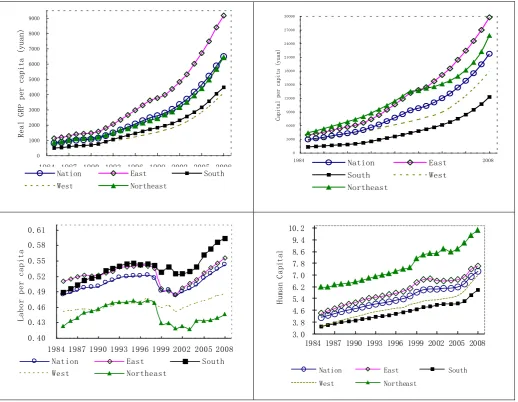
Figure 1 reports the dynamic average performances of the four variables. One
general observation is that these variables show obvious time trends in the sample
period, especially since the late 1990s. The labor per capita variable has shown a clear
structural break. The Eastern region has the highest average RGRP per capita. The
Northeastern region has a similar level of RGRP per capita to the national average,
whereas the Western and Southern regions have a lower level than the national average.
Although the Northeastern region has the highest level of physical capital and human
capital per capita, it has the lowest labor per capita. The differences in RGDP, level of
physical capital stock and human capital per capita across provinces and regions show
clearly that there are great variations in the development paths among the provinces in
China’s post-reform economy. The statistical evidences shown in Table 1 and Figure 1
hint that a flexible time-variant stochastic econometric model with individual effects
and time effects may be required in order to estimate a reliable measure of technical
0 1000 2000 3000 4000 5000 6000 7000 8000 9000
1984 1987 1990 1993 1996 1999 2002 2005 2008
Real GRP per capita (yuan)
Nation East South
West Northeast 0 3000 6000 9000 12000 15000 18000 21000 24000 27000 30000
1984 1987 1990 1993 1996 1999 2002 2005 2008
Capital per capita (yuan)
Nation East South West Northeast 0.40 0.43 0.46 0.49 0.52 0.55 0.58 0.61
1984 1987 1990 1993 1996 1999 2002 2005 2008
Labor per capita
Nation East South
West Northeast 3.0 3.8 4.6 5.4 6.2 7.0 7.8 8.6 9.4 10.2
1984 1987 1990 1993 1996 1999 2002 2005 2008
H u m a n C a p i t a l
[image:12.595.41.560.93.495.2]Nation East South West Northeast
Figure 1 Dynamics of China’s Average Real GDP or GRP per capita (1985-2008)
4. Estimation Results
In order to provide a comparison with the estimation of the nonparametric
specification indicated in Model (1), we also specify two other restricted versions with
time-invariant specification, namely, the semiparametric Model (6) and the parametric
Model (7). All the variables are expressed in logarithms. The variables are adjusted for
the time trend effect in the two restricted models, but not in the nonparametric Model (1)
because the time effect has already been picked up by the categorical variable. This
time-effect adjustment for dependent and independent variables in the time-invariant
technical efficiency for the two restricted versions is calculated from Model (8).
In the nonparametric estimation of Model (1) and Model (6), we select the
fourth-order Gaussian kernel function
2
2
( ) 1.5 0.5 exp / 2 / 2
k u u u to
alleviate the curse of dimensionality since the dimension of the input variables is three.
By using the least squares cross validation (LSCV) approach shown in (4), the optimal
bandwidths of the three continuous input variables are 0.492, 0.072 and 0.217, and the
optimal bandwidths of categorical variable i and ordered categorical variable t are
0.153 and 1.035, respectively, for the estimation of Model (1).3 The LSCV optimal
bandwidths of the three continuous input variables for the local linear nonparametric
estimation of the semiparametric Model (6) are 0.051, 0.046 and 0.041.4
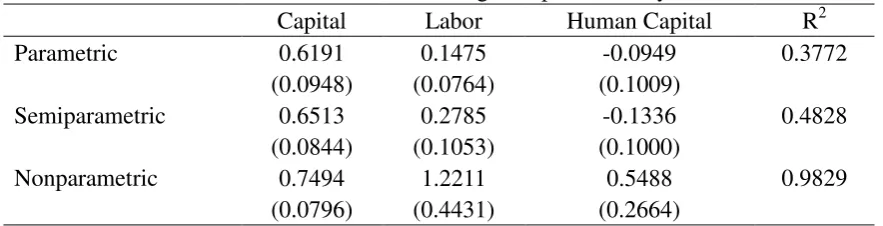
We use R2, the squared correlation coefficient between the dependent variable and
the fitted value, to measure the goodness-of-fit for the estimated model. The R2 values
for the estimation of the three models are shown in the last column of Table 2, and the
values given by parametric and semiparametric models are 0.38 and 0.48, respectively.
[image:13.595.78.520.467.580.2]The nonparametric estimation gives a large goodness-of-fit measure with R2 = 0.98.5
Table 2 Estimation of Average Output Elasticity
Capital Labor Human Capital R2
Parametric 0.6191 0.1475 -0.0949 0.3772
(0.0948) (0.0764) (0.1009)
Semiparametric 0.6513 0.2785 -0.1336 0.4828
(0.0844) (0.1053) (0.1000)
Nonparametric 0.7494 1.2211 0.5488 0.9829
(0.0796) (0.4431) (0.2664)
Note: The values in parenthesis are the bootstrapped standard errors of the estimates. The replications are 400.
3 In order to examine the effect of the kernel selection on the estimation results, we also apply the second-order and
the sixth-order Gaussian kernel for the nonparametric estimation. It is found that the results are quite similar. Hence we only report the results from the fourth-order Gaussian kernel.
4 The optimal bandwidths chosen in the nonparametric estimation of the semiparametric model (6) are much smaller
than those in the nonparametric estimation of the nonparametric model (1). This is due to the fact that the variables have been adjusted for the time effect in the semiparametric model (6) but not in the nonparametric model (1). However, the categorical variable t in nonparametric model (1) picks up the time effect with an optimal bandwidth of 1.035.
5 Note that the R2 from the nonparametric estimation is not suitably compared with the R2sfrom the parametric and
Table 2 shows the sample average of the output elasticity estimates of the three
inputs in the three specification models and their corresponding bootstrapped standard
errors. In the parametric and semiparametric models, the coefficient estimates of capital
and labor are positive and significant, while the coefficient estimates of human capital,
though insignificant, are negative and unexpected. However, the elasticity estimates of
the three inputs in the nonparametric model are positive and significant, which can
provide expected and meaningful economic explanation. When compared to other
studies, for example, by Young (2003) and Li (2009) who do not estimate the output
elasticity of inputs by using per capita output and inputs, our finding shown in Table 2 is
that the output elasticity of labor, instead of the elasticity of capital, is the largest of the
three inputs.
Table 3 presents the estimates of the yearly average technical efficiency of the 30
provinces. The average time-invariant technical efficiency results are calculated
according to the parametric Model (7) and semiparametric Model (6) using formula (8),
while the average time-variant technical efficiency results are calculated according to
the nonparametric Model (1) using formula (5).
Table 3 shows a large discrepancy in the ranking of provinces between the
semiparametric and parametric models for a majority of provinces. Only the three
provinces of Beijing, Heilongjiang and Jiangxi are ranked in almost the same order
between the two estimates. Such a result, along with the weak goodness of fit and the
meaningless and insignificant coefficient estimates of human capital, suggests that the
time-invariant assumption shown by the linear parametric and semiparametric models
may be incorrect. The less restrictive nonparametric time-variant model can correctly be
used to calculate the time-variant technical efficiency. Indeed, many of the rankings in
the nonparametric model differ significantly from those in the parametric and
semiparametric models.
Province Parametric Semiparametric Nonparametric DEA
TE rank TE rank TE rank TE rank
Beijing 0.2309 29 0.9901 28 0.7988 27 0.6941 17
Tianjin 0.2840 27 0.9905 24 0.8924 21 0.8474 8
Heibei 0.7621 8 0.9980 3 0.9794 9 0.9252 5
Shanxi 0.6185 16 0.9903 25 0.8478 25 0.6018 24
Inner Mongolia 0.6267 13 0.9923 17 0.9504 15 0.7031 16
Liaoning 0.2576 28 0.9922 18 0.6885 30 0.6123 23
Jilin 0.6204 15 0.9864 30 0.9153 19 0.7496 15
Heilongjiang 0.6294 12 0.9930 12 1.0000 1 0.8059 11
Shanghai 0.1839 30 0.9931 11 0.9575 14 1.0000 1
Jiangsu 0.4151 25 0.9917 19 0.9598 13 1.0000 2
Zhejiang 0.4270 24 0.9952 6 0.9954 6 0.8626 7
Anhui 0.7821 5 0.9934 9 0.9924 8 0.7610 14
Fujian 0.6014 17 1.0000 1 1.0000 2 0.8423 9
Jiangxi 0.7683 7 0.9935 7 0.9682 11 0.7624 13
Shandong 0.5856 18 0.9934 10 0.9324 16 0.8685 6
Henan 0.7571 9 0.9915 20 0.8625 24 0.6927 19
Hubei 0.6775 11 0.9929 14 0.9997 3 0.8095 10
Hunan 0.8760 3 0.9902 27 0.9945 7 0.7865 12
Guangdong 0.5441 22 0.9955 5 0.9784 10 0.9967 3
Guangxi 1.0000 1 0.9929 15 0.9032 20 0.6935 18
Hainan 0.5446 20 0.9957 4 0.8680 23 0.6185 22
Sichuan 0.7820 6 0.9912 22 0.9976 4 0.9911 4
Guizhou 0.9786 2 0.9890 29 0.9154 18 0.5914 25
Yunnan 0.8543 4 0.9924 16 0.9671 12 0.6653 20
Tibet 0.3752 26 0.9999 2 0.9967 5 0.3878 30
Shaanxi 0.6227 14 0.9915 21 0.8404 26 0.5638 27
Gansu 0.6838 10 0.9903 26 0.9310 17 0.6497 21
Qinghai 0.5445 21 0.9912 23 0.7565 28 0.4713 28
Ningxia 0.4996 23 0.9930 13 0.7558 29 0.4506 29
Xinjiang 0.5496 19 0.9935 8 0.8740 22 0.5793 26
The nonparametric time-variant model estimation provides more information on the
provinces and time dependent structure of the efficiencies. Appendix Table A1 reports
the yearly technical efficiency scores of all provinces based on the nonparametric Model
(1) and the formula (5). The scores show that the two provinces of Heilongjiang and
Fujian are technically efficient in all years during the sample period. A total of thirteen
provinces (Beijing, Shanxi, Liaoning, Jilin, Henan, Guangxi, Hainan, Guizhou, Shaanxi,
Gansu, Qinghai, Ningxia, and Xinjiang) are not technically efficient in any year; the
ranked 27th in technical efficiency and is less efficient than many other provinces.
It can be calculated from Appendix Table A1 that 29.7 percent of observations (720
observations from 30 provinces in 24 sample years) have attained technical efficiency.
The coefficient of variation for technical efficiency estimates is 10.6 percent, which
shows that the difference of technical efficiency among the provinces should not be
ignored. Such a finding is not available from the time-invariant parametric or
semiparametric models.
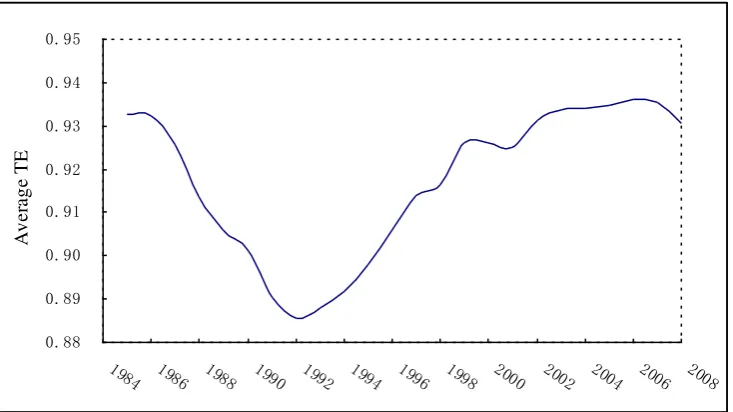
Figure 2 presents the dynamics of the average technical efficiency for the 30
provinces in the sample period. Economic liberalization in the early years of economic
reform and openness has probably led to the initial increase in technical efficiency. The
initial increase in technical efficiency, however, was not sustainable. The technical
efficiency declined rapidly to the lowest level in 1992 before it bounced back and
reached new peaks in 1998 and 2006.
0.88 0.89 0.90 0.91 0.92 0.93 0.94 0.95
1984 1986 1988 1990 1992 1994 1996 1998 2000 2002 2004 2006 2008
A
v
er
ag
e
[image:16.595.116.483.404.610.2]TE
Figure 2 The Dynamics of Technical Efficiency
Figure 3 shows the regional variation in the dynamics of average technical
efficiency. At the national level, and despite the marginal decline between 1985 and
1992, the overall trend has been a gradual increase in technical efficiency. Both the
Eastern and Southern regions have shown a better performance than the national
efficiency than the national average. Provinces in the Northeastern region have shown a
lowest level of technical efficiency before 1994, but since then, it has overtaken the
Western region. Although there has been much attention and emphasis on the economic
development in the Western region, its technical efficiency has remained backward,
probably due to the faster economic development in the Eastern and Southern regions
that had made the interior regions unattractive. Technical efficiency tends to be higher
than the national average in the Eastern and Southern regions, which historically have
been the most developed regions in China.
0.76 0.79 0.82 0.85 0.88 0.91 0.94 0.97 1.00
1984 1986 1988 1990 1992 1994 1996 1998 2000 2002 2004 2006 2008
Average TE
[image:17.595.104.492.290.508.2]Nation East South West Northeast
Figure 3 The Dynamics of Average National and Regional Technical Efficiency
5. Model Specification Test and Discussion
The semiparametric Model (6) and the linear parametric Model (7) assume
time-invariant specifications in the estimation of technical efficiency, while the
nonparametric Model (1) allows a flexible production specification with time-variant
production technology. We have shown that the efficiency rankings among provinces in
China differ greatly in the different approaches used to measure technical efficiency,
and that the nonparametric specification is most suited to our sample. For a rigid
This section presents two tests for model specification. The first test is to choose
between (6) and (7). The null hypothesis is linear parametric Model (7) and the
alternative is semiparametric Model (6). The second test is to choose between (1) and
(6). The null hypothesis is semiparametric Model (6) and the alternative is
nonparametric Model (1). We apply the test approach in Henderson et al. (2008). The
test statistics for the two tests are, respectively,
2(1) '
1 1
1 ˆ
( )
n T
n it it
i t
I x f x
nT
and
2 (2) 1 1 1 ˆ ( ) ( , , ) n T
n it it
i t
I f x f x i t
nT
,where ˆ is a consistent estimate of the coefficient vector in (7), while f( ) and
ˆ( , , )
f i t are the consistent estimators of (6) and (1), respectively. Under the
corresponding null, statistics (1)
n
I and (2)
n
I converge to zero in probability; under the
alternatives, they both converge to positive constants. Here we use bootstrap method to
approximate the asymptotic distribution and obtain the probability value (p-value) of
each test, where the bootstrap replicate is 600. The values of (1)
n
I and (2)
n
I are 2.1113
and 3.9936 with the corresponding bootstrapped p-values of 0.0317 and 0.0025,
respectively. The test results show that the nulls are rejected at a 5 percent significant
level, and imply that the final model we should apply in our study is the nonparametric
Model (1). This justifies the use of fully nonparametric model specification and
estimation and further reconfirms the analysis on technical efficiency.
It would be interesting to compare the technical efficiency estimate from the
nonparametric Model (1) and the technical efficiency measure from the data envelope
analysis (DEA) approach though the two types of models are not nested since DEA is
deterministic and does not allow for noise. The last column in Table 3 provides the TE
scores and rankings based on the DEA approach. There also exists a large difference
between the two kinds of score rankings. The DEA is essentially a descriptive tool that
allows the analysis of the observed technology with deterministic but nonparametric
frontiers where no statistical noise or random disturbance for the data is allowed (Kneip
nor inference is available from DEA.6
To compare the technical efficiency score rankings from different approaches, we
calculate the correlation of the rankings between the nonparametric and the other
models. The correlation coefficients between the nonparametric model and the two
time-invariant models are only 0.30 and 0.44, respectively, while the correlation
between the rankings in the nonparametric case and the DEA case is 0.59. This implies
that the production function form and the time-variant characteristics in the technology
are important in measuring technical efficiency in China’s post-reform economy.
6 Factor Analysis of Technical Efficiency: Tobit Model of Inefficiency
The calculated technical efficiency scores based on the fully nonparametric
stochastic frontier production model with individual effects and time effects are not
affected by the specific function form and allow for time variant, and hence can
theoretically minimize the loss due to the econometric misspecification of the frontier
model. The estimates and the specification tests in Sections 4 and 5 justified the
nonparametric model specification and the corresponding technical efficiency scores for
the China's economy. These reliable efficiency scores can further be applied in the
factor analysis of efficiency by investigating the determinants of technical efficiency
because the results can be used for policy decisions aimed at improving economic
performance.
In this study we use the customary two-stage procedure for the factor analysis of
efficiency (Chilingerian, 1995; Kirjavainen and Loikkanen, 1998). In the first stage, the
technical efficiency (TE) scores are obtained from the time-variant production
technology. In the second stage, we explain the technical efficiency by using some
relevant factors not directly included in the nonparametric Model (1). As defined in (5),
the efficiency score is essentially bounded between zero and one, making the explained
variable (namely, TE) a limited dependent variable. Also, as pointed out in Section 4,
6 Monchuk et al. (2010) regard the DEA-measured efficiency score as a sample from the population and specify a
29.7 percent of the observations in our sample attained technical efficiency. That is to
say, the values of the technical efficiency in these sub-samples are all equal to 1. This
implies that the Tobit regression model in which the dependent variable is censored is
more suitable in the factor analysis of technical efficiency.7 Specifically, we transform
the efficiency scores by taking their reciprocal minus one:
1 1
it it NTE
TE
where TEit is province i’s technical efficiency in time t calculated from (5) based
on the estimation of the nonparametric Model (1), and NTEit is the corresponding
inefficiency variable. This normalization is in fact a transformation from efficiency to
inefficiency, assigning the best provinces (with TEit 1) zero and the inefficient
provinces (with 0TEit 1) a positive number. The transformation is only for
computational convenience since the Tobit model often assumes a censoring point at
zero. The inefficiency variable, NTEit, valued in [0, ) , will be taken as the dependent
variable in our Tobit regression.
There are many factors affecting technical efficiency in the China's economy. For
the data available from the various issues of the Statistical Yearbook of China, a total of
seven determinants of efficiency are chosen as the explanatory variables for the
efficiency analysis.
First, inequality in the development between urban and rural areas and the
urbanization level within a province in China are two important factors which can
influence efficiency. China is committed to a long-term plan of building a moderately
well off society for all citizens. This necessarily requires a coordinated development
between urban and rural areas, a break down in the city-country dualistic structure, and
a reallocation of surplus rural labor. The urban-rural inequality is expected to induce
inefficiency and the urbanization is expected to reduce inefficiency. We use the income
7 See Chilingerian (1995) for a detailed discussion about blending efficiency measurement approach with
ratio of urban-rural household (URD, denoted as z1) as the proxy variable for the
urban-rural inequality. The urbanization (URBANIZE, denoted as z2) is approximated
by the percentage of the urban population in the total population of the province.8
Second, the extent of privatization that serves as a reform engine in the transition
from a planned to a market economy in post-reform China could enhance flexibility in
economic development.9 In our study privatization is represented by the ratio of
employed persons in non-state-owned units to the total employed (REFORM, denoted
as z3). The effect of REFORM on efficiency will be tested in our study.
Third, the factors related to openness in an economy are thought to affect efficiency
(Wei et al., 2001). Two kinds of important factors on openness are international trade
and foreign direct investment (FDI) (Li and Zhou, 2010). The ratio of trade (sum of
import and export) to gross regional product (TRADE/GRP, denoted as z4) serves as a
proxy for international trade. The ratio of FDI in fixed assets (including the funds from
Hong Kong, Macao and Taiwan) to gross regional product (FDI/GRP, denoted as z5) is
used as a proxy for foreign direct investment. Although openness in an economy is
thought to affect efficiency, there is no clear confirmation of the hypothesis that
countries with an external orientation benefit from greater efficiency (Iyer et al., 2008).
We also test the effect of openness on efficiency in China’s economy.
Fourth, the greater provision of infrastructure is expected to enhance technical
efficiency. Since available data on transportation reflects the extent of infrastructure
provision in China's national economy, we use the geometric average of the length of
railway in operation and the length of highways per squared kilometer in a province’s
land area (INFRAS, denoted as z6) as a proxy variable for infrastructure.10 Inadequate
transportation systems would hinder the movement of coal to the users, the
transportation of agricultural and light industrial products from rural areas and factories
to urban areas, and the delivery of imports and exports. Therefore, underdevelopment in
8 Due to data limitation, URD is regarded as a proxy variable for the urban-rural inequality. This proxy variable may
favor Beijing, Shanghai and other city provinces as they have a larger proportion of urban population than other non-city provinces. To deal with this discontentedness, we introduce URBANIZE as a control variable to partial out the effect of the urban-rural inequality on technical efficiency. We would like to thank the anonymous referee for this comment.
9 Whether or not privatization has increased technical efficiency in developing countries has been debated in Okten
and Arin (2006).
the transportation system can constrain the pace of economic development.
Fifth, in contrast to FDI which reflects foreign investments, domestic investment in
a region should affect the performance and efficiency of the local economy. We
illustrate the domestic investment by the proportion of domestic fixed assets investment
to gross regional product (INV/GRP, denoted as z7).
Finally, the geographic factor may affect technical efficiency. Historically, there has
been serious unevenness in regional development in China (Huang et al., 2003). The
geographic factor includes the between-region inequality in development and other
observable regional heterogeneities. For example, in post-reform China, the coastal
areas had already become more developed than the interior areas. We define 4
geographic dummy variables:
EAST = 1, if the province is from Eastern China; 0, otherwise;
SOUTH =1, if the province is from Southern China; 0, otherwise;
WEST = 1, if the province is from Western China; 0, otherwise;
NORTHEAST= 1, if the province is from Northeastern China; 0, otherwise.
In the regression, the Northeastern region is taken as the baseline region. The Tobit
model for technical inefficiency is specified as
' ' '
max{ , 0}
it it it i it
NTE z Tz D .
That is,
' ' '
, if 0;
0, if 0,
it it i it it
it
it
z Tz D NTE
NTE
NTE
where zit (z1it, ,z7it) ' is the vector of the seven factors illustrated above;
1 7
( , , , ) ',
it it it
Tz t tz tz Di (EAST SOUTH WESTi, i, i) '; is the intercept; , and
are parametric vectors. A negative coefficient parameter implies a positive effect of
the corresponding factor on technical efficiency. The error term vit satisfies
2 ,
| (0, )
it i
it z D
v . The Tobit model can be estimated by the maximum likelihood method
(Amemiya, 1984; Wooldridge, 2002). Since the data for Tibet and some of the factors
Tibet and covers the period 1990-2008. A total of 31.2 percent of observations in this
sample has attained technical efficiency.
Table 4 reports the maximum likelihood estimation results of the Tobit model when
the error term is distributed as a normal distribution11. The marginal effect of each factor
on technical efficiency is equal to the corresponding coefficient estimate times the ratio
of inefficiency (Wooldridge, 2002). In our sample, the ratio is 100-31.2=68.8%. The
coefficient estimate of the time variable t is negative but insignificant, which shows that
the technical efficiency generally increases with time, albeit statistically insignificant.
However, whether or not the time effects of technical efficiency in China’s post-reform
economy are positive depends also on the interaction terms of the seven factors with the
time variable t. Although only two of the seven coefficient estimates of the interaction
terms are significant at the 5 percent level (or four coefficient estimates are significant
at the 10 percent level), the joint test for all the seven coefficients equal to zero is
significant, as shown in Table 5: Row 1. This implies that the time effects on technical
efficiency are jointly and significantly related with the seven factors.
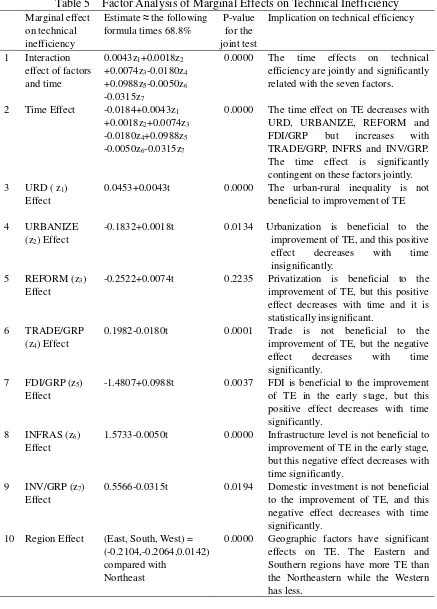
Table 5 also presents some other joint tests for the coefficients of time variable and
their interaction with the other factors Except the effect of REFORM, the estimates of
the effects of all other factors on technical efficiency with time are jointly significant in
the usual significant level, as shown in Rows 3 to 10 in Table 5. The last column in
Table 5 presents the implication for each factor analysis of TE.
Rows 1 and 2 in Table 5 show that the time effect of TE is jointly significantly
contingent on the seven factors, though the coefficient estimates of URD, URBANIZE
and REFORM are marginally significant at the 10 percent or 15 percent significant level,
as shown in Table 4. The China's economy has been experiencing a transition from the
original planned economy to a market economy with particular characteristics. The
technical efficiency path in economic growth should be significantly determined by a
mixture of miscellaneous factors. Our finding on the time effect of TE among China’s
provinces is consistent with this fact.
11
The Tobit model is also estimated when the error term is specified as a logistic or extreme value distribution, each
The urban-rural inequality (URD) has a significant but negative effect on TE since
0.0453+0.0043t is always positive, as shown Row 3 in Table 5. This shows that a
decrease in income difference between rural and urban areas within a province can
[image:24.595.107.494.227.589.2]enhance efficiency improvement.12
Table 4 Estimation Results of Technical Inefficiency from the Tobit Model
coefficient estimate standard error p-value
URD 0.0453 0.0277 0.1021
URBANIZE -0.1832 0.1135 0.1066
REFORM -0.2522 0.1719 0.1423
TRADE/GRP 0.1982 0.0465 0.0000
FDI/GRP -1.4807 0.5065 0.0035
INFRAS 1.5733 0.3746 0.0000
INV/GRP 0.5566 0.1981 0.0050
t -0.0184 0.0147 0.2099
URD × t 0.0043 0.0026 0.0962
URBANIZE × t 0.0018 0.0127 0.8859
REFORM × t 0.0074 0.0171 0.6637
TRADE/GRP × t -0.0180 0.0049 0.0003
FDI/GDP × t 0.0988 0.0586 0.0917
INFRAS × t -0.0050 0.0276 0.8557
INV/GDP × t -0.0315 0.0133 0.0177
EAST -0.2104 0.0270 0.0000
SOUTH -0.2064 0.0300 0.0000
WEST 0.0142 0.0293 0.6263
INTERCEPT 0.1988 0.1519 0.1908
SCALE: 0.1386 0.0053 0.0000
Pseudo R-squared 0. 5051
Log likelihood 92.4386
12 The inequality indicator URD is only used to express the urban-rural income difference within a province. Hence
Table 5 Factor Analysis of Marginal Effects on Technical Inefficiency Marginal effect
on technical inefficiency
Estimate ≈ the following formula times 68.8%
P-value for the joint test
Implication on technical efficiency
1 Interaction effect of factors and time
0.0043z1+0.0018z2
+0.0074z3-0.0180z4
+0.0988z5-0.0050z6
-0.0315z7
0.0000 The time effects on technical efficiency are jointly and significantly related with the seven factors.
2 Time Effect -0.0184+0.0043z1
+0.0018z2+0.0074z3
-0.0180z4+0.0988z5
-0.0050z6-0.0315z7
0.0000 The time effect on TE decreases with URD, URBANIZE, REFORM and
FDI/GRP but increases with
TRADE/GRP, INFRS and INV/GRP. The time effect is significantly contingent on these factors jointly. 3 URD ( z1)
Effect
0.0453+0.0043t 0.0000 The urban-rural inequality is not
beneficial to improvement of TE
4 URBANIZE
(z2) Effect
-0.1832+0.0018t 0.0134 Urbanization is beneficial to the improvement of TE, and this positive
effect decreases with time
insignificantly. 5 REFORM (z3)
Effect
-0.2522+0.0074t 0.2235 Privatization is beneficial to the improvement of TE, but this positive effect decreases with time and it is statistically insignificant.
6 TRADE/GRP
(z4) Effect
0.1982-0.0180t 0.0001 Trade is not beneficial to the
improvement of TE, but the negative
effect decreases with time
significantly. 7 FDI/GRP (z5)
Effect
-1.4807+0.0988t 0.0037 FDI is beneficial to the improvement of TE in the early stage, but this positive effect decreases with time significantly.
8 INFRAS (z6)
Effect
1.5733-0.0050t 0.0000 Infrastructure level is not beneficial to improvement of TE in the early stage, but this negative effect decreases with time significantly.
9 INV/GRP (z7)
Effect
0.5566-0.0315t 0.0194 Domestic investment is not beneficial
to the improvement of TE, and this negative effect decreases with time significantly.
10 Region Effect (East, South, West) = (-0.2104,-0.2064,0.0142) compared with
Northeast
0.0000 Geographic factors have significant effects on TE. The Eastern and Southern regions have more TE than the Northeastern while the Western has less.
the estimated effect of urbanization on inefficiency is negative (-0.1832+0.0018t < 0).
This positive effect of urbanization on technical efficiency is statistically significant (the
probability value of the joint test is very small, shown in Row 4 of Table 5). Although
the effect decreases with time, it is both economically and statistically insignificant
since the coefficient estimate of “URBANIZE × t” is small and statistically
insignificant (see Table 4). The neoclassical analysis would argue that urbanization
enhances efficiency in two ways. On the one hand, people migrate to cities and obtain
better employment or wages, and hence higher savings, which in turn is converted into
productive investment capital and the technical efficiency can then be improved. On the
other hand, higher incomes also lead to changes in the composition of demand from
agricultural to manufactured goods. The demand of manufactured goods increases
technology and productivity growth.
As shown in Row 5 in Table 5, the REFORM factor shows a positive, albeit
insignificant, effect on technical efficiency. The REFORM factor is beneficial to TE
improvement (-0.2522+0.0074t < 0), but the effect on TE will finally become negative
with the development of privatization (when t>34, -0.2522+0.0074t >0). Although the
effect of privatization on efficiency is ambiguous in both theoretic and empirical
literatures (Okten and Arin, 2006), it is positive in our estimation. In China,
privatization has emancipated the productive forces which have been fettered by the
planned economy for a long time. Privatization can induce competition and enhance
productivity that eventually can contribute to efficiency improvement. However, even
though the effect is large, it is not statistically significant in our estimation since the
p-value of the test is 0.2235.
Trade and foreign investment can give rise to either positive or negative efficiency
(Loungani and Razin, 2001). Our estimates and tests in Rows 6 and 7 of Table 5 show
that in the early development stage TRADE/GRP has a negative and significant effect
on efficiency (0.1982-0.018t>0 when t<12), while FDI/GRP has a positive and
significant effect (-1.4807+0.0988t<0 when t<15). In the later development stage, the
effects will drive off in the reverse direction. One can see from Table 4 that the time
10 percent level, respectively. This may be due to two reasons. One is the problem of
endogeneity in the measurement of openness with the ratio of trade to GRP in the
growth literature. The other is that trade has been overemphasized in the economic
transition, while efficiency has artificially been ignored somewhat in China. For the
China’s economy to sustain a high-speed economic development, reform will have to
become a long-term policy, whereas international trade can be adjusted to suit for
growth and efficiency. Foreign direct investment can have an indirect effect on the
domestic economy via positive spillovers and competition (Blomstrom and Persson,
1983). Our finding implies that, even though FDI have an important and positive effect
on TE in the China’s economy, it should be further encouraged to neutralize the
downward trend of the effect.
The provision of infrastructure has a negative and significant effect on technical
efficiency (1.5733-0.005t>0), which implies that regional inequality in infrastructure
development in China has hindered improvement in technical efficiency. Although this
is inconsistent with the expectation about the positive effect of infrastructure on TE, it is
the regional bottleneck that constrains economic growth in China. To keep a balanced
growth among different regions, China should expand development in the
underdeveloped regions, especially the underprivileged regions in her western
provinces.
As regards to the domestic investment factor, our finding shows that it is only when
18
t that the effect of domestic investment on technical efficiency will be positive
(0.5566-0.0315t < 0). Thus, domestic investment is not beneficial to the improvement of
TE in the early stage of development (t<18). However, the time effect of the negative
marginal influence will significantly decrease with time (-0.0315<0). As we have found,
the effect of FDI on TE is contrary to the effect of domestic investment. The two kinds
of investment have direct and significant effects on TE for capital accumulation of the
local economy, but the direction of their effects is opposite to each other.
Finally, the result of Row 10 in Table 5 shows that geographic factors have a joint
significant effect on TE. The geographical location of a province in China can often
intermediate inputs and other resources. Thus, different geographic locations among the
provinces have different effects. When compared to the Northeastern region, the Eastern
and Southern / Western regions have a higher / lower technical efficiency. Consistent
with Figure 3, the ranking of technical efficiency for the four regions in China’s
economy is: East > South > Northeast > West.
6. Conclusion
This study uses a flexible stochastic production function to estimate technical
efficiency in China’s post-reform economy. A fully nonparametric time-variant
stochastic frontier model has been specified to allow for province effects and time
effects to enter the production function with other inputs in a nonparametric way. The
generalized kernel estimation is applied to smooth both the continuous input variables
and the categorical unordered provinces and the ordered time periods. The flexibility in
the production functional form and the manner of individual and time effects that
entered into the production model can minimize the loss in the measurement of
technical efficiency, lead to robust estimates of the frontier function and produce a
reliable measure of technical efficiency. Model specification tests and estimates show
that the fully nonparametric stochastic model is more suitable for our sample. The
average output elasticity of labor is larger than those of capital and human capital,
which are all positive.
The measure of TE based on nonparametric estimation shows that the average
technical efficiency in China has declined considerably in the mid-1980s, but has
increased since 1992. Technical efficiency tends to be higher than the national average
level in both Eastern and Southern regions. Although China has emphasized a lot on the
development of the Western region, its technical efficiency has remained low.
Unexpectedly, Beijing, being the capital of China, shows a lower technical efficiency
than most other provinces.
The estimation of the Tobit model of technical inefficiency shows that the time
contingent on the seven factors shown in Table 4. With the exception of privatization,
the marginal effects of all the other factors also have significant time effects. There
exists regional difference in technical efficiency. To maintain a sustainable, high-speed
development, China should continue to reform and adjust its international trade to suit
growth and efficiency improvement. Foreign direct investments have an important and
large positive effect on technical efficiency, but it should be further encouraged to
neutralize the downward trend of the effect. China should attach great importance to its
infrastructure policy and reappraise the infrastructure development policy to give a
positive effect on technical efficiency.
The empirical findings in this paper have improved the discussion on China’s
productivity analysis, echoed on such recent discussions as regional inequality, disparity
in growth inputs and human capital development in China’s post-reform economic
development (Wu, 2008; Li, 2009; Li and Liu, 2011; Chang, 2002; Fleisher and Zhao,
2010; Liu and Li, 2006; Chi, 2008; Li et al., 2009). Furthermore, the empirical findings
in this paper provide a reflection on the efficiency in financial issues, such as bank loans
and corporate bonds development, on economic policy decisions, such as the pace of
market liberalization and privatization of enterprises, and on infrastructural and civic
development, such as eradication of informal economic activities.
References
Balaguer-Coll, M. T., Prior, D. and Tortosa-Ausina, E. (2007). On the determinants of local government performance: a two-stage nonparametric approach. European Economic Review, 51(2), 425-451.
Barro, R. J., and Lee, J. W. (2001). International data for education attainment: Updates and Implications. Oxford Economics Papers, 3, 541-563.
Barro, R. J. and Sala-i-Martin, X. (1999). Economic Growth, Cambridge, Mass.: MIT Press.
Battese G. E. and Coelli, T. J. (1992). Frontier production functions, technical efficiency and panel data: With application to paddy farmers in India. Journal of Productivity Analysis, 3, 153-169.
Battese G. E. and Coelli, T. J. (1995). A model for technical inefficiency effects in a stochastic frontier production function for panel data. Empirical Economics, 20(2), 325-332.
Bauer, P. W. (1990). Decomposing TFP growth in the presence of cost inefficiency, non-constant return to scale, and technological progress. Journal of Productivity Analysis, 1, 287-299.
Benhabib, J. and Spiegel, M.M. (2005). Human capital and technology diffusion. In P. Aghion and S. Durlauf (eds.), Handbook of Economic Growth, North-Holland, Elsevier.
Blomstrom, M. and H. Persson, (1983). Foreign investment and spillover efficiency in an underdeveloped economy: Evidence from the Mexican manufacturing industries. World Development, 11, 493-501.
Borensztein, E. and Ostry, D. J. (1996). Accounting for China’s economic performance.
American Economic Review, 86, 224-228.
Bosworth, E., and Collins, S. M. (2008). Accounting for growth: comparing China and India. Journal of Economic Perspectives, 22 (1) Winter, 45-66.
Brummer, B., Clauben, T. and Lu, W. (2006). Policy reform and productivity change in Chinese agriculture: a distance function approach, Journal of Development Economics, 81, 61-79.
Chang, G. H. (2002). The cause and cure of China’s widening income disparity. China
Economic Review, 13, 335-340.
Chen, B.L. (2003). An inverted-U relationship between inequality and long-run growth. Economics Letters. 78, 205-212.
Chen , K., Huang Y., and Yang C. (2009). Analysis of regional productivity growth in China: A generalized metafrontier MPI approach. China Economic Review 20, pp. 777-792.
Chen, P., Yu, M., Chang, C., Hsu, S. (2008). Total factor productivity growth in China's agricultural sector. China Economic Review 19, pp.580-593.
Chi, Wei (2008). The role of human capital in China’s economic development:
review and new evidence. China Economic Review, 19, 421-436.
Chilingerian, J. A. (1995). Evaluating physician efficiency in hospitals: A multivariate
analysis of best practices. European Journal of Operational Research,80, 548-574.