Munich Personal RePEc Archive
Prisoners of our own Device – an
evolutionary perspective on lock-in,
technology clusters and telecom
regulation
Cave, Jonathan
University of Warwick, Rand Europe
15 August 2009
Online at
https://mpra.ub.uni-muenchen.de/83199/
Electronic copy available at: http://ssrn.com/abstract=1995551
Prisoners of our own Device – an evolutionary perspective on lock-in, technology clusters and telecom regulation
Jonathan Cave
RAND Europe and University of Warwick [email protected]
Introduction
Economic analysis of telecom-related issues often takes an essentially static equilibrium perspective, using comparative statics or moment-to-moment sequences of equilibrium behaviour to model the development and impacts of technologies, economic behaviour and regulation. Of course, much if not all of these developments occur far from equilibrium; this paper argues for resurrecting a more evolutionary perspective – in particular by taking account of dynamic rigidities.
The models involved are not new – in the economic literature their formal development dates back at least to the work of David (1974), Desi (1982) Winter (1982), Arthur (1984) and Farrell and Saloner (1985). Taken together, these articles demonstrated the possibility of lock-in (especially to a given technology or supplier) in the presence of complementarities. A related thread in the game-theoretic literature analyses the evolution and stability of conventions, generally in coordination games.
The implications for positive analysis are fairly straightforward; change is likely to be discontinuous and path-dependent, and (evolutionary) equilibrium outcomes are not necessarily optimal. This has equally straightforward implications for policy analysis and development; governance and regulation are periodically subject to by intentional or accidental change. Often, the intent of those participating in the change is to initiate, influence or set the seal on technical, economic and/or regulatory developments. Their deliberations are often sophisticated, taking account of the optimal responses of other stakeholders – but in the presence of rigidities, these assumptions about freedom of choice may not hold; the ability to recognise and respond to challenges is strongly path-dependent. This is particularly true in relation to markets with network externalities, which – as Katz and Shapiro (1992, 1994) observed - tend towards ‘tipping’ into monopoly and polarisation of responses to innovation between excess inertia (lock-in to incumbent technology) and excess volatility (rushing to the ‘next big thing’). These phenomena are not limited to specific interoperability concerns identified by early authors in the field.
The logic applies to the self-stabilisation or persistence of technologies (and ‘technology clusters1’) business models (and populations of complimentary models); regulations (and regulatory approaches like incentive regulation or market-based regulation); and even the economic paradigms used for policy formulation2. Lock-in rigidities can arise from economic factors (as indicated below) but are often reinforced by the self-confirming nature of empirical evaluation; adoption of a technology, business model, regulation or economic theory often brings with it customary relationships, sources of evidence and evaluation frames which form a subset of a possibly much wider set.
One area where these rigidities might be anticipated is “net neutrality.” Proponents of some forms of net neutrality regulation point to the danger that end-users and/or content suppliers may be locked into vertically-integrated “walled gardens” and that useful innovation and diversity may thereby be locked out. Conversely, opponents of such restrictions who are concerned lest blanket ‘equal treatment’ rules foreclose efficient forms of differentiation3 point out that common carriage ISP business models may not be able to recognise or respond to opportunities to produce welfare improvements by introducing efficient and explicit price- and/or quality-of-service differentiation. From the policy perspective, it is also interesting to note that the net neutrality debate itself has been framed differently in the US and in Europe. Partially, this reflects different regulatory environments and levels of local broadband competition; the interpretation of net neutrality proposals and evidence is in any case different in markets where open access to networks and transport services is guaranteed by dedicated parts of the
1
Cave et. al. (2009) 2
CITI (2009) 3
Electronic copy available at: http://ssrn.com/abstract=1995551
regulatory framework4 and where in consequence regulation against price discrimination on the basis of content may appear less relevant.
Another area in which policy development shows evidence of internal rigidity is self-regulation. Lock-in arises from the capture of a regulatory area. The institutionalisation of self-regulatory bodies often leads them to become – or involve – the main source(s) of information about performance and compliance, and places such bodies beyond the effective scrutiny of independent auditors. As a result, it becomes difficult to know whether their performance is adequate and unlikely that their power will be clawed back (this is not specific to telecom self-regulation, of course). This applies to many specific areas; the intention here is not to criticise individual self-regulatory organisations but to point out their self-confirming nature.
A further specific example can be drawn from spectrum allocation. The 2.6 GHz band is potentially useable by either symmetric, telephony-related technologies (e.g. LTE) or asymmetric, computing-derived technologies WiMax. In addition to the ability to use the same spectral band, these technologies are each capable of various uses, though each technology is relatively better at some uses compared to the other. Currently, the symmetric technology is more mature. To reflect the symmetric technologies’ need for paired bands with a 120 MHz separation, auctions to date have tended to allocate spectrum separately according to fixed proportions. This can obviously affect the development of the market, as the initial lead technology is likely to build a sustainable advantage independent of technical superiority. This is reinforced by differences in access cost; the Swedish and Norwegian auctions, for instance, produced very different relative prices for the two types of licence. Other auctions, such as the package auction format planned for use in the UK, endogenise the allocation of spectrum – this auction has been delayed by lawsuits initiated by proponents of the symmetric technology. The potential for inefficient lock-in has been recognised, and can be mitigated (at least in theory) by spectrum trading; the idea is that a superior technology can gain access – when it is ready – by outbidding inferior technologies. To date, however, this remains a theoretical possibility. To see one reason why, suppose that an auction for dual-capable spectrum was being contested between two technologies of differing maturities and overlapping capability. Based on present discounted value alone, the more mature technology is likely to win; if this discourages entry by the other technology, the cost advantage of the current leader becomes even greater. If spectrum trading is a viable prospect, the proponent of the less-mature technology faces a choice between bidding (and losing) in the present auction, with the prospect of increasing the price paid by the mature technology; bidding (and winning) the present auction, with the prospect of large debts compared with a delayed income stream; or waiting for subsequent spectrum markets to secure the needed spectrum. Owners of the mature technology can bid for spectrum on the basis of its current value, but may also be motivated by the prospect of either cornering the spectrum market in advance (in case the less mature technology turns out to be dominant) or prolonging market control (by restricting supply to spectrum markets). Given this range of possibilities, there is no obvious reason to suppose that an auction held today will produce an efficient allocation of spectrum in the long run, even before accounting for the impact of strategic bidding on the availability of investment finance for the new technology or the possibility that the current winner may lock-in the installed base of users.
Rigidities
Lock-in can arise from reinforcement in a specific domain, e.g. technology (widespread adoption of a technological paradigm); market forces (natural monopoly, tipping, incomplete information); or
policy (subsidies for particular technologies, large (innovative) public procurement, adoption of a non-neutral regulatory paradigm). It can be made stronger by interaction among technical, economic, regulatory, etc. domains. This may be inefficient; equilibrium may not exist, involve adoption of an inefficient standard or fail to attain efficient standardisation. Intervention (more generally, interaction with another domain) may make matters worse. For example, public authorities can back technologies that are inefficient or that are efficient but incapable of attaining sustainable dominance, or they may champion competing standards) – sometimes as a result of capture or over-reliance legacy models and
4
Electronic copy available at: http://ssrn.com/abstract=1995551
approaches (e.g. endorsing a regulated natural monopoly approach even when new technologies make competition viable).
Evolutionary alternatives to static neoclassical models make it easier to model the behaviour of trajectories disturbed by shocks arising in one domain (e.g. a new technology, business model or policy and their interactions with other domains. The perturbations may be transitory or lasting in their ‘native’ context; where persistence involves diffusion or further exploitation, the resulting dynamics are likely to be ‘punctuated5’ with specific windows of opportunity for intervention. Business is certainly alive to the opportunities thus provided, as evidenced by the emergence of new business models based on indirect exploitation of free services6.
Lock-in can discourage, delay or prevent technological, economic or regulatory innovation, including incremental invention (e.g. new technology generations) or transition to superior existing alternatives. At the same time, actual or potential lock-in may underwrite beneficial complementary investment. The systemic impact arises from the struggle over interoperation and compatibility; firms are likely to exploit captive markets by raising prices to locked-in consumers to the height of switching costs – this can lead them to compete extensively by investing in incompatibility. Conversely, firms solicit new customers by competing intensively with discounts and complimentary products. Extensive competition tends initially to be unstable and sensitive to competing offers, new technologies elsewhere in value chains, etc. - but is in the long run liable to “tip" into rigid monopoly and to sacrifice both the immediate benefits of interoperability and the ‘generative’ further innovation to which open interaction gives rise. By contrast, intensive competition raises switching costs and thus encourages small-scale entry, but equally discourages raids on rivals’ installed base, deterring aggressive entry even by modestly superior technologies.
From a policy perspective, this argument leads to a perspective that considers extended value chains (e.g. not just telecommunications but the entire complex system of ICT-enabled economic activity; even when regulatory traction is limited to a few large telecom providers, the assessment of regulation should take into account impacts occurring up- and downstream and the prospects for new structures. These are not limited to market outcomes; as discussed below, technological, economic and regulatory compatibility affect connectivity as well. The specific concern is that even inefficient extensive competition – in a single domain - is likely to dominate intensive competition, especially for incumbents, resulting in too little connectivity or compatibility.
Formation of technology trends
The literature remains divided about the extent to which specific technology trends are defined and integrated into national, sectoral, etc. systems of innovation but there is no doubt that technological development as a whole is a systemic property7. There are, however, distinct perspectives on the 'system' involved. In much of neoclassical economics (including some endogenous growth theories), technologies arise as either exogenous shocks or more or less predictable consequences of past investments whose implications have been taken into account or at least foreseen.
Evolutionary economics8 recognises that technologies may produce lock-in either as described above or through interactions with market demand9 or regulation. These rigidities10 arise from the combined evolutionary forces of variation (innovation, under the assumption that ‘small’ and compatible innovations are more likely than large), selection (by peer review, R&D funders and complementary innovators) market forces and/or regulatory protection) and heredity (e.g. technology clustering, IPR
5
Such alternation of long periods of localised and small-scale change with brief periods of discontinuous and globalised change can be seen in e.g. technology paradigm shifts and economic structural change.
6
In many cases, the disruption comes from the recognition that third parties may pay more for system functions than the direct beneficiaries, even when the value created does not flow through markets. Examples of property rights with traction on this value include search terms, search or web page placement, domain names, access linked to the distribution of (even free) content, etc.
7
Dosi (1982) 8
Nelson and Winter (1982), Schumpeter (1939) 9
Mowery and Rosenberg (1979) 10
sharing,). This may be inefficient11. But not all possible technology trends will stabilise in this way – that generally requires positive reinforcement by selection in other domains (e.g. novel market or end-user applications, formation of new market segments, market segmentation and the adaptive expectations of financiers, customers and policy-makers). Such reinforcements make trend continuation more likely; they also imply that policy choices (e.g. adopting a particular technology for public service delivery, supporting research in certain areas, changing laws and regulations to accommodate new technologies, etc.) need to take into account the potential that policy itself may induce lock-in and conversely that negative reinforcement can upset the stability of technologies12. The picture becomes more interesting when related technologies develop together. Mutual reinforcement can discourage or even prevent new developments. For example, network externalities among previous adopters of one or more related technologies may render a new and improved generation irrelevant to the market, buta third selection mechanism (e.g. strategic public procurement of an incompatible technology selected on the basis of what is feasible (supply) and desirable (demand)13 may produce to the kind of ‘break-out’ described by Arthur (1988).
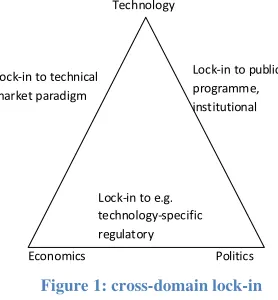
The key point is that selection can occur in many contexts (e.g. technology, economics and politics). Their mutual reinforcement (see Figure 1) can lead to persistence of arrangements that are:
• inefficient overall (either in a static sense or because they discourage further innovations);
• inefficient in context (alternative technologies, markets or policies are not realised); and/or
• prone to disruption by developments arising in another sphere (break-out).
Other obvious points are:
• the possibility of lock-in distorts technical, economic and political incentives;
• lock-in affects cluster or paradigm formation – for instance, by changing innovation trajectories to suppress continual small innovations and raising the odds of large, infrequent and disruptive innovations; and
• market and social changes are more likely to be abrupt, discontinuous and/or cyclical.
Lock-in to e.g. technology-specific regulatory paradigm Lock-in to technical market paradigm
Lock-in to public programme, institutional paradigm Technology
[image:5.612.230.369.405.555.2]Economics Politics
Figure 1: cross-domain lock-in
Thus lock-in and breakout can occur as a result of system dynamics rather than individual decision.
Lock-in in the Arthur model
Arthur (1988) considers lock-in as a result of two interacting governance mechanisms. Two types of user (α and β) have different preferences for two technologies (A and B; α prefers A and β prefers B). Preferences are also influenced by cohesion - the proportion (nA and nB) of users of each technology and the strength (νA and νB, resp.) of network effects with each – more users makes a technology
11
David (1985) points out that the QWERTY standard was originally devised to prevent mechanical typewriter keys from locking; by the time a technological ‘fix’ arrived (with electronic typewriters and computer keyboards) the standard was too well-established to be eliminated, despite its inefficiency, and despite the fact that new generations of users could, in principle, start anew.
12
see e.g. Cowan and Hulten (1996) and Islas (1997) 13
more attractive. In concrete terms, the users get the following benefits from different technology choices:
(
)
(
)
(
)
(
)
User type Proportion Utility from A Utility from B
, ,
1 , ,
A A B B
A A B B
a U A n U B n
a U A n U B n
α α ν α ν
β β ν β ν
+ +
− + +
(
) (
) (
)
(
) (
) (
)
(
)
The welfare consequences of the two 'locked-in' regimes are: Dominance by A , 1 ,
Dominance by B , 1 , where
U , is the utility derived by a user of type from adopting technolo
A
B
aU A a U A
aU B a U B
i X i
α β ν
α β ν
+ − +
+ − +
(
)
(
)
(
)
(
)
gy X (the 'intrinsic preference') is the number of adopters of technology X, and
is the 'network externality'associated with technology X X = A or B; i = or ; , > , ; and , ,
X
X n
U A U B U B U A
ν
α β α α β > β
Either technology can prevail if its share gets large enough. Both types of users will:
(
)
(
)
(
)
(
)
(
)
(
)
(
)
(
)
(
)
(
)
Adopt A if , , 0
Adopt B if , , 0
, ,
Necessary condition for A to be stable:
, ,
Necessary condition for B to be stable:
Either can prevail if both
A A B A
B A A A
A
B
N N N U B U A
N N N U A U B
U B U A
N
U A U B
N
ν ν β β
ν ν α α
β β
ν
α α
ν
− − > − >
− − > − >
− >
− >
network effects are 'strong enough' compared to user preferences.
If users choose in random order, the standard theory of Markov processes predicts the certainty of eventual lock-in. This is not easy to reverse, even if the network benefits of the losing (winning) technology strongly increase (fall). Forcing break-out by adding a large number of users preferring the new technology or pushing network externalities to unrealistic extremes produces rapid lock-in to the other technology. Hence, development of a specific technology trend depends less on past developments than the evolutionary mechanism underlying substitution; similarly, breaking out of lock-in owes less to emergence of new and superior technologies than the relative weakness of market cohesion. Simulations show that new technologies may fail or displace old technologies, but are unlikely to reach a stable balance with an incumbent technology; in this simple two-domain (technical-market) view, a technology is more likely to accumulate associated technologies than to ‘share the market.’
Of course, network effects can become negative e.g. if a technology exposes its users to risks arising from other users that outweigh the network gains. This ‘crowding out’ can destroy lock-in; in extreme cases it can force a kind of ‘negative’ competition in which no technology dominates14.
The picture changes if three (or more) selection forces interact. Dolfsma and Leydesdorff15 (2009, forthcoming) show that this can lead to enhanced break-out and competition (diversity).
Structural change
These models do not consider the structure of adopter networks; in general the cohesion of users around a particular technology and the attractiveness of a core technology to additional innovations depend on the nature of other users and on their willingness to adopt supplementary technologies. For example, the evolution of (for instance) integrated office suites combining document preparation,
14
The argument is essentially that of Tiebout (1956) 15
spreadsheet computation and presentation applications reflects their adoption in a business environment; integrated suites that develop in other contexts (e.g. scientific communities) combine different applications or emphasise different functions16.
Even the geometry of technology-supported interactions and learning alters the results. Consider a population in which new technologies arise and spread by ‘word of mouth’ – ultimately, superior technologies are likely to be adopted, so we focus here on inferior technologies. These technologies belong to a ‘cluster’ of essentially similar technologies, so that individuals can sample different versions. For concreteness, suppose that an individual will try the technology in a given moment with a probability proportional to a constant µ (the marketing effort or viral infectiousness of the technology) times the proportion of that individual’s network neighbours (influential contacts) currently using it. The probability that a user will discard the technology at a given moment is proportional to another constant ρ17
. The ratio λ = µ/ρ is the effective spreading rate; each network structure has a characteristic threshold λ* above which the technology will permeate the network (before taking over or dying out). It is interesting to note that this threshold is effectively 0 for the scale-free networks often used to describe the Internet; this structure (dominated by a few highly-connected individuals) is thus extremely open to the diffusion of (good or bad) innovations and responds reasonably well to interventions targeted at key hubs. Convergence favours the ‘risk-dominant’ technology – not necessarily the best in terms of total performance, but (roughly) the one that is best in a world where one’s neighbours choose randomly18 or where the advantages of specific complementarities are matched by robustness to ‘alien technology.’ Convergence is much faster in networks with a high degree of local interaction or clustering.
But it is hard to verify or adapt policy to patterns of interaction. In the first place, most interactions cannot be directly observed. In some cases (e.g. Walled Gardens, vertically integrated service provision or server-based peering systems) it may be possible to classify structures, but hard to evaluate their influence on individual technology choices. More importantly, structures are (at least in part) endogenous and variable. Suppose that adoption and connectivity are linked: people tend to replace links to neighbours using incompatible technologies with new links to people using the same system. This produces a range of interesting implications19. First, the distribution of connectivity changes; starting from a ‘scale-free’ distribution, for example, it becomes much ‘flatter’ with many more people at all levels of connectivity. Second, connectivity becomes more associative – firms or individuals have most of their links with others of similar connectivity – this undercuts the effectiveness of targeted interventions. For example, a direct attempt to inhibit adoption of a dangerous technology by highly-connected stakeholders will leave the less-connected majority relatively untouched; their adoption will in turn continuously re-infect the rest of the system. A third implication is endemic persistence; there is a second threshold above which even an inferior technology will not disappear from the system, but will remain as a legacy system for an extended period. Finally, the systems displays endogenous polarisation; over time, it will evolve two loosely-connected components, with very different prevalence of the new (and by assumption inferior) technology.
This analysis indicates that inefficient lock-in for technological or economic reasons can be minimised by ‘linking’ to a strategic policy selection mechanism, or merely by interconnection of domains with distinctly different user needs and/or technology bases. Second, clustering of complementary applications on the basis of aligned user interests and technological developments is
16
TeX-based document processing is better for representing equations, assembling footnotes and citations and including the forms of front matter appropriate to scientific publications; the computational elements are more likely to emphasise symbolic processing and solving general equations; and the presentation elements are more likely to be integrated with the display capabilities built into the common pdf standard. It is notable that, while MS applications are pervasive in administration-facing functions in Universities, they coexist with TeX, MAPLE- and pdf-based suites that dominate scholarly output in many disciplines.
17
We could assume that ρ depended on the use profile of the individual’s reference group, but is suffices to consider contagion and cohesion on one side of the adoption decision.
18
The basic argument is given in Young (1993) 19
not simply a result of pre-existing clusters of supply or demand characteristics but is an endogenous result of the way people come together in shared use of technologies. Finally, technological and/or business regulation can affect the structures through which new technologies diffuse and thus the ability of the economy as a whole to induce and identify superior technologies and to exploit them is beneficial ways.
Standards vs. variety
The preceding discussion is based primarily on the Arthur model, where network effects are so strong as to make lock-in inevitable. A related model is the Farrell and Saloner20 (1996) analysis of standards vs. variety. The population is divided between users of types α and β on the basis of preference (as before, type α prefers technology A) in proportions a% and 1-a%. They are also divided in terms of technology adoption, with ni using technology i (for i = A, B). A type α user gets utility nA by adopting A and nB – d from adopting B (type β users get nA – d from A and nB from B). The outcome in this model depends on the ‘distaste’ d of each user for the ‘wrong’ technology. Each additional user of a specific technology increases the value of adopting it by 1, if d is less than one, either technology can take over the market. If d is bigger than one, no single technology can prevail. If both a and 1-a are bigger than (1-d)/221 there is an equilibrium in which each user group adopts its preferred technology. Welfare possibilities depend on the balance of preferences in the population (a) and the strength of the match (d, which is bigger if users prefer their favourite technology more strongly) this ‘diversity’ outcome is only efficient if d > 1 and it is the only equilibrium.
Policy implications
Taken together, the combination of switching costs and network effects bind users to suppliers of incompatible hardware/software/services combinations, locking in their initial choices. This keeps users from changing suppliers (or even finding out about alternatives) in response to predictable or unpredictable changes in price, quality and/or efficiency, giving suppliers lucrative ex post market power. This power is exercised over the original user in the switching cost (or brand loyalty) case and over other users in the case of network effects. In market-led scenarios, suppliers can be expected to compete ex ante for this power, by means of introductory pricing, gold-plated introductory offers (especially for subscriptions), bundling and periodic price wars. This competition for the market can adequately replace competition in the market among compatible services; it can even be stronger than compatible competition if it weakens product/service differentiation22. More often, however, competition among incompatible services leads to direct efficiency loss, softens like-for-like competition and enhances incumbent advantage. In the presence of network effects, established firms have little reason continually to improve services and/or commercial arrangements, especially when users and producers of complements base expectations and behaviour on factors unrelated to efficiency (such as installed base). As noted above, while competition between incompatible or disconnected networks is initially unstable and sensitive to competitive offers, new technologies and random shocks, after it tips23 into monopoly or oligopoly entry may be unlikely or even prevented by incompatibility24. By contrast, switching costs promise profits that encourage small-scale entry but discourage more aggressive raids on rivals’ customer bases even by modestly superior technologies. The combined result is that even inefficient competition for the market based on incompatibility is more profitable than compatible competition in the market, especially for incumbents or crossover entrants with strong a priori advantages from installed base, command of other services or IPR or
20
Farrell and Saloner (1985) and Farrell and Klemperer (2006) 21
i.e. if d < 1 or d is not ‘too big’ and/or the proportions favouring A and B are not ‘too different.’ 22
In other words, if competition to capture a locked-in installed user base leads offers to converge the result may be less residual profit than in ‘monopolistic competition’ implied by ongoing competition for users. 23
Katz and Shapiro (1992 and 1994) 24
favourable expectations based on past financial performance, linkages to large stable (e.g. public-sector) users and/or links to important stakeholders in other parts of the value chain25.
There is some disagreement about whether this incompatible competition is desirable, largely arising from different expectations of adopter coordination in the presence of network effects. Those who expect competition for the market to perform well in static and dynamic senses assume that users will be able to implement coordinated shifts to better technologies or bundles via: bandwagon effects, communication (e.g. standards organisations), introductory pricing, etc. Such “good” coordination makes the market behave like a single adopter; competition among incompatible offers provides less
variety but equally less product differentiation, resulting in sharper competition. In a dynamic setting, where users make their own investments in the adopted technology/standard, individual switching costs rise and interact with network effects to create large collective switching costs. However, such markets may not do badly, because adopters’ initial benefits counterbalance their eventual losses to dominant provider(s).
Others expect coordination to fail or to “succeed” only by reinforcing aspects of technology related to external factors (e.g. installed base, prior relationships) rather than efficiency. This gives several reasons why competition for markets may fail. First, there is no a priori reason to expect ‘good’ differentiation instead of fragmentation (loss of network benefits) or locked-in convergence to the “wrong” technology, leading users collectively to ignore superior alternatives. In this world, offering better deals is not a safe strategy; suppliers will find other ways to capture the attention of users and suppliers of complements and will invest in other ways to generate profits from their captives. They will thus offer less efficient services on less attractive terms. If user and partner expectations are more responsive to e.g. installed base than actual performance (which may be harder to observe or more ‘subjective’), the extra value delivered by network effects gets converted to collective switching costs, locking users into outdated or simply inferior technologies. Finally, high returns to locking in user and partner expectations encourage other inefficiencies such as exclusive dealing26 or ‘vapourware27’ preannouncements by incumbents aimed at blocking any ‘windows of opportunity’ for entry of efficient rivals. The scope for such predatory behaviour will only increase if the attention of the market is dominated by the offerings of powerful incumbents, because incumbent status is a more attractive prize. The retrains to incumbency increase and it is easier to recover costs spent fending off more efficient rivals. Whether entry by incompatible rival technologies is desirable on other grounds, barriers to gradual or small-scale entry raise competition concerns. For instance, merger or collusion among incumbents resulting in joint control of a technology cluster or standard may be worse than the same merger or collusion if it failed to deter compatible entry.
It might be easier to tackle the combined impact of proprietary network effects and imperfect coordination, were it not for market dynamics. For example, recognising the possible anticompetitive use of preannouncements does not guide useful policy; ‘bad’ ones cannot be barred ex ante but ex post
may be too late and in any case counterfactual evidence may be impossible to obtain. Conventional approaches to predatory pricing militate against below-cost pricing, but during the initial phase or to attract key adopters or ‘platform complements’ (e.g. providers of attractive content or applications to a platform), this is an essential part of competition among incompatible platforms.
A more promising avenue may be to assist user/adopter communication or coordination, for example by means of information policies (monitoring, disclosure requirements and other ways to help users know what they are getting into), consumer protection policy to enforce promises made to adopters and other ways to overcome free-riding among users.
25
This can be seen, for instance, in the struggle for dominance in 3G mobile telephony and broadband, where links to content providers shored up investments in incompatibility, or in the eHealth domain, where major ICT stakeholders cultivated more-or-less exclusive arrangements with providers of healthcare (public and private) and of services and other inputs (e.g. pharmaceuticals and appliances).
26
Shapiro (1999) 27
Recent hopeful developments include support for self-regulation, e.g. enhancing the role of standardisation bodies in focusing user expectations. Especially helpful can be guarantees of regulatory forbearance in relation to standards bodies. Recent cases in relation to e.g. their consideration of the costs of patent licensing having raised fears of prosecution, especially in view of the presence of ‘stealth patents’ that have been inadvertently (on the part of the standards bodies) been incorporated into public standards28.
References
Arthur, B. (1988) “Competing technologies” pp 590-607 in: Dosi, G., Freeman, C., Nelson, R., Silverberg, G., Soete, L., (Eds.) Technical Change and Economic Theory London: Pinter.
Cave and Crocioni (2007) “Does Europe Need Network Neutrality Rules?” International Journal of Communication1: 669-679
Cave and Marsden (2007) (Net Neutrality at TPRC)
Cave, J. van Oranje, C. Schindler, R. Shehabi, A. and Ph-B. Brutscher (2009) “Trends in connectivity technologies and their socio-economic impacts” Report to European Commission DG INFSO, forthcoming.
CITI (2009) “The New Economics of ICT: Implications of Post-neoclassical Economics for the Information & Communications Technology Sectors” held at Columbia University 20 March 2009:
http://www4.gsb.columbia.edu/citi/neweconomics.
Cowan, R. and S. Hulten (1996) "Escaping Lock-in: the case of the electronic vehicle" Technological Forecasting and Social Change53: 541-567
David, P. (1974) Technical Change, Innovation and Economic Growth. Cambridge: Cambridge University Press
David, P. (1985) "Clio and the economics of QWERTY" American Economic Review 75: 332-337 Dolfsma, W. and L. Leydesdorff (2009) “Lock-in & Break-out from Technological Trajectories: Modelling and policy implications” Technological Forecasting and Social Change (forthcoming). Dosi, G. (1982) "Technological paradigms and technological trajectories" Research Policy 11 :142-167.
Dranove, D. and N. Gandal (2003) “The DVD vs. DIVX Standard War: Empirical Evidence of Vaporware” Journal of Economics and Management Strategy12: 363-386.
Farrell, J. and G. Saloner (1986) “Installed Base and Compatibility: Innovation, Product Preannouncements, and Predation” American Economic Review76: 940-955.
Farrell, J. and G. Saloner (1985) "Standardization, Compatibility, and Innovation" RAND Journal of Economics16(1): 70-83.
Farrell, J. and P. Klemperer (2006) "Co-ordination and Lock-in: Competition with Switching Costs and Network Effects" Economics Papers 2006-W07, Economics Group, Nuffield College, University of Oxford
Fisher, S. (1991) “FTC Investigation Unearths Many Microsoft War Stories.” PC Week8(20) (May 20, 1991).
Latimer, H. and K. Ablin (2000) “Stealth Patents: The Unconstitutionality of Protecting Product Designs Under the Federal Trademark Dilution Act” Trademark Rep90(489): 432
Haan, M. (2003) “Vaporware as a means of entry deterrence” The Journal of Industrial Economics
51(3): 345-358
Islas, J. (1997) "Getting round the lock-in in electricity generating systems: the example of the gas turbine" Research Policy26: 49-66.
28
Katz, M. and C. Shapiro (1992) “Product introduction with network externalities" Journal of Industrial Economics40: 55-83
Katz, M. and C. Shapiro (1994) “System competition and network effects" Journal of Economic Perspectives8: 93-115.
Laffont, J-J., Rey, P. and J. Tirole (1998a) "Network Competition: I . Overview and Nondiscriminatory Pricing" RAND Journal of Economics29: 1-37.
Laffont, J-J., Rey, P. and J. Tirole (1998b), "Network Competition: II. Price Discrimination" RAND Journal of Economics29: 38-56.
Mowery, D. and N. Rosenberg (1979) “The influence of market demand upon innovation: a critical review of some empirical studies” Research Policy 8: 102-153.
Nelson, R. R. and S.G. Winter (1982) An Evolutionary Theory of Economic Change Cambridge, MA: Harvard University Press
Rosenberg, N. (1976) "The direction of technological change: inducement mechanisms and focusing devices" pp. 108-125 in Perspectives on Technology. Cambridge: Cambridge University Press. Schumpeter, J. (1939) Business Cycles: A Theoretical, Historical and Statistical Analysis of Capitalist Process New York: McGraw-Hill.
Shapiro, C. (1999) “Exclusivity in network industries” George Mason Law Review, Spring.
Tiebout, A. (1956) “A Pure Theory of Local Expenditures” Journal of Political Economy64: 416– 424.