elastase-induced abdominal aortic aneurysms
in mice
Jiusong Sun, … , B. Timothy Baxter, Guo-Ping Shi
J Clin Invest. 2007;
117(11)
:3359-3368.
https://doi.org/10.1172/JCI31311
.
Abdominal aortic aneurysm (AAA), an inflammatory disease, involves leukocyte recruitment,
immune responses, inflammatory cytokine production, vascular remodeling,
neovascularization, and vascular cell apoptosis, all of which contribute to aortic dilatation.
This study demonstrates that mast cells, key participants in human allergic immunity,
participate in AAA pathogenesis in mice. Mast cells were found to accumulate in murine
AAA lesions. Mast cell–deficient Kit
W-sh/Kit
W-shmice failed to develop AAA elicited by
elastase perfusion or periaortic chemical injury. Kit
W-sh/Kit
W-shmice had reduced aortic
expansion and internal elastic lamina degradation; decreased numbers of macrophages,
CD3
+T lymphocytes, SMCs, apoptotic cells, and CD31
+microvessels; and decreased
levels of aortic tissue IL-6 and IFN-
g
. Activation of mast cells in WT mice via C48/80
injection resulted in enhanced AAA growth while mast cell stabilization with disodium
cromoglycate diminished AAA formation. Mechanistic studies demonstrated that mast cells
participated in angiogenesis, aortic SMC apoptosis, and matrix-degrading protease
expression. Reconstitution of Kit
W-sh/Kit
W-shmice with bone marrow–derived mast cells
from WT or TNF-
a
–/–mice, but not from IL-6
–/–or IFN-
g
–/–mice, caused susceptibility to
AAA formation to be regained. These results demonstrate that mast cells participate in AAA
pathogenesis in mice by releasing proinflammatory cytokines IL-6 and IFN-
g
, which may
induce aortic SMC apoptosis, matrix-degrading protease expression, and vascular wall
remodeling, important hallmarks of arterial aneurysms.
Research Article
Cardiology
Find the latest version:
Research article
Mast cells modulate the
pathogenesis of elastase-induced
abdominal aortic aneurysms in mice
Jiusong Sun,1 Galina K. Sukhova,1 Min Yang,1,2 Paul J. Wolters,3 Lindsey A. MacFarlane,1
Peter Libby,1 Chongxiu Sun,1 Yadong Zhang,1 Jian Liu,1 Terri L. Ennis,4 Rebecca Knispel,5
Wanfen Xiong,5 Robert W. Thompson,4 B. Timothy Baxter,5 and Guo-Ping Shi1
1Department of Medicine, Brigham and Women’s Hospital and Harvard Medical School, Boston, Massachusetts, USA. 2Department of Rheumatology, Nanfang Hospital and Nanfang Medical University, Guangzhou, People’s Republic of China. 3Department of Medicine, UCSF School of Medicine, San Francisco, California, USA. 4Department of Surgery, Washington University School of Medicine, St. Louis, Missouri, USA. 5Department of Surgery, University of Nebraska Medical Center, Omaha, Nebraska, USA.
Abdominal aortic aneurysm (AAA), an inflammatory disease, involves leukocyte recruitment, immune
respons-es, inflammatory cytokine production, vascular remodeling, neovascularization, and vascular cell apoptosis,
all of which contribute to aortic dilatation. This study demonstrates that mast cells, key participants in human
allergic immunity, participate in AAA pathogenesis in mice. Mast cells were found to accumulate in murine
AAA lesions. Mast cell–deficient
Kit
W-sh/Kit
W-shmice failed to develop AAA elicited by elastase perfusion or
peri-aortic chemical injury.
Kit
W-sh/Kit
W-shmice had reduced aortic expansion and internal elastic lamina degradation;
decreased numbers of macrophages, CD3
+T lymphocytes, SMCs, apoptotic cells, and CD31
+microvessels; and
decreased levels of aortic tissue IL-6 and IFN-
γ
. Activation of mast cells in WT mice via C48/80 injection resulted
in enhanced AAA growth while mast cell stabilization with disodium cromoglycate diminished AAA
forma-tion. Mechanistic studies demonstrated that mast cells participated in angiogenesis, aortic SMC apoptosis, and
matrix-degrading protease expression. Reconstitution of
Kit
W-sh/Kit
W-shmice with bone marrow–derived mast
cells from WT or TNF-
α
–/–mice, but not from IL-6
–/–or IFN-
γ
–/–mice, caused susceptibility to AAA formation to
be regained. These results demonstrate that mast cells participate in AAA pathogenesis in mice by releasing
pro-inflammatory cytokines IL-6 and IFN-
γ
, which may induce aortic SMC apoptosis, matrix-degrading protease
expression, and vascular wall remodeling, important hallmarks of arterial aneurysms.
Introduction
Abdominal aortic aneurysm (AAA), a common aortic disease in the elderly, with an unknown pathogenesis, is characterized by extensive tissue remodeling, neovascularization, inflammatory cell infiltration, and vascular cell apoptosis, all of which contribute to aortic dilatation, the sine qua non of the disease (1). Leuko-cyte recruitment is a key feature of human AAA. After infiltration, the neutrophils, macrophages, and lymphocytes in human AAA lesions produce a spectrum of proinflammatory cytokines and matrix-degrading proteases that promote formation of AAA (1). Selective depletion of neutrophils (2), lymphocytes (3), matrix-degrading proteases (4, 5), or proinflammatory cytokines (6) impairs experimental AAA formation.
Mast cells are another inflammatory cell type recently identified in human aortic lesions, including those of atherosclerosis and AAA (7, 8). Classically, mast cells have been described as essential effector cells of immediate hypersensitivity and chronic allergic reactions that contribute to asthma, atopic dermatitis, and other allergic diseases (9). Despite the lack of direct evidence of mast cell participation in either atherosclerosis or AAA, enhanced accumulation of mast cells during human atherogenesis and AAA formation suggests that mast
cells play a role in the pathogenesis of these vascular diseases. For example, active chymase, a unique mast cell protease important in the formation of angiotensin II and activation of MMP (10, 11), has been found at increased levels in extracts of human AAA lesions. Chy-mase-positive mast cells were detected in the media and adventitia in human AAA (8). Pharmacological inhibition of chymase activity reduces AAA progression in hamsters (12). In addition to a unique set of proteases, mast cells also release proinflammatory cytokines (IFN-γ, TNF-α, and IL-4, -5, -6, and -13) and chemokines (monocyte chemoattractant protein–1 [MCP-1], IL-8, RANTES), all of which may directly or indirectly participate in AAA formation. Stabiliza-tion of mast cells with disodium cromoglycate (DSCG) blocked the increase of plasma IL-6 in ApoE–/– mice (13). Many in vitro and in
vivo studies have also demonstrated that IL-6 plays a role in lympho-cyte activation and that IFN-γ stimulates lymphocytes, macrophages, ECs, and fibroblasts. In addition to activating T cells and B cells, IL-6 is required for fibroblast and EC MCP-1 expression, macrophage and leukocyte recruitment, MMP expression, angiogenesis, angiotensin II–mediated macrophage oxidized LDL uptake, and angiotensin II–mediated reactive oxygen species production and endothelial dys-function, all of which are important to AAA pathogenesis (7). Mice lacking IFN-γ are resistant to AAA (3). Injection of IFN-γ into CD4+
T cell–depleted mice, which are resistant to aneurysm induction, can partially reconstitute aneurysms in CD4–/– mice (3).
However, other inflammatory cell types in AAA lesions, such as macrophages, neutrophils, and lymphocytes, also produce potent extracellular matrix proteases as well as the aforementioned mast Nonstandard abbreviations used: AAA, abdominal aortic aneurysm; BMMC, bone
marrow–derived mast cell; DSCG, disodium cromoglycate; IEL, internal elastic lamina; MCP-1, monocyte chemoattractant protein–1; PDTC, pyrrolidine dithiocarbamate.
Conflict of interest: The authors have declared that no conflict of interest exists.
cell mediators. For example, macrophages are a major source of the vascular wall destructive cysteine proteases (14), MMP (4, 5), and the proinflammatory cytokines TNF-α, IL-1β, and IFN-γ (3, 15), implicated in the development of human and murine AAA. Lymphocytes produce Th1 and Th2 cytokines in human arterial
diseases (3, 15). Our recent studies demonstrated that CD4+ T
cells, the major lymphocytes in human AAA lesions (3), produce MMP-9 and the cysteine proteases cathepsins S, K, and L (16), all of which are essential to vasculature remodeling (4, 14).
In this study, we used an aorta elastase perfusion–initiated mouse AAA model to determine whether mast cells modulate AAA formation. Reconstitution of mast cells from different cytokine-deficient mice into mast cell–deficient mice identified mast cell mediators essential to AAA. Finally, we determined whether we can regulate mouse AAA formation by activating or stabilizing mast cell activities in vivo.
Results
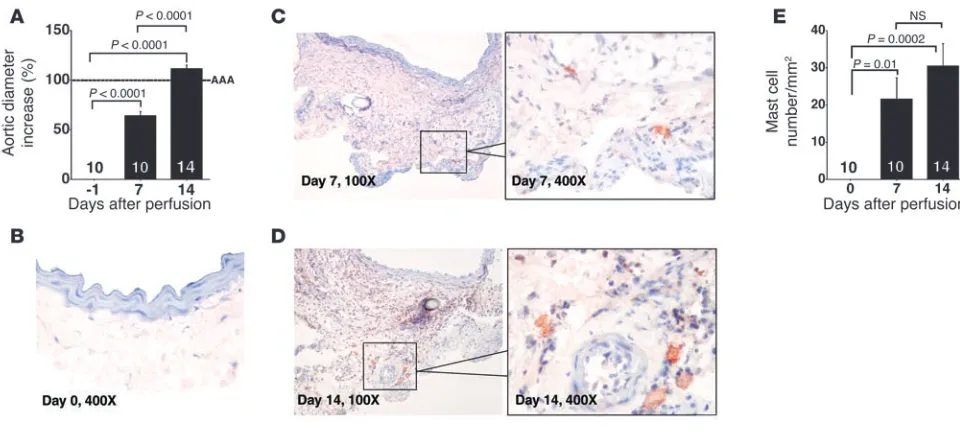
Mast cell accumulation and AAA formation. Biochemical observations revealed high numbers of chymase- and tryptase-positive mast cells in human AAA lesions and suggested an association of mast cell accumulation and AAA progression (8). To test this hypothesis, we used an established elastase perfusion model to produce AAA in mice (2, 4). In this model, the infrarenal aorta is locally exposed to pancreatic elastase, and aortic expansion forms over a period of 2 weeks as defined by an increase of aortic diameter by 100% greater than that before perfusion (4). Consistently, all mice developed AAA 14 days after elastase perfusion (Figure 1A). While normal aortas contained few if any mast cells (Figure 1, B and E), a sig-nificant increase of mast cell content appeared in the adventitia 7 days after perfusion (Figure 1, C and E) with further increase at 14 days after perfusion (Figure 1, D and E). Murine mast cells appear
predominantly in the adventitia (Figure 1, C and D). These obser-vations indicate that mast cells populate AAA induced by elastase perfusion and provide an opportunity to determine experimen-tally whether AAA formation requires mast cells.
Reduced AAA in mast cell–deficient mice. Accumulation of mast cells in AAA lesions suggests a participation of these cells in this disease. To test this hypothesis, we studied mast cell–deficient KitW-sh/KitW-sh
mice in the elastase perfusion–induced AAA model. KitW-sh/KitW-sh
mice contain a de novo inversion mutation consisting of a break point at the upstream regulatory region of the c-kit receptor gene that results in reduced Kit receptor expression and defective mast cell maturation and survival (17). However, this mutation does not affect the number or function of blood leukocytes, includ-ing lymphocytes (18). Elastase activities of bone marrow–derived neutrophils (6,185 ± 94 versus 6,195 ± 26, OD515nm; P = 0.92) and
blood monocytes (5,980 ± 167 versus 6,274 ± 62, OD515nm; P = 0.18)
showed no significant difference between WT mice and KitW-sh/
KitW-sh mice. At baseline, histological analysis did not reveal any
aortic wall elastin degradation, loss of medial SMCs, medial SMC apoptosis, or infiltration of macrophages and T cells in aortas from either WT or KitW-sh/KitW-sh mice before the elastase perfusion
(data not shown). However, KitW-sh/KitW-sh mice were protected from
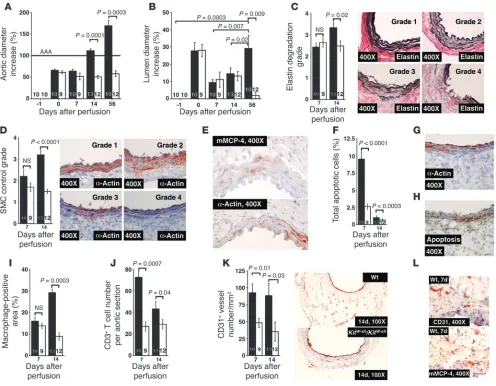
AAA formation during 56 days following elastase perfusion. After perfusion expansion (day 0), the abdominal aortas of KitW-sh/KitW-sh
mice showed no further expansion on days 7, 14, and 56, whereas all WT control mice had an average of more than 110% and approx-imately 170% aortic expansion 14 and 56 days after perfusion, respectively (Figure 2A). Importantly, while the lumen diameters of both WT and KitW-sh/KitW-sh mice increased at day 0 by nearly 30%
due to elastase perfusion, the lumen diameters of KitW-sh/KitW-sh
[image:3.585.49.529.80.296.2]mice decreased continuously to those of preperfusion at day 56 after perfusion. In contrast, although there was a decrease on day 7, lumen diameters of WT mice increased consistently over time and reached 30% at day 56 after perfusion (Figure 2B). Figure 1
research article
Therefore, the AAA protection in KitW-sh/KitW-sh mice at day 14
was largely due to attenuation of adventitial thickening, where-as AAA protection in KitW-sh/KitW-sh mice at 56 days was the result
of a combination of attenuation of both luminal expansion and adventitial thickening. Histological analysis of KitW-sh/KitW-sh mice
showed better preservation of the internal elastic laminae (IELs) (Figure 2C), consistent with higher medial SMC content on day 14, as determined by semiquantitative grading (Figure 2D). There-fore, reduced levels of medial SMCs in WT mice may result from enhanced IEL fragmentation and an increase in medial SMC death. Although most mast cells reside in the adventitia, clusters of mast
cells exist in the media where elastin degradation and SMC apop-tosis occur. Immunostaining of serial sections with mouse MCP-4
(mMCP-4) (mast cells) (19) and α-actin (SMCs) demonstrated
numerous mast cells but fewer SMCs in the media (Figure 2E), suggesting a role of mast cells in medial SMC apoptosis. Further, activated mast cells in the adventitia may also release granular con-tents capable of acting on cells at a distance, such as those in the media. Compared with KitW-sh/KitW-sh
mice, WT mice showed over-all more apoptotic cells on days 7 and 14 (~4-fold) (Figure 2F).
[image:4.585.45.541.82.468.2]By staining adjacent sections for both SMCs (α-actin) (Figure 2G) and apoptosis (TUNEL) (Figure 2H), we explored the contribution Figure 2
Characterization of AAA lesions in both WT (black bars) and KitW-sh/KitW-sh mice (white bars). (A) Aortic diameter–increase percentages in WT and KitW-sh/KitW-sh mice. (B) Lumen diameter–increase percentages in KitW-sh/KitW-sh and WT mice. (C) Medial elastin degradation in WT and
of cell death to the loss of medial SMCs. Media poor in α-actin had abundant TUNEL staining. Significantly reduced levels of macro-phages (Figure 2I) and CD3+ T cells (Figure 2J) in elastase-perfused KitW-sh/KitW-sh mice confirmed decreased inflammation.
Neovascularization plays an essential role in AAA formation, and its presence associates with AAA lesion rupture (20). To determine whether mast cells modulate neovascularization, we stained tissue sections with an anti-CD31 antibody and found a reduced content of adventitial CD31+ microvessels in KitW-sh/KitW-sh mice both 7 and
14 days after elastase infusion (Figure 2K). Immunostaining of AAA serial sections from WT mice with mMCP-4 and CD31 anti-bodies demonstrated the presence of both microvessels and mast cells in the adventitia (Figure 2L), indicating a possible interaction between mast cells and ECs.
Observations from the KitW-sh/KitW-sh mice show that mast cells
regulate AAA formation and suggest that they do so by modulating directly or indirectly the level of cellular inflammation, angiogen-esis, and SMC apoptosis in aortic wall. However, the present data do not exclude the possibility that the reduced inflammation observed resulted from decreased AAA formation rather than the converse.
Mast cells promote periaortic CaCl2-induced AAA formation. To further
test the hypothesis of mast cell participation in AAA pathogenesis, we induced AAA formation in WT and KitW-sh/KitW-sh mice using a
second model of experimental AAA (5). Six weeks after periaortic CaCl2 injury, aortic diameter in WT mice increased more than 70%.
[image:5.585.54.277.82.245.2]In contrast, KitW-sh/KitW-sh mice showed a less than 25% increase in
Figure 3
[image:5.585.74.511.384.647.2]Periaortic CaCl2-induced AAA. (A) WT mice showed much higher aortic expansion than KitW-sh/KitW-sh mice 6 weeks after periaortic CaCl2 injury. (B) Elastin degradation was also reduced in KitW-sh/KitW-sh mice. Repre-sentative photographs showing elastic laminae degradation are shown in the right panels. Data are presented as mean ± SE, and P < 0.05 was considered significant (Mann-Whitney test). Number of animals for each experiment is indicated in the bars. *Compared with WT mice.
Figure 4
research article
aortic diameter (Figure 3A) and preservation of the IEL (Figure 3B). Under these experimental conditions, no lumenal changes were noticed in WT mice 6 weeks after injury and absence of mast cells had no effect on lumen diameters. Our data presented in Figure 3, A and B, indicate that the prevention of AAA formation in KitW-sh/KitW-sh mice is independent of the animal models used.
Mast cell IL-6 and IFN-γ contribute to AAA formation. In KitW-sh/KitW-sh
mice, protection from AAA formation may result either from altered c-kit signaling caused by the inversion mutation of the c-kit receptor gene or the absence of mast cells. To differentiate these possibilities, we introduced bone marrow–derived mast cells (BMMCs) from WT mice and mice deficient in mast cell cytokines IL-6, IFN-γ, and TNF-α into the tail veins of KitW-sh/KitW-sh
mice using an established protocol (18, 19, 21, 22), followed by elastase perfusion to induce AAA formation. Reconstitution
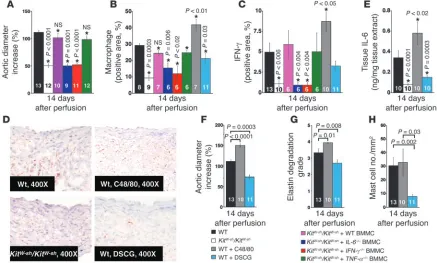
with WT BMMCs largely restored AAA formation and inflamma-tory cell (macrophages) infiltration in KitW-sh/KitW-sh mice 14 days
after elastase perfusion (Figure 4, A and B), confirming that the absence of mast cells, rather than altered c-kit signaling, protects
KitW-sh/KitW-sh mice from AAA formation. Despite TNF-α’s role in
mediating some forms of mast cell–associated inflammation (23),
KitW-sh/KitW-sh mice reconstituted with TNF-α–deficient BMMCs
developed AAA and enhanced macrophage accumulation similar to those achieved with WT BMMCs. In contrast, BMMCs from IL-6– or IFN-γ–deficient mice did not have these effects (Figure 4, A and B). Failed restoration of AAA in KitW-sh/KitW-sh
mice reconsti-tuted with IL-6– and IFN-γ–deficient BMMCs did not result from
altered maturation of IL-6– or IFN-γ–deficient BMMCs. Granular
morphology, tryptase production, and cell-surface expression of
[image:6.585.52.534.75.458.2]FcεR of IL-6– and IFN-γ–deficient BMMCs did not differ from
Figure 5
those of WT BMMCs (19). Further, immunostaining with anti-bodies against mouse chymase mMCP-4 demonstrated that the accumulation of IL-6– or IFN-γ–deficient mast cells that appeared in reconstituted KitW-sh/KitW-sh mouse abdominal aortas 14 days
after perfusion (19.3 ± 7.4 and 24.5 ± 3.7 mast cells/mm2
, respec-tively) did not differ significantly from that in abdominal aortas of WT or TNF-α–deficient BMMC-reconstituted KitW-sh/KitW-sh mice
(29.7 ± 6.8 and 20.2 ± 4.9 mast cells/mm2, respectively), indicating
similar recruitment of the IL-6– and IFN-γ–deficient mast cells to the abdominal aortas following elastase perfusion. Therefore, mast cell–derived IL-6 and IFN-γ may play key roles in aortic remodel-ing and expansion. In agreement with this hypothesis, aortas from
KitW-sh/KitW-sh mice and those reconstituted with IFN-γ– and IL-6–
deficient BMMCs had significantly fewer IFN-γ–positive areas
than those in aortic lesions from KitW-sh/KitW-sh mice reconstituted
with WT or TNF-α–deficient BMMCs (Figure 4, C and D). The
AAA tissue extract ELISA detected significant reduction of IL-6 in
KitW-sh/KitW-sh mice relative to WT mice (Figure 4E). Therefore, from
these experiments, we conclude that mast cell–derived IL-6 and IFN-γ play key roles in aortic remodeling and expansion.
Control of AAA by regulating mast cell activation. Activation of mast cells and the subsequent release of their granular constituents is a major mechanism whereby mast cells participate in pathobiological
processes (24). Mast cells likely affect AAA pathogenesis by releas-ing IL-6, IFN-γ (Figure 4, A–E), and possibly other unmeasured
molecules. Therefore, blocking IL-6 and IFN-γ
release might con- trol AAA formation, a hypothesis tested in atherosclerotic apoE-deficient mice (13). To determine whether regulation of mast cell activation controls AAA formation, we injected compound 48/80 (C48/80, 4 mg/kg/d), a mast cell degranulation agent, or DSCG (25 mg/kg/d), a mast cell stabilizer, i.p. during AAA formation. In WT mice, mast cell activation induced by C48/80 increased aortic expansion by 40% (Figure 4F). In contrast, the mast cell stabilizer DSCG reduced aortic expansion by 40%, suggesting that reduced mast cell degranulation limits AAA development. Further, increased AAA in C48/80-treated mice and decreased AAA in DSCG-treated mice corresponded with changes in IEL fragmentation (Figure 4G),
suggesting that mast cells regulate the activities of aortic elastases. Importantly, increased lesion sizes in C48/80-treated mice accom-panied enhanced lesion macrophage contents (Figure 4B) but did not alter lesion mast cell accumulation as detected by mMCP-4 immunostaining (Figure 4H), suggesting that C48/80 promotes mast cell activation or degranulation and thereby augments the release of mast cell mediators. Immunohistological analysis and ELISA of AAA tissue extracts from C48/80-treated mice revealed significantly higher levels of both IFN-γ (Figure 4, C and D) and IL-6 (Figure 4E), which could be the result of mast cell activation/degran- ulation by C48/80. In contrast, impaired AAA lesions in DSCG-treated mice also showed reduced mast cell numbers (Figure 4H),
macrophage contents (Figure 4B), and lesional IFN-γ (Figure 4,
C and D) and IL-6 (Figure 4E) levels, suggesting DSCG affects AAA beyond mast cell stabilization, possibly via an antiinflamma-tory effect (25). Alternatively, altered lesion macrophage contents
and IFN-γ
and IL-6 levels could also be secondary to correspond-ing changes of AAA lesion formation in C48/80- or DSCG-treated mice. Nevertheless, our data demonstrate an impact of C48/80 and DSCG in AAA growth and reveal a potential novel target for AAA prevention and management in humans.
Expression of elastinolytic cathepsins and MMPs in mouse AAA . Elas-tases play essential roles in arterial wall remodeling, including atherosclerosis and AAA. Deficiencies in elastinolytic cathepsins S (26), K (27), and L (16) reduce atherogenesis in mice. Mice defi-cient in cathepsins C (28) or S (unpublished data) and MMP-9 or MMP-2 (4, 5) also develop significantly less AAA in experimental models. Mast cells release a unique set of proteases, i.e., tryptase and chymase, that may participate in AAA directly or indirectly by activating MMP (11). Our recent in vitro study demonstrates that mast cells induce elastinolytic cathepsin expression in both aortic SMCs and ECs (19). Labeling the cysteine protease active
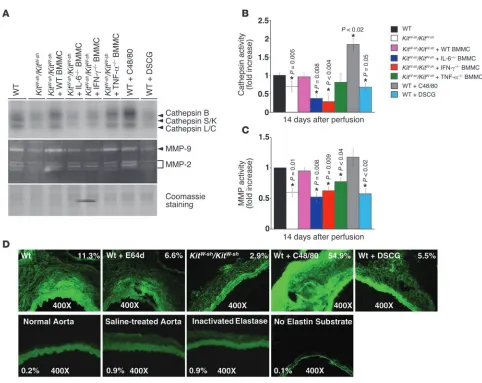
site with [125I]JPM (29) (Figure 5, A and B) and determining MMP
activity by gelatin zymography (Figure 5, A and C) (30) revealed much lower cathepsin and MMP activities in aortic extracts from
KitW-sh/KitW-sh mice than in WT mice 14 days after elastase
[image:7.585.45.409.82.314.2]perfusion. Importantly, the activities of cathepsin and MMP in Figure 6
research article
the aortas of KitW-sh/KitW-sh mice increased following reconstitution
with BMMCs from WT or TNF-α–deficient mice but not those
from IL-6– or IFN-γ–deficient mice (Figure 5, B and C), suggesting that mast cell–derived IL-6 and IFN-γ stimulate matrix-degrading protease IEL degradation (Figure 4, F and G). These observations agree with prior in vitro studies (19). BMMCs from IL-6- or IFN-γ– deficient mice produce less than 5% IL-6 or IFN-γ of those from WT
mice. In contrast, BMMCs from TNF-α–deficient mice release 50%
IL-6 and 30% IFN-γ of those from WT mice and thus may suffice
to induce vascular cell protease expression in vitro (19) and in vivo (Figure 5, B and C). Activities of both cathepsin (e.g., cathepsin B) and MMP (e.g., MMP-2) increased in aortic extracts from C48/80-treated mice but decreased to the levels found in KitW-sh/KitW-sh
mice following the stabilization of mast cells with DSCG (Figure 5, A–C) when both assays contained an equal amount of proteins (Figure 5A). In situ elastin zymography optimized for cysteine proteases (pH 5.5 with both EDTA and dithiothreitol) supported these observations. While negligible elastinolytic activities (green fluorescence in the adventitia) were detected in normal aorta, saline-treated aorta, and heat-inactivated elastase–treated aorta, AAA lesions in WT mice showed much higher elastinolytic activity than did those from KitW-sh/KitW-sh
mice, as indicated by the differ-ences in percentage area of adventitia fluorescence in Figure 5D. Media green fluorescence may come from both increased elastase activity in AAA lesions and intact elastin filament autofluores-cence, which also appeared in normal aorta and in experiments in which elastin substrate was not utilized (Figure 5D). The non-selective cathepsin inhibitor E64d (20 μM) greatly inhibited such activity in parallel sections. Increased AAA expansion (Figure 4F) and IEL fragmentation (Figure 4G) in mice treated with the mast cell activator C48/80 accompanied enhanced in situ activity of cathepsin elastase. Likewise, impaired AAA and reduced IEL degradation in DSCG-treated mice (Figure 4, F and G) may have resulted, at least in part, from a reduction in elastinolytic cathep-sin activity (Figure 5D). Omission of fluorogenic elastin substrate was utilized for the control (Figure 5D).
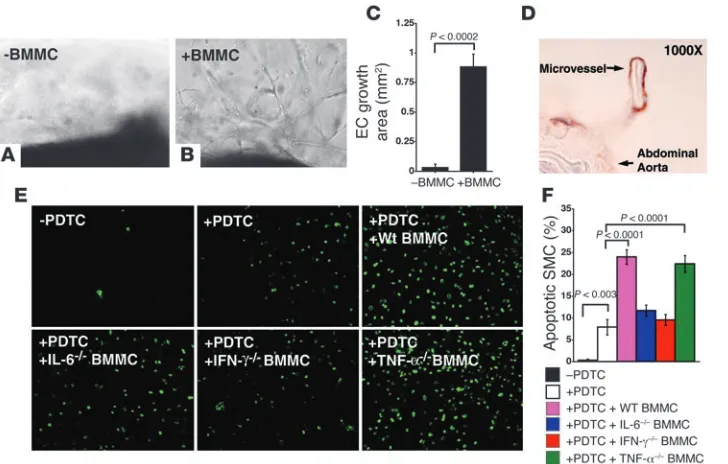
Role of mast cells in neovascularization and aortic SMC apoptosis. Angiogenesis and apoptosis, like elastinolysis, are common in human AAA (20). Inhibition of angiogenesis or apoptosis reduces AAA formation in rodents (31, 32). In KitW-sh/KitW-sh mice, decreases
in the number of microvessels (Figure 2K) and total apoptotic cells (Figure 2F) suggest that mast cells participate in these patho-logic events. After incubating mouse aortic rings in Matrigel with degranulated mast cell supernatant from WT mice (Figure 6, B and C) but not after incubation with culture medium alone (Figure 6, A and C), microvessel sprouting, similar to that seen in the aortic rings treated with IL-6–, IFN-γ–, and TNF-α–deficient mast cell supernatant (data not shown), occurred at substantial levels, suggesting that additional factors from mast cells con-tributed to microvessel growth in AAA. Immunostaining a cross section of the Matrigel with mouse CD31 antibody revealed well-formed microvessels derived from the aorta after stimulation with medium conditioned by mast cell degranulation (Figure 6D).
α-Actin staining of SMCs of AAA lesions in WT mice showed
areas negative for α-actin (Figure 2G) but rich in apoptotic cells (Figure 2H) in contrast to reduced apoptotic cells in lesions of
KitW-sh/KitW-sh mice (Figure 2F), consistent with a role of mast cells
in aortic SMC apoptosis (33). To identify mast cell–derived media- tors important for SMC apoptosis, we used pyrrolidine dithiocar-bamate (PDTC) with or without supernatant from degranulated
BMMCs to induce apoptosis of mouse aortic SMCs. TUNEL-positive cells appeared within hours. However, supernatant from
degranulated BMMCs from WT and TNF-α–deficient mice but not
that from IL-6– and IFN-γ
–deficient mice enhanced SMC apopto-sis (Figure 6, E and F), supporting a role of mast cell–derived IL-6
and IFN-γ in aortic SMC apoptosis.
Discussion
Although mast cells have been identified in human AAA lesions, evi-dence for a direct participation of mast cells in this vascular disease is lacking. The availability of mast cell–deficient mice and established mouse AAA models made it possible to determine whether these cells are essential mediators of AAA and not merely a hallmark.
This study used a BMMC reconstitution technique to determine whether mast cell–derived IL-6, IFN-γ, and TNF-α play a role in
AAA formation (Figure 4A). TNF-α is expressed in macrophages
and lymphocytes both in the atherosclerotic (34) and AAA (35) lesions. In ApoE–/– mice with diet-induced atherosclerosis, a lack
of TNF-α reduces atherosclerosis (36). In this model, TNF-α plays a proatherogenic role by upregulating expression of the vascular adhesion molecules ICAM-1 and VCAM-1 and the chemokine MCP-1 in the vascular wall and by inducing expression of scaven-ger receptor class A and uptake of oxidized LDLs in macrophages.
Although it remains to be determined whether TNF-α
plays a simi-lar role to that in atherosclerosis, both serum (37) and aneurysmal
tissues (35) from AAA patients have increased TNF-α
levels. How-ever, our data with TNF-α–/– mast cells did not support a direct
role of mast cell–derived TNF-α in AAA. This does not exclude the possibility that TNF-α plays a role in AAA formation; rather, it is
possible that TNF-α produced from other cells may compensate
for its absence from mast cells.
AAA formation requires mast cell IFN-γ and IL-6 but not TNF-α. Reconstitution of mast cell–deficient KitW-sh/KitW-sh mice with
IFN-γ–/– or IL-6–/– BMMCs did not restore the AAA phenotype
(Figure 4A). These observations agree with the findings in IFN-γ–/–
mice (3), which are protected from CaCl2-induced AAA. Both this
study (3) and others using a histocompatibility-mismatched aortic
transplantation model in IFN-γ receptor–deficient recipient mice
(6) demonstrated that Th2-slanted immune responses promote AAA formation. Indeed, mast cells from IL-6–/– and IFN-γ–/– mice
produce negligible IFN-γ and IL-6, suggesting cooperative regula-tion of these 2 cytokines (19). HeLa cells and monocytes exhibit
IFN-γ–regulated expression of IL-6 (38, 39). Enhanced IL-6 and
IFN-γ, which may come in part from mast cells, were detected in
cultured explants of human AAA lesions and in serum of AAA patients (15, 40). AAA sections or tissue extracts from WT mice
contained much higher levels of both IFN-γ and IL-6 than those
from KitW-sh/KitW-sh mice (Figure 4, C–E). In addition to their possible
roles in activating macrophages and inducing MMP and cysteine protease expression (41), which are also critical to AAA formation
(4, 5), IL-6 and IFN-γ appeared to regulate the formation of AAA
by modulating lesional SMC apoptosis (Figure 6, E and F). Our observations from in vitro cell-based assay and the murine AAA
model not only demonstrate that mast cell–derived IL-6 and IFN-γ
infected tissue compartments (43), macrophage and neutrophil TNF-α are required for resistance to intracellular Listeria infection,
and T cell TNF-α is required for protection from high bacterial
loads (44). Thus, while it may seem intuitive that, because cytokines are made by many cell types, the absence of their production by one cell type would be compensated for by their production by another cell type, when tested in experimental models, this compensation does not always prove to be true, and depending on the end point measured, a single cellular source of a cytokine can have profound influence over modulating that end point.
Our in vitro experiments demonstrate that mast cell–derived
IL-6 and IFN-γ
are required for apoptosis but not neovascular-ization. Insignificant differences in the microvessel growth from the aortic ring Matrigel assay between WT and IL-6–, IFN-γ–, and
TNF-α–deficient BMMCs suggest that mast cell mediators other
than IL-6, IFN-γ, and TNF-α modulate neovascularization in this assay even though IFN-γ, IL-6, and TNF-α have been implicated in angiogenesis. In fact, mast cell–derived bFGF, angiopoietin-1, chy-mase/tryptase, and a number of other proinflammatory cytokines and chemokines (45) have been implicated in angiogenesis. These mast cell mediators may have obscured the effect of mast cell IL-6, IFN-γ, and TNF-α in our in vitro assays (Figure 6, A–C).
Pharmacologic regulation of mast cell activation and degranula-tion directly controlled AAA formation in mice (Figure 4, F and G). These data not only strengthen the hypothesis that mast cells are essential mediators of AAA pathogenesis but also suggest that treatments blocking mast cell degranulation may prevent or delay AAA progression in humans. Compound 48/80 has been widely used to degranulate mast cells in live animals (46). Although the detailed mechanisms of how C48/80 activates mast cells need to be investigated further, recent observations suggest that C48/80 acts on mast cells via activation of phospholipase D (47) and Gαi3
G protein subunits (48) to trigger the release of histamine as well as other granule components including cathepsins and MMP-activat- ing chymases or cytokines, which may influence neighboring vascu-lar cells. This hypothesis is supported by the findings of increased cysteine protease and MMP activities, elevation of AAA tissue IFN-γ and IL-6, and enhanced medial elastin degradation in aortic tissues isolated from C48/80-treated mice (Figure 4). In contrast, DSCG is a drug widely used in the treatment of asthmatic patients. Obser-vations from in vitro tests and animal models show that the effect of DSCG is related to mast cell stabilization. Importantly, this compound reduces mouse AAA by 40% (Figure 4). Impaired AAA in DSCG-treated mice is likely due to reduced release of mast cell granule contents. This hypothesis is consistent with reduced AAA lesion cysteine protease and MMP activities and IFN-γ and IL-6 lev-els found in DSCG-treated mice (Figures 4 and 5).
While this study provides evidence that mast cells regulate AAA formation, it also leaves several important questions unanswered. First, depletion of neutrophils in mice impairs elastase perfusion–
induced AAA (2), and mice lacking T lymphocytes have protec-tion from CaCl2-induced AAA (3). Determination of whether lack
of mast cells in the current study affected the function of either neutrophils or T lymphocytes will require further investigation. Although we did not find significant differences of elastase activ-ity of neutrophils from WT and KitW-sh/KitW-sh mice, unrecognized
interactions between these cell types may exist. Second, it remains unknown what mediated the increased number of mast cells in the injured aortas following elastase perfusion. Five weeks after reconstitution, we detected few if any mast cells in the aortas. In
contrast, elastase perfusion enhanced mast cell numbers in the aortas. One possible explanation is that elastase perfusion induces aortic wall SMC expression of chemokines MCP-1 and RANTES (49), which may attract mast cells (50). Further, elastase perfusion may generate elastin degradation products that signal fibroblast, monocyte, and macrophage chemotaxis (51). Delineation of the exact mechanism will require further investigation. Third, mast cell–mediated neovascularization and SMC apoptosis remain poorly understood. Although our data suggest that SMC apoptosis involves mast cell–derived IFN-γ and IL-6, whether these cytokines regulate SMC apoptosis directly or indirectly remains unknown.
Our prior study demonstrated that mast cell IFN-γ
and IL-6 aug-ment SMC and EC expression of cysteine proteases (19), which participate in cell apoptosis (52). IFN-γ and IL-6 from mast cells may have induced cathepsin expression and further led to SMC apoptosis, a hypothesis that has not been tested in the current study. Fourth, it remains uncertain whether increased expression and activities of cathepsins and MMP in AAA lesions (Figure 5) come from mast cells or other vascular cells. Mast cells contain large quantities of cathepsins (53) and mast cell chymases that par-ticipate importantly in MMP activation (11). However, mast cell cytokines (e.g., IL-6 and IFN-γ) are known stimulators of cathepsin and MMP expression, and our previous study (19) and the current study demonstrate concurrently their importance in arterial wall remodeling. Therefore, it is possible that mast cells contribute to AAA by releasing both proteases and cytokines, a hypothesis that requires further investigation.
In summary, data from this study establish that mast cells play a role in the development of AAA by affecting matrix-degrading protease expression, medial SMC apoptosis, and microvessel growth. More importantly, our data suggest a novel and effective therapeutic strategy to control human AAA progression by preventing release of mast cell products using mast cell–stabilizing compounds.
Methods
AAA production. Eight- to ten-week-old male WT mice (from The Jackson Laboratory, C57BL/6 background) and male KitW-sh/KitW-sh mice (C57BL/6
background) (17, 21) were used for aortic elastase perfusion, as detailed elsewhere (4). Aortic diameters were measured before the surgery (day –1), immediately following elastase perfusion (day 0), and 7, 14, and 56 days after perfusion. Abdominal aortas were harvested at each time point. Lumen diameters were determined by measuring the lumen perim-eters of cross sections of frozen aortas.
To produce AAA by periaortic chemical injury, 8-week-old male mice were used for aorta CaCl2 injury as described (5). Aortic diameters were
measured before CaCl2 application and 6 weeks after the injury.
To harvest AAA tissues, after measuring the aortic diameter and collect-ing the blood, we removed the aortic zone of maximal expansion, either directly freezing the tissue for protein extraction or OCT embedding for cross section preparation. Immunohistological analysis used 6-μ m sec-tions while in situ elastin zymography used 8-μm cross sections. All mouse experiments were performed under a protocol preapproved by the Animal Research Committee of Harvard Medical School.
BMMC preparation and reconstitution. WT (C57BL/6), IFN-γ–/–
(con-genic C57BL/6, N10), IL-6–/– (congenic C57BL/6, N11), and TNF-α–/–
(C57BL/6*129/Sv, N1) mice were obtained from The Jackson Laboratory. TNF-α–/– mice were backcrossed to a congenic C57BL/6 background (N10).
stem cell factor (PeproTech) as reported (21). At this time, the cell popula-research article
tions consisted of more than 95% mast cells as assessed by the presence of metachromatic granules in toluidine blue–stained cells and FACS analy-sis for the disappearance of progenitor cell marker stem cell antigen-1. To reconstitute BMMCs in vivo, the tail veins of 5-week-old male KitW-sh/KitW-sh
mice were injected with BMMCs (1 × 10⁷ cells/mouse). Mice were perfused
with elastase to produce AAA 5 weeks after reconstitution.
Mast cell activation and stabilization in vivo. C48/80 activated the mast cells in WT mice, and DSCG stabilized the mast cells in WT mice. After mice (C57BL/6, male, 10 weeks old) recovered from elastase perfusion surgery (day 0), they received the first i.p. injection of C48/80 (Sigma-Aldrich, 4 mg/kg/d) or DSCG (Sigma-Aldrich, 25 mg/kg/d). Each animal received daily injection for the duration of the experiment thereafter (14 days).
Mast cell content measurement. Immunostaining with rabbit anti-mouse mMCP-4 antibody (1:150) determined the mast cell number on aortic sec- tions (19). Antibody specificity was confirmed using WT mouse AAA sec-tions immunostained with rabbit preimmune serum and KitW-sh/KitW-sh mouse
aortic sections immunostained with the mMCP-4 antibody at the same anti-body dilution. The total number of mMCP-4-positive cells on each section were counted manually and blindly, and the total area was determined using computer-assisted image analysis (Image-Pro Plus; MediaCybernetics).
Immunohistochemistry, ELISA, and lesion characterization. Frozen sections (6 μm) were stained for macrophages (Mac-3), T cells (CD3), SMCs (α-actin), ECs (CD31), mast cells (mMCP-4), elastin (Verhoeff–van Gieson), and IFN-γ as described previously (19, 26). Lesion apoptotic cells were determined with the In situ Apoptosis Detection kit according to the manufacturer’s instructions (Chemicon International). Elastin degradation and lesion SMC content were graded according to the grading keys shown in Figure 2, C and D. To determine lesion IL-6 levels, frozen aortas were pulverized for protein extraction in a pH 7.5 buffer containing 50 mM NaAc and 1% Tri-ton X-100. Protein concentration was determined with a BCA kit (Bio-Rad) and IL-6 levels measured by ELISA (R&D Systems). All immunostained cells were counted or calculated blindly by at least 2 observers.
Cysteine protease active site labeling and gelatin gel in situ zymogram. Pulverized aortic tissues were lysed in a pH 5.5 buffer. The cysteine protease activity in tissue lysates was determined with [125I]JPM labeling (2 μg protein/lane)
(29), and the MMP activity was assessed by in-gel gelatinase zymogram assay (5 μg protein/lane) as described (30). Equal protein loading (7 μg protein/ lane) was confirmed by SDS-PAGE followed with Coomassie staining.
Mast cell degranulation, aortic ring assay, and SMC apoptosis assay . In vitro–dif- ferentiated BMMCs were degranulated with mouse anti-DNP IgE mono-clonal antibody as described previously (54). Degranulation efficiency was calculated as follows: (experimental supernatant − control supernatant)/ (experimental supernatant + experimental cell lysates supernatant).
An aortic ring assay was used to test mast cell function in angiogenesis. In brief, a 96-well plate was coated with 50 μl of Matrigel (BD Biosciences). A 1-mm–long mouse aortic ring was laid on the top of the Matrigel and covered with 100 μl of Matrigel. After solidification, 100 μl of RPMI (10% FBS) with or without 100 μl of degranulated BMMC supernatant was added to each well. After 7–10 days of culture, the aortas were photo-graphed and the endothelial outgrowth was analyzed using Image-Pro Plus software. To confirm a microvessel phenotype of sprouts from the aortic ring, a Matrigel containing aortic ring and sprouts was embedded in OCT followed by sectioning and immunostaining with CD31.
Mouse aortic SMC apoptosis was induced with 50 μ M of PDTC (Sigma-Aldrich) as previously described with or without degranulated mast cell supernatant prepared from the same amount of BMMCs (55). Apoptotic SMCs were detected using the in situ cell death detection kit according to the manufacturer’s instructions (Roche Applied Science). Data were presented as mean ± SE of percentage of apoptotic cells.
In situ elastin zymography. AAA lesion elastinolytic activity was determined in 8-μM frozen sections using elastin conjugated with quenched fluorescein (DQ elastin; Invitrogen) as a substrate, which requires cleavage by elastino-lytic enzymes to become fluorescent. In brief, DQ elastin (1 mg/ml in H2O)
was mixed 1:10 with 1% low-melting agarose (Sigma-Aldrich). This mixture (20 μl) was added on top of each section, coverslipped, and gelled at 4°C. Following incubation at 37°C (48 hours), fluorescence was examined under fluorescent microscopy. Cysteine protease activity was determined using an EDTA-containing pH 5.5 buffer (56) with or without E64d (20 μ M). Zymo- graphic images were acquired using identical shutter conditions. The per-centage of fluorescence intensity of each cross section, excluding the media area due to medial elastin filament autofluorescence, was measured using computer-assisted image quantification (Image-Pro Plus software).
Neutrophil and monocyte elastase activity assay. Neutrophils from WT and
KitW-sh/KitW-sh
mice were prepared from bone marrow by gradient cen- trifugation. Bone marrow cells were overlaid on the top of 62.5% Per-coll (Sigma-Aldrich) followed by centrifugation at 600 g for 30 minutes. Purified neutrophils were lysed in a pH 8.5 buffer containing 150 mM NaCl, 200 mM Tris HCl, and 1% Triton X-100. Monocytes from WT and
KitW-sh/KitW-sh mice were isolated from blood by overlaying diluted blood
(1:1 in PBS) on LSM Lymphocyte Monocyte Separation Medium (LLC;
MP). Isolated monocytes were lysed in a pH 5.5 buffer containing 50 mM NaAc, 1% Triton X-100, and 12 mM dithiothreitol. Equal amounts of protein (60 μg) were added to a final volume of 100 μl with 50 μg of elastin conjugated with quenched fluorescein (DQ elastin; Invitrogen) followed by incubation at 37°C for 24 hours. Elastase activity was deter-mined by measuring the OD513nm.
Statistics. The statistical significance of data sets from this study was examined with a nonparametric Mann-Whitney test. Data from the gel densitometry analysis were also analyzed using the nonparametric Mann-Whitney test due to the relatively small sample sizes and the non-Gaussian distribution of the data. P values of less than 0.05 were con-sidered significant.
Acknowledgments
The authors thank Eugenia Shvartz for technical and Joan Perry for editorial assistance. This work is supported by NIH grants HL60942 and HL67283 (to G.-P. Shi), HL56985 (to P. Libby), HL67249 (to G.K. Sukhova), and HL75026 (to P.J. Wolters).
Received for publication December 21, 2006, and accepted in revised form July 26, 2007.
Address correspondence to: Guo-Ping Shi, Cardiovascular Medi-cine, NRB-7, 77 Avenue Louis Pasteur, Boston, Massachusetts 02115, USA. Phone: (617) 525-4358; Fax: (617) 525-4380; E-mail: [email protected].
1. Ailawadi, G., Eliason, J.L., and Upchurch, G.R., Jr. 2003. Current concepts in the pathogenesis of abdominal aortic aneurysm. J. Vasc. Surg. 38:584–588. 2. Eliason, J.L., et al. 2005. Neutrophil depletion
inhibits experimental abdominal aortic aneurysm formation. Circulation. 112:232–240.
3. Xiong, W., Zhao, Y., Prall, A., Greiner, T.C., and Baxter, B.T. 2004. Key roles of CD4+ T cells and
IFN-gamma in the development of abdominal aortic aneurysms in a murine model. J. Immunol. 172:2607–2612.
4. Pyo, R., et al. 2000. Targeted gene disruption of matrix metalloproteinase-9 (gelatinase B) sup-presses development of experimental abdominal aortic aneurysms. J. Clin. Invest. 105:1641–1649. 5. Longo, G.M., et al. 2002. Matrix metalloproteinases
2 and 9 work in concert to produce aortic aneu-rysms. J. Clin. Invest. 110:625–632. doi:10.1172/ JCI200215334.
6. Shimizu, K., Shichiri, M., Libby, P., Lee, R.T., and Mitchell, R.N. 2004. Th2-predominant inflam-mation and blockade of IFN-γ signaling induce aneurysms in allografted aortas. J. Clin. Invest.
7. Metzler, B., and Xu, Q. 1997. The role of mast cells in atherosclerosis. Int. Arch. Allergy Immunol. 114:10–14. 8. Ihara, M., et al. 1999. Increased chymase-dependent
angiotensin II formation in human atherosclerotic aorta. Hypertension. 33:1399–1405.
9. Gurish, M.F., and Boyce, J.A. 2006. Mast cells: ontogeny, homing, and recruitment of a unique innate effector cell. J. Allergy Clin. Immunol.
117:1285–1291.
10. Li, M., et al. 2004. Involvement of chymase-medi-ated angiotensin II generation in blood pressure regulation. J. Clin. Invest. 114:112–120. doi:10.1172/ JCI200420805.
11. Tchougounova, E., et al. 2005. A key role for mast cell chymase in the activation of pro-matrix metal-loprotease-9 and pro-matrix metalloprotease-2.
J. Biol. Chem. 280:9291–9296.
12. Tsunemi, K., et al. 2004. A specific chymase inhibi- tor, 2-(5-formylamino-6-oxo-2-phenyl-1,6-dihydro- pyrimidine-1-yl)-N-[[3,4-dioxo-1-phenyl-7-(2-pyri-dyloxy)]-2-heptyl]acetamide (NK3201), suppresses development of abdominal aortic aneurysm in hamsters. J. Pharmacol. Exp. Ther. 309:879–883. 13. Huang, M., Pang, X., Karalis, K., and Theoharides,
T. C. 2003. Stress-induced interleukin-6 release in mice is mast cell-dependent and more pronounced in apolipoprotein E knockout mice. Cardiovasc. Res.
59:241–249.
14. Liu, J., et al. 2004. Lysosomal cysteine proteases in atherosclerosis. Arterioscler. Thromb. Vasc. Biol.
24:1359–1366.
15. Newman, K.M., Jean-Claude, J., Li, H., Ramey, W.G., and Tilson, M.D. 1994. Cytokines that acti-vate proteolysis are increased in abdominal aortic aneurysms. Circulation. 90:II224–II227.
16. Kitamoto, S., et al. 2007. Cathepsin L deficiency reduces diet-induced atherosclerosis in low-densi-ty lipoprotein receptor-knockout mice. Circulation.
115:2065–2075.
17. Duttlinger, R., et al. 1995. The Wsh and Ph muta- tions affect the c-kit expression profile: c-kit misex-pression in embryogenesis impairs melanogenesis in Wsh and Ph mutant mice. Proc. Natl. Acad. Sci. U. S. A.
92:3754–3758.
18. Grimbaldeston, M.A., et al. 2005. Mast cell-defi-cient W-sash c-kit mutant Kit W-sh/W-sh mice as a model for investigating mast cell biology in vivo.
Am. J. Pathol. 167:835–848.
19. Sun, J., et al. 2007. Mast cells promote atheroscle-rosis by releasing pro-inflammatory cytokines.
Nat. Med. 13:719–724.
20. Choke, E., et al. 2006. Abdominal aortic aneurysm rup- ture is associated with increased medial neovascular-ization and overexpression of proangiogenic cytokines.
Arterioscler. Thromb. Vasc. Biol. 26:2077–2082. 21. Wolters, P.J., et al. 2005. Tissue-selective mast cell
reconstitution and differential lung gene expres-sion in mast cell-deficient Kit(W-sh)/Kit(W-sh) sash mice. Clin. Exp. Allergy. 35:82–88.
22. Tanzola, M.B., Robbie-Ryan, M., Gutekunst, C.A., and Brown, M.A. 2003. Mast cells exert effects out- side the central nervous system to influence exper-imental allergic encephalomyelitis disease course.
J. Immunol. 171:4385–4391.
23. Nakae, S., et al. 2005. Mast cells enhance T cell acti-vation: importance of mast cell-derived TNF. Proc. Natl. Acad. Sci. U. S. A. 102:6467–6472.
24. Woolley, D.E. 2003. The mast cell in inflammatory arthritis. N. Engl. J. Med. 348:1709–1711. 25. Shichijo, M., et al. 1998.The effects of anti-asthma
drugs on mediator release from cultured human mast cells. Clin. Exp. Allergy. 28:1228–1236. 26. Sukhova, G.K., et al. 2003. Deficiency of cathepsin
S reduces atherosclerosis in LDL receptor-deficient mice. J. Clin. Invest. 111:897–906. doi:10.1172/ JCI200314915.
27. Lutgens, E., et al. 2006. Disruption of the cathep-sin K gene reduces atherosclerosis progression and induces plaque fibrosis but accelerates macrophage foam cell formation. Circulation. 113:98–107. 28. Pagano, M.B., et al. 2007. Critical role of dipeptidyl
peptidase I in neutrophil recruitment during the development of experimental abdominal aortic aneu-rysms. Proc. Natl. Acad. Sci. U. S. A. 104:2855–2860. 29. Shi, G.P., Munger, J.S., Meara, J.P., Rich, D.H.,
and Chapman, H.A. 1992. Molecular cloning and expression of human alveolar macrophage cathep-sin S, an elastinolytic cysteine protease. J. Biol. Chem.
267:7258–7262.
30. Fang, K.C., Raymond, W.W., Lazarus, S.C., and Caughey, G.H. 1996. Dog mastocytoma cells secrete a 92-kD gelatinase activated extracellularly by mast cell chymase. J. Clin. Invest. 97:1589–1596. 31. Miwa, K., et al. 2005.Inhibition of ets, an essential
transcription factor for angiogenesis, to prevent the development of abdominal aortic aneurysm in a rat model. Gene Ther. 12:1109–1118.
32. Wang, Y.X., et al. 2005. Fasudil, a Rho-kinase inhib-itor, attenuates angiotensin II-induced abdominal aortic aneurysm in apolipoprotein E-deficient mice by inhibiting apoptosis and proteolysis. Circulation.
111:2219–2226.
33. Leskinen, M., Wang, Y., Leszczynski, D., Lindstedt, K.A., and Kovanen, P.T. 2001. Mast cell chymase induces apoptosis of vascular smooth muscle cells.
Arterioscler. Thromb. Vasc. Biol. 21:516–522. 34. Barath, P., et al. 1990. Tumor necrosis factor gene
expression in human vascular intimal smooth muscle cells detected by in situ hybridization. Am. J. Pathol. 137:503–509.
35. Hamano, K., et al. 2003. Enhanced tumor necrosis factor-alpha expression in small sized abdominal aortic aneurysms. World J. Surg. 27:476–480. 36. Ohta, H., et al. 2005. Disruption of tumor necrosis
factor-alpha gene diminishes the development of atherosclerosis in ApoE-deficient mice. Atherosclerosis.
180:11–17.
37. Fiane, A.E., et al. 2003. Mechanism of comple-ment activation and its role in the inflammatory response after thoracoabdominal aortic aneurysm repair. Circulation. 108:849–856.
38. Faggioli, L., et al. 1997. Molecular mechanisms regulating induction of interleukin-6 gene tran-scription by interferon-gamma. Eur. J. Immunol.
27:3022–3030.
39. Biondillo, D.E., Konicek, S.A., and Iwamoto, G.K.
1994. Interferon-gamma regulation of interleukin 6 in monocytic cells. Am. J. Physiol. 267:L564–L568. 40. Jones, K.G., et al. 2001. Interleukin-6 (IL-6) and the prognosis of abdominal aortic aneurysms. Circulation.
103:2260–2265.
41. Wang, Z., et al. 2000. Interferon gamma induction of pulmonary emphysema in the adult murine lung. J. Exp. Med. 192:1587–600.
42. Leon, M.L., and Zuckerman, S.H. 2005. Gamma interferon: a central mediator in atherosclerosis.
Inflamm. Res. 54:395–411.
43. Echtenacher, B., Mannel, D.N., and Hultner, L. 1996. Critical protective role of mast cells in a model of acute septic peritonitis. Nature. 381:75–77.
44. Grivennikov, S.I., et al. 2005. Distinct and nonre-dundant in vivo functions of TNF produced by t cells and macrophages/neutrophils: protective and deleterious effects. Immunity. 22:93–104. 45. Hiromatsu, Y., and Toda, S. 2003. Mast cells and
angiogenesis. Microsc. Res. Tech. 60:64–69.
46. Paton, W.D. 1951. Compound 48/80: a potent hista-mine liberator. Br. J. Pharmacol. Chemother. 6:499–508. 47. Lappalainen, H., Laine, P., Pentikainen, M.O.,
Sajantila, A., and Kovanen, P.T. 2004. Mast cells in neovascularized human coronary plaques store and secrete basic fibroblast growth factor, a potent angiogenic mediator. Arterioscler. Thromb. Vasc. Biol.
24:1880–1885.
48. Aridor, M., Rajmilevich, G., Beaven, M.A., and Sagi- Eisenberg, R. 1993. Activation of exocytosis by the het-erotrimeric G protein Gi3. Science. 262:1569–1572. 49. Colonnello, J.S., et al. 2003. Transient exposure to
elastase induces mouse aortic wall smooth muscle cell production of MCP-1 and RANTES during development of experimental aortic aneurysm.
J. Vasc. Surg. 38:138–146.
50. Conti, P., and DiGioacchino, M. 2001. MCP-1 and RANTES are mediators of acute and chronic inflammation. Allergy Asthma Proc. 22:133–137. 51. Hunninghake, G.W., et al. 1981. Elastin fragments
attract macrophage precursors to diseased sites in pulmonary emphysema. Science. 212:925–927. 52. Stoka, V., Turk, B., and Turk, V. 2005. Lysosomal
cysteine proteases: structural features and their role in apoptosis. IUBMB Life. 57:347–353. 53. Henningsson, F., Wolters, P., Chapman, H.A.,
Caughey, G.H., and Pejler, G. 2003. Mast cell cathepsins C and S control levels of carboxypepti-dase A and the chymase, mouse mast cell protease 5.
Biol. Chem. 384:1527–1531.
54. Wolters, P.J., Pham, C.T., Muilenburg, D.J., Ley, T.J., and Caughey, G.H. 2001. Dipeptidyl pepti- dase I is essential for activation of mast cell chy-mases, but not tryptases, in mice. J. Biol. Chem.
276:18551–18556.
55. Tsai, J.C., et al. 1996.Induction of apoptosis by pyrrolidinedithiocarbamate and N-acetylcyste-ine in vascular smooth muscle cells. J. Biol. Chem.
271:3667–3670.