© 2015, IRJET ISO 9001:2008 Certified Journal
Page 1127
NETWORK LIFETIME ENRICHMENT PROTOCOL FOR WIRELESS
SENSOR NETWORKS USING EESEP PROTOCOL
N.Thamizhamuthan
1, T.Prabakaran
21
PG Scholar, ECE Department, SNS College of Technology, Tamilnadu, India
2Associate Professor, ECE Department & SNS College of Technology, Tamilnadu, India
---***---Abstract— The impact of heterogeneity of nodes, in terms of their energy, in wireless sensor networks that are hierarchically clustered are considered. This sensor are randomly distributed and are not mobile, the coordinates of the sink and the dimensions of the sensor field are known. Behavior of such sensor networks becomes unstable once the first node dies (FND), especially in the presence of node heterogeneity. Energy Efficient stable election routing protocol (EESEP), is based on weighted election probabilities of each node to act as a cluster head according to remaining energy in each node. Simulation that EESEP always prolongs the stability period compared to that LEACH is obtained using current clustering protocols.
Keywords: Energy Efficient, Routing Protocol, Wireless Sensor Networks, Energy Efficient Stable Election Routing Protocol (EESEP)
1. INTRODUCTION
Wireless sensor network has appeared as an important area for research and development. The key constraints in the development of wireless sensor networks (WSN) are cost, limited energy and memory, limited computational capability, and the memory size of the sensor nodes. WSN are working as long as they can communicate sensed data to manage particular node. Sensing and communication are essential activities and they consume energy so power executive and coverage preservation can effectively network lifetime increase. In some protocols sensor nodes transmit their data directly to a BS. The most important feature of a routing protocol is reduced energy consumption and extension of the network’s lifetime. During the recent years, more energy efficient routing protocols have been proposed for WSNs.
The technology for sensing and manage includes electric and magnetic field sensors, radio-wave frequency sensors. Sensor is typically deployed in a high-density manner and in large quantities. One of the component of wireless sensor network an assembly of calculated or localized sensors, an interconnecting
network, a central point of information clustering and a set of computing sources at the central point to handle data correlation, event trending, status querying, and data mining.
2. LITERATURE REVIEW
Low-energy adaptive clustering hierarchy (LEACH)
One of the hierarchical network routing protocols is low-energy adaptive clustering hierarchy (LEACH), which has been broadly accepted for its energy efficiency. LEACH as a hieratical protocol to randomly select a few sensor nodes as cluster heads and rotates this role to evenly share the energy load among the sensors in the network. If the cluster heads were chosen a priori and stable throughout the system lifetime, these nodes would fast use up their limited energy. Once the cluster head (CHs) runs out of energy, it is no longer operational.
Thus, low-energy adaptive clustering hierarchy (LEACH) incorporates randomized revolution of the high energy cluster head location among the sensors to avoid draining the battery of special one sensor in the network. In this way, the cluster head is evenly share the energy to all the nodes. The operation of low – energy adaptive clustering hierarchy (LEACH) is divided into rounds.
2.1. Self-configuring cluster formation phase
© 2015, IRJET ISO 9001:2008 Certified Journal
Page 1128
decisions made autonomously by each node.
2.1.1. Cluster Head Selection Algorithm
At the creation of the setup phase, a round of cluster head (CH) selection start. The cluster-head election process ensures that this role among sensor nodes, thereby distributing energy consumption evenly across all network nodes. Each and every Sensor node chooses a random number, r, between 0 and 1. The node becomes a cluster head for the current round if the number is less than the following threshold
Where p is the desired percentage of cluster heads
(e.g. 0.1), r is the current round (time interval for all
nodes to send data to their respective cluster-heads),
and G is the set of nodes that have not been cluster
heads in the last 1/ rounds. Then all the non CH nodes, decide on the cluster to which they want to belong.
2.1.2. Cluster Formation Algorithm
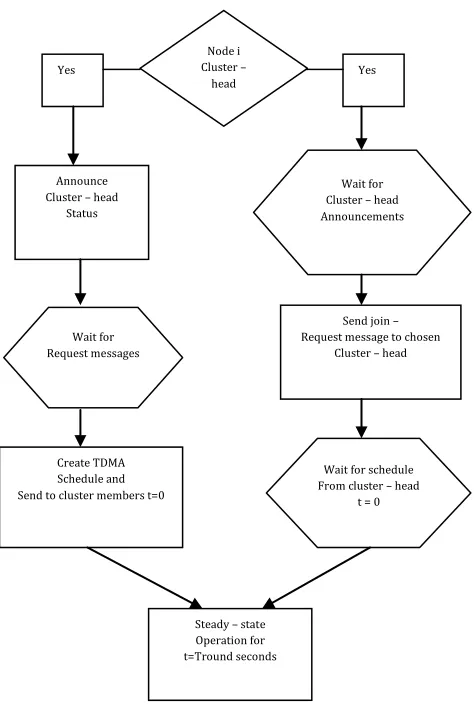
Once the nodes have elected themselves to be cluster heads, the cluster head nodes must let all the other nodes in the network know that they have chosen this role for the current round. To do this, each cluster head node broadcasts an advertisement message (ADV) using a non-persistent carrier-sense multiple access (CSMA) MAC protocol.
This message is a small message containing the node’s ID and a header that distinguishes this message as an announcement message. Each non cluster nead node determines its cluster for this round by choosing the cluster head that requires the minimum communication energy, based on the received signal strength of the advertisement from each CH. After each node has decided to which cluster it belongs, it must inform the Cluster head (CH) that it will be a member of the cluster.
[image:2.595.320.538.111.426.2]Each node transmits a join-request message (Join-REQ) back to the chosen cluster head using a non-persistent a non-non-persistent carrier-sense multiple access CSMA MAC protocol. This message is again a short message, consisting of the node’s ID and the cluster head’s ID. The cluster head node sets up a Time Division Multiple Access (TDMA) schedule and transmits this schedule to the nodes in the cluster.
Fig - 1: Flow-chart of the distributed cluster formation algorithm for LEACH.
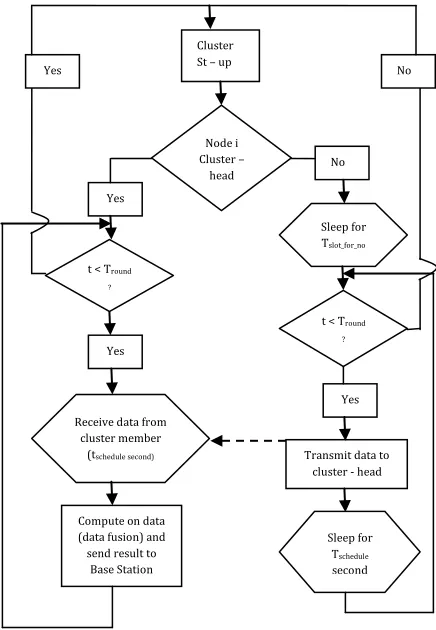
This ensures that there are no collisions among data messages and also allows the radio components of each non CH node to be turned off at all times except during their transmit time, thus reducing the energy consumed by the individual sensors. After the TDMA schedule is known by all nodes in the cluster, the set-up phase is complete and the steady-state operation (data transmission) can begin. LEACH flowchart and architecture are depicted figure 1 and 2, respectively.
Base station (Level 3)
Cluster of sensors
Cluster head
…
(Level 2)
Base station
… … …
[image:2.595.341.555.596.725.2](Level 3)
Fig - 2: LEACH architecture organized into three levels: BS level, CH level and Sensor node level.
t < Tround ?
Yes
Yes Receive data from
cluster member
(tschedule second) Transmit data to
cluster - head
Compute on data (data fusion) and send result to
Base Station
Sleep for Tschedule
second Node i
Cluster –
head No
Yes
t < Tround ?
Sleep for Tslot_for_no
Cluster
St – up No
© 2015, IRJET ISO 9001:2008 Certified Journal
Page 1129
2.2. Steady-state phase
This phase is broken into frames, as depicted in figure 3,
Fig - 3: Flow graph of the steady-state operation for LEACH.
Where nodes send their data to the CH at most once per frame during their distributed transmission slot. Every slot is constant, so the time for a frame of data transfer depends on the number of nodes in the cluster.
3. DESCRIPTION OF THE PROPOSED ALGORITHM
EESEP is based on weighted election probabilities of each node to become cluster head (CHs) unity of the remaining energy in each node. Simulation that EESEP always prolongs the stability period evaluate to the one obtained using current clustering protocols. We conclude by studying the sensitivity of our EESEP protocol to heterogeneity parameters capturing energy imbalance in the network. These nodes will be equipped with extra energy than the nodes that are already in use, which creates heterogeneity in terms of node energy.
3.1. Contribution
The sink is not energy partial and that the direct of the sink and the dimensions of the field are known. Assume that the nodes are uniformly allocated over the field and they are not mobile. This model, we propose a new protocol, we call EESEP, for selected cluster heads in a distributed fashion in 2-level hierarchical wireless sensor networks, EESEP is heterogeneous-aware, in the sense that selection probabilities are weighted by the initial energy of a node relative to that of other nodes in the network.
3.2. EESEP Protocol
Energy efficient Stable Election routing Protocol (EESEP), which is based on the initial energy of the nodes. This solution is more applicable compared to any other solution which assumes that each node knows the total energy of the network and then adapts its election possibility to become a cluster head according to its remaining energy.
3.3. Energy model analysis
[image:3.595.42.279.167.519.2]Analyzing two protocols –LEACH, EESEP-based on the energy dissipation model shown in the following figure
Fig - 4: Energy dissipation diagram
For a particular node, dissipate the receiving and transmitting energy. The energy expanded in transmitter to transmit k-bit message is given by
ET(k,d) = (Eelec * k) + (Efs*k*d2) if d<=d0
(Eelec * k) + (Emp*k*d4) if d>d0
Energy dissipation to receive a k-bit message is given by
ER(k) = Eelec* k
Yes Yes
Node i Cluster –
head
Announce Cluster – head
Status
Send join – Request message to chosen
Cluster – head
Create TDMA Schedule and Send to cluster members t=0
Steady – state Operation for t=Tround seconds
Wait for Cluster – head Announcements
Wait for Request messages
Wait for schedule From cluster – head
t = 0
K bit packet K bit packet Transmit
Electronic s
TX Amplifier
Receive Electronics Eelec* k
ET(k,d)
Eelec* k Efs*k*dλ
Er(k)
[image:3.595.335.536.436.612.2]© 2015, IRJET ISO 9001:2008 Certified Journal
Page 1130
4. SIMULATION RESULTS
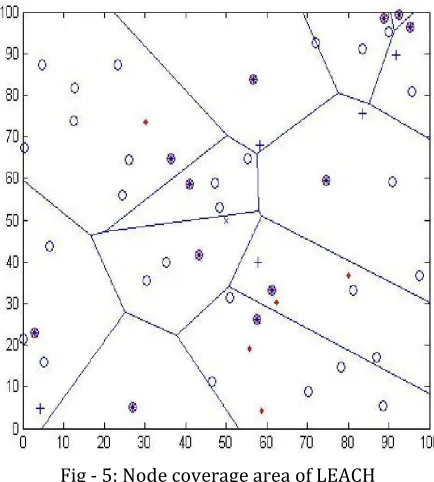
[image:4.595.324.531.133.362.2]As a performance metric, we compare the efficiency of energy consumption of the networks. The comparison is done between the LEACH and EESEP protocol with the new technique under the same simulation condition and values. In the first scheme, LEACH, the selection of CHs is based on a predetermined probability. The proposed EESEP with typical distributed clustering protocols LEACH by using performance metrics including the variance of energy level, the number of nodes alive over simulation time, number of data received at the sink, and the average lifetime.
Fig - 5: Node coverage area of LEACH
Simulate a clustered wireless sensor network in a field with dimensions 200m × 200m. The total number of sensors n = 100. The nodes, both normal and advanced, are randomly circulated over the field. This means that the horizontal and vertical coordinates of each sensor are accidentally selected between value 0 and the maximum value of the dimension.
The reason is that after the death of a considerable number of nodes, the cluster head selection process becomes unstable and as a result fewer nodes become cluster heads (CHs). Even worse, during the final rounds, there are only few rounds where more than one cluster head is elected.
Our simulation results are shown in Fig 5. Although the length of the stability region is pretty secure, LEACH takes more benefit of the presence of heterogeneity manifested in a higher number of advanced nodes. First
[image:4.595.55.272.289.530.2]node dies (FND) at 750 rounds.
Fig - 6: Node coverage area of EESEP
Simulation results are shown in Fig 6. Although the length of the stability region is pretty secure, EESEP takes more advantage of the presence of heterogeneity manifested in a higher number of advanced nodes. First Node Dies at 816 rounds.
Rounds
840
820
800
780
760 Rounds
740
720
700
LEACH EESEP
Fig - 7: Network Lifetime (stability) of LEACH and EESEP
[image:4.595.316.526.468.642.2]© 2015, IRJET ISO 9001:2008 Certified Journal
Page 1131
consumption comparison graph of LEACH and EESEP schemes are as shown in Figure 7.
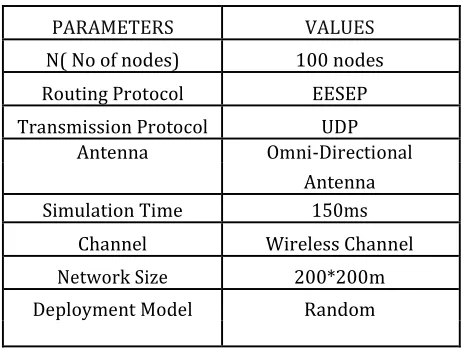
[image:5.595.51.282.193.368.2]The table represented below depicts the various parameters considered for simulation in MATLAB.
Table - 1: Design Parameters and Values
PARAMETERS VALUES
N( No of nodes) 100 nodes
Routing Protocol EESEP
Transmission Protocol UDP
Antenna Omni-Directional
Antenna
Simulation Time 150ms
Channel Wireless Channel
Network Size 200*200m
Deployment Model Random
5. CONCLUSION
Energy Efficient stable election routing protocol architecture, reduce energy consumption by using clustering technique, therefore increase system lifetime. Energy Efficient stable election routing protocol (EESEP) so every sensor node in a heterogeneous
two-level hierarchical network independently selected itself
as a cluster head based on its initial energy relative to that other nodes. The performance evaluation in terms of network lifetime and coverage was conducted using MATLAB. EESEP is more stable because FND at 816 rounds is more than as compare to LEACH values of which are 750 rounds. The future work includes providing security integration of EESEP with MAC protocol that can provide low cost information about the distribution of energy in the vicinity of each node.
REFERENCES
[1]. Jenq-Shiou Leu, Member, IEEE, Tung-Hung Chiang,
Min-Chieh Yu, and Kuan-Wu Su, “Energy Efficient
Clustering Scheme for Prolonging the Lifetime of
Wireless Sensor Network With Isolated Nodes”, Vol. 19, No. 2, February 2015.
[2]. Davood Izadi, Jemal Abawajy, and Sara Ghanavati, “An Alternative Clustering Scheme in WSN”, Vol. 15, No. 7, July 2015.
[3]. Mathumathi, Manjusha.T.M, “A QoS – oriented distributed routing protocol for hybrid wireless
networks” Vol. 4, Issue 1,January 2015.
[4]. Khushbu Babbar1, Kusum Lata Jain2 and G.N.
Purohit3, “Implementation of energy efficient coverage aware routing protocol for wireless sensor network using genetic algorithm” (IJFCST), Vol.5, No.1, January 2015.
[5]. Deepa V. Jose and Dr.G.Sadashivappa,”A novel energy efficient routing algorithm for wireless sensor network using sink mobility”(IJWMN) Vol. 6,No. 6,December 2014.
[6]. Pantazis N. A., Nikolidakis S.A. and Vergados D.D. (2013) ‘Energy-efficient routing protocols in wireless sensor networks: A survey,’ IEEE Commun. Surveys Tuts., Vol. 15, No. 2, pp. 551– 591.
[7]. Papadopoulos A. (2012)‘An energy efficient routing
protocol for dense and mobile sensor networks’, Journal of Network and Computer Applications, Vol. 35(4), pp. 1177-1190.
[8]. Kumar D., Aseri T.C. and Patel R.B. (2009) ‘Energy
efficient heterogeneous clustered scheme for wireless sensor networks’, Elsevier Comp. Comm., 32, (4), pp. 662–667.
[9]. Kim H. W. and Seo H.S.(2010) ‘Modeling of
Energy-efficient Applicable Routing Algorithm in WSN’, International Journal of Digital Content Technology and its Applications, Vol. 4, No. 5, pp.13-22.