INTERIOR NOISE REDUCTION APPROACH FOR MONORAIL SYSTEM
DJAMAL HISSEIN DIDANE
A thesis submitted in
fulfillment of the requirement for the award of the Degree of Master of Science in Railway Engineering
Center For Graduate Studies Universiti Tun Hussein Onn Malaysia
v
ABSTRACT
TABLE OF CONTENTS
TITLE i
DECLERATION ii
DEDICATION iii ACKNOLEDGEMENTS iv ABSTRACT v
TABLE OF CONTENTS vi
LIST OF TABLES x
LIST OF FIGURES xii
LIST OF SYMBOLS AND ABBREVIATION xv LIST OF APPENDICES xvi
CHAPETR 1 INTRODUCTION 1
1.1 Background 1
1.2 Problem statement 1.3 Aim
3 3
1.4 Objective 3
1.5 Scope of study 4
1.6 Significance of study 1.7 Research limitations
4 4
CHAPTER 2 LITERATURE REVIEW 5
2.1 Introduction 5
2.2 Acoustic noise in railway trains 5 2.3 Noise in the environment
2.3.1 Energy environmental advantage of railways 8 11
2.4 Mechanism of noise generation 13
vii
2.5.1 Viscoelastic damping materials 18
2.5.2 Rolling noise 21
2.5.2.1 Wheel design 2.5.2.2 Wheel dynamics
23
24 2.5.2.3 Track design
2.5.2.4 Track dynamics
25 26
2.5.2.5 Braking system 26
2.5.2.6 Local shielding 26
2.5.3 Aerodynamic noise 27
2.5.3.1 Pantograph noise 28
2.5.3.2 Aerodynamic noise in the bogie area 2.5.3.3 Nose of the power car
29 30
2.5.4 Locomotive exhaust noise 30
2.5.5 Traction motor noise 32
2.5.6 Cooling fans 32
2.5.7 Structure born noise 33
2.5.8 Horn noise 33
2.5.9 Curve squeal 34
2.6 Recommended exposure limit (REL) 2.7 Literature review summary
34
37
CHAPTER 3 METHODOLOGY 39
3.1 Introduction 39
3.2 The details of the experimental samples 42
3.3 Experimental equipment 42
3.3.1 Sound level meter 42
3.3.2 Impedance tube kit 45
3.3.3 Acrylic box 46
3.4 Testing materials 47
3.4.1 Rubber sheet 47
3.4.2 Aluminum composite 48
3.4.3 Paper composite 51
3.5 Testing procedure 53
3.6.1 Decibel (dB) 54 3.6.2 Sound power and pressure level 55
3.6.3 Sound equivalent level 56
3.6.4 Sound intensity level 56
3.6.5 Acoustic impedance 57
3.7 Current existing interior noise level 58 3.8 Selection and measuring techniques 60 3.9 Experimental work 61
CHAPTER 4 RESULTS AND DISCUSSION 63
4.1 Introduction 63
4.2 Empty box 64
4.3 Rubber sheet 65
4.3.1 Acoustic properties 65
4.3.2 R3 67
4.3.3 R6 70
4.3.4 R9 72
4.3.5 Comparison between R3, R6 & R9 75
4.4. Aluminum composite 77
4.4.1 Acoustic properties 77
4.4.2 AC3 78
4.4.3 AC6 81
4.4.4 AC9 83
4.4.5 Comparison between AC3, AC6 & AC9 86
4.5 Paper composite 88
4.5.1 Acoustic properties 88
4.5.2 PC3 89
4.5.3 PC6 92
4.5.4 PC9 94
4.5.5 Comparison between PC3, PC6 & PC9 97
4.6 Comparison of all samples 99
4.7 Synthesis 102
4.7.1 Rubber 102
ix
4.7.3 Paper composite 104
CHAPTER 5 CONCLUSION AND RECOMMENDATIONS 105
5.1 Conclusions 5.2 Synthesis
105 106
5.3 Recommendations 107
REFERENCES 108
LIST OF TABLES
2.1 Noise annoyance for the population in the old states of Germany
9
2.2 Energy efficiency of various forms of transport 2.3 Share of energy consumption and transport
volumes for rail
2.4 Frequency range for different types of railway noise 2.5 Identification of sources
12 13
14 17 2.6 Measured noise reduction obtained for various wheel
and track treatments in Silent Freight and Silent Track projects to nearest whole dB
2.7 Noise exposure levels and durations that no worker shall equal or exceed
24
36 3.1 Details of the experimental samples
3.2 Sound Level Meter (SLM) specifications
42 43
3.3 Specification of rubber sheet 47
3.4 Technical specifications for paper composite 52 3.5 Noise level when all the main and auxiliary
equipment switched ON at full load 58
3.6 Noise level when all the main and auxiliary equipment switched ON at minimum load (HVAC OFF)
3.7 Proposed installation locations
58 62 4.1 Noise level at different frequency for empty box 64
4.2 Noise level comparison for R3 68
4.3 Noise level comparison for R6 71
4.4 Noise level comparison for R9 73
xi
4.6 Noise level comparison for AC3 79
4.7 Noise level comparison for AC6 82
4.8 Noise level comparison for AC9 84
4.9 Noise level comparison for AC3, AC6 & AC9 86
4.10 Noise level comparison for PC3 90
4.11 Noise level comparison for PC6 93
4.12 Noise level comparison for PC9 95
4.13 Noise level comparison for PC3, PC6 & PC9 98
LIST OF FIGURES
2.1 Power spectrum density of the interior acoustic noise 6 2.2 Subjective experienced annoyance of the
federal german population 8 2.3 Typical comparisons of energy consumption
(litres of fuel) and carbon dioxide emissions (kg) for various modes of transport per 100 passenger-km 2.4 Summary of average sound level reductions
13 15 2.5 Sound transmission loss in one-third octave bands 20 2.6 Schematic diagram of installation of water-based
coatings on the whole internal car body and bitumen -based damping sheet on the sidewall and floor panel
in the carriage C1 21
2.7 The damping treatment of the car body 2.8 Details of the wheel-railed interaction
2.9 Transition speed Ut for a high speed wheeled train (ICE or TGV) with an average level of noise 2.10 Schematic diagram for measurement of noise from
high speed train
2.11 Components of active-passive system
21 22
27
29 31
3.1 Methodology flowchart 41
3.2 Impedance tube kit for high and low frequency 45
3.3 Acrylic box 46
3.4 Rubber sheet 48
3.5 Aluminum composite panel structure 50
3.6 Aluminum composite panel 51
xiii
3.8 The new monorail during noise measurement 59
3.9 Monorail gearbox 61
4.1 Noise level against frequency for the empty box 65 4.2 Absorption coefficient against frequency for
rubber material without an air gap 66 4.3 Absorption coefficient against frequency for
rubber material with a 10 mm air gap 67 4.4 Noise level against frequency for R3 69 4.5 Comparing noise level for R3 and empty box 69 4.6 Noise level against frequency for R6 70 4.7 Noise level against frequency for empty box and R6 72 4.8 Noise level against frequency for R9 74 4.9 Noise level against frequency for empty box and R9 74 4.10 Noise level against frequency for R3, R6 & R9
4.11 Average percentage difference for R3, R6 & R9
76 77 4.12 Absorption coefficient against frequency for
aluminum composite 78
4.13 Noise level against frequency for AC3 80
4.14 Noise level against frequency for empty box and AC3 80
4.15 Noise level against frequency for AC6 81
4.16 Noise level against frequency for empty box and AC6 83
4.17 Noise level against frequency for AC9 85
4.18 Noise level against frequency for empty box and AC9 85 4.19 Noise level against frequency for AC3, AC6 & AC9
4.20 Average percentage difference for AC3, AC6 & AC9
87 88 4.21 Absorption coefficient against frequency for
paper composite 89
4.22 Noise level against frequency for PC3 91
4.23 Noise level against frequency for empty box and PC3 91
4.24 Noise level against frequency for PC6 92
4.25 Noise level against frequency for empty box and PC6 94
4.26 Noise level against frequency for PC9 96
4.28 Noise level against frequency for PC3, PC6 & PC9 4.29 Average percentage difference for PC3, PC6 & PC9
97 99 4.30 Noise level against frequency for all samples
4.31 Average percentage difference for all samples
101 101
4.32 Monorail inner view 102
xv
LIST OF SYMBOLS AND ABBREVIATION
dB - Decibel
I - Sound intensity level
Ire - Reference intensity standardized as 10-12 W/m2 Lp - Sound pressure level
Lw - Sound power level
Pre - Reference pressure of 20µ Pa
P - Sound pressure radiated by the source, Pa U - Volume flow
Wre - Reference power 10-12 watt
LIST OF APPENDICES
APPENDIX
A B
TITLE
Experimental setup Experimental samples
PAGE
CHAPTER 1
INTRODUCTION
1.1 Background
Rail transport is perceived as one of the most efficient and environmental friendly means of transport. That is due to its potential of being safer, comfortable, environmental friendly and energy efficient form of transport. These characteristics have led to a considerable expansion of their role in the movement of freight, in long-distance high-speed passenger travel, and also to solve congestion in densely populated areas, in the form of light rail and tramway systems. Railways are therefore entering a new era of higher speeds and higher capacities both for intercity and urban systems and are set to play their part in reducing the environmental burden caused by the steady growth in road transport [1].
railway train operators to improve their competitiveness within the passenger transport market by offering more comfortable journeys, but at the same time to produce lighter train coaches. These two trends have led to increasingly sophisticated noise specifications for modern railway trains, including maximum noise levels under conditions such as full-speed running, acceleration, braking, standing, and parking, whether the train is at a ground level, in a tunnel or on a bridge, either in a straight path, or in a curve [3]. As a result, the quality and the ride comfort of the passengers on monorail will not be achieved without mitigating the noise level within the monorail car as minimum as possible in order to satisfy customer needs as well as maintaining low environmental noise.
Besides, as the evolvement of high speed train and less traditional methods of coach construction are now being considered, it is necessary to assess in advance the possible acoustic consequences of any proposed changes. This can hardly be done without a clear understanding of certain basic features of noise field characterization inside and outside railway trains. When these features are understood it becomes possible not only to forecast the effects of changes but also to modify train design. Thus, through the inclusion of advanced means of noise reduction mechanisms, a considerable reduction of the internal sound pressure level inside the train/monorail coach will eventually improve passenger comfort to a satisfactory level [3].
3
1.2 Problem statement
Railways are proven to be a sustainable and climate friendly means of transport. However, they do influence the environment. One of the critical effect is the noise they produce. As a result, the interior noise reduction has become one important concern of railway operating environments due to the influence of increased speeds and reduced vehicle weights for energy efficiency. Thus, in order to ensure that the environmentally-friendly aspect of the railways is maintained; the noise level in the monorail has to be in a moderate level that no one would be exposed to noise levels which endanger health and quality of life. Therefore, this study was conducted to mitigate the noise coming into the monorail coach/car using suitable materials to insulate the interior surfaces of the monorail coach/car, and absorbing the noise that already inside the coach interior such the air-conditioning noise or those penetrated to the coach interior through air-born path, or transmitted through the panels of the coach, by installing absorptive materials inside the coach.
1.3 Aim
The purpose of this study is to mitigate the current internal noise level in the monorail coach/car without changing the existing design of the system.
1.4 Objectives
The objectives of this study are:
i. Characterization of noise reduction performance for each material.
1.4 Scope of study
The scopes of this study are:
i. The noise reduction method would mainly focus on low frequency, fire retardant, light weight, low cost and easy installation materials.
ii. The reduction method would involve variety of different materials. iii. The technique used should fit the existing design of the monorail coach. iv. 3D geometrical model or a prototype model will be developed
v. At least 5 dB will be reduced from the existing noise level
1.5 Significance of study
This study is expected to contribute in determining suitable materials to reduce the internal noise in the monorail coach which will have a positive impact on ride comfort of the passengers. In addition, the low noise level obtained from this study will also have a good effect on the environmental noise generated by the monorail. Furthermore, optimal location with suitable thickness to install every material is identified which will give insight to the monorail manufactures on where to install these materials.
1.6 Research limitations
The limitations encountered throughout this study are:
i. Budget
ii. Material availability iii. Weight
CHAPTER 2
LITERATURE REVIEW
2.1 Introduction
This chapter presents the theoretical background on previous research related to railway acoustic noise in general and discuss the various sources excite such noise. It also discuss about the countermeasures have been taken by the concerned parties regarding this noise. In addition, application of various means such as active and passive means were adopted in many studies which involved the use of various materials to mitigate such noise was also have given a look.
2.2 Acoustic noise in railway trains
In normal train, there are two noise sources acoustic noise can be produced from; either from inside noise sources like the ventilation or air-conditioning systems, or from outside noise sources like the wheel– rail interaction, the propulsion or hydraulic systems, brakes, compressor and aerodynamics.
from a source into the surrounding air. This sound is then transmitted through the panels of the coach. Thus, air-borne sound is mainly transmitted, but not exclusively, through the air. In the structure-borne path, vibration from a vibration source is transmitted to and excites the panels of the coach body. These panels then radiate sound to the coach interior. Unfortunately, it is very difficult to split the contribution of each of these noise paths to the overall interior noise in normal operation [3]. Thus, Botto, Sousa & Costa (2004) have adopted in their study a more realistic identification method by means of field tests involving simultaneous measurement of:
i. the interior sound pressure level, ii. the outside sound pressure level, and
[image:19.612.180.548.384.572.2]iii. The structural vibration level, i.e. the one that is not caused by the incidence of air-borne sound, for two different running conditions in which the relative proportions of the acoustic and vibration inputs differ [3].
Figure 2.1: power spectrum density of the interior acoustic noise: (a) PSD on a straight path; (b) PSD on a curve [3]
7
while the high frequency noise is due to the wheel/rail interaction as can be seen in Figure 2.1. The same trend is found in the monorail interior noise which is a low frequency noise and the propulsion system is the found to be the main source [2].
However, Fan et al. (2008) also have found that one of the major problems is to prevent noise and vibrations generated by exterior sources, e.g. the wheel–rail rolling noise and the braking noise. The interior noise inside a railway coach is composed of air-borne at middle and high frequencies and structure-air-borne sound below 250 Hz. With a trend towards lighter trains the structure-borne sound will increase. There is a conflict between light weight structures and low levels of noise and vibrations. It has been proven difficult to achieve a satisfactory comfort level without adding mass to the structure. Moreover, they have revealed that Passive damping using viscoelastic materials is simpler to implement and more cost-effective than semi-active and active techniques [2].
In terms of insulation, Botto et al. (2004) have declared that, the first attempts that have been made to insulate railway trains against acoustic noise have been based largely on the assumption that most of the noise is rail-wheel-generated and that the highest level occurs beneath the train coach. The result is that current train coach floors have quite high transmission losses at the expenses of heavy thick isolating materials like plywood. Similarly, the latter assumption could be made on monorail system as well but the highest noise is from the propulsion system. However, it is by no means clear that the insulation of other parts of the train coach against airborne sound is equally adequate, nor whether sufficient isolation against structure-borne noise is provided.
reach interior acoustic comfort inside train coaches, a careful analysis is needed towards acoustic noise characterization inside the train coach [3].
2.3 Noise in the environment
[image:21.612.122.536.361.625.2]One of the most important environmental stress factors for people in industrialized societies is noise with the consequence that they may feel annoyed by various noise sources, although the degree of annoyance differ considerably. Typical environmental noise sources include road traffic, air traffic, rail traffic, industry, noisy neighbors and sports facilities. The distribution of the degree of annoyance is shown in Figure 2.2 and Table 2.1.
9
Table 2.1: Noise annoyance for the population in the old states of Germany [7] Noise source Degree of
annoyance
Total (%)
Annoyance by town size (number of inhabitants) < 5000 < 20000 <100000 >100000 Road traffic Strongly
annoyed
21 16 19 25 22
annoyed 51 48 52 48 57
Air traffic Strongly annoyed
14 14 16 14 11
annoyed 41 44 42 38 38
Rail traffic Strongly annoyed
3 2 3 6 3
annoyed 19 14 25 16 21
Industrial noise
Strongly annoyed
4 3 4 3 4
annoyed 17 11 18 22 17
Loud neighbors
Strongly annoyed
4 3 5 4 4
annoyed 17 10 17 18 22
Sports facilities
Strongly annoyed
1 1 1 1 1
annoyed 6 5 7 5 6
As it is seen in Figure 2.2 and Table 2.1 the most pervading transportation noise source is road traffic, with 21% of the people being highly annoyed, followed by air traffic at 14%, with rail traffic appearing only in third place at 3%. These figures refer to the Federal Republic of Germany for the year 1993. Rail traffic is less annoying, in general, than noise from industry and noisy neighbors (4% highly annoyed) [7, 8].
experiments. Railway noise has been found to be less annoying in many European studies. Proposed explanations for such differential annoyance response include differences in acoustic properties between the two sources, such as frequency characteristics and loudness and regularity and predictability of noise event intervals. The perception people and their attitude towards the two modes of transport may also affect their annoyance to these two individual noise sources. However, a number of Japanese studies showed that railway noise was no less annoying or even more so than road traffic noise, probably due to train-induced vibration, socio-cultural factors and differences in train schedule and average distances of houses to the railway [8, 9].
Moreover, in the study conducted by Kurra, Morimoto & Maekawa (1998) the road and rail difference was confirmed to be greater in urban environments than in rural areas. Berry compared three U.K. surveys including railway and road traffic noises and suggested that the railway noise was not always less annoying than road traffic noise. On the other hand, the regression lines for aircraft and road traffic noise seem to be almost parallel to each other with a 10 dB(A) constant difference for the same annoyance degree, implying higher annoyance from aircraft noise. Cooperet et al. in their Heathrow Airport study, compared the source-specific annoyances expressed on a four-point scale and showed that aircraft noise caused relatively higher annoyance at Leq (outdoor) = 60 dB(A), whilst below this level, road traffic noise caused higher disturbance [10].
11
While from the Chinese experience, the environmental noise of railway is generated mainly from two groups of sources, i.e. railway line noises and railway station noises. Railway line noise includes the whistling noise of locomotives and train operating noises (composed of rolling noise, traction noise and aerodynamic noise). Railway station noise includes the whistling noise of locomotives in passenger stations, freight stations, operating stations, engineering workshop and train workshop as well as loudspeaker broadcasts in these various places. However, according to a survey of main trunk lines in china whistle noise can occupy 70% of the total energy in A-weighted equivalent continuous sound pressure level at some particular sites near railway stations, alongside some railway line sections in urban regions. This demonstrates that among the existing railway noise sources whistle noise is the most important in China [11].
Moreover, the loudspeaker used for the purpose of communication and operational control at railway stations or railway workshops, has become one of the main source of noise in these areas due to the fact that the A-weighted sound level at 50 m away from the column-type loudspeaker installed at a high place reaches 80–85 dB [11].
2.3.1 Energy environmental advantage of railways
As in Table 2.2, if a comparison is made in terms of passenger-km, trains can offer substantial energy efficiencies over other forms of transport. Furthermore, in terms of their overall contribution to the transport market, trains consume a much lower proportion of the energy budget than their proportional share of the market as in Table 2.3 and Figure 2.3. As examples, in Sweden trains use only 1.8 per cent of the total transport energy to carry 7 per cent of the passenger-km and 38 per cent of the freight tonnes-km; in Japan, with a very high 30 per cent share of the passenger market, trains consume only 7 per cent of the total transport energy.
only. While In France, it is 3.8% only, due to the fact that 77% of the railway passenger-km are on electric trains, and the vast majority of the energy for which comes from nuclear power. The case for increasing electrification ratios is therefore very strong on environmental grounds, particularly if the power is generated from non-fossil fuels; however, the short-term economic case is often used to prevent this investment for the future [12].
Table 2.2: Energy efficiency of various forms of transport [12]
Mode
Efficiency
Passenger-km/MJ- kg-km/MJ
Human on bicycle (mass 60 kg)
18 1100
Human walking 5 300
Intercity train 1.7 100
Boeing 747 0.94 56
Urban bus 0.9 55
Car (4 passengers), long journey
0.7 40
Concorde 0.2 12
Car (1.15 passengers), urban commuting
13
Table 2.3: Share of energy consumption and transport volumes for rail [12]
Country
Energy
consumption (%)
Passenger-km
(%)
Tonnes-km
(%)
Germany 3.3 6.7 19.4
France 3.8 7.5 25
Sweden 1.8 7 38
[image:26.612.146.516.101.494.2]Switzerland 4 18 35
Figure 2.3: Typical comparisons of energy consumption (litres of fuel) and carbon dioxide emissions (kg) for various modes of transport per 100 passenger-km [12]
2.4 Mechanism of noise generation
However, ground borne vibrations and structure-borne noise mainly occur at low frequencies (< 50 Hz). Frequencies above this are attenuated increasingly rapidly. Vibration disturbance is usually caused by the large vertical dynamic forces between wheels and rails. These forces fluctuate in response to wheel and rail roughness over a wide range of frequencies.
[image:27.612.147.505.545.697.2]In addition, the wheel squeal originates from frictional instability in curves between the wheel and rail. Stick-slip oscillations (more accurately referred to as roll-slip) excite a wheel resonance; the wheel vibration radiates noise efficiently. In the study conducted by Eadie et al. (2004) the accepted model involves top of rail (TOR) frictional instability under lateral creep conditions leading to excitation of out of plane wheel bending oscillations. These are radiated and heard as squeal. The starting point for squeal is lateral creep forces that occur as a bogie goes through a curve and the wheel/rail contact patch becomes saturated with slip (creep saturation). A critical component in all the modeling work is the requirement that beyond the point of creep saturation, further increases in creep levels lead to lower coefficient of friction. This is known as negative friction, referring to the slope of the friction creep curve at saturated creep conditions. In more general tribological terms, this would be equated to changes in sliding velocity, rather than the railroad term creep. This leads to roll-slip oscillations between the wheel and the rail which excite a wheel resonance, and the wheel web radiates the noise [5].
Table 2.4: Frequency range for different types of railway noise [5]
Noise type Frequency range (Hz)
Rolling 30–5000
Flat spots 50–250 (speed dependent)
Ground borne vibrations 4–80
Structure – borne noise 30–200
Top of rail squeal 1000–5000
15
[image:28.612.202.478.162.336.2]However, from the Figure 2.4 shown below it is seen that friction modifiers can reduce overall noise in curves across a wide range of wheel/rail systems.
Figure 2.4: Summary of average sound level reductions [5]
This work also shows that in practical railways there is a large variation in absolute sound levels and spectral patterns. These have been characterized across trams, Metro, and heavy haul freight. The results show that:
i. Friction modifiers reduce squeal noise across all systems considered.
ii. Friction modifiers reduce flanging noise in all transit systems tested, but not necessarily in freight, where effective gauge face lubrication may also be required because of the higher lateral and flanging forces, especially in sharper curves.
iii. For systems with highest overall noise levels, the noise tends to be reduced across a broader part of the spectrum with friction modifiers.
2.5 Noise sources and reduction methods
In the past few years Botto et al. (2004) have conducted an experimental study on active noise control and applied to a laboratory railway coach model and concluded that, noise reduction can be achieved by two different methods. The first one consists of using passive means which are based on the absorption and reflection properties of materials, presenting excellent noise cancellation properties for frequencies above 1 kHz. The other method consists of using active means, which can show considerable noise cancellation performance for noise frequencies below1 kHz. The design of active noise cancellation systems are based on the principle of wave interference, where a sound is generated with the same amplitude as the noise source but with an adequate phase shift, in order to cancel the primary noise. This is usually known as active noise control (ANC) [3]. It is worth to mention that the noise reduction mechanism that will be adopted in our study is by using passive means even though the interior noise inside the monorail coach is of low frequency.
Moreover, the first attempts that have been made to insulate railway trains against acoustic noise have been based largely on the assumption that most of the noise is rail-wheel-generated and that the highest level occurs beneath the train coach [3]. However, this phenomenon is not so on the monorail, because firstly, it is not running on rails, and secondly, the internal noise level on monorail is mainly coming from the motor or gearbox, although the highest noise level occurs beneath the monorail coach as well. Therefore, low frequency and high absorptive materials will be used to reduce such noise coming from the motor/gearbox in order to reach interior acoustic comfort inside the monorail coach.
17
these sources according to their behavior and the speed dependence of their contribution. Three main families have been identified with the aero-acoustic sources:
i. Aero-acoustic sources mainly composed of the bogies, pantograph and its accessories and the front windscreen
ii. Rolling noise source composed of wheels.
[image:30.612.114.543.293.653.2]iii. Unclassified, which have been added to put unclassifiable sources such as the louvres. Insufficient information is available to discriminate if the noise emitted by these sources is generated by the flow over these louvres or from the cooling fan operation [16] as shown in Table 2.5 below.
Table 2.5: Identification of sources [16] High speed train
Identified sources
Forward power car
First bogie Second bogie
Front glass Pantograph recess
Wheels Louvers air inlets Louvers air outlets
Middle coaches
Ventilation Wheels Inter-coach gap
Rear power car
Pantograph Last bogie
2.5.1 Viscoelastic damping materials
Fan et al. (2008) have adopted the material damping in their study and concluded that, the material damping is able to extract mechanical or acoustical energy from a vibrating system and convert it into heat, by taking advantage of the viscoelastic damping capacity around the glass transition region. Taking into account the spectral characteristics in internal noise in railway vehicles, three new types of damping materials, such as bitumen-based damping materials, butyl rubber damping materials, and water-bitumen-based damping coating, are developed for damping treatment of railway carriages to reduce the dominant components of noise within carriages [2]. Similarly, this trend will be adopted in our study as well but by using bitumen-based damping material, cement and acoustic foam.
In addition, there is tuned viscoelastic damper (TVD) similar to a dynamic absorber or referred to as tuned mass damper. TVDs are generally applicable to reduce vibration/noise with a single frequency or a narrow band of frequency. Even if they are designed to reduce vibration/noise frequency at a given frequency, several TVDs with different frequency range have a wide band effect. The TVDs are very sensitive to the expected operating temperature range and the glass transition temperature of the viscoelastic material. Any temperature change in the damping material caused by energy dissipation into the internal heating is sufficient to alter the dynamic stiffness. This may lead the TVDs to detune itself. This characteristic of the TVDs makes elastomeric materials for TVDs only used in the rubbery region where slight changes in temperature do not have significant effect on the stiffness [2].
19
characteristics lead to the maximum damping. These optimum parameters could give birth to the maximum improvement of riding comfort in a lightweight car body of a high-speed train. The full scale experimental results of Fan et al. (2008) showed that the riding comfort level was improved by about 3 dB at 275 km/h [2].
Furthermore, the sound absorption and transmission loss of about 80 samples of three types of damping materials were measured by the method of standing wave separation. The sound transmission loss of the least efficient and the most efficient damping materials among three kinds is illustrated in Figure 2.5. The three types of damping materials of optimal transmission loss and higher loss factor as shown in Figure 2.5(a), (c) and (e), were selected for the survey study. The bitumen-based damping materials in Figure 2.5(a) have higher transmission loss at low frequency than the other two damping materials shown in Figure 2.5(c) and (e). These three types of viscoelastic damping materials using damping treatment method mentioned above have been applied to the luxury sleeper carriage to investigate the optimal reduction effect of damping materials on noise and vibration.
However, Bitumen based and butyl rubber damping sheet were designed to isolate the transmission of vibration from the bogie frame to the car floor and attenuate the vibration of the wall panel of car body. Water-based damping compound of synthetic resin and fillers is suitable to spray onto the whole internal surfaces of the car body to prevent the transmission of rolling noise through car body [2].
(a) the best efficient bitumen-based damping material, (b) the least efficient bitumen-based damping material; (–) bitumen-based damping sheet with thickness of 2.5 mm; (- - -) the laminate consisting of 1.2 mm thick steel sheet and 2.5 mm thick bitumen-based damping
sheet
(c) the best efficient butyl rubber damping material; (d) the least efficient butyl rubber damping material; (–) 3 mm thick butyl rubber damping sheet; (- - -) the laminate consisting
of 1.2 mm thick steel sheet and 3 mm thick butyl rubber damping sheet.
[image:33.612.116.537.69.224.2](e) The most efficient water-based damping coatings; (f) the least efficient water-based damping coatings; (–) 2.4 mm thick water-based damping coating; (- - -) the laminate consisting of 1.2 mm thick steel sheet and 2.4 mm thick water-based damping coating
21
Figure 2.6: Schematic diagram of installation of water-based coatings on the whole internal car body and bitumen-based damping sheet on the sidewall and floor
panel in the carriage C1 [2]
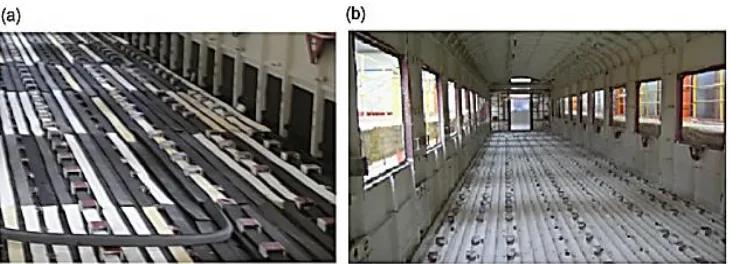
Figure 2.7: The damping treatment of the car body: (a) the equipment of damping sheets on the corrugated steel panel and side wall of the car body and (b) the car body sprayed
with water-based damping coating [2]
2.5.2 Rolling noise
[image:34.612.162.527.388.520.2]vibrations to other parts of the train. Therefore, in the recent years the main focus of research into rolling noise has been the application of theoretical models to the design of low noise wheels and tracks. Furthermore, Thompson et al. (1995) have further clarified that, when a railway wheel rolls on straight or slightly curved track in the absence of discontinuities, a broadband noise is emitted which is known as rolling noise. Theoretical models for this rolling noise have been substantially developed by them [13]. They added that rolling noise is generated by surface irregularities (roughness) on the wheel and/or rail running surface. These roughnesses introduce a relative vibration between the wheel and the rail, the consequent wheel and rail vibrations radiating noise [1, 4, 13, 14].
[image:35.612.243.428.453.676.2]Moreover, as in Figure 2.8, the roughness induces a vertical relative displacement between the wheel and rail or in the Hertzian contact spring, the motion of each depending on the relative amplitudes (and phases) of their receptances. The local contact defections are represented by a linearized incremental stiffness, which is valid only for relatively small amplitudes, but allows the model to be implemented in the frequency domain [13]. In contrast, this trend is not so in monorail system, because it does not run on rails and thus the main source of noise is from the propulsion system.
23
2.5.2.1 Wheel design
The shape of the wheel also has turned out to have significant effect on the noise generated by the wheel-rail interface. Optimized wheel designs using theoretical models have been considered for some time. However, in the OFWHAT project an optimized wheel shape was designed and implemented that had a thick web and diameter of 860 mm. This was predicted to reduce the wheel component by 4 dB although in field tests only 1 dB reduction was measured. The design was, in any case, unsuitable for application in tread-braked vehicles. In Silent Freight, optimized wheel shapes were again studied. In this case, the thermo-mechanical requirements of tread braking had to be taken into account, which imposed a further constraint. Two 860 mm diameter wheels were produced, each predicted to reduce the wheel noise by 3 dB; experimental results showed modest reductions. However, for a disc-braked wheel, the potential of shape optimization is much greater than for a tread-braked wheel.
Wheel shape optimization was attempted on a TGV in France as well, producing 4–5 dB less noise in the frequency range above 1.6 kHz where the wheel is expected to dominate. A small (640 mm diameter) straight-webbed design has been shown to produce as much as 18 dB reduction in wheel noise compared with a conventional wheel, although the track component of noise can increase slightly due to a shift in the contact filter effect [4]. The other main area in which wheel noise reductions are sought is in added damping. More recently such damping treatments have also been used in attempts to reduce rolling noise. A reductions of 3–4 dB was predicted in the wheel component of noise.
Silent Freight and Silent Track projects. The first column of results indicates the reduction in the wheel component of noise compared to the reference wheel and the first row similarly the reduction in track component of noise. The remaining figures are reductions in overall noise due to the various combinations of measures [4]. However, all of these optimization techniques are not applicable in the monorail system due to some reasons mentioned earlier.
Table 2.6: Measured noise reduction obtained for various wheel and track treatments in Silent Freight and Silent Track projects to nearest whole dB [4]
Wheel noise reduction Stiffer pads Reference track + absorbers Stiffer pads + absorbers New track New track+ absorbers Track noise reduction
- 2 6 5 3 7
Perforated wheel with ring damper
4 2 6 4 2 6
Optimized wheel with shields
8 3 7 5 4 8
Optimized wheel with tuned absorbers
7 3 7 6 4 8
2.5.2.2 Wheel dynamics
It is also found that the wheel dynamics also has an effect on the vibration created and that will increase the total amount of noise produced. A railway wheel is a very lightly damped resonant body, which can be characterized readily by its normal modes. Axial modes are categorized by the number of nodal diameters (n) and the number of nodal circles (m)
108
REFERENCES
1. Fan, Rongping, et al. "Experimental study of the effect of viscoelastic damping materials on noise and vibration reduction within railway vehicles." Journal of Sound and Vibration 319.1 (2009): 58-76.
2. M. Ayala Botto, J.M.C. Sousa and J.M.G.Sá da Costa, “Intelligent Active Noise Control Applied to a Laboratory Railway Coach Model,” Control
Engineering Practice, 13 (2005), 473–84
<http://dx.doi.org/10.1016/j.conengprac.2004.04.009>.
3. Talotte, C., et al. "Identification, modelling and reduction potential of railway noise sources: a critical survey." Journal of Sound and Vibration 267.3 (2003): 447-468.
4. Eadie, Donald T., Marco Santoro, and Joe Kalousek. "Railway noise and the effect of top of rail liquid friction modifiers: changes in sound and vibration spectral distributions in curves." Wear 258.7 (2005): 1148-1155.
5. Sayed Abas Ali, “Railway Noise Levels, Annoyance and Countermeasures in Assiut, Egypt,” Applied Acoustics, 66 (2005), 105–13 <http://dx.doi.org/10.1016/j.apacoust.2004.06.005>.
6. Obermeyer Planen, “RAILWAY NOISE AND VIBRATION : EFFECTS AND CRITERIA,” 193 (1996), 9–20.
7. Lam, Kin-Che, et al. "Annoyance response to mixed transportation noise in Hong Kong." Applied Acoustics 70.1 (2009): 1-10.
8. Cinzia Buratti, Elisa Belloni and Elisa Moretti, “Façade Noise Abatement Prediction: New Spectrum Adaptation Terms Measured in Field in Different Road and Railway Traffic Conditions,” Applied Acoustics, 76 (2014), 238–48 <http://dx.doi.org/10.1016/j.apacoust.2013.08.016>.
Noises, Part 1: Overall Annoyance,” Journal of Sound and Vibration, 220 (1999), 251–78 <http://dx.doi.org/10.1006/jsvi.1998.1928>.
10. Gu Xiaoan, “Railway Environmental Noise Control in China,” Journal of
Sound and Vibration, 293 (2006), 1078–85
<http://dx.doi.org/10.1016/j.jsv.2005.08.058>.
11. Yano, T., T. Yamashita, and K. Izumi. "Comparison of community annoyance from railway noise evaluated by different category scales." Journal of sound and Vibration 205.4 (1997): 505-511.
12. Xuetao Zhang, “The Directivity of Railway Noise at Different Speeds,”
Journal of Sound and Vibration, 329 (2010), 5273–88
<http://dx.doi.org/10.1016/j.jsv.2010.07.003>.
13. Tassi, Patricia, et al. "Living alongside railway tracks: Long-term effects of nocturnal noise on sleep and cardiovascular reactivity as a function of age."Environment international 36.7 (2010): 683-689.
14. Smith, R. A. "Railways: how they may contribute to a sustainable future."Proceedings of the Institution of Mechanical Engineers, Part F: Journal of Rail and Rapid Transit 217.4 (2003): 243-248.
15. Thompson, D. J., B. Hemsworth, and N. Vincent. "Experimental validation of the TWINS prediction program for rolling noise, part 1: description of the model and method." Journal of sound and vibration 193.1 (1996): 123-135. 16. Talotte, C. "Aerodynamic noise: a critical survey." Journal of Sound and
Vibration 231.3 (2000): 549-562.
17. Bewes, O. G., et al. "Calculation of noise from railway bridges and viaducts: Experimental validation of a rapid calculation model." Journal of Sound and Vibration 293.3 (2006): 933-943.
18. Mellet, C., et al. "High speed train noise emission: Latest investigation of the aerodynamic/rolling noise contribution." Journal of sound and vibration 293.3 (2006): 535-546.
19. Thompson, D. J., and C. J. C. Jones. "A review of the modelling of wheel/rail noise generation." Journal of sound and vibration 231.3 (2000): 519-536. 20. Remington, P., et al. "A hybrid active-passive system for controlling
110
21. Lei, Shi, et al. "Numerical Analysis of Aerodynamic Noise of a High-Speed Pantograph." Digital Manufacturing and Automation (ICDMA), 2013 Fourth International Conference on. IEEE, 2013.
22. L Rosenstock, “Criteria for a Recommended Standard: Occupational Noise Exposure,” National Institute for Occupational Safety and Health., 1998, 1– 132 <http://dx.doi.org/No. 98-126>.


![Table 2.1: Noise annoyance for the population in the old states of Germany [7]](https://thumb-us.123doks.com/thumbv2/123dok_us/8767460.897194/22.612.120.547.96.544/table-noise-annoyance-population-old-states-germany.webp)
![Table 2.2: Energy efficiency of various forms of transport [12]](https://thumb-us.123doks.com/thumbv2/123dok_us/8767460.897194/25.612.111.543.255.535/table-energy-efficiency-various-forms-transport.webp)
![Figure 2.3: Typical comparisons of energy consumption (litres of fuel) and carbon dioxide emissions (kg) for various modes of transport per 100 passenger-km [12]](https://thumb-us.123doks.com/thumbv2/123dok_us/8767460.897194/26.612.146.516.101.494/figure-typical-comparisons-consumption-emissions-various-transport-passenger.webp)
![Table 2.4: Frequency range for different types of railway noise [5]](https://thumb-us.123doks.com/thumbv2/123dok_us/8767460.897194/27.612.147.505.545.697/table-frequency-range-different-types-railway-noise.webp)
![Figure 2.4: Summary of average sound level reductions [5]](https://thumb-us.123doks.com/thumbv2/123dok_us/8767460.897194/28.612.202.478.162.336/figure-summary-average-sound-level-reductions.webp)
![Table 2.5: Identification of sources [16]](https://thumb-us.123doks.com/thumbv2/123dok_us/8767460.897194/30.612.114.543.293.653/table-identification-of-sources.webp)
![Figure 2.5: Sound transmission loss in one-third octave bands [2]](https://thumb-us.123doks.com/thumbv2/123dok_us/8767460.897194/33.612.116.537.69.224/figure-sound-transmission-loss-octave-bands.webp)