Benoˆıt Crabb´e
∗INRIA - Universit´e Paris 7
Denys Duchier
∗∗LIFO - Universit´e d’Orl´eans
Claire Gardent
† CNRS - LORIA, NancyJoseph Le Roux
‡LIPN - Universit´e Paris Nord
Yannick Parmentier
§ LIFO - Universit´e d’Orl´eansIn this article, we introduce eXtensible MetaGrammar (XMG), a framework for specifying tree-based grammars such as Feature-Based Lexicalized Tree-Adjoining Grammars (FB-LTAG) and Interaction Grammars (IG). We argue that XMG displays three features that facilitate both grammar writing and a fast prototyping of tree-based grammars. Firstly, XMG is fully declarative. For instance, it permits a declarative treatment of diathesis that markedly departs from the procedural lexical rules often used to specify tree-based grammars. Secondly, the XMG language has a high notational expressivity in that it supports multiple linguistic dimensions, inheritance, and a sophisticated treatment of identifiers. Thirdly, XMG is extensible in that its computational architecture facilitates the extension to other linguistic formalisms. We explain how this architecture naturally supports the design of three linguistic formalisms, namely, FB-LTAG, IG, and Multi-Component Tree-Adjoining Grammar (MC-TAG). We further show how it permits a straightforward integration of additional mechanisms such as linguistic and formal principles. To further illustrate the declarativity, notational expressivity, and extensibility of XMG, we describe the methodology used to specify an FB-LTAG for French augmented with a
∗UFR de Linguistique, Universit´e Paris Diderot-Paris 7, Case 7003, 2, F-75205 Paris Cedex 13, France. E-mail:[email protected].
∗∗Laboratoire d’Informatique Fondamentale d’Orl´eans, Bˆatiment IIIA, Rue L´eonard de Vinci, B.P. 6759, F-45067 Orl´eans Cedex 2, France. E-mail:[email protected].
†Laboratoire LORIA - CNRS, Projet Synalp, Bˆatiment B, BP 239, Campus Scientifique, F-54506 Vandœuvre-L`es-Nancy Cedex, France. E-mail:[email protected].
‡Laboratoire d’Informatique de Paris Nord, UMR CNRS 7030, Institut Galil´ee - Universit´e Paris-Nord, 99, avenue Jean-Baptiste Cl´ement, F-93430 Villetaneuse, E-mail:[email protected].
§Laboratoire d’Informatique Fondamentale d’Orl´eans, Bˆatiment IIIA, Rue L´eonard de Vinci, B.P. 6759, F-45067 Orl´eans Cedex 2, France. E-mail:[email protected].
Submission received: 27 March 2009; revised version received: 2 July 2012; accepted for publication: 11 August 2012.
unification-based compositional semantics. This illustrates both how XMG facilitates the modeling of the tree fragment hierarchies required to specify tree-based grammars and of a syntax/semantics interface between semantic representations and syntactic trees. Finally, we briefly report on several grammars for French, English, and German that were implemented using XMG and compare XMG with other existing grammar specification frameworks for tree-based grammars.
1. Introduction
In the late 1980s and early 1990s, many grammar engineering environments were developed to support the specification of large computational grammars for natural language. One may, for instance, cite XLE (Kaplan and Newman 1997) for specifying Lexical-Functional Grammars (LFG), LKB (Copestake and Flickinger 2000) for speci-fying Head-driven Phrase Structure Grammars (HPSG), and DOTCCG (Baldridge et al. 2007) for specifying Combinatory Categorial Grammars (CCG). Concretely, such environments usually rely on (i) a formal language used to describe a target com-putational grammar, and (ii) a processor for this language, which aims at generating the actual described grammar (and potentially at checking it, e.g., by feeding it to a parser).
Although these environments were tailored for specific grammar formalisms, they share a number of features. Firstly, they are expressive enough to characterize subsets of natural language. Following Shieber (1984), we call this feature weak completeness. Secondly, they arenotationally expressiveenough to relatively easily formalize important theoretical notions. Thirdly, they arerigorous, that is, the semantics of their underlying language is well defined and understood. Additionally, for an environment to be useful in practice, it should besimpleto use (by a linguist), and make it possible to detect errors in the described target grammar.
If we consider a particular type of computational grammar, namely, tree-based grammars—that is, grammars where the basic units are trees (or tree descriptions) of arbitrary depth, such as Tree-Adjoining Grammar (TAG; Joshi, Levy, and Takahashi 1975), D-Tree Grammar (DTG; Rambow, Vijay-Shanker, and Weir 1995), Tree Description Grammars (TDG; Kallmeyer 1999) or Interaction Grammars (IG; Perrier 2000)— environments sharing all of the listed features are lacking. As we shall see in Section 7 of this article, there have been some proposals for grammar engineering environments for tree-based grammar (e.g., Candito 1996; Xia, Palmer, and Vijay-Shanker 1999, but these lack notational expressivity. This is partly due to the fact that tree-based formalisms offer an extended domain of locality where one can encode constraints between remote syntactic constituents. If one wants to define such constraints while giving a modular and incremental specification of the grammar, one needs a high level of notational expressivity, as we shall see throughout the article (and especially in Section 4).
In this article, we present XMG (eXtensible MetaGrammar), a framework for specifying tree-based grammars. Focusing mostly on Feature-Based Lexicalized Tree-Adjoining Grammars (FB-LTAG) (but using Interaction Grammars [IG] and Multi-Component Tree-Adjoining Grammars [MC-TAG] to illustrate flexibility), we argue that XMG departs from other existing computational frameworks for designing tree-based grammars in three main ways:
r
First, XMG is adeclarativelanguage. In other words, grammaticality isconstraints rather than by procedures. In particular, XMG permits a fully declarative treatment of diathesis that markedly departs from the procedural rules (called meta-rules or lexical rules) previously used to specify tree-based grammars.
r
Second, XMG isnotationally expressive. The XMG language supports fulldisjunction and conjunction of grammatical units, a modular treatment of multiple linguistic dimensions, multiple inheritance of units, and a sophisticated treatment of identifiers. We illustrate XMG’s notational expressivity by showing (i) how it facilitates the modeling of the tree fragment hierarchies required to specify tree-based grammars and (ii) how it permits a natural modeling of the syntax/semantics interface between semantic representations and syntactic trees as can be used in FB-LTAG.
r
Third, XMG isextensiblein that its computational architecture facilitates(i) the integration of an arbitrary number of linguistic dimensions (syntax, semantics, etc.), (ii) the modeling of different grammar formalisms (FB-LTAG, MC-TAG, IG), and (iii) the specification of general linguistic principles (e.g., clitic ordering in French).
The article is structured as follows. Section 2 starts by giving a brief introduction to FB-LTAG, the grammar formalism we used to illustrate most of XMG’s features. The next three sections then go on to discuss and illustrate XMG’s three main features— namely, declarativity, notational expressivity, and flexibility. In Section 3, we focus on declarativity and show how XMG’s generalized disjunction permits a declarative encoding of diathesis. We then contrast the XMG approach with the procedural methods previously resorted to for specifying FB-LTAG. Section 4 addresses notational expressiv-ity. We present the syntax of XMG and show how the sophisticated identifier handling it supports or permits a natural treatment (i) of identifiers in tree based hierarchies and (ii) of the unification-based syntax/semantics interface often used in FB-LTAG. In Section 5, we concentrate on extensibility. We first describe the operational semantics of XMG and the architecture of the XMG compiler. We then show how these facilitate the adaptation of the basic XMG language to (i) different grammar formalisms (IG, MC-TAG, FB-LTAG), (ii) the integration of specific linguistic principles such as clitic ordering constraints, and (iii) the specification of an arbitrary number of linguistic dimensions. In Section 6, we illustrate the usage of XMG by presenting an XMG specification for the verbal fragment of a large scale FB-LTAG for French augmented with a unification-based semantics. We also briefly describe the various other tree-based grammars implemented using XMG. Section 7 discusses the limitations of other approaches to the formal specification of tree-based grammars, and Section 8 concludes with pointers for further research.
2. Tree-Adjoining Grammar
N
Marie
Mary
V
V
a
has V
S
N↓ V
vu
seen N↓
N
Jean
John
∗
⇒
S
N
Marie
Mary
V
V
a
has
V
vu
seen
N
Jean
[image:4.486.51.329.62.168.2]John
Figure 1
Sample derivation ofMarie a vu Jean‘Mary has seen John’ in a TAG.
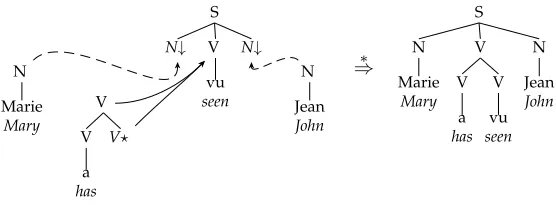
into a tree. Figure 1 shows a toy TAG generating the sentenceMarie a vu Jean‘Mary has seen John’ and sketches its derivation.1
Among existing variants of TAG, one commonly used in practice is Lexical-ized FB-LTAG (Vijay-Shanker and Joshi 1988). A lexicalLexical-ized TAG is such that each elementary tree has at least one leaf labeled with a lexical item (word), whereas in an FB-LTAG, tree nodes are additionally decorated with two feature structures (called top and bottom). These feature structures are unified during derivation as follows. On substitution, the top features of the substitution node are unified with the top features of the root node of the tree being substituted in. On adjunction, the top features of the root of the auxiliary tree are unified with the top features of the node where adjunction takes place; and the bottom features of the foot node of the auxiliary tree are unified with the bottom features of the node where adjunction takes place. At the end of a derivation, the top and bottom feature structures of all nodes in the derived tree are unified.
Implementation of Tree-Adjoining Grammars.Most existing implementations of TAGs fol-low the three-layer architecture adopted for the XTAGgrammar (XTAG Research Group 2001), a feature-based lexicalized TAG for English. Thus the grammar consists of (i) a set of so-called tree schemas (i.e., elementary trees having a leaf node labeled with a
referring to where to anchor lexical items2), (ii) a morphological lexicon associating
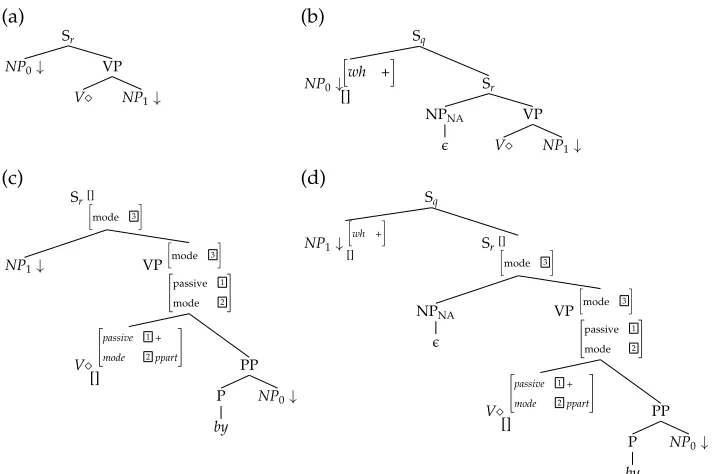
words with lemmas, and (iii) a syntactic lexicon associating lemmas with tree schemas (these are gathered into families according to syntactic properties, such as the sub-categorization frame for verbs). Figure 2 shows some of the tree schemas associated with transitive verbs in the XTAG grammar. The tree corresponds (a) to a declarative sentence, (b) to a WH-question on the subject, (c) to a passive clause with a BY-agent, and (d) to a passive clause with a WH-object. As can be seen, each tree schema contains an anchor node (marked with). During parsing this anchor node can be replaced by any word morphologically related to a lemma listed in the syntactic lexicon as anchor-ing the transitive tree family.
This concept of tree family allows us to share structural information (tree schemas) between words having common syntactic properties (e.g., sub-categorization frames). There still remains a large redundancy within the grammar because many elementary tree schemas share common subtrees (large coverage TAGs usually consist of hun-dreds, sometimes thousands, of tree schemas). An important issue when specifying
1 The elementary trees displayed in this article conform to Abeill´e (2002), that is, we reject the use of a VP constituent in French.
(a) (b) Sr
NP0↓ VP
V NP1↓
Sq
NP0↓
wh +
[] Sr
NPNA
VP
V NP1↓
(c) (d)
Sr[]
mode 3
NP1↓ VP
mode 3
⎡ ⎣passive 1
mode 2
⎤ ⎦
V
⎡ ⎣passive 1+
mode 2ppart
⎤ ⎦
[] PP
P
by
NP0↓
Sq
NP1↓
wh +
[] Sr
[] mode 3 NPNA VP mode 3 ⎡ ⎣passive 1
mode 2
⎤ ⎦
V
⎡ ⎣passive 1+
mode 2ppart
⎤ ⎦
[] PP
P
by
[image:5.486.53.413.61.298.2]NP0↓
Figure 2
Some tree schemas for English transitive verbs.
such grammars is thus structure sharing. Being able to share structural information is necessary not only for a faster grammar development, but also for an easier grammar maintenance (modifications to be applied to the tree schemas would be restricted to shared structures). In the next section, we will see how XMG declarativity can be efficiently used to factorize TAGs. In addition, Section 4 will show how XMG notational expressivity facilitates the specification of another commonly used tree sharing device, namely, inheritance hierarchies of tree fragments.
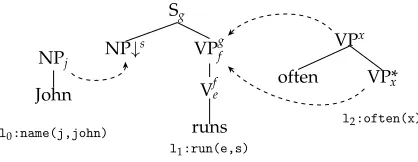
Extending TAG with a Unification-Based Semantics. To extend FB-LTAG with a compo-sitional semantics, Gardent and Kallmeyer (2003) propose to associate each elementary tree with a flat semantic representation. For instance, in Figure 3, the trees3forJohn, runs,
andoftenare associated with the semanticsl0:name(j,john),l1:run(e,s), andl2:often(x), respectively. Importantly, the arguments of semantic functors are represented by uni-fication variables which occur both in the semantic representation of this functor and on some nodes of the associated syntactic tree. Thus in Figure 3, the semantic indexs
occurring in the semantic representation ofrunsalso occurs on the subject substitution node of the associated elementary tree. The value of semantic arguments is then deter-mined by the unifications resulting from adjunction and substitution. For instance, the semantic indexsin the tree forrunsis unified during substitution with the semantic indexjlabeling the root node of the tree forJohn. As a result, the semantics ofJohn often runsis{l0:name(j,john), l1:run(e,j), l2:often(e)}.
Gardent and Kallmeyer’s (2003) proposal was applied to various semantic phe-nomena (Kallmeyer and Romero 2004a, 2004b, 2008). Its implementation, however,
3 Cx/C
xabbreviate a node with category C and a top/bottom feature structure including the feature-value
NPj
John
l0:name(j,john)
Sg
NP↓s VPg
f
Vfe
runs l1:run(e,s)
VPx
often VP*x
l2:often(x)
[image:6.486.50.259.63.144.2]⇒l0:name(j,john), l1:run(e,j), l2:often(e) Figure 3
A toy lexicalized FTAG with unification-based semantics (l0,l1,l2,e, andjare constants and
s,f,g,xare unification variables).
relies on having a computational framework that associates syntactic trees with flat semantic formulae while allowing for shared variables between trees and formulae. In the following sections, we will show how XMG notational expressivity makes it pos-sible to specify an FB-LTAG equipped with a unification-based semantics.
3. Declarativity
In this section, we show how a phenomenon which is often handled in a procedural way by existing approaches can be provided with a declarative specification in XMG. Concretely, we show how XMG supports a declarative account of diathesis that avoids the drawbacks of lexical rules (e.g., information erasing). We start by presenting the lexical rule approach. We then contrast it with the XMG account.
3.1 Capturing Diathesis Using Lexical Rules
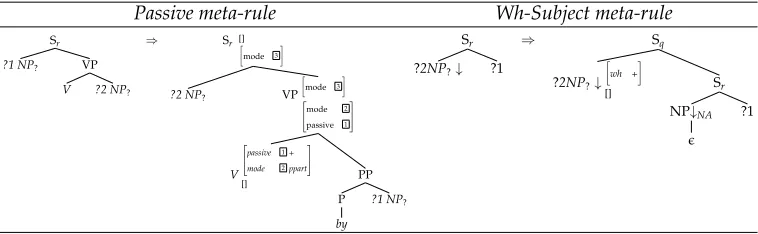
Following Flickinger (1987), redundancy among grammatical descriptions is often han-dled using two devices: an inheritance hierarchy and a set of lexical rules. Whereas the inheritance hierarchy permits us to encode the sharing of common substructures, lexical rules (sometimes called meta-rules) permit us to capture relationships between trees by deriving new trees from already specified ones. For instance, passive trees will be derived from active ones.
Passive meta-rule Wh-Subject meta-rule
Sr
?1 NP? VP
V ?2 NP?
⇒ Sr[]
mode 3
?2 NP? VP
mode 3
⎡ ⎣mode 2
passive 1
⎤ ⎦
V
⎡ ⎣passive 1+
mode 2ppart ⎤ ⎦
[] PP
P
by ?1 NP?
Sr
?2NP?↓ ?1
⇒ Sq
?2NP?↓
wh +
[] Sr
NP↓NA
[image:7.486.54.433.63.180.2]
?1
Figure 4
Simplified meta-rules for passive and wh-subject extraction.
More generally a meta-rule is a procedural device that, given a tree instance, generates a new tree instance by adding, suppressing (hence possibly substituting) information in grammatical units. Prolo (2002) defines a set of meta-rules that can be used to specify a large FB-LTAG for English. Given an ordered set of meta-rules, however, there is no guarantee that the trees they derive are linguistically appropriate and that the derivation process terminates. Thus, to ensure termination and consistency, Prolo needs to additionally provide rule ordering schemes (expressed as automata).
3.2 XMG: Capturing Diathesis Using Disjunction
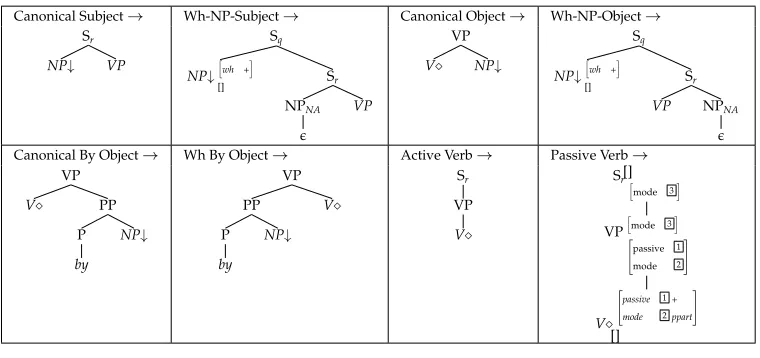
XMG provides an alternative account for describing tree sets such as that of Figure 2 without lexical rules and without the related ordering constraints. In essence, the approach consists of enumerating trees by combining tree fragments using conjunction and disjunction.
More specifically, the tree set given in Figure 2 can be generated by combining some of the tree fragments sketched in Figure 5 using the following conjunctions and disjunctions:4
Subject → CanonicalSubject∨Wh-NP-Subject (1)
ActiveTransitiveVerb → Subject∧ActiveVerb∧CanonicalObject (2)
PassiveTransitiveVerb → Subject∧PassiveVerb∧CanonicalByObject (3)
TransitiveVerb → ActiveTransitiveVerb∨PassiveTransitiveVerb (4)
The first clause (Subject) groups together two subtrees representing the possi-ble realizations of a subject (canonical and wh). The next two clauses define a tree set for active and passive transitive verbs, respectively. The last clause defines the
TransitiveVerbfamily as a disjunction of the two verb forms (passive or active). In sum, theTransitiveVerb clause defines the tree set sketched in Figure 2 as a disjunction of conjunctions of tree fragments.
One of the issues of meta-rules reported by Prolo (2002) is the handling of feature equations. For a number of cases (including subject relativization in passive trees),
Canonical Subject→ Wh-NP-Subject→ Canonical Object→ Wh-NP-Object→ Sr
NP↓ VP
Sq
NP↓
wh +
[] Sr
NPNA
VP
VP
V NP↓
Sq
NP↓
wh +
[] Sr
VP NPNA
Canonical By Object→ Wh By Object→ Active Verb→ Passive Verb→
VP
V PP
P by NP↓ VP PP P by NP↓ V Sr VP V
Sr[] mode 3
VP
mode 3
⎡ ⎣passive 1
mode 2
⎤ ⎦
V ⎡ ⎣passive 1+
mode 2ppart
⎤ ⎦
[image:8.486.49.429.61.240.2][]
Figure 5 Tree fragments.
ad hoc meta-rules are needed, for a unified tree transformation cannot be defined. In a declarative approach such as the one here, dealing with feature equations can be done relatively easily. Let us imagine that we now want to extend the trees of Figure 2 with feature equations for subject–number agreement. We can for instance do so by defining the following tree fragment (the dashed line indicates that theVPnode can be a descendant, not only a daughter, of theSnode):5
SubjAgreement → S
NP↓ num 1 num 1 VP num 1 num 1
Then we extend the definition ofSubjectas follows:
Subject → SubjAgreement∧( CanonicalSubject∨Wh-NP-Subject ) (5)
If we want to get further with the description of transitive verbs, for instance by taking into account wh-objects and by-objects, this can be done as follows. We first define the elementary fragments Wh-NP-Objectand Wh-By-Object(see Figure 5), and then define the following additional combinations:6
ActiveTransitiveVerb → CanonicalSubject∧ActiveVerb∧Wh-Np-Object (6)
PassiveTransitiveVerb → CanonicalSubject∧PassiveVerb∧Wh-By-Object (7)
5 Note that in XMG, it is not mandatory to define any tree structure insideSubjAgreement. We could define independent NP and VP nodes, and associate them with variables, sayn1andn2.n1andn2would then be exported and reused directly in the classesCanonicalSubjectandWh-NP-Subject, respectively. 6 Note that these clauses only consider canonical subjects to avoid having both a Wh-subject and a
Evans, Gazdar, and Weir (1995) argue for the necessity of using lexical rules for grammatical description based on two arguments: (i) morphology is irregular and has to be handled by a non-monotonic device and (ii) erasing rules such as the agentless passive (John eats an apple / An apple is eaten) are needed to erase an argument from the canonical base tree. Neither of these arguments holds here, however: The first argument because we describe tree schema hence lexical and morphological issues are ruled out; the second because agentless passive and, more generally, argument erasing constructions can simply be defined by an additional clause such as:
AgentlessPassiveTransitiveVerb → Subject∧PassiveVerb (8)
To summarize, using a declarative language to specify a tree-based grammar offers an adequate level of control on the structures being described while avoiding having to deal with ordering and termination issues. It facilitates grammar design and mainte-nance, by providing an abstract view on grammar trees, uniquely made of monotonic (no information removal) combinations of tree fragments.
4. Notational Expressivity
We now focus on notational expressivity and show how XMG supports a direct encoding of (i) distinct linguistic dimensions (here syntax, semantics and the syntax/ semantics interface) and (ii) the various types of coreferences7 that arise in the devel-opment of tree-based grammars.
The syntax of the XMG language can be formally defined as follows.
Class ::= NameC1,...,Ck
x1,...,xn → Content (9)
Content ::= SYN, SEM, DYN | Name | Content∧Content | Content∨Content
(10)
SYN ::=
n1→n2 | n1→+n2 | n1→∗n2 | n1≺n2 | n1 ≺+n2 | n1≺∗n2 |
n1[f1: v1,..., fk: vk] | n1(c1: cv1,..., cl: cvl) | n1=n2 | x=Ci.y |
n1(c1: cv1,..., cl: cvl) [f1: v1,..., fk: vk] | SYN ∧ SYN
(11)
SEM ::= li:p(E1,...,En) | li≤hj | SEM ∧ SEM (12)
DYN ::= f1: v1,...,fn: vn (13)
Here and in what follows, we use the following notational conventions.Cidenote
variables over class names;xi,x, andyare variables ranging over tree nodes or feature
values;nirefer to node variables;f,fiare features andv,viand feature values (constants
or variables);li,hj,p, andEi are variables over semantic labels, semantic holes,
predi-cates, and predicate arguments in flat semantic formulae, respectively.8 [ ] are used to
associate a node variable with some feature constraint. ( ) are used to associate a node variable with some property constraint (e.g., node colors, see Section 5).ciandcvidenote
7 By coreference, we mean the sharing of information between distinct elementary fragments of the grammar specification.
a property constraint and a property constraint value, respectively.Ci.y denotes they
variable declared in classCiand=is unification;≺and→denote linear precedence and
immediate dominance relations between nodes. Finally,+,∗represent the transitive and transitive-reflexive closure of a relation, respectively.
The first two clauses of the formal definition here specify XMG classes and how they combine. The next three clauses define the languages supported for describing three lin-guistic dimensions, namely, syntax (SYN), semantics (SEM), and the syntax/semantics interface (called DYN for dynamic interface). We now discuss each of these in more detail starting bottom–up with the three linguistic dimensions and ending with the control language that permits us to combine basic linguistic units into bigger ones.
SYN.The XMG formalism for syntax (copied here for convenience) is a tree description logic similar to that proposed by Vijay-Shanker and Schabes (1992) and Rogers and Vijay-Shanker (1994) to describe tree-based grammars.
SYN ::= n1→n2 | n1 →+n2 | n1 →∗n2 | n1 ≺n2 | n1 ≺+n2 | n1 ≺∗n2 | n1[f1: v1,..., fk: vk] | n1(c1: cv1,..., cl: cvl) | n1 =n2 | x=Ci.y |
n1(c1: cv1,..., cl: cvl) [f1: v1,..., fk: vk] | SYN ∧ SYN
It includes tree node variables, feature names, feature values, and feature variables. Tree node variables can be related by equality (node identification), precedence (imme-diate or non-imme(imme-diate), and dominance (imme(imme-diate or non-imme(imme-diate). Tree nodes can also be labeled with feature structures of depth 2, that is, sets of feature/value pairs where feature values are either variables, constants (e.g., syntactic category), or non-recursive feature structure (e.g., top and bottom feature structures).
Here is a graphical illustration of how tree logic formulae can be used to describe tree fragments: The depicted tree fragment is a model satisfying the given formula.
n1 → n2 ∧ n1 → n3 ∧ n2 ≺ n3
∧ n1[cat : S] ∧ n2(mark : subst) [cat : NP] ∧ n3[cat : VP] S
NP↓ VP
One distinguishing feature of the XMG tree language is the introduction of node constraints (n1(c : cv)) that generalize Muskens and Krahmer’s (1998) use of positive
and negative node markings. Concretely, node constraints are attribute-value matri-ces, which contain information to be used when solving tree descriptions to produce grammar trees. In other words, node constraints are used to further restrict the set of models satisfying a tree description. As an example of node constraint, consider node annotations in FB-LTAG (foot node, substitution node, null-adjunction, etc.). Such annotations can be used as node constraints to allow the description solver to apply well-formedness constraints (e.g., there is at most one foot node).
SEM.The semantic dimension supports a direct encoding of the flat semantic formulae used by Gardent and Kallmeyer (2003):
SEM ::= li:p(E1,...,En) | li≤hj| SEM ∧ SEM
whereli:p(E1,..., En) represents a predicatepwith labelliand argumentsE1,..., Enand li≤hj is a scope constraint between labelliand scopehj. Expressions (predicate
argu-mentsEi) can refer to semantic holes, constants (atomic values), or unification variables
(writtenx,yhereafter).
For instance, the following flat semantic formula can be used to underspecify the meaning of the sentence “Every dog chases a cat”:
l0:∀(x,h1,h2) ∧ l1≤h1 ∧ l1: Dog(x) ∧ l2≤h2 ∧ l2: Chase(x,y) ∧ l3 :∃(y,h3,h4) ∧ l4≤h3 ∧ l4: Cat(y) ∧ l2≤h4
(14)
This formula denotes the following two first-order logic formulae, thereby describing the two possibles readings of this sentence.9
l0:∀(x,l1,l3) ∧ l1 : Dog(x) ∧ l2: Chase(x,y) ∧ l3:∃(y,l4,l2) ∧ l4: Cat(y) (15) l0:∀(x,l1,l2) ∧ l1 : Dog(x) ∧ l2: Chase(x,y) ∧ l3:∃(y,l4,l0) ∧ l4: Cat(y) (16)
DYN. The DYN dimension generalizes Kinyon’s hypertag (Kinyon 2000) which is unified whenever two tree fragments are combined. Similarly, in XMG the DYN
dimension is a feature structure that is unified whenever two XMG classes are com-bined through inheritance or through conjunction (see the discussion on XMG control language, subsequently).
For instance, the following constraints ensure a coreference between the index I
occurring in the syntactic dimension and the argument X occurring in the semantic dimension (indexsubject andarg1 are feature names, andE,I,X, andVlocal unification
variables).
C1 → Node[idx:I] ∧ indexsubject :I (17)
C2 → L:P(E)∧L:Theta1(E,X) ∧ arg1:X (18) SubjectArg1 → C1 ∧ C2 ∧ indexsubject :V,arg1:V (19)
More generally, the DYN dimension permits us to unify nodes and feature values that belong to distinct classes and dimensions, and are thus often not related within the inheritance hierarchy. As we shall see in Section 6, the DYN dimension permits a modular account of the syntax/semantics interface in which linking constraints can be stipulated separately and reused to specify the various diatheses.
In other words, theDYN feature structure allows us to extend the scope of some specific variables so that they can be unified with variables (or values) introduced in some other classes of the metagrammar. This concept of scope extension can be compared with that ofhookin Copestake, Lascarides, and Flickinger (2001).
Control language.The linguistic units (namedContenthere) defined by the linguist can be abstracted and combined as follows:
Class ::= NameC1,...,Ck
x1,...,xn → Content
Content ::= SYN, SEM, DYN | Name | Content∧Content | Content∨Content
The first clause states that the linguistic information encoded inContentis abstracted in a class named Nameand that this class inherits classesC1,..., Ck and exports variables x1,..., xn. That is, XMG allows for abstraction, inheritance, and variable exports. By
default, variables (referring to nodes and feature values) are local to a class. Export statements extend the scope of a variable to all sub-classes, however. An exported variable can also be accessed from outside its class in case of class instantiation (using the dot operator introduced earlier in this section). The second clause states that an XMG class consists of a syntactic, a semantic, and a dynamic description (each of them possibly empty), and that XMG classes can be combined by conjunction and disjunc-tion and reused through class instantiadisjunc-tion. The notadisjunc-tion SYN, SEM, DYNrepresents simultaneous contributions (possibly empty) to all three dimensions.10
The XMG control language differs from other frameworks used to specify tree-based grammars (Vijay-Shanker and Schabes 1992; Xia et al. 1998; Candito 1999) in two main ways. First, it supports generalized conjunctions and disjunctions of classes. As shown in Section 3, this permits us, inter alia, a declarative treatment of diathesis.
Second, it allows for both local and exported variables. As mentioned in Section 3, a common way to share structure within a tree-based grammar is to define an inheritance hierarchy of either tree fragments (Evans, Gazdar, and Weir 1995) or tree descriptions (Vijay-Shanker and Schabes 1992; Candito 1996; Xia 2001). When considering an FB-LTAG augmented with unification semantics, the hierarchy will additionally contain semantic representations and/or tuples made of tree fragments and semantic represen-tations. In all cases, the question arises of how to handle identifiers across classes and, more specifically, how to share them.
In Candito’s (1996) approach, tree nodes are referred to using constants so that multiple occurrences of the same node constant refer to the same node. As pointed out in Gardent and Parmentier (2006), global names have several non-trivial shortcomings. First, they complicate grammar writing in that the grammar writer must remember the names used and their intended interpretation. Second, they fail to support multiple uses of the same class within one class. For instance, in French, some verbs sub-categorize for two prepositional phrases (PP). A natural way of deriving the tree for such verbs would be to combine a verbal tree fragment with two instances of a PP fragment. If, however, the nodes in the PP fragment are labeled with global names, then the two occurrences of these nodes will be identified thereby blocking the production of the appropriate tree.11
A less restrictive treatment of identifiers is proposed by Vijay-Shanker and Schabes (1992), where each tree description can be associated with a set of declared node variables and subsets of these node variables can be referred to by descriptions in the
hierarchy that inherit from the description in which these node variables were declared. For instance, if entityAin the hierarchy declares such a special node variableXandB
inherits fromA, thenXcan be referred to inBusing the notationA.X.12
XMG generalizes Vijay-Shanker and Schabes’s (1992) approach by integrating an export mechanism that can be used to extend the scope of a given identifier (node or feature value variable) to classes that inherit from the exporting class. Thus if class B inherits from class A and class A exports variable X, then X is visible in B
and its reuse forces identity. IfB inherits from several classes and two (or more) of these inherited classes export thesamevariable nameX, thenXis not directly visible fromB. It can be accessed though using the dot operator. FirstAis identified with a local variable (e.g., T=A), then T.Xcan be used to refer to the variable Xexported byA.
To summarize, XMG allows for local variables to be exported to sub-classes as well as for prefixed variables—that is, variables that are prefixed (using the dot operator) with a reference to the class in which they are declared. In this way, the pitfalls in-troduced by global names are avoided while providing enough expressivity to handle variable coreference (via the definition of variable namespaces). Section 6 will further illustrate the use of the various coreference devices made available by XMG showing how they concretely facilitate grammar writing.
Let us finally illustrate variable handling with XMG in the example of Figure 2. Recall that we define the trees of Figure 2 as the conjunctions and disjunctions of some tree fragments of Figure 5, such as:
Subject → SubjAgreement∧( CanonicalSubject∨Wh-NP-Subject ) (20)
CanonicalSubjectcan be defined as a tree description formula as follows (only variables
n2andn3are exported):
CanonicalSubjectn2,n3 → n1 →n2 ∧ n1[cat : S] ∧ n2(mark : subst) [cat : NP]∧ n1→n3 ∧ n3[cat : VP] ∧ n2≺n3
(21)
The class Wh-NP-Subject is defined accordingly (i.e., by means of a slightly more complex tree description formula using the n2 and n3 variable identifiers to refer to
the nodes involved in subject agreement). The classSubjAgreementis defined slightly differently (we do not impose any tree relation between the node concerned with number agreement):
SubjAgreementn
1,n2 →
n1[[top : [num : x]] [bot : [num : x]]]∧ n2[[top : [num : x]] [bot : [num : x]]]
(22)
12 In fact, the notation used by Vijay-Shanker and Schabes (1992) isattr:Xwith attr an attribute variable ranging over a finite set of attributes, to indicate special node variables that scope outside their class; and
We can then explicitly control the way the fragments combine as follows:
Subject →
C1=SubjAgreementn1,n2 ∧
C2=( CanonicalSubjectn2,n3∨Wh-NP-Subjectn2,n3)∧
C1.n1 =C2.n2 ∧ C1.n2 =C2.n3
(23)
In this example, we see how to constrain, via variable export and unification, some given syntactic nodes to be labeled with feature structures defined somewhere else in the metagrammar. We use XMG’s flexible management of variable scope to deal with node coreference. Compared with previous approaches on metagrammars such as those of Candito (1996), Xia (2001), having the possibility of handling neither only global nor only local variables, offers a high level of expressivity along with a precise control on the structures being described.
5. Extensibility
A third distinguishing feature of XMG is extensibility. XMG is extensible in that (i) dimensions can be added and (ii) each dimension can be associated with its own interpreter. In order to support an arbitrary number of dimensions, XMG relies on a device permitting the accumulation of an arbitrary number of types of literals, namely, Extensible Definite Clause Grammar (EDCG) (Van Roy 1990). Once literals are accumu-lated according to their type (i.e., each type of literals is accumuaccumu-lated separately), they can be fed to dedicated interpreters. Because each of these sets of literals represents formulas of a description language, these interpreters are solvers whose role is to compute models satisfying the accumulated formulas.
Via this concept of separated dimensions, XMG allows us (i) to describe different levels of language (not only syntax, but also semantics and potentially morphology,13
etc.), and (ii) to definelinguistic principles(well-formedness constraints to be applied on the structures being described). These principles depend either on the dimension (e.g., scope constraints in flat semantics), the target formalism (e.g. cooccurrence predicate-arguments in FB-LTAG), or the natural language (e.g., clitic ordering in Romance lan-guages) being described.
In what follows, we start by showing how XMG handles dimensions independently from each other introducing EDCG (Section 5.1). We then summarize the architecture of the XMG system (Section 5.2). We finally show how different solvers can be used to implement various constraints on each of these dimensions (Section 5.3). In partic-ular, we discuss three kinds of extensions implemented in XMG: extension to several grammar formalisms, integration of explicit linguistic generalizations, and inclusion of color-based node marking to facilitate grammar writing.
5.1 XMG: Accumulating and Interpreting an Arbitrary Number of Descriptions
Accumulating (tree) descriptions.First, let us notice that XMG is nothing other than a logic language`a laProlog (Duchier, Parmentier, and Petitjean 2012). More precisely, an XMG
specification is a collection of Horn clauses, which contribute a declarative description of what a computational tree grammar is.
Logic Program XMG Metagrammar
Clause::= Head → Body Body ::= Fact | Head |
Body∨Body | Body∧Body Query ::= Head
Class ::= Name → Content Content::= Description | Name |
Content∨Content | Content∧Content Axiom ::= Name
Recall that the descriptions handled by XMG are in fact tuples of the form
SYN,SEM,DYN. An XMG class can thus describe, in a non-exclusive way, any of these three levels of description. If one wants to add another level of description (i.e., another dimension), one needs to extend the arity of this tuple. Before discussing this, let us first see how such tuples are processed by XMG.
As mentioned earlier, XMG’s control language is comparable to Horn clauses. A common way to represent Horn clauses is by using Definite Clause Grammar (DCG) (Pereira and Warren 1980). Concretely, aDCG is a rewriting system (namely, a context-free grammar), where the symbols of the rewriting rules are equipped with pairs of unification variables (these are usually called difference list or accumulator) (Blackburn, Bos, and Striegnitz 2006, page 100). As an illustration, consider the follow-ing toy example.
s --> np,vp. np --> det,n. vp --> v,np. vp --> v. det --> [the]. det --> [a]. n --> [cat]. n --> [mouse]. v --> [eats].
The string language described by thisDCGcan be obtained by submitting the query
s(X,[])whereXis a unification variable to be bound with lists of facts (these being the
sentences belonging to the string language). As we can easily see, this language contains the sentences “a cat eats,” “the cat eats,” “a mouse eats,” “the mouse eats,” “a cat eats a mouse,” “a mouse eats a cat,” and so on.
Similarly, we can represent XMG classes asDCGclauses. For instance, the combina-tions of syntactic fragments given in relacombina-tions (1)–(4) can be rewritten asDCG clauses as follows:
subject --> canonicalSubject. subject --> whNpSubject.
activeTransitiveVerb --> subject, activeVerb, canonicalObject. passiveTransitiveVerb --> subject, passiveVerb, canonicalByObject. transitiveVerb --> activeTransitiveVerb.
transitiveVerb --> passiveTransitiveVerb.
Disjunctions (e.g., thesubjectspecification) translate to multiple clauses with iden-tical heads and conjunctions (e.g.,activeTransitiveVerb) to a clause body.
adequate descriptions, these can contain unification variables, whose scope is by default local to the clause):
canonicalSubject --> [desc(syn(...),sem(...),dyn(...))].
In order to allow for an extension of XMG to an arbitrary number of dimensions, instead of compiling XMG classes into a DCG whose accumulator stores tuples with a fixed arity, these classes are compiled into an EDCG (Van Roy 1990). EDCG areDCG with multiple accumulators. In XMG, each dimension is thus allocated a dedicated accumulator in the underlyingEDCG.
Note that although the content of the various dimensions is accumulated separately, dimensions may nevertheless share information either via local unification variables (if the XMG class defines several dimensions locally), via exported unification vari-ables (in case of class instantiation or inheritance), or via the shared unification varivari-ables supported by theDYNdimension.
At the end of theEDCGexecution, we obtain, for each axiom of the metagrammar (i.e., for each class name to be valuated), a list of description formulas per accumulator. These lists are grouped together into a tuple of lists of the following form (Nis the number of dimensions, and consequently of accumulators):
desc(accu1(L1),accu2(L2), ... ,accuN(LN))
Each element (i.e., listLi) of such a tuple is a complete description of a given dimension, where shared variables have been unified (via unification with backtracking).
Solving (tree) descriptions.As illustrated earlier, interpreting XMG’s control language in terms of an EDCG yields tuples whose arity is the number of dimensions defined by the linguist, that is, triples of the form SYN,SEM,DYNif syntax, semantics, and the dynamic interface are described.
For each dimensionD, XMG includes a constraint solverSDthat computes the set of
minimal modelsMD =SD(dD) satisfying the description (dD) of that dimension. In other
words, each dimension is interpreted separately by a specific solver. For instance, the syntactic dimension is handled by a tree description solver that produces, for a given tree description, the set of trees satisfying that description, whereas the solver for the semantic dimension simply outputs the flat semantic representation (list of semantic literals) built by theEDCGthrough accumulation.
Note that, although solvers are distinct, the models computed in each dimension may nonetheless be coupled through shared variables. In that case, these variables can constrain the models computed by the respective solvers. For instance, shared variables can be used for the syntactic tree description solver to be parametrized by some value coming from the semantic input description. Note that the output of the solving process is a Cartesian product of the sets of minimal models of each solver. As a consequence, the worst case complexity of metagrammar compilation is that of the various solvers associated with relevant dimensions.
In addition to having separate solvers for each dimension, the constraint-solving approach used in XMG permits us to modularize a given solver by combining different
5.2 Architecture
The XMG compiler14consists of the following three modules:
r
A compiler that parses XMG’s concrete syntax and compiles XMG classesinto clauses of an EDCG.
r
A virtual machine (VM), which interpretsEDCG. This VM performsthe accumulation of dimensions along with scope management and identifiers resolution. This VM is basically a unification engine equipped with backtracking, and which is extended to supportEDCG. Although its architecture is inspired by the Warren Abstract Machine (A¨ıt-Kaci 1991), it uses structure-sharing to represent and unify prolog terms, and, given a query on a class, processes the conjunctions, disjunctions, inheritance, and export statements related to that class to produce its full definition, namely, a tree description for theSYNdimension, a flat semantic formula for theSEMdimension, and a feature structure for theDYNdimension.
r
A constraint-solving phase that produces for each dimension the minimalmodels satisfying the input description as unfolded by the preceding two steps.
As already mentioned, the first part is extensible in that new linguistic dimensions can be added by specifying additional dedicated accumulators to the underlyingEDCG. The second part is a unification engine that interpretsEDCGwhile performing both term unification and polarized unification (i.e., unification of polarized feature structures, as defined by Perrier [2000], and discussed in Section 5.3.1). This extended unification is the reason why XMG does not merely recourse to an existing Prolog engine to process EDCG, but relies on a specific VM instead.
The third part is completely modular in that various constraint solvers can be plugged in depending on the requirements set by the dimensions used, and the chosen grammatical framework. For instance, theSYN dimension is solved in terms of tree models, and the SEM dimension is solved in terms of underspecified flat semantic formulae (i.e., the input semantics remains untouched modulo the unification of its shared variables).
Importantly, these additional solvers can be “turned on/off” (via a primitive of the XMG language) so that, for instance, the same processor can be used to compile an XMG specification for an FB-LTAG using linguistic principles such as those defined in the next section (i.e., clitic ordering principle) or not.
5.3 Three Extensions of XMG
We now show (i) how the modular architecture of the XMG compiler permits us to specify grammars for several tree-based linguistic formalisms; (ii) how it can be extended to enforce language specific constraints on the syntactic trees; and (iii) how additional formal constraints (namely node marking) can be integrated to simplify node identifications (and consequently grammar writing).
Eq
Up
Down Left
[image:18.486.49.144.64.167.2]Right
Figure 6
Partition of the nodes of tree models.
5.3.1 TAG, MC-TAG, and IG: Producing Trees, Tree Sets, or Tree Descriptions. XMG in-tegrates a generic tree solver that computes minimal tree models from tree descrip-tion logic formulae built on the language SYN introduced in Section 4. This solver integrates the dominance solving technique proposed by Duchier and Niehren (2000) and can be summarized as follows. A minimal tree model is described in terms of the relative positions of its nodes. For each node n in a minimal tree model T, the set of all the nodes of T can be partitioned in five subsets, depending on their po-sition relative to n. Hence, for each node variable n appearing in a tree description, it is first associated with an integer (called node id). We then define the five sets of node ids (i.e., sets of integers) Downn, Upn,Leftn, Rightn, and Eqn referring to the
ids of the nodes located below, above, on the left, on the right, or identified with n, respectively (see Figure 6). Note that we require that these sets are a partition of all node ids.
Using this set-based representation of a model, we translate each node relation from the input formula (built on the tree description language introduced in Section 4) into constraints on the sets of node ids that must hold in a valid model. For instance, the sub-formula n1≺+n2, which states that node n1 strictly precedes node n2, is
translated into:
n1 ≺+n2 ≡EqDownn1⊆Leftn2∧EqDownn2⊆Rightn1∧
Rightn2 ⊆Rightn
1∧Leftn1 ⊆Leftn2
(24)
where15 EqDownx=EqxDownx forx∈ {n1,n2}. In other words, in a valid minimal
tree model, the set of nodes below or equal ton1is included in the set of nodes (strictly)
on the left ofn2, the set of nodes below or equal ton2 is included in the set of nodes
(strictly) on the right ofn1, the set of nodes on the right ofn2 is included in the set of
nodes on the right ofn1, and finally the set of nodes on the left ofn1 is included in the
set of nodes on the left ofn2.
Once all input relations are translated into set constraints, the solver uses standard Constraint Satisfaction techniques (e.g., afirst-failexploration of the search tree) to find a set of consistent partitions. Finally, the nodes of the models are obtained by considering nodes with distinctEqn.
FB-LTAG trees.To support the specification of FB-LTAG trees, the XMG compiler extends the generic tree solver described here with a set of constraints ensuring that the trees are well-formed TAG trees. In effect, these constraints require the trees to be linear ordered trees with appropriate decorations. Each node must be labeled with a syntactic category. Leaf nodes are either terminal, foot, or substitution nodes. There is at most one foot node per tree and the category of the foot node must be identical to that of the root node. Finally, each tree must have at least one leaf node that is an anchor.
MCTAG tree sets.Where FB-LTAG consists of trees, MC-TAG (Weir 1988) consists of sets of trees. To support the specification of MC-TAG, the sole extension needed concerns node variables that are not dominated by any other node variable in the tree description. Whereas for FB-LTAG, these are taken to denote either the same root node or nodes that are connected to some other node (i.e., uniqueness of the root), for MC-TAG they can be treated as distinct nodes, thereby allowing for models that are sets of trees rather than trees (Parmentier et al. 2007). In other words, the only modification brought to the tree description solver is that, in MC-TAG mode, it does not enforce the uniqueness of a root node in a model.
IG polarized tree descriptions.IG (Perrier 2000) consist of tree descriptions whose node variables are labeled with polarized feature structures. A polarized feature structure is a set of polarized feature triples (f,p,v) wheref andvare standard features and feature values, respectively, andp is a polarity value in {→,←,=,≈}. Polarities are used to guide parsing in that a valid derivation structure must neutralize polarities.
To support an XMG encoding of IG, two extensions are introduced, namely, (i) the ability to output tree descriptions rather than trees, and (ii) the ability to write polarized feature structures. The first extension is trivially realized by specifying a description solver that ensures that any output description has at least one tree model. For the second point, theSYNlanguage is extended to define polarized feature structures and the unification engine to support unification of polarized features (for instance, a→ feature will unify with a neutral (=) feature to yield a→polarized feature value triple).
5.3.2 Adding Specific Linguistic Constraints: The Case of Clitics. XMG can be extended to support specific constraints on tree descriptions (e.g., constraints on node linear order), which make it possible to describe linguistic-dependent phenomena, such as, for instance, clitic ordering in French, at a meta-level (i.e., within the metagrammar).
According to Perlmutter (1970), clitics are subject to two hard constraints. First, they appear in front of the verb in a fixed order according to their rank (Exam-ples 25a and 25b).16 Second, two different clitics in front of the verb cannot have the
same rank (Example 25c).
(25) a. Jean le3lui4donne.
‘John gives it to him.’ b. *Jean lui4le3donne.
*‘John gives to him it.’ c. *Jean le3la3donne.
*‘John gives it it.’
S
N↓ ≺+ V’ ∧
V’
Cl↓3 ≺+ V ∧
V’
Cl↓4 ≺+ V ∧
S
V’
V
⇒
SN↓ V’
Cl↓3 Cl↓4 V
S
N↓ V’
[image:20.486.54.430.67.121.2]Cl↓4 Cl↓3 V
Figure 7
Clitic ordering in French.
To support a direct encoding of Perlmutter’s observation, XMG includes both a
node uniqueness principle and a node ordering principle. The latter allows us to label nodes with some property (let us call itrank) whose value is an integer (for instance, one can define a node as n1(rank: 2)[cat:Cl]). When solving tree descriptions, XMG
further requires that in a valid tree model, (i) there are no two nodes with the same rank and (ii) sibling nodes labeled with a rank are linearly ordered according to their rank.
Accordingly, in the French grammar of Crabb´e (2005), each node labeled with a clitic category is also labeled with a numerical node property representing its rank.17 XMG
ordering principle then ensures that the ill-formed tree crossed out in Figure 7 is not produced. Note that in Figure 7, every type of clitic is defined locally (i.e., in a separate class), and that the interactions between these local definitions are handled by XMG using this rank principle, to produce only one valid description (pictured to the right of the arrow).
That is, XMG ordering constraints permit a simple, declarative encoding of the interaction between clitics. This again contrasts with systems based on lexical rules. As noted by Perlmutter (1970), if clitics are assumed to be moved by transformations, then the order in which lexical rules apply this movement must be specified.
To implement the uniqueness principle, one needs to express the fact that in a valid model φ, there is only one node having a given property p (i.e., a parameter of the constraint, here the value of therank node property). This can be done by introducing, for each nodenof the description, a Boolean variablepn indicating whether the node
denotingnin the model has this property or not (i.e., are there two nodes of identical rank?). Then, if we callVpφthe set of integers referring to nodes having the propertypin
a model, we have:pn≡(Eqn∩V φ
p )=∅. Finally, if we representpnbeingtruewith 1 and pnbeingfalsewith 0,18 and we sumpnfor eachnin the model, we have that in a valid
model this sum is strictly lower than 2:n∈φpn < 2.
To implement the ordering principle, one needs to express the fact that in a valid model φ, two sibling nodesn1 and n2 having a given propertypof type integer and
of values p1 and p2, respectively, are such that the linear precedence between these
nodes conform to the natural order between p1 and p2. This can be done by first
introducing, for each pair of nodes n, m of the description, a Boolean variable bn,m
indicating whether they have the same ancestors: bn,m≡(Upn∩Upm)=(Upn∪Upm).
For each pair of nodes that do so, we check whether they both have the property p,
17 Recall that node properties are features whose values are used by the tree description solver in order to restrict the set of valid models. These properties may not appear in the trees produced from the input metagrammar. For instance, the rank property is not part of the FB-LTAG formalism, and thus does not appear in the FB-LTAG elementary trees produced by XMG.
and if this is the case, we add to the input description a strict precedence constraint on these nodes according to their respective values of the propertyp:19
bn,m∧(pn<pm) ⇒ n≺+m (26)
bn,m∧(pm<pn) ⇒ m≺+n (27)
5.3.3 Adding Color Constraints to Facilitate Grammar Writing.To further ease grammar development, XMG supports a node coloring mechanism that permits nameless node identification (Crabb´e and Duchier 2004), reminiscent of thepolarity-based node iden-tification first proposed by Muskens and Krahmer (1998) and later used by Duchier and Thater (1999) and Perrier (2000). Such a mechanism offers an alternative to explicit node identification using equations between node variables. The idea is to label node variables with a color property, whose value (either red, black, or white) can trigger node identifications.
This mechanism is another parameter of the tree solver. When in use, the valid tree models must satisfy some color constraints, namely, they must only have red or black nodes (no remaining white nodes; these have to be identified with some black nodes). As shown in the following table, node identification must observe the following constraints: A white node must be identified with a black node; a red node cannot be identified with any other node; and a black node may be identified with one or more white nodes.20
•B •R ◦W ⊥ •B ⊥ ⊥ •B ⊥
•R ⊥ ⊥ ⊥ ⊥
◦W •B ⊥ ◦W ⊥ ⊥ ⊥ ⊥ ⊥ ⊥
We now briefly describe how the constraint solver sketched in Section 5.3.1 was extended to support colors. As mentioned previously, in valid models all white nodes are identified with a black node (at most one black node per white node). Consequently, there is a bijection from the red and black nodes of the tree description to the nodes of the model. In order to take this bijection into account, we add a node variableRBnto
the five sets already associated with a node variablen from Section 5.1.RBn denotes
eithernifn is a black or red node, or the black node identified withnifn is a white node. Note that all the node variables must be colored: the set of node variables in a tree description can then be partitioned into three sets:Red,Black, andWhite. Basically, we know that, for all nodesn,RBn∈Eqn (this is what the bijection is about). Again
we translate color information into constraints on node sets (these constraints help the generic tree solver by reducing the ambiguity for theEqnsets):
n∈Red ⇒(n=RBn) ∧ (Eqn={n}) (28)
n∈Black ⇒(n=RBn) ∧ (Eqn\{n} ⊆White) (29) n∈White ⇒(RBn∈Black) ∧ (Eqn∩Black={RBn}) (30)
19 In fact, rather than adding strict precedence constraints to the tree description, we directly add to the solver their equivalent set constraints onEq,Up,Left,Right,Down, introduced earlier.
Node coloring offers an alternative to complex namespace management. The main advantage of this particular identification mechanism is its economy: Not only is there no longer any need to remember node identifiers, there is in fact no need to choose a name for node variables.
It is worth stressing that the XMG node identification process is reduced to a constraint-solving problem and so it is not a sequential process. Thus the criticisms leveled by Cohen-Sygal and Wintner (2007, 2009) against non-associative constraints on node unification do not apply.
Briefly, in their work, Cohen-Sygal and Wintner (2007, 2009) showed that any polarity-based tree description formalism is not associative. In other words, when describing trees in terms of combinations of polarized structures, the order in which the structures are combined matters (i.e., the output structures depend on the combi-nation order). This feature makes such formalisms not appropriate for a modular and collaborative grammar engineering, such as that of Cohen-Sygal and Wintner (2011) for Unification Grammar.
In the XMG case, when using node colors, the tree description solver does not rely on any specific fragment combination order. It computesallpossible combination orders. In this context, the grammar designer cannot think in terms of sequences of node identifications. This would lead to tree overgeneration.
Again, it is important to remember that tree solving computes any valid tree model, independently of any specific sequence of node identifications (all valid node identifica-tions are computed). In this context, non-associativity of color-based node identification is not an issue, but rather a feature, as it allows for a compact description of a large number of node identifications (and thus of tree structures).
6. Writing Grammars with XMG
In this section, we first provide a detailed example showing how XMG can be used to specify the verbal trees of a large FB-LTAG for French extended with unification-based semantics. We then give a brief description of several large- and middle-scale grammars that were implemented using XMG.
6.1SEMTAG: A large FB-LTAG for French Covering Syntax and Semantics
We now outline the XMG specification for the verbal trees of SEMTAG, a large FB-LTAG for French. This specification further illustrates how the various features of XMG (e.g., combined use of disjunction and conjunction, node colors) permit us to specify compact and declarative grammar descriptions. We first discuss the syntactic dimension (SYN). We then go on to show how the semantic dimension (SEM) and the syntax/semantic interface (DYN) are specified.
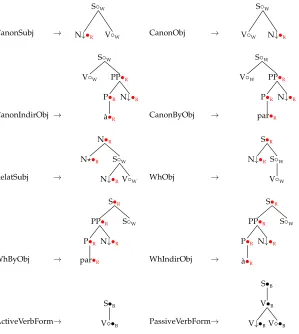
6.1.1 The Syntactic Dimension.The methodology used to implement the verbal fragment of SEMTAGcan be summarized as follows. First, tree fragments are defined that rep-resent either a possible realization of a verb argument or a possible realization of the verb. The verbal elementary TAG trees of SEMTAGare then defined by appropriately combining these tree fragments.
CanonSubj →
S◦W
N↓•R V◦W CanonObj →
S◦W
V◦W N↓•R
CanonIndirObj →
S◦W
V◦W PP•R
P•R
`a•R N↓•R
CanonByObj →
S◦W
V◦W PP•R
P•R
par•R N↓•R
RelatSubj →
N•R
N•R S◦W
N↓•RV◦W WhObj →
S•R
N↓•R S◦W
V◦W
WhByObj →
S•R
PP•R
P•R
par•R N↓•R
S◦W
WhIndirObj →
S•R
PP•R
P•R
`a•R N↓•R
S◦W
ActiveVerbForm→
S•B
V•B PassiveVerbForm→
S•B
V•B
[image:23.486.61.360.57.391.2]V↓•BV•B Figure 8
Elementary tree fragments used as building blocks of the grammar (nodes are colored to control their identification when blocks are combined).
functions. Fourth, diathesis alternatives are gathered into tree families. In the next paragraphs, we explain each of these levels in more detail.
Tree fragments.Tree fragments are the basic building blocks used to define SEMTAG. These are the units that are shared and reused in the definition of many elementary trees. For instance, the fragment for a canonical subject will be used by all FB-LTAG elementary trees involving a canonical subject.
As mentioned earlier, to specify the verbal elementary trees of SEMTAG, we begin by defining tree fragments which describe the possible syntactic realizations of the verb arguments and of the verb itself. Figure 8 provides some illustrative examples of these fragments. Here and in the following, we omit the feature structures decorating the trees to facilitate reading.21
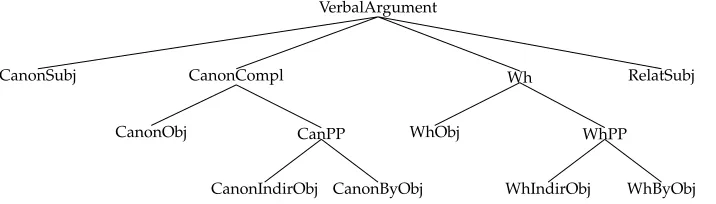
To further factorize information and facilitate grammar maintenance, the basic tree fragments are organized in an inheritance hierarchy.22 Figure 9 shows a partial view of
21 See Crabb´e (2005) for a complete description of SEMTAGtree fragments, including feature structures. 22 Recall from Section 4 that inheritance is used to share namespaces. Thus, (node or feature) variables
VerbalArgument
CanonSubj CanonCompl
CanonObj CanPP
CanonIndirObj CanonByObj
Wh
WhObj WhPP
[image:24.486.50.408.68.170.2]WhIndirObj WhByObj RelatSubj
Figure 9
Organization of elementary fragments in an inheritance hierarchy.
this hierarchy illustrating how the tree fragments for argument realization depicted in Figure 8 are organized to maximize the sharing of common information. The hierarchy classifies the verbal arguments depicted in Figure 8 into four categories:
1. The canonical subject is a noun realized in front of the verb.
2. Canonical complements occur after the verb. The canonical object is a noun phrase whereas prepositional complements are introduced by specific prepositions, namely,`afor the canonical indirect object and
parfor the canonical by object.
3. Wh-arguments (or questioned arguments) occur in front of a sentence headed by a verb. A Wh-object is an extracted noun whereas questioned prepositional objects are extracted prepositional phrases that are
introduced by a specific preposition.
4. Finally, the relativized subject is a relative pronoun realized in front of the sentence. Extracted subjects in French cannot be realized at an unbounded distance from the predicate.
Syntactic functions.The second level of abstraction uses syntactic function names such as Subject and Object to group together alternative ways in which a given syntactic function can be realized. For instance, if we make the simplifying assumption that the possible argument realizations are limited to those given in Figure 8, theSubject, Object, ByObject, andIndirectObjectclasses would be defined as follows.23
Subject→CanonSubj∨RelatSubj (31)
Object→CanonObj∨WhObj (32)
ByObject→CanonByObj∨WhByObj (33)
IndirectObject→CanonIndirObj∨WhIndirObj (34)
That is, we define the Subject class as an abstraction for talking about the set of tree fragments that represent the possible realizations of a subject argument—namely, in