Evaluation of Contributing Factors on Strength Development of Lime
Stabilized Artificial Organic Soils using Statistical Design of Experiment
Approach
Felix N. L. ~ i n g ' ?
*la,Khairul Anuar ~ a s s i m ~ . ~ ,
Ahmad Tarmizi Abdul ~ a r i m ' ~ ~ ,
& S. C.
H O ~ ~ ~ 1Faculty of Civil & Env. Eng., Universiti Tun Hussein Onn Malaysia (UTHM), Malaysia
2
Faculty of Civil Eng., Universiti Teknologi Malaysia (UTM), Malaysia
3
Community College of Batu Pahat, Malaysia
"[email protected], [email protected], [email protected], [email protected]
Keywords: Lime stabilization, Organic soil, Design of experiment, Strength development
Abstract. Lime is widely used as chemical stabilizer in soft soil stabilization. However, lime is reported to be less effective when dealing with organic soil. It is believed that the organic matter in the soil will retard the pozzolar~ic reaction which is responsible for strength enhancement. The heterogeneity nature of the organic matter in the soil makes the study complicated and reduced the repeatability of the test results. Hence, artificial organic soil with known organic matter and content are preferred by researchers when repeatability of the test results are required in determining the influential effect of each contribution factor. Various factors such as additive contents, effect of aging (curing periods), curing temperature, density of materials and moisture content are reported by previous researchers as the potential contributing factors towards the strength development. It is believed that the interaction of the factors also will contribute to the strength enhancement. Hence, this study is carried out to evaluate the contributing factors and its interactions on strength development of artificial organic soils with ltnown type and contents of organic matter. Statistical design of experiment (DOE) approach was utilized to evaluate the factors and its interaction on the strength development of lime stabilized artificial organic soils by using commercial statistics package. Three main factors were investigated: effect of organic content, effect of curing periods, and effect of additive, while other factors namely curing temperature, molding water content, types of compaction and compactive effort were keep constant through controlled experiments. Processed kaolin (inorganic material) is mixed with humic acid (organic matter) to simulate the organic soil which comprised of inorganic soil and organic matter. The density of the soil specimen and its moisture content were recorded before and after the curing process. General Linear Model (GLM) was utilized to determine the significance of the main factors, two-factor interactions, and three factor interactions. The significance factors and interactions were utilized in multiple regression analysis to develop the strength prediction model which can be utilized to predict the strength of stabilized materials within the inference space defined by the experiment.
Introduction
Calcium based stabilizer
-
lime was reported to be firstly used as stabilizing agent in 1924 when hydrated lime was used to strengthen a short stretches of highway [I]. Reaction of lime with soil can be broadly divided into four main stages, which are hydration, flocculation, cementation and carbonation. It is believed that the cementation process, which is resulting of pozzolanic reaction is the main contributor for the strength enhancement of lime stabilized soil. An aqueous environment of pH 12.4 at 25"c is required to allow for pozzolanic reaction and thus the minimum amount of lime required to achieve that pH value is determined as initial consumption of lime. Besides it, it is alsoAdvanced Materials Research Vol. 905 363
necessary to determine the optimum content of lime required in lime stabilized soil because too much of lime added will causing the strength to decrease unlike cement stabilization in which the strength will almost linearly increase with the cement content. [2]. Apart of the suitable environment, it is also reported that the pozzolanic reaction is an aging process in which a duration of curing periods are required for strength development. It is recommended that curing periods of 7, 28, 56 and 112 days are appropriate for lime stabilized materials. However, a single fixed period of curing also commonly used depending on the process of stabilization, in which a curing periods of 28 days is common for lime-stabilized materials [2]. Despite of it, some of the researcher proposed that the time of curing could be recommended as early as one day. Based on their findings, dry volumetric weight of the lime stabilized expansive soil decreased with the increasing of curing time and simultaneously the materials are found to be harder because of the "bark" formation [3].
Besides the effect of additive content and curing periods, curing temperature is also found to be responsive in soil lime reactions [4,5]. It is reported that progress of lime-soil reactions are faster under higher curing temperature, which suggested that ambient temperature affects the pozzolanic activity [4]. When three different curing temperature of 20°c, 35"c and 50°c are compared, it is notably found that significant gain in the soil strength and modulus were only observed in curing temperature of 50°c. The findings implied that the high temperature is favour for the soil-lime reactions. [5]. Despite the factors that may encourage the soil-lime reactions, some contents of the soil are found to have detrimental effects on the reactions. Organic matter [6, 71 and sulphate [8, 91 contents are commonly found to have deleterious effect on soil-lime reactions.
Various factors had been considered by researchers with the aim to study its effects on soil-lime reactions. However, there are very few literature on the interaction of various factors that may influence the strength enhancement of soil stabilized by lime. Hence, this study is aimed to assess quantitatively the contribution of varius factors as well as its interaction on the soil stabilized with lime.
Materials & Experimental Programme
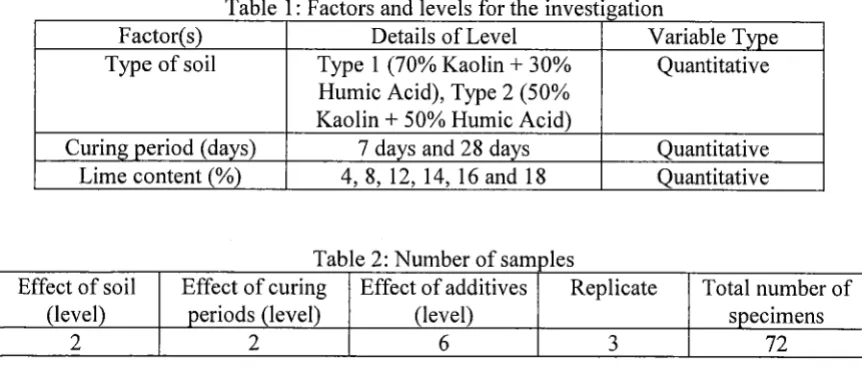
Artificial organic soil with known organic matter and inorganic matter was prepared in laboratory to simulate the organic soil. Commercial kaolin which is marketed by Kaolin (M) Sdn. Bhd. as model S300 was chosen as inorganic matter. Kaolin S300 was reported to be rich in silica content [lo] and dominant silt sized with some traces of sand and clay particles [ l 11. In terms of organic matter, humic acid was chosen as the organic matter. It is reported that humic acid is one of the types of humified matter which is soluble in dilute alkali, but precipitates in acid solution [7]. Two types of artificial organic soil with different ratio of kaolin and humic acid were mixed manually in laboratory. Hence, two levels of investigation was taken to study the effect of type of soil with different organic contents. It is believed that the physical-chemical characteristics of soil were affect its quality and strength of stabilized materials [12].
Six levels of investigation were taken for effect of additive content. Percentage of lime added were range from 4% to 18% for each type of artificial organic soil. Based on the previous studies, the strength increment of lime stabilized materials is parabolic in which the optimum content of lime are varies for different types of soil.
Pozzolanic reaction which is responsible for strength enhancement in cement and/or lime stabilized soil is actually a time-consuming process. A logarithmic relationship between the compressive strength and curing periods was found for silty and clayey cement-treated mixtures [I 31. Two levels of investigation were specified in this study in which the stabilized materials were subjected to curing period of 7 and 28 days.
were not considered in this study because the inclusion of this factors would have required a big number of specimens which would have been impractical. Hence, those effects were made constant throughout the study.
Evaluation on the effects of main effects and all the interaction effects are based on the strength properties of stabilized materials. The specimens were tested for its compressive strength using the unconfined compressive strength testing apparatus with axial increment of 1% per minute. The test specimens are 50 mm in diameter and 100 mm in height which are remolded using axial compression in accordance to BS EN 13286-53: 2004.
Table 1 : Factors and levels for the investigation
Table 2: Number of samples
I
Effect of soilI
Effect of curing1
Effect of additives1
Replicate(
Total number ofI
Factor(s)Type of soil
Curing period (days) Lime content (%)
The main factors and interaction of the factors considered in the investigation are summarized in Table 3. The analysis of variance (ANOVA) is carried out using commercial statistics software Minitab Ver. 16 which is able to analyze three independent variables with the aim to determine the significance and order of significance of all the main factors and interactions. Secondly, regression analysis was conducted to obtain a predictive equation for unconfined compressive strength of lime stabilized soils by including all the significant factors and interactions.
Details of Level Type 1 (70% Kaolin
+
30% Humic Acid), Type 2 (50% Kaolin i- 50% Humic Acid)7 days and 28 days 4, 8, 12, 14, 16 and 18
(level)
Variable Type Quantitative
Quantitative Quantitative
Besides it, the moisture content (%) and density (kg/m3) of the specimen after curing were also recorded with the objective to determine the potential effects of moisture content (%) and density (kg/m3) on the strength enhancement. Analysis of variance for the quantitative factors, density and moisture content were carried out using commercial statistics software Statgraphics Centurion XV.
periods (level)
1
(level)Table 3: Categorical factors and interactions considered in the experimental design
RESULTS & DISCUSSION
specimens
Main factor(s) A , B , C
The results of the analysis of variance (ANOVA) for main factors and its interactions are shown in Appendix A. The P-value of each factor and interaction is found to be less than 0.05 which indicated that the term is statistically significant at the 95.0% confidence level. Hence, it can be deduce that the strength of stabilized materials is governed by the main factors as well as its interactions.
Legend:
A- Lime (%),B- Curing periods (day), C- Contents of Kaolin (%)
Two-factor Interaction(s) A*B, A*C, B*C
[image:3.596.81.512.214.402.2]Advanced Materials Research Vol. 905 365
Main effect plots for the predictive factors, namely lime content (%), curing periods (day) and type of soil (percentage of kaolin) are plotted in Fig. 1. It is clearly shown that the effect of lime (%)
on strength enhancement is almost bell-shaped with the optimum lime content of 12%. Whereas, the increment of strength over the curing periods is found to be linear with two-level of investigation. However, the strength enhancement is found to be decreasing with the increment of kaolin (%).
The interaction plots for two-factor and three factor are illustrated in Fig. 2. It explained the case that relatively higher strength are found on soil with higher kaolin (%) at low lime content whereas the strength of lower kaolin (%) soil are found to be higher at higher percentage of lime. Higher content of kaolin in percentage is explained as the soil with lower organic content with its lower percentage of humic acid. The findings agreed well with the other researcher who worked on soil with humic acid content up to 3 % that the increment of humic acid had found to have deleterious effect on strength of soil [l4].
The normal probability plot of residuals as shown in Fig. 3 almost form a straight line indicated that the residuals are normally distributed. Furthermore, the residuals versus fits as shown in Figure 4 showed a random pattern of residuals on both sides of 0 which explained that predictor variables are unrelated to the residuals and thus can be concluded that the model assumptions are satisfied.
Besides it, the analysis of variance (ANOVA) for moisture content (%) and density (kg/m3) as shown in Appendix B suggested that these two predictive factors are statistically insignificant at the 95.0% confidence level because of the P-value of each factor is higher than 0.05. However, based on the first ANOVA table when summarizing a general linear statistical model relating Strength to 2 predictive factors, the P value is less than 0.05 suggested that there is a statistically significant relationship between Strength and the predictor variables at the 95.0% confidence level.
Multiple regression analysis was also carried out to determine the equation for predicting strength with the significant factors and interaction factors. The results of the multiple regression analysis is shown in Appendix C. The equation of the fitted model of Strength with the seven (7) independent variables is:-
Strength = -281.142
+
19.9584A-
23.4858B+
6.84134C+
6.58472AEl-
0.121038AC+
0.38355BC-
0.0796907ABC (1)Since the P-value in the ANOVA table is less than 0.05, hence it can be deduce that there is a statistically significant relationship between the strength with the seven (7) factors at the 95.0% confidence level.
CONCLUSIONS
Main Effects Plot for Strength (kPa)
Atted Means
m e ( % ) I Curtng Penodr (day1
IWO A
Fig. 1 Main effects plot of unconfined compressive strength (kPa)
Interaction Plot for Strength (kPa)
Fltted Means
[image:5.595.64.530.38.451.2]Fig. 2 Interaction plot for unconfined compressive strength ( H a )
Fig. 3 Normal probability plot of residuals for Fig. 4 Residuals versus fits for unconfined unconfined compressive strength (@a) compressive strength ( H a )
Advanced Materials Research Vol. 905 367
Appendix A:-
General Linear Model: Strength (kPa) versus Lime(%), Curing Periods, and Kaolin (%)
Factor Type Levels Values
Lime ( % ) fixed 6 4, 8, 12, 14, 16, 18
Curing Periods (day) fixed 2 7, 28
Kaolin ( % ) fixed 2 50, 70
Analysis of Variance for Strength (kPa), using Adjusted SS for Tests
Source DF Seq SS
Lime ( % ) 5 5317133
Curing Periods (day) 1 3556400
Kaolin ( % ) 1 154614
Lime ( % ) *Curing Periods (day) 5 886329 Lime ( % ) *Kaolin ( % ) 5 647803 Curing Periods (day) *Kaolin ( % ) 1 260389 Lime ( % ) *Curing Periods (day) * 5 341675
Kaolin ( % )
Error 48 263287
Total 71 11427630
Adj SS 5317133 3556400 154614 886329 647803 260389 341675
Appendix B :
-
General Linear Models Number of dependent variables: I
Number of categorical factors: 0 Number of quantitative factors: 2
A=Density (kglm3) B=MC (%)
Ad] MS 1063427 3556400 154614 177266 129561 260389 68335
I
~ o t a l (Corr.)1
1.14276E7 1711
I
SourceModel Residual
Density*MC 1395144. 11 1395144. 13.70 10.0587 Residual 17.26719~6 168 1106870.
Sunz ofSquares 4.16044E6 7.26719E6
Type I11 Sums of Squares
I
~ o t a l (corrected)1
1.14276E7 1711
SourceDensity
R-Squared = 36.4069 percent
R-Squared (adjusted for d.f.) = 33.6013 percent Standard Error of Est. = 326.91
Mean absolute error = 248.812
Durbin-Watson statistic = 0.60453 1 (P=0.0000)
Df 3 68
Sum of Squares
I
~f lA4ean SquareI
F - ~ a t i oI
P-value 196505. 11 (196505. 11.84 10.1796Appendix C:-
Multiple Regression
-
StrengthMean Square 1.38681E6 106870.
Dependent variable: Strength ( H a ) Independent variables:
Lime (Oh)
Curing Periods (days) Kaolin (%)
R-squared = 72.12 1 percent
R-squared (adjusted for d.f) = 69.0718 percent
Standard Error of Est. = 223.1 14 Mean absolute error = 162.306
Durbin-Watson statistic = 0.726968 (P=0.0000) Lag 1 residual autocorrelation = 0.61 541 5
Analysis of Variance
References
[1] F. G. Bell: J of Engineering Geology, Vol. 42 (1996), pp. 223-227 Source
Model Residual Total (Corr.)
[2] BS1924-2. Stabilized materials for civil engineering purposes. Part 2: Methods of test for cement-stabilized and lime-stabilized materials, BSI Institution, Oct 1990.
[3] T. L6pez-Lara, J. B. Hernhndez Zaragoza, G. R. Serrano Gutierrez & V. Castaao M.: Electronic Journal of Geotechnical Engineering (EJGE) (2005), Paper 2005 -0597.
Sum ofSquares 8.24172E6 3.18591E6 1.14276E7
[4] S.M. Rao, & P. Shivananda: Geotechnical and Geological Engineering, Vol. 23, No. 1 (2005), pp. 79-85.
[5] S. Z. George, D. A. Ponniah and J. A. Little: Construction & Building Materials, Vol. 6, No. 4. (1 992), pp. 247-252.
Df 7 64 71
[6] G. Kuno, I<. Kutatra, H. Miki: Proceedings of XIIth Int. Conf. on Soil Mechanics and Foundation Engineering (1 989), Rio de Janeiro, Brazil, pp. 13 8 1
-
13 84.[7] H. Chen & Q. Wang: Bull Eng Geol Env, Vol. 65 (2006), pp. 445-448. Mean Square
1.17739E6 49779.8
[8] J. I<. Mitchell: Journal of the Geotechnical Engineering Division, Vol. 1 12 (1 986), pp. 259 - 289.
[9]D. Hunter : Journal of Geotechnical Engineering, Vol. 114 (1988), pp. 150 - 167.
F-Ratio 23.65
[ l o ] F. N. L. Ling, K. A. Kassim, & A. T. Abd. Karim: Applied Mechanics and Materials, Vol. 372 (2013), pp 88-96.
P-Value 0.0000
[1 1] F. N. L. Ling, K. A. Kassim, & A. T. Abdul Karim: Advanced Materials Research, Vol. 341-342 (2012), pp. 108-112.
[12] H. J. Pendola, T. W. Kennedy & W. R. Hudson: Research Report No: 98-3 (1969), Center for Highway Research, The University of Texas at Austin.
[13] L. J. Circeo, D. T. Davidson, and H. T. Davis: Bulletin 353, Highway Research Board (1962).